The left blogosphere, and Jewish Democrats, are promoting the idea that Sarah Palin supported Pat Buchanan for President in 2000. Their sole evidence is that Lexis reveals that when Buchanan came to visit her small town in late 1999, she was seen wearing a Buchanan button. When I first read this, it sounded to me more likely that it meant "civic booster mayor of nothing town will wear the campaign button of anyone who is willing to waste their time coming to said nothing town, while that person is speaking in town." And indeed, Lexis also reveals--as I'm sure was readily apparent to the blogger who started the Buchanan meme--that Palin was on Steve Forbes's Alaska leadership committee, and was announced as such only about three weeks after the button incident was reported. [timeline and Palin's position corrected.] How about some basic decency, people?
UPDATE: I guess wearing a Buchanan button, once, when he visited Palin's town is supposed to tell us a lot about Palin's character, and perhaps her feelings about Israel and Jews, but Obama's 20-year intimate history with Rev. Jeremiah Wright is supposed to tell us nothing about Obama. [See Florida Rep. Robert Wexler: "John McCain's decision to select a vice presidential running mate that [sic] endorsed [sic] Pat Buchanan for president in 2000 is a direct affront to all Jewish Americans.]
FURTHER UPDATE: It gets better. Wexler, in February: "It is unfair to attribute Pastor Wright's views to Barack Obama." And Ben Smith reports that Palin wrote a letter to the editor when the button story appeared, making it clear that she wasn't endorsing Buchanan, but just welcoming him to town, like any other candidate.
ONE MORE UPDATE: Pat Buchanan apparently (and self-servingly) claims that Palin and her husband strongly supported him in 1996, and that he met them at a fundraiser. Putting aside the unlikelihood that Buchanan would have such a vivid memory of meeting the mayor of Wasilla, Alaska, federal campaign records, accessible online, show that Palin never cut a check to Buchanan (or for that matter, any other politician before 2004), at least not one big enough to be reportable. And it's hard to believe Buchanan would specifically remember a supporter in Alaska who gav e him fifty bucks. Color me skeptical. UPDATE WITHIN AN UPDATE: Ben Smith reports: "I also spoke to Bay Buchanan, Pat's sister, this morning. She also said her only knowledge of Palin's contact with Buchanan was at the event in the '90s, which she described as a fundraiser for Alaska Republican Jerry Ward."
Two of three registered voters, 67%, say putting Palin on the ticket won't affect their vote; 72% say that of Biden. Of those who say the running mates will make a difference, 18% say Palin makes them more likely to vote for McCain, 11% less likely. That net-positive impact of 7 points is similar to Biden's: 14% said his pick made them more likely to vote for Obama, 7% less likely.
Unlike Barack Obama's selection of Joe Biden, John McCain's choice of Sarah Palin seems to have been largely driven by campaign calculations. From an electoral point of view, she brings three assets to the ticket: she's a woman, a staunch conservative, and relatively charismatic. Her gender will give McCain some favorable headlines and perhaps a chance to pick off some pro-Hillary Clinton Democrats and moderates. I'm skeptical that many women or feminists will switch to the GOP ticket merely because the Republicans have a female veep candidate and the Democrats didn't nominate Hillary. But if a few do, it could perhaps make a difference in a close election. Palin's conservatism will help shore up the support of the GOP base, which isn't exactly thrilled with McCain. Finally, her charisma will help in TV appearances and in debates. Since she's articulate and a onetime beauty contest winner, she will certainly cut a better media image than Biden. Though no one else on either ticket this year can match Obama's star power.
As I've argued in the past, the most important attribute of a veep candidate is her potential as a possible future president. How does Palin stack up on this score? In my view, she has one big positive that has to be weighed against a major potential negative.
The big positive is her apparent support for limiting government power. As co-blogger Todd Zywicki notes, she has gone against Alaska's ubiquitous political culture of porkbarrel spending and advocated major cuts in government spending. Sadly, this is an exceptional accomplishment in today's "big government conservative" GOP. Her record in this regard certainly isn't perfect, but it is impressive relative to that of most other prominent politicians in either party. Moreover, the fact that her stands on these issues went against the preferences of powerful interest groups in her state suggest that they are at least to some extent genuine and not solely the product of political calculation. Radley Balko - who is generally very critical of the Republicans - writes that Palin "seems to be about as good a pick from a major party as libertarians could hope for." I tend to agree.
The negative is her lack of experience with foreign policy issues, which are arguably the central focus of the modern presidency. No amount of Republican spin can dissipate this weakness. However, it may be partly mitigated by the fact that she will likely have some time to learn these issues on the job before she has to assume the presidency (if she ever does). Moreover, history suggests that there is at best a weak correlation between prior foreign policy experience and performance in office. Lincoln and Reagan, among others, did an excellent job of managing foreign policy despite having little or no prior experience with such issues. Dick Cheney probably had more foreign policy experience than any other recent vice president; yet his performance in office was far from stellar. Overall, I think that ideology and general political competence are stronger determinants of political leaders' performance in office than issue-specific experience.
Sarah Palin probably would not be my choice if I had the luxury of picking a vice presidential nominee without reference to campaign calculations. Nonetheless, I am guardedly optimistic about her. She seems to be a skillful politician and her positions on size of government issues strike me as a good deal better than what we have gotten from either party in recent years. The idea of a President Palin is more appealing to me than President McCain, President Obama, or President Biden. That, of course, may not be saying much given my grave reservations about all three of the others. Still, I look forward to having her as a VP or as a leading contender for the presidency in 2012 or 2016.
Tony Mauro has a short item on Gov. Sarah Palin and the Supreme Court's Exxon decision. Interestingly enough, Palin and her husband qualified as members of the class in the litigation, but did not file. Nonetheless, Palin was supportive of the plaintiffs' claims, and critical of the Supreme Court's decision.
After the Supreme Court ruled, Gov. Palin was critical of the outcome. “I am extremely disappointed with today’s decision by the U.S. Supreme Court,” she was quoted as saying. “While the decision brings some degree of closure to Alaskans suffering from 19 years of litigation and delay, the Court gutted the jury’s decision on punitive damages.” She also said, “It is tragic that so many Alaska fishermen and their families have had their lives put on hold waiting for this decision. My heart goes out to those affected, especially the families of the thousands of Alaskans who passed away while waiting for justice.”
I’ve been trying for the last day to figure out how I feel about McCain’s pick for Vice President. My first instinct was to think that this is a breathtakingly bad choice. It’s bad politics because it highlights the reckless side of McCain’s admirable boldness. And, far more importantly, it’s bad for the country because Palin is unusually unready to be President, yet was chosen primarily as a political stunt to drive wedges and manufacture excitement. All of this puts a dent in McCain’s commitment to “Country First.”
The more I’ve learned about Palin, however, the more I admire and respect her. Her personal story is unquestionably compelling. Her religious beliefs and views on some social issues are not mine, but she’s in the best tradition of Republican reformism against wasteful spending and entrenched bureaucracy. She brings an outsider’s willingness and ability to think anew about what government is doing well and what’s gone wrong. And she brings the newcomer’s enthusiasm and idealism to that effort. I would have voted for her as governor.
However, as McCain himself described his criteria for a veep choice last February, the first question for those of us inclined to vote for him is now this: Is Palin “fully prepared to take over” as president?
Many of the defenses of Palin’s readiness have been partisan hackery. This morning, for example, Newt Gingrich offered up her ex officio role as head of the Alaska National Guard as “military experience.” But several defenses or near-defenses have come from people whose views I take very seriously, including some of my co-bloggers. These have caused me to think harder about why it is I’m uncomfortable with this choice.
Especially impressive is the blog post by Bill Stuntz (noted earlier today by Jim) taking apart the arguments about “experience” now filling the airwaves and commentaries. Stuntz’s taxonomy of the types of experience – time in D.C., time in some “executive” office, and actual accomplishments while in office – is astute. Palin has no experience on the first dimension and little on the second. On the third, she’s more impressive but still thin, given only 18 months as governor.
But we have to ask, compared to whom? Obama himself has had little time in D.C., no time in executive office (running a campaign is not the same thing), and, despite his obvious intelligence and thoughtfulness, an undistinguished record of actual legislative accomplishment either as a state legislator or U.S. Senator. As a feminist friend of mine pointed out, the knock against Palin is that she’s one 72-year-old’s heartbeat away from the presidency, but the Democratic nominee is the living heartbeat of a potentially vacuous president.
Let me suggest a fourth dimension of “experience” that ought also be weighed: sheer exposure and vetting at a national and international level. By this I mean experience over time in answering hard questions about a wide range of issues, meeting with other national and international leaders, and responding on the record to crises and other developments as they arise. This kind of experience gives the country a chance to see how you think, to see how you handle high-octane pressure on the relevant national and international stages, to observe how you adapt when things don’t go as you thought they would, and so on. It also forces you to learn about, and to develop views about, important and complex national and international questions. Voters deserve to know these things about you. On this fourth dimension of experience, I’d rank McCain and Biden about even. I’d put Obama distinctly third. Palin doesn’t even register.
All of this may be academic in short time. The current defenses of McCain’s choice may look downright silly after Palin gives a few uninformed and embarrassing answers to basic questions of policy. The simmering scandal in Alaska over the firing of her ex-brother-in-law (or some other heretofore unexamined matter) may boil over in the heat of a national spotlight, revealing a personal pettiness and vindictiveness behind the earnest persona. For all the optimism we’re now hearing in conservative circles, McCain may be put in the position of having to win despite his veep pick, just as the first President Bush had to do.
None of this is decisive on how a person should vote. Having the relevant experience at the top of the ticket is still more important than having it at the bottom. Even on the experience question, there’s some ground to believe that Palin is smart enough and dedicated enough to ramp up fairly quickly. She’d at least have some time and experience in all four dimensions before she might have to take over as president.
Further, lots of things besides experience matter in a presidential election. We’ve had some “experienced” presidents who were terrible and a few inexperienced ones who were quite good. Substantive policy views matter tremendously. I'd rather have an inexperienced president haphazardly advancing good policies than an experienced one effectively pursuing destructive ones. Intelligence, broad knowledge, willingness to consider opposing views and evidence, and temperament matter, too. On some of these criteria, Palin seems like a good choice, on others not so much, and on still others, we don’t yet know.
But for at least some of us who have welcomed the thought of President McCain, the prospect of President Palin is, at least for now, unsettling.
Senator Hillary Clinton made the following statement about John McCain's selection of Sarah Palin as his running mate:
“We should all be proud of Governor Sarah Palin's historic nomination, and I congratulate her and Senator McCain. While their policies would take America in the wrong direction, Governor Palin will add an important new voice to the debate.
The Washington Post also has a roundup of comments on the pick from Newt Gingrich, Grover Norquist, John Podesta, and others. And Fred Barnes has a good profile in today's WSJhere.
UPDATE: Ed Morrissey responds to criticisms of the Palin pick here.
Her Wikipedia page was very thorough (assuming it hasn't been vandalized since I read it).
And here's an amusing article on Frank Murkowski's state jet, which Palin had the state of Alaska sell on eBay. Murkowski bought it with state money after the Department of Homeland Security turned down his request for money.
I love that Palin has been willing to take on all those pork-barrelling corrupt Alaska Republicans like Murkowski, Don Young, and Ted Stevens. According to Barnes she line-item vetoed 13% of Alaska's capital budget in her first year in office.
Bill Stuntz has a fascinating analysis of experience and accomplishments. After discussing experience as time spent in state or federal jobs, he writes:
But there is a third definition, and it may be the one the voters care most about: the relevant question is not how much time the candidate has spent in the relevant government jobs, but what the candidate has accomplished during that time. Most politicians, like most people in any line of work, leave no particular mark on the offices they hold. Their chief accomplishment is winning elections. But a few--the real standouts--rise to the top wherever they serve. Mark Warner didn't just warm the Virginia Governor's chair; he blew the job away. When he took office, the state's fiscal condition was awful; there was a massive structural mismatch between its revenue stream and the services voters demanded. (Sort of like the federal government today: an issue none of the candidates seems to want to discuss.) Warner fixed that problem, improved Northern Virginia's awful road system, upgraded the state university system--and did it all while keeping taxes reasonably low. On the Republican side, Bobby Jindal has a Warner-like record: he seems to transform every job he holds, making Louisiana's health care system, its university system, and now the state's government as a whole accomplish much more without spending much more to do it.
How do the current candidates stack up on that definition?
McCain has plainly left his mark on the Senate--whether it's a good or bad mark depends on how one evaluates McCain-Feingold, the Senate compromise on judicial confirmations, the bipartisan immigration bill that failed to pass the House in 2006, and McCain's frequent attacks on Congressional pork. And that's just a short list of domestic issues from the last few years. Reasonable people can disagree about these topics, but it seems clear that McCain hasn't just been a timeserver. The Senate of the last decade (at least) would have been a very different place without him.
Is the same true of Joe Biden, who has been a Senator for fourteen years longer than McCain? Not obviously so, but perhaps that reflects my ignorance. Still, nothing I've read since Obama picked him and nothing in my memory of the past thirty years makes me think that either the Senate in particular or American government in general would look different without Biden's contributions. Quieter maybe, and a little less entertaining. But not appreciably different.
What about Obama? This, it seems to me, is the question that bothers a lot of voters who, like me, find Obama extremely impressive but worry that he might not be ready for the job he seeks. The problem isn't time: four years in the Senate are more than enough for an exceptional talent like Obama's to shine. Nor is the problem that he was a state senator only four years ago. State legislatures are hugely important institutions; eight years of service in one seems to me an underrated plus for a presidential candidate. The problem is, I'm not sure what Obama did during those eight years. It isn't obvious to me that he left a mark on Illinois government--and he should have, if he aspires to the nation's presidency. The same point applies to his current job: I have yet to hear any current Senator explain how Obama changed some important piece of legislation in fundamental ways, or stood up to the Democratic caucus on some major issue about which he and his party disagreed, or worked to bring about some compromise that would have been impossible without his efforts. With McCain, the question is whether you like the things he's done. With Obama--Biden too, I think--the question is whether he's done much.
Which brings me back to Palin. Clearly, her résumé is thin, maybe disqualifying. Perhaps the jobs she has held are too small to count in a national presidential campaign. But that isn't obvious, not yet anyway. What matters more, to me and I bet to more than a few others, is what she's done in those jobs. The fact that her approval rating among Alaskans is in Mark Warner territory suggests that she might be the kind of governor Warner was in Virginia. If so, that should count for a lot--even if she hasn't had much time in office. Because time-serving won't count for much in the offices these four candidates are seeking.
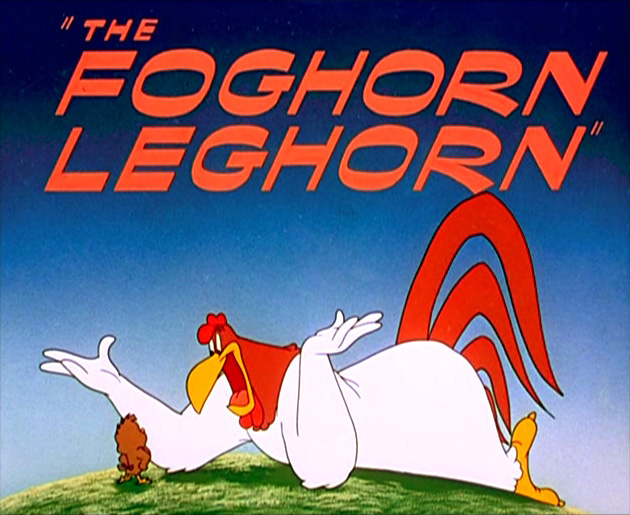
Whichever candidate is elected President, it will be the first time since Kennedy that someone went straight from the Senate to the White House – and Kennedy came from a very politically experienced family. Senators – like most academics, reporters, and we bloggers – tend to be know-it-alls and second-guessers. When I hear Senators speak, I can’t help thinking of Forghorn Leghorn (based on a comedic Senatorial character, Senator Claghorn). Senators (and bloggers) usually act as if they could do everything better, but the institutions that Senators have the most influence over (eg, the federal government, Fannie Mae) tend to be relatively poorly run.
Joseph Biden Questioning SC Nominee Samuel Alito (drawn from memory) "Pay Attention, Son."
Successful governors and business CEOs learn to say No. They deal with limited resources. If you haven’t dealt with bureaucracies and made tough choices about priorities, — and succeeded at it — you tend to want to add too many new programs.
A President should have held at a minimum a major elective governmental position (such as VP, Governor, or Senator). Assuming that, I believe that the best actual experience for being President is, in descending order:
(1) Vice President,
(2) White House Chief of Staff (plus a major elective position),
(3) Governor,
(4) Business CEO (plus a major elective position),
(5) Mayor of one of the few very largest cities,
(6) major Cabinet Official (plus a major elective position),
(7) Senator.
I am disappointed that neither Senator McCain nor Senator Obama have substantial administrative experience in situations of scarcity. For each man, his most significant administrative experience so far has been his own campaign for President. I was surprised that Barack Obama did not pick a VP with administrative experience (such as Bayh), and I was even more surprised that many commentators (including here at VC) thought that Biden had the sort of experience that Obama lacked. Biden has knowledge of foreign policy, not substantial foreign experience. If Obama wins, I hope he picks David Axelrod as his chief of staff; that guy knows what he’s doing.
I was also hoping and assuming that McCain would pick a governor for VP, though I thought it would be Pawlenty. I follow politics more closely than most, but there are only four sitting governors who before today I had heard interviewed for more than a 30-second sound bite: the governors of California, New Jersey, Illinois (my home state), and Alaska.
I had heard Palin interviewed for several minutes (as well as hearing some sound bites) and before today thought of her as the governor with the best reputation in the nation for fighting pork, the governor with the best reputation in the nation for taking on the corrupt heavyweights in her own party, and one of the nation’s most popular governors. I guess I hadn’t realized until today that she had been in office only two years. Now that Warner has stepped down in Virginia, I thought of Palin somewhat vaguely as perhaps the nation’s best sitting governor. Today I learned more about her that I like and more about her that I don’t like (e.g., her view on abortion and her ridiculous and embarrassing approach to creationism).
I remember when George H.W. Bush picked Dan Quayle. It was obvious from the start that he was a lightweight. If only I knew Dan Quayle personally (rather than knowing friends of his), then I could paraphrase Quayle’s debate opponent, “I knew Dan Quayle; Dan Quayle was a friend of mine; Governor Palin, you’re no Dan Quayle.”
I can assure you that the tepid response to Quayle’s announcement in 1988 was nothing like the excited response to Palin today, and Quayle’s first informal remarks were at best underwhelming. Palin’s remarks were far more impressive, as are her accomplishments. It was said at the time that Quayle’s greatest political accomplishment was getting a friend confirmed for the Seventh Circuit Court of Appeals despite strong opposition. For most of the people making the Quayle comparisons, either they are too young to remember him, or they are engaging in wishful thinking.
As with any new candidate for President or VP, we don’t actually know whether he or she would be a good President. There’s always a risk of disaster. If I thought it likely that John McCain would drop dead in his first year in office, then I think the lack of foreign policy experience for Sarah Palin might be a very serious risk. But looking at probabilities, even if John McCain were to die in office, it is probable that it would be later in his first (or second) term. By that time, it is likely that Palin would be better prepared by experience to act as President than were these men on their first day as President: Jimmy Carter, Ronald Reagan, Bill Clinton, or George W. Bush — or for that matter, Barack Obama would be. That’s why the actual pragmatic standards for being VP are different than the standards for being President.
If Obama or McCain were to die in office, by the time either Joe Biden or Sarah Palin replaced them, they would probably have spent several years getting good experience as VP. With Palin, we know not only that she has administrative experience, but that she has been successful in that experience. McCain brings foreign policy knowledge, as does Biden, and Obama brings brilliance, but we really have very little idea how well these three men can manage a government.
Unlike the Palin risk (becoming President with no substantial foreign policy experience and less than a year’s experience as VP), which is unlikely to occur, the Obama risk is likely to be realized: becoming President without having any substantial administrative experience as a governor or business CEO. I think everyone – Republicans and Democrats alike – hope that Obama’s brilliance and decency can make up for his experiential deficits.
I raise Bill Stuntz’s interesting, and somewhat related, views on experience here.
Back in January, Governor Palin had an op-ed in the NYT arguing against the proposed listing of polar bears under the Endangered Species Act. It began:
About the closest most Americans will ever get to a polar bear are those cute, cuddly animated images that smiled at us while dancing around, pitching soft drinks on TV and movie screens this holiday season.
This is unfortunate, because polar bears are magnificent animals, not cartoon characters. They are worthy of our utmost efforts to protect them and their Arctic habitat. But adding polar bears to the nation’s list of endangered species, as some are now proposing, should not be part of those efforts.
The balance of the article makes the standard arguments against listing the polar bear, including that many bear populations are stable or increasing and that an ESA listing won't do much of anything to protect the bear's habitat or forestall the threat of global warming. While the listing won't do much to help the bear, or reduce greenhouse gas emissions, it could well hamper oil and gas development in Alaska, which I am certain is one reason Palin wrote the piece, as well as a reason Alaska has filed suit to reverse the FWS' decision. This is the position I would expect just about any Alaska Governor to take. But while this view may make for sound policy -- again, the listing won't do much to help the bear -- it's not good law. I think there was ample legal basis for the FWS listing decision, and I expect Alaska and the other listing opponents to lose their case in court.
My New Atlantis article on the FWS decision to list the polar as a "threatened species" under the Endangered Species Act is now available online. Here's my conclusion:
the polar bear’s ESA listing will do little to preserve bear populations in the wild. It could complicate other conservation efforts. It will have no effect on the projected loss of sea ice over the next few decades. And it will have no effect on global warming. Getting a handle on anthropogenic climate change will require broad international efforts; jury-rigging a decades-old species-conservation statute just won’t cut it. The polar bear may be an “animal to save the world,” but the Endangered Species Act will do little to save the bear.
The L.A .Times on Prof. Groseclose's Allegations of Possible Malfeasance in UCLA Admissions:
Seemingly nothing so far (as of 7:47 pm Pacific), though Yahoo! News reports the story has been covered not just by the Orange County Register (the newspaper that broke the story), but by the AP and — apparently mostly based on the AP story — by the sites of the San Francisco Chronicle, the San Jose Mercury News, the Fresno Bee, the Las Vegas Sun, and the local CBS and NBC affiliates.
Maybe I'm spoiled by the 24-hour news cycle, but I would think that the Times would at least run the AP story on its site, while it's waiting to either print the story or produce its own — even recognizing that there's a certain other story out in the news today.
UPDATE: The L.A. Times now has a story, which apparently appeared this (Saturday) morning.
UCLA's Short Response to Prof. Groseclose's Allegations:
Here it is; as I read it, it doesn't really respond to Prof. Groseclose's concerns (which he discusses in more detail here):
UCLA's admissions policies and practices were developed to scrupulously adhere to state law and University of California regulations. The campus remains committed to the highest ethical standards and to openness and transparency in establishing and maintaining admissions policies in compliance with applicable laws and regulations.
The admissions process has many safeguards to ensure fairness to all applicants and compliance with state law. For example, approximately 55,000 applications are distributed randomly to more than 160 trained readers, and there is no way for a reader to know who else is reviewing the same applications. Two trained readers score each application, and if one score is inconsistent with another, the application is reviewed by a senior reader.
Nevertheless, UCLA several weeks ago initiated a comprehensive study to analyze the effect of the holistic review admissions process and ensure its continued consistency with state law. Funding has already been approved and a researcher selected to conduct the study. To ensure fairness, the review is being conducted by an independent researcher for the Academic Senate's admissions policy–setting body. The concerns expressed by Professor Timothy Groseclose will be addressed in the study.
UCLA stringently follows state and federal law and university policy protecting the privacy of student applicants and governing the release of personally identifiable information. UCLA's admissions team has offered to work with Professor Groseclose to provide data meaningful for use in his own analysis — within the constraints of privacy laws but going well beyond what would be required by the California Public Records Act. It is disappointing that Professor Groseclose has decided not to work with staff to arrive at a solution.
Background on the holistic review admissions process
Beginning with the fall 2007 freshman class, the UCLA faculty adopted the "holistic" process — which has been in use at UC Berkeley for many years and also is used at Ivy League schools and at most highly selective institutions — in which applicants are assessed in terms of the full range of their academic and personal achievements, viewed in the context of the opportunities and challenges each has faced.
The UCLA Academic Senate made the change because the faculty believed a more individualized and qualitative assessment of each applicant's entire application would be fair and would better achieve the UC Regents' goal of comprehensive review.
Today a divided U.S. Court of Appeals for the D.C. Circuit held in Creekstone Farms Premium Beef v. USDA that the USDA may prohibit Creekstone Farms from testing its cows for bovine spongiform encephalopathy (BSE), aka "mad cow disease" with the so-called "rapid" BSE test. At issue was whether the Virus-Serum-Toxin Act (VSTA) authorized the USDA to prohibit Creekstone's use of the test. Judges Henderson and Rogers said "yes." Chief Judge Sentelle, dissenting, said "no." I am inclined to think Sentelle is correct.
The majority accepted the USDA's argument that VSTA, which covers "any . . . virus, serum, toxin, or analogous product" used for "treatment" of animals can be stretched to cover BSE test kits. It further argued that USDA's authority to "prevent the preparation, sale, barter, exchange, or shipment" of such items includes the authority to ban the use of the tests as well. I find neither persuasive. While there may be a good argument that the USDA should have such authority, that's not what VSTA does.
In his dissent, Sentelle stressed these points, but also highlighted the problem of allowing an agency to stretch the scope of its own regulatory authority. As Sentelle explained, "congressional provision of an expressed authority mandate to accomplish statutory goals does not create for the agency ‘a roving commission’ to achieve those or ‘any other laudable goal,' . . . by means beyond the authority granted in the statute." Agencies are constrained to the jurisdiction conferred upon them by Congress, and courts should not lightly defer to agency claims that they can construe the scope of their own power (as Nathan Sales and I argue here).
It is worth noting Creekstone did not maintain that such testing was necessary to ensure the safety of its beef. It was undisputed that the test they sought to use was very unlikely to detect the presence of BSE given the age of the cows at slaughter. Rather, Creekstone sought to test its beef so that it could export its meat to Japan and Korea, which have limited U.S. beef imports due to BSE fears. Again from the Sentelle dissent:
It seems that the Department’s fear is that Creekstone’s use of the test kits would enable it to provide buyers with a false assurance that the cattle from which its beef is obtained are free of Bovine Spongiform Encephalopathy. However, as I read the record, all Creekstone hopes to do is assure foreign buyers that the beef is as well-tested as would be the case with beef produced in the home countries of those buyers.
To this I would add that I believe the USDA has adequate authority to prevent Creekstone and other producers from making false claims about the relative safety of their products vis-a-vis their competitors. So even if the USDA was justified in worrying that Creekstone would make false claims that their meat was somehow "safer" than others, there are other ways to address this concern.
My earlier posting on Sarah Palin generated some interesting (and pointed) comments, some of which I tried to respond to directly, but I thought that perhaps it called for a more thoughtful response. I think the choice was both bad and (probably) stupid.
Why It's (probably) Stupid. It's probably stupid because it will gain McCain little and may lose him a great deal. Nobody can possibly know, at this point, how she will perform on the stage she is about to enter onto -- debates with 100 million viewers, a daily crush of reporters, speech after speech after speech, where one bad gaffe puts you in the dustbin of history forever. It's unspeakable pressure, she's never faced anything like it, and I'd happily put money on the following: she will make at least one serious gaffe over the next two months. Plus, I don't care how carefully vetted she's been by the McCain campaign -- I think it's close to even money that 10,000 reporters and bloggers who will now descend upon Alaska (at least virtually) will find something less than savory.
Why It's Bad. It's a bad choice because John McCain is 71 years old, and his vice president will have a non-trivial chance of becoming president, and absolutely nothing suggests that Sarah Palin would be credible as President of the United States. I do NOT think this is just a matter of adding up the number of years spent doing this or doing that. Sarah Palin has been in public life, basically, for two years. to my knowledge, she has never articulated (because she was never called upon to articulate) any views whatsoever on:
military strategy in the Persian Gulf
the proper response to Iranian nuclear weapons
the Russian invasion of Georgia
the United Nations
US immigration policy
the Federal Reserve Bank
the effectiveness of international aid programs
Israeli-Palestinian relations
AIDS policy
federal support for basic research
European Union integration
the US Constitution
the optimal means of protecting US borders from terrorists
Guantanamo, and the proper scope of interrogation techniques
Deficit financing and Keynesian economics
the Supreme Court
Should I go on? I could, of course. But hopefully you get the idea. How anyone could say that knowing what they know now they'd be comfortable with her as President is entirely beyond me.
I am having a hard time figuring out when "experience" is important on a presidential ticket. Until yesterday, we were told that "judgment" was more important than any meaningful foreign policy experience for a Presidential candidate. Now that John McCain has selected Alaska's maverick governor Sarah Palin as his running mate, we're told that foreign policy experience is essential for the bottom of the ticket. So while we were told Barack Obama's lack of foreign policy or executive experience was irrelevant, now we hear Sarah Palin's lack of foreign policy experience should be a deal-breaker.
Sure, Sarah Palin was a "hockey mom" before her entry into politics, but Barack Obama has never held a single full-time job for more than three years (and does not have many substantive achievements in any of them). When Palin entered politics, she successfully challenged the corrupt old guard of the Alaska Republican party. When Obama entered politics, he played by the rules of the Chicago machine. So, if experience is what matters (and we ignore the fact that John McCain is the one at the top of the ticket), is it really clear that we'd rather have Obama across the table from Putin than Palin?
Now I've never found the "he has no foreign policy experience" argument against Obama all that compelling. George H.W. Bush had more relevant foreign policy experience than any recent president, and I was hardly a fan. George W. Bush and Bill Clinton partisans, respectively, should also have some difficulty arguing that foreign policy experience is all that important, as neither had any to speak of. Nor, for that matter, did Margaret Thatcher.
If we look at the evidence, I don't think we'd find much evidence that "experienced" Presidents or other Heads of State perform that much better on the international stage. Indeed, in some respects, they perform worse. After all, it was the voices of experience that encouraged the coddling of Saudi Arabia in both the Clinton and Bush Administrations. So in the end, I prefer candidates whose principles and perspectives I believe in over old Washington hands. And while I'm still somewhat undecided, the Palin pick makes me more likely to pull the lever for John McCain.
UPDATE: Quite a few folks have asked whether I'm really undecided in the Presidential race. Yes I am. I have never been a big McCain fan, and I continue to have concerns about his temperament, his view of the First Amendment, judges ("Gang of 14"), his approach to regulation, and other issues (even water). I feel no obligation to vote for him because of the "R" after his name. I will only do so if I believe he will be good for the country, and at this point he has yet to close the deal.
You would not believe how the Sarah Palin pick is playing out at the Hillary Clinton Forum (tip to a VC commenter). In order, these are all the posts on the first (and only) page I've looked at (page 8 of the Palin thread; this link may not point to exactly the same posts). I cut out headers and footers only.
+++++++++++++++
________________________________________
Wow, Thanks so much to this Sarah Palin who never forgot us. She is a fighter. She paid her respects to our Hillary and Geraldine . They now no more think women in this country are 2nd class. You go girl and thank you for a refreshing pick Sen. McCain.
+++++++++++++++
________________________________________
i wish i could see the look on obamas face when he heard this vp pick
Or Michelles. "Why'd he go and do that!"
+++++++++++++++
________________________________________
I am going over to John McCain's website and thank her for acknowledging the glass ceiling and our struggles. She needs to know that there are LOTS of us behind her fight.
+++++++++++++++
________________________________________
Maybe those 18 million cracks will help her shatter the ceiling!
+++++++++++++++
________________________________________
You can bet that BO did not see this coming.
I'm listening to his acolyte now on MSNBC, Andrea Mitchell. The tone of her voice and this almost choking quality of her words tells me that she sees this as a real problem for her guy, BO. (I'm gleeful.)
+++++++++++++++
________________________________________
gave John McCain a standing ovation and a 10 minute claps. It did not matter that there was no one around except my dog to share that.
Hats off! Bigtime!!
+++++++++++++++
________________________________________
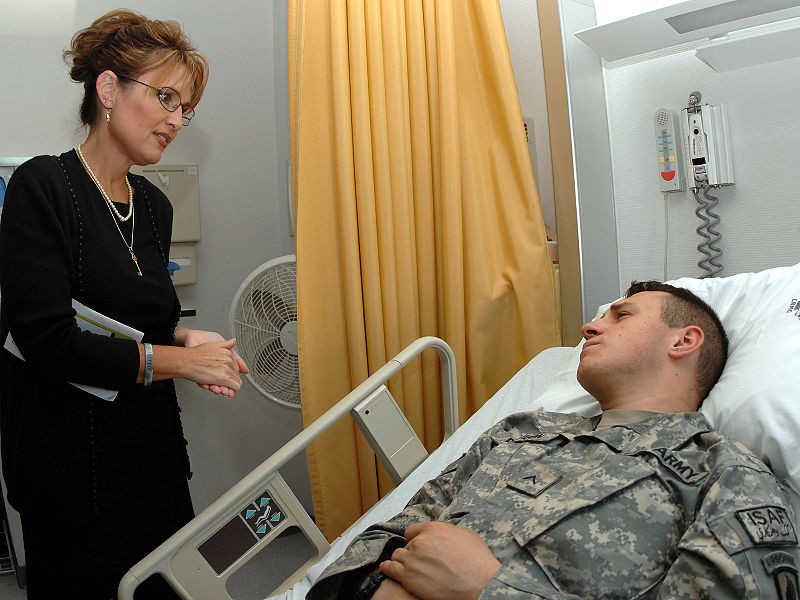
Sarah visiting a wounded soldier in Germany.
Remember just a short while ago Obama would not visit the wounded soldiers in Germany but he would take take to play the rock idol there.
+++++++++++++++
________________________________________
Geraldine Ferraro is a very astute woman!
+++++++++++++++
________________________________________
obama made the biggest mistake of his career not choosing Hillary. The Democrats got behind obama so much they didn't even realize what they were doing trying to push Hillary out of the picture. I'm sure Hillary is not happy obama did not make her but she is probably laughing now and preparing for 2012 campaign with the slogan "I told you so"
+++++++++++++++
________________________________________
I am thrilled her speech was genuine, and promising!!!!! Let's go Forum, we have a mission.
+++++++++++++++
________________________________________
Obama did not see that coming!
I'm sure a lot of people didn't see it coming. Great job by the McCain campaign to keep things very hush hush!
McCAIN / PALIN '08
+++++++++++++++
________________________________________
Wow. I've been listening to 98.7 Kluv, and they keep cranking out songs about women. They're really celebrating, too! The last one I heard was, "Treat her like a Lady!" TOOOOOOOOOO cool.
These are the only Clinton Forum comments I've read so far — no cherry-picking. Incredible!
UPDATE: In the comments below, someone is so stunned by this outpouring that he thinks the Clinton Forum is a Republican site. It's a real site for die-hard Clinton supporters. I've now read posts going back to March (the forum started in February).
If the McCain Campaign had such brilliant and energetic grassroots supporters that they could plant 300,000 pro-Hillary comments on one website starting in February, selling Hillary merchandize, and raising money for Hillary -- all the while knowing that Hillary would lose nonetheless, I would be very impressed (and more than a bit frightened). Can the McCain campaign even get 300,000 comments on their OWN campaign website, let alone a fake one?
No, it's a real site, and many recent posters are longtime members of it.
That some of you doubted it just proves my point: this outpouring is amazing.
The homepage of the town of Wasilla, Alaska (population 5469 as of the last census), has links to three news stories. The lead story, as you might expect, is that the town's former mayor, Sarah Palin, has been named John McCain's running mate. The second story announces the town's new website. The third advertises the "Baby and Me Lap Sit-Program at the Library."
Before serving as Wasila's mayor, Sarah Palin earned a B.A. at the University of Idaho, worked as a sports reporter for an Anchorage television station, and did commercial fishing with her husband.
At age 72, John McCain has already lived longer than his father, John McCain Jr., who died at age 70.
Sarah Palin looks like an interesting woman, but let's hope she doesn't have to stare down Vladimir Putin any time soon.
I've always admired John McCain (though I have to say, in the interests of full disclosure, that I'm not voting for him this Fall); he was, by far, my favorite among the Republicans seeking the nomination, and I was delighted that he prevailed. I have to say, though, that his choice of Sarah Palin as his running mate is appalling and insulting to the American people. Perhaps it will turn out to be a political masterstroke, "energizing the base" and garnering lots of disaffected Clinton supporters; perhaps not. But to my mind, as a voter, the sole criterion for evaluating a candidate's VP choice is whether or not the candidate has picked someone who can plausibly be viewed as presidential timber and, no disrespect intended to Ms. Palin, who was apparently a decent mayor of Wasilla AK (pop. 9,000) and who has been serving as governor of Alaska for all of two years, McCain has failed miserably on that score. His recent complaints that Obama is too inexperienced to be President are not only fatally undercut by this choice, they look downright idiotic now -- coming from someone who would put Gov. Palin a heartbeat away from the presidency. It is the grossest form of pandering -- what happened to "putting your country first"? This choice puts McCain's candidacy first and the fate of the country a very distant second, and he should be, and Ihope he is, punished by the electorate for having made it.
Once the sappy warm-ups were over, Sarah Palin hit her stride. She is good when talking about what she did in Alaska. I can see why she has an 80% approval rating. The frequent interruptions for cheering, however, are annoying.
She's not as polished as Joe Biden, but she's much more straightforward in her speech patterns and (to me) she comes off as more genuine.
So as public speakers, I'd rate Obama way ahead of the other three, McCain at the bottom, and Biden and Palin in the middle (with very different styles). In debates, I don't know how they would rank, but I would be surprised if Palin is as good as the other three.
A Random Thought:
I'm cautiously optimistic about the Palin pick. I don't know much about her, but from what I have learned in the last 24 hours I see a lot of strengths in her candidacy over the other possible picks. On an only marginally-related note, I have to wonder: Are Pres/VP tickets consisting of two white men going to become a thing of the past? Or at least relatively rare? With the precedent of two "non traditional" tickets established, I wonder if the norm will shift.
but she makes Barack Obama look almost over-qualified to be president. City Councilman and mayor of Wasilla, Alaska (pop. 5,000), before serving less than two years as governor of Alaska. You gotta be kidding me!
I've never been a fan of W, but I respected his choice of Cheney for V.P.--Cheney didn't seem to add much of anything politically to the ticket, and his main qualification for the post seemed to be that he would actually be ready to be president if something happened to Bush. My respect for McCain has gone down a few notches.
UPDATE: She has "executive experience," but Obama doesn't? Obama has run one of the most successful presidential campaign upsets in modern history. And less than two years as governor of Alaska (the second-least populous state in the country) when oil prices have been booming is not exactly trial-by-fire.
Obama's also spent the last several years receiving advice on national and international issues from some of the most talented people in the United States.
No one who's not a Republican partisan is going to take the argument that she's more qualified has more relevant background experience than Obama seriously. Fortunately for the Republicans, Obama is not in a position to raise the experience issue--after all, unlike Palin, who will likely spent the next four years learning the ropes, he'll definitely become president immediately if he wins.
FURTHER UPDATE: Obama campaign spokesman Bill Burton for some reason thought it was a good idea to attack Palin for having "zero foreign policy experience." I guess because, you know, during Obama's less-than-one-term in the Senate he's virtually been a shadow Secretary of State.
UPDATE: CNBC, which had a reporter and film crew with Palin in Alaska last week, reports that Palin calls her husband "the First Dude." Also, CNBC calls him a "sloper," which in Alaska apparently refers to someone who works on the North Slope.
The brief clip CNBC is showing of Sarah Palin pulling in a fish in a net makes her look very competent at fishing. Is she a woman with the kind of genuine blue collar appeal that Hillary Clinton had to work hard to acquire? I don't know.
2d UPDATE: Vice Presidents often become Presidents, a transition which may be slightly more likely to occur with John McCain's health problems.
It is now quite likely that — one way or another — the US will have either an African American or a female President at some time in the next 9 years. And we might have one and then the other.
3d UPDATE: Maria Bartiromo, whose Monday interview of Palin will run today in the 3-4pm hour on CNBC, pronounces Palin's name as PAL-in, not PAY-lin, [but Wikipedia says the pronunciation is PAY-lin].
The loss of arctic sea ice is bad for walrus populations, which means the walrus may soon be listed under the Endangered Species Act (ESA).
Though drops in walrus population haven't been documented, scientists and Natives are afraid the ripple effects of climate change could thin walrus numbers.
Walrus need to rest on sea ice no more than 400 feet above the ocean floor so they can dive down to eat shellfish and plants. But sea ice is retreating so far north that the waters are too deep for walrus to feed. This forces them to squeeze onto land, and last summer about 4,000 young walruses were trampled to death by males in the crowded conditions.
"On land, they are really vulnerable to predators and to being trampled by big males; when a human or polar bear shows up, they panic and stampede," said Shaye Wolf, a staff biologist for the Center for Biological Diversity, which is petitioning for an Endangered Species Act listing for the walrus.
The Center for Biological diversity is the same group that successfully petitioned the Fish & Wildlife Service to list the polar bear as a threatened species under the ESA.
The WSJreports corporations have given substantially more money to the Democrats for their just-concluded convention than to the Republicans for theirs.
A list of Democratic convention events compiled by the Washington lobbying firm Quinn Gillespie & Associates LLC is three times as long as one it compiled for the Republican convention.
A separate study by the nonpartisan Campaign Finance Institute shows that 141 companies have donated $160 million to the host committee for the Democratic convention, compared with 80 companies and $100 million for the Republican convention.
Precise figures are impossible to produce because companies aren't required to disclose all of their spending at conventions, and host committees may report spending at a later date. But nonpartisan watchdogs have been monitoring spending by special interests in Denver. "There certainly seems to be more parties at the Democratic convention than [planned for] the Republican convention," said Nancy Watzman with the Sunlight Foundation.
The story also notes that this shift mirrors broader trends in corporate support for the two parties.
he attention that businesses are devoting to Democrats at the convention underscores a broader shift in political spending as the Democratic Party increases its power in Washington.
For the first time in at least a decade, corporations are spending more money to elect Democrats this fall than they are on Republicans. Data compiled by the nonpartisan Center for Responsive Politics show that corporations and their political action committees have contributed $115.9 million to Democratic candidates, the Democratic Party and outside political organizations this election cycle, compared with $111.5 million for Republicans. The data don't include donations from individuals.
That gives Democrats a 51% to 49% advantage over Republicans in corporate money.
One likely explanation is that corporate money follows those that are (or that corporations believe will be) in power. With Democrats in control of Congress, and Senator Obama expected to win in November, corporations are trying to ensure that they have a "place at the table." Another factor is that corporate donations are often influenced by the preferences of their Washington representatives, even if this is not in line with corporate interests. A third factor is that Democratic policies are better for some firms and some industries, particularly those that rely upon or benefit from increased government intervention in the economy. Whatever the ultimate reasons, however, the bottom line is the same: The GOP is not the exclusive party of big business.
Immediately after Obama concluded his acceptance speech, the McCain campaign release a statement calling the speech "misleading" and providing a list of seven allegedly misleading claims made by Obama. McCain's people probably should have spent a bit more time on the response rather than rushing it out the door, because much of this rebuttle doesn't make sense at all (the claims aren't the type that are even subject to being misleading) and much of the rest is pretty unconvincing. Out of seven allegations of "misleading claims," by my count, only one really hits its target. It is a pretty poor performance, indeed, if you can't successfully identify more than one misleading claim in a 50 minute political speech, much of which focused on criticizing the opposing candidate.
"MISLEADING CLAIM #1: Barack Obama Can Bring Democrats and Republicans Together."
It remains to be seen whether he can, of course, but the claim is aspirational, not factual. A claim that he had a record of bringing Democrats and Republicans together would a factual claim, but no such claim was made in the speech. The supposed evidence that the "claim" is misleading are a series of quotes from sources that say Obama takes liberal positions and has a liberal voting record.
"MISLEADING CLAIM #2: Barack Obama Will Ensure That Our Troops On The Ground Have The Equipment They Need In Battle."
It is hard to see how this promise made by Obama during his speech could be true, false, misleading or not misleading, since it is a claim about the future. The supposed evidence is that Obama voted against a particular war funding bill.
"MISLEADING CLAIM #3: Barack Obama Has Not Supported The President."
I'm not sure what to make of this "claim". I think it is a typo, and what is meant is that John McCain has not supported the president, but it is hard to tell because at least one of the pieces of evidence offered to demonstrate that the claim is misleading seems to me to be attempting to suggest that Obama was a frequent supporter of Bush.
"MISLEADING CLAIM #4: John McCain Believes We've Made Great Progress And Families Aren't Hurting."
At least this claim logically could be misleading, but is it? Obama did allege that McCain said he believes the economic has made great progress under Bush. He didn't say that McCain said families were not hurting, although one could infer that from the context of the speech. Interestingly, none of the evidence offered by the McCain campaign on this point even implies that McCain does not in fact believe that economic progress has been made during the Bush years, only that McCain recognizes some people are hurting. If McCain's actual position is that there has been great economic progress but he recognizes some families have suffered, this is only slightly inconsistent with Obama's claim. I don't think Obama was really trying to imply that McCain thinks every single person in the entire country is better off now than 8 years ago, but rather that McCain thinks there has been economic progress generally during the Bush years whereas Obama thinks that there generally has been economic decline.
"MISLEADING CLAIM #5: Barack Obama Will Pay For His Massive Spending."
Fair point here for McCain. The sources that Obama claimed during the speech would pay for his spending priorities certainly would be insufficient to do so.
"MISLEADING CLAIM #6: Under Barack Obama, We Will Achieve Energy Independence."
Obama said he would set a goal of energy independence in 10 years. I can't understand what could be misleading about this. Certainly the McCain response does not challenge the claim that Obama would set such a goal if elected. Sure, this goal might be difficult to achieve, but it was obviously meant to be aspirational. What is misleading about what Obama said?
"MISLEADING CLAIM #7: Barack Obama Will Cut Taxes." Obama claimed that he will cut taxes for 95% of working families. This could potentially be a misleading statement, but the McCain response doesn't argue that Obama's policy proposals would not, in fact, do this. Instead, the evidence cited is that, in the past, Obama voted to raise taxes on middle income workers. Maybe this evidence suggests that Obama could be lying when he promises to cut taxes, or is likely to change his mind, but it doesn't suggest that there is anything misleading about what Obama said during the speech.
Sixth Amendment Violated When Government Pressures Employer Not To Fund Employees' Criminal Defense:
That's what the U.S. Court of Appeals for the Second Circuit just held today in U.S. v. Stein, in a case involving the prosecution of 13 former KPMG partners and employees. "We affirm the district court’s ruling that the government deprived Defendants-Appellees of their right to counsel under the Sixth Amendment by causing KPMG to place conditions on the advancement of legal fees to Defendants-Appellees, and to cap the fees and ultimately end them."
I'm not an expert on this particular area of the law, and the state action caselaw on which the court relied to get to this result is murky. But I tentatively think the court's decision is right. Constitutional rights generally (with some exceptions not applicable here) include the rights to pay for what it takes to exercise the right -- to pay for counsel, advertising space, private schooling, contraceptives, abortion, and the like. They likewise include the rights to pay for what it takes to exercise the right using money donated by friends, family, well-wishers, or others.
Thus, if the government pressures (using the threat of indictment and financial ruin) your customary benefactors to stop paying you the money you need to exercise your rights, precisely to affect your exercise of the right, that would itself presumptively violate the constitution. If the government is investigating (say) a pro-life public advocacy organization's funder for some crime, offers more lenient treatment if the funder cooperates, and tells the funder that one factor in deciding whether he's cooperating is whether he cuts off funding for the advocacy group, I think that would violate the Free Speech Clause. If the government is investigating a Planned Parenthood funder for some crime, offers more lenient treatment if the funder cooperates, and tells the funder that one factor in deciding whether he's cooperating is whether he cuts off funding that goes to paying for abortions for poor women, that would violate the Supreme-Court-recognized right to abortion. Likewise, if the government is investigating a company, offers more lenient treatment if the company cooperates, and tells the company that one factor in deciding whether it's cooperating is whether it cuts off funding for its employees' exercise of their right to hire counsel, that would violate the Sixth Amendment.
It's true that the company might well have been free to voluntarily cut off the payment for its employees' lawyers (apparently such payment was the norm at KPMG and similar companies, but probably wasn't part of any enforceable promise on KPMG's part). Likewise, the funders in the examples above might well have been free to voluntarily cut off funding for others' political advocacy, abortions, and the like. But when the government coercively pressures the funder, the government's actions may violate the funded party's constitutional rights even if purely voluntary actions on the funder's part would be entirely lawful.
I want disagree with David Bernstein's somewhat tepid praise and second Jim Lindgren's more effusive praise of Barack Obama's acceptance speech. Everyone knows Obama can give a good speech, but this was his best. Three highlights: (1) Directly challenging John McCain on national security. Obama forcefully made the case that judgment matters more than experience. (2) Juxtaposing his aggressive agenda of government programs with a call for personal responsibility — critical for appealing to centrists. (3) Identifying common ground on the polarizing issues of abortion, gay marriage, and gun control — critical to his agenda of bringing people together. Moving the event to the football stadium, identified by pundits as a risky move, proved to be a masterstroke. The visual affect was awesome. By comparison, McCain is bound to look small, unimportant, and unpopular when he gives his acceptance speech next week.
There were two weaknesses of the speech, one of commission, one of ommission: (1) Claiming that he could pay for his domestic proposals by closing tax loopholes and eliminating unnecessary government programs (without even naming the targets) was utterly unconvincing. Better to say nothing about the financing than to call attention in this way to the fact that his proposals are expensive. (2) Failing to attack the Bush administration for trampling the Constitution, trashing privacy rights, and mistreating prisoners of war. It might have made sense not to highlight Bush's support of torture, since McCain clearly opposed this and can use that issue to distance himself from the President, but there is lot more in this area Obama could have gone after.
[Cass] Sunstein writes of him:
When he offers visionary approaches, he does so as a visionary minimalist--that is, as someone who attempts to accommodate, rather than to repudiate, the defining beliefs of most Americans. His reluctance to challenge people's deepest commitments might turn out to be what makes ambitious plans possible--notwithstanding the hopes of the far left and the cartoons of the far right.
He goes on to insist, "Above all, Obama's form of pragmatism is heavily empirical; he wants to know what will work."
So it turns out that Obama is a minimalist empiricist who believes in market-based approaches for pursuing progressive ends. In short, Obama is...Cass Sunstein.
Federal Judge Holds Statute Banning Publication of Social Security Numbers Is Unconstitutional,
when the statute is applied to a Web site's reposting of "unredacted public documents such as land and tax-lien records posted on government Web sites" that contain the numbers. The site operator is apparently using such postings to condemn the government's posting of such information: "As part of a campaign to draw attention to the issue, Ostergren routinely posts the Social Security numbers of high-profile individuals that she claims to have easily obtained from county and state government Web sites. The list includes former Florida Gov. Jeb Bush, former U.S. Secretary of State Colin Powell, former U.S. House Majority Leader Tom DeLay, former Missouri Sen. Jean Carnahan and several county clerks in Virginia."
The decision -- Ostergren v. McDonnell, handed down last Friday -- is quite narrow, focusing chiefly on the fact that the social security numbers were drawn from publicly available records, and were presented in the context of quotes from those records, rather than just as some freestanding list. I've argued before (though tentatively) that bans on publishing social security numbers are a rare example of a constitutionally permissible restriction on crime-facilitating speech. I didn't discuss, however, what happens when the laws are applied to republication of publicly available court records that themselves contain such numbers.
The Indictment of U.S. District Court Judge Samuel Kent
is here. You don't see these often for sitting federal judges. I assume that, if Judge Kent doesn't resign, a criminal conviction would be followed promptly by impeachment by the House and then conviction and removal by the Senate. An interesting question is what would happen if Judge Kent is acquitted, but there is sufficient evidence to believe he was likely guilty (the Justice Department obviously believes this to be the case), but not guilty beyond a reasonable doubt to the satisfaction of a criminal jury. But that's all a hypothetical at this point.
UPDATE: Sorry; I should have made this clearer — certainly the Congress has the power to remove someone who has been acquitted, and I don't see anything wrong with it, if the Representatives and the Senators think he's guilty. As commenter David Nieporent pointed out, that of course is what happened to former Judge (now Congressman) Alcee Hastings. What I was wondering was what the Congress would (not may) do if they thought the accusation wasn't proven beyond a reasonable doubt, but was still likely true — not an implausible scenario if the case ends up mostly being a swearing contest between Judge Kent and the woman he is accused of attacking.
There's also the question of what the Congress should do in such a situation; I think it should remove the judge from office — "better that ten guilty men go free than one innocent man go to prison" may be a sensible rule, but I don't think that "better that ten guilty judges remain in office than one innocent judge be erroneously removed" is equally sensible.
A professor who said he suspects UCLA is cheating to illegally admit black students resigned today from its admissions committee, saying the university refused to provide him the data he needs to investigate his suspicions.
Prof. Tim Groseclose's "Report on Suspected Malfeasance in UCLA Admissions and the Accompanying Cover-Up is available online. Groseclose also attaches letters from three other (nonvoting) committee members, including two student members, that support his view that the university has not been sufficiently willing to allow possibly critical examination of the underlying data.
Naturally, if there's a formal response to Prof. Groseclose's allegations, I'd love to link to it, and the Register article notes that "Campus officials deny the accusations and say they're following the law. Privacy concerns prevented the university from giving Groseclose the data he wanted, officials said." (Groseclose spends some time in his report arguing that these privacy arguments are not sound.)
Congratulations on the scoop to Marla Jo Fisher at the Register.
I usually make a point of not watching convention speeches, State of the Union addresses, and the like, because I can't stand politicians' blather. But I couldn't resist the opportunity to watch such a historic event--the acceptance speech of the first African American major party nominee.
So here's my purely stylistic take. I've heard Obama's speeches a few other times, and found him to be an unusually compelling speaker, in large part because he delivers his speeches so naturally, as if he's speaking extemporaneously. I was disappointed at first, this time. I thought he got off to a slow start, and sounded like he was reading from a text prepared by someone else. His initial attacks on McCain also seemed that way. Once he got past that, though, he got better and better, until he reached near perfection when he spoke of MLK. I would have ended the speech there.
Beyond that, I thought he should have looked more often directly at the camera, and less at the audience--better to play to tens of millions than to 84,000. And the missing visual, from my perspective, was Bill and Hillary cheering wildly for their recent opponent.
Consider this an open thread on the speech.
UPDATE: Why no comment on the substance from me? I'm not a political expert, so I have no idea how the speech will "play in Peoria." And I can't otherwise take the substance of a speech like this seriously. Some people watch politicians give speeches like this and see statesmen. I see Joe Isuzu.
The text of Obama's speech is here. I've read it. On balance, it looks excellent.
UPDATE: I think that was the best delivered acceptance speech I've heard since at least Reagan. Reagan perhaps had a little more heart in his delivery; Obama's style is cooler. But then, in prepared remarks Obama comes across as smarter when he talks than Reagan did, though not necessarily deeper.
For both men, their only weaknesses in prepared remarks were that (like almost all politicians) they too often tend to mine platitudes, just different sets of them.
Unlike some European systems of the past two centuries, the American tradition is for individuals to form their own diverse communities and for each community to govern itself to the extent possible. Universal national service seems to reverse the direction of this relationship: its goal is to use the government to transform people to fit within the government’s vision of what’s important and how one should serve. Senator Barack Obama makes that government direction clear, promising us that his administration “will direct that service to our most pressing national challenges,” eschewing the traditional American approach of having the government take its direction from the diverse choices of its people.
As de Tocqueville understood, voluntary associations are valuable not merely on account of what they accomplish, either for participants or for others, but also because they establish cultural and political forces in society independent of government. In modern society, and perhaps especially in America, each individual stands alone as an independent citizen in relation to the state, and individuals are therefore peculiarly dependent on voluntary associations to ensure that the state does not acquire a monopoly of cultural and political influence. Voluntary associations help to protect us from what de Tocqueville called “the tyranny of the majority.”
In Mr. Obama’s vision of voluntary organization, however, the government would develop, coordinate, and focus the efforts of private individuals and their associations, which thus would lose their independence and much of their capacity to offer alternatives to the state and its vision of life. Indeed, far from challenging the state and holding it accountable, morally or politically, many private associations would become aligned with the state. Rather than being alternatives to government, they would become its instruments.
One of John Locke’s most important philosophical moves was to posit a state of limited powers. Not all good things must be within the state or be promoted by the state. For example, the sovereign could be persuaded of the good of the “one true religion” and yet could believe that it would be best for the state to be cautious about promoting that religion.
That crucial Enlightenment insight helped end centuries of European religious wars. Among twentieth-century governments, most communist, fascist, and sharia-based regimes rejected that Enlightenment view and tried to bring within their ambit all things that the state considered good – with predictable results for human flourishing and freedom.
A key element in the rise of modern life, both its freedom and its prosperity, was the substitution of taxation for personal services, a development that allowed individuals to spend their time on what they know and love -- on tasks in which they have a comparative advantage. Being more productive as a result of this freedom, individuals can spare more of the fruits of their labor for the community.
This move from services in kind to financial payment by taxes was and is a matter of personal liberty. Such a transition was essential if individuals were no longer to be serfs in service to their lord or other communal authorities. Except for a military draft (which should be contemplated only in dire emergencies), individuals these days are mostly free to engage in voluntary activities for the benefit of themselves and others.
******
Mandatory community service sucks in much that is private and diverse and spits out an excessively homogenized version of the good, a version that would come with a government seal of approval.
It’s probably not an accident that many American groups who tend to favor greater government largesse are relatively stingy in their own donations to charity. Nor do I think it an accident that Americans are the most generous people in the world, while the few European countries that have universal military or community service have populations that fall far short of America’s in donating their time and money to the less fortunate. For charity work to be truly transformative in a positive way, perhaps it must be truly voluntary. That coerced service can be transformative without endangering freedom is even more improbable.
By bringing voluntary charitable activity under government control and by presenting his scheme as a “civilian national security force,” Mr. Obama is breaking down the barriers between private and public life, between individual choice and government programs, between childhood education and adult employment, and between the diversity of freely chosen efforts on behalf of one’s neighbors and subservience to the government’s vision of the good.
Numerous interesting comments on previous posts expressed every possible theory. The topic is complicated, but here are a few brief responses:
Bigger (in the sense of population size, not land area) is better, because of economies of scale. Imagine that a country builds an expensive asteroid warning system that protects the territory from asteroids. The system has a large fixed cost. The greater the population, the less each person needs to contribute to the protection system. Large countries also can have larger markets, allowing for greater division of labor, and hence greater wealth. In a phrase, enormousness is not an enormity.
However, maybe small countries can obtain these economies of scale by contracting with each other. Countries can, by treaty, share the costs of asteroid warning systems and enter trade treaties that provide for the reduction of tariffs. Still, countries have trouble entering treaties and (especially) ensuring compliance, because no external power can force countries to comply with treaties. Evidence suggests that even when trade barriers are eliminated, trade across borders is more expensive than trade within borders, no doubt because of the difficulty of dealing with two separate legal systems with their often conflicting requirements.
Smaller is better, because of heterogeneity. As countries become bigger, they become more diverse, and diverse people have different preferences for political outcomes – taxes, environmental regulation, social welfare, and so forth. As people’s preferences diverge, political bargains are harder to make; either agreement can’t be reached, or transfers to losers must be arranged, and these transfers are economically costly. One might fear that people lose the ability to monitor leaders as the population increases, and so leaders can pursue self-aggrandizing or redistributive policies with little fear of political sanction. Still, maybe diversity brings benefits – cultural and economic – and it is possible, as Madison thought, that groups have more trouble taking control of the political system in a large polity.
Should we cheer whenever an ethnic minority obtains independence for its small or infinitesimal territory? Maybe if it the majority treated it badly. But note that when a minority breaks off from an otherwise adequately governed state, its gains (in the form of greater control over political outcomes in the territory it occupies) come at the expense of the people left in the rump territory, who lose the economies of scale associated with the larger population. There is no natural stopping point to this process if any group can separate for any reason. In an ideal world, other nation states might be skeptical of attempts to secede for this reason, plus the additional important reason that it is harder to cooperate with two little states than one big state, holding constant the effectiveness of the government.
Readers interested in these questions should consult this book, on which I have (loosely) relied.
I looked to see if I could find evidence to support Joe Biden’s claim today that he had “‘hundred of thousands’ of people at his announcement speech for his first U.S. Senate run” in 1972. Tip to Ben Smith.
In 1972, Joe Biden was elected to the Senate with 116,006 votes (50.5%); his Republican opponent received 112,844 votes.
So far I can find no evidence that when 29-year-old New Castle County Council member Joe Biden announced his candidacy for the US Senate in 1971-72, every voter in the state, both Republican and Democratic, took off from work or childrearing to hear him speak in person.
Maybe some of our Delaware readers are old enough to remember such an amazing day. It must be seared — seared — into their memories.
So says Abner Mikva, in yet another article on Jewish voters and Obama. This article is not any more enlightening on the issue than most others, but does contain some interesting information about liberal Chicago Jews who helped facilitate Obama's rise in politics, including Martha Minow's dad, who heard about Obama from Harvard Law Prof. Minow.
that 1.85 million Americans go bankrupt every year due to medical bills. In other words, the AARP is claiming that every single bankruptcy in the U.S. is due to medical bills. Even Elizabeth Warren doesn't go that far. The AARP has launched a mass media campaign, including television ads, based on this blatantly dishonest premise. One can only hope it will damage its credibility.
Regulation of "Economic" Markets vs. Regulation of the Market for Culture and Ideas:
Economist Bryan Caplan poses some excellent questions to liberal economists who want heavy government regulation of "economic markets" but take a laissez-faire approach when it comes to the market for culture and ideas. Bryan gives his own answers to the questions in this follow-up post.
Bryan's challenge to liberals parallels my own recent article challenging conservatives such as Robert Bork, who defend laissez-faire with respect to economic markets, but advocate extensive cultural censorship in order to protect our "morals." Bryan and I both believe that many of the rationales used to justify government regulation of cultural and idea markets are applicable to the market for goods and services, and vice versa. But we also believe that the government has common, systematic weaknesses in both fields that outweigh those of the private sector. Thus, we advocate a free market approach in both fields (though Bryan is probably more sweeping in his rejection of government regulation than I am).
Nobel Prize-winning economist R.H. Coase addressed some of the same issues in his underrated 1974 article "The Market for Goods and the Market for Ideas" (available here to those with access to J-Stors). He too stressed the parallels between conservative arguments for regulation of the culture and the left's arguments for regulation of the market for goods and services.
Barack Obama and John Roberts:
Maybe this is a quirky reaction, but the more I get to know Barack Obama, the more he reminds me of Chief Justice John Roberts. Their politics are very different, of course — perhaps 180 degrees apart. But there is something about the two men that strikes me as similar.
First, it seems that both Obama and Roberts were identified at a very young age as having truly exceptional talents that would likely take them to the top. Both were naturals; not just bright and charismatic, but really standouts. As young men, both had an easy manner, and both got along well with others with very different views. And while both clearly had a side, both generally avoided taking controversial positions along the way. Both were very ambitious, extremely bright, and remarkably articulate, and they played their cards with a rise to the top very much in mind. They spent years building their resume and biding their time (eschewing high income positions, at least initially) until they would be ready for their chance.
By the time they became nominees — Roberts as Chief Justice, and Obama as President — both men were the subject of tremendous admiration by their political allies. For many conservatives, Roberts was nearly ideal as a Supreme Court nominee; for many liberals, Obama is nearly ideal as a Presidential candidate. Of course, political opponents tend to see both men as wolves in sheep's clothing. For many liberals, Roberts is a hard-core conservative who faked being principled to get confirmed. And for many conservatives, Obama is a hard-core liberal who is just pretending to be some sort of post-partisan moderate to win the White House.
And meanwhile, I think it's hard for outside observers to get a sense of either of them as people. Now I suppose you never actually really know public figures, so I'm just focusing here on public perceptions. But both Obama and Roberts come off as unusually measured and in control in public; public observers of them don't expect to see the kind of personal quirks that would reveal their personalities. Indeed, their most human public moments are when we see them with their adorable young children.
Anyway, I don't want to take this too far. Obama and Roberts are obviously very different people in many ways. (Among other things, Obama was President of the Harvard Law Review and Roberts was Managing Editor — totally different jobs!) But I do see some interesting similarities.
Obama statement from 2004 campaign now in YouTube ad.--
Althouse points to a pro-McCain YouTube ad up on
Hot Air that she calls "devastating."
It ends with a clip from Barack Obama’s 2004 campaign for the Senate:
You know, I am a believer in knowing what you’re doing when you apply for a job. And I think that if I were to seriously consider running on a national ticket, I would essentially have to start now, before having served a day in the Senate. Now there’s some people who might be comfortable doing that, but I am not one of those people.
What makes this clip so much more powerful than the ones of Hillary Clinton or Chris Dodd criticizing Obama during the 2008 primaries is that Clinton and Dodd are in part posturing for political advantage, while Obama in 2004 is simply saying what he believes about himself at the time.
Althouse begs for a similarly powerful pro-Obama ad.
William Henry Harrison, Barack H. Obama, and Social Networking
"O, what has caused this great commotion, -motion, -motion, Our country through? It is the ball that’s rolling on for Tippecanoe and Tyler too." Like the William Henry Harrison campaign of 1840, the Barack Obama campaign has been at the cutting edge of using social networking media. My column for today's Rocky Mountain News, "Twitter and Text Your Way to Victory," looks at innovative use of media in 2008, and in the past. It's mostly based on an interview with Chris Hughes, the 24-year-old wunderkind who is Obama's Director of Online Organizing. I suggest that Obama's brilliant use of social networking was a sine qua non of his victory.
[Bill Clinton] left the stage to U2's "Beautiful Day," which then strangely segued into Robert Palmer's "Addicted to Love" — although the band cut off the refrain but the crowd shouted out the line they dropped: "You might as well face that you're addicted to love."
This calls for the 12" remix:
Let the healing begin.
(HT: Jim Chen)
UPDATE: CSPAN captures the precise moment of addictus interruptus:
Apparently, somebody at the convention noticed the problem and abruptly pulled the plug on the sound, but couldn't stop the audience from continuing the song.
Obama Campaign Denounces Kurtz To a Much Greater Extent Than Ayers.--
As some of you may remember, I previously explained why I didn’t put too much stock in the stories about Barack Obama’s ties to Bill Ayers, a position for which I received some positive comments at Huffington Post and elsewhere. I concluded:
It seems to me that Obama's serving on the board of the Woods Fund for a few years with a former member of the Weather Underground is not fundamentally different from my serving for more than a decade on a law faculty with one [ie, Bernadine Dohrn].
Further, Obama strikes people as an extremely non-violent person; indeed, Republicans might like him better if he seemed to be more willing to embrace violence against America’s enemies. Thus, guilt by association seems a particularly unfair tack to take in criticizing Obama for someone else’s violent acts. To the extent Obama’s contacts with Ayers are relevant at all, then it shouldn’t be as shared responsibility, but merely as a question of judgment and of candor if Obama were to be misleading in his statements.
I'm much more interested in what the Annenberg Challenge funded and how its projects mirror Obama's current proposals than in who he served with.
Yet I was nonetheless puzzled by this story by Ben Smith at Poltico:
Barack Obama's campaign hasn't advertised this a great deal this week, but the campaign's "Action Wire" has been waging large-scale campaigns against critics. That includes tens of thousands of e-mails to television stations running Harold Simmons' Bill Ayers ad, and to their advertisers — including a list of major automobile and telecommunications companies.
And tonight, the campaign launched a more specific campaign: an effort to disrupt the appearance by a writer for National Review, Stanley Kurtz, on a Chicago radio program [hosted by University of Chicago sociologist, Milt Rosenberg, on WGN]. Kurtz has been writing about Obama's relationship with Bill Ayers, and has suggested that papers housed at the University of Illinois at Chicago would reveal new details of that relationship.
The campaign e-mailed Chicago supporters who had signed up for the Obama Action Wire with detailed instructions including the station's telephone number and the show's extension, as well as a research file on Kurtz, which seems to prove that he's a conservative, which isn't in dispute. The file cites a couple of his more controversial pieces, notably his much-maligned claim that same-sex unions have undermined marriage in Scandinavia.
"Tell WGN that by providing Kurtz with airtime, they are legitimizing baseless attacks from a smear-merchant and lowering the standards of political discourse," says the email, which picks up a form of pressure on the press pioneered by conservative talk radio hosts and activists in the 1990s, and since adopted by Media Matters and other liberal groups.
"It is absolutely unacceptable that WGN would give a slimy character assassin like Kurtz time for his divisive, destructive ranting on our public airwaves. At the very least, they should offer sane, honest rebuttal to every one of Kurtz's lies," it continues.
The campaign mentions, and objects to, one specific claim of Kurtz's, for which I've never seen hard evidence:
Just last night on Fox News, Kurtz drastically exaggerated Barack's connection with Ayers by claiming Ayers had recruited Barack to the board of the Annenberg Challenge. That is completely false and has been disproved in numerous press accounts.
There are several odd things about this:
1. Barack Obama and his campaign have denounced Ayers’s actions and at least one of Ayers’s statements, but I think that neither Obama nor his campaign has ever denounced Ayers himself. As with the first Reverend Wright speech, this is no accident. Obama usually takes the “Christian” position: hate the sin, love the sinner.
2. Kurtz, unlike Ayers, is denounced in the most vicious and uncivil terms (there is a lot more than I quoted). If Obama or his campaign had ever denounced Ayers with the fervor that his campaign has now used in denouncing Kurtz, Obama wouldn’t be having trouble on his connection to Ayers. And I’m not suggesting that Obama should have denounced Ayers. I am just noting the grossly disproportionate responses of the Obama campaign to their differing offenses and the Obama campaign’s direct attack on Kurtz’s character, not just what he's done or said – including very explicitly using arguments of guilt by association against Kurtz (which of course are being used against Obama, despite the protestations to the contrary of his critics).
3. I heard Kurtz’s statements on FOX, and — though my memory may well be faulty — I thought that Kurtz was speculating that Ayers had probably recruited Obama, not stating it as a fact.
4. I went to Obama’s official Fight the Smears page to read the transcript of what Kurtz said, and there was nothing there about Ayers. If Kurtz actually said what the Obama campaign said he said (Kurtz was “claiming Ayers had recruited Barack to the board of the Annenberg Challenge”), they should allow us to read the transcript. Since the Obama campaign is so emphatic in their email, perhaps my memory of what Kurtz said is wrong. I find it strange that the Obama’s Fight the Smears website does not lay out the details of their relationship, including how Obama was hired by Annenberg.
5. The email says “That is completely false and has been disproved in numerous press accounts.” As Ben Smith notes about the hiring claim, “I've never seen hard evidence” presumably he means from either side.
The Obama campaign response is so unusual (the wording used against a member of the press and their contacting TV advertisers on stations running the TV ad) that I wonder if they have polled the issue and they discovered that voters give this whole issue a lot more credence than I think it merits.
UPDATE: The Fact Check part of the Obama site, not the Fight the Smears page, has had a page on Ayers since April 17, 2008, with a URL that includes the phrase "fact_check_on_clinton_attacks."
The page is mostly about Ayers. It includes some news articles saying that the relationship is a stretch. The Annenberg tie is neither disclosed, nor mentioned, nor specifically debunked.
2d UPDATE: TPM has a thoughtful — and eminently reasonable — response to my post. I recommend you read it.
Some of Alkali's comments are about why the Obama campaign needed to respond now. I agree that they should respond now, but as I noted, I thought that the nature of the response was unusual: "the wording used against a member of the press and their contacting," not just TV stations, but their advertisers as well.
I noticed that the LA Times mentioned that WGN was Tribune owned, which reminded me that 29 years ago, I represented the Tribune Co. on several matters, and on at least one occasion, WGN. Also, the host of the radio program, Milt Rosenberg, is (as I previously noted), a Univ. of Chicago Sociology professor. That's the department where I am getting my Ph.D., though I've had no interaction with him there. My professional ties to Dohrn were previously disclosed above and in an earlier post. I've met Ayers only once, in the lobby of my building.
Community Service for all Middle and High School Children.--
The most worrisome of Barack Obama’s proposals is his goal of bringing most charities under the federal umbrella in part by inducing all middle and high school children to do 50 hours of community service every year.
By requiring almost all public middle schoolers, starting at the age of 10 or 11, to join his new cadres of community service workers and become part of his “civilian national security force,” Barack Obama shows himself to be out of touch with American traditions of individual volunteerism.
There is nothing wrong with a family allowing a child to volunteer at a young age: in the summer when I was 11, I spent several nights a week working for free at a concession stand in a little league baseball park. My parents were comfortable with this community service because at all times I was under the supervision of my mother’s best friend. Parents then and parents today would like to choose whether their 11-year old child takes on even a part time job, and they would like to choose the job and judge for themselves whether the working conditions are suitable.
With his myriad proposals for new "Corps" and his proposal for universal service for all school children, Obama is trying to bring the charitable activities of 50 to 100 million people –- about half of them children –- under state control. That our government is even capable of running a service program on a scale never before attempted is a matter of faith, not evidence.
Steven Malanga of City Journal has an article that deals more with Barack Obama’s past than his proposals for the future.
Community organizing’s roots stretch back to the 1930s and Chicago organizer Saul Alinsky, founder of the Industrial Areas Foundation and author of Rules for Radicals. But it wasn’t until President Lyndon Johnson’s ambitious plan to end poverty through massive federal spending that the Alinsky model—grassroots organizing, neighborhood by neighborhood—really took off. Starting in the mid-1960s, the federal government directed billions of dollars to neighborhood groups, convinced that they knew better than Washington what their communities needed. The federal funds, eventually supplemented by state and local tax dollars, helped create a universe of government-funded community groups running everything from job-training programs to voter-registration drives—far beyond anything Alinsky could have imagined. Some 3,000 local social-services groups were soon receiving government funding in New York City alone. Many were new, but the money also helped turn traditional charities that had operated on private donations into government contractors.
Those who led these social-services groups became advocates, unsurprisingly, for government-funded solutions to social problems. To defend and expand their turf, organizers began heading into the political arena, wielding the power they had accumulated in neighborhoods to build a base of supporters. In New York, operators of huge social-services groups like Pedro Espada in the Bronx and Albert Vann in Brooklyn won election to state and federal posts after heading up large, powerful nonprofits. By the late 1980s, nearly 20 percent of New York City Council members were products of the government-funded nonprofit sector, and they were among the most strident advocates for higher taxes and more government spending. In other cities, too, from Chicago to Cleveland to Los Angeles, the road to electoral success increasingly ran through the government-funded social-services sector. Spending directed to these groups boomed through both Republican and Democratic administrations. “The non-profit service sector has never been richer, more powerful,”former welfare recipient Theresa Funiciello wrote in her 1993 book Tyranny of Kindness. “Except to the poor, poverty is a mega-business.”
Obama began his organizing life in the mid-1980s in a community group whose progress mirrored that of the rest of the industry: the Developing Communities Project, formed on Chicago’s South Side as a “faith-based grassroots organization organizing and advocating for social change.” Though founded with resources from a coalition of churches, over time the DCP evolved, like many left-leaning religious organizations, into a government contractor essentially subsisting on tax money—with nearly 80 percent of its revenues deriving from public contracts and grants.
As a young college graduate immersed in the world of tax-bankrolled activism, Obama adopted the big-government ethos that prevailed among neighborhood organizers who viewed attempts to reform poverty programs as attacks on the poor. Speaking to an alternative weekly on the eve of his 1995 run for state senate, Obama said . . . that “these are mean, cruel times . . . .” He derided the “old individualistic bootstrap myth” of American achievement that conservatives were touting. Self-help strategies “have become thinly veiled excuses for cutting back on social programs, which are anathema to a conservative agenda,” he wrote in a chapter that he contributed to a 1990 book, After Alinsky: Community Organizing in Illinois. (He also depicted leftist community organizing as a harder task than similar efforts by the Christian Right, telling a reporter in 1995 that “it’s always easier to organize around intolerance, narrow-mindedness and false nostalgia.”)
Master Conspirator Eugene Volokh has suggested that we might do some posts giving advice to entering law students. I don't have much to add to what I said in this 2006 post on the subject.
However, I will give one new piece of advice: don't automatically believe everything you hear about the "right" study methods for learning the law. From the first day of law school, many people will tell you that studying law is radically different from studying anything else and that you need to use all sorts of time-consuming new methods just to keep up. For example, some will tell you need that you need to outline every case you read in great detail or that you have to buy lots of commercially produced study guides.
It may be that some or all of these things really will help you get through law school. But you may want to consider the possibility that you can study law more or less the same way you studied other liberal arts and social science subjects as an undergrad or graduate student. With relatively minor modifications, I got through law school using the same study skills as I had used before. Lots of others have done the same thing. Many people achieve excellent records in law school without tedious new study methods, and without ever so much as glancing in a study guide other than the assigned readings. It can work, and if it does, it'll be a lot less aggravating than the alternatives.
Different people learn in different ways. My approach to studying may not work for you. So I'm not saying that you should necessarily do what I did or that you should reject study guides, detailed outlines, and the rest out of hand. Just approach the task with an open mind, and don't assume that the only way to survive law school is to adopt the time-consuming study methods many people will try to foist on you during your first year.
Improperly Authorized Organ Use as Tortious Interference with a Corpse:
There was an interesting Ninth Circuit opinion yesterday, certifying questions of state law to the Washington Supreme Court, and in the process summarizing the uncertainty in the law. Here's one question: Can any close enough relative (here a sister) sue for improperly authorized organ use as tortious interference with a corpse, or does it have to be the next of kin (here the father), who is in a position to authorize the use in the first place? I'd be inclined to say that only the father can sue, since exactly the same behavior would have been entirely permissible -- notwithstanding any possible distress to the sister -- if the father had said so. But apparently there's a disagreement among state courts on the subject, and the Ninth Circuit is asking the Washington courts what the rule ought to be.
There's also an interesting question about whether the Washington Anatomical Gift Act creates an implied private right of action, supplementing whatever remedy might be available under the common-law rules of tortious interference with a corpse.
Gold Coins and 99 Year Leases:Howard flags a fascinating contract law case handed down by the Sixth Circuit today. The question, in simplified form: If a 99-year lease signed in 1912 specifies that the lease payments are $35,000 per year, payable "in gold coin of the United States," can the lessor almost 100 years later demand that the payment be $35,000 in gold coinage rather than just $35,000?
For 90 years, the lessor only demanded payment of the dollars themselves, essentially ignoring the "gold coin" provision. And from 1933 to the 1970s, the "gold coin" clause was unenforceable under federal law thanks to U.S. monetary policy. But in 2006, a new company bought the property and began demanding the value of gold coins that on their face are worth $35,000. Does the language of the contract entitle the company to the value of the gold coins rather than just $35,000? In a very interesting opinion, Judge Sutton concludes that it does. Seems pretty persuasive to me, although I don't know much about the topic.
UPDATE: My colleague Donald Clarke chimes in via the comment thread:
The entire case here is just about whether the assignment of the lease to the current lessee in 1982 constituted a novation, an issue because of previous federal legislation about contracts containing such clauses. It's not about the value owed at all, an issue that is sent back to the District Court to resolve.
Starting in the 1950s, she was a leader for the rights of lesbians and gay men in a time when the FBI was infiltrating the meetings of gay organizations, sodomy laws were in force in all fifty states, police were raiding gay bars and humiliating, beating, and arresting patrons, and homosexuality was officially considered a "mental disorder" to be treated with electric-shock therapy.
On June 16, she married her partner of 55 years, Phyllis Lyon, in San Francisco.
In this picture, taken at their wedding, Martin is on the left.
This morning, at age 87, she died. Lyon, 83, her spouse, was with her when she died and had this to say:
Ever since I met Del 55 years ago, I could never imagine a day would come when she wouldn’t be by my side. I am so lucky to have known her, loved her, and been her partner in all things. I also never imagined there would be a day that we would actually be able to get married. I am devastated, but I take some solace in knowing we were able to enjoy the ultimate rite of love and commitment before she passed.
Once a week, I ask my first-year law students a language puzzle, often focused on legalese but sometimes on broader English usage matters that can arise in legal work. Yesterday's puzzle involved the distinctions between permissive and permissible, between conclusory and conclusive, and between enormity and enormousness. I noticed that none of the student volunteers could answer the enormity question — and when I discussed it later with some other very smart and well-educated people, I saw that they were unaware of the (possible) distinction. I therefore thought it was worth blogging, for the benefit of our similarly very smart and well-educated readers.
Here's the distinction: While enormousness generally means "very great or abnormal size, bulk, degree, etc.; immensity; hugeness," enormity is often used to mean "outrageous or heinous character; atrociousness" and "something outrageous or heinous, as an offense." Therefore (a) "enormity" makes some listeners think of something bad, and (b) some people believe that the use of "enormity" to mean "enormousness" is an error.
As it happens — and I stressed this to my students — "enormity" has long been used to mean "enormousness." The OED attests this back to 1792, and Random House reports that "Enormity has been in frequent and continuous use in the sense “immensity” since the 18th century." I therefore wouldn't say that the use is thus "incorrect" in any objective sense.
Nonetheless, both the OED and the Random House report that the use is regarded as incorrect by at least a considerable number of people; my law students, I think, ought to know this, so that they don't inadvertently alienate those readers. (If they knowingly alienate them, because they refuse to be bullied by the Language Police, that's a different matter.) Moreover, even readers who aren't so picky but who associate "enormity" with something bad might be distracted by the term: If you say "The enormity of his generosity impressed me," you'll at least be distracting readers, even if they understand what you mean and don't deliberately hold your word choice against you. If you write about "the enormity of the task," you might lead readers to wonder -- even if only briefly -- which meaning you have in mind. So I would caution people to avoid using "enormity" to simply mean "large size," though as I said I don't think I can objectively call this a language error.
UPDATE: I should have mentioned two other things. First, I'd probably caution people away from using "enormity" even in the sense of "atrociousness," unless the context is such that even those who read "enormity" as being "immensity" will get your message. "Enormity of his sins" might be fine; "enormity of the task" probably will be confusing. It may be too bad that many intelligent, well-educated readers don't know the word, but that seems to be the reality.
Second, "enormousness" strikes me as pretty clunky; I'd suggest "vastness" or "immensity" or some such instead. I'm not recommending its use -- I'm just cautioning against using "enormity" as a rough synonym for those three words.
Yesterday's Gallup Tracking Poll showed McCain up by an insignificant 2% (46% to 44%). Today showed a 3-point swing in just one day, to Obama up an insignificant 1% (45% to 44%). Today's release is an average of polls done on Sunday, Monday, and Tuesday.
While it may be just random variation, a 3% jump in a 3-day average in one day suggests that Obama polled about 8-10% better in the Tuesday polling (added today to the 3-day Tracking Poll) than in the Saturday poll (dropped today from the Tracking Poll). That difference should be statistically significant, since both daily polls were done with about 900 respondents.
We will have to wait a few more days to see if this difference is real or a 1-day aberration. After all, they average these polls for a reason.
Lots of Obama biographical pieces in the media this week, including the Washington Post, Newsweek, Time, The New Republic, and National Review. My column in today's Rocky Mountain News examines them all, pointing out the most thorough (WaPo) and the most sanitized (Newsweek). I point out that the coverage neglects the radical socialist and racialist views of Barack Hussein Obama, Sr.
The column also examines the faulty reasoning in Jacob Weisberg's claim in a Newsweek column that older Jews who are hesitant about voting for Obama because of Israel are really closet racists. And the column points to some of the best Colorado-related articles from the Washington political insider publications.
"The Real Significance of the Biden Pick":
Over at Nuts and Boalts, blogger "Earl Warren" has a pretty astute post on what Barack Obama likely hoped to achieve by picking Joe Biden as his running mate.
I was watching ABC, which showed the end of Hillary Clinton's pre-speech film. In one clip of Bill Clinton, he was identified by a small title that simply said, "Hillary's Husband."
UPDATE: Hillary Clinton just finished speaking. Her first 15 minutes or so were relatively poorly delivered, but she seemed energized by a joke about Bush & McCain in the Twin Cities (get it: twins). Her last 5 minutes were well delivered. She finished with a genuinely enthusiastic crowd cheering.
Announcing the Republican VP candidate on Thursday?
It has been suggested that John McCain might announce his VP choice on Thursday.
I see that Rich Lowry has been thinking the same thing that I’ve been thinking, though I’d use stronger language than he did. IMO, (1) it would be a classless act; and (2) unless it’s a strange choice for VP, it would get relatively little play competing with the conclusion of the Democratic Convention.
Advice for 1Ls: What If You Don't Know the Answer?:
Many first-year law students worry about being called on in class. What might happen if the professor asks a question that the student just can't answer? Here are a few thoughts on what to do, depending on the nature of the question.
1) Reciting the case. Sometimes a professor asks a question about the facts or the analysis in the case. They're trying to get students to identify and wrestle with the key parts of the opinion, and they're asking the student to remember what the opinion said. As a student, sometimes you just can't answer: You read the case earlier on, but you don't remember the part your professor has in mind.
What to do? If you really don't know the answer, I think you should just say so. You might say, "I don't recall that from the opinion" or just "I don't remember that." The alternative is to pretend that you know the answer. You could just guess, or you could start scanning the opinion in the unlikely chance you'll see the point in a second or two. But these alternatives usually don't work. If you guess incorrectly you'll probably look a bit silly, and everyone can tell when a student is staring at the page for a long time. Just be straightfoward and acknowledge politely that you don't know the answer.
2) Applying the rule. Sometimes a professor will ask students how a legal rule would apply to a hypothetical case. You know the rule and you understand the facts, but you're just not sure how the facts would apply.
What to do? I think you should explain your uncertainty. To the extent you can, articulate why you're unsure. You might say, "I'm not exactly sure how the rule would apply. On one hand, it seems that the rule would apply like this [fill in details]. But on the other hand, there's a detail that seems to point the other way because [fill in details]." Articulating why a hypothetical is hard is a really essential skill: It's the same skill you'll need to show on an exam to get a high grade.
3) Normative questions. Sometimes a professor will ask a student to take a position about what is the best rule. As a student, you might be unsure of what is the best rule. You'll have instincts about which rule you like, but you're just not confident that your instincts are sound.
What to do? Different people will have different advice here, but I think the best approach is to just pick a position and run with it. When a professor asks a normative question, the goal is to engage in a discussion of the pros and cons of different legal rules. The questioning should bring out those pros and cons, and a student needs to take a position for the process to begin. Sure, it may happen that the questioning reveals a problem with the initial choice: Upon seeing the drawbacks to your position more clearly, you may want to change your mind. But that's a good thing, not a bad one. It means that you're learning how to think through the consequences of different rules. Further, no one should be embarrassed by changing their mind after expressing a normative view. While a student may feel embarrassed to not know the facts, as it suggests lack of proper preparation, there is no shame in learning.
Anyway, those are my two cents. I trust readers will chime in if they disagree.
Recent articles in the Rocky Mountain News: Al Jazeera makes a blatantly false claim against Joe Biden, and gets other facts wrong, too. Plus: Rum, Romanism, and Rebellion--the story from the 19th century shows that some things haven't changed. (Both stories in same link).
Just posted: Democratic prayer celebration with Sister Helen Prejean and the head of the Islamic Society of North America should have spurred media queries.
Coming soon: The Obama biographies recently published in the Washington Post, Newsweek, and Time.
Personal note: I was in the convention hall for Senator Kennedy's speech, almost certainly his last to a Democratic National Convention. Back at the 1956 Democratic Convention, Adlai Stevenson threw open the Vice-Presidential nomination, and let the delegates pick. Young Senator John F. Kennedy tried, but was defeated by Estes Kefauver. For over half a century since then, the Kennedys have been a major part of every Democratic National Convention. All three of the brothers had successes and failures, good ideas and not-so-good ones. The mass of delegates at the Denver Convention waving their white-on-blue "Kennedy" signs were remembering the many positive parts of the Kennedy record. Senator Edward Kennedy's final speech to a Convention was dignified, gracious, beautiful, and exemplified the Kennedy family at its best.
a pair of darling twins, though a bit on the small side (populations 70,000 and 250,000 respectively), and perhaps not with a terribly appealing prognosis. In fact, one might wonder whether they have really been born. Russia has recognized them as independent states; the rest of the world considers them provinces of Georgia. They do have de facto independence. What are we to make of this situation?
For one thing, we can look at their elder sibling, Kosovo. Recognized by western countries but not by Russia or China, it declared independence from Serbia in 2008. Russia has made much of this precedent. “If you can decide that Kosovo is a state over our objections, we can decide that South Ossetia is a state over yours!”
International law has little to say about the creation of states. From time to time, one hears statements that a population can obtain statehood if it controls a territory, can have legal relations with other states, and so forth, but in fact statehood is determined by other states, in a recursive process, and when other states can’t agree, there are serious problems. Suppose, for example, that the United States would like to persuade the people living in South Ossetia to join an anti-moneylaundering effort. Should it ask South Ossetia to join a treaty? But only states can enter treaties! Should it make a treaty with Georgia? But Georgia can’t control the South Ossetians! The United States would like to help Georgia get control over the South Ossetians, but if this doesn’t happen – and it doesn’t seem likely – it will have to eventually bow to reality and recognize South Ossetia as an independent state, or – to the confusion of all – treat it like a state without calling it that.
People should be more worried than they are by the fragmentation of states. Consider that shortly after World War II, there were around 60 states. Today, there are almost 200 (depending on how one counts quasi-states like Kosovo, and weird cases like Taiwan, which everyone has agreed is both a state (because it clearly has independence) and that is not a state (to mollify China), and there are even stranger beasts). A lot of this increase is due to decolonization, but in recent years, the main cause has been, essentially, ethnic separatism. Because ethnic groups are mixed together, ethnic separatism is a recipe for civil war, ethnic cleansing, and worse. And because most ethnic groups are tiny, the resulting nation states can be too small to govern themselves – Kosovo is an example, again. They either become failed states, magnets for terrorists and drug smugglers, or wards of powerful states or what is mischievously called the “international community.”
The more states there are, the harder it will be for them to cooperate -- a worry for those concerned with world-scale problems such as climate change and international terrorism. And because international law rests on the cooperative efforts of states themselves, fragmentation may further weaken international law, to the detriment of all.
Nine-year-old Jericho Scott is a good baseball player — too good, it turns out. The right-hander has a fastball that tops out at about 40 mph. He throws so hard that the Youth Baseball League of New Haven told his coach that the boy could not pitch any more....
"I think it's discouraging when you're telling a 9-year-old you're too good at something," said his mother, Nicole Scott. "The whole objective in life is to find something you're good at and stick with it. I'd rather he spend all his time on the baseball field than idolizing someone standing on the street corner."
League attorney Peter Noble says the only factor in banning Jericho from the mound is his pitches are just too fast.
"He is a very skilled player, a very hard thrower," Noble said. "There are a lot of beginners. This is not a high-powered league. This is a developmental league whose main purpose is to promote the sport."
Noble acknowledged that Jericho had not beaned any batters in the co-ed league of 8- to 10-year-olds, but say parents expressed safety concerns.
"Facing that kind of speed" is [frightening] for beginning players, Noble said....
"You don't have to be learned in the law to know in your heart that it's wrong," [local attorney John Williams] said. "Now you have to be punished because you excel at something?"
Now it's hard to tell for sure how justified the league's action is, especially given the allegations that "Jericho's coach and parents say the boy is being unfairly targeted because he turned down an invitation to join the defending league champion, which is sponsored by an employer of one of the league's administrators" (something that the league denies). There are also follow-up problems stemming from the team's refusal to abide by the league's ruling, and alleged excessive reactions by the child's parents. I also can't speak for sure about just how much better Scott is than other players in the league. And I should also stress that I have no personal experience with competitive athletics (as opposed to some competitive nonathletic games), so that's one more reason for me to be tentative in my thinking here.
But setting this aside, it seems to me that this doesn't quite deserve to be tarred with the Harrison Bergeron brush that some seem to be using (unlike, for instance, this incident from two years ago). Competitive sports, especially but not exclusively among children, generally works best when the players have roughly the same ability. Including players who are much better than others tends to make things less fun for other players, for spectators, and sometimes for the much better players themselves. And it also makes things less educational for other players and for the much better players.
True, there might be some educational benefits, such as learning to deal with adversity or fear, learning how to lose gracefully, and so on. But on balance it seems to me that at some point the ability differential sucks too much fun and educational value out of the experience, at least for many of the other players and maybe for the much better player himself. And the whole point of youth sports is precisely fun and educational value, not simply determining who the most excellent player is.
We see this reflected in many situations — basketball leagues that are only open to players six foot and under, sports teams that have upper limits on player age, boxing events open only to participants under a certain weight, and the like. Here the league's action seems to be more focused on a direct measure of the player's ability rather than on a proxy such as height or age; that could be better, because it focuses on ability, or worse, because it's more subjective, but in principle it seems to be the same idea.
Players who excel far beyond their age group should of course still be playing. They just should be playing against others who are roughly their equals in ability. It sounds like the other players in New Haven Youth Baseball are out of Scott's league (in a more literal way than usual for that phrase) — and they should indeed be in different leagues. (If the next higher league doesn't allow Scott because he's too young, even if he's good enough, then that should be the target of criticism, it seems to me, and not the actions of the Youth Baseball league.)
These studies seem to come out at convenient times. When its a republican who exhibits slips of the tongue, we get "Bushisms" as evidence of lack of intelligence. When a Democrat comes along with the same problem, its "Oh, well, it doesn't mean anything, everyone does it."
When it looked like the Democrats were a lock on the Presidency, all of the sudden academics were proposing a "cease fire" in the judicial confirmation wars.
These all remind me of the "homeless rediscovery" watch from Opinion Journal.
Now I'm happy to agree that academics do tend to, on average, lean left; and academics, like other people, on balance have their share of partisanship. But before you accuse a particular academic of partisanship, wouldn't it be good to actually look a little at his track record, rather than simply inferring his behavior from his profession?
As it happens, the Language Log post asserted that "With respect to speech-production blunders all across the political [spectrum], our perspective has been consistent," and included links to some earlier posts on the subject. But even if the commenter hadn't noticed that, it would have been trivial to just Google "language log" bushism or "mark liberman" bushism. Either approach would have made clear that Liberman has indeed criticized Bushisms often (and in my view quite persuasively), and thus indeed seems to be quite evenhanded on this subject. The commenter's accusations were unfounded, as many inferences from a group's behavior to an individual member's behavior tend to be.
Those words, written on a poster above the image of a topless man tenderly kissing Jesus on the neck, angered dozens of students Thursday night at Lorain County Community College....
The sign went up about 4 p.m. in College Center student commons as part of Club Awareness Week, along with many other displays advertising student-run extracurricular organizations....
Questioning religion is fine, but mocking it isn’t, [one student] said.
[Senior Amanda] Lucero said the LCCC student handbook agrees, and pointed out a part of the school code that says, “Harassing any person(s) verbally, in writing, by graphic illustration, or physically, including any abuse, defamatory comments, signs or signals intended to mock or ridicule race, religion, age, sex, color, disability, sexual orientation, or national or ethnic origin” is not allowed....
Sophomore Dejoune Grantham said the poster is libelous and blasphemous, and in her opinion it isn’t protected by the First Amendment.
“I don’t want my children walking through here and seeing that. It’s filthy,” she said.
Another sophomore, Amber Cales, said the poster was in a public place, and it was easily seen by anyone who passed. She said that took away her right as a parent to shield her children from controversial ideas....
A student named Zach Jefferson, who Weaver said is not a member of the atheist group, decided about 7:30 p.m. to take down the poster, but he wouldn’t say why.
Laura Nash, president of the Student Senate, said she wasn’t surprised at the outrage so many students voiced.
She said anyone offended should write a complaint and submit it to the Campus Life Division or campus security....
To the school's credit, Marcia Ballinger, LCCC’s vice president is apparently defending the right to post such material: "In higher education, we certainly respect all viewpoints. There is debate, and there are different perspectives.... Controversy on a college campus from students is something that is inherent to free speech." Moreover, "Campus security guards said offended undergrads voiced complaints for about three straight hours, but the sign remained up because it didn’t present a security issue...." Nonetheless, to the school's discredit, the policy does appear to ban "signs ... intended to mock or ridicule race, religion, age, sex, color, disability, sexual orientation, or national or ethnic origin" — pretty clearly an unconstitutional restriction on speech at a public college or university. (See also this closely related policy.)
The poster was put up by the local Activists for Atheism club, who apparently don't take the view that you catch more flies with honey than with vinegar. The club officers' claim is that the poster "wasn’t intended to mock religion" but "was meant to stir debate about Christianity by referencing a passage of the Bible that was allegedly cut out by early Christians [--] ... the Secret Gospel of Mark, which was found inscribed in a letter by Greek historian Clement of Alexandria," and which some have read as suggesting a homosexual relationship between Jesus and a man whom he had raised from the dead.
Atheist club president Aaron Weaver also "put up a picture of the prophet Mohammed," and reports that he then "received a death threat in response to the picture, which read, 'With love and missiles.'" (No more details are given, so it's hard to tell whether the picture was just a picture of Mohammed or something pejorative, and it's hard to tell how threatening the letter was.) "He took the picture down, turned over the note to campus security officers and went home."
The Journalhas a story on the consideration U.S. News is giving to counting entering part-time students along with full-time students. For what it's worth, I think the problem is with law schools that have started bogus part-time day programs to admit students who don't otherwise have the proper credentials. Long established part-time evening programs, like George Mason's, tend to have students with a bit weaker academic credentials than their full-time counterparts, but with vastly more real-world experience. I've had, for example, evening students in their 40s and 50s who have successfully built multi-million dollar businesses. Does it make sense to judge them based on their undergraduate GPA from twenty years earlier?
I was also struck but this line: "Mr. Morse of U.S. News says the magazine will run tests of how the change would play out in rankings, and then decide in January." If the change is methodologically valid (or not), it shouldn't matter "how the change would play out in rankings." It's bizarre to first decide what you think the rankings should look like, and then create (or retain) criteria to meet that preconceived notion.
What I'd like to see is a separate ranking of part-time programs, especially given that most part-timers are working professionals who are choosing among part-time programs, and do not even consider full-time admissions. Not only would this provide very useful information to such students, but schools that, say, are revealed to have nine part-time day students out of a class of 200, with an LSAT 10 points below their full-time median, will be called out for abusing the system.
If I'm Not Listed in the AALS Directory, Do I Still Exist?
I just learned -- much to my dismay -- that I was not listed in the 2007-08 AALS Directory of Law Teachers. I was forwarded our school's data from a forthcoming faculty productivity study and noticed that my work had not been included in the tabulations. When I asked why, I learned it was because I was not listed as a member of the Case Western faculty by the AALS. Well, just in case there is any confusion out there, I was still on the Case Western faculty in 2007-08, and I am still on the Case Western faculty today.
Biden's Law Review Article on Constitutional War Powers:
Peter Spiro has an interesting post on a law review article Biden co-authored in 1988 on constitutional war powers. Here's the cite: Joseph R. Biden Jr. & John B. Ritch III, The War Power at Constitutional Impasse, 77 Geo. L.J. 367, 397-98 (1988).
The Washington Postreports that the Bush Administration is proposing to enact less protective whale buffer zones around ports designed than had initially been proposed. The protections will be the first for whales along the Atlantic Coast, but they will be less stringent than environmentalist groups had sought (but more stringent than shippers would like).
n July 2006, NOAA announced plans to create 30-nautical-mile buffer zones off of several East Coast ports, in which ships would be required to slow to 10 nautical miles per hour during certain times of the year.
But cargo companies said that this would cause their ships to lose time and burn more fuel, and the proposal was held up for months by the administration.
Yesterday, in a document called an environmental impact statement, NOAA announced a change. Its new plan would reduce the buffer zone to 20 nautical miles, or about 23 standard miles. . . .
The right whales' population crashed because of 19th-century whaling -- whalers called them "right" whales because they were the easiest to hunt. But in recent decades, scientists say, one major known cause of death has been collisions with ships.
To reduce those, NOAA proposes to create seasonal speed-limit zones off Georgia and Florida, in the whales' calving grounds, and in their feeding areas off Cape Cod. It would also establish similar zones off major ports from New York to Brunswick, Ga. -- including the Hampton Roads ports.
The story highlights the economic aspects of the decision, but there's an also an interesting environmental trade-off involved. According to the article, speed zones not only cost shippers valuable time -- "Time is money in shipping," a Bush Administration said -- but it also costs more fuel. More fuel, likely means more emissions, particularly of carbon dioxide. So, slowing ships in certain areas to protect whales may increase emissions of greenhouse gases. This doesn't mean whale buffer zones are a bad idea, just that there are trade-offs, both economic and environmental.
Yesterday, twelve state attorneys general filed suit against the EPA seeking the regulation of emissions of greenhouse gases from oil refineries. According to the suit, the EPA is required to set New Source Performance Standards for greenhouse gas emissions from such facilities, but has failed to do so. Given Massachusetts v. EPA, and the Supreme Court's conclusion that greenhouse gases are "pollutants" under the Act, I think they have a pretty open-and-shut case. The WSJ reports here.
Should Biden's Plagiarism (and Puffery) Still Matter?
Historian David Greenberg thinks that the plagiarism and puffery that drove Senator Biden from the presidential race in 1988 are "worth recalling in detail." He writes:
Biden's misdeeds encompassed numerous self-aggrandizing thefts, misstatements, and exaggerations that seemed to point to a serious character defect. In some ways, the 1988 campaign—in which scandal forced not just Biden but also Gary Hart from the race—marked a watershed in the absurd gotcha politics that have since marred our politics and punditry. But unlike Hart's plight, Biden's can't be blamed on an overly intrusive or hectoring press corps. The press was right to dig into this one.
Greenberg doesn't argue that these misdeeds should have disqualified Biden, but he also thinks the press should revisit the story and ensure the propensity for lifting language and inflating his own experience has not continued.
The sheer number and extent of Biden's fibs, distortions, and plagiarisms struck many observers at the time as worrisome, to say the least. While a media feeding frenzy (a term popularized in the 1988 campaign) always creates an unseemly air of hysteria, Biden deserved the scrutiny he received. Quitting the race was the right thing to do.
Twenty-one years on, how much should Biden's past behavior matter? In and of itself, the plagiarism episode shouldn't automatically disqualify Biden from regaining favor and credibility, especially if in the intervening two decades he's not done more of the same, as seems to be the case. But no one has looked into it. The press should give his record since 1988 a thorough vetting. It's worth knowing whether the odds-on favorite to be our next vice president has truly reformed himself of behavior that can often be the mark of a deeply troubled soul.
Michelle Obama is giving a strong speech — personal, sincere, clearly presented. The theme seems to be "The World as it Should Be."
She is talking about the American Dream.
She ends with "God Bless America."
UPDATE: Barack Obama showed up on satellite from Kansas City to praise his wife -- in a very charming way. The kids are on stage and staggeringly cute in their comments to their dad. A great moment.
Many pundits on the right are underestimating the ease with which Barack Obama has it within his power to get a 3-8% bump in support in the polls.
Remember, Obama got enormous mileage in his 2004 convention speech from some modest statements about African-American personal responsibility. If Barack –- or for that matter, Michelle — Obama decides to make a MUCH bigger deal about this topic (after all, it’s already part of Barack’s repertoire), he could get a BIG bump in the polls this week.
In a sense, it's sad that such a tack might be necessary for Barack Obama to get a big bump, but there it is.
Interesting numbers on Obama, Clinton, McCain, and Bush
Keith Poole is a major figure among political scientists, having gathered data on every significant congressional vote since time immemorial and analyzed those voting patterns. I just realized that he has put a ton of data and analysis online. It's fasacinating stuff. Here are his data on polarization (note that party polarization is at its highest level since reconstruction). Here is his paper finding that gerrymandering does not cause polarization, and here is his paper finding that members of Congress adopt a consistent ideological position and maintain it over time.
But what spurred me to write this post are his data on the ideological mapping of Obama, Clinton, McCain, and Bush. The analysis shows very little distance between Obama and Clinton (both slightly to the left of the middle of their party), but what's really interesting to me is the gap between Bush and McCain, and in particular how far to the right Bush is. Also interesting is how McCain's voting party moved him to the left of his party as the parties became more polarized. Of course, a single left-right axis flattens out a fair amount of complexity, but they also have two-axis measures that capture more, and in any event their data still capture a fair amount. (If you want more on the reliability, validity, and signficance of Poole's data, there's tons on that. His numbers have been used for so long, by so many political scientists, that just about every aspect of them has been considered exhaustively.)
The Pennsylvania Religious Freedom Protection Act, 71 Penn Stats. §§ 2401 et seq., is pretty much a Religious Freedom Restoration Act, which mandates religious exemptions whenever a law substantially burdens a person's religious practice, unless applying the law to the person is narrowly tailored to a compelling government interest. But the law defines "substantial burden" -- which needs to be proved by "clear and convicing evidence" -- this way:
"Substantially burden." An agency action which does any of the following:
(1) Significantly constrains or inhibits conduct or expression mandated by a person's sincerely held religious beliefs.
(2) Significantly curtails a person's ability to express adherence to the person's religious faith.
(3) Denies a person a reasonable opportunity to engage in activities which are fundamental to the person's religion.
(4) Compels conduct or expression which violates a specific tenet of a person's religious faith.
But what does "specific tenet" mean, how does it differ from a nonspecific tenet, and can the specific tenet/nonspecific tenet distinction be applied without violating the Establishment Clause? The panel majority Combs v. Homer-Center School Dist. (3d Cir., decided last Thursday) leaves the state law question for state courts, concluding (correctly, I think) that there's no viable federal constitutional claim. But Judge Scirica's concurrence has an interesting discussion; I don't find it entirely persuasive, especially given the possible constitutional problems with this interpretation, but perhaps it's the best that can be done with the statutory language:
Parents rely exclusively upon the RFPA's fourth definition of “substantially burden” -- “an agency action which ... [c]ompels conduct or expression which violates a specific tenet of a person's religious faith.” Parents contend they are compelled, under threat of truancy charges, to submit the portfolio of their children's work product to the school districts for discretionary review. Parents describe the act of turning over the portfolio for discretionary review as “conduct or expression.” They point to the exercise of editorial judgment and creativity on the part of the home education supervisor as evidence of this expression. Moreover, Parents assert a “specific tenet” based upon certain religious beliefs.
First, Parents maintain their faith teaches that “education of their children, not merely the ‘religious education,’ is ‘religion.’” Parents cite, inter alia, Deuteronomy 6:5-7(NIV) (“Love the Lord your God with all your heart and with all your soul and with all your strength. These commandments that I give you today are to be upon your hearts. Impress them on your children. Talk about them when you sit at home and when you walk along the road, when you lie down and when you get up.”), Psalms 145:4(NIV) (“One generation will commend your works to another; they will tell of your mighty acts.”), Ephesians 6:4(NIV) (“Fathers, do not exasperate your children; instead, bring them up in the training and instruction of the Lord.”), and Proverbs 22:6 (“Train up a child in the way he should go and when he is old, he will not depart from it.”), for the proposition that God has directly called upon them to home educate their children.
Second, Parents contend God has assigned religious matters to the exclusive jurisdiction of the family, citing, inter alia, Luke 20:25 (“Then render to Caesar the things that are Caesar's, and to God the things that are God's.”), Pslams 127:3(NIV) (“Sons are a heritage from the Lord, children a reward from him.”), Matthew 7:6 (“Don't give what is holy to unholy people.”), 1 Corinthians 10:31 (“Whatever you do, do it all for the glory of God.”), 2 Timothy 2:15 (“Be diligent to present yourself approved to God.”), 1 Thessalonians 2:4 (“We are not trying to please men but God, who tests our hearts.”), and Acts 5:29 (“We must obey God rather than men.”). Parents contend Act 169 replaces the headship of Christ over the family, and their headship over their children, with the headship of the state over the family, citing, inter alia, 1 Corinthians 11:3(NIV) (“Now I want you to realize that the head of every man is Christ, and the head of the woman is man, and the head of Christ is God.”), Ephesians 5:23(NIV) (“For the husband is the head of the wife as Christ is the head of the church, his body, of which he is the Savior.”), and Ephesians 6:1(NIV) (“Children, obey your parents in the Lord, for this is right.”). As a result of this “specific tenet,” Parents assert a sincerely held religious belief that the school districts have no authority to compel reporting or to engage in discretionary review of their home education program.
The term “specific tenet” is not defined in the Religious Freedom Protection Act .... The Oxford English Dictionary defines “specific” as “precise or exact in respect of fulfilment, conditions, or terms; definite, explicit” and “exactly named or indicated, or capable of being so; precise, particular.” See also Merriam-Webster's Dictionary 1132 (9th ed.1990) (defining “specific” as “sharing or being those properties of something that allow it to be referred to a particular category” or as “free from ambiguity”). “Tenet” is defined as “[a] doctrine, dogma, principle, or opinion, in religion, philosophy, politics or the like, held by a school, sect, party, or person.” 2 Oxford English Dictionary 3260 (Compact ed.1971); see also Merriam-Webster's Dictionary 1215 (9th ed.1990) (defining “tenet” as “a principle, belief, or doctrine generally held to be true; especially: one held in common by members of an organization, group, movement, or profession”).
In the religious context, the term “specific tenet” is difficult to define.FN41 Even though a religious concept may be stated generally, it may, in the believer's mind, be a specific religious tenet. At one end of the spectrum, specificity may be relatively straightforward and easy to identify because the “specific tenet” is observed as an outward manifestation of a particular religious belief [for instance, a religious commandment to grow and wear a beard, a “prohibition against Saturday labor [that] is a basic tenet of the Seventh-day Adventist creed, based upon that religion's interpretation of the Holy Bible,” or religious dietary rules such as beliefs that one ought not aid others in the consumption of pork.]
At the other end of the spectrum are claims similar to Parents'. These claims cite more general and less obviously manifested concepts. This is not to undervalue these tenets which, as revelations, may be fundamental to one's religious beliefs. In these situations, however, it may be difficult to determine whether a litigant's citations to scripture or to general religious concepts articulate a “specific tenet.” Also problematic in this analysis are religious tenets that may be viewed as both general and specific. See, e.g., Exodus 20:7 (“Thou shalt not take the name of the LORD thy God in vain, for the LORD will not hold him guiltless that taketh his name in vain.”); Exodus 20:12 (“Honor thy father and thy mother that thy days may be long upon the land which the LORD thy God giveth thee.”).
Furthermore, the RFPA definition of “substantially burden” appears to create some tension between state and federal law. The United States Supreme Court has cautioned against making religious interpretations in the First Amendment context. “Repeatedly and in many different contexts, we have warned that courts must not presume to determine the place of a particular belief in a religion or the plausibility of a religious claim.” “It is no more appropriate for judges to determine the ‘centrality’ of religious beliefs before applying a ‘compelling interest’ test in the free exercise field, than it would be for them to determine the ‘importance’ of ideas before applying the ‘compelling interest’ test in the free speech field.” “Courts should not undertake to dissect religious beliefs ... because [the believer's] beliefs are not articulated with the clarity and precision that a more sophisticated person might employ.” “Courts are not arbiters of scriptural interpretation.” Additionally, the Religious Land Use and Institutionalized Persons Act (“RLUIPA”), 42 U.S.C. §§ 2000cc to 2000cc-5, “does not permit a court to determine whether the belief or practice in question is ‘compelled by, or central to, a system of religious belief.’”
Nevertheless, the Pennsylvania General Assembly's statutory definition of “substantially burden” appears to require courts to inquire into, inter alia, whether an activity is fundamental to a person's religion or whether a person is compelled to violate a specific tenet of their religious faith. Arguably, a violation of a general tenet might substantially burden one's religious faith. But that was not what the Pennsylvania General Assembly proscribed. The statutory language shifts the burden of establishing a compelling interest and least restrictive means to the state actor only after the violation of a specific tenet, which must mean something different from a general tenet. As noted, the dilemma is especially striking because, in the view of the believer, the violation of a general tenet may very well substantially burden one's religious faith.
Nevertheless, given the normal usage of the term, it is difficult to see that Parents have cited a specific tenet that would prohibit reporting requirements and discretionary school district review of their children's educational progress. Instead, they reference general, but nonetheless important, religious tenets, see, e.g., Luke 20:25 (“Then render to Caesar the things that are Caesar's, and to God the things that are God's.”); 2 Timothy 2:15 (“Be diligent to present yourself approved to God.”), to assert that local school districts have no authority to conduct a limited review of their children's educational progress. In addition, under RFPA's fourth definition of “substantially burden,” a party must establish a nexus between the specific tenet and the compelled violation, a nexus that Parents have not established here.
Furthermore, the inconsistencies in Parents' complaints, depositions, briefs and appellate oral argument suggest the difficulty in identifying a specific tenet (as opposed to a general tenet) and its attendant consequences. In their complaints, briefs to the district court, and some deposition testimony, Parents asserted a “specific tenet” that the state “lacks the jurisdiction” over their children's education, i.e., that no level of state review would be permissible. [Footnote: Although it is not entirely clear, I understand Parents' argument to mean that the natural consequence of their asserted specific tenet is that the state has no jurisdiction over home-schooling.] But at oral argument, Parents implied that their asserted “tenet” might allow non-discretionary review of their home education programs. See also Parents Reply Br. at 8 (“Parents do not contend that the government may not establish any standards to govern home education. Rather, the Parents' core objection ... is that their religious beliefs forbid them from submitting their religious education of their children to the discretionary review of a governmental official.”). Yet it is problematic whether this interpretation of “non-discretionary” review would amount to any review at all.
Based upon the plain language of the RFPA, Parents have failed to prove by clear and convincing evidence that they have been compelled or will likely be compelled to violate a specific tenet of their religious faith. Accordingly, Parents cannot sustain their cause of action under the Pennsylvania RFPA.
When introducing his running mate, Obama said, "So let me introduce to you the next president - the next vice president of the US of America, Joe Biden."
And then when it was Biden's turn to speak, the Delaware senator called the presumptive Democratic nominee "Barack America" instead of Barack Obama.
"My friends, I don't have to tell you, this election year the choice is clear. One man stands ready to deliver change we desperately need. A man I’m proud to call my friend. A man who will be the next president of the United States, Barack America,” Biden said, per ABC News' Sunlen Miller.
Liberman points to particular linguistic reasons why these particular kinds of slips are commonplace, and concludes — rather more categorically and forcefully than I would, but on balance basically soundly — with this:
With respect to speech-production blunders all across the political [spectrum], our perspective has been consistent[]. Everyone commits speech errors, even professional talking heads, and anyone who makes a big deal about particular examples is either a fool or a hypocrite. Since fatigue, stress, and complex ideas all promote speech errors, you can depend on political rhetoric to provide plenty of occasions for foolishness and hypocrisy.
My 2 3/4 year-old daughter came up to me yesterday as I was sitting reading a book and said, "Daddy, I want to see Barack Obama." I replied, "Natalie, who is Barack Obama?" To which she replied, firmly and insistently, "I don't know!"
[Obama is not a frequent topic of conversation in the Bernstein household, but Natalie was driven to day camp for two weeks during NPR's Morning edition, which I think is the source of her infatuation.]
This week I will be part of a team of 150 journalists covering the Democratic National Convention for theRocky Mountain News. The News' coverage will be 24/7, with very frequent web updates. You can find a link to my material from the Opinion page for DNC commentary. Topics already in the pipeline are: Al Jazeera's terrible coverage of Joe Biden; the connections between late 19th century politics (including "rum, Romanism, and rebellion") and the present; Joe Biden and the RAVE Act; and the press missing the story about some of the controversial speakers at Sunday's interfaith prayer meeting.
Some commenters on the thread about no-laptop policies in law schools (and the related thread on libertarianism and actions within institutions) asked: Why not rely on each student's own judgment about whether laptops are too distracting to them? Shouldn't we assume that our adult students generally know best what's best for themselves?
It's an interesting question (a question of ethics and good sense rather than of rights-based constraints on government power) to what extent universities and law schools should be paternalistic to the students who have chosen to attend. A simple example: Many professors require students to hand in a rough draft of a seminar paper at a particular date, rather than just handing in a final draft. (If the student is late with the rough draft, they may get penalized, and in any event the student understandably thinks that the professor's rule is a demand and not just a request.) The main reason for this is to help discipline the student into getting a rough draft in early, so that the student can profit from the professor's comments, and so the student will produce a better paper and learn more about the subject and about writing in the process. Is that improper, because it's unduly paternalistic? Should I stress to students that the rough draft deadlines are optional, and that if they don't want to hand in a rough draft, that's likely to be a mistake but it's entirely up to them? I'm not sure, but I think the right answer isn't obvious.
But in this post I want to focus on something else: The role of class discussion in legal education. I want to argue that students — though they of course pay lots of money to us — are not just customers of legal education, but are also in a sense a sort of employee: Law school classes rely on students' participating in the class, as a means of helping educate the other students. Learning, the theory goes, is a cooperative endeavor, in which students benefit from hearing each other's comments.
This is most obvious in seminars, classes that are usually of twelve or fewer students, in which most of the discussion involves students discussing the materials, or each other's papers. Naturally, the discussion is guided by the professor, but the point is for the students to learn by having a conversation. That's the format for seminars in most subjects, I think, and certainly for law school seminars.
Because of this, both attendance and discussion are required in seminars. If you don't show up, your grade might be reduced; likewise if you don't talk in class. If the professor calls on you, passing is not an option. (In some large classes, professors offer a no-hassle pass option, but if you pass in a seminar, the professor may well publicly reprimand you, and might penalize you more formally if you keep doing this.) The reason isn't paternalistic concern for the particular student. Rather, it's that the student's job is to participate, in order to create the class discussion that is supposed to be the mechanism through which all the students learn.
Likewise, some seminars involve students commenting on each other's rough drafts or on each other's presentations of their works in progress. This means that students must hand in rough drafts on time, or else they won't be available as subjects for discussion, and for the other students to practice their editing skills and their constructive criticism skills. (This is why I don't need to decide whether a mandatory rough draft policy is improperly paternalistic when the students just hand in the rough drafts to me: The seminar I teach is heavily organized around students' commenting on each other's work product, so punctual submission of rough drafts and other stages of a paper is necessary for the benefit of the other students, and not just of the submitting students.)
Most law school classes are between seminars and lectures: The professor talks more than he does in a seminar, and class discussion is less important than in a seminar, but class discussion still takes up a large part of the time, and the professor's conversations with the students — and sometimes students' conservations with each other — are an important pedagogical tool. Some question whether it's an effective tool; perhaps we'd be better off lecturing more and drawing the students in less. But most of our classes do heavily rely (rightly or wrongly) on this tool.
This means that whether students are paying attention in class affects not just themselves, but their classmates. Students who tune out, either because they're distracted by non-class materials, or because they are so focused on taking verbatim notes that they aren't really mentally engaging the information, aren't doing the job they're supposed to do. (Again, I recognize that they're not being directly paid for the job, but rather have to pay us; but part of the educational transaction is that they get an education and a credential in exchange for money and class participation.) When fewer students participate in class, other students get less out of the class discussion. When a student is called on and doesn't give a good answer, other students get less out of the class discussion (especially since time is wasted, and the conversation is interrupted).
In my view, the main impetus for the non-laptop policies has not been paternalism towards students who choose to tune out. That may have been part of some professors' concern, but it wasn't the deciding factor for me, and I suspect it wasn't the deciding factor for most other professors who have experimented with these policies. Rather, the concern is about the impact of laptops on others — both (1) the distraction to other students when someone is surfing the Web or (even if Internet access is turned off) is playing solitaire, and, probably more importantly, (2) the perceived decrease in class discussion stemming from laptop use, and the hoped-for increase in the number of participants and the quality of participation when people stop using the laptops.
Now I'm not sure whether class discussion improves as a result of no-laptop policies. I've heard favorable reports from others, but the reason I'm calling this an experiment is precisely because I don't know for sure whether the results will be positive (though I've heard enough to suggest that the results are unlikely to be highly negative). But I don't think they can be faulted — whether on libertarian reasons or others — simply on the grounds that they are paternalistic towards the students, in the sense of stopping each student from doing something because we think that behavior is bad for that particular student. Rather, we're trying to improve class discussion, a discussion through which each student's participation benefits the other students as well as the participant.
That's a familiar policy, as I've said, for seminars, where attendance and participation rules are commonplace. And I think it's also an ethically permissible policy for larger classes that generally rely at least in part on student discussion, and not just on lecturing.
at Opinio Juris. Though I was born in the Russian Empire (in what's now the Ukraine, but Kiev was a heavily Russified city at the time), I haven't kept up on the situation there; I therefore can't speak from any real experience. But while my instinctive sense in the Russian-Georgian conflict is that the Russians are in the wrong, I think it's important not to assume that therefore the Georgians are in the right, or ought to get what they want. And my sense is that the talk of letting Georgia into NATO is likely quite misguided: It's not clear to me that it's in our national interest to get into this fight, and I suspect that our participation will on balance not be good for anyone (and certainly not for us).
Prof. Anderson, who seems to have a good deal of knowledge on the subject, likewise thinks that the Georgians ought not be allowed to actually govern Abkhazia and South Ossetia. And while for the reasons I mentioned I can't speak with any confidence about whether he's right, his arguments seem to me much worth considering. I'll of course be happy to link to thoughtful and detailed responses to Anderson's arguments.
On Friday, the U.S. Court of Appeals for the Sixth Circuit considered whether federal law preempts application of the Ohio Mortgage Broker Act to agents who sell mortgage products for State Farm Bank in State Farm Bank FSB v. Reardon. Yes, the court concluded. While the court agreed with the federal Office of Thrift Supervision, it did not show any deference to the OTS' conclusion. As the court explained in a footnote:
The approach we take today (i.e., answering the preemption question without consideration of the OTS Opinion and the level of deference it should be afforded) is consistent with the Supreme Court’s approach in Watters v. Wachovia Bank, N.A., 127 S.Ct. 1559, 1572 (2007). In Watters, the Court determined that federal banking law preempted the application of a Michigan licensing and registration law to subsidiaries of a national bank. Id. The Court reached its conclusion without devoting any discussion to whether the Office of the Comptroller of the Currency’s (“OCC”) interpretation of the National Banking Act was entitled to Chevron deference. Id. The Court’s failure to discuss the OCC’s interpretation of the Act is especially significant because the lower courts who addressed the issue had decided the case based on Chevron deference to the OCC’s interpretation of the applicable statute.
Whether the Court reached the proper result on the preemption question, it certainly handled the Chevron question properly. Whether a federal statute (or regulatory scheme) preempts state law is a question that should be answered by courts, not agencies, in the first instance, and courts should not presume that preemption questions have been delegated to federal agencies without an explicit delegation of such authority in federal law. In my view, this is essentially the sort of jurisdictional question that should not be subject to Chevron deference.
Sunday Song Lyric:
The songwriting duo of Harold Arlen and E.Y. Harburg may be best known for the songs they wrote for The Wizard of Oz, particularly "Over the Rainbow." This weekend's news brings to mind another Arle-Yarburg gem: Happiness Is a Thing Called Joe. It begins:
It seem like happiness is jus' a thing called Joe
He got a smile that make the lilac wanna grow
He got a way that make the angels heave a sigh
When they know little Joe's passing by.
Second, it seems to me that Obama's choice of Biden reflects confidence among Democrats that they are going to win this year and don't need any boost from the VP pick to do so. Biden is not particularly charismatic, won't enable the Democrats to win any states they wouldn't take otherwise (Delaware is a Democratic lock anyway), and is just as liberal as Obama (therefore with little ability to attract moderates). Virtually his only political assets are his being a white male (which might perhaps reassure some traditionalists or relatively mild racists), and his having more political experience than Obama. There are many candidates that Obama could have chosen that would have brought greater electoral advantage, such as Senator Evan Bayh of Indiana (a well-respected moderate who is more charismatic than Biden and might have put a traditionally Republican state in play).
Third, the choice of another very liberal senator as veep is one more sign that Obama has little intention of moving to the center anymore than is absolutely necessary to win the election. The selection of a prominent moderate such as Bayh or former Iowa governor Tom Vilsack might have been of some small reassurance to people like myself who fear a vast expansion of government should Obama win the election and get the chance to govern with a strong Democratic majority in Congress.
In fairness, even if Obama had picked a moderate, I would still put more faith in the power of divided government to stem the growth of the state than in the potential influence of a moderate veep. This year, the only hope for divided government is a victory by McCain, no matter how flawed he is in other respects. However, not all libertarians and pro-limited government conservatives are as committed to that view as I am. Some of them are supporting Obama or are at least open to doing so. It is perhaps of some note that Obama decided to deny us even the modest hope that could have created by picking a moderate veep who could have been expected to press for centrist policies.
Property Rights as the "Poor Relation" of Constitutional Law:
For all the property rights mavens out there, my article considering the last two decades of Supreme Court property rights jurisprudence is now available on SSRN. It is scheduled to be published in an edited volume including contributions by various constitutional law scholars on recent Supreme Court jurisprudence in their areas of expertise. Among the highlights are contributions by Michael McConnell (general introduction), Larry Sager (religion clauses), and Reva Siegel (equal protection). Here's an excerpt from the abstract of my own much less exalted contribution:
Over the last twenty-five years, the Supreme Court has expanded protection for constitutional property rights. After decades of neglect, the Court has begun to take property rights seriously. At the same time, however, protection for property rights still falls far short of that enjoyed by most other individual rights . . . In case after case, the Court has expressed support for property rights, but stopped short of providing them with more than minimal protection . . . Despite the Court's own rhetoric to the contrary, property rights are still the poor relation of the Constitution.
Part I of this article analyzes the Court's recent property rights jurisprudence. It particularly focuses on the Court's decisions interpreting the Takings Clause of the Fifth Amendment. I examine key decisions on public use, regulatory takings, remedies for takings clause violations, and access to federal courts for citizens who claim that their property rights have been violated...
Part II considers some of the standard rationales for denying judicial protection for property rights equal to that enjoyed by other constitutional rights. It addresses claims that property rights deserve little or no protection because they are already protected by the political process, because the courts lack expertise on economic issues, because judicial protection would benefit the rich at the expense of the poor, because the Courts should not enforce supposedly arbitrary common law property baselines, and because judicial protection for property rights might harm the environment. I suggest that each of these concerns is overstated, and that many apply with equal or greater force to the enforcement of other constitutional rights. Moreover, expanded judicial protection for property rights might actually benefit the poor more than the wealthy and may in some important cases promote environmental protection rather than diminish it.
Finally, Part III briefly considers the future of constitutional property rights. In the long run, judicial protection for property rights can only be effective if it is embraced by jurists from a broad portion of the political spectrum. Property rights probably will not get much more judicial solicitude than they enjoy today if support for them remains confined to judicial conservatives and libertarians. Outside the Court, some liberal jurists and activists have shown an increasing willingness to reconsider traditional post-New Deal hostility to property rights. The strong left of center reaction against the Court's decision in Kelo v. City of New London may point the way forward to cross-ideological cooperation on these issues.