|
Saturday, August 5, 2006
Why Environmental Law?
I am often asked why I decided to specialize in environmental law. Not many folks with my political perspective choose to do so; environmental law is hardly a "glamor" subject on the political right.
My primary answer is that I find environmental law very challenging and rewarding because of the nature of the trade-offs involved. On the one hand, environmental law concerns our efforts to protect human health and the world around us. Failure to provide for environmental protection can leave the world a less safe, less vibrant, and less beautiful place. On the other hand, because environmental concerns are ubiquitous, environmental law itself can pose a serious threat to individual liberty. Today, environmental protection is probably the only intellectually respectable basis for urging policies that amount to central planning. As I see it, the stakes are enormous on both sides, making this a challenging and important field, and one that is worth far more serious attention from those who generally prefer limited government.
Of course, there are other reasons I enjoy environmental law that are more difficult to put into words. I was reminded of this yesterday when I landed a 21-inch brown trout while floating through Paradise Valley on the Yellowstone River. Such experiences give me a connection to my work that are difficult to articulate.
[For those who are curious, I caught the trout on a fly rod using flies with pinched barbs, and all fish were returned to the river properly so as to ensure their survival. I don't fish for trout any other way.]
Related Posts (on one page): - Why Environmental Law?
- Blogging under the Big Sky:
Never Again
Israeli journalist Ben Caspit, who writes commentary for the daily newspaper Ma'ariv (and who, in early 2006, was criticized by some as an apologist for Ariel Sharon's plans to withdraw from most of the West Bank/Judea/Samaria) has penned a speech which he thinks that Israel's Prime Minister should give:
Ladies and gentlemen, leaders of the world. I, the Prime Minister of Israel, am speaking to you from Jerusalem in the face of the terrible pictures from Kfar Kana. Any human heart, wherever it is, must sicken and recoil at the sight of such pictures....Still, I am looking you straight in the eye and telling you that the State of Israel will continue its military campaign in Lebanon....
We will not hesitate, we will not apologize and we will not back off. If they continue to launch missiles into Israel from Kfar Kana, we will continue to bomb Kfar Kana. Today, tomorrow and the day after tomorrow. Here, there and everywhere. The children of
Kfar Kana could now be sleeping peacefully in their homes, unmolested, had the agents of the devil not taken over their land and turned the lives of our children into hell.
Ladies and gentlemen, it’s time you understood: the Jewish state will no longer be trampled upon. We will no longer allow anyone to exploit population centers in order to bomb our citizens. No one will be able to hide anymore behind women and children in order to kill our women and children....
Today I am serving as the voice of six million bombarded Israeli citizens who serve as the voice of six million murdered Jews....In both cases, those responsible for these evil acts were, and are, barbarians devoid of all humanity, who set themselves one simple goal: to wipe the Jewish race off the face of the earth, as Adolph Hitler said, or to wipe the State of Israel off the map, as Mahmoud Ahmedinjad proclaims.
And you - just as you did not take those words seriously then, you are ignoring them again now. And that, ladies and gentlemen, leaders of the world, will not happen again....Never again will we wait for salvation that never arrives. Now we have our own air force. The Jewish people are now capable of standing up to those who seek their destruction - those people will no longer be able to hide behind women and children. They will no longer be able to evade their responsibility.
Every place from which a Katyusha is fired into the State of Israel will be a legitimate target for us to attack. This must be stated clearly and publicly, once and for all. You are welcome to judge us, to ostracize us, to boycott us and to vilify us. But to kill us? Absolutely not.
Four months ago I was elected by hundreds of thousands of citizens to the office of Prime Minister of the government of Israel, on the basis of my plan for unilaterally withdrawing from 90 percent of the areas of Judea and Samaria...
The Prime Minister who preceded me, Ariel Sharon, made a full withdrawal from the Gaza Strip...The Prime Minister who preceded him, Ehud Barak, ended the lengthy Israeli presence in Lebanon....
What did the State of Israel get in exchange for all of this?...Ehud Barak's peace initiative at Camp David let loose on us a wave of suicide bombers who smashed and blew to pieces over 1,000 citizens, men, women and children. I don't remember you being so enraged then....
We do not dance on the roofs at the sight of the bodies of our enemy's children - we express genuine sorrow and regret. That is the monstrous behavior of our enemies....
And Ariel Sharon's withdrawal from Gaza. What did it get us? A barrage of Kassem missiles fired at peaceful settlements and the kidnapping of soldiers. Then too, I don't recall you reacting with such alarm....
In a loud clear voice, looking you straight in the eye, I stand before you openly and I will not apologize. I will not capitulate. I will not whine. This is a battle for our freedom. For our humanity. For the right to lead normal lives within our recognized, legitimate borders. It is also your battle. I pray and I believe that now you will understand that. Because if you don't, you may regret it later, when it's too late.
More on the Media and Lebanon:
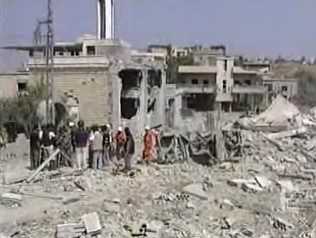
Remember the AP's Kathleen Carroll's response to questions regarding whether AP photos taken at Qana were staged? "I also know from 30 years of experience in this business that you can't get competitive journalists to participate in the kind of (staging) experience that is being described." Via EU Referendum, here is a group of these competitive journalists, all struggling to outcompete each other by investigating what happened at Qana: how many dead and wounded? why are none of the reported victims men? did the Party of God (Hezbollah) fire missiles from the building that collapsed or from the close vicinity? use that building or one nearby as a headquarters or a hiding place? were there overt signs of civilian habitation that Israel should have been aware of?
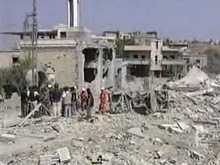
Oops. Actually, these "competitive journalists" all appear to be standing at about the same spot near some especially stark rubble (from what appears, if you look at other photos, to be from an entirely different building) waiting, as EU comments "for the next photo-opportunity to be presented to them." EU also provides a great deal more seemingly damning context that suggests staging, and I'd be interested to see a response from the news wires.
Meanwhile, remember Israel's attack on a "hospital" in Baalbeck Tuesday night? That's how I heard it reported in several newscasts. You may have missed this paragraph in the Washington Post (hat tip to EyeonthePost):
Halutz said the hospital building was being used as a Hezbollah logistics base and storage site for weapons. Hezbollah fighters prohibited reporters from approaching the hospital, which they said had been emptied of patients at the beginning of the war. Local officials said a number of Hezbollah fighters and guards were inside.
Hmm, a "hospital" with no patients? And with Party of God terrorists inside instead? And that reporters aren't allowed to approach?
Meanwhile, here is a report by an AP employee, who reported the Party of God's lies about the "hospital raid" without any qualifications. Does it not occur to reporters that a totalitarian terrorist movement that keeps a very tight leash on reporters in the territory it controls may lie to them occasionally? And if you think that sloppy (at best) reporting has no effect on how the conflict is perceived, note the first comment under this article, by an equally credulous reader: "I guess it goes with a true democracy's right to self-defense to attack hospitals. I am sure that there must have been a rocket launcher parked in the operating room of that hospital. No way Israel, being a model democracy, would attack a hospital over 100 km from its border unless its citizens were being threatened by patients in their hospital gowns!"
UPDATE: In the comments below, VC readers Fisk and destroy a column by one Tom Clonan, circulating around Leftist Internet news services, that makes wild claims about Party of God missiles and alleged Israeli intentions to purposely kill civilians. One additional point: What are Clonan's qualifications to make broad pronouncements on military hardware in Lebanon, and Israel's military strategy? "Dr. Tom Clonan, a retired (Irish) Army captain, lectures in the political economy of communications in the Institute of Technology, Tallaght." Three of his years in the army were spent as a press officer. His PhD thesis is on the roles and status assigned female personnel in the Defence Forces. You know the pro-terrorist side is getting desperate when they need to trot out stuff like this. Next up: a home economics teacher reveals that Israel is poisoning Lebanese muffins.
Advice to Entering Law Students:
Lawprofs Orin Kerr and Brannon Denning have useful advice for entering law students. Here are a few suggestions of my own.
I. Get to know at least some of your professors outside of class.
As Orin suggests, it can help you understand the class assignments better. But just as important, it will be a big help when you need to ask them for recommendations for jobs or clerkships. If all I know about a student is that he or she got a good grade in my class and did well in class discussion, I can't write a recommendation that will say much beyond what the employer can learn by reading the student's transcript.
Sadly, there are some professors who still don't realize that seeing students outside of class is part of the job. But more often than not, talking to profs will be easier than you think, because most academics love to talk about their subject! If they didn't, they probably wouldn't be in academia in the first place.
One particularly good way to get to know professors is to work as a research assistant. It certainly worked well for me.
II. Do the reading.
I'm not a believer in the theory that law school classes are vastly different from other types of classes, or that mastering legal materials is some kind arcane art that is unlike anything else you will ever study. But one way in which law school classes do differ from many undergraduate classes is that it's much harder to "wing it" without doing the reading. Legal issues often turn on fine distinctions buried in judicial precedents or in the text of statutes. It's hard to learn these things if you didn't do the reading.
III. Get to know the other students.
Many of your classmates are likely to end up working in the same field of law as you do. They can be extremely useful connections. And if you're lucky, they might turn out to be interesting people as well. This is one of the things that I neglected when I was in law school. It was a major mistake. So do as I say, not as I did!
IV. Do extracurricular activities.
Most law schools have a variety of activities for students outside the classroom, including numerous clinics and student organizations such as the conservative/libertarian Federalist Society and the liberal American Constitution Society. Getting involved in these will help you learn more about the law, and can also lead to important career benefits. You may learn about an area of law that will become the focus of your career, and you can also develop useful contacts that will help you later.
If you are at all interested in constitutional law or in public policy, I especially recommend the Fed Soc and the ACS (established as the left's answer to Fed Soc). But there are lots of other groups catering to a wide range of interests. If you go through law school doing nothing but taking classes and studying, it will probably be a mistake - both educationally and career-wise.
Related Posts (on one page): - Advice to Entering Law Students:
- Good Advice for Incoming Law Students,
Friday, August 4, 2006
Who Thinks Bush is a lot like Hitler?
The organization World Can't Wait has run an advertisement urging a rally on October 5 to "mass resistance" to begin to "Drive out the Bush regime." After listing various Bush sins, the advertisement declares "People look at all this and think of Hitler – and they are right to do so. The Bush regime is setting out to radically remake society very quickly, in a fascist way, and for generations to come."
The advertisement lists the following endorsers:
James Abourezk, Aris Anagnos, Anti-Flag, Edward Asner, Russell Banks, Ed Begley Jr., Harry Belafonte, St. Clair Bourne, Gabriel Byrne, Margaret Cho, Ward Churchill, Kate Clinton, US Rep. John Conyers Jr., John Densmore, Jesse Díaz Jr., Ariel Dorfman, Tom Duane, Michael Eric Dyson, Steve Earle, Niles Eldredge, Daniel Ellsberg, Eve Ensler,
Lawrence Ferlinghetti, Jane Fonda, Michael Franti, reg e. gaines, Martin Garbus, Wavy Gravy, André Gregory, Paul Haggis, Sam Hamill, Suheir Hammad, Kathleen Hanna, Stephen Hays, Merle Hoffman, Rev. Jesse L. Jackson, Mumia Abu-Jamal, Bill T. Jones, Rickie Lee Jones, Sarah Jones, Brig. Gen. (ret) Janis Karpinski, Casey Kasem, Ron Kovic,
Jonathan Kozol, Jessica Lange, Lewis Lapham, Mark Leno, Rabbi Michael Lerner, George Lois, US Rep. Cynthia McKinney, Mark Crispin Miller, Tom Morello, US Rep. Major Owens,
Ozomatli, Grace Paley, Harvey Pekar, Sean Penn, Jeremy Pikser, Harold Pinter, Frances Fox Piven, Sister Helen Prejean, Michael Ratner, Boots Riley, Mark Ruffalo,
US Rep. Bobby Rush, Susan Sarandon, James Schamus, Richard Serra, Rev. Al Sharpton, Cindy Sheehan, Martin Sheen, Gary Soto, Nancy Spero, Gloria Steinem, Lynne Stewart,
Serj Tankian, Jonathan Tasini, Sunsara Taylor, Studs Terkel, Gore Vidal, Kurt Vonnegut, Alice Walker, Naomi Wallace, Lt. Ehren Watada, US Rep. Maxine Waters,
Cornel West, Saul Williams, Krzysztof Wodiczko, Ann Wright, Howard Zinn.
All I can say is that I'm disappointed with Wavy Gravy, but not surprised about most of the rest.
The Psychology of Beliefs About the Hezbollah War.--
There are several highly interesting long posts on the psychological makeup of those who interpret the Hezbollah War (and the world) in irrational terms.
Perhaps the most interesting is at ShrinkWrapped, which I would recommend reading in its entirety.
But Richard Landes also has some good insights, though his tone deteriorates somewhat as he gets worked up over the abusive nonsense he is fisking. Landes's analysis is "The 'Left' Takes on the Qana Affair: Fisking the Daily Kos". What is stunning is that the Kos diarist Smintheus seems to trust the motives of Hezbollah more than he does those of conservative bloggers. Although he doesn't say so flatly, he seems to me to find it hard to believe that in the midst of such a tragedy as Qana, Hezbollah could be so callous as to stage photos of the bodies of the dead children pulled from the rubble.
This brings to mind the last great supposed Israeli massacre, Jenin, where a gullible world press falsely reported hundreds of Palestinians massacred, when even Fatah ended up claiming that there were 56 deaths, compared to the 23 lost by the Israelis at Jenin (apparently, it was a battle, not a massacre). Mark Steyn recalls a failed attempt to stage one of the deaths there:
Anxious to lend the west’s agitated humanitarians a helping hand, a group of Palestinians in Jenin held a funeral a week ago for one of their massacred compatriots and invited a cameraman along. The deceased, covered in a shroud, was being borne on a stretcher to his final resting place when, alas, his bearers stumbled and the body fell to the ground. The “corpse” picked himself up, dusted himself off and climbed back on the stretcher to start all over again. Unfortunately, the clumsy pallbearers managed to drop him a second time. At this point, the crowd, who apparently weren’t in on the scheme, fled in terror. The stiff, meanwhile, had had enough of his bungling bearers and flounced off in a huff.
Because I am traveling on Saturday, I will turn on comments for only 11 hours.
Should You Support An Immediate Ceasefire in Lebanon if You Want to See More Israeli Withdrawals from the West Bank?
Outside of Israel, almost everyone who supports further Israeli withdrawal from the West Bank also seems to support an immediate ceasefire in the Israel-Hezbollah conflict, before Israeli is able to deal Hezbollah a decisive blow. But do these positions in fact go together? There is a strong case that they are actually at cross-purposes with each other. If you really want Israel to withdraw from more of the West Bank and allow the establishment of a Palestinian state, you should hope that the Israelis defeat Hezbollah as decisively as possible.
Israeli Prime Minister Ehud Olmert and his Kadima Party won the Israeli elections earlier this year on a platform calling for continued unilateral withdrawals from Palestinian territories, similar to last year's withdrawal from Gaza and the 2000 withdrawal from southern Lebanon. Olmert and Kadima assured the Israeli public that the withdrawals would enhance Israeli security (or at leat not harm it) and increase the chances for a permanent peace.
If, however, further withdrawal means that land is turned over to terrorist groups such as Hamas and Hezbollah who will then use it to launch more attacks on Israeli civilians, Israeli support for the Olmert-Kadima strategy will evaporate. This is especially likely if the terrorists can use the newly acquired land to launch their attacks, but Israel is prevented from responding effectively by pressure from the "international community," much of which is now trying to accomplish exactly that by calling for a ceasefire. Most of the Israeli public is willing to accept "land for peace;" that is one of the reasons why Kadima won the election. But they aren't going to accept land for missiles.
Dovish Israelis understand this dynamic, which is why most of them support the current offensive against Hezbollah. Consider this article in the left-wing Israeli publication Haaretz, describing the views of the Four Mothers, a group of women peace activists whose sons were killed in Lebanon and whose agitation for Israeli withdrawals played a key role in persuading the government to remove its forces from Lebanon in 2000. Here is a telling quote by Zohara Antebi, one of the Four Mothers:
So if you are saying now that I was wrong when I believed that it would be possible to ensure far fewer casualties and far more quiet after leaving Lebanon, you're right. I was wrong. I'm afraid of those who are incapable of saying 'I was wrong' in the first person. I lived on the border, in Malkiya, and I saw the small tobacco plots of the farmers in southern Lebanon, and I believed that prosperity on both sides of the border would ensure quiet. That Nasrallah would aspire for his people to have a good life. In that I was wrong. I was definitely wrong . . .
[T]here is now no choice. Now we have to change the diskette. This time we are fighting for our home. This time we are fighting so that we will have lives here.
The other three leaders of the Four Mothers still believe that the 2000 withdrawal was the right decision at the time, but they too support Israel's military effort today. Indeed, they seem to recognize that withdrawal can only be justified to the Israeli public if it permits Israel to retain a free hand in responding to terrorist attacks from the territories in question. As Bruria Sharon [no relation to Ariel], one of the other Mothers, puts it:
[B]eing out of Lebanon makes it possible for us to mount this strong response. When we were in Lebanon we could not respond like this, because then we were occupiers, whereas now we are just. Today we are fighting for our home from within the international border.
If Bruria Sharon is proven wrong and the international community forces a ceasefire on Israel anyway, it is unlikely that she would support future withdrawals. More importantly, neither will the vast majority of the Israeli public who are more skeptical of the "peace process" than the Four Mothers are.
For another prominent Israeli dove taking a similar view, see this op ed by famous Israeli novelist and peace activist Amos Oz. And, of course, it's worth mentioning that Israeli Defense Minister Amir Peretz is the leader of very left-wing and dovish Labor Party. If Israel is forced to stop short of victory, Peretz and his party (which is more dovish than Olmert) will be even more discredited than Kadima.
Left-wing Israeli supporters of withdrawal are not the only ones drawing such conclusions. So too are their right-wing, anti-withdrawal domestic opponents. Consider this statement by Likud Party leader Benjamin Netanyahu, the most prominent opponent of further Israeli withdrawals:
What will help the Likud [politically] is that after the fighting stops, people will assess what the Likud said about the effects of unilateral disengagement and what other parties said, and then they will come to the right conclusions.
Bibi and the Likud, of course, argued from the beginning that Israeli withdrawals would stimulate terrorism and that the international community would not give Israel any more latitude to respond than it has in the past. If Israel is forced to stand down before achieving a clear victory, Bibi will be the big winner politically. Even if Olmert and Kadima are able to stay in power, they will have to change their policies. Further Israeli withdrawals from the West Bank will be highly unlikely, to say the least. Those who truly want to see Israel withdraw from all or most of the West Bank and permit the establishment of a Palestinian state should hope that Israel wins as big a victory as possible. And should oppose any ceasefire arrangements that prevent that.
UPDATE: Co-blogger David Bernstein asks (by e-mail): "[A]re there left-wing types outside of Israel who were critical of Israel in the past who are supporting Israel in Lebanon on the grounds you suggested?" A good question to which I do not know the answer. If there are readers who do know of relevant examples, feel free to point them out in the comments.
Better living through public service:
I know what's on everyone's mind these days: Incoming Treasury Secretary Henry Paulson. Specifically, why would a CEO of Goldman Sachs want to be (1) Treasury Secretary, (2) in the last two years of an administration (3) that doesn't have the coziest relationship with the Treasury Department?
My colleague Marty Ginsburg has two possible explanations: (1) perhaps he's public-spirited?, and (2) section 1043.
Here's what §1043 of the Internal Revenue Code (26 U.S.C. §1043) says (my translation into English):
Suppose you take a position in the Executive Branch. To comply with federal conflict of interest rules, you have to get rid of some of your property — say, stock in companies that do business with the Treasury. Normally, you would have to sell the offending property — and pay tax on your capital gain. This could come out to a hefty chunk of change for people who have a lot of their wealth tied up in unrealized capital gains (i.e., assets that have gained a lot in value since they acquired them). But thanks to §1043, you get to instead use your capital gain to buy new, non-conflicting property, for instance a diversified fund approved by the Office of Government Ethics, tax-free!
Section 1043 was passed in 1989, in the days of Bush, Sr., apparently to make wealthy people more willing to go into government. Now I know what you're thinking: Can I, too, save by becoming Treasury Secretary? To answer your question, let's work through an example. Suppose you bought (or got as compensation) stock for $100 million. We law types call $100 million your "basis." Now it's worth $500 million. If you sell the stock, you realize a capital gain of $400 million. Normally, when you sell the stock, the gain is also "recognized," i.e., taxed. Section 1043 allows you to avoid recognition if you buy $400 million of other stuff.
The tax code is clever, though. Your $400 million unrecognized gain sticks around, and goes to reduce your basis on your new property. Even though you bought your $400 million of stock at a price of $400 million, your basis is now considered to be $0. One day, if you sell your new stock, you'll still have to pay tax on that $400 million (plus whatever extra gains you've had since then). So the recognition of your capital gain has only been delayed, not avoided.
Bottom line: Suppose you're perfectly happy with your portfolio, and (rather than holding it until you die, when you'll get some beneficial tax treatment) plan to sell some day in the future. If you become Treasury Secretary, you can rejuggle your portfolio, but when you sell in the end, you haven't saved any money. So what's the point? I suspect that, if you're the CEO of Goldman Sachs, you're not perfectly happy with your portfolio. In particular, you're heavily invested in Goldman Sachs stock, and would prefer to diversify. Even if you think Goldman Sachs will do fine, you're risk averse and would rather not have too many eggs in one basket. But to diversify is to sell, and to sell is to pay tax. So if you're in that sort of position, becoming Treasury Secretary lets you do what you'd like to do — diversify — without getting penalized.
More seriously, talking about §1043 allows us to talk about the "lock-in" effect of capital gains taxation generally — i.e., why do we have a system that taxes transactions, and thus discourages efficient portfolio reshuffling and diversification, rather than taxing capital gains as they happen? See, e.g., George R. Zodrow, Economic Analyses of Capital Gains Taxation: Realizations, Revenues, Efficiency and Equity, 48 Tax L. Rev. 419, 467 (1993). Why can't we all be Henry Paulson? But that more serious discussion is a topic for another post.
Thanks, Marty! (Cross-posted on Georgetown Law Faculty Blog. See also this New York Times article, Paul Caron's discussion on TaxProf Blog, and this Bruce Bartlett op-ed.)
UPDATE: Preliminary notes on the serious question at the end of the main body of this post -- why not tax capital gains as they happen? (This is called "marking to market.") The main reasons we have a "realization rule" are administrability -- once you sell, you know how much you've made -- and liquidity -- once you sell, you definitely have the cash to pay the tax. Check out the excellent comment by commenter nc3274, going into more detail on potential problems with "mark to market."
Psychological/De Facto Parent Doctrine:
A commenter on the Vermont/Virginia child custody determination thread asks: "So what is the relationship between claimed parent Janet and IMJ if not Janet's 'civil union' with Lisa?"The Vermont court was relying in large measure on what is sometimes called the "de facto parent" or "psychological parent" doctrine, which applies not just to same-sex partners, but also to the biological parent's opposite-sex boyfriend/girlfriend (or to the child's stepparent).
The doctrine is recognized not just in crunchy granola places like California and Vermont, but also Alaska, Maine, South Carolina, West Virginia, and Wisconsin (and, I'm sure, other states -- I just don't have a list handy). See, for instance Middleton v. Johnson, 2006 WL 1814177 (S.C. App. 2006), and the cases cited therein; here's the test that the South Carolina case adopts, following a Wisconsin precedent: [T]he petitioner must show ... (1) that the biological or adoptive parent[s] consented to, and fostered, the petitioner's formation and establishment of a parent-like relationship with the child; (2) that the petitioner and the child lived together in the same household; (3) that the petitioner assumed obligations of parenthood by taking significant responsibility for the child's care, education and development, including contributing towards the child's support, without expectation of financial compensation; [and] (4) that the petitioner has been in a parental role for a length of time sufficient to have established with the child a bonded, dependent relationship parental in nature. Factor 4 suggests that the doctrine would apply more strongly for older children, and I don't know how often it has in fact been applied as to children who are a year and a half old at the time of the breakup; but it seems a comfortable fit in such cases, too.
Australian Official Nominates the Father of a Terrorist Detainee for "Father of the Year."--
Jon Stanhope, the head of the Australian Capital Territory (and a Labor Party leader) has nominated Australian Terry Hicks for "Father of the Year." Terry is the father of David Hicks, who was arrested in 2001 while fighting for the Taliban (against coalition forces including Australia).
THE father of terrorist suspect David Hicks has been nominated as Australian father of the year by ACT [Australian Capital Territory] chief minister Jon Stanhope.
Mr Stanhope compared Terry Hicks to Steve Waugh, Prime Minister John Howard and former leader Billy McMahon — all former fathers of the year.
The chief minister said Mr Hicks had stuck by his son, advocated justice and did it with grace — all qualities of a good dad.
"But the anguish of that news must have been nothing compared to the relentless pain and uncertainty that Terry Hicks has experienced every day since, as he tries, from afar, to support his son," Mr Stanhope said.
"That Terry Hicks has continued to behave during this terrible time with such public stoicism and courtesy and strength is a lesson to all."
I can understand considerable sympathy for the Terry (it must be painful to raise a son who would take up arms against his own country), but giving the father an award for parenting seems an odd suggestion.
Tip to Tim Blair, who dryly observes: "Well deserved, too. After all, he did such a fine job of raising the boy."
Conflict Between Vermont Courts and Virginia Courts in Dispute Over Lesbian's Parental Rights:
The Vermont Supreme Court just issued its opinion in Miller-Jenkins v. Miller-Jenkins; here's a brief summary of the facts: Lisa and Janet lived together in Virginia for several years in the late 1990's. In December 2000, the parties traveled to Vermont and entered into a civil union. In 2001, while Lisa and Janet were still a couple, Lisa began to receive artificial insemination from sperm provided by an anonymous donor. Janet participated in the decision that Lisa become impregnated and helped select the anonymous donor. In April 2002, Lisa gave birth to IMJ, with Janet present in the delivery room. Lisa, Janet, and IMJ lived in Virginia until IMJ was approximately four months old and then moved together to Vermont around August of 2002. The parties lived together with IMJ in Vermont until the fall of 2003, when they decided to separate. After the separation, in September 2003, Lisa moved to Virginia with IMJ.
On November 24, 2003, Lisa filed a petition to dissolve the civil union in the Vermont family court in Rutland. In her complaint, Lisa listed IMJ as the "biological or adoptive child[]of the civil union." Lisa requested that the court award her custodial rights and award Janet parent-child contact. The family court ... on June 17, 2004 ... awarded Lisa temporary legal and physical responsibility for IMJ, and awarded Janet [visitation and a right to daily telephone contact] .... Lisa eventually started denying Janet her visitation and contact rights, and the Virginia court in which Lisa filed an action to establish IMJ's parentage backed her up, holding that "any claims of Janet to parental status were 'based on rights under Vermont's civil union laws that are null and void under Va. Code § 20-45.3,'" that Lisa was the "sole biological and natural parent," and that Janet had no "claims of parentage or visitation rights over" IMJ. (That order is being appealed in Virginia.) The Vermont court, on the other hand, found Lisa guilty of contempt of court for violating the Vermont order, and refused to adhere to the Virginia order (which was issued after the initial Vermont order).
I'm not a family law maven, but here's my sense of the matter.
First, despite how Lisa's lawyers (Liberty Counsel) are characterizing the case, this is not primarily a case about civil unions. Child custody cases often arise in divorces (or, where civil unions are available, in civil union dissolutions), but they can arise even if the parties aren't married. The relevant federal statute, the Parental Kindapping Prevention Act, 28 U.S.C. § 1738A (which the Vermont court calls, in a possibly amusing mistake, the Parental Kidnapping Protection Act), requires courts to adhere to preexisting custody awards generally, not just ones that follow the dissolution of a marriage. The Act requires each state to "enforce according to its terms" out-of-state custody orders if, among other things: (1) [the original] court has jurisdiction under the law of [the court's] State; and
(2) ... (A) such State
(i) is the home State of the child on the date of the commencement of the proceeding, or
(ii) had been the child’s home State within six months before the date of the commencement of the proceeding and the child is absent from such State because of his removal or retention by a contestant or for other reasons, and a contestant continues to live in such State; And if this provision protects the original Vermont judgment (which I think it does), then the later Virginia judgment is invalid (see subdivision (g), "A court of a State [here, Virginia] shall not exercise jurisdiction in any proceeding for a custody or visitation determination commenced during the pendency of a proceeding in a court of another State [here, Vermont] where such court of that other State is exercising jurisdiction consistently with the provisions of this section to make a custody or visitation determination").
So even if Janet and Lisa weren't in a civil union, but were merely living together and had raised a child together, the initial Vermont order would have been valid, and the subsequent Virginia order invalid — that's why I say that this case is not primarily about marriage or civil unions. The Vermont Supreme Court did rely in part on the civil union, in deciding in the first instance that Janet (who isn't IMJ's biological parent) was entitled to parental rights. But while the court noted this "first and foremost," it also pointed to many other factors that would have been present even had this situation arisen without a civil union: "It was the expectation and intent of both Lisa and Janet that Janet would be IMJ's parent. Janet participated in the decision that Lisa would be artificially inseminated to bear a child and participated actively in the prenatal care and birth. Both Lisa and Janet treated Janet as IMJ's parent during the time they resided together, and Lisa identified Janet as a parent of IMJ in the dissolution petition. Finally, there is no other claimant to the status of parent, and, as a result, a negative decision would leave IMJ with only one parent." "Because so many factors are present in this case that allow us to hold that the non-biologically-related partner is the child's parent, we need not address which factors may be dispositive on the issue in a closer case."
Thus, a Vermont court decided — based partly on Lisa's and Janet's Vermont civil union, but also on other factors that would cut in favor of this decision in case — that Janet was entitled to parental rights. At that point, the federal statute kicked in, and the Virginia courts were not allowed to revisit the Vermont decision, not because Lisa and Janet had a civil union, but because the Vermont decision took precedence and would have took precedence even Lisa and Janet had been an unmarried opposite-sex couple Lisa and John.
One last issue: What about the Defense of Marriage Act"? For the reasons I mentioned, the Act doesn't apply, and thus doesn't trump the PKPA.
The Act provides that states (here, Virginia) need not follow "any public act, record, or judicial proceeding of any other State [here, Vermont], territory, possession, or tribe respecting a relationship between persons of the same sex that is treated as a marriage under the laws of such other State, territory, possession, or tribe, or a right or claim arising from such relationship." Virginia thus has no obligation to take into account Lisa's and Janet's civil union. But the Vermont court's custody decision didn't involve a right or claim legally arising from the civil union; it involved a right or claim arising from a child custody decision — a decision that, as I said, could have been rendered even for a couple who had never been either married or in a civil union.
(Had the Vermont court concluded that the decision would have been otherwise absent the civil union, the matter might have been different, but the court strongly suggested that the other factors would have yielded the same result. Also, the child did "aris[e] from such [civil union] relationship," in the sense that it was born into the civil union, and Lisa and Janet might not have agreed to have a child were it not for the civil union — but the right or claim doesn't arise from a relationship, just like, say, two married people's purchase of a house as tenants in common wouldn't be "a right or claim arising" from the marriage, and would remain legally valid even if the marriage were found to be invalid.)
The Vermont Supreme Court held only (and clearly correctly) that DOMA doesn't require Vermont to honor the Virginia custody decision, and given the procedural posture of the case didn't have to "reach the broader question of whether DOMA, and not the PKPA" would govern Virginia's decision whether to honor the Vermont custody decision. But if my analysis is right, then it shows that under federal law Virginia must indeed honor the custody decision that flows from Lisa's and Janet's parenting of the child, though Virginia need not honor the civil union status.
Related Posts (on one page): - Virginia Appellate Court Sides With Vermont Court in Dispute Over Lesbian's Parental Rights:
- Conflict Between Vermont Courts and Virginia Courts in Dispute Over Lesbian's Parental Rights:
The Specter Bill's Changes to the Basic Definitions of FISA:
Senator Specter's bill on the NSA domestic surveillance program has been much in the news lately, but there is a very important part of the bill that hasn't been covered much: the bill's changes to the definition of the key terms in FISA. Based on my study of the bill, it seems that the Specter bill would bring changes to several of the basic principles of FISA that would considerably alter the law's scope. In this post, I'd like to review some of those changes I've found and suggest what they might mean for the scope of government surveillance powers in national security cases. First, some background. The basic idea of FISA is that it requires the Executive Branch to get a warrant to conduct "electronic surveillance," and permits the government to get a long-term, lower-threshold monitoring order when it is monitoring "an agent of a foreign power" (such as a foreign spy). So the most basic questions under FISA are what is "electronic surveillance," and who is an "agent of a foreign power"? These definitions are found in Section 101 of FISA, codified at 50 U.S.C. 1801. Under the current version of FISA, "electronic surveillance" is quite broad, and "agent of a foriegn power" is relatively narrow. As a result, FISA imposes a fairly comprehensive regulatory scheme over national security surveillance. It's kind of hard to explain this without some details, so here are the details. (If you want to skip to the punchline, scroll down a bit.) Here is the statutory definition of electronic surveillance:
"Electronic surveillance" means—
(1) the acquisition by an electronic, mechanical, or other surveillance device of the contents of any wire or radio communication sent by or intended to be received by a particular, known United States person who is in the United States, if the contents are acquired by intentionally targeting that United States person, under circumstances in which a person has a reasonable expectation of privacy and a warrant would be required for law enforcement purposes;
(2) the acquisition by an electronic, mechanical, or other surveillance device of the contents of any wire communication to or from a person in the United States, without the consent of any party thereto, if such acquisition occurs in the United States, but does not include the acquisition of those communications of computer trespassers that would be permissible under [the Wiretap Act]
(3)the intentional acquisition by an electronic, mechanical, or other surveillance device of the contents of any radio communication, under circumstances in which a person has a reasonable expectation of privacy and a warrant would be required for law enforcement purposes, and if both the sender and all intended recipients are located within the United States; or (4)the installation or use of an electronic, mechanical, or other surveillance device in the United States for monitoring to acquire information, other than from a wire or radio communication, under circumstances in which a person has a reasonable expectation of privacy and a warrant would be required for law enforcement purposes.
"Contents" are in turn defined as "any information concerning the identity of the parties to such communication or the existence, substance, purport, or meaning of that communication." An "agent of a foreign power" is defined as follows: "Agent of a foreign power" means—
(1) any person other than a United States person, who— (a) acts in the United States as an officer or employee of a foreign power, or as a member of a foreign power as defined in subsection (a)(4) of this section; (B) acts for or on behalf of a foreign power which engages in clandestine intelligence activities in the United States contrary to the interests of the United States, when the circumstances of such person’s presence in the United States indicate that such person may engage in such activities in the United States, or when such person knowingly aids or abets any person in the conduct of such activities or knowingly conspires with any person to engage in such activities; or
(2) any person who— (A) knowingly engages in clandestine intelligence gathering activities for or on behalf of a foreign power, which activities involve or may involve a violation of the criminal statutes of the United States;
(B) pursuant to the direction of an intelligence service or network of a foreign power, knowingly engages in any other clandestine intelligence activities for or on behalf of such foreign power, which activities involve or are about to involve a violation of the criminal statutes of the United States ;
(C) knowingly engages in sabotage or international terrorism, or activities that are in preparation therefor, for or on behalf of a foreign power;
(D) knowingly enters the United States under a false or fraudulent identity for or on behalf of a foreign power or, while in the United States, knowingly assumes a false or fraudulent identity for or on behalf of a foreign power; or
(E) knowingly aids or abets any person in the conduct of activities described in subparagraph (A), (B), or (C) or knowingly conspires with any person to engage in activities described in subparagraph (A), (B), or (C). So what does this all mean, in plain English? Well, the basic idea is that the government can't monitor content or non-content information about people in the U.S. without a court order, and it can only get a long-term monitoring order to monitor people if there's probable cause to beliebve they are spies or members of terrorist groups. That's the current law, at least, which is pretty much what we've had for the last 30 years or so. But check out what the Specter bill would do to the basic definitions of FISA. The changes appear at page 25, the beginning of Section 9 of the latest draft. First, the existing 4-part definition of "electronic surveillance" is eliminated, and replaced with this shorter and also narrower definition: (f) electronic surveillance means --
(1) the installation or use of an electronic, mechanical, or other surveillance device for the intentional collection of information concerning a particular known person who is reasonably believed to be in the United States by intentionally targeting that person under circumstances in which that person has a reasonable expectation of privacy and a warrant would be required for law enforcement purposes; or
(2) the intentional acquisition of the contents of any communication under circumstances in which that person has a reasonable expectation of privacy and a warrant would be required for law enforcement purposes, and if both the sender and all intended recipients are located within the United States. (Note that all of the definitions of the Specter bill are as transcribed my me as the version of the latest text has cut-and-paste functions disabled. So errors in transcription are possible.) The definition of contents is changed, as well: instead of "any information concerning the identity of the parties to such communication or the existence, substance, purport, or meaning of that communication," the Specter bill would borrow the Wiretap Act's definition, "any information concerning the substance, purport, or meaning of that communication," excluding information that merely contains the identity of the parties and the existence of the communication. Finally, the definition of "agent of a foreign power" is amended, too, so that it includes a non-U.S. person — that is, someone other than a U.S. citizen or permanent resident alien — who "otherwise possesses or is expected to transmit or receive foreign intelligence information inside the United States." So what does this all mean? Well, to me it says that these are some pretty important changes. Start with the change in the definition of "agent of a foreign power." That used to mean a spy or terrorist, and the government needed probable cause to believe that the bad guy was in cahoots with a foreign government or terrorist organization to get the monitoring order. The Specter bill would bring a much broader approach: as long as the person is not a U.S. citizen or permanent resident alien, the fact that some one is expected to receive foreign intelligence info -- that is, info about national security threats or about foreign governments -- would be enough to treat them as agents of a foreign power. You can see why this would make an enormous difference in an era of easily-forwarded Internet communications: the government could follow the trail of data, and could start monitoring the folks who were along the trail so long as they were not U.S. citizens or permanent resident aliens. Maybe this is a good idea, and maybe it's a bad idea. Either way, it strikes me as a pretty important change. The changes to the definition of "electronic surveillance" are even more important. Part of the changes are presumably needed to authorize the NSA program; much of the program would seem to be excluded from the definition of "electronic surveillance." But more broadly, note that under the new definition, monitoring does not constitute electronic surveillance if a) the person monitored has no Fourth Amendment "reasonable expectation of privacy" or b) no warrant would be required to conduct that monitoring in the criminal context. This explicit incorporation of Fourth Amendment law as the sole test of the statute is troubling, I think, because the Fourth Amendment standards for electronic surveillance are tremendously murky right now. For example, courts have held that you don't have a reasonable expectation of privacy in calls to or from cordless phones, and they have used reasoning that would also appear to apply as well to cell phone calls. (You have statutory privacy protection, which is much stronger than constitutional protection, but not constitutional protections.) If you don't have a reasonable expectation of privacy in your cell phone calls, which those cases suggest is the case, Specter's bill would mean that the NSA can tap every cell phone in the country of every US citizen, for entirely domestic calls, all without a warrant. This monitoring wouldn't be "electronic surveillance" because (based on the cordless phone cases) the Fourth Amendment doesn't apply. Similarly, right now it's really uncertain whether one can have a reasonable expectation of privacy in your e-mail, and if so, when such protection exists. (Again, there is statutory protection, but constitutional protection is really uncertain.) Some scholars suggest that there is such protection, others suggest there isn't; as a matter of doctrine, the answer is essentially unknown. But if the statutory standard hinges on constitutional protection, and it may be that there isn't any constitutional protection at all, then it may be that there is no statutory protection either. And since the government's applications are secret, we wouldn't know it. What would happen, I would assume, is that DOJ and the FISA court judges would reach some kind of understanding about how the Fourth Amendment applies to these new technologies. But no one else would get to know what that understanding is, and as a result no one else would know how the law actually would apply. (Some of this presumably happens now, as parts 1, 3, and 4 of the current definition incorporate this approach: but under current law, part 2 is the broader definition, and does not incorporate the Fourth Amendment standard.) In sum, my sense is that the Specter bill would make some pretty significant changes to some of the basic principles of FISA. Some of the changes may be good, others bad, and some are just quite uncertain (a constant problem with FISA, as it's hard for outsiders to get an accurate feel for the impact of specific legislative reforms on secret monitoring). But however you look at it, it's pretty clear that the Specter bill does a lot more than just subject the NSA program to constitutional review. That's my sense of it, at least; if you think my analysis is off, please let me know.
New York Congressional Candidate David Yassky Getting Criticism
for His Position that the Second Amendment Doesn't Secure an Individual Right: No, wait, that would be a substantive criticism.
Instead, he's being faulted for being "not ... of our color" (Al Sharpton, with the "our" referring to Sharpton and the mostly black electorate in the district), a "colonizer" (Major Owens, the retiring Congressman from that district), and "a white individual" (City Councilman Al Vann). Plus, Sharpton linked Yassky to Nicholas Minucci, who's accused of attacking a black man with a baseball bat while shouting a racial slur ("From this to the Minucci case to Yassky thinking he's going to run for that seat -- do they think we're just going to sit this out?"). The only connection between Yassky and Minucci appears to be that they're both white.
Here's Al Sharpton's letter defending himself:
Despite Andrea Peyser's protestations to the contrary, I and other black leaders have repeatedly stated that our objection to David Yassky's congressional candidacy in the 11th district of Brooklyn has nothing to do with his skin color or religion ("Election 'Slur' Spur," June 10).
Rather, our problem with his running in the 11th is that he made an opportunistic political calculation to move out of his own district and move into a district with four black candidates under the assumption that they'd split the vote, providing him with an inroad to victory.
That's a clear undermining of the spirit of the 1965 Voting Rights Act.
Further, population estimates from the Census Bureau reveal that blacks still don't have equal representation in New York City's congressional delegation.
I firmly believe that in a supposedly progressive state like New York, that's a problem that must be remedied, not further exacerbated. However, being for proportional representation makes me neither anti-white nor anti-Jewish.
I'm not sure how Sharpton's claim that this "has nothing to do with his skin color or religion" is consistent with Sharpton's other quoted statements. More importantly, how is it consistent with Sharpton's "being for proportional representation"? True proportional representation would mean that there'd be 2 Jewish Senators and 9 Jewish Congressmen (plus, while you're at it, almost never a Jewish Justice), since Jews are 2% of the population. It also would mean that some candidates should be opposed because of their "skin color or religion," since if one group is overrepresented, backers of "proportional representation" would presumably have to oppose candidates of that group in order to cure that overrepresentation.
The good news:
July 13, 2006 - Don't Keep White Candidate Out Of Black District, New Yorkers Tell Quinnipiac University Poll ....
By a 61 - 23 percent margin, New York City voters oppose a move by black politicians to prevent a white candidate from winning a Congressional race in a Brooklyn district that has been represented by black members of Congress since 1968, according to a Quinnipiac University poll released today. White voters oppose this move 68 - 16 percent while black voters oppose it 53 - 31 percent and Hispanic voters oppose it 54 - 28 percent.
By an even larger 77 - 12 percent margin, voters would oppose a group of white politicians trying to prevent a black candidate from winning in a historically white legislative district. There is little difference among white, black or Hispanic voters, the independent Quinnipiac (KWIN-uh-pe-ack) University poll finds.
When asked if they prefer having a candidate of their own race, New York City voters say no 54 - 19 percent. White voters say no 59 - 10 percent, while black voters say no 45 - 30 percent and Hispanic voters say no 56 - 25 percent....
Or is it such good news? True, about 77% of white voters and 53% of black voters would oppose trying to prevent a candidate of the opposite race from winning in a "historically [white / black]" district. On the other hand, 10% of white voters and 31% of black voters say they would support it. So Sharpton's, Owens', and Vann's sentiments are unfortunately hardly isolated.
Bison Hunt to Increase:
Today's Bozeman Chronicle reports that the state Fish, Wildlfe and Parks Commission endorsed a plan to increase the number of bison hunting licenses for the second time this summer. Whereas last year only 50 licenses were issued to hunters who wish to shoot bison that come into Montana from Yellowston National Park, it looks like the state will issue 140 this year. The increase appears to be motivated by a genuine concern about increased bison populations and brucellosis, a disease some bison carry that can infect cattle herds. Among other things, the news story reports that a greater percentage of the licensies will be for bison cows, a move that makes sense for keeping the population in check, but not for satisfying would-be trophy hunters who much prefer to hunt the males. At present Yellowstone's bison population is 15-20 percent larger than what the federal government believes is ideal. While the bison population is up, the elk population is way down, due in part to the successful reintroduciton of wolves into the Yellowstone area. Thus, a few hunters who would prefer to hunt elk, may get the opportunity to go after bison instead.
Blogging under the Big Sky:
This morning, during some quick, pre-fishin web browsing, I cam across this article on change in Montana. Without a doubt, the state has changed, particlarly in the Bozeman area, as it has grown and the economy has shifted away from traditional resource extraction industries.
For a decade or two, college-educated people who want to live in decent towns, fish in clean rivers and hike in high mountains have been descending on western Montana. Unlike the farmers, ranchers and miners that have traditionally run the state, they tend to be green and lean Democrat -- and they are changing the state's politics.
To the regret of many longtime Montanans, these New Westerners are getting awfully thick on the ground, especially in Gallatin County. They are building monster houses, seeding the periphery with big-box stores, and sullying the Montana that they and their birdhouse-building kids came to celebrate.
As with decline around Malta, no one has come up with a sure-fire scheme to control growth around Bozeman.
Still, once you get out of any Montana town and pick up some speed on a highway, the big sky, limitless space and staggering absence of traffic have a way of soothing a traveler. Emptiness out here has a kind of holiness. It blows away worries about sprawl in the west or decline in the east and seduces a driver, even in a rental car, into thinking of himself as a rugged individualist.
Despite the changes, Montana remains a beautiful place, and the fishing remains fabulous. Yesterday we floated the Upper Madison River. In about two hours we'll be casting onto the Yellowstone. Related Posts (on one page): - Why Environmental Law?
- Blogging under the Big Sky:
Thursday, August 3, 2006
Samuelson Looks Back at Welfare Reform.--
Robert Samuelson looks back at the greatest success of the Clinton years: Welfare Reform (tip to Betsy).
President Bill Clinton signed the Personal Responsibility and Work Opportunity Reconciliation Act of 1996, better known as "welfare reform," on Aug. 22 of that year. A decade later it stands as a rarity: a Washington success story. It did not succeed in the utopian sense of eliminating all poverty or family breakdown. It succeeded in a more practical way. It improved life modestly for millions of people and showed that government could orchestrate constructive change. There are small and large lessons in this. The small lessons involve poverty; the large lessons involve politics.
One little-known fact is that we have made gains against poverty in recent decades — and welfare reform deserves some credit. The poverty rate among blacks has fallen sharply, though it's still discouragingly high. From 1968 to 1994, it barely budged, averaging 32.4 percent. By 2000 it was 22.5 percent. . . . Similarly, there have been big drops in child poverty. From 1989 to 2004, the number of children in poverty fell 12 percent for non-Hispanic whites and 14 percent for blacks.
The economic boom of the 1990s explains much of this improvement. But it is not the whole explanation, because even after the 2001 recession, many poverty rates stayed well below previous levels. For all blacks, it was 24.7 percent in 2004. . . .
Welfare caseloads have plunged. From August 1996 to June 2005, the number of people on welfare dropped from 12.2 million to 4.5 million. About 60 percent of mothers who left welfare found work. Their incomes generally rose. Many qualified for the federal earned-income tax credit, which subsidizes low-income workers. Finally, there were intangible benefits: work connections, self-respect.
One lesson is that what people do for themselves often overshadows what government does for them. Since 1991, for example, the teen birthrate has dropped by a third.
Of course poverty endures. Some mothers are unemployable and are worse off without continuous welfare. . . .
So: We've made a stubborn problem a bit more manageable. It's pragmatic progress, not a panacea. Why can't we do the same for other pressing problems — energy, immigration, retirement spending (Social Security, Medicare)? Here, welfare reform's political lessons apply.
One is the need to overcome a bias against change. We underestimate people's ability to adapt. In 1995 one think tank forecast that the welfare bill would throw 1 million more children into poverty. If Congress had listened, little would have happened. Today we could gradually raise Social Security and Medicare eligibility ages without causing a social catastrophe. Another lesson is the virtue of candor. Welfare's flaws were openly acknowledged. . . .
The final lesson is the value of some bipartisanship. Although welfare reform was mainly a Republican project, President Clinton (who had pledged to "end welfare as we know it") provided general support, as did many Democrats who voted for the final bill.
According to what I recall from that master of triangulation, Dick Morris, White House staffers were mostly fervently opposed to substantial welfare reform, but both Bill Clinton and Al Gore were eventually solidly in favor of it.
Does Japan Have the Right to Exist As a Japanese State?
A reader, sympathetic to Israel but troubled by its existence as "Jewish state," asks: "Can you point me to any case in any example where you would say '[Country A] has the right to exist as a [Race B] OR [Religion C] state?' I can think of numerous claims like this by societies in the past, which are now widely condemned."
Actually, many, many countries, have an official religion, including not only "backwards" countries such as Iran and Saudi Arabia, that enforce religious law, but "progressive," liberal bastions such as Norway, Denmark, and Iceland (all Lutheran). By contrast, Judaism is not the official religion of Israel. Jewish holidays are government holidays, but that's like Christmas in the U.S. [Family law is controlled by religious bodies, but that's true for Moslems, Christians, et. al, as well as Jews, and is an artifact of Ottoman and British rule. My understanding is that most Jews in Israel are against the religious monopoly on family law, but it survives because the religious parties have disproportionate power. The Arab community, which is far more traditional in its religious practices than is the Jewish community, almost certainly is more supportive of this arrangement than the Jews are, so this has really nothing to do with Israel being a "Jewish state," as such.]
As for the question of "race," the problem can't be "self-determination" of a group, because the propriety of that principle seems rather well-accepted. "Jewishness" is not a racial identity, but complaints about Israel being a "Jewish state" are often put in terms of the Law of Return being "racist." The Law of Return is based on ethnic (not racial) heritage grants anyone with a Jewish grandparent automatic citizenship (the Israeli Supreme Court has held that one is not eligible for the Law of Return if one has adopted the Christian religion, because in the complex area of Jewish identity, Jews who become Christians have left the Jewish people). Non-Jewish immigrants with no ethnic Jewish background can become citizens, with some difficulty, as can, automatically, non-Jewish immigrants closely related to Jews (e.g., spouses), many of whom have recently arrived from the former Soviet Union. Arabs who lived in Israel during the War of Independence (and thus presumptively accepted the existence of Israel and were not engaged in warfare against Israel) and their descendants have full citizenship rights, but they are relieved of one of the major obligations of Israeli citizenship, military or other national service (I think this is a big mistake, but that is a topic for a separate post).
One's liberal, progressive, or libertarian hackles can easily be raised at Israel's citizenship policies. Why should ethnic background entitle one to citizenship? On the other hand, Israel's defenders would argue that given that the Jews have been the subject of massive state and private violence over the last few centuries, including one attempted genocide (by Hitler) and another one that was averted only by Stalin's timely death, Jews need a homeland/refuge where they can go with automatic citizenship rights.
Whatever side you take on that debate, the more interesting question is why the question of basing citizenship (in part) of ethnic descent only calls the right of Israel to exist into question.
My correspondent was unaware of any other countries that have an overt ethnic identity, but, judging by immigration laws, there are quite a few, and with a few exceptions (Armenia and Germany), their discriminatory immigration policies exist, unlike Israel's, without any justification resulting from persecution of that group.
For example, according to Wikipedia: "Japanese citizenship is conferred jus sanguinis, and monolingual Japanese-speaking minorities often reside in Japan for generations under permanent residency status without acquiring citizenship in their country of birth." Why does Japan have the right to exist as a Japanese state? Has this question ever been asked?
Ireland: "If you are of the third or subsequent generation born abroad to an Irish citizen (in other words, one of your grandparents is an Irish citizen but none of your parents was born in Ireland), you may be entitled to become an Irish citizen" [if, as I understand it, you register properly]. Does Ireland have the right to exist as an Irish state?
Several other countries recognize a "right of return" similar, but often broader, than Israel's (via Wikipedia):
Armenia: "Individuals of Armenian origin shall acquire citizenship of the Republic of Armenia through a simplified procedure."
Bulgaria: "Any person ... whose descent from a Bulgarian citizen has been established by way of a court ruling shall be a Bulgarian citizen by origin."
Finland: "The Finnish Aliens Act provides for persons who are of Finnish origin to receive permanent residence. This generally means Karelians and Ingrian Finns from the former Soviet Union, but United States, Canadian or Swedish nationals with Finnish ancestry can also apply."
Germany: "German law allows persons of German descent living in Eastern Europe to return to Germany and acquire German citizenship." My understanding is that this German descent may go back many generations. [Note that until recently, Germany's citizenship law was less liberal than Israel's, in that it did not allow non-ethnic Germans, including Turkish who had lived in Germany for generations, to be become citizens.]
Greece: "'Foreign persons of Greek origin', who neither live in Greece nor hold Greek citizenship nor were necessarily born there, may become Greek citizens by enlisting in Greece's military forces."
Wikipedia provides a several other examples, none of which seem to ever raise the same questions about the legitimacy of the states involved as the Law of Return does for Israel.
Of course, Israel has the added burden that the Palestinians claiming that they are the true "owners" of the relevant land, or that at least the Palestinians who fled in 1948 and their descendants should have their own "right to return". But I think that issue exists quite apart from whether Israel's Law of Return is objectionable, and, indeed, must, given that the Palestinian side is calling for even fourth generation descendants of residents of what is now Israel, who never set foot there, to be allowed based on their ancestry to return.
In short, the perception my correspondent had, which in my experience is shared by many, that Israel is a uniquely "religous state" is not only wrong, it's backwards--Israel has less of an explicit religious identity than many countries (complicated, I admit, by the fact that one can in an odd way assume a Jewish ethnic identity by converting religiously.) And Israel is hardly unique in basing immigration and citizenship policy at least partly on ethnic heritage (the thought that Israel is unique in this regard seems bound up with the confused notion that it must have something to do with Jews thinking they are God's "Chosen People," misconceptions about which I addressed a while ago here). The big difference is that unlike, say, Japan, Israel actually has especially strong, though I wouldn't say completely unassailable, reasons for doing so.
UPDATED: I meant to save this for further editing, but I accidentally posted it instead. Now that it's out there, I'll leave it up, but I don't have time to moderate comments now. I'll open comments anyway, but ask commenters to be especially careful to keep their comments polite and on-topic.
Notice of Appeal:
The Legal Reader reports (thanks to Joe Olson for the pointer):
Plaintiff George C. Swinger, Jr., an inmate in Washington State, filed a pro se Notice of Appeal in a civil case before U.S. District Judge Ronald B. Leighton in the Western District of Washington. The Notice, filed July 12, 2006, states:
I hereby am informing you that I am appealing the asshole Ronald B. Leighton's decision in this matter.
You have been hereby served Notice. You're not getting away with this shit that easy.
You can view the handwritten Notice of Appeal here (.pdf). (That's almost as good as a "Motion to Kiss My Ass" . . . .)
The links to the notice (and the motion to kiss the movant's ass) are in the Legal Reader post.
Larry Legend vs. Big Papi:
Bloggers are sometimes accused of ignoring the really big issues of the day. To combat this erroneous impression, I felt I absolutely had to blog about ESPN columnist Bill "The Sports Guy" Simmons' transcendently important column addressing the absolutely vital question of whether or not Larry Bird is a bigger Boston sports legend than David Ortiz, the Big Papi. Simmons makes a good argument that Ortiz has not yet reached Bird's level of greatness.
My take:
Bird was one of the 5-6 greatest basketball players of all time. Ortiz has not yet reached that level in his sport, and will probably never do so. But although Bird had the better overall career, he cannot match Ortiz's achievements in 2004: playing the decisive role in breaking The Curse of the Bambino and winning the Red Sox' first championship since 1918. Ortiz's heroics not only put an end to The Curse, but also inflicted a crushing defeat on the NY Yankees, the hated enemies of Red Sox Nation. Bird's triumphs over the Lakers, Sixers, and Rockets just don't compare in emotional impact. Rationally, I have to admit that Simmons is probably right. But in my heart I have to go with the Papster.
Neil Gorsuch's The Future of Assisted Suicide and Euthanasia:
It's just out from Princeton University Press, and I quite liked it (to the point of writing a jacket blurb for it). I know Neil from clerking, and he's a very smart and thoughtful guy. He's also just been appointed to the U.S. Court of Appeals for the Tenth Circuit -- a very good choice, in my view. Here's the publisher's summary:
In clear terms accessible to the general reader, Neil Gorsuch thoroughly assesses the strengths and weaknesses of leading contemporary ethical arguments for assisted suicide and euthanasia. He explores evidence and case histories from the Netherlands and Oregon, where the practices have been legalized. He analyzes libertarian and autonomy-based arguments for legalization as well as the impact of key U.S. Supreme Court decisions on the debate. And he examines the history and evolution of laws and attitudes regarding assisted suicide and euthanasia in American society.
Pronouncing Foreign Place Names:
A comment on the "Call Us X" thread raised the Beijing/Peking question. As I understand it, Beijing is the more accurate pronunciation, and now that the shift has happened, it's probably for the good.
But there too I'd counsel against condemning people for sticking with the pronunciation that they've used all their lives, whether the condemnation is on identity politics grounds (you Western imperialists calling our places by your names) or on supposed error grounds (what a fool you are for mispronouncing this term). In many languages, foreign place names get translated. Partly this is to track the natural sounds of the language (which is why people mock those who abandon normal English diction when using a foreign, often Spanish-language, place name), but partly this is just an accident of history.
English speakers say "Moscow," not "Moskva"; would we say that "Moskva" is more correct, or just that "Moscow" is correct in English and "Moskva" in Russian. Russian speakers say "Reem" instead of "Roma," just as English speakers say "Rome." French speakers say "Londres" instead of "London." Russians pronounce "Warszawa" much like Poles do (despite having a different alphabet), while English speakers say "Warsaw." The Poles retaliate by calling Italy "Włochy." Deutschland can be Allemagne, Germany, or Nemechyna (transliteration from Ukrainian imprecise), and while the Italians, I'm told, call it Germania, they call Germans Tedeschi. That's history for you, both the history of one country being known by the names of different groups, and the history of phonetic and orthographic modifications in translation.
If everyone started calling places by their native names (setting aside cases of political controversy, and making allowances for the target language's sounds and cadences), that would probably be good; as I said, I'm glad that we've shifted to Pinyin from Wade-Giles. But let's keep some perspective, and recognize that this is a longstanding feature of many languages, one that's probably most aptly fought on grounds of practicality than ideology or even abstract "correctness."
Not a Winning Legal Argument:
An Ohio television station's site reports:
A suburban Cleveland man accused of sexually assaulting nine disabled boys told a judge Wednesday that his apartment was a religious sanctuary where smoking marijuana and having sex with children are sacred rituals protected by civil rights laws....
[Phillip] Distasio, a self-professed pagan friar, is representing himself .... He said he's the leader of a church called Arcadian Fields Ministries, and that some of his congregants are among the victims in his case....
Cuyahoga County Bill Mason said Distasio was arrested after he wanted to write a blog for the Lakewood Library. Officials noticed something was wrong and notified Rocky River police.
Distasio was arrested on charges he molested two disabled boys he was tutoring at his home. He's also accused of raping seven other autistic children at a Cleveland school for special-needs students, The Plain Dealer reported. All but one of the boys was under 13, which carries a mandatory life-in-prison sentence if he is convicted, the paper reported....
This is a good illustration of two principles related to religious exemptions:
1. Though the Court has read the U.S. Constitution's Free Exercise Clause as not requiring the government to provide religious exemptions from generally applicable laws (i.e., laws that apply to conduct without regard to its religiosity), about half of U.S. jurisdictions do presumptively require such exemptions either under the state constitution's religious freedom clause or under the jurisdiction's religious freedom statute. The Ohio courts, for instance, have interpreted the Ohio Constitution this way.
2. But this is only a presumption, and generally not a strong presumption. (The cases and statutes tend to use the language of "strict scrutiny," requiring that denial of the exemption be "narrowly tailored to a compelling government interest," but while this test has been applied in a very demanding way as to content-based speech restrictions and as to most racial classifications, it has been applied in a much more pro-government way in religious freedom cases.) If there's a strong enough reason -- in the court's judgment -- for applying the law uniformly even to religious objectors, the law can be applied.
I'm positive that Ohio courts will find such a strong reason in the state's statutory rape laws (the Ohio age of consent, I believe, is 16). Some courts have suggested that such religious freedom regimes do mandate an exemption from bans on marijuana, but that's a minority view, and in any case wouldn't apply if any of the charges involved distribution of marijuana to minors.
Thanks to reader John Hackathorn for the pointer.
Law School Anomalies:
A humorous observation in a new paper by Jim Chen:
The exceptional institution of the student-edited law review [is] an anomaly, even an embarrassment within an academic universe in which the professors in every other discipline get to edit the journals and the students are made to teach class....
I never really thought about it that way.
The Must-Have Fashion of the Summer:
I recently learned of this funny t-shirt that has been created by a Dartmouth undergraduate.
And to assure you that I had no hand in its creation I never would have chosen that color.
Left, right, and betwixt on gay marriage and polygamy:
On the heels of the recent judicial losses for same-sex marriage litigants, a group of academics and activists issued a manifesto entitled "Beyond Marriage" that basically repeats the things they've been saying for decades about family policy: Gay marriage is not their cause because they really don't much like marriage at all. Marriage should not be special in any way. Marriages should be treated legally the same as any arrangement any group of people want to live in.
Seizing on this, Princeton professor and gay-marriage opponent Robert George praised their "intellectual honesty and logical consistency" and replied, in effect: "Aha! This proves we were right all along! Gay marriage will lead to polygamy and gay-marriage supporters have no serious answer on the subject." For him, gay marriage is just part of the movement for "multiple sex partners."
Jon Rauch has some replies for George here. (Update: If that link to Rauch's reply doesn't work, go to www.indegayforum.com and look for "Not So Fast, Mr. George" under the "CultureWatch" column on the right.)
Research bleg 2:
Well, my first research bleg kind of came up a bust, but maybe I'll have better luck on this one. My understanding is the prison guards union in California pushes for tougher criminal law. (1) Do prison guards unions do this in places other than California? (2) Are prison systems themselves, perhaps Departments of Corrections?, also active in lobbying for tougher criminal law or enforcement, either openly or behind the scenes?
Why "I'd Prefer If You Called Us X" Isn't Enough of an Argument in My Book:
On the "handicapped" thread, Trevor Morrison asks: My mother spent years as an advocate for the disabled. On the basis of her work there, I'm reasonably certain that people actually involved in the lives of the disabled tend to favor "disabled" over "handicapped." Your defense of "handicapped" relies on your account of the word's etymology. So is your position that the formal definition and origin of a word always defines its appropriate usage, or do contemporary changes in usage affect things?
A good question, which I think deserves a detailed answer.
First, let me make clear that I don't think etymology dictates meaning; my post about "handicapped" was a rebuttal to the argument that "handicapped has a pejorative etymology, therefore it's a rude term to use"; that argument, I pointed out, was premised on an inaccurate factual claim. But one can still argue that the term is pejorative even if its original meaning is fairly innocent. Let me also make clear that I don't want to fault anyone for trying extra hard to accommodate what he sees as the preferences of a group or some members of that group; if that's your choice, fine by me.
Rather, it seems to me that the interesting question here is whether people have some sort of good manners obligation to abandon "disabled" for "handicapped," "American Indian" for "Native American," "black" for "African American," and so on. I think the answer is generally no, unless the old term is so commonly used as a pejorative that listeners can reasonably infer that your use of it is pejorative, or possibly if the old term is so rarely used and thus archaic that listeners can reasonably wonder "what does he mean by that?" when they hear it (e.g., "Negro" or "Hebrew" as a noun to refer to Jews). The mere fact that some members of a group, or even a majority of the members of a group, prefer the new term doesn't impose on us an obligation to use the new term. Here are a few reasons why.
1. To begin with, note that Prof. Morrison cites the views not of the disabled generally (a hard group to poll), but of "people actually involved in the lives of the disabled." More precisely, I suspect that he is relying on the views of those people who are "advocates of the disabled" and who are outspoken enough to express their views as to the preference. This may well be a highly unrepresentative sample of the disabled.
Just by way of example, a 1995 Labor Department survey reported that 50% of American Indians preferred "American Indian" and only 37% preferred "Native American"; 44% of blacks preferred "Black" and only 40% preferred "African-American" or "Afro-American"; 58% preferred "Hispanic" and only 12% preferred "Latino" (no separate data was given for "Latino/a"). Matters may have shifted some since 1995, but not vastly; and I'm pretty sure that in 1995, the preferred terms among activists were "Native American," "African-American," and (here I'm less sure) "Latino," yet the actual majority (or, for blacks, plurality) preferences were different. (Source: U.S. News & World Report, Nov. 20, 1995.) Even if I thought that I had some moral or good manners responsibility to use the label preferred by a strong majority of the group, I see no basis for accepting such a responsibility to use the label preferred by a vocal minority, or even half of the group.
2. Moreover, shifting from an old label to a new label is not cost-free. It's not cost-free for the speaker. Sometimes the new term has shades of meaning that aren't quite apt for certain uses, and thus requires extra work to think through. ("African-American," for instance, isn't a racial group, but a racial subset of Americans; it thus isn't always an apt substitute.) Sometimes the new term carries an ideological literal meaning that the spaker may disliks evoking, even when it's fairly clear that he's using the term just as a label and not for its literal meaning. This is clearest for "differently abled" or "Latter-Day Saint" (I have nothing against Mormons, but I prefer not to call them Saints, even with the implied quotes). But it may also apply in other situations, such as with "disabled"; some people may genuinely prefer to stress the handicap (i.e., burden) under which a person labors rather than his disability.
Sometimes the word acquires a connotation of adherence to the ideology that spawned it; the word "womyn" may be the most famous example, though I suspect that these days it's so often used facetiously that people may want to avoid it for that reason as well. Speakers may then resist using the term because they don't want to be seen as proclaiming allegiance to an ideology that they do not adhere to. Sometimes the new term is just clunkier and sounds more stilted to many people; some, I suspect, take this view as to African-American, and I suspect that headline writers are especially unhappy with it.
3. But the more important cost to the speaker is that telling people that they should stop saying certain words, not because those words are likely to be reasonably interpreted as expressing hostility, but simply because some other people dislike those words, is itself something of an affront to dignity and a possible source of offense. Even the good-mannered among us cherish our freedom to speak as we please, and while we try not to be rude (in the sense of slighting others or saying bad things about them), we understandably bristle at being told to stop using this word and start using that one on pain of Being a Bad Person.
A sound explanation that shows why people are reasonably offended by a term (for instance, an explanation to someone coming from Russia, where "black" is insulting much like "yellow" would be, and "negro" is considered the proper scientific term, that in America "negro" is so rarely used that it sounds like a deliberate insult at worst or one of those what-did-he-mean-by-that? archaicisms at best) might soften the sting. But simply saying "most of us like this term, so stop using this other one that you've used all your life" is a legitimate source of offense for those whose speech people are trying to control. It's even more such a source if those people were once taught by then-representatives of the same group that "handicapped" was the better term, and some years later are now told that it's become bad. And it's especially so when the number of forbidden words grows and grows ("rule of thumb," "Chinese wall," "seminal," etc.).
4. On top of that, there's also another substantial cost to the "If you aren't a bigot, stop saying 'handicapped' and say 'disabled' instead" approach: It may actually increase how often the group that one is trying to protect from offense ends up feeling offended.
If handicapped people learn that some people say "disabled" and others say "handicapped," and that neither is evidence of hostility, a few might still bristle at one (or the other); but many will be satisfied by the explanation that decent people use both. But say that everyone is told that "disabled" is the one right term, and some decent people don't go along, whether because of force of habit, strong preference for "handicapped," or just bristling at being told what to say. Then handicapped people who hear the term may well become more offended, because they've been taught that the word is offensive.
People who might even prefer to shrug the term off might feel almost obligated to take it as an insult. If someone calls me "Gene" rather than "Eugene," I'm a little annoyed (that's just not the name I prefer in English), but I assume that it's just because they've fallen into that habit with other Eugenes they know, who do go by Gene in a way that I don't. I assume the speaker's intentions were good, and I think I'm happier for it.
But if someone started a campaign of insisting that calling me Gene is actually rude, perhaps even insulting (because the diminutive implies a diminution of my status), I'd both hear "Gene" a bit less often, and be much more annoyed when I do hear it, precisely because I'll worry that it's a deliberate violation of the New Good Manners Rule and thus a deliberate slight. Those who make the handicapped/disabled issue into a matter of identity politics rather than just a matter of apricot/apricot (or even Gene/Eugene) may thus increase the amount of hurt feelings on both sides.
5. So I think the approach that's more tolerant of speakers, ultimately more likely to avoid offense to the subjects of the speech, and less likely to be subject to the whims of a small minority of activists is generally to tolerate both the old terms and the new terms, and not consider either to be a breach of good manners.
There are exceptions. One, as I noted above, is when one term is so often used pejoratively that reasonable listeners might assume that the current user is using it pejoratively. Another is when the term is so archaic that it will make people wonder whether the speakers must have some ulterior motive in using it (the obvious motive, which is that it's a commonly used term that springs to people's minds naturally, being absent). There may well be others; rules of manners are often not competely simple and crisp. But as to handicapped/disabled, or American Indian/Native American, or black/African American, the let-at-least-a-couple-flowers-bloom approach strikes me as the clearly preferable one.
Related Posts (on one page): - Handicapped vs. Disabled:
- Why "I'd Prefer If You Called Us X" Isn't Enough of an Argument in My Book:
- Handicapped:
- Picnic:
- Tar Baby:
Wednesday, August 2, 2006
The Conspiracy Takes Over the Supreme Court Economic Review:
Co-blogger Todd Zywicki and I are the new Co-Editors of the Supreme Court Economic Review, beginning with Volume 17. We are filling the VERY large shoes left by our predecessors Lloyd Cohen and Francesco Parisi, who did an outstanding job.
The SCER is one of the country's best-known peer-reviewed law journals focused on constitutional and public law. We invite submissions in the areas of constitutional law, judicial power, regulation, law and economics, and constitutional political economy. We are particularly interested in articles that address these types of issues using the tools of economics, political science, and other interdisciplinary approaches. We of course welcome submissions by economists, political scientists, and other scholars outside the legal academy.
Not only is SCER the first academic journal to be co-edited by two Volokh Conspiracy members, it is also now the first to be co-edited by two former clerks of Judge Jerry E. Smith of the Fifth Circuit!
"Irish Jury Acquits Plane-Bashing Peace Protesters":
A very interesting story discussed by Manfred Gabriel (Law & Society Blog):
This week in Ireland, five peace protesters were aquitted by jury verdict of the charge of criminal damage to property. In 2003, the protesters forced their way into an airplane hanger at Shannon airport and attacked a US Airforce transport plane, bashing the airplane’s nose and causing $2.5 million of damage.
The Dublin Criminal Circuit Court ruled July 25 that the five ... were not guilty of causing damage to U.S. government property and the Aer Rianta doors at the airport. The five admitted in the court that they had forced their way into the hangar and had attacked the plane, but said their actions were legally excusable because they were trying to protect lives and property in Iraq, which the U.S. invaded the following month....
The post makes lots of interesting points, but here's one that particularly struck me:
The Irish statute declares criminal damage that was reasonably believed to be necessary to prevent harm to be lawful, which means, for example, that self-defense would not be permissible against the act. Consider that the airplane’s pilot had tried to defend his airplane against the attacking peace protesters and that the pilot had injured one of the protesters while trying to ward them off. If the protesters’ reasonable beliefs made their act lawful, the pilot would be prevented from stopping the attack by force and could be prosecuted for assault and battery if he tried: self-defense is a right only against unlawful attacks.
I should say that the Irish government would of course be entirely free to refuse to let us use their airfields. (I assume they have no treaty obligations to us on this point, but even if they did, I suspect they could renounce those obligations in various ways.) But one unfortunate aspect of the necessity defense is that the Irish government lets us use their airfields and then does not protect us when we do so. Not a good position for Irish law (which is what lets this defense go to the jury) to place the Irish government and the Irish nation.
Incidentally, many U.S. jurisdictions recognize the necessity defense in some cases, but as I understand it the defense has been interpreted quite narrowly. I doubt, for instance, that the defense would have allowed Americans to destroy British warplanes if those warplanes were bound for the Falklands War, and the defendants had thought the war improper or illegal.
UPDATE: Note that this wasn't an incident of jury nullification, in which applying the law as the judge accurately described it would lead to result X, but the jury reached result Y becauuse it chose to ignore the law. Irish law seems to be that the necessity defense actually provides a valid legally sanctioned justification that a jury can (and perhaps should) apply to acquit the defendants. The jury wasn't nullifying the law; it was applying the law.
If you want an analogy, when a judge instruct jurors that vandalizing an abortion clinic in order to stop abortions from being performed is a crime, the vandalism is proven, but the jury still acquits because it thinks that abortion is so evil that the vandals were morally justified, that's jury nullification. If a judge instructed jurors that the vandalism is not a crime if the defendants sincerely believed that fetuses were persons who were in immediate need of protection, and that the vandalism was a reasonable means of protection under the circumstances, and the jury then acquitted on those very grounds, that's not jury nullification -- it's a jury's application of the law that lets people destroy property under the specified circumstances.
Some More Details About Qana:
Early reports: Israel struck a four-story building in the early morning hours; or, according to CNN's Ben Wedeman on July 30, the bomb hit "right next" to the building. Wedeman also reported that the building was supposed to have been the sturdiest in Qana, which is why the victims hid there!
The next day, CNN's Brent Sadler reports that the the locals (who certainly aren't trying to get Israel off the hook) told him that the building was not struck, but that a target 20 to 30 meters (65 to 100 feet) was hit, with the blast causing the building to collapse. And according to the July 31 Lebanon Star, the building was not a sturdy four-story apartment building, but a "half-finished," three-story house, which may explain why it collapsed. Also according to the Star, the refugees were not hiding in the basement, but on the ground floor, behind a pile of dirt and sand that they hoped would protect them.
The later reports seem more reliable, as the reporters in question actually seem to have done some investigation, and questioned locals. None of this changes the basic outlines of the story: Hezbollah is firing from civilian areas, Israel warns the residents to leave, some residents don't/can't leave, and get killed in an Israeli strike that collapses a building. But it does change some of the details. Conspiracy theorists relied on various discrepancies in the early reports to charge that Qana was a total Party of God setup. It turns out that many of these discrepancies were just sloppy reporting (besides the above, some media outlets gave an incorrect timeline of the building's collapse, and others accepted estimates of body counts as facts, even though they were not yet substantiated, and turned out to be wrong). The nearby pile of dirt and sand also explains how the victims could have easily been asphyxiated, ruining another element of the conspiracy theories (claiming that the lack of blood and bruises is evidence of sham). On the other side of things, if Sadler and the Star are right, it's wrong to speak of an Israeli "attack on an apartment building." An under-construction home is not an apartment building, (nor is it the most likely place to think refugees would be hiding, for those who claim that Israel intentionally "murdered" civilians), and if the bomb landed up to 100 feet away from the building, the actual target may have been an entirely different building, a nearby missile launcher, etc.
The lesson from all this is that it's a mistake to rely on initial journalistic accounts of an event, especially when the journalists in question don't speak the language, and haven't had the time to investigate in any event.
Martin Peretz: John Kerry on Jesus and the Koran.--
TNR publisher Marty Peretz has an amusing blog post making fun of some John Kerry's statements meant to jumpstart his run for the 2008 presidency:
JOHN KERRY AND JESUS: . . .
[1] According to The New York Times yesterday [4-8-06], in what appeared to be rather inchoate remarks, Kerry used Iraq as a trope but offered a ten-point plan for the nation from soup to nuts ... well, from getting Osama bin Laden to legislating lobby reform. The Times alluded to Kerry's well-known verbosity. So it wasn't surprising that he also went off and said, "Not in one phrase uttered and reported by the Lord Jesus Christ, can you find anything that suggests that there is a virtue in cutting children from Medicare." I'd actually go Kerry one further: I doubt that Jesus ever mentioned Medicare at all. . . .
[2] Kerry is not only a Roman Catholic but also an ecumenicist. Once again I rely on the Times: Kerry asserted that "the Koran, the Torah, the Gospels and the Acts of the Apostles had influenced a social conscience that he exercised in politics." My God, what bullshit politicians feel obliged to utter! Or maybe the bullshit is already second nature, or even first. But since Kerry raised it, let me ask: What hadith of the Prophet influenced him the most, and why? And here I have a personal interest: Which of the injunctions of Leviticus and who among the Prophets have the most meaning for him? Ordinarily, of course, I wouldn't ask such personal questions of a politician. In the spirit of Jesus, Kerry will certainly forgive me for doing so.
Peretz's post is several months old, but I just came across it (tip to Barnett at Hewitt). And given Kerry's recent unfortunate statement about the Hezbollah-Israeli War, I thought it was worth mentioning.
How the Internet Might Affect Legal Scholarship:
I've agreed to write a short essay on the subject, and now I have to find something interesting to say. I think I have some ideas already (beyond, of course, what I've already written in my Scholarship, Blogging and Trade-offs: On Discovering, Disseminating, and Doing paper), but I'm always delighted to get tips from others. So any suggestions? The topic assigned to me is deliberately broad -- it includes how online publication might affect legal scholarship, how blogging might affect legal scholarship, and more -- though I'll probably narrow it myself.
In any event, I'd love to have your input (for which I'll gladly pay you not just in a thank-you note, but in a 10% royalty on the $0 that I'll get from the publisher for this essay). In a few days, I'll blog about an area that I'm particularly thinking about, but for now I wanted to get suggestions that aren't influenced by my current plans. Many thanks!
Reporters' Phone Records Discoverable in Leak Investigation:
So holds a Second Circuit panel in New York Times v. Gonzales, over a dissent. I think the majority is right, though I'd have a quibble or two here or there. Here's the panel's summary:
After the attacks on the World Trade Center and the Pentagon on September 11, 2001, the federal government launched or intensified investigations into the funding of terrorist activities by organizations raising money in the United States. In the course of those investigations, the government developed a plan to freeze the assets and/or search the premises of two foundations. Two New York Times reporters learned of these plans, and, on the eve of each of the government's actions, called each foundation for comment on the upcoming government freeze and/or searches.
The government, believing that the reporters' calls endangered the agents executing the searches and alerted the targets, allowing them to take steps mitigating the effect of the freeze and searches, began a grand jury investigation into the disclosure of its plans regarding the foundations. It sought the cooperation of the Times and its reporters, including access to the Times' phone records. Cooperation was refused, and the government threatened to obtain the phone records from third party providers of phone services. The Times then brought the present action seeking a declaratory judgment that phone records of its reporters in the hands of third party telephone providers are shielded from a grand jury subpoena by reporter’s privileges protecting the identity of confidential sources arising out of both the common law and the First Amendment....
We hold first that whatever rights a newspaper or reporter has to refuse disclosure in response to a subpoena extends to the newspaper's or reporter's telephone records in the possession of a third party provider. We next hold that we need not decide whether a common law privilege exists because any such privilege would be overcome as a matter of law on the present facts. Given that holding, we also hold that no First Amendment protection is available to the Times on these facts in light of the Supreme Court’s decision in Branzburg v. Hayes, 408 U.S. 665 (1972).
Juan Cole on Who Caused the Iraq War:
Cole, in the process of criticizing Mel Gibson for stating that "The Jews are responsible for all the wars in the world": As for the Iraq War, puh-lease. Opinion polling shows that in spring of 2003, some 75 percent of Americans wanted to go to war against Saddam's regime. At the same time, only a little over 50 percent of American Jews supported the war. "Jews" did not cause the Iraq War. George W. Bush caused the Iraq War. He had Gentile advisers who wanted him to go for it. He had a handful of Jewish advisers who wanted him to go for it. But he is the president. It was his decision. And the American Jewish community was distinctly lukewarm about the whole idea, and very divided. Hmm. One could easily have gotten the impression from previous posts that Cole blamed the war largely on Jews [update: that is, certain "pro-Likud" or "neoconservative" Jews, not "the Jews," as Gibson said This is not the same thing, and I didn't mean to imply otherwise. But in Cole's post, he says "'Jews' did not cause the Iraq War." I'm commenting on the contrast between Cole's own current statement and his prior writings, not trying to analogize Cole to Gibson.].
Cole on Douglas Feith: "Having a Likudnik as the number three man in the Pentagon is a nightmare for American national security, since Feith could never be trusted to put US interests over those of Ariel Sharon."
Cole on Justin Raimondo's claim that events leading up to the Iraq War "looks more like an Israeli covert operation by the day": "because Raimundo pulls no punches, he forces us to consider the degree to which Congressional foreign policy on the Middle East in particular has become virtually captive to the Zionist lobby (just as US policy toward Cuba is captive to the Cuban-American community and its lobby). He clearly goes too far, but how far should an analyst of this [AIPAC/Franklin spy] case go?"
Cole on Ariel Sharon and Iraq: "If Sharon wanted a war against Iraq, why didn't he fight it himself instead of pushing it off on American boys?"
Cole on the "neoconservative coup at the Pentagon": "The Neocons wanted to knock down Saddam, Khamenei and al-Asad in hopes that those countries would be so weakened and preoccupied with internal power struggles that Sharon would have an unimpeded opportunity to pursue his dreams of Greater Israel and the final destruction of the Oslo Peace Accords."
Cole on the "pro Likud faction at the Defense Department": "These pro-Likud intellectuals concluded that 9/11 would give them carte blanche to use the Pentagon as Israel's Gurkha regiment, fighting elective wars on behalf of Tel Aviv (not wars that really needed to be fought, but wars that the Likud coalition thought it would be nice to see fought so as to increase Israel's ability to annex land and act aggressively, especially if someone else's boys [implying that "pro Likud" Jews at the Defense Department didn't think of American soldiers as "our boys'] did the dying)."
It strikes me that given that Cole has claimed that high level Jewish U.S. officials are putting Ariel Sharon's interests over the U.S.'s, that Congressional foreign policy is "virtually captive to the Zionist Lobby," while praising Raimondo, who thinks Israel was responsible for 9/11, that Ariel Sharon wanted to fight a war against Iraq with "American boys," that "pro Likud" intellectuals in the Pentagon wanted to use the Pentagon as Israel's "Gurkha regiment," etc., one can reasonably surmise that Cole has argued in the past that "Jews," if not "the Jews" bore a great deal of the blame for the Iraq War. Indeed, Cole's comments have a lot in common with comments made over the years by Pat Buchanan; the difference is that Cole doesn't seem to harbor a distaste for Jews, as such [and indeed, is always careful to disclaim anti-Semitic motive and condemn anti-Semitism]. Rather, just like Walt and Mearsheimer, my surmise is that he is so arrogant about the correctness of his own views on the Middle East that he thinks that anyone who disagrees with him must be acting out of intellectually impure motives, such as misguided ethnic loyalty [or, in some cases, fundamentalist Christian religious belief], and thus he really dislikes what he thinks of as neoconservative "Likudnik" Jews, not because they are Jews, as such, but because of their misguided views on the Middle East.
Anyway, I'm glad Cole now puts responsibility (or, as he'd put it, blame) for the Iraq War where it belongs, with the president and his inner circle, albeit in a context that gives him the opportunity to reiterate an attack one of his favorite targets, right-wing Christians who support Israel. But if I were going to publish a refutation of Gibson's thesis, Cole's past blogging would not exactly be the first place I'd look for footnotes.
By the way, what does it say about Cole's readers that he feels the need to go into some detail to refute Gibson's absurd meanderings? I'm glad that Cole, who undoubtedly has a worldwide readership, went to the trouble, but I'm not so glad that the idea that the "Jews are responsible for all the wars in the world" is one that he thinks is necessary to refute for the benefit of his readership.
Thanks to Stuart Buck for the pointer.
UPDATE: Here's something else Cole wrote on the subject at hand, for what it's worth: "American Jews were less likely to support the Iraq war than the general US population. So no one should blame 'the Jews' for the Iraq War. Mainly they should blame Bush and Cheney and Delay and Frist. But the case for an Iraq War was significantly bolstered by American supporters of Ariel Sharon (by no means all of them Jewish) high in the Bush Administration."
Yale Law Journal Pocket Part:
Ever since this was announced, I thought it was a great move for a law journal; and now it's available on LEXIS, too (and I'm told WESTLAW might come soon) — a really important feature for those who want to be found later as well as read now. Plus the unsolicited submissions are blind-reviewed (see the last paragraph), which is a good move, especially for a journal of this caliber.
In any case, here's their latest call for papers. Heed the call.
THE POCKET PART CALL FOR PAPERS
In October 2005, The Yale Law Journal launched The Pocket Part, an online companion to the Journal. Since then, The Pocket Part has published original essays and responses to the articles printed in the Journal. Those pieces, and future Pocket Part publications, will be available through LexisNexis later this summer.
The Journal seeks three types of submissions for The Pocket Part.
Essays. We invite members of the academy and the legal profession to submit original essays. These essays should achieve one of three purposes. First, a Pocket Part essay might bear directly on events unfolding in the present, so that it ought to be published at once, rather than at the end of a year-long editorial process. For example, while then-Judge Alito sat before the Senate Judiciary Committee, we published an essay on the scope of that Committee’s questions for a nominee — Robert Post & Reva Siegel, Questioning Justice: Law and Politics in Judicial Confirmation Hearings, 115 YALE L.J. POCKET PART 38 (2006). Second, an essay might seek to influence legislators and policy-makers outside of academia, who may lack the time to read printed law journals. Third, an essay might set forth what Professor Eugene Volokh has termed a "micro-discovery" — a brief observation that is novel and useful but that does not require a full-length article to express. See, for example, Daniel A. Farber, Uncertainty as a Basis for Standing, 33 HOFSTRA L. REV. 1123 (2005). Essays should be as short as possible, and must not exceed 4000 words.
Responses. We invite all our readers to respond to arguments made in the Journal. See, for example, Robert C. Ellickson, A Private Idaho in Greenwich Village?, 115 YALE L.J. POCKET PART 5 (2005); Andrew P. Thomas, The CSI Effect: Fact or Fiction?, 115 YALE L.J. POCKET PART 70 (2005). Responses should be as short as possible, and must not exceed 4000 words.
Commentaries. We invite all our readers to submit commentaries on interesting legal events. Recent court decisions, statutes, trials, speeches, and publications might all be good subjects for a commentary. For an excellent example, see Judy Coleman, Judgment Day — Arnold’s Star Turn as a California Supreme Court Justice, SLATE, Dec. 15, 2005. A commentary should describe and critique its subject in less than 1500 words.
We encourage authors to write in a style accessible to policy-makers and practitioners. For a detailed style guide and more information about the submissions process, please visit our website, and follow the link for "Submissions." Kindly remove all self-references from the submission itself; we will use the same blind selection process that we use for the Journal. We hope to respond to submissions within two weeks of receipt, and to publish within one month of acceptance.
I'll Likely Be on KPCC-FM (89.3) in L.A. at a Little After 2 PM Today,
talking about UC's likely joining the google library scanning project:
In a move with major significance for the worlds of academic research and publishing, the University of California is in talks to join Google's controversial project to digitize great libraries and offer books online.
Google is keen to have access to UC's 34 million volumes from 100 libraries on 10 campuses, which is described as collectively the largest academic research library in the world. UC wants to delve more deeply into the Internet revolution with a deep-pockets partner like Google paying the costs of scanning books....
Last year, a group of U.S. publishers and the Authors Guild filed suits in federal court in New York against Google, contending that scanning copyrighted books without permission is copyright infringement, even if the books are not posted online or only tiny excerpts are shown....
Under agreements with libraries, Google makes two copies of books, keeps one and gives one to the campuses. To avoid trouble, some of the libraries now allow scanning of only public domain books. But the University of Michigan and Google have said they do not need permission to allow a few sentences from copyrighted works online; such "fair use" quotation, they said, can help authors by boosting sales.
UC probably would follow the Michigan model in scanning works both in and out of copyright, Greenstein said....
UC would not receive any payments under the proposed contract. It potentially could save millions of dollars a year if libraries could buy fewer copies of books and journals and instead direct students and scholars to the digital versions. Plus, it could avoid scanning costs, which some estimate can be as much as $35 a book....
The station also provides streaming audio at the KPCC Web site.
Are You a UCLA Law School Graduate Interested in Clerking?
If so, drop me an e-mail (volokh at law.ucla.edu) or call me (310-206-3926). Quite a few of our graduates go into clerking two, three, or more years after graduating, and we'd love to help. We'll give you advice on whether to do it, on where to apply, and on whom to ask for letters of recommendation; we'll help get you back in touch with your recommenders; we'll even ghost-write your writing sample and take the interview for you OK, we won't do that, but we'll do a lot to help.
I'm the chair of the Clerkship Committee this year, but I'm happy to help with such matters any year, as is the fabulous Malini Nangia at Career Services. Helping people get clerkships is a joint faculty-administration endeavor, and both the faculty and the administration are committed to it and work hard at it. So if you're interested, or even interested in finding out whether you should be interested, please let me know!
Incidence of Gas Tax:
An issue arose in the Comments on my earlier post on suspending the gas tax regarding the tax incidence of this tax. The basic economics of taxes is straightforward--if the demand curve is relatively more inelastic then the supply curve the consumer ends up bearing the greater proportion of the cost of the tax. So if the tax is increased on a product with an inelastic demand curve, most of the cost of the tax will be passed onto consumers (cigarettes being the typical stylized example that is used). Similarly, if the tax on a product with an inelastic demand curve is reduced, then most of the tax cut will be passed on to consumers as well.
So to determine whether a gas tax moratorium will reduce prices depends on the relative inelasticities of supply and demand over the relevant time period.
This is an empirical question, and one on which there seems to be relatively little research. I've found two recent papers that suggest that consumers and suppliers each pay about half of the federal gas tax and that consumers pay a higher percentage of state sales tax (in one study, all of it). Chouinard and Perloff find that consumers and wholesalers each pay about half of the federal gas tax and that consumers pay all of the state gas tax. They argue that the reason for the difference is that the elasticity of supply is greater for state taxes because wholesalers can shift supplies among states more easily than at the national level. Consistent with the finding that consumers pay most of the state gas tax, a paper by Doyle and Samphantharak studied the impact of the suspension and then subsequent reinstatement of a 5% gas tax in Illinois and Indiana and concluded that retail gas prices are found to drop by 3% following the suspension, and increase by 4% following the reinstatements (the differences between the 3% fall and 4% increase were not statistically significant). They also concluded that some evidence suggests that the tax increases are associated with higher prices up to an hour’s drive into neighboring states. Because they were looking at specific state-level gas taxes, they don't provide a separate estimate of the incidence of federal gas taxes.
So from what I have found in the sparse empirical literature, probably the best estimate is that about half of a federal gas tax moratorium would be passed on to consumers and about half would be borne by wholesalers.
Revealing CNN Transcript:
While I'm on the subject of media coverage of the Israel-Party of God war, here is a very revealing excerpt from CNN's Reliable Sources, July 23rd:
KURTZ: All right. I want to go now to CNN's Nic Robertson, who joins us live from Beirut.
Nic Robertson, we were speaking a moment ago about the way journalists cover Hezbollah and some of these tours that Hezbollah officials have arranged of the bomb damage in the areas of Southern Lebanon. You, I believe, got one of those tours.
Isn't it difficult for you as a journalist to independently verify any claims made by Hezbollah, because you're not able to go into the buildings and see whether or not there is any military activity or any weapons being hidden there?
NIC ROBERTSON, CNN CORRESPONDENT: Well, Howard, there's no doubt about it: Hezbollah has a very, very sophisticated and slick media operations. In fact, beyond that, it has very, very good control over its areas in the south of Beirut. They deny journalists access into those areas. They can turn on and off access to hospitals in those areas. They have a lot of power and influence. You don't get in there without their permission.
And when I went we were given about 10 or 15 minutes, quite literally running through a number of neighborhoods that they directed and they took us to.
What I would say at that time was, it was very clear to me that the Hezbollah press official who took us on that guided tour — and there were Hezbollah security officials around us at the time with walkie-talkie radios — that he felt a great deal of anxiety about the situation. And they were telling him — I just listened to an explosion going off there, coming from the southern suburbs. They were — they were telling him — a second explosion there. They were telling here — rumbling on — they were telling him get out of this area, and he was very, very anxious about it.
But there's no doubt about it. They had control of the situation. They designated the places that we went to, and we certainly didn't have time to go into the houses or lift up the rubble to see what was underneath.
So what we did see today in a similar excursion, and Hezbollah is now running a number of these every day, taking journalists into this area. They realize that this is a good way for them to get their message out, taking journalists on a regular basis. This particular press officer came across his press office today, what was left of it in the rubble. He pointed out business cards that he said were from his office that was a Hezbollah press office in that area.
So there's no doubt that the bombs there are hitting Hezbollah facilities. But from what we can see, there appear to be a lot of civilian damage, a lot of civilian properties. But again, as you say, we didn't have enough time to go in, root through those houses, see if perhaps there was somebody there who was, you know, taxi driver there...
KURTZ: So to — so to what extent...
ROBERTSON: ... of access, Howard.
KURTZ: To what extent do you feel like you're being used to put up the pictures that they want — obviously, it's terrible that so many civilians have been killed — without any ability, as you just outlined, to verify, because — to verify Hezbollah's role, because this is a fighting force that is known to blend in among the civilian population and keep some of its weapons there?
ROBERTSON: Absolutely. And I think as we try and do our job, which is go out and see what's happened to the best of our ability, clearly, in that environment, in the southern suburbs of Beirut that Hezbollah controls, the only way we can get into those areas is with a Hezbollah escort. And absolutely, when you hear their claims they have to come with — with a — more than a grain of salt, that you have to put in some journalistic integrity. That you have to point out to the audience and let them know that this was a guided tour by Hezbollah press officials along with security, that it was a very rushed affair.
KURTZ: Right.
ROBERTSON: That there wasn't time to go and look through those buildings. The audience has to know the conditions of that tour. But again, if we didn't get all — or we could not get access to those areas without Hezbollah compliance, they control those areas.
KURTZ: Right.
ROBERTSON: And I think to bring the audience the full picture of what's happening in Beirut, you have to go into those southern suburbs.
KURTZ: All right.
ROBERTSON: Because that's where the vast majority of bombs were falling.
KURTZ: I understand.
ROBERTSON: Again, they come with a health warning that we cannot vouch for everything that Hezbollah is saying. And I think the audience is sophisticated enough to appreciate that, Howard.
UPDATE: For those who may be curious, below "the fold" is the report Robertson gave after his tour. He makes it clear that Hezbollah organized the tour, and implies that Hezbollah controlled access to the relevant neighborhood, and doesn't mention that he wasn't permitted to walk around on his own, only that he was given "exclusive access" to the neighborhood "with security". I also don't see the "health warning" he mentions above. I wonder to what extent, if any, other correspondents have made any of this clear in their reports.
PAULA ZAHN, CNN ANCHOR: And thank you all for being with us.
Tonight, an exclusive in our top story coverage — for the first time, we're going to take you into Israel's top priority target, the Beirut neighborhoods where Hezbollah is now in control.
Before we go in depth, though, here's where the crisis stands at this hour.
Just into CNN, word of a major change in policy for Americans stuck in Lebanon — CNN has just confirmed that Secretary of State Condoleezza Rice has decided that all evacuees will not be asked to sign a promissory note to reimburse the government before they will be evacuated.
Only 350 of an estimated 25,000 Americans in Lebanon have helicoptered out so far. Two cruise ships are expected to dock tomorrow.
Israeli jets continue hitting Beirut — the latest explosions lighting up the skies just a short time ago. Israeli leaders say they're prepared to fight Hezbollah for weeks, and may even send in ground troops into Lebanon.
Hezbollah is vowing to keep fighting as well. Rockets are still thundering across northern Israel, hitting, among other places, the city of Haifa.
President Bush and Saudi Arabia's King Abdullah spoke just a short time ago, both expressing concern about the humanitarian situation in Lebanon.
In our control room, we have correspondents on the front lines, in Beirut, along the Israeli-Lebanese border.
And, on the home front, Deborah Feyerick joins us from Dearborn, Michigan, tonight.
The most dangerous place in the world tonight is probably southern Beirut. That's where our top story coverage begins.
For the first time in the fighting, Hezbollah is allowing a CNN crew into this tightly controlled area, literally the top priority for Israeli attacks.
Senior international correspondent Nic Robertson joins me from Beirut with his exclusive report — Nic.
NIC ROBERTSON, CNN SENIOR INTERNATIONAL CORRESPONDENT: Well, Paula, there have been explosions here.
Just a little over an hour ago, two very large, huge, thunderous explosions sounded as if they were bunker-buster-type bombs. There have been attacks all over Lebanon today. We were given exclusive access by Hezbollah, by their media office, with security, into an area of southern Beirut where they were expecting the possibility of Israeli airstrikes at any time.
They wanted to show us that their civilians are being caught up in this conflict. When Israelis say that they are targeting the leadership of Hezbollah, when they say they're targeting the military of Hezbollah. Hezbollah wanted to show us, in the southern suburbs of Beirut, densely populated, that this area is an area where civilians are getting caught up in the conflict, that the bombing has been all over Lebanon today.
(BEGIN VIDEOTAPE)
ROBERTSON: Where are we going now?
UNIDENTIFIED MALE: Now we are moving to where Israeli jet fighters bombed what it called Hezbollah headquarters. I am going to show you on the ground that this is — these are buildings inhabited by civilians, innocent civilians.
ROBERTSON: We are moving around very quickly here, I noticed. Are you concerned that there could be strikes at any times?
UNIDENTIFIED MALE: You never know when Israeli jet fighters come and hit any target in this area. So, now we are objected to any fire from Israel.
ROBERTSON: It could come down right here at any moment?
UNIDENTIFIED MALE: Right now, right here. There's now jet fighters in the sky.
ROBERTSON: There's jets in the sky right now?
UNIDENTIFIED MALE: Exactly. So, you never know when they hit this area.
ROBERTSON: And what happened here?
UNIDENTIFIED MALE: This is one of the bombs that fell. And look what happened to this building, which is all, like, inhabited by innocent civilians living there, people who are just working, like everybody else, no military bases, nothing, no anti-aircraft fire, just building, people living there.
ROBERTSON: How many people were — were killed and injured in this particular attack here?
UNIDENTIFIED MALE: Thanks God, people evacuated these buildings early. And, luckily, no one was killed in this — in such attacks.
But I want to tell you something. Where is the international community? Where is the Security Council? Where is the United Nations? Where is the whole world? We are under fire.
ROBERTSON: You are really worried about another strike here right now, yes?
UNIDENTIFIED MALE: Of course, of course.
ROBERTSON: How dangerous is it in this area at the moment?
UNIDENTIFIED MALE: It is very, very dangerous. It's — we are now the most dangerous place in the most dangerous moment.
ROBERTSON: In civilian housing.
Well, what — what — what was here?
UNIDENTIFIED MALE: Just look. Shoot. It is civilians, buildings. Look at this building. Is it a military base? Is it a military base, or just civilians living in this building?
(END VIDEOTAPE)
ROBERTSON: Now, that tour we had was a very brief tour.
But, in that time, all the evidence that we saw, everything we saw around us, looked like civilian buildings. We didn't any military hardware lying around. We didn't go into the buildings and look. But all the belongings that you could see pouring and strewn out of the buildings into the rubble all looked like that they were fallen out of regular, normal civilian housing — Paula.
ZAHN: Extraordinary pictures. None of us have seen anything like that before, clearly, Nic.
Now, at the top of your report, you were reminding us that, just about 20 minutes before you went on the air with us here, there were more airstrikes. Can you give us an update on what you think was being targeted then and how far those strikes were away from where you are standing right now?
ROBERTSON: You know, what we saw in southern Beirut were areas of civilian housing that had been targeted, collapsed buildings that have been leveled to the ground. Those big booms that we heard a little earlier sounded like bunker busters. And I say that because there was a sort of a — an initial thump, and, then, after, a huge boom right behind it.
It is not clear exactly where those bombs were striking. We heard the Israeli aircraft overhead a little bit before. It won't be until daylight, I think, that we can get a — a better analysis of what has been hit. But, again, the Israelis say they're targeting the military infrastructure of Hezbollah. Hezbollah doesn't have barracks. It doesn't have places where it — it houses its — its armed wing. It makes it very, very difficult for anyone wanting to target that military infrastructure — Paula.
ZAHN: So, how much did you trust the man who was taking you on the tour, if, in fact, Hezbollah blends in so seamlessly into this civilian infrastructure there?
ROBERTSON: The area we were in was absolutely deserted.
The — the houses that we could see that were broken apart and the — and the belongings strewn out of the side of the buildings into the road, all were civilian possessions. I — I have been in bombed- out areas where there has been military equipment before.
It gets lying — it's laid around in the road, in the rubble. Nobody had been tidying up this area. I was also very struck by the fact that the people we were with, despite the fact that they said morale was very high, that they would fight to the end, that they weren't afraid of dying, were very concerned about being in that precise area, very, very concerned.
The young man we were with seemed very agitated. There were other people around who were clearly in touch with a situ — with a bigger situation, who were telling him: You know, get out of this area. Get out now very quickly.
So, I — I believe that what we saw there was civilian housing. And, again, we did not see any sort of military infrastructure whatsoever in that brief time — Paula.
ZAHN: Nic Robertson, thanks so much for the update.
UPDATE: Kudos to Richard Engel of MSNBC, for actually doing some investigative reporting. Strata-sphere has some more photos from Qana that appear staged, and a generally reasonable perspective on the matter.
Mystery Deepens--Who is "Green Helmet'?:
"Green Helmet" is moniker EU Referendum has given to the mystery man who appears in the most famous photo to come out of Qana, of a grieving man identified as a rescue worker holding up the body of a dead baby. He was also photographed holding up a dead baby for the cameras in 1996 in Qana dressed in fatigues, and mysteriously in Sreefa the day after the Qana incident (when rescue workers were still sifting through the rubble at Qana) [you can see the photos here--warning, disturbing images]. Oddly, he was also photographed in Qana holding a dead child while in full rescue worker gear in one picture, and in another holding the same child dressed just in a t-shirt, sans flak jacket, flourescent jacket, radio and helmet.
The AP interviewed a rescue worker identified as Abu Shadi Jradi at the scene, who claimed that the bodies of at least 27 children were pulled from the wreckage (even though only 28 bodies total were ultimately found, according to the Red Cross). This may or may not be the same person.
"Green Helmet" is identified in this Arabic news video as one "Abdel Qader" (I have this from two Arabic speakers). He says in the video that fifteen bodies have been pulled from the wreckage, and he estimates that there were 210 total victims. (My Arabic-speaking sources had trouble understanding much of the rest of the dialogue, as Mr. Qader is speaking extremely quickly and crying). Who is Abdel Qader? Is he the same fellow as Abu Shadi Jadri? Is he just a beleaguered relief worker? A Party of God propaganda agent? Both?
UPDATE: IsraelInsider makes the case that Qader and Jadri are the same person, and that perhaps he is in charge of the hospital morgue in Tyre. This could provide an innocent, or sinister, explanation, for some of what occured; IsraelInsider prefer sinister. If Qader lied about the 27 bodies, that's some evidence for sinister. But it's also possible that he said something like "at least 27 casualties" (which is how many there turned out to be) and the reporter wrote down, or remembered, "27 child casualties".
Research bleg:
I have a couple of these, which I'll post separately. This first one is about the Clean Water Act: Are there any good sources out there arguing that stricter NPDES permit requirements would have perverse (i.e., bad for the environment) effects?
UPDATE: By "stricter NPDES permit requirements," I mean "making more activities subject to NPDES permit requirements."
Congratulations to Susan Dudley:
Congratulations to my friend and colleague Susan Dudley who the President has just announced will be nominated to be Administrator of OIRA. Susan is an outstanding regulatory economist with a very serious mind and a commitment to "getting it right" in terms of applying rigorous economic analysis to governmental regulation. She also has a indefatigable sunny disposition and friendliness--both traits that will come in handy in that political thicket.
Tuesday, August 1, 2006
That Was Quick:
In my last post (linked below), I wondered whether the MSM would seriously investigate allegations that some of the photos taken by photojournalists at Qana, including a few that appeared in major newspapers around the world, were staged. Answer--No!
The AP said information from its photo editors showed the events were not staged, and that the time stamps could be misleading for several reasons, including that web sites can use such stamps to show when pictures are posted, not taken. An AFP executive said he was stunned to be questioned about it. Reuters, in a statement, said it categorically rejects any such suggestion.
"It's hard to imagine how someone sitting in an air-conditioned office or broadcast studio many thousands of miles from the scene can decide what occurred on the ground with any degree of accuracy," said Kathleen Carroll, AP's senior vice president and executive editor.
Carroll said in addition to personally speaking with photo editors, "I also know from 30 years of experience in this business that you can't get competitive journalists to participate in the kind of (staging) experience that is being described."
Photographers are experienced in recognizing when someone is trying to stage something for their benefit, she said.
"Do you really think these people would risk their lives under Israeli shelling to set up a digging ceremony for dead Lebanese kids?" asked Patrick Baz, Mideast photo director for AFP. "I'm totally stunned by first the question, and I can't imagine that somebody would think something like that would have happened."
Indeed, Little Green Footballs reports that the AP has already given its "Lebanese Team" its "Beat of the Week" Prize.
I'm a little surprised, though not shocked, by the arrogance of the answers. Carroll's answer is ridiculous. We know that photojournalists have been caught staging (and beyond that, faking) photos in the past. For example, local Palestinian stringers, including some working for major news agencies, have been known to assist in "creating" news photos and video. The idea that photojournalists are somehow beyond reproach and never engage in staging defies credulity. Moreover, it's possible the photos were staged by the locals, with the photojournalists unwitting accomplices.
Also, Carroll, apparently criticizing Rush Limbaugh, who attacked the photos for abeing staged, says: "It's hard to imagine how someone sitting in an air-conditioned office or broadcast studio many thousands of miles from the scene can decide what occurred on the ground with any degree of accuracy," said Kathleen Carroll, AP's senior vice president and executive editor. Right. That's why, Ms. Carroll, you don't really know whether the photos were staged until you investigate thoroughly. Aren't you sitting in an office thousands of miles from the scene?
Baz's response goes to the conspiracy theories around whether the Qana deaths were really caused by an Israeli air strike, but say nothing about whether the photos were staged. We don't have a quote from anyone at Reuters, but, if anything, my presumption would be against trusting anything Reuters says that relates in any way to the Middle East. Without further evidence, I trust Reuters denials as much as Al-Manar television. [I have one link above, but to get a full flavor of the tenor of Reuters' mideast coverage, google "al reuters".]
There is no indication that any of these agencies have investigated why the "rescue worker" holding the baby in the most famous photos (including one lavished with praise by the AP's bigwigs that appeared on the front page of 33 newspapers worldwide) was also filmed holding a dead baby for the cameras 10 years ago. (He's identified in some news reports as civil defense worker Abu Shadi Jradi [update: who by the way lied about finding the bodies of at least 27 children in the wreckage--see link below, only 28 bodies, 19 of them children, have been found as of almost two days later]; despite being on the scene ten years ago, and also after an explosion in Tyre last week, neither Google nor Lexis have any other record of his existence under that name, or at least that spelling--any Arabic speakers out there want to Google the name in Arabic?). Nor are the agencies releasing the time-stamped photos that would remove doubt about chronology.
Meanwhile, EU Referendum continues its investigation of the photos.
I'm not saying the photos in question were definitely staged. I'm saying legitimate questions were raised about the possible staging of some of the most influential news photos of the year. For the news wire agencies to simply pooh-pooh the claims does not suggest a serious commitment to transparency.
UPDATE (Moved up from Comments): Just to be clear, I don't think the question of whether or not the photos were staged has any bearing on one's view of the Israel-Party of God conflict (even if they were actually faked, not just stage,that would be the least of Hezbollah's sins). It also doesn't change my view of the overall situation if 60 (original reports) 28 (more recent reports of how many bodies the Red Cross actually found there; of note that the reporters at the scene quoted the higher figure basd on pure hearsay;) or zero (conspiracy theorists) civilians were killed by an Israeli airstrike in Qana. So long as Israel has taken reasonable precautions to limit civilian casualties, as it has, the moral responsibility for any death lies with the Party of God for using Qana as a staging ground for attacks on Israel, knowing (far better than Israel) that civilians had remained in the village and were at risk. So why care if the photos were staged? Well, if that's your attitude, why not just have Oliver Stone recreate the scene and spread those photos around the international media?
Suspend the Federal Gas Tax:
I was at a party the other night and I suggested that from a purely political perspective, it seems to me that going into this fall's election President Bush should propose a suspension of the federal gas tax for 6 months or a year. It seems to me that this does two things for him. First, the federal gas tax is 18.4 cents per gallon, so suspending the tax would create immediate price relief at the pumps, just as the summer vacation season is beginning (and adjusting of course for the highly inelastic short-term supply and demand curves for gasoline). Second, it allows the Republicans to make a statement on the tax issue. Third, perhaps some states will follow suit and suspend their own gas tax levies. Surely this would play in places like Pennsylvania and other places with close political races. According to a recent Gallup Poll, high gas prices was recorded as the third most important problem confronting the country, well behind Iraq, slightly behind immigration, and tied with healthcare and congressional corruption.
The only downside I can see would be that Republicans would take flack from environmentalists and elite opinion for not encouraging short-term conservation. But these groups aren't in play anyway. Moreover, if it is clearly styled as short-term relief, over which demand and supply are highly inelastic, then it shouldn't affect long-term gasoline use anyway.
Focusing purely on the short-term political questions, can anyone think of any reason why President Bush would not want to propose this and have the Republicans roll it through Congress? Is there something I'm missing here?
The Perverse Incentives Created by Rewarding Terrorists for Hiding Behind Civilians:
Other writers such as Charles Krauthammer and co-blogger David Bernstein (link below) have made the moral case against blaming Israel for civilian deaths in Lebanon resulting from Hezbollah's tactics of hiding behind civilians.
I want to focus on a different point and emphasize the perverse incentives this practice creates. If terrorists know that liberal democracies will be blamed for civilian casualties resulting from the use of human shields by the terrorists themselves, they will have a strong incentive to keep up the practice and even expand.
Hezbollah is not the first terrorist group to use the tactic and probably won't be the last. But its tactics and the "international community's" reaction to them pose an unusually grave risk of creating perverse incentives. If world reaction against the Qana bombing and other similar incidents forces the US to compel Israel to accept a ceasefire before Hezbollah has been decisively defeated, this will be the first time in history that the use of civilian human shields has actually saved a major terrorist group from imminent catastrophic defeat, as opposed to merely protecting individual terrorists. Both Hezbollah and other terrorist groups are likely to learn from the experience and greatly increase the use of human shields in future conflicts. This makes it all the more important to resist calls for a premature ceasefire - even for those who care little about Israel or disapprove of its policies.
Ideally, world opinion would blame the terrorists rather than their adversaries in such cases. That approach would punish the use of human shields rather than reward it, thereby impeding the spread of this pernicious practice. Unfortunately, European, Arab, and even many American commentators are unlikely to adopt it anytime soon. For the time being, all we can do is strive to diminish perverse incentives. But the ultimate goal must be to first eliminate and then reverse them.
Word Puzzle:
"Add" is an example of a word that's 2/3 composed of one letter. "Lull" is 3/4 composed of one letter. But this is easy enough with short words ("I" is 100% one letter!). What words can you think of that are 6 letters long but are more than 50% one letter? 7 letters? 8 letters? Words with internal special characters (hyphens or apostrophes) are fine, and the special characters don't count towards the word length.
I include some of my own answers below; post yours in the comments, if they yield results that are better than mine, and than the others you see in the comments. If you think someone's answers (including mine) are incorrect, please check the usual sources before so asserting.
6: muumuu, sasses, susses, assess, tee-hee, tut-tut, (possibly) dudded.
7: pizzazz, referee, plus boring variants of some of the 6's.
8: assesses.
Lammers Gets A New Job:
Defense attorney Ken Lammers, the author of the excellent CrimLaw blog, is taking a new job. The bad news is, he's going to have just one client; the good news is, the client generates a lot of business. You can read the details here.
That Passionate and Provocative Man of Iron-Clad Convictions:
The Daily Telegraph (Sydney)'s article about Mel Gibson speaks a lot about how Gibson's anti-Semitic tirade might cause him trouble "in a Hollywood dominated by powerful Jews." This seems to me quite fair; I'm not positive what share of the power in Hollywood is wielded by Jews, but plenty of the top players are indeed Jewish (surely at quite a disproportionate level to the 2% of the U.S. working population that's Jewish), and I would think that they are indeed reluctant to do business with people who say anti-Semitic things. But isn't it a bit odd just how the issue is framed not just as powerful Jews vs. people who engage in drunken anti-Semitic tirades, but as powerful Jews vs. man of iron-clas convictions? Here are some excerpts (emphasis added):
Mel Gibson's anti-Semitic remarks could have repercussions in a Hollywood dominated by powerful Jews.
Passionate and provocative, Mel Gibson has always courted controversy, thanks largely to his iron-clad convictions.
In Hollywood alone, where his voice has remained relatively uncensored, the movie star-turned producer regularly chomped on the gigantic hand that fed him....
Making anti-Semitic remarks in a movie land controlled by powerful Jews is not the most discerning thing for an actor to do.
Then again, it is nothing abnormal for Gibson, who regularly faces the ire of Jews for his statements and stances....
And one cannot forget arguably the greatest director the industry has produced, Steven Spielberg. Another famed Jew.
And it appears Gibson is not afraid of upsetting any of them....
Gibson's saving grace may be his newfound individuality. ...
[T]hanks to the success of [Passion of the Christ], he may never need to feed from Hollywood's hand again.
That passionate and provocative man of iron-clad convictions, whose voice has remained relatively uncensored: He faces the ire of Jews for his statements and stances, but he isn't afraid of upsetting any of them, especially since now he doesn't need to feed from Hollywood's hand. Doesn't that seem like an odd tone for an article that comes not in the wake of some principled disagreement about artistic matters, or even in the wake of the controversy about Passion of the Christ, but in the wake of a drunken rant about "fucking Jews"?
In any case, please read the whole thing — perhaps I've unduly focused on the excerpts I give, and you'll come to a different conclusion when you read the item.
Thanks to my colleague Mark Greenberg for pointing me to this article. Related Posts (on one page): - That Passionate and Provocative Man of Iron-Clad Convictions:
- Boycott Mel Gibson?
The Hidden Function of Honoraria:
When a professor is invited to give a talk somewhere (especially out of town), he's often given an honorarium, in addition to having his expenses paid. Naturally, the practice as well as the amount varies, likely from field to field and institution to institution. Nonetheless, it's a common enough practice.
One doesn't need to be a great economist to recognize that this increases recipients' willingness to give talks, especially when it involves a good deal of travel. Yet when I first went into teaching, and for several years afterwards, I thought that this effect wouldn't be that great. We're in this field to spread our ideas, after all, and giving talks is a good way of doing that; what's more, many people, myself included, find it to be a good deal of fun (and, sometimes, something of an honor). It's also a good way to get to know faculty members at other schools, to get good ideas from questioners and commentators (espeically when the talk is at a faculty workshop), and in many instances to visit friends in town, though of course that depends on the town. What's more, while I'm not wild about spending time in crowded airports and airplanes, I find I can get a good amount of work done when traveling.
Having small kids, though, exposed for me an interesting economic twist on the matter: The pleasure of spreading ideas, and the honor of being a featured speaker at a high-profile event, are valuable, but they're valuable to the invitee. The costs of the trip, though, are often imposed on the invitee's spouse, who has to mind the children alone.
Naturally, we can assume that the spouses love one another, and derive at least some joy from knowing that the other is doing something fun, and some unhappiness from knowing that the other is being stuck with the kids. Still, "Honey, I'd like to go out of town for a few days; can you mind the kids? It'll be a great way for me to spread my ideas, I'll enjoy giving the talk, and the invitation is something of an honor" is a harder thing to say than "Honey, I'd like to go out of town for a few days to give a talk, and they'll be paying me $X,000." So even if an honorarium's marginal value to the speaker is not that significant, the honorarium's marginal value to the speaker's spouse may be the deciding factor.
More on Qana and the Question of Staged Photos:
I'm not sure of what I make of the evidence David mentions that the photographs of Qana were staged (for reasons suggested in the comment thread), but I think it's worth pointing out that the reporters at the Qana site included both still photographers and video cameramen. So if the photographs were staged, I would imagine that there is video of the staging that can either confirm the reports or show they are false. You can find some video of the events that morning at YouTube, although based on my quick check, I didn't see video of the exact episodes covered by "EU Referendum". If someone finds video of the events that were alleged to have been staged, send me the link at my law.gwu.edu account and I'll post an update.
Odd Development in Seattle Murder and Attempted Murders:
The Seattle Post-Intelligencer reports:
Naveed Haq, now widely portrayed as a Muslim American so angry at Israel that he shot up a Jewish charity in Seattle, had recently converted to Christianity.
Recall that Haq is reported to have said, "I am a Muslim American, angry at Israel," before shooting.
The following paragraph suggests that a possible explanation -- he converted, but then began to view himself as a Muslim again: "Haq, 30, told a ministry leader that he saw too much anger in Islam and wanted to find a new beginning in Christianity. He converted to Christianity, but, as with many other endeavors in his life, drifted away from the faith."
The rest of the story discusses Haq's life, and suggests, in my view plausibly, that the shooting was triggered by personal problems, rather than by a coherent longstanding ideology of anti-Semitic murder. Yet my guess is that ideology can't be irrelevant here. Some people, when they have serious problems, drink. Some commit suicide (unfortunate, but still better than murder). Some decide to kill, and in particular to kill members of certain groups; and that seems like a pretty clearly ideology-driven choice, and reason to see what we can do about fighting such ideologies.
One more paragraph, for an extra ecumenical twist:
A neighbor of Haq's parents told the Tri-City Herald that Haq expressed anger at Jews, having convinced himself that the Jewish community controls the nation's media and economic system. The neighbor, Caleb Hales, also said Haq expressed an interest in the Mormon faith.
Since the worst that I've heard about Mormon-Jewish relations is that many Jews (not including me) are upset at Mormons' attempts to posthumously baptize Holocaust victims, I can only wish that the interest had blossomed into reality.
Testifying on Rapanos:
Later today I will be testifying before the Senate Environment Committee's subcommittee on fisheries, wildlife and water on the implications of the Supreme Court's opinion in Rapanos v. United States. In short, I will be discussing how to interpret the Court's 4-1-4 split, how the Rapanos decision imposes some meaningful limits on the scope of federal regulatory jurisdiction under the Clean Water Act, and how the federal government should respond to the decision. I hope to post a copy of my testimony, and other thoughts on the hearing, later today.
UPDATE: A PDF of my testimony is here.
The MSM and Staged Photos:
As I noted previously, the blog EU Referendum has presented powerful evidence that the photos of Qana splashed across the front pages of newspapers worldwide yesterday were staged. Indeed, further evidence suggests that one "rescue worker" whose photograph with a dead child was circulated around the world is actually a leading and longstanding Party of God (Hezbollah) PR poobah (he was photographed in military garb holding up a dead baby for the cameras in 1996). This, along with other (perceived) anomalies (summarized here), has led to a bevy of conspiracy theories circulating around the blogosphere, that I won't bother linking to unless some hard evidence turns up.
But the staged photo claims seem rather persuasive (update: as a commentor below notes, Taranto in yesterday's opinionjournal.com is skeptical about whether the time stamps on the photos are meaningful, but it seems likely that the photographs were "set up" to provide maximum effect, rather than just being photos of rescue workers going about their business; I should also note that the media could have used other, unstaged images that would have conveyed the same message of tragedy) and I want to focus on a narrower issue, how the MSM deals with staged photos.
(1) Do mainstream media outlets have a policy against publishing "staged" photos that appear to be spontaneous? (There's obviously nothing wrong with publishing "posed" pictures if its obvious that the subjects are posing for the camera.)
(2) If so, are they currently investigating what is documented at EU Referendum, and has been discussed on blogs and radio shows around the world?
(3) If so, if the photos turned out to be staged, will the newspapers apologize to their readers for publishing them?
(4) If the photos turn out to be staged, will the photographers in question be fired [assuming they were aware of the staging]? Can you still be a respectable photojournalist if it turns out you've be an accomplice in staged photographs?
(5) Or are staged photos just par for the course in the MSM, or at least no big deal, because "if it bleeds it leads," and newspaper need "good" photos, staged or not?
I don't mean the last question to be snarky, I'm genuinely curious. Maybe lots of the photos we see from disaster zones, wars, etc., are staged, but that's just the way things are done. If so, newspaper photos present a "fictionalized reality."
Respublica:
A comment raises a great question: In many states, criminal cases are styled People v. X. In some, they are State v. X, and in some they are Commonwealth v. X. But until 1807, in Pennsylvania they were Respublica v. X. What happened in 1807 to change that, and why? I'd love to know.
A Nifty Quote from a 1795 Case:
I thought it was worth passing it along, both for the interesting language and as evidence that there is nothing new under the sun. It's from Pennsylvania Supreme Court Justice M'Kean, addressing the jury in a murder case (Respublica v. Mulatto Bob, 4 U.S. 145, 147 (Penn. 1795)) -- at the time, it was commonplace for judges to express their view of the evidence to the jury, and here the Chief Justice's view was not on the defendant's side:
Tenderness and mercy are amiable qualities of the mind; but if they are exercised and indulged beyond the control of reason, and the limits of justice, for the sake of individuals, the peace, order, and happiness of society, will inevitably be impaired and endangered. As far as respects the prisoner, I lament the tendency of these observations, but as far as respects the public, I have felt it a sacred duty to submit them to your consideration.
"Verdict, guilty," in case you were curious.
Circumstances Positively Demand
Updating This Oldie But Goodie:
A schoolteacher asks her students to identify various quotes, by author and year.
"We hold these truths to be self-evident ...," she says.
"Thomas Jefferson, 1776!," shouts out little Moishe.
"Very good!," she says. "Now, government of the people, by the people, for the people ...."
"Abraham Lincoln, 1863!," shouts out little Shmuel.
"Very good!," the teacher says. "Now, one small step for man, one giant leap ...."
"Neil Armstrong, 1969!," says Moishe.
A voice from the back of the room mutters, "Fucking Jews."
"WHO SAID THAT?," bellows the teacher.
"Mel Gibson, 2006!," says Shmuel.
Monday, July 31, 2006
Handicapped:
The last few posts reminded me of two incidents in 1993-94 (which I also blogged about back in 2002) in which people complained about my using the term "handicapped," rather than "disabled." "Handicapped," they pointed out, comes from "cap in hand," referring to handicapped people begging with their caps in their hands. (A NEXIS search reveals several newspaper stories in which other people also make this claim.)
Actually, it comes from "hand in cap," a betting game (see, e.g., the New Shorter Oxford, but I've found the same derivation in other sources); from there it evolved into handicaps as burdens that one party labors under in a game (as in golf or horse racing); and from there it apparently evolved into burdens that people labor under as a result of cruel fate. People are getting offended -- and then trying to use that offense to change others' speech -- based on sheer myth.
Picnic:
A comment on the "tar baby" thread referred to the claim that "picnic" is offensive because it refers to a lynching, the theory being that they were referred to as "pick nigs" or some such. The most prominent media source I could find that described such a complaint was this, from Andrew Brownstein, Albany Times Union, Apr. 18, 2000 (though the commenter reports that he too had been admonished about using the word):
To many, the word picnic conjures images of romance, of leisurely days in the park with cheese and a bottle of wine.
But for 40 University at Albany students, it harks back to an ugly chapter in American history -- when picnic, they alleged, meant a racist lynching....
Zaheer Mustafa, a student who serves as affirmative action director for the Student Assembly, issued the warning despite learning that the word had a harmless French derivation. It stems from the 17th-century pique-nique and referred to a fashionable type of social entertainment in which each person who attended brought a share of the food.
"My job is to make sure people from underrepresented groups are heard," Mustafa said. "Whether the claims are true or not, the point is the word offended."
He said he received 40 complaints about the issue last week, most of them from black students, which he called "unusual for such an apathetic campus." ...
Indeed, neither the current meaning nor the derivation of the word is related to lynchings; nor have I seen any evidence that the word was ever actually used in the "pick nig" sense. I'm not sure what Mr. Mustafa's job was, but I had thought that a university's job is to make sure that people from all groups, underrepresented and otherwise, are educated, and that their erroneous beliefs are corrected rather than being catered to.
Tar Baby:
Massachusetts Governor Mitt Romney has gotten into trouble for referring to the Big Dig as a "tar baby": "'The best thing politically would be to stay as far away from that tar baby as I can," he told a crowd of about 100 supporters in Ames, Iowa."
Black leaders were outraged at his use of the term, which dates to the 19th century Uncle Remus stories by journalist Joel Chandler Harris. The term refers to a doll made of tar that traps Br'er Rabbit, the main characters in the series of stories. It has come to be known as a way of describing a sticky mess — and has been used as a derogatory term for a black person.
"Tar baby is a totally inappropriate phrase in the 21st century," said Larry Jones, a black Republican and civil rights activist.
As a practical matter, politicians may be well advised to stay away from words or phrases that may be seen by some — whether rightly or wrongly — as offensive. But it seems to me that the rest of us, regardless of our race, have no legitimate grounds for complaining about statements like Romney's.
"Tar baby" is one of many words that has a standard and common meaning that is not pejorative, and that isn't even derived from a pejorative concept or strengthened by its association with a pejorative concept, but at the same time has a completely different meaning than is derogatory. Using it in a context where there's no reason to think the speaker is saying something pejorative (such as this context) is no more offensive than saying "a chink in his armor," "spic and span," or "nip it in the bud" where there's no reason to think the speaker is trying to insult the Chinese, Hispanics, or the Japanese.
Conversely, it seems to me that if you complain about Romney's use of "tar baby," you must equally condemn someone who innocently says "nip it in the bud." Both "tar baby" and "nip" can be and have been used as pejoratives; "nip" is, I suspect, even more broadly known as a pejorative than "tar baby" (Romney said he was unaware of the pejorative meaning, which seems to me plausible). Both are being used without any such intention. Someone who is actually trying to figure out what the speaker means would clearly and quickly grasp that the speaker is using the term with the innocent meaning. It seems to me that either you must condemn both (and the other examples) as "totally inappropriate," or, in my view the better position, avoid taking offense where none was intended.
Thanks to Richard Graves for the pointer.
"Hate Speech":
That's how Judge Gould, concurring in the denial of rehearing en banc in Harper v. Poway Unified School Dist., describes a T-shirt that reads "Be Ashamed, Our School Embraced What God Has Condemned" and "Homosexuality Is Shameful."
I would surely not endorse not endorse the sentiments on the T-shirt; and such sentiments may indeed sometimes flow from "hate," whether of the "hate the sin, love the sinner" variety or of the "hate the sinner just as much as the sin" flavor. Yet if the label is apt for a T-shirt in a high school, it would apply pretty much as well to these sentiments everywhere. (The speech may be easier for offended people to avoid — or to deal with — in other contexts, but if it's "hate speech" it would still be "hate[ful]" even in those contexts.) And it could easily apply to any criticisms of homosexuality, whether or not they use the term "shameful," so long as they (in Judge Gould's words) "misusing biblical text to hold gay students to scorn" or presumably use other arguments for why homosexuality is improper.
This is all the more evidence, it seems to me, to reject the often-urged "hate speech" exception to the First Amendment, at least if one values debate about political and religious matters rather than coercive imposition of the government's preferred views. Judge Gould's opinion at least offers hope that he would limit the exception to speech in government-run K-12 schools. The calls for a "hate speech" First Amendment exception have generally not been so limited.
Judge O'Scannlain, joined by Judges Kleinfeld, Tallman, Bybee, and Bea, dissent from the denial of rehearing en banc, largely endorsing Judge Kozinski's dissent from the panel opinion. They are also kind enough to cite my post on the subject, which generally takes a view very much closer to the dissent's than to the majority's.
Many thanks to Charles Morse and Kimberly Kralowec for the pointer.
A Poem:
I was looking for a humorous legal poem I vaguely recalled, so I borrowed some legal poetry books from the library; and by sheer accident, I ran across a set of serious poems about war, including in one of the books chiefly because they appear to be by English lawyers. Here's one I particularly liked, presumably written around World War II (or at least about it): TRUMPETS AGAIN
Trumpets again too soon have pealed
For us who dreamed release from war.
Asking that courage once before
Our fathers showed on Flanders field.
Not ours to judge their ill success,
Who won the war and lost the peace.
Enough if when our tired guns cease,
They deem our bravery not less.
No Lord of Hosts shall bear our trust,
Who face all fates with open eyes.
Straight home the unswerving bullet flies,
Unschooled to know whose cause is just.
No Angel's wings shall shield from harm,
Nor turn the swift resistless blow.
Stands only 'gainst a cunning foe
The cunning of our own right arm.
It may be, howsoever fain,
We shall not hold the last redoubt;
Stern steel shall wear our ardour out,
And all our soldiery be vain.
It may be when the fight is done,
And peace war's retinue reprieves,
We shall march home with laurel leaves,
As fruitless as our fathers won.
We ask nor pity nor applause.
Say only "In the narrow pass
Close comrades with Leonidas,
They broke a lance in freedom's cause.
-- Michael Albery
What an Interesting Article:
I just ran across this item on NEXIS, from the October 15, 1943 New York Times:
President Roosevelt announced today that the Allied forces are withdrawing from Italy. "Regrettably, our forces have now killed over 24,000 Italians, both soldiers and civilians who died in attacks on military targets," the President said in a prepared statement. "This puts Italian deaths at ten times our deaths at Pearl Harbor — and the Italians weren't even the attackers there, though they declared war on us after the Japanese attack. More importantly, while no exact figures are available, we suspect that Italian civilian deaths caused by our invasion are now roughly ten times the number of our civilian deaths at Pearl Harbor.
"We feel that continuing the invasion of Italy, which will likely incidentally kill more civilians, will cause harm disproportional to the harm Italy's allies have inflicted on us. We therefore feel morally obligated to declare a ceasefire. We are sure that the Italians have learned their lesson and that they won't engage in unjustified attacks again; and in any event, international law and simple morality require us to desist. Only an evil Zionist nation would ever retaliate against an act of war in a way that creates civilian casualties disproportional to those that were inflicted on it.
"Naturally, if the Italian military had had the foresight to place its forces chiefly interspersed with the civilian population, we would have had to stop even earlier, because we would have long since passed the acceptably proportional level of incidental civilian casualties. And of course if we find that we have killed a comparable number of Germans and Japanese civilians, we will promptly cease fire as well. We're sure that the world will thank us for our humaneness."
I did not know that!
Boycott Mel Gibson?
Over at the Huffington Post, Hollywood agent Ari Emanuel writes:"People in the entertainment community, whether Jew or gentile, need to demonstrate that they understand how much is at stake in this by professionally shunning Mel Gibson and refusing to work with him, even if it means a sacrifice to their bottom line." Even before Gibson's recent anti-Jewish tirade, according to a couple of articles in the New York Times (that I cite here) various Hollywood figures refused to work with Mel Gibson because of controversy over The Passion of the Christ and Gibson’s views on the Holocaust.
All this "boycotting Gibson" talk raises the question of why, if it's okay to boycott Gibson because his of his views on Jews, it wasn't okay for the Hollywood studios to boycott Stalinists because they were supporters of one of the great mass murderers in world history, who also happened to be America's greatest enemy at the time. The Hollywood Ten, for example, were all members of the Stalinist, and Stalin-controlled, Communist Party. Former Hollywood screenwriter Ayn Rand wrote at the time: "Should the Hollywood 10 suffer unpopularity or loss of jobs as a result of being Communists? They most certainly should — so long as the rest of us, who give them jobs or box office support, would not want to aid Communists or be accessories to the spread of communism."
As I discuss in my review essay on free speech and the "McCarthy era" (which goes into subtleties that are too lengthy and complex for a blog post, but read the whole thing if you are interested), Ronald Radosh, co-author of Red Star Over Hollywood: Th Film Colony's Long Romance With The Left (2005), and an expert on American Communism, tells me that not only were all of the Hollywood Ten members of the CPUSA at the time they were blacklisted, so were approximately 98 per cent of all of the Hollywood blacklist's targets. According to Larry Ceplair & Steven Englund, The Inquisition in Hollywood 239, 241 (2003), Communist screenwriters, in particular, "defended the Stalinist regime, accepted the Comintern’s policies and about-faces and criticized enemies and allies alike with infuriating self-righteousness .... screen artist reds became apologists for crimes of monstrous dimensions. ... film Reds in particular never displayed any independence of mind or organization vis-a-vis the Comintern and the Soviet Union." Moreover, as I wrote, "nor was the screenwriters’ Communist activism irrelevant to their jobs, as they actively sought to maximize Communist and pro-Soviet sentiment in films, and minimize the opposite."
Yet, the "blacklist" remains one of Hollywood's deepest shames. I'm not going to shed any tears over Mel Gibson's self-destruction, but I haven't shed any over those poor unfortunate Stalinists who temporarily lost their jobs in the 1950s, either.
UPDATE: Beyond not shedding tears, do I support a boycott of Gibson? That's a difficult question. Supposedly, he has been very nice and fair to many Jews he has worked with, and I tend think that actions speak louder than words, especially words not uttered for public consumption (H.L. Mencken, who was prejudiced against Jews, but not only was extremely fair to them as an editor, but was one of a very few public figures who advocated allowing Jews from Germany to immigrate to the U.S. in the 1930s, comes to mind). I still haven't seen his controversial movie, so I have no informed opinion on that. To make the Communist analogy fairer, IF it turns out that Gibson belongs to an anti-Semitic organization, and IF it turns out that he intended to convey hostility to Jews in his movie, a boycott would be as justified as boycotting the Hollywood Ten for being active Stalinists. But I certainly wouldn't begrudge anyone who doesn't want to work with someone who launches into anti-Jewish tirades as soon as he gets a little (.12 blood alcohol) liquor in him.
Ponnuru & Bazelon Go Another Round:
This morning on NRO, Ramesh Ponnuru responds once again to Emily Bazelon on how Senators and the Supreme Court (mis)handled the legislative history of the Detainee Treatment Act.
Mystery:
A teaser from the L.A. Times front page:
Well, I suppose all of life is a mystery in some ways, so why not this? Patterico explains. (Thanks to InstaPundit for the pointer.)
P.S.: The word "mystery" (not the murder) reminds me of this substantively entirely unrelated joke:
A young Catholic boy is going through confirmation; unfortunately, he has something of a speech impediment, which is made worse by the pressure of being the center of attention. The priest asks him, "What is the Holy Trinity?"
"The father, the thon, and the holy thpiwit, thwee perthonth in one," the boy says.
"What did you say?"
"The father, the thon, and the holy thpiwit, thwee perthonth in one," the boy says.
"I'm sorry, could you repeat that, please; I still don't understand."
"You're not thuppothed to underthtand — it'th a mythewy!"
Israel Starts 48-hour unilateral cease fire [on Air Strikes]; Hezbollah silent.
Israel has called a 48-hour unilateral cease fire in its air strikes:
The Israeli suspension of air strikes in Lebanon began early Monday and covers the entire country, an Israel Defense Forces spokesman said.
The suspension of strikes allows for an investigation into Sunday's bombing that killed 56 Lebanese civilians.
Israel will also coordinate with the United Nations to allow a 24-hour window for residents of southern Lebanon to leave the area if they wish, U.S. State Department spokesman Adam Ereli told a briefing in Jerusalem.
The pause in overflights began at 2 A.M. Monday (23:00 GMT Sunday) and will last for 48 hours, the IDF spokesman said. An attack on a main highway near Lebanon's border with Syria occurred about two hours before the start of the suspension of air strikes, the IDF said.
Israel reserves the right during the suspension to attack any militants who pose an immediate threat to Israel, like those preparing to launch rockets against Israel or transporting rockets that they are preparing to fire, the IDF said.
Whether Hezbollah will follow suit and also stop shooting rockets into Israel is unknown.
In its Sunday night newscast, the local Chicago NBC news affiliate repeated claims of genocide without the slightest hint that such claims might be unfounded. To the contrary, they followed up these claims by arguing that important targets for airstrikes in Lebanon seemed to be in entirely civilian residential neighborhoods. To be fair, it is true that infrastructure (such as bridges, airports, and power-related facilities) have been struck.
On the other side of the dispute, the Israeli IDF claims that 150 missiles were launched from Qana, before the Israelis sent in air strikes.
UPDATE: Olmert makes clear that the suspension of air strikes is not a general cease fire (tip to an anonymous commenter below).
Sunday, July 30, 2006
Self-Refuting Article in Salon.com:
Top of the article: The "hiding among civilians" myth "Israel claims it's justified in bombing civilians because Hezbollah mingles with them. In fact, the militant group doesn't trust its civilians and stays as far away from them as possible."
First two paragraphs of the article: "The bombs came just as night fell, around 7 p.m. The locals knew that the 10-story apartment building had been the office, and possibly the residence, of Sheik Tawouk, the Hezbollah commander for the south, so they had moved their families out at the start of the war. The landlord had refused to rent to Hezbollah when they requested the top floors of the building. No matter, the locals said, the Hezb guys just moved in anyway in the name of the 'resistance.' Everyone knew that the building would be hit eventually. Its location in downtown Tyre, which had yet to be hit by Israeli airstrikes, was not going to protect it forever. And 'everyone' apparently included Sheik Tawouk, because he wasn't anywhere near it when it was finally hit."
Is it just me, or does the first two paragraph of this articles directly contradict its thesis? Thesis: Hezbollah does not hide behind civilians. First paragraphs: A Hezbollah commander and other "Hezb guys" force themselves into the top floors of a ten-story apartment buiding, knowing that its likely to be targeted by Israel.
There is more, albeit somewhat less egregious, evidence, later in the article, that contradicts the thesis: "The almost nightly airstrikes on the southern suburbs of Beirut could be seen as making some sense, as the Israelis appear convinced there are command and control bunkers underneath the continually smoldering rubble. There were some civilian casualties the first few nights in places like Haret Hreik, but people quickly left the area to the Hezbollah fighters with their radios and motorbikes." If the civilians "left the area" to "Hezbollah fighters," doesn't that mean that "Hezbollah fighters" were in the area mixed with civilians before that?
Still later: "In three trips over the last week to the south, where I came near enough to the fighting to hear Israeli artillery, and not just airstrikes, I saw exactly no fighters. Guys with radios with the look of Hezbollah always found me." Umm, how exactly did they "find" the author if they weren't around to begin with? Maybe they, you know, HIDE (perhaps in plain sight in civilian clothes), until they make sure that the new visitors to town are really journalists, and not an Israeli secret service unit?
And: "A fellow journalist, a Lebanese who has covered them for two decades, knows only one military guy who will admit it, and he never talks or grants interviews. All he will say is, 'I'll be gone for a few months for training. I'll call when I'm back.' Presumably his friends and neighbors may suspect something, but no one says anything." Geez, maybe this is actually evidence that a "Hezbollah fighter" is living amongst the civilian population ("friends and neighbors").
The article makes two salient points: (1) Israel does not distinguish between the "political/humanitarian" wing of the Army of God, and its military wing, in selecting targets; and (2) that Party of God fighters are disciplined and discrete, and blend into the local population.
That's all well and good, and would make an interesting article. But instead, the author, Mitch Prothero, "debunks" the claims that Hezbollah hides among civilians, and instead provides evidence that it's true. Worse yet, Salon's editors play up a sensational angle in the headline ("The 'Hiding Among Civilians' Myth") that is actually contradicted by the text of the article. If I didn't suspect that either sympathy for the Party of God or hostility to Israel blinded the editors to the obvious, I'd be embarassed for them.
UPDATE: The obvious foolishness of this article hasn't stopped various bloggers from linking to it favorably.
UPDATE 2: On a related note, this is a pretty remarkable examination of how photos from Qana that have been sent around the world were staged (hat tip: Instapundit). This doesn't make the tragedy for the individuals involved any less, but it does suggest that photojournalists are tossing anything resembling journalistic ethics away to get a sensationalistic shot, and can reasonably be accused of serving as propaganda shills for the Party of God.
Meanwhile, the New York Times reports on survivors in Qana. Here's all the Times has to say about whether the Party of God was using human shields in the town:
A grocer, Hassan Faraj, stood outside his shop, near a monument to those killed in the 1996 attack. He said that Hezbollah fighters had not come to Qana, but that residents supported them strongly. There was little evidence of fighters on Sunday, but Hezbollah flags and posters of Shiite leaders trimmed the streets. "They like the resistance here," he said.
Not exactly Woodward and Bernstein. Given that it's extremely pertinent whether Israel was attacking Party of God positions or, as Human Rights Watch (which is almost cartoonishly biased agaisnt Israel, as I noticed even before I read this op-ed) alleges today, was firing indiscriminatey, you would think the Times reporter would dig a bit deeper. At least the Times might mention Israel's claim that 150 missiles were fired at Israel from Qana, and IAF footage that purports to show rockets launched by the Party of God from Qana.
Sunday Song Lyric:
I was surprised and impressed by the debut album of Fort Minor (aka Linkin Park's Mike Shinoda), The Rising Tied. The album has the obligatoy unrepresentative single ("Where'd You Go"), highlight-reel track ("Remember the Name"), and rejoinders to critics ("Get Me Gone", "High Road"). Shawn Carter served as executive producer, and there are guest spots from Styles of Beyond, Black Thought, and Jon Legend, among others. Shinoda is anything but the best rapper, as the Linkin Park/Jay-Z collaboration Collision Course amply demonstrated, but he is a skilled emcee, producer, and songwriter, and the The Rising Tied includes social commentary and spots of lyrical depth that were quite unexpected given Shinoda's work with Linkin Park.
From "Right Now": Somebody right now is dropping his vote
Inside a box and trying not to get shot in his throat
For the act of freedom
Right now, somebody's stuck in Iraq
Hoping that he gets shipped back breathing
In a war but he's not really sure the reasons
So we show our support when the press mislead him
Though we mourn, remain proud, Salute the troops
Get some, I know you boys got some work to do
Meanwhile, right now someone's 25-to-life-ing
Standing on a corner with their thumb up hitchhiking
Scratching off a lotto ticket hoping for a real winner
sneaking through the border just to work and eat a real dinner
Right now someone wishes they were you and I
Instead of second-guessing fatal thoughts of quiet suicide
But right now I'm staring out the window at a fiend
With holes in his arm and holes in his jeans
He pulled out a cigarette and sparked a light
And walked right around the corner just out of my sight From "Cigarettes": Lemme tell you something that I realized tonight
My hip hop radio's like Marlboro Light
They're both selling stories
And they sound abot the same
Cigarettes say the're safe
Rappers claim they really bang
We don't care if it's true when we lay the money down
We don't believe the words
We just love the way they sound
They're acting like we're idiots
They're lying to our face
Maybe we are idiots
We buy it anyway
I'm running out to get the next rapper's CD
Just sucking up the guns, drugs and misogyny
The same way that I suck up all the stories when I breathe
That little bit of death supposedly cancer free
And everything they say's got the truth twisted up
But twisted up's what I want
Man, I can't get enough
'Cause even though we know it's all just a big bluff
We just light another up
What we don't give a f**k Perhaps the most surprising, and poignant, part fo the album is "Kenji," Shinoda's retelling of the history of Japanese internement, complete with samples from interviews with his father and aunt about their experiences. they gave Ken a couple of days
To get his whole life packed into two bags
Just two bags
He couldn't even pack his clothes
And some folks didn't even have a suitcase
to pack anything in
so two trash bags is all they gave them
And when the kids asked mom
Where are we going
Nobody even knew what to say to them
Ken didn't want to lie
He said the US is looking for spies
So we have to live in a place called Manzanar
Where a lot of Japanese people are . . .
Now the names have been changed but the story's true
My family was locked up back in '42
My family was there
Where it was dark and damp
And they called it an "internment camp." Whether or not Shinoda gets all of his particulars correct (I'll defer to Eric Muller on that), the track is a welcome addition to a worthwhile album.
Judicial Nomination Hearings and the Miers Example:
I enjoyed Jonathan's post below, and the Wittes article that he discuses, but it's interesting that Wittes doesn't mention the most recent example of how extensive open hearings can make a significant difference to the outcome of a nomination: the Supreme Court nomination of Harriet Miers. At least according to news reports, it was widely believed by around mid-October 2005 that the Miers nomination would stand or fall based on whether Miers could establish herself at the hearings as a fluent and well-informed voice on the Supreme Court and its jurisprudence. Her nomination was pulled for a few reasons, I gather, but, if reports are to believed, one of them was a sense that Miers would not thrive in the "kabuki dance" of live Senate hearings. If those reports are true, then I think that's an important data point to consider. Of course, how the example cuts depends on your view of the Miers nomination, about which reasonable people can differ. But I think it's important to view the role of hearings through the lens of all of the recent nominations, not just the ones that stayed viable through the period of Senate hearings.
Wittes on Reforming the Confirmation Process:
In contrast to Senator Kennedy's op-ed (which I discuss here), Benjamin Wittes offers a thoughtful essay in today's Washington Post on the judicial confirmation process, based in part on his interview of Chief Justice Roberts. (Interestingly, Senator Kennedy's essay is on the front page of the Post's Outlook section this morning, while Wittes' piece is buried on page 4.) Among other things, Wittes adds some useful historical perspective to the debate over judicial nominations.
As Wittes notes, judicial confirmation hearings have never been about the substance of a nominees views. If the history of judicial confirmations proves anything, it is that the hearings were never meant to be a thoughtful inquiry into a nominee's judicial philosophy. Rather, their point has always been to wring concessions from would-be jurists or to tar them as unworthy. Since live testimony by nominees became standard after the Supreme Court's 1954 decision striking down segregated public schools, senators have sought to pressure nominees into swearing allegiance to contested ideas, or to make statements that provide ground for opposition.
That is what the hearings still achieve today. They function coercively not because they are failing their intended purpose. Coercion is their intended purpose. Indeed, the nature of the political process is such that even if a serious probing of a nominee's substantive views were desirable (and I do not believe it is), such a dialogue would not occur in the Senate.
How should the hearings be conducted? Chief Justice Roberts' prescription does not sound so bad. If there are serious questions about qualifications, senators should explore those. If there are serious questions about ethics, senators should explore those. If there are disputes about appropriate judicial philosophy and approach, talk about those. But barring that . . . everybody doesn't have to think that this is an opportunity for them to be the reincarnation of Clarence Darrow. Wittes offers an alternative prescription: End nominee testimony. The democratic moment is not the interrogation of the nominee. It is the point at which the people's representatives debate the nominee's record and cast their votes. Ironically, the hearings only obscure that moment. Many viewers probably remember Alito and Roberts demurring on how they would vote on abortion. But how many remember what a single senator said during the floor debate over either of them? This is a good idea too, but I would not hold my breath waiting for it to happen.
I have long believed that the Senate should be quite deferential to a President's judicial nominations, should not vote for or against judicial nominees due to their judicial philosophy, and should ensure that all nominees receive a quick up-or-down vote, largely based upon the nominee's record, qualifications, and character. In my view, the relevant "democratic moment" occurs during the Presidential election, but I realize this is anything but a consensus view. I also believe that past Democratic mistreatment or Republican nominees did not justify Republican payback during the Clinton presidency, and Republican malfeasance does not justify Democratic payback since.
However one believes the process should be reformed, there is a window for meaningful reform of the confirmation process. At present, neither party is particularly interested in endorsing "neutral" rules for the process. Senator Leahy, for example, proposed rles for ensuring quick consideration of judicial nominees during the Clinton Administration, but he would not support (let alone sponsor) that legislation today. The only real hope is for a majority of Senators to endorse a set of neutral procedures that will take effect after an intervening election -- preferably one far enough in the future that the outcome is indeterminate (e.g. an agreement in early 2007 to take effect in January 2009). In this way, both parties could endorse the reforms on their merits, rather than on their likely effect on either party's nominees. Similar ideas have been floated in the past, but there have not been many takers in the Senate.
Party of God Using Human Shields in a Christian Neighborhood:
[NEW UPDATE: NY Times: But for some of the Christians who had made it out in this
convoy, it was not just privations they wanted to talk about, but their ordeal at the hands of Hezbollah — a contrast to the Shiites, who make up a vast majority of the population in southern Lebanon and broadly support the militia.
"Hezbollah came to Ain Ebel to shoot its rockets," said Fayad Hanna Amar, a young Christian man, referring to his village. "They are shooting from between our houses." ... Mr. Amar said Hezbollah fighters in groups of two and three had come into Ain Ebel, less than a mile from Bint Jbail, where most of the fighting has occurred. They were using it as a base to shoot rockets, he said, and the Israelis fired back.
One woman, who would not give her name because she had a government job and feared retribution, said Hezbollah fighters had killed a man who was trying to leave Bint Jbail.
“This is what’s happening, but no one wants to say it” for fear of Hezbollah, she said.]
The Australian Herald Sun publishes the picture below and others, smuggled out of Lebanon. According to the Herald Sun, the pictures were taken in a Christian neighborhood in East Beirut town called Wadi Chahrour [my error corrected], and show Lebanese Party of God (Hezbollah) militiamen, in civilian clothes, hiding and using weapons in a densely populated area.
The Melbourne man who smuggled the shots out of Beirut told yesterday how he was less than 400m from the block when it was obliterated.
``Hezbollah came in to launch their rockets [counterterrorism blog wrote about this a few days ago], then within minutes the area was blasted by Israeli jets,'' he said.
``Until the Hezbollah fighters arrived, it had not been touched by the Israelis. Then it was totally devastated.
``After the attacks they didn't even allow the ambulances or the Lebanese Army to come in until they had cleaned the area, removing their rockets and hiding other evidence.
``Two innocent people died in that incident but it was so lucky it was not more.
`
`The people there were horrified and disgusted at what Hezbollah were doing.''
The fighters used trucks, driven into residential areas, as launch pads for the rockets, he said.
Thanks to reader Victor Steinbok for the tip.
UPDATE: Party of God gets what it wants: There are only two reasons to put missile launchers in (when they are not in use) and next to (when they are in use) apartment buildings, and, for that matter, to have your local militia headquarters double as the local bomb shelter; the first is the hope that it will dissuade the enemy from attacking you, and the second is the hope that if they do bomb you, many civilians will be killed, leading to a propaganda victory. Unfortunately, the Party of God has benefited from both--many commentators in the Israeli media believe that the eight Israeli soldiers killed and dozens wounded a few days ago would not have met this fate if, instead of going house to house to search for Party of God fighters, Israel had leveled the buildings they were hiding in. So the Party of God got at least a partial military victory. Today, Israel leveled a building they were hiding in, which unfortunately also turned out to house many innocent children. So the Party of God gets a propaganda victory. Those who relexively condemn Israel when the Party of God's strategy works (and Israel inadvertantly kills civilians) are being worse than naive; they are encouraging not just the Party of God, but other terrorist groups, to use human shields in the future, as it proves to be an effective strategy.
Further Update: Here's footage of the Party of God firing missiles at Israel from behind an apartment building.
|
|