Saturday, May 20, 2006
Who knew? The Iranian dress-code-for-non-Muslims-or-not story taught me that there is such a member -- Morris Motamed -- and he is in fact the member set aside to represent Iran's 25,000-person Jewish community. Here's an Australian Broadcasting Corporation story that mentions him, and his status.
Naturally, this doesn't mean that Jews in Iran have equal rights, or are treated well by the government or by fellow citizens -- the presence of a non-set-aside Jewish politician would be much better evidence of social tolerance than the presence of a set-aside one -- but only that Iran's Islamic legal system sometimes yields things that are unexpected to the uninitiated.
Related Posts (on one page):
JunkYardLawDog: Yes, indeed courts can act unconstitutionally in their rulings. One virtue of originalism is that it provides a benchmark external to case law by which to judge judicial behavior. As the first sentence of Restoring the Lost Constitution states, "Had judges done their job, this book would not need to be written." Allowing precedent to trump original meaning (where that meaning is clear), which is supported by all ideological stripes when it is convenient, actually puts the rulings of judges above that of the Constitution.
SCOTUS lawyer: It is impractical NOT to have an external baseline against which to measure the constitutional performance of all branches and levels of government. Of course, any benchmark--including originalism--will not be implemented unless it is accepted by a sufficient number of decision makers. But to achieve this end, we must consider, debate, and eventually persuade enough people on the proper way to interpret the Constitution. That is the point of discussions such as these, and any claim of "unreality" simply misses the point of this particular discussion and constitutes a self-fulfilling prophesy. I do not claim it is likely that the original meaning of the entire Constitution will be restored. I claim only that knowing what that original meaning is (and its limits) is a prerequisite to its restoration. On the other hand, I believe it is highly unrealistic to expect much improvement from sloganeering about "judicial activism," "judicial restraint," or "not legislating from the bench." In the absence of some coherent view of constitutional meaning (such as that provided by originalism), these terms are simply too vacuous to accomplish anything.
Andrew Hyman: Whether or not the unenumerated rights to which the Ninth Amendment refers are enforceable is a legitimate debate that cannot settled by assertions on one side or the other. I comprehensively address the evidence of original meaning of the Ninth Amendment in an article, The Ninth Amendment: It Means What It Says forthcoming in the Texas Law Review. (A preliminary version can be downloaded here, but the paper has been substantially revised to respond to some valid criticisms of this version.) While that evidence is very clear on the meaning of "the rights retained by the people," there is little originalist evidence on the enforcement of ANY constitutional right, including those enumerated in the first 8 Amendments.
One way to approach the question of enforceability seems to emerge from the origins of the 9th Amendment: however enumerated rights are protected, so should unenumerated right. To do otherwise would be to "deny or disparage" the other rights retained by the people precisely because they were not enumerated. (Remember for 2 years after ratification of the Constitution NO rights were enumerated.) Here are the rules of construction that Virginia jurist and scholar St. George Tucker thought flowed from the Ninth and Tenth Amendments, as stated in his Notes on the U.S. Constitution published in 1802:
All the powers of the federal government being either expressly enumerated, or necessary and proper to the execution of some enumerated power; and it being one of the rules of construction which sound reason has adopted; that, as exception strengthens the force of a law in cases not excepted, so enumeration weakens it, in cases not enumerated; it follows, as a regular consequence, that [1] every power which concerns the right of the citizen, must be construed strictly, where it may operate to infringe or impair his liberty; and liberally, and for his benefit, where it may operate to his security and happiness, the avowed object of the constitution: and, in like manner, [2] every power which has been carved out of the states, who, at the time of entering into the confederacy, were in full possession of all the rights of sovereignty, is, in like manner to be construed strictly, wherever a different construction might derogate from the rights and powers, which by the latter of these articles; are expressly acknowledged to be reserved to them respectively. (numbers inserted in brackets)And elsewhere in his treatise, he writes:
As federal it is to be construed strictly, in all cases where the antecedent rights of a state may be drawn in question.This sentence is followed by a footnote citing the Tenth (twelfth) Amendment. The passage then continues by clarifying what are the rights of citizens:
as a social compact it ought likewise to receive the same strict construction, wherever the right of personal liberty, of personal security, or of private property may become the subject of dispute; because every person whose liberty or property was thereby rendered subject to the new government, was antecedently a member of a civil society to whose regulations he had submitted himself, and under whose authority and protection he still remains, in all cases not expressly submitted to the new government.This passage is followed by a footnote reference to the Ninth (eleventh) and Tenth (twelfth) Amendments. Sounds a lot like the Presumption of Liberty, doesn't it?
Finally, these passages concerning the proper construction of the 10th Amendment must be tempered by the change to federalism brought about by Republicans in the 39th Congress with the 14th Amendment, the original meaning of which gave a new jurisdiction to the federal government to protect the rights of citizens from being violated by their own state governments. But that is another story. (Civil comments only please.)
Related Posts (on one page):
- Responses to Comments on "Legislative Restraint":
- Legislative Restraint:
- "Judicial Negation is Not Legislation":
Here is the federal government's press release announcing the indictment.
For commentary on the indictments, see these posts by Professor Bainbridge, Christine Hurt at Conglomerate, and Miriam Cherry at Concurring Opinions.Related Posts (on one page):
- Olson & WSJ on Milberg Weiss:
- More on Milberg Weiss Indictment:
- Milberg Weiss Indicted
- Will Milberg Weiss Be Indicted?
The interpretation of the laws is the proper and peculiar province of the courts. A constitution is, in fact, and must be regarded by the judges, as a fundamental law. It therefore belongs to them to ascertain its meaning, as well as the meaning of any particular act proceeding from the legislative body. If there should happen to be an irreconcilable variance between the two, that which has the superior obligation and validity ought, of course, to be preferred; or, in other words, the Constitution ought to be preferred to the statute, the intention of the people to the intention of their agents.Andrew then makes the following interesting observation:
Nor does this conclusion by any means suppose a superiority of the judicial to the legislative power. It only supposes that the power of the people is superior to both; and that where the will of the legislature, declared in its statutes, stands in opposition to that of the people, declared in the Constitution, the judges ought to be governed by the latter rather than the former. They ought to regulate their decisions by the fundamental laws, rather than by those which are not fundamental.
Of course, the Supreme Court has long since abandoned Hamilton's test of "irreconcilable variance" in favor of a test resembling "plausible variance." In other words, it's not judicial review that's truly controversial, but rather the manner in which it's exercised.While, there is much to be said about this, let me offer the following thoughts. First, though the evidence of this is far more fragmentary than that which establishes the power of judicial nullification, from my reading, judicial deference as exemplified by "Hamilton's test of 'irreconcilable variance'" was probably the dominant view. The fact that Jefferson too articulated this view as Secretary of State in the context of the debate over the national bank, which he opposed and Hamilton supported, is evidence that the view was commonly held. Second, while Hamilton's statement precedes the Constitution, after ratification, this degree of deference corresponded to lengthy and very serious debates in Congress over the extent of its constitutional powers--most notably during the first major constitutional controversy involving the first Bank of the United States. Third, judicial deference seems to have persisted up until the Progressive and Populist movements began to undermine the American commitment to broad liberties of the People and limited legislative powers. Fourth, when judges who had been trained in the previous culture of legislative restraint confronted manifestations of the new "Progressive" and "Populist" philosophies of agressive governmental solutions to "social problems" they resisted by becoming somewhat less deferential. Fifth, this less deferential stance by judges was overcome by the political triumph of Progressivism in the form of the New Deal, and judicial appointments by President Roosevelt, ushering in a period of judicial deference on matters of constitutionality in the face of legislative activism.
One way of framing the issue of judicial deference is to ask: "deference to what?" Many mean "deference to the policy judgment of the legislature." With that proposition few disagree. But what the debate is also about is deference to the constitutional judgment of Congress that a particular act is within its powers. When Congress was exercising "legislative restraint" by considering itself bound by limited and enumerated powers, its judgment on this question may have merited the deference showed to it by Hamilton, Jefferson, and others as well. But when Congress has abandoned any sense of constitutional limits, then there would seem to be no real judgment of constitutionality to which to defer. In this, Congress has been aided and abetted by the post-New Deal Supreme Court and by law professors who would take judicial power even farther than the New Deal justices actually did.
The next question is whether an originalist is committed to the attitudes of the founders towards judicial restraint, in the face of legislative activism that took 100 years to develop. The answer to this question is worth debating and raises tricky methodological issues. I, for one, do not think we are bound by such an unwritten doctrine. Deference is a prudential doctrine that assumes there is a judgment to which to defer. When that assumption proves false, the doctrine (which is really no where in the Constitution) may be altered. In my book, Restoring the Lost Constitution, I propose adopting a "presumption of liberty" by which the burden is placed on Congress to establish that its laws are truly "necessary and proper"—what it used to debate but no longer. I think experience with the scrutiny given laws governing the freedoms of speech and press strongly suggests that Congress will be more circumspect if courts are less deferential. Paradoxically, this would result in a congressional judgment of constitutionality to which courts could defer. But the New Deal experience teaches where courts give Congress carte blanche, it will push beyond any limits contained in the written Constitution. If this is right, then legislative activism is itself a product of judicial restraint on the issue of congressional power. The result of this judicial abdication is a fundamental alteration of our constitutional order without benefit of constitutional amendment. (Civil comments only please.)
Related Posts (on one page):
- Responses to Comments on "Legislative Restraint":
- Legislative Restraint:
- "Judicial Negation is Not Legislation":
Friday, May 19, 2006
The The Canadian Press agency reports that Iranian legislators are denying the allegations that a new bill would require Christians, Jews, and Zoroastrians in Iran to wear special insignia:
Iranian politicians -- including [Morris Motamed,] a Jewish legislator in Tehran -- were infuriated by the Post report, which they called false.
"Such a plan has never been proposed or discussed in parliament," Motamed told the Associated Press.
"Such news, which appeared abroad, is an insult to religious minorities here."
Another Iranian legislator said the newspaper has distorted a bill that he presented to parliament, which calls for more conservative clothing for Muslims.
"It's a sheer lie. The rumours about this are worthless," Emad Afroogh said.
Afroogh's bill seeks to make women dress more traditionally and avoid Western fashions. Minority religious labels have nothing to do with it, he said.
"The bill is not related to minorities. It is only about clothing," he said....
Non-Muslims in Afghanistan were required to wear arm bands under the former Taliban regime.
The practice is a throwback to centuries-old rules imposed on non-Muslims living in Islamic states. Under Dhimmi law, non-Muslims were guaranteed security in exchange for paying a tax and wearing special labels on their clothing.
Meantime, the National Post -- the original source of the story -- is reporting on the claims that the story was mistaken, and also writing:
Ali Reza Nourizadeh, an Iranian commentator on political affairs in London, suggested that the requirements for badges or insignia for religious minorities was part of a “secondary motion” introduced in parliament, addressing the changes specific to the attire of people of various religious backgrounds.
Mr. Nourizadeh said that motion was very minor and was far from being passed into law.
That account could not be confirmed.
Meir Javdanfar, an Israeli expert on Iran and the Middle East who was born and raised in Tehran, said yesterday that he was unable to find any evidence that such a law had been passed.
“None of my sources in Iran have heard of this,” he said. “I don’t know where this comes from.” ...
Thanks to reader Victor Steinbok for the pointer.
Much of what is termed "judicial activism" is simply the Court exercising its judicial review power to nullify a piece of legislation, usually a piece of legislation which impinges on liberty. Is that really "legislating"? In my eyes, judicial review is the very opposite of legislating. Legislatures, by their very nature, pass laws. Nullification is negating, or taking away, legislation. It's reverse legislating.Read the rest here. Civil comments only, please.
Regarding that Texas law to which Sowell refers, it was the sodomy law in Lawrence. A problem with the "if I were a member of the Texas legislature, I would have voted against the law," sentiment is that, by the very nature of the legislative process, it's quite easy to add a plethora of new (and mostly useless) laws every year to the record, but almost impossible to repeal old ones.
Finally, regarding the "nobody knows that they have violated the law until after the fact" assertion, Sowell's argument doesn't fit well to circumstances where courts exercise their judicial nullification power. Again, legislating, in my mind, is passing a command and control like rule which binds the people like "you can't drive over 55 mph." If, for instance, you were driving 60 in a 65mph zone and some court, after the fact, found you guilty of breaking the 55mph speed limit, then Sowell's argument would make sense.
Let's actually see what goes on with judicial nullification, using Lawrence as an example. . . .
Related Posts (on one page):
- Responses to Comments on "Legislative Restraint":
- Legislative Restraint:
- "Judicial Negation is Not Legislation":
A congressional committee overwhelmingly approved a bill yesterday that would grant the District a permanent, full voting member of the House of Representatives and add another legislator from Utah.
I've written before (and see also here) that I think giving D.C. a Representative and a say in the election of two Senators from a medium-population state (for instance, Maryland) would be fair. But I just don't see how this could constitutionally be done through a statute such as this one.
Article I, section 2 of the Constitution provides that "The House of Representatives shall be composed of Members chosen every second Year by the People of the several States, and the electors in each State shall have the Qualifications requisite for Electors of the most numerous Branch of the State Legislature." Article I, section 8, clause 17, specifically describes the seat of government as a "District," over which Congress has the power of "exclusive Legislation" — not a State, and not a place that has a State Legislature (the D.C. City Council is definitely not a state legislature, but a creature of Congress, which is the entity that has the ultimate power of "exclusive Legislation" over the District).
I believe that in some other contexts, the term "State" has been read as including D.C., Puerto Rico, and the like; I'd love to hear more about this in the comments. But it seems to me pretty clear that the text, the original meaning, and the historical understanding of article I, section 2 excludes the District, just as the Presidential election rules in article II, section 1 exclude the District (it took the Twenty-Third Amendment to change that). Am I missing something here?
Thanks to reader Jeff Hart for the pointer.
UPDATE: I've now read the Viet Dinh / Adam Charnes submission and the Ken Starr testimony, both available here (thanks to commenter Nels Nelson for the pointer); they argue that Congress's power of exclusive Legislation includes the power to treat the District as a State for purposes of article I, section 2, and point to situations (which I alluded to above) where the Court has already treated the District as a State.
Read them yourselves, but while I think they're very well argued, I'm unpersuaded. How far one should extend departures from constitutional or statutory text is always a complicated questions. My sense, though, is that relatively minor departures (relating to matters such as diversity jurisdiction of the federal courts dealing with suits between state citizens and D.C. residents) have little bearing on structural questions like this one, which have to do with who gets to participate in exercising the nation's legislative power.
David Kravitz (Blue Mass. Group) blogs about them.
A commenter questioned my questioning Art Spiegelman's statement that this cartoon is racist — not just critical of Islam, or at least of some strands of Islam, but racist (or perhaps more precisely "ethnically bigoted," though for our purposes we can view the two as roughly interchangeable):
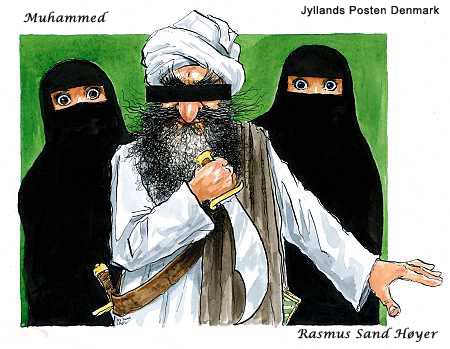
I know that people have sometimes argued that any cartoons that depict stereotypical racial or ethnic features are racist; but I've never been quite persuaded about that, whether as to such cartoons that depict Jews (a common source of this argument) or as to cartoons that depict Arabs.
Cartoons, like illustrations generally, are supposed to provide images that at least have the air of verisimilitude. If one is to depict a generic Jew, a generic Arab, a generic Swede, or an archetypal Arab whose true appearance is unknown (here, Mohammed) one ought to depict him in a way that makes people recognize what is being discussed. "A conventional, formulaic, and oversimplified conception, opinion, or image" (the definition of stereotype) may be unsound if used as an overgeneralization about people's traits — but that's what cartooning requires. If you can't use characteristic features of a group's appearance, effective cartooning — or illustration generally — becomes much harder, in my view unjustifiably harder.
I think the matter is different if the features are portrayed in a way that makes them look ridiculous or disgusting. At some point, exaggeration, for instance a ridiculously beaked nose on a Jew or on an Arab, or exaggerated lips on a cartoon depicting someone black, does make the subject look that way, and may be seen as an aspersion on the ethnic group to which the person belongs. But the important point, in my view, is that this is true as to certain sufficiently exaggerated or distorted depictions, not as to depictions of stereotypical features generally.
The cartoon does depict Mohammed negatively — but because of what he's doing, coupled with the fierce cast of his features (which is not necessarily linked to their stereotypical qualities). One might compare it, for instance, with this cartoon:
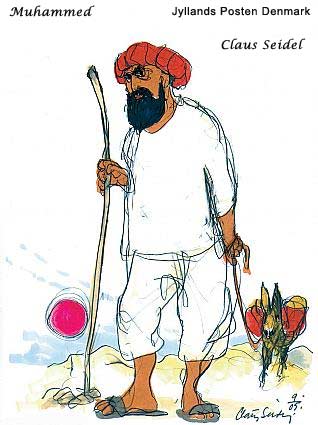
The features are comparable, though not identical; but the latter cartoon seems like a humanizing and even compassionate portrait. It's the message of hostility to a particular religious belief system embodied by Mohammed that differentiates the two, not that one uses somehow inherently "racist" imagery and the other doesn't.
In any case, that's my take on it. Perhaps I'm mistaken, but it seems to me that the permissible stereotyping vs. exaggeration to make the group look ridiculous or disgusting distinction is an important one, and that visual stereotyping can't be universally condemned at least where cartooning is concerned.
But, as I said before, the more important point is that one can't even have this discussion unless one can see the cartoons themselves — further evidence that it's unsound to argue, as the New York Times did, that "report[ing] on the cartoons but refrain[ing] from showing them" "seems a reasonable choice for news organizations that usually refrain from gratuitous assaults on religious symbols, especially since the cartoons are so easy to describe in words."
UPDATE: Thanks to Human Events Online for the high-resolution cartoons, and to reader Nels Nelson for the pointer to those cartoons.
Related Posts (on one page):
- We Are All Danes Now, Latest Installment:
- Canada's Largest Retail Bookstore Bows To Fear of Anti-Cartoon Demonstrations,
- "Racist" Cartoons:
- It Appears Borders Is Carrying the Harper's Issue
- Harper's Magazine Apparently Publishing the Mohammed Cartoons,
- Free Speech and Tort Lawsuits Over Attacks on Bookstores:
- Fear of Extremist Muslim Violence Suppresses Speech in the U.S.:
Wired News reports on a lawsuit over virtual land. For those excited about the prospects of developing all sorts of new weird legal rules to govern virtual words, note that this seems to be a pretty simple breach of contract theory, based on the alleged breach of a real-world contract.
Thanks to my friend Haym Hirsh, a computer science professor at Rutgers, for the pointer.
Here's today's Slate's Bushism of the Day:
"That's George Washington, the first president, of course. The interesting thing about him is that I read three -- three or four books about him last year. Isn't that interesting?" -- Showing German newspaper reporter Kai Diekmann the Oval Office, Washington, D.C., May 5, 2006
Now it strikes me as a little odd that Slate, one of the pioneers of online journalism, doesn't take advantage of one of the great advantages of online journalism over offline journalism -- the ability to link to the original sources (eithers ones that are already online or ones that are put up on the Web by the journal itself), so that readers can see the context for themselves.
Here is the context for that quote:
That's George Washington, the first President, of course. The interesting thing about him is that I read three -- three or four books about him last year. Isn't that interesting? People say, so what? Well, here's the "so what." You never know what your history is going to be like until long after you're gone. If they're still analyzing the presidency of George Washington -- (laughter.) So Presidents shouldn't worry about the history. You just can't. You do what you think is right, and if you're thinking big enough, that history will eventually prove you right or wrong. But you won't know in the short-term.
Without this context, Bush's quote seems mysteriously inarticulate, and understandable only as an unintentional self-parody of his own unintellectualism. Why would he say that it's interesting that he read three or four books about Washington this year? Mystifying.
But the rest of the quote explains the mystery, and makes what strikes me as a pretty sensible (though of course not earthshattering) point. It's true that as a logical matter the interesting point for Bush's argument is that there are three or four such books (presumably recent ones), not that Bush read them. But it's the sort of formally illogical but conveniently descriptive statement that ordinary speakers would, I think, often make, if they wanted to orally make the points that (1) there are (at least) three or four books on a subject, and at the same time that (2) they're interested in the subject enough to have read three or four such books on it.
In any case, analyze this how you will -- but it does seem to me that (A) the full quote seems a lot different from the brief excerpt that Slate provided, and (B) it would be nice if Slate made a habit of providing links so that readers can more easily check such things for themselves.
All Related Posts (on one page) | Some Related Posts:
- Whom Are You Going To Believe -- The Transcript or Your Lying Ears?
- Bushism of the Day:
- My Three Suggestions for Improving Slate:...
- We Provide the Context, So Slate Doesn't Have To:
- We Provide the Context, So Slate Doesn't Have To:
- Another Puzzling Bushism:...
- Bushism of the Day:
- Spinsanity criticizes Slate's Bushisms and Kerryisms.
- Latest Bushism:
As some anticipated, one of the nation's most famous (or perhaps infamous) litigation firms has been indicted on a range of charges, including money laundering, mail fraud, conspiracy, racketeering, and filing false tax returns. For years Milberg Weiss has been the nation's dominant plaintiffs' firm in class-action securities cases.
From today's WSJ (subscription required):
The 102-page indictment details cases, reaching back more than two decades, in which partners in the firm allegedly conspired to pay clients who agreed to act as lead plaintiffs. This would give Milberg an edge in the scramble to be named lead law firm in a case by providing the firm with a "ready stable" of plaintiffs, the grand jury alleged.Aside from the specific charges against Milberg Weiss and some of the firm's partners, this case is of particular interest given the government's aggressive prosecutorial tactics, including pressure to waive attorney client privilege. The WSJ also notes that former Bush Administration Justice Department official Viet Dinh is among the attorneys on the Milberg Weiss defense team, and that the firm launched a website to present its side of the case.The firm paid more than $11 million in kickbacks, the indictment charges, often going to great lengths to disguise the payments as referral fees or other legitimate payments. With the exception of expenses and incidentals, it is illegal for the lead plaintiff in a class action to be paid more than other members of a class.
"This case is about protecting the integrity of the justice system," said Debra Wong Yang, the U.S. Attorney in Los Angeles. "Class-action attorneys and plaintiffs occupy positions of trust in which they assume responsibility to tell the truth....This indictment alleges a wholesale violation of this responsibility." Officials said the investigation was continuing and that more indictments could be expected.
Melvyn Weiss, Milberg's co-founder, said in a statement that the firm and its employees are "outraged" at the indictment. "Our firm is the champion of consumers and investors. We provide access to the courts so that the victims of corrupt corporations can achieve justice." He added that over the years, the firm has recovered more than $45 billion for these victims. "We will vigorously defend ourselves and our partners against these charges, and we will be vindicated," he said.
UPDATE: More on the specifics of the case from the New York Times:
The charges against the firm and the two partners were included in a revised indictment against a retired California lawyer and former Milberg client, Seymour M. Lazar, who was originally charged last summer.From 1981 through about 2004, Mr. Lazar, 78, or members of his family served as plaintiffs in about 70 lawsuits for Milberg Weiss and got about $2.4 million in "secret and illegal kickback payments," the new indictment said.
According to the charges, the scheme involving Mr. Lazar and two other paid plaintiffs worked like this: Plaintiffs would buy securities anticipating that they would decline in value, hence positioning themselves to be named plaintiffs in the class actions.
After the court in a lawsuit awarded lawyers' fees, the firm and Mr. Bershad and Mr. Schulman [two Milberg Weiss attorneys] gave cash directly to the plaintiffs or to intermediary lawyers.
The firm also falsely accounted for the payments as referral fees or professional fees, the indictment said.
Under New York law, it is illegal for a lawyer to promise or give anything to induce a person to bring a lawsuit or to reward a person for having done so, the indictment said.
Furthermore, the payments created a conflict because the paid plaintiffs had a "greater interest in maximizing the amount of attorneys' fees awarded to Milberg Weiss than in maximizing the net recovery" to others in the class, the indictment said.
Related Posts (on one page):
[UPDATE: For more on this subject, which casts doubt on the story quoted below, see here.]
The National Post (Canada) reports:
Human rights groups are raising alarms over a new law passed by the Iranian parliament that would require the country's Jews and Christians to wear coloured badges to identify them and other religious minorities as non-Muslims....
Iranian expatriates living in Canada yesterday confirmed reports that the Iranian parliament, called the Islamic Majlis, passed a law this week setting a dress code for all Iranians, requiring them to wear almost identical "standard Islamic garments."
The law, which must still be approved by Iran's "Supreme Guide" Ali Khamenehi before being put into effect, also establishes special insignia to be worn by non-Muslims.
Iran's roughly 25,000 Jews would have to sew a yellow strip of cloth on the front of their clothes, while Christians would wear red badges and Zoroastrians would be forced to wear blue cloth....
The new law was drafted two years ago, but was stuck in the Iranian parliament until recently when it was revived at the behest of President Mahmoud Ahmadinejad.
A spokesman for the Iranian Embassy in Ottawa refused to comment on the measures.
[Iranian President Mahmoud] Ahmadinejad has repeatedly described the Holocaust as a myth and earlier this year announced Iran would host a conference to re-examine the history of the Nazis' "Final Solution."
He has caused international outrage by publicly calling for Israel to be "wiped off the map." ...
I haven't seen any other stories on this, and the information trail cited in the story seems a little indirect — can anyone shed more light on this?
Many thanks to Clay Young for the pointer.
UPDATE: A Montreal radio station reports:
[I]ndependent reporter Meir Javedanfar, an Israeli Middle East expert who was born and raised in Tehran, says the report is ... "... absolutely factually incorrect[.]"(Thanks to OpinionJournal's Best of the Web and to reader Victor Steinbok for pointing me to this.)"Nowhere in the law is there any talk of Jews and Christians having to wear different colours. I've checked it with sources both inside Iran and outside."
"The Iranian people would never stand for it. The Iranian government wouldn't be stupid enough to do it."
Political commentator and 940 Montreal host Beryl Waysman says the report is true, that the law was passed two years ago....
As I noted in the original post, the information trail cited in the story seems a little indirect — if anyone can shed more light on this, I'd be much obliged.
Related Posts (on one page):
- National Post Apologizes for the Iranian-Jews-Required-to-Wear-Identifying-Markers Story:
- Jewish Member of Iranian Parliament:
- More on Iranian Dress Code?
- Iran Requiring Badges for Christians, Jews, and Zoroastrians?
Thursday, May 18, 2006
That Contains the Mohammed Cartoons.
UPDATE: Just got the article and read it -- it is generally very good, though there's quite a bit in it that I disagree with. And it helps illustrate, I think, what some (including me) have argued: It's hard to seriously discuss the issue without showing the cartoons and talking about them one by one.
Incidentally, one of my disagreements with Art Spiegelman is in his characterization of the Mohammed-with-two-veiled-women cartoon as "An overtly racist caricature of an angry Muhammad." What's racist about it? That he has a big beard and a big nose? But they're not displayed in a way that makes them objects of mockery or derision -- the negative component of the image is his seeming anger, but that's not a racist commentary.
In any case, though, how can one possibly judge whether or not the cartoon is indeed racist -- as some commentators have alleged the cartoons generally, or some in particular, are -- without seeing it for yourself?
Finally, to Spiegelman's credit, he provides his own cartoon that he describes as "My final solution to Iran's anti-Semitic cartoon contest," which strikes me as on-topic, smart, and even humorous in its own blacker-than-black way.
Related Posts (on one page):
- We Are All Danes Now, Latest Installment:
- Canada's Largest Retail Bookstore Bows To Fear of Anti-Cartoon Demonstrations,
- "Racist" Cartoons:
- It Appears Borders Is Carrying the Harper's Issue
- Harper's Magazine Apparently Publishing the Mohammed Cartoons,
- Free Speech and Tort Lawsuits Over Attacks on Bookstores:
- Fear of Extremist Muslim Violence Suppresses Speech in the U.S.:
In fact, my computer searches could find no previous instances of this combination before (emphasis added):
[N]o constitutional provision prohibits the dissemination of general information on subjects of public interest to children or to adults (unless it is the Establishment or the Treason Clause).The quote is from the panel's order refusing rehearing nostra sponte (not sua sponte) in Fields v. Palmdale School District. I discussed the original panel decision in Fields here; it's the case in which the Ninth Circuit held that distributing a survey with sex-related questions to public elementary school students didn't violate the Constitution.
Just got This Is Our War, a book of "Servicemen's Photographs of Life in Iraq" (Devin Friedman & the Editors of GQ, eds.) -- very interesting.
May Help Lead to Legal Liability Under Hostile Work Environment Harassment Law:
Candy Bredt, a white woman, worked as a medical assistant at the Cancer Institute of New Jersey (a division of the University of Medicine and Dentistry of New Jersey); after she quit, she sued, complaining about (among other things) racial harassment.
The alleged harassment consisted of three categories of speech and conduct.
"[Regina] Johnson[, a coworker,] told plaintiff that she had a 'black butt' and subsequently smacked her on the buttocks on at least three occasions. Johnson threatened to 'kick her white ass.'"
Johnson also made some much more political statements. "Johnson routinely spoke about how white state troopers always harassed her and her husband. In her deposition plaintiff testified that because the office was small and crowded, she was forced to listen to Johnson's contentious discussions with others, including her supervisor defendant Will[ia]ms, about how white people got all of the jobs and that there were not enough black doctors and nurses at CINJ. Plaintiff testified that she recalled on one occasion that defendant Williams distributed a flier that depicted photographs of newly graduated doctors. Johnson and Williams looked at the photos to see 'how many black doctors graduated because it's all white people and Indians.' They then said, 'Look at that. Disgusting.'"
This was listed on par with the first category, under the rubric of "[P]laintiff contends Johnson's speech and conduct were clearly indicative of her racial animosity towards white people and created a work environment of 'black vs. white' and 'us vs. them.’”
"In addition to the racially charged comments, plaintiff testified that Johnson told her that she hated her, called plaintiff stupid, also called her 'asshole' once a week, and on one occasion took her finger and pushed it against plaintiff's breast."
The court reversed a summary judgment entered in favor of the employer, concluding that a jury could find that the offending speech could lead to legal liability:
We are satisfied that when the race-based comments and conduct directed at plaintiff, and the racially insensitive remarks about white people plaintiff was forced to overhear, are considered along with the facially neutral comments and conduct Johnson directed towards plaintiff, a jury could reasonably find that Johnson's conduct and racially charged comments were directed towards plaintiff because she was white, were sufficiently severe or pervasive to make a reasonable person believe that the conditions of the workplace had been altered, and that the working environment had become hostile or abusive.
Bredt v. Johnson, 2006 WL 941754 (N.J. Super. App. Div. Apr. 13).
This, it seems to me, is a serious First Amendment violation. I’ve argued elsewhere that offensive one-to-one speech, such as that involved in items 1 and 3, may indeed be properly punishable under harassment law. Speech said to a particular person who is offended by it, and who wants it to stop, is likely only to insult, not to edify or educate. But under the First Amendment, discussions with willing listeners about racial profiling, or about allegedly bad racial disparities in various professions, have to be constitutionally protected against government-imposed legal liability, even if some people who overhear them may be offended.
Now in many harassment cases, including this ones, there’s a complicating factor: The lawsuit is based on a combination of protected speech and unprotected conduct or unprotected speech (such as offensive touching, threats, or even one-to-one insults).
But the free speech law on this is quite clear: A judgment cannot be based even in part on constitutionally protected speech. If the plaintiff wants to sue based on the unprotected material, that’s just fine; the factfinder should then be allowed to consider only that material. But a plaintiff cannot argue for a judgment based both on the unprotected matter and the constitutionally protected speech. (For cites and more argument, see here.)
This makes sense, both theoretically and practically. Theoretically, assume that someone is sued for a combination of constitutionally protected speech and unprotected conduct. The plaintiff’s argument is that the speech and the conduct supposedly create a “hostile environment” or “interfere with prospective business advantage” or “intentionally inflict emotional distress” or some such.
Either the lawsuit would succeed based on the conduct alone, or it wouldn’t. If it would succeed, then there’s no reason why the words need to be considered: Might as well sue just based on the conduct.
But if it wouldn’t succeed without the words, then it’s the constitutionally protected speech that makes the difference between the defendant’s actions being lawful and unlawful. If the defendant had engaged only in the unprotected conduct, he would have been acting lawfully, since by hypothesis the conduct alone wasn’t sufficient to support the plaintiff’s claim. But making the constitutionally protected statements in addition to the conduct is what makes the behavior illegal. The law is punishing the constitutionally protected speech, since it wouldn’t have punished the conduct standing alone. That’s a First Amendment violation.
What’s more, in most civil cases (including harassment cases), the jury will be asked to render a general verdict as to whether there was speech or conduct that was severe or pervasive to create a hostile, abusive, or offensive work environment based on race. They could disbelieve the plaintiff's claims about the statements in the first and third categories, but find hostile environment liability based on just the statements in the second category. Or they could believe some of the plaintiff's claims, and conclude that a combination of some of the statements in all three categories created a hostile environment, but without the statements in the second category, the other speech wouldn't have risen to the level of a hostile environment. Or they could find a hostile environment based solely on the first and third categories.
We just won't know, because they won't be rendering specific findings about each claimed statement. All we know is that the jury verdict may well have rested on the racial profiling/racial disparity statements alone.
Practically, imagine how a reasonably cautious employer would react to a decision imposing liability in a mixed protected speech/unprotected speech case. Recall that in harassment cases, the employer may be liable for the aggregate of the statements made by a wide range of employees -- an insult here, an overheard racially offensive political discussion there, a poster there.
Given this, the employer can’t just say to its employees “It’s fine for you to make potentially offensive political statements about racial profiling or racial disparities in various professions, unless some other people are also mistreating the offended worker in other ways (about which you, the employee, might not even know).” So long as courts say that constitutionally protected speech can contribute to a hostile environment, the cautious employer would be wise to restrict it: After all, it’s this constitutionally protected speech that might make the difference between a legally permissible, nonhostile environment, and an illegal hostile environment. So -- just as the Court has recognized -- imposing liability based on a combination of constitutionally protected speech and unprotected conduct would unconstitutionally chill the speech.
For those of us still holding out hope for the return of Arrested Development on another network, the announcement of the Bluth Family Estate Sale this weekend is yet another nail in the coffin of those hopes:
Friday, May 19 – Sunday, May 21, 2006 2032 Stoner Avenue, Los Angeles, CA 90025 | Driving Directions and Map 8:00 a.m. – 4:00 p.m. Estate Sales Los Angeles is pleased to announce that it will conduct an exciting prop house sale of the contents of one of Twentieth Century Fox Television's favorite television shows of the past decade "Arrested Development".
Spectacular array of items will include several periods of furniture, magic show accessories and artifacts, interior décor items, art, books, kitchen appliances and kitchen ware, interior/exterior lighting, office furniture, extensive entertainment memorabilia and too much more to itemize.
Don't miss the opportunity to own a piece of this show.
Congress seems intent on doing something to address current gasoline prices. Last time around all they could muster was a pork-laden energy bill that did nothing meaningful to address consumer concerns about energy costs and price volatility. Alas, Congress does not seem to have learned its lesson, and is pursuing a new set of policies that will do little good, and may cause harm -- or so I argue in this NRO column.
If Congress really cares about high gasoline prices -- even if the gasoline is more affordable than in decades past -- they should consider the role of current federal policies in reducing supply, balkanizing markets, enhancing price volatility, and discouraging alternative fuel sources. Yet if Congress won't even reduce tariffs on ethanol imports -- which would significantly reduce the costs associated with current ethanol mandates -- I see little hope for more meaningful policy reforms.
On a related note, here is a new study on SSRN quantifying the effect of reformulated gasoline requirements on wholesale gasoline prices and price volatility. The abstract is below:
The 1990 Clean Air Act Amendments stipulated gasoline content requirements for metropolitan areas with air pollution levels above predetermined federal thresholds. The legislation led to exogenous changes in the type of gasoline required for sale across U.S. metropolitan areas. This paper uses a panel of detailed wholesale gasoline price data to estimate the effect of gasoline content regulation on wholesale prices and price volatility. In addition, we investigate the extent to which the estimated price effects are driven by changes in the number of suppliers versus geographic segmentation resulting from regulation. We find that prices in regulated metropolitan areas increase significantly, relative to a control group, by an average of 3.6 cents per gallon. The price effect, however, varies by ten cents per gallon across regulated markets and the heterogeneity across markets is correlated with the degree of geographic isolation generated by the discontinuous regulatory requirements.
Related Posts (on one page):
- Energy Policy Follies
- Gasoline Affordability Revisited:
- The Affordability of Gas:
The New York Times reports on how technology has made it easier for students to cheat, leaving universities to play catch up.
With their arsenal of electronic gadgets, students these days find it easier to cheat. And so, faced with an array of inventive techniques in recent years, college officials find themselves in a new game of cat and mouse, trying to outwit would-be cheats this exam season with a range of strategies — cutting off Internet access from laptops, demanding the surrender of cellphones before tests or simply requiring that exams be taken the old-fashioned way, with pens and paper.
Whether or not students are relying on technological gadgets, cheating appears to be quite widespread.
In a survey of nearly 62,000 undergraduates on 96 campuses over the past four years, two-thirds of the students admitted to cheating. The survey was conducted by Don McCabe, a Rutgers professor who has studied academic misconduct and helped found the Center for Academic Integrity at Duke.
Wednesday, May 17, 2006
Tonight, in Detroit, the Cleveland Cavaliers defeated the Detroit Pistons, 86-84, to take a 3-2 series lead. All hail Lebron James - a master of the game, and he's only 21.
At Marginal Revolution, Alex Tabarrok has posted the text of an open letter summarizing the economic consensus on immigration. If Gregory Mankiw, Vernon Smith, Tyler Cowen, and Brad DeLong agree, it's worth taking to heart.
Related Posts (on one page):
- Immigration for Academics II - Answering the Challenge:
- Immigration for Academics:
- Immigration: The Economic Consensus
From "Definitions of Racism":
Cultural Racism:Also included: "Defining one form of English as standard," and "identifying only Whites as great writers or composers." I should say that assuming that only Whites can be great writers or composers is of course indeed racism; but providing a list of the greatest composers and writers that consists only of whites may be perfectly legitimate, depending on your criteria (which could be entirely fair, though not indisputable, criteria) of greatness.Thanks to Hans Bader for the pointer.
Those aspects of society that overtly and covertly attribute value and normality to white people and Whiteness, and devalue, stereotype, and label people of color as “other”, different, less than, or render them invisible. Examples of these norms include defining white skin tones as nude or flesh colored, having a future time orientation, emphasizing individualism as opposed to a more collective ideology, defining one form of English as standard, and identifying only Whites as great writers or composers.
Related Posts (on one page):
- Seattle School District Takes Down Odd Definition of "Cultural Racism"
- Seattle Public Schools' Web Site Says Individualism is a Form of "Cultural Racism":
with commentary by Art Spiegelman. Robert Bidinotto asks whether Borders will likewise refuse to stock these (though I should note that I don't entirely agree with his analysis). I called the Borders on Westwood; the Harper's site lists that store as a place to buy the magazine, and the clerk there said they regularly carried out, but didn't have it now -- I don't know whether it's because the issue hasn't yet arrived (though the Chronicle article linked to above says that the issue was available on newsstands Tuesday), has sold out, or is not being carried by Borders.
Related Posts (on one page):
- We Are All Danes Now, Latest Installment:
- Canada's Largest Retail Bookstore Bows To Fear of Anti-Cartoon Demonstrations,
- "Racist" Cartoons:
- It Appears Borders Is Carrying the Harper's Issue
- Harper's Magazine Apparently Publishing the Mohammed Cartoons,
- Free Speech and Tort Lawsuits Over Attacks on Bookstores:
- Fear of Extremist Muslim Violence Suppresses Speech in the U.S.:
Since 1988, John and Judith Rapanos have been embroiled in a dispute with the government over federal regulation of remote wetlands on their property. For more than ten years they have had to defend themselves in court against an expansive interpretation of the Clean Water Act the U.S. Supreme Court has never sustained and arguably rejected in Solid Waste Agency of Northern Cook County v. United States Army Corps of Engineers, 531 U.S. 159 (2001) ("SWANCC")--an interpretation that has created a stark conflict among the Courts of Appeals and which raises serious constitutional questions.One of the articles about the case to which it links is by our own Jonathan Adler: Supreme Clean Water Day. Here is his summary of the issues in the case:
As a result of a separate criminal suit, John Rapanos now faces jail time in a federal penitentiary while in this civil case both he and his wife are subject to fines and mitigation fees totaling several million dollars. The Rapanos are accused of filling wetlands--shallow depressions--on their property without a federal permit in purported violation of section 404(a) of the Clean Water Act.
The issues raised by Rapanos and the Carabells are hardly new. The precise scope of federal authority to regulate “navigable waters of the United States” has been contested since the CWA was enacted in 1970. Initially, the U.S. Army Corps of Engineers denied the law applied to wetlands, but environmentalists sued and the Army Corps changed its mind. Some years later, the Supreme Court upheld the regulation of wetlands adjacent to navigable waters, holding that the CWA covers those wetlands “inseparably bound up with the ‘waters’ of the United States.” The Court considered the scope of “navigable waters” again in 2001, this time finding the federal government had gone too far. In Solid Waste Agency of Northern Cook County v. U.S. Army Corps of Engineers (SWANCC), the Court rejected the federal government’s claim that the presence of migratory birds allowed the Army Corps to regulate isolated ponds lacking any hydrological connection to navigable waters.Depending on its outcome and holding, Rapanos could be decided on statutory grounds, or it could signal whether the aspect of the "New Federalism" that sees some limits on the Commerce Clause power of Comgress is dead or alive.
The Carabells and Rapanos argue that SWANCC is proof the federal government lacks the authority to regulate their lands. It is one thing to regulate wetlands directly adjacent to navigable waters, they claim, quite another to control every parcel abutting the tributaries of such waters, let alone those lands alongside ditches that drain into the tributaries. The federal government maintains that any hydrological connection is enough to sustain federal jurisdiction, and that without control over adjacent wetlands federal regulators cannot fulfill their mandate to protect the waters of the United States from pollution and other threats. However reasonable this argument may seem, it is a license for federal regulatory control over literally millions of acres of private land.
The Wisconsin Supreme Court has announced its 4-3 decision in Wisconsin v. Fischer. Previously, the Court had held that Wisconsin's complete prohibition on concealed handgun carry could not constitutionally be applied to carrying in one's home or place of business. However, the Court also ruled that Wisconsin's constitutional right to arms did not forbid the prohibition of concealed carry in an automobile. Today's decision examined the case of a tavern owner who carried large sums of cash in his automobile after closing the tavern late at night in dangerous neighborhood. The majority of the court held that automobile carry was constitutionally protected only in "extraordinary" circumstances, which the majority said were not present in the instant case.
Three dissenters would have ruled that the concealed carry prohibition could not constitutionally be applied to the instant case. One of the three wrote a dissenting opinion in which he argued that Wisconsin's total ban on concealed carry should be held facially unconstitutional, in light of the right to arms which Wisconsin voters overwhelmingly added to their state constitution in 1998. The dissent briefly cited an Albany Law Review article I wrote about the previous Wisconsin cases. This is my 8th state supreme court citation, for those of you who are counting.
Diverges from the Supreme Court's Kelo Decision: That's what Board of County Com'rs of Muskogee County v. Lowery, 2006 WL 1233934 (Okla.), decided last Tuesday, appears to hold. I haven't read the whole opinion yet, but here's what seems to be a key excerpt (some paragraph breaks added):
To the extent that our determination may be interpreted as inconsistent with the U.S. Supreme Court's holding in Kelo v. City of New London, today's pronouncement is reached on the basis of Oklahoma's own special constitutional eminent domain provisions, Art. 2, §§ 23 & 24 of the Oklahoma Constitution, which we conclude provide private property protection to Oklahoma citizens beyond that which is afforded them by the Fifth Amendment to the U.S. Constitution.In other words, we determine that our state constitutional eminent domain provisions place more stringent limitation on governmental eminent domain power than the limitations imposed by the Fifth Amendment of the U.S. Constitution. We join other jurisdictions including Arizona, Arkansas, Florida, Illinois, South Carolina, Michigan, and Maine, which have reached similar determinations on state constitutional grounds. Other states have similarly restricted the government's eminent domain power through state statute.
While the Takings Clause of the U.S. Constitution provides "nor shall private property be taken for public use without just compensation," the Oklahoma Constitution places further restrictions by expressly stating "[n]o private property shall be taken or damaged for private use, with or without compensation." That constitutional provision additionally expressly lists the exceptions for common law easements by necessity and drains for agricultural, mining and sanitary purposes. The proposed purpose of economic development, with its incidental enhancement of tax and employment benefits to the surrounding community, clearly does not fall within any of these categories of express constitutional exceptions to the general rule against the taking of private property for private use.
To permit the inclusion of economic development alone in the category of "public use" or "public purpose" would blur the line between "public" and "private" so as to render our constitutional limitations on the power of eminent domain a nullity. If property ownership in Oklahoma is to remain what the framers of our Constitution intended it to be, this we must not do.
One of the Comments to my Champions League post earlier today reminds me of a book I recently read, "How Soccer Explains the World: An Unlikely Theory of Globalization" by Franklin Foer. Relevant to the Comment from this morning, one chapter in Foer's book relates the politics of Barcelona and Real Madrid, relating to Franco, conservatism, and Catalan independence. Barcelona, he claims, symbolizes middle class, metropolitan values, whereas Real Madrid represents conservatism (and was highly associated with Franco). Foer is also a Barca fan, so maybe that's why I liked the book so much...
His chapter on Italian soccer was quite interesting as well. First, he discusses the rivalry between the two Milan clubs, Inter and AC Milan and the issues of politics rolled up in that rivalry. He has this quite amusing description of the efforts of Inter fans (Communists and other anti-Berlusconi people) to try to invest Inter with all kinds of political symbolism.
Foer also discusses at great length the longstanding rumors in Italian soccer that Juventus has for a long time corrupted the referee selection process in Italy--exactly the allegations that have exploded in Italian soccer over the past few weeks. For those interested in that issue, Foer provides a nice background to the current scandal.
Foer's larger theme is using soccer as a exemplar and case study of human tribalism and human "groupishness" and the way in which these soccer rivalries and affiliations come into contact with the modern world of globalization. It is a very colorful and entertaining book and while I can't independently vouch for the portrayals he lays out in the book I think it is quite a clever and entertaining way of not only talking about soccer but raising some interesting questions about the the tensions created by globalization.
Is it a good idea to deploy National Guard units along the U.S.-Mexico border? Department of Homeland Security Secretary Michael Chertoff did not think so several months back. (Hat Tip: Brad DeLong)
This NYT story suggests an indictment is on the way.
Negotiations to avert an indictment of the firm have stepped up in recent weeks. But by this week, hopes for a settlement were quickly fading as both sides remain far apart on several crucial points surrounding any so-called deferred prosecution agreement, including the waiver of client-attorney privileges; new compliance and monitoring systems and personnel the firm would be required to put in place; and the size of any potential payments, according to several lawyers involved in the talks.
Federal prosecutors were initially seeking a payment of more than $100 million, the lawyers said. A payment of that size would either require individuals inside the firm to put up the cash themselves or the firm to commit to pay it from future earnings, the lawyers said.
The talks have been complicated by the Justice Department's reluctance to indict a firm since it came under fire for putting the accounting firm Arthur Andersen out of business after it was indicted on obstruction of justice charges in 2002. (The firm's conviction was later overturned by the Supreme Court.) Since then, the accounting firm KPMG and the drug maker Bristol-Myers Squibb, among others, have reached deferred-prosecution agreements with Justice.
Furthermore, in the dog-eat-dog world of class-action securities law, Milberg Weiss has one of the biggest barks.
Related Posts (on one page):
- Olson & WSJ on Milberg Weiss:
- More on Milberg Weiss Indictment:
- Milberg Weiss Indicted
- Will Milberg Weiss Be Indicted?
The first time I ever visited Europe I went to Spain, and the first city I visited was Barcelona. I fell in love with both the city and the soccer team. Since that time I've been a Barca fan and, needless to say, have reveled in the team's return to form in recent years.
Barca is the favorite to take the Champions League Title today. And in a twist that may even top the "Giambi to the Yankees" scenario of a few years ago, Arsenal's captain Thierry Henry, is expected to join Barcelona following this game. (It is amazing to me the sorts of things that English bookies will post odds on.) If Barca plays like they have this season, both in the Champions League and the Primera League, Arsenal will have its hands full. Nonetheless, this looks like one of those classic battles of offensive v. defensive strengths that can turn out unpredictably.
I'm sure all you Gunners fans out there will let me know in the Comments why I'm sure to be disappointed this afternoon...
Tuesday, May 16, 2006
Though only one member of the Churchill investigative committee recommended that Churchill be fired -- two others recommended a five-year unpaid suspension, and two more recommended a two-year unpaid suspension -- it seems to me that this one member was right.
As best I can tell, from what press accounts I've read and from the Report itself, Churchill hasn't shown any contrition. His falsification, fabrication, and plagiarism (in the Committee's words), which the Committee quite plausibly found to be deliberate, are substantial.
And these are falsehoods in his published work, which can readily be checked. How can his future students be confident that things he says in class are accurate? (Yes, we try to instill skepticism in our students, but they still rightly expect that they can count on our factual assertions, rather than double-checking every word.) How can his colleagues, and Colorado taxpayers, be confident that his students are learning things accurately? His work has been cited by over 100 times in law reviews alone, and law isn't even his main field; I assume that quite a few scholars are now wondering whether their reliance on his work led their own work to be in error. How can other scholars, and his other readers, ever rely on anything he says?
It seems to me that keeping him on the faculty would be a substantial disservice to Colorado students, Colorado taxpayers, and the academic fields in which he works. I hope that in its sympathy for a colleague, and its desire to avoid hassle or even litigation, the University doesn't lose sight of that.
Related Posts (on one page):
Something is missing on this map, provided by Foreign Policy magazine -- something pretty significant, though I admit not vast. Hat tip to Michael Standaert (Huffington Post) for catching this; see that post for the answer. The map accompanies this story on "countries on the verge of collapse."
The Churchill report generally seems very thoughtful and scholarly, but it does have a small error (which commenter DelVerSiSogna also caught). The report states (p. 4):
To use an analogy, a motorist who is stopped and ticketed for speeding because the police officer was offended by the contents of her bumper sticker, and who otherwise would have been sent away with a warning, is still guilty of speeding, even if the officer’s motive for punishing the speeder was the offense taken to the speeder’s exercise of her right to free speech. No court would consider the improper motive of the police officer to constitute a defense to speeding, however protected by legal free speech guarantees the contents of the bumper sticker might be.
In fact, the First Amendment rule, as set forth in Wayte v. U.S., 470 U.S. 598 (1985), is:
"Selectivity in the enforcement of criminal laws is . . . subject to constitutional constraints." In particular, the decision to prosecute may not be "'deliberately based upon an unjustifiable standard such as race, religion, or other arbitrary classification,'" including the exercise of protected statutory and constitutional rights [such as free speech].
Even prosecution of people who are guilty of a nonspeech crime might thus violate the First Amendment if the government deliberately selected them for prosecution because of their constitutionally protected expression (though I should note that this is a very tough claim to prove).
Nonetheless, whatever may be the rule for criminal prosecutions triggered by the policeman's own hostility to the target's speech, such a rule need not be applied here. This isn't a criminal prosecution, but the university's decision whether to keep someone on its faculty; it need not keep a dishonest scholar on board, even if the complaints about the scholar were motivated partly by the complainers' hostility to the scholar's viewpoints. And as best I can tell, there's little reason to think that the University wouldn't have investigated Churchill had he been accused of the same misconduct but had expressed diferrent views. These are serious charges, and my guess is that most universities would indeed look into alleged multiple falsification of evidence and plagiarism by their faculty members.
There was a connection between Churchill's politics and the investigation, but it seems to me much more attenuated than in the bumper sticker context. Churchill first attracted public notice because of his "little Eichmanns" comment. This led people to scrutinize his work, and past critics of his to repeat their criticisms. This in turn yielded the large body of accusations, large enough that the University had to take notice (in a way that it didn't seem to have done when at least one of the accusations had been separately brought to its notice some years before). So the better analogy is if someone had caused a lot of controversy by his bumper sticker; this caused a lot of people to notice him, and in the process to notice that he was speeding; they in turn complained to the police officer; and the police officer gave him a speeding ticket. There, I think there's no problem under Wayte; the government official (the police officer) wasn't making the enforcement decision based on the bumper sticker, though the people who complained to the officer -- private parties who have no viewpoint-neutrality obligation under the First Amendment -- were motivated by the bumper sticker.
As the report points out, "public figures who choose to speak out on controversial matters of public concern naturally attract more controversy and attention to their background and work than scholars quietly writing about more esoteric matters that are not the subject of political debate" (p. 4). That seems to me to be exactly what happened here. Unfortunately for Ward Churchill, it turns out that his scholarship couldn't bear the attention that his statements prompted.
Related Posts (on one page):
- Text of University of Colorado President's Letter About Ward Churchill:
- Dismissal Recommended for Ward Churchill
- The Punishment in the Ward Churchill Case:
- Real Misconduct, Uncovered By Politically Motivated Actions:
- Churchill and Sock-Puppetry:
- Ward Churchill:
The Churchill report is much worth reading -- it's long, but quite interesting and strikes me as quite persuasive (though I should stress that I haven't checked the sources myself).
Here's an interesting item that I haven't seen much discussed: Churchill is found guilty of passing off others' work as his own (plagiarism), but also of passing off his own work as others'. The latter is faulted as a general departure from "established standards regarding author names on publications" (p. 89); but it's also more specifically, and more seriously, faulted because Churchill then used the work published under another's name "as apparently independent authority for claims that he makes in his own later scholarship" (p. 89). This "permits the author to create the false appearance that his claims are supported by other scholars when, in fact, he is the only source for such claims" (p. 90). Here's an example, from pp. 23-24 (some paragraph breaks and emphasis added):
Footnotes 63 and 64 of his “Perversions of Justice,” in Struggle for the Land (1993 edition), contain basically three sources to support the claims regarding the General Allotment Act of 1887. All appear to the reader to be reputable, independent third-party sources.
First, Professor Churchill cites directly to the originally enacted version of the General Allotment Act of 1887 .... [But n]ot only is his statement unsupported by his source, but also more significantly, he did not follow the referencing convention that a lawyer or historian citing a lengthy statute for a particular detail normally would follow, which is to pinpoint the precise section number of the multi-section statute that supported his claim. As one will see throughout this report, this general reference to an apparent independent source in its entirety constitutes an unconventional referencing style frequently employed by Professor Churchill to create the appearance of independent support for his claims, while simultaneously discouraging or, at least, making far more difficult, any effort by other researchers to check his claims by failing to pinpoint the precise location of his claimed support in an otherwise lengthy work. Standing alone, this referencing failure might constitute some level of sloppiness, but certainly would not constitute research misconduct.
When it is combined with a pattern of other misconduct reflected in this and other allegations, however, the Committee is left with a firm impression, by a preponderance of the evidence, that it constituted part of a deliberate research stratagem to create the appearance of independent verifiable support for claims that could not be supported through existing primary and secondary sources. To put it most simply, it was part of a pattern and consistent research stratagem to cloak extreme, unsupportable, propaganda-like claims of fact that support Professor Churchill’s legal and political claims with the aura of authentic scholarly research by referencing apparently (but not actually) supportive independent third-party sources. The next problem discussed with these two footnotes makes this stratagem far clearer.
The other two apparently independent third-party sources cited in footnotes 63 and 64 are essays published in the same volume, The State of Native America, one under the name of a person named Rebecca Robbins and the other under the name of M. Annette Jaimes, the editor of the volume. Since both essays do contain statements of the type that Professor Churchill claims, that might have put an end to the matter of research misconduct regarding this allegation, except for the fact that in response to the separate allegation that he had plagiarized the Robbins essay in another later published piece, Professor Churchill said in Submission E that he had in fact ghostwritten both the Robbins and the Jaimes essays, in full.... [This] constitutes a serious problem of research misconduct. The initial support for the disputed statement involved three independent sources. As already noted, the Act does not expressly provide what Professor Churchill claims and therefore can provide no support for his claims whatsoever. The two other apparently independent third-party sources, the Robbins and Jaimes essays, turn out not to be independent sources at all but, rather, to have been ghostwritten in their entirety by Professor Churchill. This action provided him with apparent independent sources that he could and did in fact cite to support otherwise insupportable claims of legal and historical fact. In short, when one carefully dissects the Churchill claim quoted in the original allegation, the three apparently independent third-party sources dissolve into one source (the Act) that clearly does not expressly support his claim, and two other sources (the Robbins and Jaimes chapters) that he wrote himself.
Although Professor Churchill purported to offer his claims as supported by research, based on independent sources, it turns out that the claims not only cannot be supported but that he has misrepresented the independent nature of his sources employed to buttress the unsupportable details of his conclusions....
The University of Colorado's report on the investigation of Ward Churchill's alleged scholarly misconduct has just been released. Here's an excerpt of the summary:
Summary of Key Points of Report of the Investigative Committee of the Standing Committee on Research Misconduct at the University of Colorado at Boulder concerning Allegations of Academic Misconduct against Professor Ward ChurchillMay 16, 2006
The Committee was charged with investigating seven allegations:
Allegation A: Misrepresentation of General Allotment Act of 1887
Allegation B: Misrepresentation of the Indian Arts and Crafts Act of 1990
Allegation C: Captain John Smith and smallpox in New England, 1614-1618
Allegation D: Smallpox epidemic at Fort Clark and beyond, 1837-1840
Allegation E: Plagiarism of a pamphlet by the Dam the Dams group
Allegation F: Plagiarism of Professor Rebecca Robbins
Allegation G: Plagiarism of Professor Fay G. CohenBased on its investigation of those allegations, the Committee unanimously found, by a preponderance of the evidence, that Professor Churchill committed several forms of academic misconduct as defined in the policy statements of the University of Colorado at Boulder and the University of Colorado system:
1. Falsification, as discussed in Allegations A, B, C, and D.
2. Fabrication, as discussed in Allegations C and D.
3. Plagiarism, as discussed in Allegations E and G.
4. Failure to comply with established standards regarding author names on publications, as discussed most fully in Allegation F but also in Allegations A, B, and D.
5. Serious deviation from accepted practices in reporting results from research, as discussed in Allegation D.The Committee did not find fabrication in the first sub-question of Allegation D or plagiarism in Allegation F....
The Committee found that Professor Churchill’s misconduct was deliberate and not a matter of an occasional careless error. The Committee found that similar patterns recurred throughout the essays it examined. The Committee therefore concluded that the degree of his misconduct was serious, but differed on the sanction warranted. The Committee’s report states as follows:
...• Two members of the Committee conclude and recommend that Professor Churchill should not be dismissed. They reach this conclusion because they do not think his conduct so serious as to satisfy the criteria for revocation of tenure and dismissal set forth in section 5.C.1 of the Law of the Regents, because they are troubled by the circumstances under which these allegations have been made, and because they believe that his dismissal would have an adverse effect on other scholars’ ability to conduct their research with due freedom. These two members agree and recommend that the most appropriate sanction, following any required additional procedures as specified by the University’s rules, is a suspension from University employment without pay for a term of two years.
• Three members of the Committee believe that Professor Churchill’s research misconduct is so serious that it satisfies the criteria for revocation of tenure and dismissal specified in section 5.C.1 of the Laws of the Regents, and hence that revocation of tenure and dismissal, after completion of all appropriate procedures, is not an improper sanction. One of these members believes and recommends that dismissal is the most appropriate sanction; the other two believe and recommend that the most appropriate sanction is suspension from University employment without pay for a term of five years....
Voting Members of the Committee:
Chair: Marianne Wesson, Professor of Law, Wolf-Nichol Fellow, and President’s Teaching Scholar, University of Colorado at Boulder
Robert N. Clinton, Foundation Professor of Law, Sandra Day O'Connor College of Law, Arizona State University
José E. Limón, Director, Center for Mexican-American Studies and Mody C. Boatright Regents Professor of American and English Literature, University of Texas at Austin
Marjorie K. McIntosh, Distinguished Professor of History, University of Colorado at Boulder
Michael L. Radelet, Professor and Chair, Department of Sociology, University of Colorado at Boulder
The Christian Science Monitor explores why e-mails are often the source of miscommunication.
Though e-mail is a powerful and convenient medium, researchers have identified three major problems. First and foremost, e-mail lacks cues like facial expression and tone of voice. That makes it difficult for recipients to decode meaning well. Second, the prospect of instantaneous communication creates an urgency that pressures e-mailers to think and write quickly, which can lead to carelessness. Finally, the inability to develop personal rapport over e-mail makes relationships fragile in the face of conflict.
On the whole, the article is a useful summary of what you probably know already.
UPDATE: Kaimipono Wagner thinks these insights might apply to blogging as well.
A left-wing newspaper at the University of Oregon, The Insurgent, ran some cartoons depicting Jesus Christ in (among other things) sexual contexts. A group of Oregon students complained to the University, reasoning that:
The government is perhaps required, or at least allowed, not to support student group speech that "attack[s] specific religious groups or religious concepts."
Speech that is "inten[ded] to incite anger" on the part of certain religious groups is unprotected — or at least may be stripped of government funding — because it's "discriminatory."
Various criticisms of Christianity, for instance "The [Catholic] Church attacked sex, sex education ... and children with a viciousness and vengeance that warps our thoughts today," or "the Church would like to burn [all gays] at the stake if they could," are "fabricated" and therefore violate the University of Oregon Policy on Academic Dishonesty."
To its credit, the University has just rejected this argument. (Thanks to reader Oliver Ruff for the pointer.) As the University program administrator's opinion points out, speech doesn't become "discrimination" just because it's offensive; distributing student fee funds in viewpoint-neutral ways doesn't violate the constitutional rights of objecting students; and the Policy on Academic Dishonesty applies to academic work submitted for a grade, not to public debate. I might have added that First Amendment law requires that these programs be run in a viewpoint-neutral way, with no exclusion of controversial viewpoints (religious, anti-religious, or otherwise); and that the cure for exaggeration and hyperbole in debate is not administrative sanctions, but criticism.
More broadly, I wonder if the Students of Faith had really thought through the implications of their argument. Under their view, public university student group funding programs couldn't fund religious newspapers (though the Supreme Court specifically held in Rosenberger v. Rector (1995) that religious newspapers have a constitutional right to participate in funding programs on par with other newspapers). Public universities would have to, or at least would be allowed to, exclude offensive speech on campus property as well as using campus funds (since access to campus property is itself a form of subsidy) — this would mean bans not just on the Jesus cartoons and the Mohammed cartoons, but on speakers that criticize homosexuality, that argue that some religions are wrong, that discuss biological sex differences, and the like.
Groups that engage in "discriminatory" speech, such as speech that's offensive to, or at least intended to incite anger among, people of a particular religion, race, sex, sexual orientation, or veteran status would have to be stripped of their tax-exempt status as well as any subsidies. (After all, one example that the Students of Faith gave for its position that "public groups that receive public funds are confined by law to much stricter tolerances" than provided under private groups' "virtually unrestricted right to Freedom of Speech" is that "[p]ublicly funded groups cannot promote or attack specific political figures or specific political groups" — a somewhat distorted version of the content-based but viewpoint-neutral prohibition on electioneering and lobbying by tax-exempt groups.) General hyperbole on political, religious, and social topics in student newspapers — such as rhetorical condemnations of the attitudes and actions of the Catholic Church, Christians, atheists, homosexuals, fundamentalists, men, women, feminists, the Bush Administration, Democrats, liberals, or conservatives — would lead to punishment by the school.
This would not, I think, be a good outcome for American public debate, in universities and out. The Court's First Amendment caselaw certainly precludes it: The University of Oregon is subsidizing the Insurgent under a program that "expends funds to encourage a diversity of views from private speakers" (and that doesn't involve a "competitive process according to which the grants are allocated" under an "inherently content-based 'excellence' threshold," see NEA v. Finley). (There is a requirement that, to get funding, a group must be generally certified as advancing the "cultural or physical" development of students; but as best I can tell the funding authorities rightly read this very broadly, and treat all groups that "engage in dynamic discussions of philosophical, religious, scientific, social, and political subjects" as qualifying.)
Such a program for funding a diversity of private groups' speech — as opposed to a program for expressing the university's own views — "may not discriminate based on the viewpoint" of the speakers, as the Court held in Rosenberger. The government might be able to define the program in content-based but viewpoint-neutral ways, such as prohibiting electioneering in favor or against particular candidates, prohibiting lobbying in favor or against particular legislation, or possibly even prohibiting profanity or depictions of nudity (since those too would likely be viewpoint-neutral, though content-based). But it surely couldn't exclude speech on the grounds that it conveys "discriminatory" viewpoints, in the sense of viewpoints that are offensive to various groups.
And this result, I think, is right. The government (federal, state, and local put together) takes and then redistributes 25-30% of the GNP, through funding, access to government property, tax exemptions, access to government-provided services such as the post office, and more. If the government had unlimited authority to condition the use of these benefits on having government-approved, inoffensive, or non-"discriminatory" viewpoints, it would have tremendous authority to influence what kinds of speech can be effectively spread. Once the government has such control over so many places and services — and of course it could one day grow bigger still — there needs to be some constitutional constraint on its ability to leverage that control into control over public debate.
In any case, cheers for the University of Oregon, and a mild Bronx cheer to the Students of Faith. I understand why they're offended, and I understand that undergraduates can't be expected to know the ins and outs of First Amendment jurisprudence. But if you're making assertions about First Amendment law — as the students were doing in their grievance — then you ought to check them with a First Amendment lawyer. And if you're making arguments for why certain speech should be excluded from university-supported publications, it would help to think harder about the implications of those arguments for speech besides the sort that has made you angry in this particular case.
(By the way, for whatever it's worth, I actually find the cartoons somewhat more offensive than the Mohammed cartoons. Bt if the difference — which has to do, in my mind, with the gratuitous connection to sex as a means of showing contempt, with little by way of substantive argument — does exist, it's a difference of degree, not of kind, and one that's not relevant to the First Amendment principle.)
Last week, relying on data posted by Indur Goklany on The Commons Blog, I claimed that gasoline is "more affordable than ever," despite the increase in real and nominal gas prices. Some commenters objected that this generalization is misleading due to a rise in income disparities. The price-to-income ratio for the average American may have dropped, largely because the rich got richer, without equivalent affordability gains for the poor.
Glen Whitman at Agoraphilia investigates this claim by examining the price-to-income ratio by quintile from 1973 to the present, and finds that even for the poorest fifth, gasoline is cheaper than it was at its peak.
So what can we see? Even looking at the poorest fifth of the population, the fraction of income required to buy gasoline is still lower than it was in the early '80s. Not surprisingly, the fraction has risen a great deal over the last few years, but it still has not surpassed its historical peak. The same holds true for every other income quintile, but the effect is more muted, since higher income means any given price difference will correspond to a smaller fraction of income. (If gas prices stay at their current price of about $2.90/gallon, however, then we could pass that early-80s high-water mark this year.)
Related Posts (on one page):
- Energy Policy Follies
- Gasoline Affordability Revisited:
- The Affordability of Gas:
Yesterday the Supreme Court granted certiorari in Environmental Defense v. Duke Energy Corp.. The case arises out of an EPA enforcement action against Duke, alleging violations of the Clean Air Act's New Source Review (NSR) provisions and applicable regulations. Duke prevailed in the district court and before the U.S. Court of Appeals for the Fourth Circuit. (Here is the decision below.)
What is particularly surprising is that the Supreme Court granted the petition filed by environmental group intervenors over the objection of the United States. While the federal government maintained the Fourth Circuit's decision was wrong (and the Justice Department filed an unsuccessful petition for en banc review), the Solicitor General's office argued that Supreme Court review was unwarranted because there was no "square conflict among the courts of appeals" and the EPA was proceeding with additional NSR regulatory proposals that would render the Fourth Circuit's opinion largely irrelevant for future cases. At least four justices found these arguments (and those proffered by Duke Power) unpersuasive, and voted to grant. As Georgetown law professor Richard Lazarus observes, this is "only the third time the Court has granted review at the exclusive request of an environmental organization to hear a case fully on the merits. The other two were standing cases: Sierra Club v. Morton and Friends of the Earth v. Laidlaw."
It is unlikely four justices voted to grant cert because of any burning desire to delve into the complexities of NSR regulation. Rather, it appears the grant was driven by the claim that the Fourth Circuit's decision violated the Clean Air Act's jurisdictional provisions, which grant the U.S. Court of Appeals for the District of Columbia Circuit exclusive jurisdiction over challenges to Clean Air Act regulations of national application. The Fourth Circuit panel, rather than upholding the district court's opinion rejecting the EPA's enforcement action on the various grounds initially urged by Duke Power or supporting amici (of which I was one), held that the Clean Air Act required the EPA to interpret its applicable regulations in a particular way. This holding, Environmental Defense argued, effectively invalidated the applicable EPA regulations, and therefore exceeded the Fourth Circuit's jurisdiction. Moreover, ED maintained, the Fourth Circuit's ruling was in tension, if not direct conflict, with a nearly contemporaneous D.C. Circuit decision involving direct challenges to the relevant EPA regulations.
The cert grant places the federal government in an interesting position. As Professor Lazarus observes, the EPA essentially wanted to walk away from this enforcement action (as it seems to have wanted to walk away from many NSR enforcement cases brought under the Clinton Administration). With this grant, the Supreme Court said no. Having argued both that the Fourth Circuit was wrong and that certiorari was unwarranted, one would expect the Justice Department to revert to its original position, defending the EPA's actions and arguing that the Fourth Circuit had no jurisdiction to rule as it did. A remaining question whether the Supreme Court will confine itself to addressing the jurisidicational question, or will wade more deeply into the intricacies of NSR. I would expect the former, but time will tell.
UPDATE: The Washington Post covers the story here, and editorializes on it here.
Monday, May 15, 2006
Percy Shelley and Harriet Westbrook were married. At first, their marriage was happy, and a year after they married, their daughter was born. Soon after that, however, Shelley realized he no longer loved Westbrook. Though they conceived another child a year after the birth of the daughter, shortly after the conception Shelley ran off with Mary Godwin. Westbrook gave birth to Shelley’s son, and proceeded to raise the children by herself.
Shelley and Godwin wanted to marry each other, but couldn’t do so while Harriet was alive. (For purposes of this problem, assume that divorce is illegal.) Shelley often bemoaned his plight to his friend Lord Byron, a nasty character who had the reputation of being “mad, bad, and dangerous to know.” It was widely rumored that Byron had in the past tried to poison Samuel Coleridge by giving him tainted opium, and had killed both Alexander Pushkin and Vladimir Lensky in duels. Byron often expressed his sympathy to Shelley, and would sometimes say that something needed to be done about Shelley’s problem. “Can Westbrook swim?,” he at one point asked Shelley. “No, she can’t,” Shelley responded. “Hmm,” Byron said.
One day, Shelley returned to the family home to see his children (who were then four and two). Though Westbrook naturally felt herself quite wronged by Shelley, she still loved him; and though Shelley by this point hated her and wished her dead, he was still sexually attracted to her. After the children went to bed, Shelley and Westbrook started to have sex (though Westbrook remained mostly clothed).
Unbeknownst to Shelley, Godwin had suspected that Shelley was still attracted to Westbrook, and followed him. She lurked outside the house, spying on the couple, and drinking a bottle of wine to drown her sorrows. She saw pretty much everything Shelley and Westbrook were doing, and when she saw Westbrook and Shelley start to have sex, Godwin ran in, armed with a pitchfork. Godwin stabbed at Westbrook, but missed her.
Westbrook ran off, fleeing Godwin. Shelley ran after Godwin, but Westbrook wrongly assumed that Shelley and Godwin were in league with each other, so fled both.
Shelley’s and Westbrook’s house was near a river, and Westbrook ran onto a bridge spanning the river. To her surprise, she ran into Byron — whom she had long suspected, it turns out wrongly, of having had a homosexual affair with Shelley — standing in the middle of the bridge. “You somdomite!,” she shouted at Byron, temporarily distracted from her attempt to run away from Shelley and Godwin, and started punching him. (Assume that “somdomite” would generally be understood as a pejorative for “homosexual.”)
Byron then pushed Westbrook, who as a result fell off the bridge into the water. Shelley and Godwin, who by then had caught up, didn’t try to save Westbrook, and Westbrook drowned.
Assume that all this happens in the state of Xanadu, in the present day. Xanadu is generally a common-law jurisdiction, but its courts are open to influence from the Model Penal Code (not including § 210.3(1)(b) [extreme-disturbance manslaughter], which we didn’t study) and from the various state law rules that we studied in class.
Assume that § 1939.9.1 of the Xanadu Penal Code provides that “Burglary, defined as entering the dwelling of another with the intent to commit a crime therein, is a felony.”
In case you find it helpful, you may read and consider Model Penal Code § 2.03, which you may assume all jurisdictions (even non-MPC ones) would apply by analogy. Do not discuss any insanity defense.
Analyze what charges — under criminal law rules that we studied in class (not including assault or battery), or that are defined in this problem — can be brought against Shelley, Godwin, and Byron (though do not discuss charges that can be brought against Byron as to Coleridge, Pushkin, and Lensky).
Just for fun, folks — you don't really have to take eight hours and then post the answer in the comments. In fact, if you'd rather just try to catch all the allusions and post those in the comments, that would be great. I'm sure you'll catch some I didn't even intend to make!
I'm pleased to report that my brother Sasha -- one of the cofounding members of what was then the Volokh Brothers blog, but who's been off the blog while clerking -- will be spending the next two academic years as Visiting Assistant Professor at the Georgetown University Law Center. Professor Volokh, welcome to The Guild, and to your new title! (Of course, he's Professor Doctor Volokh, rather than my own Professor Volokh.)
My coblogger Randy Barnett will also be joining Georgetown (as a full professor), as will Rosa Brooks from the University of Virginia; Amanda Leiter will be also be a Visiting Assistant Professor. It seems to me that Georgetown is doing very well for itself.
I've said it before, but it's worth repeating -- read the instructions, and then reread them some time later.
When I first read the instructions while doing this Spring's law review write-on competition, I saw that they told me to include no more than 80 characters on each line. I can do that, I thought; I carefully adjusted my margins, and thought I was set. (The instructions also told me to use a nonproportionately spaced font, so this fixed character limit was easy enough.)
A few days later, I followed the advice I gave in my book (the point of the exercise, after all, was to test and improve on the advice that I've been giving) -- and saw that the instructions said no more than 70 characters on each line. Whoops! Fortunately, I caught the problem in time, and had plenty of time to trim my paper by 12.5%. (It turns out that one can almost always find enough flab in a first draft to cut that much, and even more.) But I shudder to think of how embarrassed I'd have been if I hadn't caught it in time -- or if I had erred in reading the instructions 16 years ago, on my real write-on, when the error would have cost me an important credential for my future legal career.
Now I'm generally a pretty careful and attentive fellow when it comes to things like this. I know how to read. I know my 7s from my 8s. I don't even have the excuse of having been under the influence of the pressure that ordinary first-year students feel when they're doing the law review write-on. Yet I still made a dumb mistake -- which just shows how easy dumb mistakes like this are to make.
So protect yourself from these mistakes: Make sure that you reread the instructions a few days after you first read them, so that your mind is fresh enough to pay attention to them, but so that there's still time to correct your paper if you find that you misread the instructions at first.
Related Posts (on one page):
- Something My Law Review Write-On Exercise Reminded Me About:
- Write-On Competitions and the Bluebooking/Cite-Checking/Editing Test:
- What I Learned This Spring Vacation -- Doing Things More Than Once:
- What I Did This Spring Vacation:
A fascinating story in yesterday's Washington Post magazine about the execution of convicted murdered Roger Coleman. Coleman was executed in 1992 when I was in law school at UVA and I vividly remember the great controversy surrounding it, and especially this Time Magazine cover story suggesting that an innocent man was about to be executed.
As the Washington Post story recounts, some of those who opposed Coleman's execution kept pushing until last year a DNA test of semen found on the victim was conducted which confirmed that Coleman was in fact guilty. The hook for the Post's story is summarized in one caption, "Even after Roger Coleman's execution, his advocates didn't stop believing in his innocence. The question is why."
A senior federal law enforcement official tells us the government is tracking the phone numbers we call in an effort to root out confidential sources.Link via Raw Story.
"It's time for you to get some new cell phones, quick," the source told us in an in-person conversation.
We do not know how the government determined who we are calling, or whether our phone records were provided to the government as part of the recently-disclosed NSA collection of domestic phone calls.
Other sources have told us that phone calls and contacts by reporters for ABC News, along with the New York Times and the Washington Post, are being examined as part of a widespread CIA leak investigation.
Related Posts (on one page):
- Harris Barnett:
- My Name:
(1) The recreation was even more impressive than I thought. Notice how the reactions of other players to the Jordan move are also recreated. This must have been very difficult.
(2) There was a debate in comments on the original post over whether the recreation showed the "push off" by Jordan that freed him up for his "final shot." Whether or not the contact constituted an illegal push off and whether or not the recreation showed the contact at all, Jordan's contact is much more visible and obvious in the original than in the recreation and this cannot have been an accident. (see point (1))
(3) I think the recreation is somehow more poignant than the original of the very same action.
(4) I still get chills from this. Either version.
Related Posts (on one page):
Sunday, May 14, 2006
The Daily Mail (U.K.) reports:
He is the BBC's latest star - the cab driver who a leading presenter believed was a world expert on the internet music business.
The man stepped unwittingly into the national spotlight when he was interviewed by mistake on the corporation's News 24 channel.
With the seconds ticking down to a studio discussion about a court case involving Apple Computer and The Beatles' record label, a floor manager had run to reception and grabbed the man, thinking he was Guy Kewney, editor of Newswireless.net, a specialist internet publication.
Actually, he was a minicab driver who had been waiting to drive Mr Kewney home.
Baffled, but compliant, the driver was fitted with a microphone and allowed himself to be marched in to the studio. Cameras rolled, and he was quizzed live on air by consumer affairs correspondent Karen Bowerman -- who missed the cabbie's panic-stricken expression when he realised he was being interviewed....
For more, and for the link to the video, see here.
Thanks to reader Patrick Anders for the pointer.
then why is the sound effect for "she'll be coming 'round the mountain when she comes" "toot-toot"?
Is she coming on a train and then renting a team of six white horses? Possible, it seems, but unlikely.
With that introduction, here are the lyrics to Live's "Heaven" off of their 2003 album "Birds of Pray":
You don't need no friends
Get back your faith again
You have the power to believe
Another dissident
Take back your evidence
It has no power to deceive
I'll believe it when I see it for myself
I don't need no one to tell me about heaven
I look at my daughter, and I believe.
I don't need no proof when it comes to God and truth
I can see the sunset and I perceive
I sit with them all night
Everything they say is right
But in the morning they were wrong
I'll be right by your side
Come hell or water high
Down any road you choose to roam
I'll believe it when I see it for myself
I don't need no one to tell me about heaven
I look at my daughter, and I believe.
I don't need no proof when it comes to God and truth
I can see the sunset and I perceive, yeah
Darling, I believe, Oh Lord
Sometimes it's hard to breathe, Lord
At the bottom of the sea, yeah yeah
I'll believe it when I see it for myself
I don't need no one to tell me about heaven
I look at my daughter, and I believe.
I don't need no proof when it comes to God and truth
I can see the sunset and I perceive
I don't need no one to tell me about heaven
I look at my daughter, and I believe.
I don't need no proof when it comes to God and truth
I can see the sunset
I can see the sunset
I can see the sunset
I don't need no one
I don't need no one, oh
I don't need no one
I don't need no one
To tell me about heaven
I believe
I believe it, yeah