A commenter questioned my questioning Art Spiegelman's statement that this cartoon is racist — not just critical of Islam, or at least of some strands of Islam, but racist (or perhaps more precisely "ethnically bigoted," though for our purposes we can view the two as roughly interchangeable):
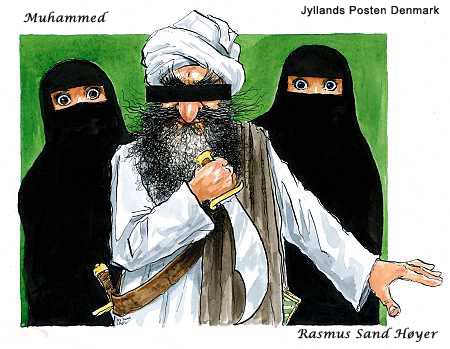
I know that people have sometimes argued that any cartoons that depict stereotypical racial or ethnic features are racist; but I've never been quite persuaded about that, whether as to such cartoons that depict Jews (a common source of this argument) or as to cartoons that depict Arabs.
Cartoons, like illustrations generally, are supposed to provide images that at least have the air of verisimilitude. If one is to depict a generic Jew, a generic Arab, a generic Swede, or an archetypal Arab whose true appearance is unknown (here, Mohammed) one ought to depict him in a way that makes people recognize what is being discussed. "A conventional, formulaic, and oversimplified conception, opinion, or image" (the definition of stereotype) may be unsound if used as an overgeneralization about people's traits — but that's what cartooning requires. If you can't use characteristic features of a group's appearance, effective cartooning — or illustration generally — becomes much harder, in my view unjustifiably harder.
I think the matter is different if the features are portrayed in a way that makes them look ridiculous or disgusting. At some point, exaggeration, for instance a ridiculously beaked nose on a Jew or on an Arab, or exaggerated lips on a cartoon depicting someone black, does make the subject look that way, and may be seen as an aspersion on the ethnic group to which the person belongs. But the important point, in my view, is that this is true as to certain sufficiently exaggerated or distorted depictions, not as to depictions of stereotypical features generally.
The cartoon does depict Mohammed negatively — but because of what he's doing, coupled with the fierce cast of his features (which is not necessarily linked to their stereotypical qualities). One might compare it, for instance, with this cartoon:
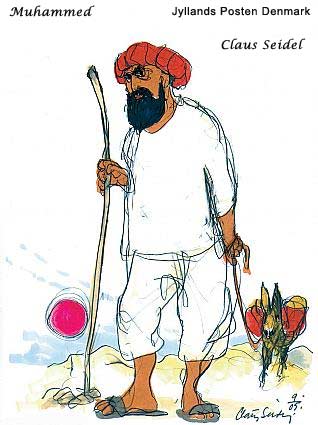
The features are comparable, though not identical; but the latter cartoon seems like a humanizing and even compassionate portrait. It's the message of hostility to a particular religious belief system embodied by Mohammed that differentiates the two, not that one uses somehow inherently "racist" imagery and the other doesn't.
In any case, that's my take on it. Perhaps I'm mistaken, but it seems to me that the permissible stereotyping vs. exaggeration to make the group look ridiculous or disgusting distinction is an important one, and that visual stereotyping can't be universally condemned at least where cartooning is concerned.
But, as I said before, the more important point is that one can't even have this discussion unless one can see the cartoons themselves — further evidence that it's unsound to argue, as the New York Times did, that "report[ing] on the cartoons but refrain[ing] from showing them" "seems a reasonable choice for news organizations that usually refrain from gratuitous assaults on religious symbols, especially since the cartoons are so easy to describe in words."
UPDATE: Thanks to Human Events Online for the high-resolution cartoons, and to reader Nels Nelson for the pointer to those cartoons.
Related Posts (on one page):
- We Are All Danes Now, Latest Installment:
- Canada's Largest Retail Bookstore Bows To Fear of Anti-Cartoon Demonstrations,
- "Racist" Cartoons:
- It Appears Borders Is Carrying the Harper's Issue
- Harper's Magazine Apparently Publishing the Mohammed Cartoons,
- Free Speech and Tort Lawsuits Over Attacks on Bookstores:
- Fear of Extremist Muslim Violence Suppresses Speech in the U.S.:
Cultural archtypes are not the same thing as racist depictions.
On the other hand, the line has a lot to do with the sensitivity of the group being represented. How does one draw a racist cartoon of white people?
And to that extent, now that I think about it, that's Spiegelman's best case for its supposed racism: it tells us nothing about Muhammed other than that he had a big nose and looked angry. If I caricature Jesse Jackson as looking black, and that's all I have to say about him, then what's up with that?
I think the point of the cartoon is all the black. The cartoon is satirizing all the things that Islam forbids viewing of. Women's bodies aren't allowed to be seen. Any picture of Muhammad is also forbidden, as shown by blocking out his face. I think the cartoon makes two points:
1. There's a whole lot of 'forbidden' in Islam.
2. The 'forbidden' is pretty sexist, as shown by the different amount of blacked out space. (Plus it looks like the bar over the man's face is almost an exact cut out of the woman's face.)
1. Remember the basic starting point of the controversy. The paper was providing commentary on the fact that a children's author could not find anyone that would provide an illustration of Mohammed for a children's book. The point of the paper's story was self censorship by artists in fear of attack by the Muslims. THEY were right.
2. BGates, there is some great irony on your comment.
On 8 Feb 2006, in an article about the cartoons, the NYT refused to publish the cartoons that were the focus of the article but had no problem illustrating the article with the Dung Madonna. Obviously it doesn't have a problem with gratuitous assaults on religious symbols as long as the folks offended don't cut your head off. They proved their point, both the islamists and the secularist NYT. All religions are not equal. The more crazy you act, the more respect you are given in some quarters.
Wait, are you saying that buck teeth and thick glasses are cultural archetypes in Asia? You must not have seen many actual asian people in your lifetime; those features are characteristic of racist depictions of asians, not of asians themselves.
No one ever thought Dick Tracy was made ridiculous by his preposterously square jaw.
Um, not to undercut your point, but I always thought he looked loony.
To actually undercut your point, sure different peoples have different ideations of "beauty" (as do individuals within those peoples) but that doesn't prevent some depictions from actually being racist. Take a look at cartoons in America depicting blacks in the early 20th century, or Japanese during WWII. Perhaps these are racist because of the context in which they were presented (i.e. to presumably white American audiences thought to share negative stereotypes of those groups) -- but you don't need a European standard of beauty to get there.
On the other hand, the line has a lot to do with the sensitivity of the group being represented. How does one draw a racist cartoon of white people?
This?
Note the lynching noose on the tree.
Here we have something different. The appellation "Racist" is popularly used here and elsewhere to condemn and silence the critic without debate. It is used to choke off debate, criticism, and ridicule (which is a form of social criticism) by those who consider themselves above criticism or ridicule.
In the case of the Mohammed cartoons, it is literally a manifestation of the Islamic "Holier-Than-Thou" position, holding themselves as more special than all others, superior you might say.
This is unfortunate because fundamentalist Islamic societies direly need to respond to some criticism to function. Without the heavy flow of oil money they would be nothing but murderous anarchies.
I think it puts the backwards priorities of fundamentalist Islam in a very stark and funny light. The women can only show their eyes, but figuratively speaking, the religion forbids actually using them. So what are we left with? The blind leading the... well, leading something. It's not necessarily a brilliant argument, but I loved the cartoon.
I interpreted it differently: "Islam keeps its female adherents from being seen and it's male adherents from seeing."
I don't think that's even supposed to be Mohammed, just an angry Moslem, blinded by intolerance.
Of course not - I am saying that those characteristics are cultural archtypes of Asians here in Western socities (and particularly here in the U.S.) that are often used in caricatures. But I suspect that you know that and you are just being a silly contrarian. If not - then I would have to assume that you do indeed think the Mohamad cartoon is "racist", that you disagree with the reasing of Prof. volokh in his post, and that you would in fact object to the depiction of any racial features in cartoon caricatures since they must by definition depict such features.
It is no different that Japanese-Anime that almost always depicts Western women as having very wide eyes and big breasts. It is not an "acurate" depiction of Western women - but neither is it racist. It is an archtype that the Japanese culture has about Western women.
Really, this point is so obvious that I am surprised I even need to make it.
The black strip over the eyes also recalls the older style of hiding identities on TV before pixilation became common, so we can't even be for certain it's Mohammed without seeing the eyes.
And there's just a perfect artistic inversion between the women and the man.
A couple of others were funny, but that one was one of the fiew thoughtful ones.
The painting (you can see it here among other places) isn't even recognizable as the Virgin Mary—we only get that from the title. It's a black woman in a blue sheet with a gold background and little bits flitting about that look like butterflies but on closer inspection are private parts. The style is somewhat "primitive" and it actually looks pretty sweet. (The woman, by the way, seems to have some overdone racial characteristics, but no one's claimed yet the painting is racist.)
Then there are the small mounds of elephant dung (it's not smeared on, as many claim). Leaving aside the meaning of elephant dung where the artist is from, it's worth noting he uses it regularly in his art. For instance, anther painting feature clumps of dung on the names of African-American heroes like Miles Davis. Is that also meant to be offensive? Should jazz fans try to shut down the exhibit?
Without commenting on other religious sensibilities, we can note that showing Mary is not in and of itself offensive to Christians. And different artists will wish to show her in different ways. If a viewer honestly tries to understand the painting—not a great effort, just see it (which many haven't, not even a photo) and read a caption perhaps—she should not be offended.
Yes, but they (buck teeth and coke bottle glasses) are depictions with distinctly racist overtones. Do you really not think Andy Rooney's depiction of the Japanese guy in Breakfast at Tiffany's is not a racist stereotype? What would you say about cartoons about blacks eating watermelons and fried chicken? That's certainly a "cultural archtype." It also happens to be a racist one. Or maybe hook-nosed Jews lending out money at high rates of interest? You can't tell me that's not a "cultural archtype."
It is no different that Japanese-Anime that almost always depicts Western women as having very wide eyes and big breasts. It is not an "acurate" depiction of Western women - but neither is it racist. It is an archtype that the Japanese culture has about Western women.
Do you read much anime? You do realize that all the characters have very wide eyes, including the Japanese ones, right? And basically all the main female characters, even (or especially) the Japanese schoolgirls have huge breasts. The comparison with the depictions from the NR cover just doesn't work. The Japanese do have plenty of racist Sambo-like depictions of African Americans and I don't have any problem criticizing them just as I would the NR cover.
>And there's just a perfect artistic inversion between the women and the man.<
My thoughts exactly.
The other element that it satirizes is the simultaneous repression, particularly of women. The blindness of the guy then implies the pointlessness of that repression, along with the rest of the ideas that have been mentioned.
I also like the way in which the sum-total of the blackout results essentially in a complete smothering of the entire person.
I find more offensive the denial of ethnic features, such as a depiction of a blond, blue-eyed Jesus, especially if all the other Semites are shown more realistically swarthy.
I think that my memory of this entire discussion will always be colored by the treatment of the subject, and, in particular, the differing treatment of Jesus and Mohammed, in South Park.
Oh, I am sorry. I was just taken over by some goofy leftist poltergeist. Thanks for posting them, albeit months later than you should have.
Still not terribly impressed, though maybe b/c I was slow to get the joke, but at least I see the point now.