|
Saturday, February 11, 2006
Shall We Live under de facto Shari'a?
That's the question posed by my latest media analysis column for Rocky Mountain News. Also in today's News, publisher John Temple suggests that fear of Islamist terrorists is a key reason why American newspapers aren't publishing the cartoons. Editorial page editor Vincent Carroll has lambasted the New York Times for its refusal to print the cartoons. And the News in its formal editorial voice has taken perhaps the most uncompromising pro-free speech position of any major daily newspaper in the United States.
A Second Look at the Second Extra Cartoon.--
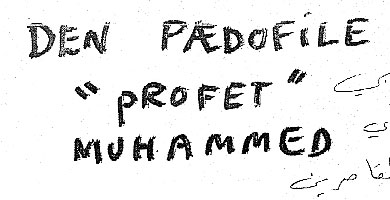
In an earlier post, I asked for those with special expertise to examine the text accompanying the second extra cartoon of Mohammad, the one depicting him as a demon pedophile. I wondered whether the lettering suggested the possibility that the original language of the author of the cartoon was Arabic, not a Western language using the Roman alphabet. Andrew Sullivan, Betsy Newmark, Michelle Malkin, and ABC's Jake Tapper have spread the call, as have other bloggers here, here, here, and here.
From the following picture, I deleted the actual drawing of Muhammad as a demon pedophile, retaining just the caption above the crude drawing:
(click to enlarge)
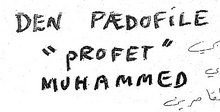
Reading through the comments so far to my earlier post, no true expert graphologist has come forward, but several people with at least some knowledge of Arabic writing and calligraphy have weighed in. The most interesting comment so far comes from E.S., who says he/she is not a graphologist but has "a little experience in English and Arabic calligraphy and typography":
I noticed a few interesting things about the writing that may indicate that it isn't the product of a native speaker.
1) If you look at the lowest horizontal stroke on the first capital E, it is a curved or squiggly line. This is characteristic of the arabic character "sukkund" which is denotes a glidle (sp?) stop. These symbols are used extensively in old texts in the Arab world including the Quran.
2) Many of the letters have too many strokes, and are thus inefficient. Over time native speakers develop proficiency in writing quickly and use less strokes per letter on average. Looking closely at the first M of the last line it has four strokes. Most native speakers would make it with two or three. Also notice on this M that the strokes don't match up correctly. This indicates a lack of familiarity with the structure of the letter.
3) The cross strokes on the E's and F's seem to be drawn from right to left. The "ink clumping" you notice on some of the letters is formed when the author keeps the pen on the paper for too long without moving it. It often indicates hesitation in executing a stroke. If you look at the E and F in the word "Profet" the ink clumping is on the right hand side of the letter indicating that the person put pen to paper, considered the stroke momentarily, and then pulled the pen from right to left across the page. This is also inefficient in writing Roman letters because the movement across the page is from left to write, so cross strokes from right to left slow down the production of the letter. (Also interesting is the large amount of ink wasted on the beginning of the uppermost crossbar on the E in "Paedofile." It appears that this stroke went from left to right [note the ink clumping on the left of the letter]). This is consistent with the idea that the person is an Arabic writer since the long delay would indicate a discomfort with the left-to-right stroke.
4) The u in "Muhammed" appears a great deal like the Arabic Laam (one of the most common letters as it is part of the arabic AL meaning the). If you notice the right side of the letter is longer, this is what an individual Laam looks like, almost like a Roman capital J. Also note that a native writer of Roman based letters would not make the right side larger as it is inefficient in writing a full word. There is no need to bring the pen that high if you're going to move on to the next letter.
5) Finally as a general matter the letters do have a more "drawn" feel than usual native Roman-based letters. The cross strokes have the slant of calligraphy fonts, especially those used in Arabic. This is indicated by the sharp points on both ends of the cross which indicates that the pen was held at an angle. Most Roman letter writers without calligraphy experience hold their pen straight, which results in "block" letters and not angled letters. Finally the curves on the D's are tapered which indicates holding of the pen at an angle, and experience with "drawn" letters. These same curved shapes are common in the arabic letters Jeem, Haah, and one other that I am not even going to attempt to transliterate but comes from the back of the throat.
I hope that others — with even more extensive knowledge — will come forward to assess the evidence in the text accompanying the "demon pedophile" cartoon.
Appearance on NPR's On The Media:
I appeared on this radio this weekend discussing hate speech, free speech, and the Mohammed cartoons, and you can find my interview on the show's website. Scroll to "speech impediment," and, after clicking on the link, go to approximately 2:45.
Unfortunately, if you keep listening, you will find that the next guest is Juan Cole, who attributes the Muslim world's reaction to the legacy of "European racism and anti-Semitism" (by which he means anti-Arab sentiment; here is yet another reason to disdain Prof. Cole--the phrase anti-Semitism was invented by those who hated Jews on "racial" grounds, and has a generally accepted meaning of "anti-Jewish." Apologists for anti-Semitism in the Arab world like to say things like, "we can't be anti-Semitic, we are Semites ourselves." Wikipedia has a very useful entry (though of course it can change at any moment) on anti-Semitism, including the way the phrase is misused to downplay anti-Semitism in the Arab world.)
Op-ed in Today's Wall Street Journal on the ABA and Racial Preferences:
Page A9 of today's Journal contains my Rule of Law Column, which begins as follows:
According to its mission statement, a primary goal of the American Bar Association is to "promote respect for the law." In the interest of mandating racial preferences in admissions, however, the ABA is about to order law schools to do just the opposite — in fact, to violate the law — and is resorting to blackmail to achieve its end.
Meeting in Chicago today, the ABA's Council of the Section on Legal Education and Admissions to the Bar will vote on new "equal opportunity and diversity" standards. If they are approved, any law school that seeks to maintain or acquire ABA accreditation will be required to engage in racial preferences in hiring and admissions, regardless of any federal, state or local laws that prohibit of such policies.
I'll post an Internet link, with further comments, when one is available.
Why we fight:
According to the AP caption: "An unidentified Kenyan woman demonstrates in Nairobi, Kenya Friday Feb. 10, 2006."

(AP Photo/Sayyid Azim)
More Bad News on Hamas and Gaza.--
Anyone who has followed Debka.com, an Israeli website run by former Time Magazine journalists, knows that they have come up with more than their share of farfetched stories. But (with their apparent ties to Israeli intelligence) Debka has also been the most accurate reporter of the infighting among Palestinian factions and within the Israeli government over Gaza. It appears that many western governments were caught unawares by the victory of Hamas in the Palestinian elections, but Debka had been detailing for months the unpopularity of Fatah and the Abu Mazen government.
Debka has a string of depressing articles on Hamas and its latest cautious embrace by European and Middle Eastern powers.
First, according to Debka, France has joined Russia in supporting overtures to Hamas and invitations to visit their capitals, without first insisting on Hamas renouncing violence:
France jumps into diplomatic row to side with Putin’s proposal to invite Hamas to Moscow. Turkey follows suit. . . .
French Foreign Ministry spokesman Denis Simonneau said: "As long as we stay within the framework of the objectives and principles that we have fixed, we think that this initiative can contribute towards advancing our position." He added: "We share with Russia the goal of leading Hamas towards positions that permit reaching the objective of two states living in peace and security."
Israeli officials are dismayed by the erosion of the Jan. 30, Quartet decision to make aid conditional on Hamas renouncing violence and recognizing the Jewish state. Hamas has rejected the demand. Russia as a member endorsed this decision. But Russian defense minister Sergei Ivanov defended president Vladimir Putin’s invitation to Hamas by arguing: "Hamas is in power . . . as a result of free democratic elections." Moscow is not happy with all of Hamas`s policies, but the West has no choice but to deal with it. Sooner or later certain countries, including those of the Quartet, will favor contacts with Hamas, he said. In Jerusalem, Putin’s invitation has been called a knife in Israel’s back for which the Russian ambassador should be put on the carpet. . . .
In New York, UN Secretary-General Kofi Annan cautioned against hasty judgments and advocated patience while Hamas forms a new Palestinian government.
One Debka story concerns Hamas's conclusion that only violence works:
“We come to power with gun in hand!” Hamas political leader Khaled Mashaal declared at a rally in Qatar Friday night, Feb. 10.
“The Palestinian rifle proved its power to evict the Jews from the Gaza Strip when Israel carried out its evacuation,” Meshaal declared. “Unless we use force, no one will talk to us. At this moment, Palestinian government belongs to the force whose platform pledges warfare.”
DEBKAfile’s political sources describe the rush of events Friday as blowing away the last remnants of the Middle East policies charted in Washington and Jerusalem.
Our Moscow sources report Meshaal made his speech after Russia’s special Middle East envoy Alexander Kalugin personally handed him President Putin’s invitation to visit the Russian capital. He then received a pile of invitations from Jordan, Saudi Arabia, Oman, Kuwait and Syria. Turkish prime minister Tayyip Erdogan said he justified the Russian-French position. “I too invite Hamas leaders to Ankara,” he said.
In more disturbing news, according to Debka, Abu Mazen has just released 56 convicted terrorists from jail, including 26 members of Islamic Jihad:
Palestinian Authority Chairman Abu Mazen suddenly throws open Jericho lock-up and frees 56 convicted terrorists. . .
Among the men freed without prior notice are 26 Islamic Jihad members from northern and central Samaria, who plotted and masterminded suicide bombings in Hadera, Netanya, and Kfar Saba in 2005. Also released were 13 members of the PA General Intelligence Service, loyal to Col. Tewfik Tirawri, and 17 members of the PA Military Police – all of whom participated in terrorist attacks. Abu Mazen thus renews Yasser Arafat`s revolving-door policy for terrorists, while Acting Prime Minister Ehud Olmert and Foreign Minister Tzipi Livni call Hamas a terrorist organization and speak about the need to call Hamas a terrorist organization and fight terrorism.
Friday, February 10, 2006
Article on "Munich" by a former Mossad Operative:
From the Forward:"During the 1970s, none of us had qualms about 'moral equivalency,' an issue debated by the Israeli characters in 'Munich.' Palestinian terrorists were killing innocent civilians; in response, Israel was targeting only terrorists and the terrorist infrastructure."
This Is Intolerance?
LifeSite.net quotes Catholic League president Bill Donohue:
"In the January 30 edition of the Connecticut Jewish Ledger, Abigail Pogrebin was asked which Jewish persons have left a 'profound impression' on her. She answered, 'I will never forget Justice Ruth Bader Ginsburg saying, 'Don't put a [Christmas] wreath on this door.' Indeed, Ginsburg admits to putting a gold mezuzah on her office door's frame as a way of saying, 'This is my space, and please don't put a wreath on this door.' To observant Jews, the mezuzah reminds them of their connection to God. To Ginsburg, who is not observant, it is a symbol of protest.
"Ginsburg used to attend the annual Red Mass, a Catholic Mass that honors lawyers, but then she had a bad experience: 'I went one year and I will never go again, because this sermon was outrageously anti-abortion.' So much for respect for diversity. Just imagine how it would go down in the Jewish community if a Catholic Supreme Court Justice were to say that he would never again attend a particular Jewish event because he had to endure a talk that was 'outrageously pro-abortion.'
"In 1995, the Supreme Court ruled, 7-2, that it was constitutional to put a cross outside Ohio's state capitol building. The ruling said that the park was a public forum open to all expression, and could not therefore exclude a Christian symbol. Ginsburg dissented, explaining to Pogrebin, that 'a Jewish child who is passing by the Capitol' would surmise that 'this is a Christian country,' thus provoking the conclusion that 'There's something wrong with me.' Ginsburg had nothing to say about the fact that a menorah had been allowed on the same grounds prior to the ruling.
"What Ginsburg has said should give all Christians pause, especially Catholics. Her intolerance for our teachings and traditions is striking."
Now I should say that I disagree with Justice Ginsburg's opinion in Pinnette, though not quite on the grounds Mr. Donohue urges.
But what exactly is Donohue's beef with Ginsburg's position on the Mass? Ginsburg used to go to the Mass, presumably because she thought it was a nice gesture, and perhaps because she found it interesting. Then she heard a sermon she strongly disagreed with -- and, horror of horrors, decided to stop going to another religion's religious services! "Respect for diversity" doesn't mean that you have to listen to sermons that you think are wrongheaded. It's not "intoleran[t]." It's not disrespectful of diversity. It's a sign of diversity of opinions, a sign that Ginsburg is not a Catholic, and disagrees strongly with some Catholic views. What precisely is wrong with that?
As to "imagin[ing] how it would go down in the Jewish community if a Catholic Supreme Court Justice were to say that he would never again attend a particular Jewish event because he had to endure a talk that was 'outrageously pro-abortion'" -- shouldn't be too hard. First, let's imagine a Catholic Supreme Court Justice going to a service at a synagogue; I can imagine that, though I'd think that would be pretty rare (perfectly understandable, since I'd expect Catholic Justices to prefer Catholic services to Jewish ones). Then, let's imagine that he heard the rabbi preach a sermon that he thought was "outrageously" pro-abortion-rights (presumably something more than just a mild expression of support); and that he then decided to quit going to a synagogue.
How would Jews feel? How should Jews feel? I suppose they probably should, and would, think: Well, it's nice that he tried to be ecumenical, but I suppose he realized that there really are big gulfs between his religious/political views and our religious/political views, and that there's a reason why people usually go to religious services of their own faith (and their own twist on their own faith) rather than of other faiths. Thanks for coming, sorry you won't be back, guess we disagree on some things.
Likewise as to Christmas wreaths. Ginsburg wasn't trying to ban Christmas wreaths. She wasn't berating someone for wishing her a Merry Christmas. She was trying to subtly convey the message that this is her office, and she wants it to reflect her own cultural identity (my understanding is that she is indeed nonobservant, and that Jewish is to her a cultural identity rather than a religious one) rather than someone else's cultural identity. This isn't even exactly "protest"; but in any event it's hardly "intolerance" to try to control which symbols are put on your own office door.
There is sometimes genuine government discrimination against and intolerance towards religiosity, and sometimes against Christianity. I've criticized it in the past, on many occasions. Justice Stevens's and Ginsburg's dissents in Pinnette, I think, do represent such discrimination against religious speech, though not necessarily against Christian speech.
But the other two examples are not remotely grounds for legitimate complaint. Donahue's complaints work only by turning personal disagreement with others' views, and assertion of one's own cultural identity, into "[dis]respect for diversity" or "intolerance" -- which is to say by sapping the concept of "intolerance" of any real meaning.
Finnish Government Trying to Suppress Private Schooling?
Maybe I'm missing some important context here (for instance, may private schools function without a license?), but this seems quite troubling:
In its Thursday session the [Finnish] government decided to deny licenses for new private schools, as well as to turn down applications for the expansion of the activities of existing schools. . . .
Minister of Education Antti Kalliomäki (soc dem) said in a statement Thursday that it was not the function of schools to proclaim one single truth, religious or otherwise. "One school teaching according to the convictions of some and a second school teaching according to the convictions of others is not real pluralism." Mr Kalliomäki previously proposed also denying extensions to fixed-term licenses held by existing private schools. . . .
It's dangerous enough when state and local governments have a de facto near monopoly over primary and secondary education, as they do in the U.S. But at least here private schools are legal, though they labor under a stiff competitive disadvantage against the government-subsidized public schools; and even public schools are mostly controlled at the state level and the local level, not at the federal level. When a government actually prohibits private schools (which would be unconstitutional in the U.S., incidentally), or prohibits new private schools, that seems much more troublesome. And if the Finnish government's control over the schools is centralized (a matter that I'm not sure about) rather than mostly decentralized, that would be more troubling still.
The "not the function of schools to proclaim one single truth" argument also strikes me as weak to the point of disingenuousness. I will bet you that government-run Finnish schools, like all government-run schools and likely all schools, period, do proclaim one single truth on certain matters.
Sometimes that's uncontroversially right -- few schools, I suspect, even discuss the flat earth theory (at least in geology class). Sometimes it's controversial, but also right: While I think that at least private schools should be entitled to teach creationism (I set aside for purposes of this post whether the U.S. Establishment Clause bars government-run schools from doing the same), surely a school should be entitled to say that it will teach just the theories that it thinks are scientifically sound. (Perhaps in some situations it would be good to spend some time discussing rival theories, but that's a complicated decision, and schools should certainly be free to decide otherwise.) And sometimes the decision is subject to very serious political and ideological dispute, and far from clearly correct, but I suspect inevitable in any country: I'm pretty certain that Finnish government-run schools do proclaim a single truth on many historical, ethical, and other matters.
Finally, I recognize that many people support government-run schools precisely because they do teach an orthodoxy, an orthodoxy that one hopes will create better future citizens, and a more cohesive society. But my view is that the benefits of such government-imposed teaching of orthodoxy are considerably outweighed by the risks.
By the way, just to head off one possible source of speculation: As best I can tell from The CIA World Factbook, the move seems quite unlikely to stem from concerns about the presence of large and potentially dangerous unassimilated ethnic or religious minorities. The Factbook reports Finland's demographics as "Finn 93.4%, Swede 5.7%, Russian 0.4%, Estonian 0.2%, Roma 0.2%, Sami 0.1%," "Lutheran National Church 84.2%, Greek Orthodox in Finland 1.1%, other Christian 1.1%, other 0.1%, none 13.5%," and (as to language) "Finnish 92% (official), Swedish 5.6% (official), other 2.4% (small Sami- and Russian-speaking minorities)." The Swedes have been part of Finnish life for centuries, and while one should always be scared of us Russkies, I doubt that we're causing the Finns that much trouble these days . . . .
Palsgraf Loses Again:
The jury has ruled in Benihana's favor in the killer shrimp lawsuit:
A Benihana chef may have tossed a hot shrimp at a customer five years ago, but a Nassau jury decided yesterday it's not the restaurant's fault the man wrenched his neck that night and later died.
It took the jury less than two hours to decide that Benihana, a Japanese restaurant chain famous for its theatrical table-side food preparation, was not responsible for the death of Jerry Colaitis, 47, of Old Brookville. . . .
UPDATE: Thanks to Jim Lindgren and Joe Zwers for giving me the correct cite. Related Posts (on one page): - Palsgraf Loses Again:
- Palsgraf All Over Again:
No Trial in Italy About Jesus's Existence, After All:
The AP reports that "An Italian judge has dismissed an atheist's petition that a small-town priest should stand trial for asserting that Jesus Christ existed, both sides said on Friday. Luigi Cascioli, a 72-year-old retired agronomist, had accused the Rev. Enrico Righi of violating two laws with the assertion, which he called a deceptive fable propagated by the Roman Catholic Church." I had noted the matter before, and thought I'd provide this update.
Saddam Hussein Shark:
BBC News reports:
A town in Belgium has banned an artwork of Saddam Hussein for fear that it will put off tourists and offend Muslims.
The piece, called Saddam Hussein Shark, shows the handcuffed ex-Iraqi ruler suspended in liquid and wearing nothing more than underpants. [EV: Click on the link above to see the picture.]
The mayor of Middelkerke, Michel Landuyt, said the work could "shock people", including Muslims.
He said he decided to ban Czech artist David Cerny's sculpture before the row over cartoons of the Prophet Muhammad. . . .
"They wanted to put this piece in a location where many children come, so that couldn't be allowed," [the mayor] told the BBC.
He added that the work was now going to be displayed in a museum in the Belgian city of Ostend.
"When you go to a museum and are prepared to see those things and there is an explanation, perhaps there is no problem. But when you come somewhere where you don't expect that, it can be a problem," he said. . . .
Bareknucklepolitics pointed to this story, seemingly to condemn it; and if the city is indeed banning the display of this work on private property, that would be quite troublesome. On the other hand, if the work was to be displayed on city property -- which would presumably involve some preferential treatment by the city, since I doubt that the city lets anyone install just any artwork on its property -- then I think the city is entitled to decide that the work is bad for tourism, or offensive to some of its citizens.
Does anyone have more details on this? Was the "ban" simply a refusal to host the work on city property, or a city-imposed prohibition on its display even on private property?
Lawsuit Against CraigsList:
I generally agree with David's criticisms of the lawsuit against CraigsList for allowing allegedly discriminatory housing ads. But, as a my friend and fellow lawprof (and former student) Jennifer Rothman has also pointed out, CraigsList is almost certainly immune from liability under 47 U.S.C. § 230. Section 230 is a federal law that largely immunizes service and content providers from liability for material posted by others on their sites; there are some exceptions, and some gray areas, but none seem to apply here. Section 230 was prompted by a decision that had held a service provider liable for defamation based on what was posted on its service, but the law has been applied to many other causes of actions as well.
Here's what a federal trial court dealing with a lawsuit against roommates.com -- a lawsuit that's nearly identical to the one against CraigsList -- held (Fair Housing Council of San Fernando Valley v. Roommate.Com, LLC., 33 Media L. Rep. 1636 (C.D. Cal. Sept. 30, 2005)):
Roommate argues that the CDA shields it from liability for Plaintiffs' claims. The immunity provision of the CDA at issue here provides: "No provider or user of an interactive computer service shall be treated as the publisher or speaker of any information provided by another information content provider." 47 U.S.C. § 230(c)(1).
The CDA clarifies its effect on other laws and specifically exempts federal criminal laws, laws pertaining to intellectual property, and the Electronic Communications Privacy Act of 1986. 47 U.S.C. § 230(e). State laws which are consistent with the CDA are not barred, but "[n]o cause of action may be brought and no liability may be imposed under any State or local law that is inconsistent with this section." 47 U.S.C. § 230(e)(3).
This is apparently the first case to address the relationship between the CDA's grant of immunity and the FHA's imposition of liability for the making or publishing of discriminatory real estate listings. The FHA is not among the types of laws which are specifically exempted from the CDA. As such, and without evidence of contrary legislative intent, a court may not create an exemption for the fair housing laws without violating the maxim expressio unius est exclusio alterius. "'Where Congress explicitly enumerates certain exceptions to a general prohibition, additional exceptions are not to be implied, in the absence of evidence of a contrary legislative intent.'" In the absence of contrary legislative intent, therefore, the Court finds that the CDA applies to shield Roommate from liability for the FHA violations alleged by Plaintiffs to the extent that Plaintiffs seek to make Roommate liable for the content provided by its users.
As the Ninth Circuit has indicated, "reviewing courts have treated § 230(c) immunity as quite robust, adopting a relatively expansive definition of 'interactive computer service' and a relatively restrictive definition of 'information content provider.' Under the statutory scheme, an 'interactive computer service' qualifies for immunity so long as it does not also function as an 'information content provider' for the portion of the statement or publication at issue." In [Carafano v. Metrosplash.Com. Inc., 339 F. 3d 1119, 1123 (9th Cir. 2003)], the Ninth Circuit applied the CDA's immunity provision to invasion of privacy, defamation, and negligence claims brought against Matchmaker.com arising out of a false listing on Matchmaker's website. As in this case, the questionnaire at issue there contained both multiple choice and essay questions. In the multiple choice section, members could select from answers to more than fifty questions from menus providing between four and nineteen options. "The actual profile 'information' consisted of the particular options chosen and the additional essay answers provided."
In Carafano, the Ninth Circuit concluded that Matchmaker "was not responsible, even in part, for associating certain multiple choice responses with a set of physical characteristics, a group of essay answers, and a photograph." In those circumstances, Matchmaker could not be "considered an 'information content provider' under the statute because no profile has any content until a user actively creates it." The Ninth Circuit went on to find that "the fact that Matchmaker classifies user characteristics into discrete categories and collects responses to specific essay questions does not transform Matchmaker into a 'developer' of the 'underlying misinformation.'"
Plaintiffs express a concern that application of the CDA might eviscerate the FHA. Though mindful of that concern, the most that can be said is that operators of Internet sites such as Roommate have an advantage over traditional print media because websites, unlike newspapers, are exempt from 42 U.S.C. section 3604(c) and the related state fair housing laws for publishers. This is a concern created by Congress' adoption of the CDA, and is not unique to the FHA. Instead, it is identical to the numerous other federal and state statutes and common law remedies for which the CDA's immunity provision applies. See Batzel v. Smith, 333 F.3d 1018, 1026-27 (9th Cir. 2003) ("The specific provision at issue here, § 230(c)(1), overrides the traditional treatment of publishers, distributors, and speakers under statutory and common law. As a matter of policy, 'Congress decided not to treat providers of interactive computer services like other information providers such as newspapers, magazines or television and radio stations, all of which may be held liable for publishing or distributing obscene or defamatory material written or prepared by others.' Absent § 230, a person who published or distributed speech over the Internet could be held liable for defamation even if he or she was not the author of the defamatory test, and, indeed, at least with regard to publishers, even if unaware of the statement. Congress, however, has chosen to treat cyberspace differently.").
The Ninth Circuit's decision in Carafano compels the conclusion that Roommate cannot be liable for violating the FHA arising out of the nicknames chosen by its users, the free-form comments provided by the users, or the users' responses to the multiple choice questionnaire. Plaintiffs' federal claims against Roommate are therefore barred by the CDA.
This decision is not binding precedent, and one Seventh Circuit opinion -- the CraigsList case is being filed in the Seventh Circuit -- has suggested that the CDA should be interpreted somewhat more narrowly than most other courts (including the Ninth Circuit) have interpreted. Nonetheless, the great weight of authority on § 230, from a wide range of courts, cuts against liability for CraigsList.
When Is A Bill Signed By the President Not a Law?:
Marty Lederman has the scoop.
President Kollar-Kotelly?:
The Wall Street Journal has a very puzzling op-ed today criticizing the Chief Judge of the FISA Court, Judge Colleen Kollar-Kotelly, for not permitting DOJ to include evidence obtained from the NSA domestic surveillance program in applications for FISA warrants. The Journal's editors are apparently outraged by a judge taking on this role, and ask "Who elected Ms. Kollar-Kotelly?" [W]hy is an unelected judge such as Ms. Kollar-Kotelly making these decisions? Under the Constitution, those calls ought to be made by the President, who swears to defend the U.S. and can be held accountable by the voters if he fails. Under the current FISA court process, Judge Kollar-Kotelly answers essentially to no one. I don't understand. Judge Kollar-Kotelly "answers essentially" to the Foreign Intelligence Court of Review, the appellate court that has statutory authority to review denials of FISA warrant applications. If DOJ didn't like Kollar-Kotelly's interpretation of her legal obligation under FISA, then presumably the proper course of action under the law was to invite Kollar-Kotelly to deny an application and then to seek review in the Foreign Intelligence Court of Review — and, if necessary, in the United States Supreme Court. That's the process designed by the "elected" Congress that enacted FISA, at least.
Another Possible Hoax of a Cartoon; Call for Graphology Expertise.—
1. Background.
The Danish clerics who spread the 15 Muhammad cartoons have been evasive about where they got the three most offensive ones, ones that had never been published by Jyllands-Posten or media in any country, at least before the dispute arose.
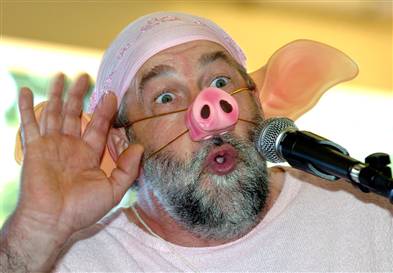
As NeanderNews revealed, the second extra "cartoon," supposedly showing Muhammad with a pig snout, is a crude forgery, not even a picture of Muhammad at all. It is rather an altered photo of a “contestant at the French Pig-Squealing Championships” in France.
In the comments to an earlier post on the Volokh Conspiracy, a poster who identified himself merely as “K” raised an interesting issue:
I am not a graphologist, but a student who had a chance to attend very interesting lecture two years ago — a part of it was about the fact that whatever alphabet you learn to write the first influences the way you write in all the other alphabets you later learn. Hence you can identify, if sometimes with difficulty, that an individual learned to write Cyrillic or Arabic before they learned to write Latin [Roman letters].
Such individuals often never receive any instruction in writing in the “new” alphabet, and so they are:
1. Drawing the letters and not writing them
2. Maintaining the habits they have acquired when learning their first alphabet. – eg. the letters have their normal shapes but look as though the have been written backwards (someone has started to write the letter from the wrong end)
Now look closely at the writing on the caricature that shows Mo[hammad] as a pedophile, and ask yourself doesn’t it look a bit strange?
The more I considered K’s comment, the more troubled I became. These extra three cartoons were presented as evidence of what non-Muslim Danes thought of Muslims, but what if all the cartoons were created by Muslims themselves, just to garner sympathy or to inflame anti-western sentiment? The pig “cartoon” has already been shown to be a hoax, though the perpetrator of the hoax has not been determined.
Maybe the manner in which the letters in the “demon pedophile” cartoon were written would reveal whether they were most likely written by someone who first learned to write in Arabic.
2. Analysis of Lettering in the “Demon Pedophile” Cartoon.
From the following picture, I deleted the actual drawing of Muhammad as a demon pedophile, retaining just the caption above the crude drawing:
(click to enlarge)
I was struck by two letters that seemed (to my untrained eye) to have been drawn in an unconventional way. The first was the first “M” in Muhammed. In writing a capital “M,” it is common to start with a downstroke at the left side of the “M,” then go back to the top left of the “M” and complete the rest of it without a break. It appears that the person who composed the demon pedophile cartoon did much the same thing, but instead started with a downstroke on the top right, and then returned to the top right to complete the letter “M” without a further break. In other words, it appears that he was writing that capital “M” from right to left, not from left to right as most westerners would have done. The first website on Arabic writing that I went to, not only confirmed my understanding that Arabic letters are written from right to left, but showed that there is a standard Arabic letter (alif) that consists of a single downstroke, so such a downstroke may well have been a natural movement for an Arabic writer.
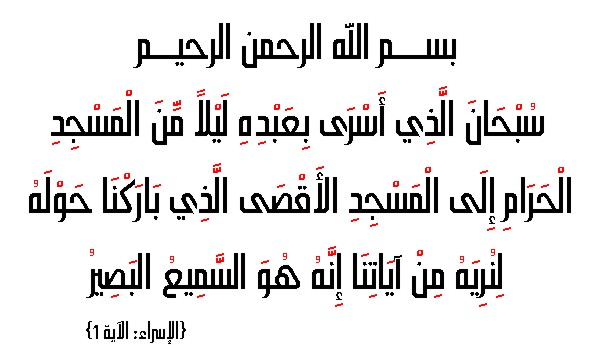
The second letter that struck me as odd was the placement of the capital P in the word “PROFET.” Note that the top of the P is not on the same level as the rest of the capital letters in the word or the note. I wondered whether there were any letters in Arabic that are commonly written with a tail below the line and a body that does not reach the top of the adjacent letters. In the second website I looked at, I saw this example of a font called “Hasan Al Quds Open Type”:
(click to enlarge)
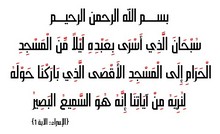
Shockingly, not only did I find a letter with (1) a body below the letters adjacent and (2) a tail below the line, I saw that (3) the letter looked remarkably like a Roman “p” and (4) it was placed on the left edge of the word, just as in the “demon pedophile” cartoon. Note the first and last words on the first line both have a letter resembling such a “p” on the left edge of each word. A word on the third line has the same letter resembling a “p” on its left edge.
These two oddly drawn letters raise a question in my untrained mind whether the author of the "demon pedophile" cartoon was brought up writing some form of the Arabic alphabet.
3. A Call for Help.
Obviously, I lack the expertise to evaluate the evidence I have raised on any but the crudest level. We need graphologists or other experts on how Arabs who learned to write first in Arabic eventually write Roman letters in the West, particularly in Denmark or Scandinavia. I am calling for the help of “An Army of Davids,” using the “distributed intelligence” of the blogosphere to examine the questions that K raised in his comment to an earlier post of mine and that I have explored here. Much as in the CBS/Dan Rather forgeries, perhaps bloggers can contact the best experts in the field to determine whether the person who originally created this reprehensible cartoon was brought up writing Roman letters or Arabic ones.
Even if it should be determined that the creator of the “demon pedophile” cartoon was probably brought up writing Arabic, that does not necessarily mean that any Danish cleric forged the cartoon himself. It would still remain possible that some Muslim-hating person who was brought up writing Arabic created this cartoon, but it would definitely make it highly unlikely that these cartoons reflected typical Danish society (as they were originally supposed to do).
UPDATE: Because of the length of this post, I have updated it in a new post above. I found the comments below intriguing and highlight one of them in my update above. I also link some of the other bloggers who have spread the call for help.
Patriot Act Compromise Reached:
The Washington Post has the story. I haven't seen the actual text yet, though, so it's hard to know what to make of it.
Thursday, February 9, 2006
You Can't Post That!
The Chicago branch of Lawyers' Committee for Civil Rights Under Law is suing Craigslist for running housing ads that allegedly violated the federal Fair Housing Act.
An important issue in this lawsuit is whether the Fair Housing Act's restrictions on discriminatory advertising apply to an electronic "bulletin board" such as Craigslist. I don't have an informed opinion on that issue, but I do have an informed opinion on other issues related to this lawsuit.
(1) A loss by Craigslist would likely either end real estate advertising on Craigslist, or force Craigslist to charge for advertising to recoup the signifcant expense of screening ads for discrimination. Not only would Craigslist have to comply with the federal Fair Housing Act, but it could also be subject to liability under local fair housing laws, which are often much broader, sometimes absurdly so, than federal law. D.C., for example, bans discrimination based on political affiliation, so you can't advertise that you only want a Republican or Democrat tenant, or even roommate. Local fair housing officials also are often extremely overzealous in their enforcement interpretation of antidiscrimination laws, to the extent that realtors and newspapers sometimes avoid phrases such as master bedroom (evocative of slavery or demeaning to women), walkup (discourages the disable) and even great view (expresses an alleged preference for the sighted). The bureaucracy needed to comply with such nonsense is simply not compatible with Craigslist's business model.
(2) The Complaint itself takes a rather overbroad view of what constitutes a discriminatory ad; many of the examples of alleged discrimination based on religion simply provide useful factual information that might make the property attractive to particular potential tenants, but suggest only to the hypersensitive that members of other groups would not be welcome: across the street from church, next to temple, walk to synagogue, church is a block away, church and beautiful Buddhist Temple within a block.
(3) Some of the ads noted in the complaint seem to be for roommates or houseshares. The federal Fair Housing Act does not apply to roommates or houseshares, but HUD claims that discriminatory advertising for roommates nevertheless violates the FHA ("This prohibition against discriminatory advertising applies to single-family and owner-occupied housing that is otherwise exempt from the Fair Housing Act."). See also 24 C.F.R. §§ 109.20(b)(5) (withdrawn), that codified this rule, but was withdrawn under criticism that its restriction on wording in advertising swept too broadly. I think HUD's interpretation of the law is dubious. Moreover, it seems reasonably clear that the constitutional right to intimate association protects one's right to discriminate in one's choice of roommates (however, the Wisconsin courts have upheld a fine against a woman who declined to share a house with a lesbian, Sprague v. City of Madison, 207 Wis.2d 284 (1997)). That being the case, it seems to me that one should also have the constitutional right to engage in discriminatory advertising for roommates in order to effectuate that right.
(4) At least in the roommate/houseshare context, it is ironally members of minority groups who suffer most if they can't advertise discriminatory preferences. Consider some of the "illegal" ads noted in a complaint a few years back against D.C.'s City Paper: "seeking a gay male to share two bedroom, one bath condo"; "gay female seeking another gay female to share a house"; "housemate needed for a spacious 30ish group house";
"housemate needed, no pets, no Republicans"; "women of color group house seeking a new member"; "Jewish cooperative home starting."
Some of these ads represent attempts by members of minority groups to find housemates who share the same subculture; others express a desire to live with people of like-minded political views or who are at the same stage in life. In most of these cases, an advertisement that didn’t specify the relevant discriminatory preferences would be nearly useless, because the advertisers would be inundated by calls from disfavored heterosexuals, gentiles, twenty-somethings, etc. Banning such ads puts a great burden on individuals with idiosyncratic roommate preferences: District of Columbia residents seeking to establish a group house for gay Jewish Libertarian women of color must either find new housemates by word of mouth, or be willing to sift through the random mix of would-be renters that respond to a more generalized ad. Because of the advertisement restrictions, some individuals may never be able to find roommates who match their preferences. Such governmental intrusion on the ability to form a relationship as intimate and private as the relationship between people who share living space is unjustifiable.
(5) The Fair Housing Act is the law that got me interesting in the first instance in the conflict between antidiscrimination laws and the First Amendment. The FHA contains many provisions, either explicitly or through HUD regulations, that conflict with freedom of speech. Indeed, during the Clinton years, HUD infamously tried to use the FHA to punish homeowners who dared speak and write in opposition to the placement of halfway houses in their neighborhoods. While this action was clearly contrary to the First Amendment, I thought HUD had a pretty good case that it acted properly under the statute.
Much more on this and related topics in You Can't Say That!.
With thanks to reader (and George Mason Law School student) Lowell Jacobson for the pointer, and the title of this post.
All You Need to Know About Joseph Massad of Columbia:
Joseph Massad of Columbia, one of the Middle East Studies professors embroiled in a controversy over alleged anti-Semitism, has been promoted to associate professor, though not yet tenured. As I've suggested before, the allegations of anti-Semitism, which are, in part, an attempt by some members of the Jewish community to play the minority-victim card [update: which, admittedly, is how one gets attention from university officials these days; and, of course, such allegations should be treated with the same seriousness as allegations of discriminatory behavior from other groups], are a distraction from the real issue of academic credibility facing Massad and other politicized Middle East Studies professors, at Columbia and elsewhere.
If one needed any fresh evidence of this, one need only consult Massad's recent review of Spielberg's Munich. "Lunatic" would not be too harsh a description of the review. For example,many of us are familiar with the ship "Exodus," made famous by the movie of that name. The ship was one of many ships carrying Holocaust survivors trying to get from Europe to Palestine after World War II, only to be captured by the British and diverted to Cyprus, where the refugees were placed in internment camps. [The actual passengers on The Exodus were sent to internment camps in Germany, but in the movie they may have been sent to Cyprus, were most "illegal" Jewish immigrants were sent]. Here is a handy website detailing the history of the ship and its passengers.
Here is how Massad describes the movie's plot: "Exodus tells the story of the Zionist hijacking of a ship from Cyprus to Palestine by a Zionist Haganah commander." This is analogous to saying that Schindler's List was a movie about Jews taking a working vacation in Poland.
We're all familiar with Holocaust denial; no respectable university would hire a Holocaust denier for its faculty. So why would any elite university like Columbia retain, much less promote, someone who similarly intentionally falsifies Jewish history (indeed, in this case, the history of Holocaust survivors) for political ends? You might think, well maybe Massad just made an error, but I've also noted in the posts linked above other such "errors", which seem to create a consistent pattern. Moreover, Massad has taught a course "Palestinian and Israeli Politics and Societies"; if he is completely ignorant of Israeli (and pre-State Zionist) history, then the course was a fraud; if he is not completely ignorant, than he must know that what he wrote about the Exodus is false.
Martin Kramer writes that "[i]f Edward Said hadn't been pulling all the strings on Morningside Heights, Massad probably would have ended up teaching in a community college." Actually, I can't imagine any self-respecting community college would give him a job.
UPDATE: An excellent post by a commentator on the Solomania blog:
I'm no Martin Kramer, but what I do know about Middle East studies continually reaffirms a suspicion of mine. That is: post-Edward Said Middle East Studies, beyond being thoroughly politicized, is in itself a political statement about the relationship of Jews to the Middle East.
What do I mean? Consider the stars today of Middle East Studies -- people like Massad and Juan Cole. They (at least putatively) have a general knowledge of the region, they have their areas of cultural specialization, and they are of course steeped in postcolonial, that is Saidian, theoretics. You also have the sundry scholars of Islam. But is there any one of them whose area of cultural specialization is Jews? [Editor's note: or even read or speak Hebrew?] Any one who is a scholar of Judaism? [Editor: or Israel?] Any one who learned the Bernard Lewis/Chatham House ouevre before rejecting it?
Clearly then, for the Saidian set of Middle East scholars, a political statement about the relationship of Jews to the Middle East is being made: that there is no relationship between the two besides that of Zionist-colonial depredation. Jews are mere interlopers, fanged colonists, European bagmen, even Nazis. They are not -- cannot -- be indiginous to the region, and worthy of study themselves.
It is therefore not just "lunacy", or sub-par scholarship, or political indoctrination that results in pablum like Massad's review, but a studied disengagement from anything authentically Jewish. It is, in short, politicized ignorance.
More on the Canadian Professor and the Cartoons:
The Canadian Press reports:
An outspoken professor who was forced to remove incendiary drawings of the Prophet Muhammad from his office door now plans to display them in his classroom to prove a point about freedom of speech. . . .
"I probably will take them into the classroom tomorrow morning," [Peter March] said in an interview Wednesday.
"There's a clash between (the university's) perception of protecting health and safety and my perception of what my job is. My job is, I think, to take risks."
A university spokesman said while March is free to discuss the drawings in class, displaying them is another matter.
"It would be up to the professor to decide whether that would be appropriate and necessary," said Chuck Bridges, the university's vice-president of external affairs. "I can't speculate on that. We have to wait and see what would happen if it happens." . . .
March was confronted Wednesday outside his university office by three Muslim students.
"I will say what I want . . . this is a university, this is a university," March told the students.
"That was a little bit disrespectful for the Muslims who are here," one of the students said to March, who told them he respects their rights.
"But I don't believe in your faith," he said. "I believe your faith is a pernicious thing - the same as Christianity, the same as Hinduism."
March said later that he was confronted in his office by another group who told him to apologize or face the consequences.
"The leader said, 'We're going to get you,'" said the professor, adding he notified police.
The controversy was also being felt in Charlottetown, where the student newspaper at the University of Prince Edward Island published the 12 cartoons.
The university moved quickly to stop about 2,000 copies of the newspaper from being distributed on campus.
"When we realized that they were in circulation, we acted to round up the copies that were in circulation," said UPEI president Wade MacLauchlan.
"We see it as a reckless invitation to public disorder and humiliation."
Ray Keating, editor of The Cadre, said he was disappointed by what he views as censorship by the university.
"I see this as an issue of freedom of expression and freedom of the press," he said.
Meanwhile, March said he plans to launch a union grievance against Saint Mary's, which ordered him to remove the drawings from his door Tuesday.
"There's a great deal in my collective agreement that says that what I am doing, which is engaging public discussion using my skills as a philosopher, is part of my job description," he said. . . .
Paul Bowlby, chairman of religious studies at Saint Mary's, is another who was bothered by March's actions.
"I find it very offensive that academic freedom is being used to defend an act of posting those cartoons in a public space, on a university campus," he said. . . .
More Stifling of Dissent (in Canada).--
At Judeoscope, a Canadian website, there is a story about a Canadian professor who has been ordered to remove the 12 cartoons from his office door:
Philosophy professor Peter March was ordered by the administration of St. Mary’s University in Halifax, to take down cartoons from his office door. The cartoons in question are copies of the 12 Danish drawings of Mohammed manipulated by Muslim Brotherhood clerics and embattled regimes to whip up Muslim anger at the West and send infuriated Muslims on a path of death and destruction for the last few days.
The Canadian Press reports that "the administration told March to take down the cartoons because the space outside his door is considered a public place and caricatures are considered very disrespectful by many members of the Muslim community".
That these doors are considered "public space" will come as a novelty to anyone who’s ever set foot in a university building; it has become a university tradition for professors to post on their office doors political cartoons dealing with the hot issues of the day or questions their research examinates. As to the question of disrespect, universities should not even go near there, if they want to remain, as they should, to uphold the principles of freedom of thought and free debate.
In response to this nonsense, Professor March argues he should be allowed to show the drawings to his students and added he would probably show them in his class on Thursday. "There’s a great deal in my collective agreement that says that what I am doing, which is engaging public discussion using my skills as a philosopher, is part of my job description," he said. Indeed it is!
Judeoscope also reports that the student newspaper of another Canadian university, the University of Prince Edward Island, printed the cartoons, an offense that prompted the university administration there to "pull the paper out of circulation."
The Future of Education?
From today's WSJ, "Reading Law at Oxford":
Rather than being more formal than the lecture-driven, American undergraduate life to which I was accustomed, the British environment is more relaxed. In the intimate tutorials that are the main means of undergraduate instruction, an air of easy informality prevails. Rather than get hung up on rules and procedure, tutors focus on creating a stimulating intellectual exchange.
That's why I cringed when it came out this week that Oxford's colleges are drafting a new legal agreement, which they plan to compel all new undergraduates to sign beginning this fall. The lawyers fear the lack of a written contract leaves colleges too vulnerable to being sued by disgruntled students. Modest student fees are soon to be phased in on top of what has until recently been an entirely free public education (at least for British citizens). The fear is that an unhappy student might take his college to court for providing bad value for money, as if it were a construction contractor.
Students, just in case they haven't yet made up their minds, are asked to formally confirm that they "undertake to pursue satisfactorily" the course of study for which they are arriving. The document helpfully clarifies that "studies include the reading of materials." The college, for its part, promises to "make such teaching provision for undergraduates as it reasonably decides is necessary." The colleges also promise to provide library and computer access (except in "adverse circumstances") and meals ("from time to time").
***
Oxford's colleges do have reason to worry. In 2002, a student sued Wolverhampton University, claiming he was receiving substandard instruction, and adducing assignments with grammatical errors as court evidence! But the colleges, in trying to shield themselves with more legalese, have drawn the wrong lesson. The plaintiff in the Wolverhampton suit was a law student, and viewing his studies in legal terms was the start of all the trouble.
Once it is allowed in at all, the legal mindset increases in scope until it encompasses nearly everything. This process has already begun, with the president of Oxford's student council complaining that the contract needs to be made longer and more specific. She fears students are "at risk" if there are no contractual guarantees that they will be consulted on major decisions....
USC Violating the Law by Restricting Student Speech:
[See UPDATE below for the USC Administration's ultimate decision on the matter, which I think is much better than its initial decisions.]
The Daily Trojan reports:
Eddie Marquez, assistant director of Norman Topping Student Center, shut down a Gender and Sexuality Week event being held in a designated free-speech zone after receiving several complaints about vulgar language.
George Weiss Vando was near Tommy Trojan and in the middle of performing "Man Lady," a performance based on his life experiences, when Marquez interrupted him, asked the organizers to turn the speakers off and pulled the power cords. . . .
Marquez said that after hearing complaints from a Department of Public Safety officer, a staff member and the vice president's office, he made the decision to stop the performance. He did not give names of the complainants.
Ian Scott, a senior majoring in music education, was walking past Tommy Trojan between classes when he heard Vando speaking. . . . Scott said the language and content of the poetry was "raunchy," but was also artistic and not profane.
The term "motherf-----" was used. . . . [Scott is quoted as a witness, not as someone who was complaining. -EV] . . .
When asked if vulgar speech was allowed in the free speech zone, Marquez said, "I would say no, just because we don't want to offend anyone . . . We do this to protect the students and make sure we maintain the integrity of the university."
A later story reports that a couple of days later students tried to protest the administration's actions by displaying signs that used the word "fuck" and its variations; the administration shut down one such protest, and apparently tried to shut down a second, though the story is a bit ambiguous on what ultimately happened as to the second protest. USC Department of Public Safety officer Bryan Hunt said display of profanity violated California Penal Code 415. "'This is the deal: There is freedom of speech, but there are words that can offend people,' Hunt said."
1. As to California Penal Code 415, USC is 35 years behind the times. In Cohen v. California (1971), the U.S. Supreme Court dealt with the prosecution of someone publicly displaying the word "fuck," under precisely the statute USC is citing, California Penal Code 415. The Court held that such public display of profanity generally may not be criminally punished, unless it's a personalized insult "directed to the person of the hearer" and therefore likely to start a fight — if you say "fuck you" to someone, that might be criminally punishable, but wearing a "Fuck the Draft" jacket (the particular facts involved in Cohen), giving a performance that uses the word "motherfucker," carrying signs containing the word "fuck" as a protest against suppression of profanity, and the like are constitutionally protected.
2. USC is also over 10 years behind the times when it comes to the broader question of whether it may suppress offensive student speech. As a private university, USC is not bound by the First Amendment — but the Leonard Law, enacted by the California Legislatures in 1992, obligates private colleges in California to generally tolerate student speech under the same standards imposed by the First Amendment on the government:
(a) No private postsecondary educational institution shall make or enforce any rule subjecting any student to disciplinary sanctions solely on the basis of conduct that is speech or other communication that, when engaged in outside the campus or facility of a private postsecondary institution, is protected from governmental restriction by the First Amendment to the United States Constitution or Section 2 of Article 1 of the California Constitution. . . .
I'm not wild about this restriction on private universities' freedom of action; while I think that private universities generally ought not suppress student speech, I think they should have the legal right to do so. But the Leonard Law is the law in California, and it seems to me that USC ought to comply with it. And the Leonard Law quite clearly bars USC from suppressing student speech simply because it's offensive or because includes profanities.
UPDATE: I'm pleased to report that the USC administration has ultimately come to the right conclusion: Carey Drayton, assistant chief for the Department of Public Safety, is quoted as saying: "The administrator should have said, 'Yes, it may be offensive to you, but that person has a right to speak,'" Drayton said. "We're going to start a joint training with administrators and DPS so everybody will know what is expected."
Tulane Law Post-Katrina:
Tulane lawprof John Eason offers a reflection about the recent past, present, and future of Tulane Law School over at TaxProfBlog. Hat tip: Dan Markel.
Law School Applicant Bubble:
It looks like the law school applicant bubble of the last five years has finally burst, and the number of applicants is now dropping. Thanks to the Basher for the link.
Congressional Reaction to NSA Briefing:
The Associated Press reports on some of the reactions from members of the House Intelligence Committee to their briefing on the NSA program. An excerpt: At least one Democrat left the four-hour House session saying he had a better understanding of legal and operational aspects of the anti-terrorist surveillance program, being conducted without warrants. But he said he still had a number of questions.
"It's a different program than I was beginning to let myself believe," said Alabama Rep. Bud Cramer, the senior Democrat on the Intelligence Committee's oversight subcommittee.
"This may be a valuable program," Cramer said, adding that he didn't know if it was legal. "My direction of thinking was changed tremendously."
Wednesday, February 8, 2006
The FISA Court and the NSA Surveillance Program:
The Thursday Washington Post has a must-read story on how the FISA court has dealt with the NSA domestic surveillance program. The whole story is worth reading, but here are the key excerpts: Both [chief judges of the FISA Court, Colleen Kollar-Kotelly and her predecessor Royce C. Lamberth,] expressed concern to senior officials that the president's program, if ever made public and challenged in court, ran a significant risk of being declared unconstitutional, according to sources familiar with their actions. Yet the judges believed they did not have the authority to rule on the president's power to order the eavesdropping, government sources said, and focused instead on protecting the integrity of the FISA process.
. . . Both presiding judges agreed not to disclose the secret program to the 10 other FISA judges, who routinely handled some of the government's most highly classified secrets.
So early in 2002, the wary court and government lawyers developed a compromise. Any case in which the government listened to someone's calls without a warrant, and later developed information to seek a FISA warrant for that same suspect, was to be carefully "tagged" as having involved some NSA information. Generally, there were fewer than 10 cases each year, the sources said.
According to government officials familiar with the program, the presiding FISA judges insisted that information obtained through NSA surveillance not form the basis for obtaining a warrant and that, instead, independently gathered information provide the justification for FISA monitoring in such cases. They also insisted that these cases be presented only to the presiding judge.
Lamberth and Kollar-Kotelly derived significant comfort from the trust they had in Baker, the government's liaison to the FISA court. He was a stickler-for-rules career lawyer steeped in foreign intelligence law, and had served as deputy director of the office before becoming the chief in 2001.
Baker also had privately expressed hesitation to his bosses about whether the domestic spying program conflicted with the FISA law, a government official said. Justice higher-ups viewed him as suspect, but they also recognized that he had the judges' confidence and kept him in the pivotal position of obtaining warrants to spy on possible terrorists. Very interesting stuff. Incidentally, the question of the FISA Court's authority under existing law to address the legality of the NSA program turns out to be a very interesting issue. I hope to blog more about it soon. The tail end of the Post story suggests sourcing from judges on the FISA Court itself, and strongly hints that none of the FISA judges are likely to invite Alberto Gonzales to dinner any time soon. An excerpt: Shortly after the warrantless eavesdropping program began, then-NSA Director Michael V. Hayden and Ashcroft made clear in private meetings that the president wanted to detect possible terrorist activity before another attack. They also made clear that, in such a broad hunt for suspicious patterns and activities, the government could never meet the FISA court's probable-cause requirement, government officials said.
So it confused the FISA court judges when, in their recent public defense of the program, Hayden and Attorney General Alberto R. Gonzales insisted that NSA analysts do not listen to calls unless they have a reasonable belief that someone with a known link to terrorism is on one end of the call. At a hearing Monday, Gonzales told the Senate Judiciary Committee that the "reasonable belief" standard is merely the "probable cause" standard by another name.
Several FISA judges said they also remain puzzled by Bush's assertion that the court was not "agile" or "nimble" enough to help catch terrorists. The court had routinely approved emergency wiretaps 72 hours after they had begun, as FISA allows, and the court's actions in the days after the Sept. 11 attacks suggested that its judges were hardly unsympathetic to the needs of their nation at war. Ouch.
LET THE CONSPIRING BEGIN:
Thanks much to Eugene and all the VC for letting me join in.
I plan to post mostly on gay legal/political/cultural issues, especially developments on the gay-marriage front. Believe it or not, I have a few other interests and I'll explore them on occasion. Overall, I don't expect to contribute nearly as often as the most prolific bloggers here. I have no idea how they do it so responsibly and hold down day jobs.
I think I'll start out with a presumption in favor of allowing comments to my posts, since part of the value of this for me will be to try out ideas I haven't fully thought through. If I find that reviewing and responding to the comments becomes too time-consuming (or not very constructive) I might reverse the presumption.
Mostly, I'm just delighted to be here with you all.
The GOP Congress and the NSA Surveillance Program:
There were a bunch of signs today that Republican leaders in Congress are not convinced by the Administration's defense of the NSA surveillance program. First, Heather Wilson, Chair of a House Intelligence Subcommittee with oversight over the NSA, called for full Congressional hearings on the program. Second, Senator Specter, Chairman of the Senate Judiciary Committee, announced that he plans to introduce legislation requiring the program to be submitted to judges of the FISA court for review. Third, James Sensenbrenner, Chairman of the House Judiciary Committee, sent Attorney General Gonzales a list of 51 questions about the program, many with several parts. The Sensenbrenner letter can be viewed here in .pdf form. In response to this resistance, the White House has agreed to brief members of the House and Senate Intelligence Committees on the details of the program. The House Committee received its briefing today, and the Senate Committee apparently will be briefed soon. Stay tuned.
A New Cartoon of Mohammed Printed in French Paper:
BareKnucklePolitics quotes Reuters:
A French satirical weekly reprinted cartoons of the Prophet Mohammad on Wednesday and published one of its own on its front page, further angering Muslim groups which say the caricatures are blasphemous.
French Muslim organizations tried to prevent Charlie Hebdo reprinting the 12 cartoons, which were first published by the Danish paper Jyllands-Posten, but a court rejected their suit on Tuesday on a technicality. . . .
The new cartoon was on the front page, "depicting the Prophet Mohammad burying his face in his hands and saying: 'It's hard to be loved by fools.'"
Desecration:
A commenter (Porkchop) raises a great point:
Republication of the cartoons boils down to this: Depicting Mohammed in violation of Muslim tenets strikes a blow at the very heart of Islamic beliefs, and and such sacrilegious desecration of their beliefs is so offensive and hurtful that it simply should not be allowed, even under the guise of "free speech."
Personally, I don't buy into that, but here's a question for discussion: Isn't this the same argument advanced in the United States by those who want a constitutional amendment (and implementing federal and state statutes) to ban the burning or other desecration of the flag of the United States? Can one support the right to publish the cartoons and also support a flag-burning amendment? If so, how does one distinguish between the two?
One can naturally come up with some distinctions — among other things, banning all depictions of Mohammed burdens a wider range of speech (e.g., pretty much any film biography of Mohammed) than banning flagburning would — but I think that on balance these distinctions are unpersuasive. If you want to credibly say to Muslims that they have to tolerate offense to their sacred symbols, you have to tolerate offense to your own sacred symbols, too.
Conversely, as I've argued before, allowing flagburning bans seems likely to help stimulate what I call "censorship envy": If my neighbor gets to ban symbols he dislikes, why shouldn’t I get to do the same? This kind of misplaced desire for equality of repression is a powerful psychological force.
One risk, then, is that banning the desecration of one symbol will help lead to bans on desecration of the other — allowing flagburning bans will change swing voters' views about freedom of offensive speech, or will trigger their concerns about equality, and will lead to bans on desecration of religious symbols.
Of course, it's quite possible that this slippage will be resisted — that even if there's not much of a good logical distinction between flagburning bans and bans on insults to religious symbols and figures, American politics will lead to the adoption of the former but rejection of the latter. But that itself, I think, will be harmful: Right now, when American Muslims are deeply offended by pejorative depictions of Mohammed, we can tell them: "Yes, you must endure this speech that you find so offensive, but others must endure offensive speech, too. Many Americans are deeply offended by flagburning, much as you are deeply offended by depictions of Mohammed, but the Constitution says we all have to live with being offended: We must fight the speech we hate through argument, not through suppression."
But what would we say when flagburning is banned but other offensive symbols are allowed? "We in the majority get to suppress symbols we're offended by, but you in the minority don't"? "Our offense at flagburning is reasonable but your offense at depictions of Mohammed with a bomb in his turban is not"? If you were a Muslim citizen of America, would you be persuaded by these arguments? Would you feel better about America because of them?
The First Amendment was drafted and interpreted by people who intimately understood cultural, religious, and political conflict, and who knew how calls for censorship could launch the most bitter of culture wars. The First Amendment is a truce: "I won't suppress your ideas, and you won't suppress mine." And a ban on flagburning would undermine this truce.
What Academics Want:
Endowed chairs are all well and good, but just yesterday I realized that what we really need are endowed parking spaces.
He Said "Jehovah"!
The Philadelphia Inquirer's story about the cartoon controversy included the cartoon of Mohammed with a bomb in his turban. The story noted,
This cartoon and others have inflamed many Muslims since they were first published as a group in a Danish newspaper last year and reprinted in Norway last month. Islam teaches that any portrayal of Muhammad is sacrilegious. Some Muslims accept respectful representations but object to the cartoons' portrayal of Muhammad as a terrorist or as a caricature of Muslims or Arabs.
The Inquirer intends no disrespect to the religious beliefs of any of its readers. But when a use of religious imagery that many find offensive becomes a major news story, we believe it is important for readers to be able to judge the content of the image for themselves, as with the 1987 photograph by Andres Serrano of a crucifix in urine. On that basis we reprint this cartoon.
This strikes me as quite right: People need to see the cartoons to really understand what the controversy is about. Nonetheless, the Inquirer was then picketed, and an "umbrella group for mosques in the Delaware Valley" is "calling for a boycott of The Inquirer until it issues a public apology to its Muslim readers."
Now here's my question: As I understand it, many Muslim critics of the cartoons are themselves distributing (and presumably reproducing) the cartoons, precisely because they believe it is important for Muslims to really understand what the controversy is about. Are they too committing blasphemy? Should they too face boycotts and protests?
One possible response is that actually expressing sentiments as if you endorse them (even if you're just presenting them as a bunch of works that you've commissioned, which is something of an endorsement) is different from quoting material. This might explain why some people would be upset by the original publication, but not by publications that reprint the cartoons to illustrate the controversy. Yet this would mean that the Inquirer's position is proper, just as the position of those Muslims who quote it in order to show other Muslims how they're supposedly being abused is proper.
Another possible response is that even if you quote the cartoons as part of a sincere attempt to report the news, that's still offensive and still blasphemy. Yet I take it this would cover republication in Muslim countries aimed at informing Muslims as well as republication in the U.S. aimed at informing Americans.
Another possibility is that some Muslims think such quotation of the cartoon is OK when done to inflame Muslim sensibilities, but not when done to inform non-Muslim readers. Yet that seems to be a position that's hard to defend, and I see no obligation (even a good manners obligation) for American papers to accede to it.
More on The Interesting Appointments Clause Issue:
Lawprof Donna Nagy writes:
I've been out of town for a few days, so I just saw your post on the PCAOB and the Appointments Clause. I discussed the appointments clause issue extensively in my article, Playing Peekaboo with Constitutional Law: The PCAOB and its Public/Private Status, 80 Notre Dame Law Review 973 (2005) (pages 1049-53). As I point out in the article, the PCAOB also triggers separation of powers questions that are related to the appointments clause issue: whether Congress can shield the PCAOB's enforcement function from presidential control by placing the responsibility for oversight -- including the power to remove the PCAOB's five members -- in a source other than the President. (see pages 1053-57).
A threshold issue to any constitutional challenge under the appointments clause or the doctrine of separation of powers is whether the PCAOB is an entity of the federal government notwithstanding Congress's pronouncement in the Sarbanes-Oxley Act that the PCAOB is a private nonprofit corporation. Based on the analysis in Lebron v. National Railroad Passenger Corp., I conclude that the PCAOB must be considered the "government itself" for purposes of constitutional law (pp. 1036-44)
Here's a link to an earlier draft of the article on SSRN.
I see that the Free Enterprise Fund filed a complaint yesterday challenging the constitutionality of the PCAOB.
Given the stakes, litigation over the PCAOB's constitutional status was inevitable.
"Voter Fraud Charges Collapse":
In October 2004, I posted some about some allegations of voter fraud, under the title "Pretty Appalling, If True." An update cited a Florida Today story, which read (in part), "A field director for one of the many national partisan organizations trying to drum up votes in Florida admits to routine efforts to rig the outcome. They include submitting thousands of invalid voter registration cards, as well as failing to turn in boxes of cards filled out to register Republicans. 'There was a lot of fraud committed,' said Mac Stuart, former Miami-Dade field director for ACORN. Among his allegations — that ACORN "quality control" workers routinely kicked back Republican voter registrations while paying for Democratic ones. 'They said they had enough,' he said."
Well, it seems that the charges in the update were in fact not true. According to the St. Petersburg Times (Dec. 15, 2005),
Fourteen months after a campaign to increase Florida's minimum wage drew allegations of voter fraud, a federal judge in South Florida has ruled at least some of those accusations against grass roots political group ACORN were so baseless they amount to defamation.
U.S. District Judge James King has dismissed a lawsuit brought by Mac Stuart, a former ACORN employee, saying Stuart never provided evidence to support his claim that he was fired because he uncovered voter fraud. . . .
The judge upheld ACORN's counterclaim that Stuart's lack of evidence made his allegations libel and slander. The group has always claimed it fired Stuart for insubordination. . . .
An investigation by the Florida Department of Law Enforcement also found no evidence of criminal activity at ACORN, department officials confirmed Wednesday. . . .
I'm sorry to have inadvertently passed along the erroneous accusations, but glad to be able to report this latest development.
Speaking Gigs This Week:
I will be giving a Federalist Society sponsored talk on " Scalia's Infidelity: A Critique of Faint-Hearted Originalism" at the University of Pennsylvania Law School on Thursday (tomorrow) from 3-4:30pm in Silverman Hall, Room 240. Penn Law Prof Kermit Roosevelt (author of this novel) will be commenting. The paper on which my talk is based is available for downloading here. The talk is open to the public.
On Friday, February 10th, I will be speaking at Penn at a symposium on "The Future of Unenumerated Rights" sponsored by the University of Pennsylvania Journal of Constitutional Law. My panel is at 12:45pm; the complete schedule with directions can be found here. It is really an All Star line up of participants.
My paper is entitled, " Who's Afraid of Unenumerated Rights?" Here is the abstract:
Unenumerated rights are expressly protected against federal infringement by the original meaning of the Ninth Amendment and against state infringement by the original meaning of the Privileges or Immunities Clause of the Fourteenth Amendment. Despite this textual recognition, unenumerated rights have received inconsistent and hesitant protection ever since these provisions were enacted and what protection they do receive is subject to intense criticism. In this essay, I examine why some are afraid to enforce unenumerated rights. While this reluctance seems most obviously to stem from the uncertainty of ascertaining the content of unenumerated rights, I contend that underlying this concern are more basic assumptions about legislative sovereignty and the proper role of judges. I explain why a proper conception of constitutional legitimacy requires that unenumerated rights be protected somehow; and that judicial protection is not as problematic as commonly thought once it is acknowledged that all liberty may be reasonably regulated (as opposed to prohibited), and that we need ascertain the scope of unenumerated rights only to identify wrongful behavior that may be prohibited altogether because it invariably violates the rights of others. This paper, which is available for download from SSRN here, addresses some of the practical issues raised by the original meaning of the Ninth Amendment and Privileges or Immunities Clause of the Fourteenth. Those interested in the evidence of the original meaning of the Ninth Amendment should take a look at my paper The Ninth Amendment: It Means What It Says, available for download here.
Tuesday, February 7, 2006
The Three Extra Cartoons May Be Forgeries.--
In an earlier post Eugene Volokh demands a fatwa against anyone bearing false witness in the Danish cartoon flap. As detailed below and elsewhere, at least one of the supposed "cartoons" is a hoax.
Gateway Pundit points out that the Danish clerics who spread the 15 Muhammed cartoons have been awfully evasive about where they got the three extra cartoons that had never been published by Jyllands-Posten or media in any country, at least before the dispute arose:
The first of the three additional pictures, which are of poor quality, shows Muhammad as a pedophile demon.
The second shows Muhammed with a pig snout.
The third depicts a praying Muslim being raped by a dog.
BBC World also aired a story showing one of the three non-published images, on 2006-01-30, and wrongly claimed it had been published in Jyllands-Posten.
On the tour, the group claimed to represent 21 different Muslim organisations in Denmark, although many of these groups have disclaimed any connection.
Akhmad Akkari, spokesman of the Danish Muslim organisations which organised the tour, explained that the three drawings had been added to "give an insight in how hateful the atmosphere in Denmark is towards Muslims."
Akkari claimed he does not know the origin of the three pictures. He said they had been sent anonymously to Danish Muslims. However, when Ekstra Bladet asked if it could talk to these Muslims, Akkari refused to reveal their identity. These images had however never been published in Jyllands-Posten.
The second extra "cartoon," supposedly showing Muhammed with a pig snout is a crude forgery, not even a picture of Muhammed at all. As NeanderNews revealed (tip to Powerline), it is:
a photo of Jacques Barrot, a pig squealing contestant at the French Pig-Squealing Championships in Trie-sur-Baise’s annual festival. NeanderNews discovered this photo, taken by Bob Edme of AP, posted on an August 15, 2005 AP story seen here on MSNBC’s website.
The photo of Barrot in a pig snout appears merely to have been photoshopped with a black and white screen to make it appear to be a cartoon.
Original AP photo (click to enlarge):
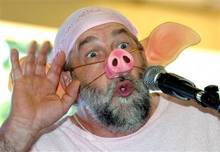
Fake "cartoon" (click to enlarge):
I wish there were some way of holding the perpetrators of this fraud responsible. Did the Danish clerics organize the fraud themselves, or were they duped? And how clear were they during their tour that the three most offensive cartoons had never been published?
More on Danes Boycotting, and Being Boycotted:
[Circa 2002-2003] many Palestinian groups, left-wing political parties (such as the Socialist People’s Party, the Unity List and the Communist Party) and NGOs (such as the International Forum and the Anti-fascist Association), together with trade unions, launched a nation-wide campaign to boycott Israel. The boycott, which includes farm produce and manufactured goods, as well as cultural and scientific exchanges, is specifically aimed at the preferential trade agreement between the EU and Israel. Despite a huge propaganda campaign the boycott has not had a great impact in Denmark.
As part of this campaign, attempts were made to boycott a friendly football match between Denmark and Israel on 17 April. When, nevertheless, 30,000 people showed up, violent demonstrations ensued outside the stadium and about 150 demonstrators were arrested.
By contrast, the "right-wing" Danish People's Party "demonstrated its support for Israel by defying an anti-Israel boycott and serving Israeli produce at its annual convention in October." I suppose Denmark can take limited pride in the fact that neighboring Norway's attitude toward Israel is even worse. But a country in which a boycott of Israel can thrive, if not necessarily succeed, because a large chunk of the public was angry at Israel for retaliating against Islamist violence in 2002 is one that is, in a sense, getting a reality check when it gets boycotted. Denmark is actually in a relatively favorable position--it is being boycotted for having freedom of speech; Israel is attacked for merely existing on "Muslim" land (i.e., Israel).
And while on the subject of the Mohammed cartoons, with regard to Islamist claims that Danes would never dare say anything offensive about the Holocaust:
Although most writers were careful to avoid comments that might be construed as antisemitic [in opposing male circumsion], Finn Nielsen, in Jyllands Posten[!--same newspaper that printed the Mohammed pictures], stated, for instance, that the practice of circumcision was "barbarian," but that there was no hope of abolishing it since any criticism led to "a chorus crying 'Holocaust!'"
And regarding Jews more generally: "Under the headline 'The World’s Strongest Lobby,' a man called Kjeld Poulsen wrote in Jyllands Posten[!] on 8 March [2003] that no American president with an anti-Israel position could be elected because Jews 'control a very large percentage of the American press as well as… radio and television.'"
I Demand a Fatwa:
Several seemingly reputable press accounts (NPR, New York Times, and The Observer (U.K.)) report that, when the 12 Danish cartoons depicting Mohammed were distributed in many Muslim countries, they were distributed alongside three other cartoons that were much more offensive. One of the extra cartoons showed Mohammed as a pedophile demon, another showing him with a pig snout, and a third apparently showing a praying Muslim being sexually mounted by a dog. The accounts report that the cartoons were in a packet distributed by some radical Danish Muslim imams, who are apparently not saying where they got the cartoons.
Now the first two cartoons, if they purport to be depictions of Mohammed, would presumably be at least as blasphemous as the original ones (if not more so). What's more, anyone who distributed them as the work of the Danish cartoonists, knowing that this wasn't so, is guilty of bearing false witness against others — potentially in a way that threatens others' lives. I take it that Islam takes a dim view of that.
Is there an attempt to bring this heinous blasphemer to Islamic justice? To punish him for his sins against Allah and his fellow man? If there is, please let me know about this.
Muhammad Depicted in the Supreme Court Courtroom.--
Duncan Frissell has a nice post on the depiction of Muhammad in a frieze on the wall of the Supreme Court's courtroom. In response to complaints, C.J. Rehnquist refused to remove the work, but he altered its description in Supreme Court literature. In response to complaints:
Rehnquist replied that the depiction of Muhammad "was intended only to recognize him, among many other lawgivers, as an important figure in the history of law; it [was] not intended as a form of idol worship," and that "[a]ltering the depiction of Mohammed would impair the artistic integrity of the whole." Rehnquist also dismissed the objection to the curved sword in the marble Muhammad's hand as reinforcing the stereotypical image of Muslims as intolerant conquerors: "I would point out that swords are used throughout the Court's architecture as a symbol of justice and that nearly a dozen swords appear in the courtroom friezes alone." Rehnquist said the description and literature, however, would be changed to identify Muhammad as a "Prophet of Islam," and not "Founder of Islam." The rewording, based upon "input of numerous Muslim groups," would also say that the figure "is a well-intentioned attempt by the sculptor Adolph Weinman to honor Mohammed, and it bears no resemblance to Mohammed."
Our New Conspirator:
I'm delighted to welcome Dale Carpenter, who teaches law at the University of Minnesota, as a new member of the Volokh Conspiracy. (Many of you may remember him from his guest-blogging early last November.)
Dale graduated from the University of Chicago School of Law, where he was one of the founders of the law school's conservative debating group, the Edmund Burke Society. He clerked for Judge Edith Jones on the Fifth Circuit, practiced for several years, and in 2000 started at Minnesota, where he teaches and writes on Constitutional Law, the First Amendment, and Sexual Orientation and the Law. He also writes a regular column called OutRight for several gay newspapers around the country; many of these columns can be accessed here.
Relevant Signals?
My post on the letters responding to legal arguments on wiretapping, and some of the feedback to it, got me thinking about two signals beyond mere political pigeon-holing, at least one of which is of greater substantive relevance. First, the DOJ memo has a very strange attribute -- its lack of attribution. It is not on anyone's letterhead or signed by anyone. When I was at OLC (in the first Bush administration and in the Clinton administration), everybody recognized the importance of the name(s) of the people at the top of a document -- it told you who, exactly, was putting his or her name behind a given DOJ document. I haven't followed DOJ practice closely, but the lack of any name struck me as odd, and perhaps significant.
Second, and more obviously significant, is the fact that Curt Bradley, along with Jack Goldsmith, has written articles that have (to oversimplify matters greatly) articulated A) a broader vision of executive authority than most other academics would adopt, and B) a particularly broad construction of the September 18, 2001 Authorization for Use of Military Force statute on which the Administration attempts to rely. Jack Goldsmith probably feels constrained from joining the debate (given that he was at OLC for some of the period in question), but Bradley's joining of the letter criticizing the government's position seems quite significant. Bradley and Goldsmith considered the AUMF at great length and put forward a quite expansive interpretation of it. If Bradley nonetheless doesn't think that it provides a legal justification for the Administration's wiretapping, that tells us something -- and a good bit more than the fact that he's not on the political left
Hollywood Blacklist Question:
I've read quite a bit about the Hollywood blacklist lately, but the answer to an obvious question has been surprisingly elusive: what percentage of those blacklisted were members of the Communist Party of the United States at the time of their blacklisting? A secondary question is, of those who weren't members of the CPUSA at the time of their blacklisting, why (a) did they wind up on the blacklist; and (b) did they not "clear their names" and get off the blacklist (I know some did, but I'm talking about those who didn't).
I've opened comments, but I really don't want to open a debate on the morality, wisdom, etc. of the blacklist--perhaps we can have one after I finally post my review of Redish's The Logic of Persecution. Rather, I'd like informed answers, preferably with sources, to either or both of the questions above.
UPDATE: An expert on the subject emails (didn't get his permission yet to use his name) to estimate "98 per cent, and the other two per cent had been and may have left its ranks by that time." If anyone has contrary information, please let me know.
Max Rosenn:
Judge Max Rosenn, a Judge on the U.S. Court of Appeals for the Third Circuit since 1970, passed away today at the age of 96. Judge Rosenn was a terrific judge, and remained strong until the end; a quick check on Westlaw suggests that Judge Rosenn's last opinions were issued just over a week ago. Interestingly, Judge Rosenn is not the only Third Circuit judge from Eastern Pennsylvania to pass away on February 7th in his mid 90s while still very much active in the work of the Third Circuit. The legendary Judge Albert Maris passed away on February 7, 1989, at the age of 95, a day after issuing a published opinion in a civil rights suit against a prison guard. Thanks to Howard for the link.
Computer Crime Law Sales Pitch:
Are you a law professor interested in criminal law or technology law, who is looking for a new course to teach and field to study? Or are you a lawyer with similar interests who wants to teach a class as an adjunct professor at a nearby law school, but who doesn't know exactly what the school's course needs are? Do you want to experience and teach the future of criminal law today?
Well have I got a course for you! No, seriously. Sometime this fall, West Publishers will be publishing my bright shiny new casebook on Computer Crime Law. The book will be available for use in the Spring 2007 semester, and I wanted to let folks know about it now in case they have some interest in teaching it next spring. About 30 law schools have offered a course in computer crime law at some point, the majority taught by adjuncts (usually practicing prosecutors), and the introduction of the book should make it a lot easier to start teaching and writing in the field.
Here's an overview of the book and its subject matter. The book is divided into three parts: substantive law, procedural law, and jurisdictional questions. The chapters on substantive law cover unauthorized access crimes, such as hacking and viruses, as well as traditional crimes often committed using computers, such as online theft, threats, copyright crimes, Internet gambling, obscenity, and child p0rnography offenses. The chapters on procedural law cover the Fourth Amendment and digital evidence, both in the stand-alone context and in the network context, as well as the statutory privacy laws that regulate Internet surveillance (the Wiretap Act, Stored Communications Act, and Pen Register statute). The chapters on jurisdiction consider federal limits on investigating and prosecuting computer crimes, state limits on the same, international computer crimes, international evidence gathering, cybercrime treaties, and the role of the Foreign Intelligence Surveillance Act. Taken together, the materials offer a comprehensive look at the who, how, what and where of investigating and prosecuting computer-related crime.
The book is largely traditional in approach; it is a casebook, and is anchored by judicial decisions. But wait-- there's more to it than that. The book is also partly a treatise that should be useful to practitioners. The notes and comments offer a comprehensive analysis of the law, designed not only to raise interesting questions but to explain existing law to the reader. It also has a number of problems designed to show how the issues fit together. Finally, I have also cited a large chunk of the academic scholarship in the area, so the book should also be a helpful resource for those looking to find interesting scholarly projects.
Right now I expect the book to be out sometime this fall for use starting in the spring 2007 semester. If you're interested in teaching from the book next year, let me know and I'll see if I can get you a preview of a few key chapters before publication. Call now! Operators are standing by.
Questions regarding the Danish Cartoons:
Since last week, the Rocky Mountain News website has included a link to all 12 of the controversial Danish cartoons. The link currently resides in the lower-left column on the home page. Have any other U.S. newspaper websites published a link (or republished the 12 cartoons directly)? Comments are enabled for answers to this question.
Comments are also enabled for answers to some questions about Islamic law. Please comment only if you have actual knowledge of the answer to at least one question:
1. Is the ban actually based on the Koran, or is it based on clerical interpration?
2. My understanding is that the clerical/legal scholar stance on the question has not, historically, been unanimous. Is that correct?
3. To the extent that Shari'a does prohibit depictions of Mohammed, is the prohibition part of a general prohibition on the depiction of any prophet? BTW, Bahrain banned "The Passion of the Christ" because of what was said to be a general prohibition on depicting prophets (including Jesus).
4. To what extent, if any, does Shari'a law claim to be applicable in a non-Muslim country? Only to Muslims in that country, or does Shari'a claim universal jurisdiction at all times?
Of course citations of legal sources, and links, would be welcome.
On the Signatories of the Two Letters in Response to Wiretapping:
Orin mentions the response by scholars and government officials to the DOJ "White Paper" on the wiretapping program. Two additional points bear mentioning. First, this same group issued a letter on January 9, 2006 that laid out their views; the DOJ white paper responded to that, and their February 2 letter responds to the DOJ memo.
Second, and more importantly, this is an impressive group that includes distinguished people from different political camps. At least three are not on anyone's definition of the conventional political left -- Curt Bradley, Richard Epstein, and Bill Van Alstyne. And, for what it's worth, Bradley was the Counselor on International Law in the State Department Legal Adviser’s Office for 2004 (it's a one-year position, chosen by the State Department Legal Adviser).
Perhaps in the best of all worlds this point about the signatories would be irrelevant, and each of us would evaluate the arguments without regard to who made them. But in a time-starved (and politically charged) world, the identities of the signatories often is significant. And here the breadth of the signatories is notable.
Response to DOJ Brief:
I've been planning to take a close look at select parts of DOJ's 42-page brief in defense of the NSA surveillance program, but the posts turn out to be very time-consuming to write and get pushed to the backburner pretty easily. In the meantime, Marty Lederman has orchestrated a response that I think makes a number of persuasive points. I don't agree with all of it, but it's a notable response to the DOJ memo that deserves serious attention.
An Israeli View of the Mohammed Cartoon Issue:
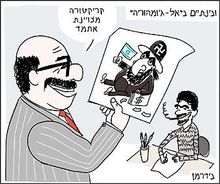
"Meanwhile in Al Jumhuriya [Egyptian newspaper]." “Excellent cartoon Ahmad.” Via HonestReporting, this cartoon appeared in Ha'aretz yesterday.
Intolerant of Intolerance:
This spectacle of mobs in various Muslim countries turning violent against the Danes (and, in some places, other Scandinavians) because of the publication of several nasty anti-Muslim cartoons in a Danish newspaper has a peculiar kind of viciousness and idiocy behind it. Forgive me, but my strong suspicion is that the folks who have burned the Danish embassy have tolerated, for many years, the most appalling anti-Semitic (and, of late, anti-western and anti-US) garbage, day in and day out, in their hometown papers without much protest. I was reminded of a discussion I had with some Dutch friends several years ago, after the assassination of Pim Fortuyn, the Dutch "right wing" leader who had campaigned against immigration, and in particular against Muslim immigration, into the Netherlands. Fortuyn, though he was portrayed often as some kind of fascist (along the lines of Le Pen in France), was in fact campaigning on behalf of tolerance -- and the particularly benign and benevolent tolerance for which the Dutch pride themselves. There are people out there, Fortuyn warned, who are not tolerant, and if we let them into the Netherlands they will transform our society into one that is not tolerant, so if we want to retain a society that is tolerant of the views and beliefs of others we will need (perhaps paradoxically, but truly) to be intolerant of those who are intolerant.
Funny NY Times Headline:
Column A1, today's Times: "Record Sales of Sleep Pills Cause Worry." Funny, I would've thought it was the other way 'round . . .
Monday, February 6, 2006
The Canon of Constitutional Avoidance:
In the hearings earlier today, Attorney General Gonzales argued that FISA's exceptions should be read broadly under the canon of construction of avoiding constitutional doubt. Consider this exchange between Gonzales and Senator Feinstein: FEINSTEIN: What in FISA specifically, then, allows you to conduct electronic surveillance within America, on Americans?
GONZALES: I believe that it's Section 109, which talks about persons not engaged in electronic surveillance under cover of law except as authorized by statute. And I may not have it exactly right.
We believe that that is the provision in the statute which allows us to rely upon the authorization to use military force.
Now, you may say, "Well, that — I disagree with that construction." That may be so. There may be other constructions that may be fairly possible. We believe this is a fairly possible reading of FISA. And as the Supreme Court has said under the canon of constitutional avoidance, if you have two possible constructions of a statute and one would result in raising a constitutional issue, if the other interpretation is one that is fairly possible, that is the interpretation that must be applied.
And if you reject our interpretation of FISA, Senator, then you have a situation where you've got an act of Congress intention with the president's constitutional authority as commander in chief. And the Supreme Court has said when that happens you go with another interpretation if it's a fair application. And that's what we've done here. One difficulty with Gonzalez's argument, it seems to me, is that the Supreme Court didn't rely on this argument when DOJ tried it before. Specifically, DOJ made a similar argument in its brief filed in Hamdi v. Rumsfeld, but found no takers among the Justices. In Hamdi, the Supreme Court confronted a question similar to the one raised by FISA and the NSA program. Yaser Hamdi was being held as an enemy combatant, and claimed that his detention violated 18 U.S.C. 4001(a): "No citizen shall be imprisoned or otherwise detained by the United States except pursuant to an Act of Congress." The question was whether the AUMF was an Act of Congress that authorized Hamdi's detention, such that the detention did not violate Section 4001. DOJ's brief relied in part on the canon of constitutional avoidance. It argued that Section 4001 should be construed to avoid a clash with Article II Commander in Chief powers: The canon of constitutional avoidance counsels against interpreting Section 4001(a) in a manner that would interfere with the well-established authority of the Commander in Chief to detain enemy combatants in wartime. See Public Citizen v. United States Dep’t of Justice, 491 U.S. 440, 466 (1989). Justice O'Connor's plurality opinion and Thomas's dissent created fives votes for the view that the AUMF did in fact satisfy the statute, so the detention was lawful. However, none of the opinions filed in that case relied on the canon of constitutional avoidance to construe 18 U.S.C. 4001. Scalia's dissent mentioned the canon, but rejected its application in the Hamdi case: "I do not think this statute even authorizes detention of a citizen with the clarity necessary to satisfy the interpretive canon that statutes should be construed so as to avoid grave constitutional concerns." The rest of the opinions didn't mention it. Given that none of the Justices accepted DOJ's invitation to apply the canon of constitutional avoidance in Hamdi, it's not obvious to me why a court would think the canon applies in somewhat analogous circumstances to interpret FISA.
Transcript of NSA Testimony:
The transcript of the Attorney General's Senate testimony today is available at the Washington Post website in two parts: Part I and Part II. Perhaps the most interesting aspect of the AG's testimony is his suggestion, made at various places, that there are other classified telecommunications surveillance programs beyond FISA and the NSA program. Gonzales repeatedly limited his remarks to "the program that the President has confirmed," and suggested that some of the press coverage has erroneously reported stories about other programs with this one. Consider this exchange between Gonzales and Senator Schumer: SCHUMER: It's been reported by multiple news outlets that the former number two man in the Justice Department, the premier terrorism prosecutor, Jim Comey, expressed grave reservations about the NSA program and at least once refused to give it his blessing. Is that true?
GONZALES: Senator, here's the response that I feel that I can give with respect to recent speculation or stories about disagreements.
There has not been any serious disagreement — and I think this is accurate — there has not been any serious disagreement about the program that the president has confirmed. There have been disagreements about other matters regarding operations which I cannot get into.
I will also say...
SCHUMER: But there was some — I'm sorry to cut you off — but there was some dissent within the administration. And Jim Comey did express, at some point — that's all I asked you — some reservations.
GONZALES: The point I want to make is that, to my knowledge, none of the reservations dealt with the program that we're talking about today. They dealt with operational capabilities that we're not talking about today.
. . .
SCHUMER: It's also been reported that the head of the Office of Legal Counsel, Jack Goldsmith, respected lawyer and professor at Harvard Law School, expressed reservations about the program. Is that true?
GONZALES: Senator, rather than going individual by individual, let me just say that I think the differing views that have been the subject of some of these stories did not deal with the program that I'm here testifying about today.
SCHUMER: But you were telling us that none of these people expressed any reservations about the ultimate program, is that right?
GONZALES: Senator, I want to be very careful here, because, of course, I'm here only testifying about what the president has confirmed.
And with respect to what the president has confirmed, I do not believe that these DOJ officials that you're identifying had concerns about this program.
Any thoughts on what other programs might exist?
Multiplication:
I've much enjoyed the discussion about the multiplication posts, and I agree that calculating in one's head is a good skill to have. Even if there's a calculator handy, people are often reluctant to use it (perhaps overestimating the effort it would take, or not wanting to look ignorant or skeptical), and if one can do even approximate calculations in one's head, one can often spot errors that one would have otherwise missed. Also, my sense is that learning arithmetic is good mental training for other thought processes, but I may be mistaken on that.
Nonetheless, my point was different: The important thing is not knowing how to multiply, but what, when, and why to multiply. Once you understand what calculation to do to check something, you can do it easily enough on a calculator. But the calculator won't explain to you how to structure the calculation, or whether a calculation ought to be done.
That, incidentally, is one reason that I'm so frustrated when people say "I never minded math" (usually referring to arithmetic or at most algebra) "in school, but I just never liked the word problems." All of life is word problems! A problem in the real world never comes to you as "figure out 123 x 456 + 789." Understanding how to translate the real-world condition into numbers is the important skill, not the calculation. And while most school-level word problems are usually only a very first step in that direction, if people can't master that first step, their knowledge of raw arithmetic or algebra won't help them actually deal with the world.
Interesting Appointments Clause Issue:
A Competitive Enterprise Institute paper (cowritten by Hans Bader and John Berlau) argues that part of Sarbanes-Oxley violates the Appointments Clause ("[The President] shall nominate, and by and with the Advice and Consent of the Senate, shall appoint . . . [all] Officers of the United States . . .: but the Congress may by Law vest the Appointment of such inferior Officers, as they think proper, in the President alone, in the Courts of Law, or in the Heads of Departments."):
The Sarbanes-Oxley Act of 2002 created a powerful quasi-private agency to oversee the auditing of American business, the Public Company Accounting Oversight Board (PCAOB). . . . Congress gave the power to appoint the members of the PCAOB not to the President, but to the five members of the Securities and Exchange Commission. This method of appointment violates the Appointments Clause in numerous ways. The Appointments Clause gives only the President the power to appoint the nation's principal officers, and allows low-ranking officers to be picked only by the President, a court, or by a single head of a cabinet-level department. The five commissioners of the SEC, as a group, don't fall under any of these categories.
Above all, the authors conclude, the Appointments Clause violation creates a lack of accountability for rules that hurt businesses and don't help investors. They note that England's abuses with offices spawning more offices led the Constitution's Framers to take great care to ensure that the power to appoint was limited to the very top officials of the Executive Branch. . . .
I know a bit about the Appointments Clause, but I'm no expert on the subject; and I know nothing about Sarbanes-Oxley. My sense is that the main questions would be (1) whether the PCAOB members are "inferior officers," and (2) whether the SEC board qualifies as a "head of department." (The notion of plural agency heads is familiar in modern legalese, though it might have been outside the contemplation of the Framers, who I suspect neither anticipated independent administrative agencies nor even non-independent departments who would be run by a board rather than by an individual.) The test for question 1, I believe, is whether the appointee "exercis[es] significant authority pursuant to the laws of the United States," and to answer that one would need to know both the precise powers of the Board, and the caselaw defining what's "significant."
Nonetheless, despite my massive gaps in knowledge here, my colorability antennae (or would it be colorability cones?) are giving me positive signals here -- whether or not it's a winning argument, it seems at least a plausible and interesting one. I'd love to hear what people think about, but please comment only if you're knowledgeable about the Appointments Clause caselaw, about the nature of the PCAOB, or about both. For the purposes of this discussion, I'm much interested not in what the structure of our government or of our accounting industry should be (so no arguments, please, that the SEC is just plain unconstitutional from the get-go), but rather in whether the PCAOB appointments method is indeed unconstitutional under current law.
Precedents on Inherent Authority:
I've been watching parts of the Gonzales hearings this morning, and find it a bit frustrating that Gonzales seems to me mixing up two different kinds of claims concerning "inherent authority" to conduct surveillance. The first kind of inherent authority is inherent in the sense that Congress does not need to create it for it to exist; the power exists even before Congress grants it. The second kind of inherent authority is inherent in the sense that Congress cannot extinguish it; the power exists even after Congress tries to take it away. It is true that there are a number of past precedents on the first type of inherent authority, but there is very little on the second type. My understanding is that Gonzales is using "inherent authority" in the second sense, but I don't think it's particularly helpful to cite precedents on the first type of inherent authority to support a claim of the second type of inherent authority.
UPDATE: Commenters question whether such a distinction exists, and want some examples. Justice Jackson's Youngstown concurrence explains the basic categories; I trust many readers will be familiar with them. Readers may be less familar with a particularly relevant example, traditional Fourth Amendment search and seizure law. Congress didn't pass a statute regulating federal search and seizures until 1917, when it passed the Espionage Act of 1917. Federal agents had been executing searches and obtaining warrants for over 100 years up to that point without any explicit statutory authorization; such powers were considered part of the inherent authority of the executive branch. Starting in 1917, however, Congress explicitly authorized federal search warrants to be issued, and included explicit statutory limits on their use. In the last 90 years, Congress has often passed laws regulating the warrant process beyond Fourth Amendment limits, ranging from the Wiretap Act of 1968 to the Patriot Act of 2001. I don't think anyone has argued that the executive branch's inherent authority to conduct warrantless searches and obtain warrants before the Espionage Act of 1917 means that Congress lacks the power to impose restrictions on the warrant process and domestic searches and seizures. Inherent authority absent statutory authorization is different from inherent authority in the face of statutory prohibition.
Steelers Win!
Bliss.
Definitely a weird, controversial game, but we'll take it!
"Not an Issue of Free Speech," says the Council on American-Islamic Relations:
CAIR's statement ont he matter "reiterate[s] the Muslim community’s strong belief that the controversy is not an issue of free speech, but is instead based on concerns over hate speech and incitement."
"Not an issue of free speech." Newspapers' rights to publish cartoons, some of which simply portray a religious figure (albeit in a way that many adherents of the religion find blasphemous) and others of which link the religious figure to violence as a way of making a political statement about the violence practiced in the religion's name, is "not an issue of free speech." I certainly hope that CAIR's views of what constitutes "free speech" don't make much headway, though I'm sorry to say that others and still more others — who are fortunately not in America — seem to agree with them.
CAIR does "condemn all violent actions by those who are protesting the cartoons." I'm glad that CAIR doesn't belong to the camp that believes in street violence as a means of suppressing political and religious expression it finds offensive. I'm not glad that it belongs to the camp that believes in governmental suppression — fines? prison? — of political and religious expression it finds offensive.
CAIR describes itself as "America's largest Muslim civil liberties group." Too bad that its view of civil liberties is so cramped as to fail to recognize the liberty of speech involved here.
UPDATE: Some commenters asked me to clarify why I see the CAIR statement is a call for legal punishment, and not just for denunciation. Sure; "incitement" is a classic example of speech that's constitutionally unprotected, and thus punishable even in the U.S. It's also a classic example of punishable speech in international discussions of the matter. When someone says that a "controversy" about the publication of certain materials "is not an issue of free speech, but is instead based on concerns over hate speech and incitement," it seems to me that it's saying that the materials aren't protected as free speech, but punishable as incitement. Likewise, many people have urged a creation of a new "hate speech" exception to First Amendment protection (and I've seen plenty of casual statements, though generally not by First Amendment lawyers, that assume that such an exception exists); that is likewise consistent with my interpretation.
If someone had said that a controversy about some statements "is not an issue of free speech, but is instead based on concerns over libel," or "obscenity," or "fighting words," we'd easily recognize, I think, that the person is urging that the speech be punishable (since libel, obscenity, and fighting words are the names of categories of punishable speech). The same applies when people say that a controversy about cartoons "is not an issue of free speech, but is instead based on concerns over . . . incitement." In fact, this speech does not fall within the recognized First Amendment incitement exception, but I take the reference to "incitement" to be a call for treating the speech as constitutionally unprotected.
Super Bowl Ads:
You can watch them all here. Thanks to Gordon Smith for the link.
Sunday, February 5, 2006
The Catholic Church and Free Expression:
The Church (I'm not speaking of individual Catholics, just the church hierarchy, or at least its authoritative voices), still seems not to have accepted free expression about religion, or for that matter religious freedom. Here's a Reuters report: The Vatican on Saturday condemned the publication of cartoons lampooning the Prophet Mohammad which have outraged the Muslim world, saying freedom of speech did not mean freedom to offend a person's religion.
"The freedom of thought and expression, confirmed in the Declaration of Human Rights, can not include the right to offend religious feelings of the faithful. That principle obviously applies to any religion," the Vatican said.
"Any form of excessive criticism or derision of others denotes a lack of human sensitivity and can in some cases constitute an unacceptable provocation," it said in a statement issued in response to media demands for the Church's opinion.
The seat of the Roman Catholic Church said it deplored violent reactions to the cartoons. "Real or verbal intolerance, from wherever it comes, whether as an action or a reaction, is always a serious threat to peace." . . .
The Vatican said the institutions of a country should not be held responsible for the actions of a newspaper, but said governments "could and should intervene according to (their) national legislation".
This is not just an admonition about what's right, decent, productive, or in good taste -- rather, it's a claim that the law ought to have a relatively free hand in restricting speech that "offend[s] religious feelings of the faithful," which apparently includes some unstated amount of "excessive criticism or derision of others" that "denotes a lack of human sensitivity." May we still publish the works of Martin Luther? How about of Christopher Hitchens? The Last Temptation of Christ? The religious works of the Jehovah's Witnesses? A historical film in which some actor plays Mohammed? How about linking to the cartoons themselves (as I've done before)? Seeing the cartoons is , yet surely some who believe that any depiction of Mohammed is blasphemy can be offended even by a republication that's aimed at exploring the controversy.
This is not a marginal issue; it is at the core of the rights of free speech and religious freedom. Under the position the Vatican sets forth, large zones of religious debate, political debate, and art would be outlawed.
I realize this is just a press account; I've searched for an English-language version of the Vatican statement itself, but couldn't find it. I would love to learn that this is all just a misquote; if that's so, please do let me know. But if the account is accurate, it speaks pretty badly of the Church.
Thanks to Tim Cavanaugh at Reason's Hit & Run for the pointer.
PIttsburgh's Secret Weapon:
One for the thumb!
Sunday Open Thread:
What's on your mind? Comment away.
|
|