Let's say that an editorial board "turns over" on March 15th. Do the incoming articles editors actually wait until 3/15 to read manuscripts, or do they start a few days early so they can be ready to recommend articles at the first board meeting?
In my column for today's Rocky Mountain News, I critique a newspaper article which reported on the continuing controversy in Colorado over homeowner waiver of tort liability regarding the purchase of newly-constructed homes. Colorado buyers can still sue to enforce the home builder's warranty.
How about some comments from readers with expertise in real estate or torts? What do you think of tort liability caps for home-buyer lawsuits? (Colorado has them.) Should the legislature, or the courts, prohibit the enforcement of tort liability waivers in home sale contracts? (That's the current proposal in the Colorado legislature.) Do you have evidence for or against the home builder lobby's claim that tort liability is driving up home prices? Have you, or your clients, or someone you know, ever succeeded or attempted in striking language from standard-form real estate contracts? (I've done so on mortgage contracts, although that's not exactly the same.)
In your comments, please try to avoid simply making theoretical statements, such as "no government should interfere with any freely-negotiated contract." It's not that these theoretical statements are necessarily wrong, but I don't think they will advance the real-estate-specific discussion.
Uganda terrorizes its own citizens under the auspices of UN gun control mandate
That's the thesis of my article just posted on Reason Online. Commenters are encouraged to stay on-topic, rather than trolling about John Lott. Commenters are likewise encouraged not to feed the trolls by responding to them.
Does the recent Supreme Court opinion on punitive damages have implications for the constitutionality of class action lawsuits involving thousands of plaintiffs? Mark Moller of the Cato Institute says "yes."
"Our sources will dry up if sources . . . think that anything they tell us will be repeated against them in court. Why would you speak to a reporter if those words are going to be read back against you in court?" said George Freeman, in-house counsel for The New York Times.
"We are supposed to be the watchdog of our government, not its lap dog, so we shouldn't be in bed with it testifying," Freeman said....
Isn't this rhetoric about not being the "lap dog" of the government or "in bed with" the government pretty appalling? All of us, as citizens (or even noncitizens), generally have a duty to testify when called on to do so. That duty is part of the legal system's attempt to learn the truth, and provide justice to the government and to individuals alike.
This duty applies even when it may deter some constitutionally protected speech. If I talk to you about something, or e-mail you something, and that becomes relevant to some civil or criminal case (e.g., because it's relevant to determining my actions or intentions), you can be compelled to testify about it. This may well deter me from saying certain things to you: A businessperson, for instance, might be reluctant to express potentially racist, religiously hostile, or sexist views to people, for fear that those views may be discovered and used against him in a discrimination case.
Private conversations about politics are just as constitutionally protected as media reporting, and just as valuable; people's attitudes are often molded as much about what they hear from their friends and acquaintances as by what they hear from strangers in the media. Yet we accept that the duty to testify may well deter such conversations -- it's part of the price we have to pay for getting at the truth in criminal trials.
Nor does a citizen become a "lap-dog" of the government, or get "in bed with" the government, because he does his duty (whether voluntarily or involuntarily), and helps the jury learn the truth about what happened. It seems to me arrogant, contemptuous, and contemptible for media representatives to suggest otherwise -- to suggest that there's something base or some sort of sell-out in a person's responding to a subpoena.
I should stress that there are sensible arguments for a limited journalist's privilege, especially a common-law privilege (like the psychotherapist-patient or civil attorney-client privilege) rather than a constitutional one; and the desire to encourage confidential statements to reporters, which can (sometimes) help enlighten the public and (sometimes) even enlighten law enforcement about crimes and scandals that law enforcement might otherwise not have learned about, and might effectively investigate even without subpoeaning the reporter. I speak here only about a particular argument, which strikes me as unsound and as high-handed on the part of the pro-media-rights forces.
"Loss of Press Freedoms in Post-September 11 America":
The executive editor of commentary at c|net news writes:
[A] San Francisco video blogger named Josh Wolf remains in the Federal Detention Center in Dublin, Calif., where he continues to set new records as this country's longest-serving journalist behind bars.
Wolf's family and friends understandably can think of little else. He's become the poster child for a variety of free speech advocates who say his imprisonment vividly symbolizes the loss of press freedoms in post-September 11 America. You might assume more people would be listening, but Wolf's plight has failed to capture the public's imagination....
Well, consider the details of Wolf's plight:
Wolf videotaped a July 2005 demonstration in San Francisco protesting a meeting of the G8 economic summit. The local district attorney wanted the unedited footage to assist a police investigation into violence which marked that night. The 24-year-old refused to turn over the full video to a grand jury.
Recall that all citizens must generally testify before grand juries -- or turn over tangible evidence to grand juries -- if they know things relevant to a criminal investigation. In 1972, 29 years before 9/11, the Court faced a journalist's claim that journalists have a First Amendment exemption from this duty, and rejected it. The Court left open room for some limited First Amendment protection for journalists, but quite limited; and since then journalists have repeatedly been required to testify before grand juries. And this is so even as to confidential communications to journalists, where journalists can most plausibly claim an analogy to the several narrow exceptions to the duty to testify (for instance, attorneys', psychotherapists', and clergy's right not to testify about confidential communications by their clients or parishioners).
It's hard to see how Wolf's case symbolizes "the loss of press freedoms in post-September 11 America." First, the rejection of the First Amendment arguments he makes long predates September 11. Second, to my knowledge there was never a time when the press had an established freedom not to testify, especially as to facts they observed in a public place. Third, even if "press freedom" should include the right to gather confidential information without the risk that one will be required to testify about it, I don't see a persuasive argument for why "press freedom" includes the right not to turn over publicly gathered video footage of a public demonstration. I certainly don't see any such argument in the c|net column.
Here, by the way, is what the Ninth Circuit wrote about this (some citations omitted):
The issue of whether journalists who are called to testify before grand juries are entitled to protection under the First Amendment is not new. The Supreme Court has declined to interpret the First Amendment to "grant newsmen a testimonial privilege that other citizens do not enjoy." Branzburg v. Hayes, 408 U.S. 665 (1972). The Court held, "the Constitution does not, as it never has, exempt the newsman from performing the citizen's normal duty of appearing and furnishing information relevant to the grand jury's task." Reporters have no First Amendment right to refuse to answer "relevant and material questions asked during a good-faith grand jury investigation."
In interpreting Branzburg, we have held that a limited balancing of First Amendment interests may be conducted only "where a grand jury inquiry is not conducted in good faith, or where the inquiry does not involve a legitimate need of law enforcement, or has only a remote and tenuous relationship to the subject of the investigation." Scarce v. United States, 5 F.3d 397, 401 (9th Cir. 1993) [EV: A Post-September 11 case or not? You be the judge]. The district court specifically found that none of the concerns articulated in Scarce is present in this case. We agree. None of the authorities cited by either Wolf or the amici requires the district court to conduct a balancing test where, as here, there is no showing of bad faith and the journalist refuses to produce non-confidential material depicting public events.
Wolf argues that the grand jury is being conducted in bad faith because he thinks that the burning of a police car is not a federal concern. The issue here is not whether prosecution of a given crime is in the government's interest. The Supreme Court specifically cautioned against the courts making such determinations. The grand jury in this case is investigating conduct related to a possible violation of 18 U.S.C. § 844(f)(1). The evidence in the record appears to support the investigation. Moreover, the video footage of the protest filmed by Wolf is directly relevant to the grand jury's investigation. Accordingly, the grand jury investigation is being conducted in good faith and the district court correctly refused to conduct a balancing test.
[Footnote: Even if we applied a balancing test, we would still affirm. Wolf sold a portion of the videotape to several television stations, and posted portions of the videotape on his Website. The taped activities occurred entirely in public and did not occur in response to Wolf's prompting, whether by questions or recording. He simply videotaped what people did in a public place. Wolf does not claim that he filmed anything confidential nor that he promised anyone anonymity or confidentiality. Therefore, this case does not raise the usual concerns in cases involving journalists. See Branzburg; Lewis v. United States, 501 F.2d 418, 423 (9th Cir. 1974) (holding "there was no request by the suppliers of the document and the tape to keep the information contained in them private or to withhold the articles themselves from examination. Even had there been such, the lesson from Branzburg, supra, is that such a request, either explicit or implicit, may not override the authority of the Grand Jury.").]
Wolf and amici next argue that we should recognize a common-law journalist's privilege pursuant to Federal Rule of Evidence 501. This argument has been squarely rejected. See Branzburg; cf. Scarce.
Wolf and amici also argue that the district court's order will have a chilling effect on Wolf's ability to gather news because groups will perceive him as being an investigative arm of the law. This argument has also been rejected by the Supreme Court. See Branzburg, 408 U.S. at 698 ("From the beginning of our country the press has operated without constitutional protection for press informants, and the press has flourished. The existing constitutional rules have not been a serious obstacle to either the development or retention of confidential news sources by the press."). Our decision today does not alter the long-established obligation of a reporter to comply with grand jury subpoenas.
I wish I could give this as an example of the not uncommon loss of press perspective, and commitment to accuracy, in post-September 11 America. But there too I can see nothing quintessentially "post-September 11" about it.
In a new article for America's 1st Freedom (a NRA member magazine), I recommend ten of my favorite books on the Second Amendment and firearms policy. Since it's my own personal list, it tends towards law, history, and international issues, which are three of my favorite right to arms sub-topics. I encourage commenters to add recommendations for their own favorite books on firearms law and policy — including "pro-control" books, fiction, or whatever else you would highly recommend. Also feel free to discuss movies or television programs which you would like to recommend. As for movies, I would have to say that I thought "Red Dawn" was wonderful. Please try to stay on the positive side--that is books, movies, or TV shows (from any perspective) which you recommend, rather than things which you did not like.
UPDATE: The PDF file may have been corrupted, and I'm not sure how long it will take me to fix it. In short, my favorites included Cramer, Halbrook, Hardy, Kleck, LaPierre (his latest, on the UN), and Malcolm. In the meantime, just add your own favorites.
There is an academic meme that seems to have spread without citations to any military regulations or published collection of stories that would support it: that returning soldiers reporting being spat upon often claim to have flown directly from Vietnam into civilian airports in situations where such flights would not have happened (or would have been extremely rare).
In the entry on Military Folklore, in American Folklore: An Encyclopedia (pp. 484-85), Carol Burke advances this false meme:
The war-weary soldier, many accounts claim, taxis into the gate, deplanes, and walks across the tarmac, but instead of hearing the cheers and bands that welcomed his predecessors, he walks through a crowd of jeering people, one of whom spits on him. Although the account defies reality (How many troop transport planes flew into commercial airports?), it is always told seriously.
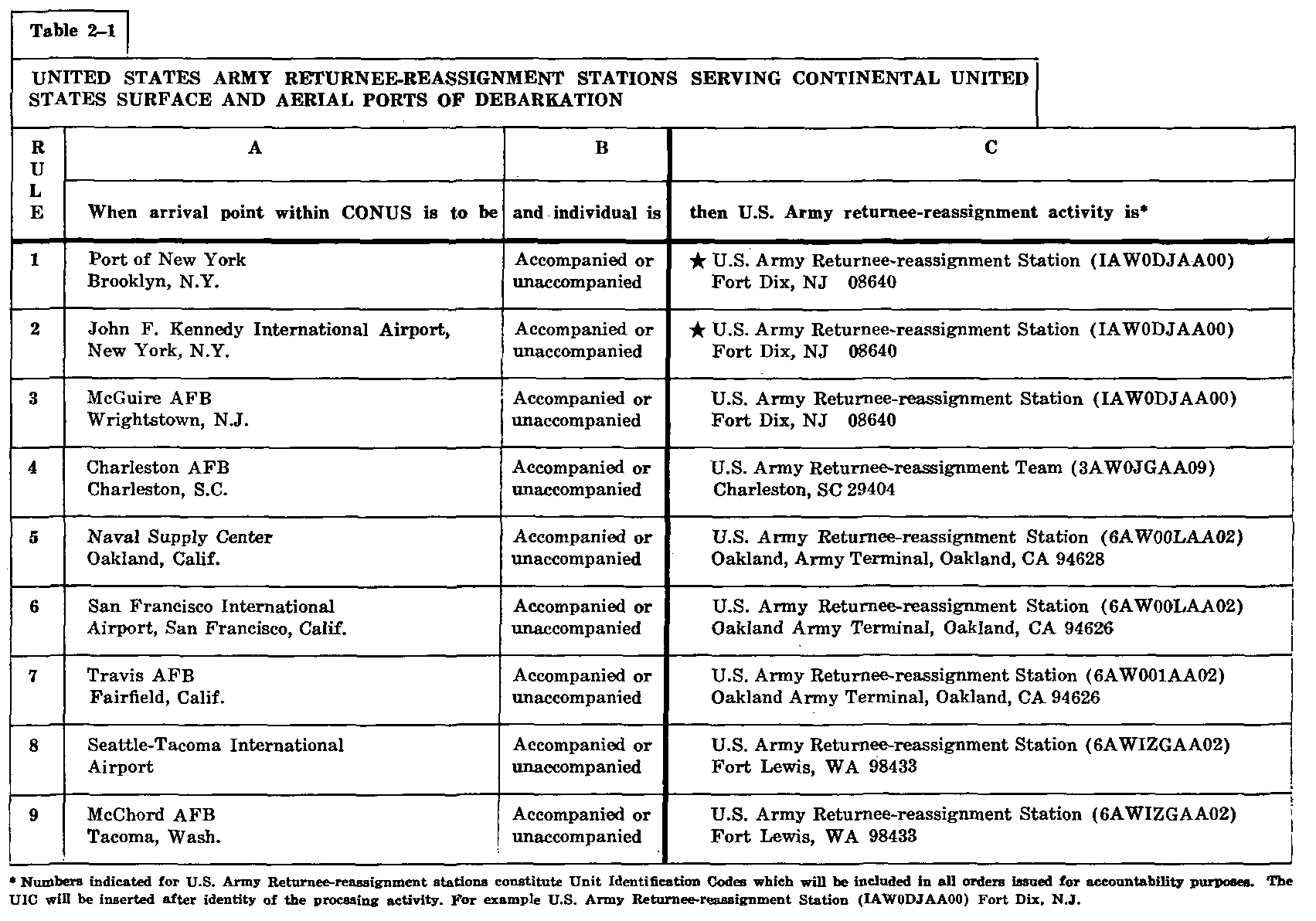
But in Homecoming, Bob Greene’s 1989 collection of spitting stories, not one of the 58 reasonably detailed first-hand accounts fully fits Burke’s description, though a few could be stretched to fit it. Barry Streeter (p. 41) claims to have flown into San Francisco, but does not claim to have flown on a troop transport. Indeed, since he was flying back to the US on emergency leave, he would have been flying alone. As Part II of my report on spitting documented, it would have been typical for soldiers flying on emergency leave to be flying on commercial flights into commercial airports, in particular, San Francisco, designated in military regulations as one of the four regular ports of debarkation for soldiers flying from the Far East to the West Coast.
Another veteran in Bob Greene’s book was not returning from Vietnam, but rather he was being reassigned from a hospital in Japan (where he met and married his Japanese wife) to a particular hospital in the states. His Japanese wife and child were flying with him, so again there is no suggestion that it was a troop transport. Like those flying on emergency leave, those reassigned to a specific unit in the states flying with dependents often flew on commercial airlines into commercial airports at the military expense.
A third spitting story involved a serviceman who had flown into the San Francisco airport, but there was no indication in which direction he was headed or even whether he himself was ever stationed overseas. A couple more writers in Bob Greene’s Homecoming appear to have flown into the San Francisco Airport, and another letter writer reports having flown into the Los Angeles Airport.
Most of these stories were either of soldiers on leave statuses that often took commercial flights from the Far East, or the accounts did not disclose where the flight to the US airport originated (it may have come from another US commercial airport after he had arrived at a military airport and been processed). None of these stories explicitly involved troop transport planes flying into commercial airports.
Bruce Franklin appears to make the same mistake:
“How then to explain the belief now held by many veterans that they were indeed spat upon as they arrived from Vietnam at the San Francisco and Los Angeles airports? The answer lies in the transformative power of collective national myth over individual memory. The myth is so strong that it has even determined their memory of where they arrived, for they were flown back not to these civilian airports but to military bases closed to outsiders.” (H. Bruce Franklin, Vietnam and Other American Fantasies, p. 62)
The story that Carol Burke and Bruce Franklin tell appears to be a bit of “academic folklore.”
Interestingly, Jerry Lembcke suggests how such myths and folklore could have come about and what purposes they might fulfill:
Myths can play a positive role in society by helping a people create a common sense of who they are. The stories that make up the myths help establish the boundaries between who and what the people in the society are and who and what they are not. Viewed this way, myths arise out of the common experience of a people and serve the interests of the group as a whole. But the creation of myths can also involve the exercise of power, and their utilization can serve the particular needs of dominant interest groups. The origins of a myth . . . lies less in the common experience of the people than in the need of one group of people within a particular society to have another group believe that something did or did not happen. (Lembcke, Spitting Image, p. 8)
Myths help people come to terms with difficult periods of their past. They provide explanations for why things happened. Often, the explanations offered by myths help reconcile disparities between a group's self-image and the historical record of the group's behavior. (Lembcke, Spitting Image, p. 184)
Indeed!
That's the problem with Whig History.
Even some VC commenters seem to be seeing things from an almost exclusively presentist lens. But it's Lembcke's pre-occupation with the current-day implications of spitting stories that may be causing his problems in seeing the past clearly. Not everyone lines up the same on every war. Some of us opposed the Vietnam War (and are not ashamed of our opposition to it), but that doesn't mean that we were blind to the nastier side of that movement. Attitudes toward the military are nothing like they were then, a fact that I think some younger readers may find it hard to credit fully.
ABC News has recently posted this handy Sunni-Shiite quiz. The quiz tests your knowledge of which important Middle Eastern Muslim countries and political factions - such as Al Qaeda and Iran - are Sunni and which are Shiite. As I explained in this post, many members of Congress, including some who sit on the House Intelligence Committee would probably flunk. In general, I'm skeptical of the utility of "good government" reforms. However, here's one that I can support:
No congressman should be allowed to join the Intelligence Committee - or any other committee that deals with US Middle East policy - without first scoring a perfect 8 for 8 on this very simple quiz.
UPDATE: Mark Kleiman comments on this post. He agrees with me on the desirability of applying the test to would-be members of relevant congressional committees. And I agree with him that it would make sense to apply a similar test to executive branch officials responsible for foreign policy issues. However, I part company with his claim that ignorance in government is unrelated to the vast size and complexity of the public sector and can easily be solved by "attract[ing] a better class of elected and appointed officials" (I originally made the opposite argument here). I'm all for attracting more knowledgeable officials, but the modern state creates perverse incentives that make this laudable objective difficult to achieve.
Voters don't select candidates based on the latters' knowledge of policy issues, and given the voters own massive ignorance (see e.g., my publications here and here), it is highly unlikely that they will ever do so. Successful politicians must devote their time to those activities that help them get reelected, which involves more time spent fundraising, handing out pork, and lining up interest group support, and relatively little time spent studying public policy in any depth.
As for executive branch officials, they are selected for the kinds of qualifications that help to achieve the objectives of their superiors and often those of powerful interest groups that influence the selection of appointees. Sometimes these agendas will lead to the hiring of knowledgeable policy experts, but often they won't. Moreover, given the enormous size, scope, and complexity of modern government, it is highly unlikely that top officials will be knowledgeable about more than a small fraction of its activities, even if those officials were much smarter and better educated than those we have now. Even with a degree of specialization, the knowledge burden of running the modern state will still be enormous. As F.A. Hayek explained in this classic essay "The Use of Knowledge in Society," this is one of the main reasons why markets are superior to central planning.
If we want leaders who are knowledgeable about the issues they decide on, we need to reduce the number of those issues, and also reduce their opportunities to ensure their election and reelection by means other than good policy performance. Much of the time, the only way to achieve these objectives is to reduce the size and scope of government. If Congress lacked the power to hand out pork, give political payoffs to interest groups, and engage in other similar activities, its members would have much stronger incentives to become knowledgeable about major issues, since it would be harder for them to achieve reelection other than by good performance on those issues.
Contra Kleiman's characterization of my views, I don't believe in the mantra of "private sector good, public sector bad." Rather, I believe that the public sector can be good (especially compared to the status quo) if its functions are confined to a narrow range. Otherwise, its performance will indeed be "bad" a high percentage of the time.
In this Slate column, Pepperdine law professor Doug Kmiec decries two recent 5-4 Supreme Court decisions because they undermine Chief Justice Roberts' effort to promote unanimity on the Court, which in turn makes Supreme Court decisions less clear. As Kmiec puts it, "[w]hen the justices work out their disagreements before they write opinions, unanimity has the potential to supply what practicing lawyers (and their clients) most often need—a clear rule."
My view is exactly the opposite: other things equal, the effort to achieve unanimity on the Court actually reduces the likelihood of decisions that establish clear rules. A unanimous decision requires the consent of nine different justices, people who in this day and age have widely differing ideologies and jurisprudential philosophies. An opnion that can command such a broad consensus is likely to require compromise between the preferences of conservative and liberal justices, originalists and living constitutionalists, and so on. Thus, any rule that is agreed to unanimously is likely to be riddled with exceptions, balancing tests, and other compromises that had to be included in order to win the support of all nine justices. This is especially likely to be true if the issue being decided is an important and controversial one that the justices disagree on.
Many of the complex balancing tests and complicated exceptions to rules that legal commentators like to make fun of in Supreme Court opinions are the result of the need to "count to five" - corral the five votes needed to create a binding Supreme Court decisons. Counting to nine is usually likely to require more compromise - and thus more complicated balancing tests and exceptions - than counting to five.
There may be other good reasons to value unanimity in Supreme Court decisions. For example, a unanimous decision that has the support of justices across the political spectrum is probably less likely to be wrong than a 5-4 decision that may have been reached on narrow ideological grounds. But, to the extent that we value clarity in legal doctrine, the quest for unanimity on the Court is likely to do more harm than good.
E-voting will be introduced for a parliamentary election on March 4, for the first time after it was used in more limited local elections in 2005....
The e-voting system was tested earlier this week, including the chance to choose the "king of the forest". Voters could pick an animal from 10 candidates, including moose, deer and boars....
But who won? In any case,
Just under 10,000 people voted via the Internet in local elections in October 2005. Computer specialists have estimated 20,000 to 40,000 of 940,000 registered voters will vote via the Internet from February 26 to 28, ahead of the March 4 election day....
The voting will take place by people putting their state-issued ID card, which has an electronic chip on it, into a reader attached to a computer and then entering two passwords....
Dennis "DJ" Johnson, a star player on the Boston Celtics teams that I grew up rooting for in the 1980s died suddenly today at the tragically early age of 52.
Johnson was one of the most widely admired and respected NBA players of his generation, a star on three championship teams (two with the Celtics), and the MVP of the 1979 NBA finals. He was also, for a long time, a resident of Lexington, Massachusetts, the town where I grew up.
Condolences to Johnson's family, friends, and former teammates.
UPDATE: Here is an obituary by ESPN columnist and longtime Celtics fan Bill Simmons that summarizes DJ's many achievements and puts his career in perspective.
Take a look at the mini-script at the bottom of the Group of 88 ad. It states in part: “We thank the following departments and programs for signing onto this ad with African & African American Studies: Romance Studies; Psychology; Social and Health Sciences; Franklin Humanities Institute; Critical U.S. Studies; Art, Art History, and Visual Studies; Classical Studies; Asian & African Languages & Literature; Women’s Studies; Latino/a Studies; Latin American and Caribbean Studies; Medieval and Renaissance Studies; European Studies; Program in Education; and the Center for Documentary Studies. Because of space limitations, the names of additional faculty and staff who signed on in support may be read at the AAAS website…”
Does this mean these departments and programs approved of the ad? Was it the head of each department or program that gave assent? Was a vote taken among the faculty of each of these departments or programs approving of their support? Is the list simply reflective of the departments and programs of the 88 signatories? Have this ever been addressed? Let’s say I’m a member of the Post-Raphaelite Studies Department and strongly disapproved of a certain position. If I later saw an ad supporting that position and thanking the Post-Raphaelite Studies Department for signing onto it, I would have a thing or two to say about that.
In response to this question, I looked into the issue, and was deeply troubled at what I discovered.
I e-mailed all the professors in the Romance Studies; Psychology: Social and Health Sciences; Art, Art History, and Visual Studies; and Asian & African Languages & Literature departments who did not sign the Group of 88’s ad, and asked when their department formally endorsed the Group of 88’s statement. Many did not respond. Those who did, however, could not recall any formal departmental mechanism through which their department approved the ad.
For those outside of the academy, it is hard to overstate the significance of this point. Departments rarely speak as corporate bodies: in my 13 years as a professor at ASU, Williams, Brooklyn, and (as a visitor) Harvard, I have never been part of a department that formally “endorsed” any public statement. At a minimum, for such an endorsement to have been made, the department would have needed to have voted, either by e-mail or in person.
When did the votes in these four departments occur? Why is there no record of the votes? . . .
This makes absolutely no sense to me. As a former associate dean at two universities, I have trouble understanding how this state of affairs could be true.
The first two possibilities are that those professors who responded to KC Johnson are simply wrong, that there were official departmental votes, but (1) that they were unaware of them or (2) that they are lying to Johnson to try to get him to embarrass himself by publishing false information. That no one confirmed their faculty's vote to join the Group of 88's letter would seem to make these possibilities less likely than other possibilities.
So now one must consider the other possibilities, in which at least some departments and programs did not have a meeting and vote on joining the Group of 88.
Could any of 15 departmental and program chairs have so abused their powers that they unilaterally committed their programs officialy to a public political position in opposition to a group of Duke students without a full departmental meeting, deliberation, and vote? My guess is that this is probably what happened in at least some departments or programs, but then I am just speculatiing. Most chairs that I've dealt with would never have done such a thing. Duke's trustees should consider policy changes to prevent future abuses of this type.
The next possibility is even more disturbing, even if less likely to be true than the others. Could it be that one or more of the approximately 15 departments or programs that supposedly endorsed the letter did not do so? Did the letter writers fabricate departmental or programmatic support that did not exist, either intentionally or out of confusion?
That is a truly frightening possibility, even if less likely to have happened than some of the others. After the Group of 88's letter was published with departments and programs at Duke presented as official signatories, the President or the administration would likely have talked to at least a few chairs to determine the circumstances of their departments' signing on. Is it possible that the President or another member of his administration had discovered that the authors of the Group of 88 were falsely claiming official Duke departmental endorsements that were fraudulent--and kept silent about it?
Leading a university is like herding cats, and faculty members can be expected to make many irresponsible statements for which the administration can't reasonably be held responsible. But claiming departmental support (if there were none) is a claim that an administration would have a moral (and perhaps a legal) obligation to correct. Publishing the Group of 88's letter certainly damaged the reputation of the Duke students accused of rape, and encouraged those who were harassing them. If a professor lied about whether departments or programs at Duke joined in the denunciation of the accused Duke students, that lie would have damaged the reputation of those students. Because of its somewhat odd posture, I don't know whether such a lie (if it occurred) is actionable (defamation not being an area of my expertise).
Could a departmental chair, dean, or university president have been so craven that he or she would not have taken steps to correct a false endorsement of a damaging political ad. Was the climate of fear so bad or the administration so weak that even this simple correction was deemed too much?
Ultimately, I don't believe that President Brodhead could have been so frightened of his own faculty as this possibility would suggest. While it seems in retrospect that Brodhead was not a good leader, I have no reason to think that he is not at least a competent and honest follower.
WHAT TO DO:
DUKE CHRONICLE: Now that the issue whether any of the 15 departments or programs did not endorse the letter has been raised, the Duke Chronicle, which published the ad, is (in my opinion) obliged to examine the matter. To avoid criticisms of "reckless disregard for the truth," the Chronicle should investigate and correct any significantly false information it has published in the ad.
TRUSTEES AND UNIVERSITY COUNSEL: It is not clear what the trustees' obligations in this matter are, but if I were a trustee, I would try to get the University Counsel to look into whether anyone has falsely claimed to have departmental or programmatic support for the Group of 88's letter. If I were University Counsel, I would make the inquiry on my own initiative. If Counsel were to determine that someone did make such a false claim (which, as I said, I think is less likely than other possibilities), then Counsel should be asked to give an opinion about the liability of the university, the administration, or any departmental chair for failing to correct that falsehood. If (as I hope and think did not happen) President Brodhead did know that some departments or programs had not endorsed the letter, and concealed that fact from the Duke community, I wonder how he can look his students or faculty in the eye anymore--let alone face himself in the mirror.
Earlier today, I commented that I although I thought that the holding in the Supreme Court's opinion in Marrama was correct, the opinions suffered from a lack of consideration of the policies and legislative context of the statutory provisions in question in the case. If you buy my argument about the relevance of policy and historical legislative context in illuminating the plain language of the statute (a big "if" I recognize), I think this leads directly to some reflection on the nature of the Supreme Court and its expertise (a question that was anticipated by one of the Commenters in the earlier Comment thread as well).
Perhaps this opinion style was intentional and the Justices believe that this is the best way to address a question such as this. But I fear that an alternative hypothesis presents itself--the Supreme Court today lacks the expertise to fully understand the full policy and historical context that arises in a particular bankruptcy case like Marrama.
I think few people would say that the Supreme Court could do its job well, or perhaps even competently, if none of its members had substantial expertise in constitutional law or criminal law. It is not clear to my why the same concern doesn't apply to matters of commercial law.
Several years ago, a Supreme Court Justice spoke here at GMU Law, and a student asked what advice the Justice had for law students. The Justice replied, "Take as many classes in as wide a variety of areas as possible. For instance, I never took bankruptcy in law school, and to this day I don't understand the policies and concepts that underlie the Bankruptcy Code." This statement seems that it could be applied to any of the sitting Justices.
Justices seem to be drawn from a relatively narrow pool of lawyers with particular expertise developed in either the Executive Branch, appellate practice, or both (as with Chief Justice Roberts). Experience in the Executive Branch rarely exposes one to very different questions from those that arise in bankruptcy, securities, or the like. As for appellate lawyers, although they get exposed to many varied areas of law, their exposure is piecemeal and at the level of the law, typically rather than developing a deep expertise in any substantive field of law, such as bankruptcy. Breyer and Scalia have some expertise in economics (the former academics), but it is not clear that this necessarily extends to commercial law more generally.
So, while it is possible that the Justices sincerely believe that these sorts of opinions are the best way to address questions that arise under the Bankruptcy Code, it seems equally plausible to me that they feel like they have to address the questions in this manner because of a lack of expertise to address them in a deeper way. Perhaps in the long run that is good, but at first glance I'm not persuaded.
Private employers are, in nearly all states, presumptively free to fire employees for any reason or no reason at all. There are quite a few statutory limits on this (such as bans on discrimination based on race, sex, and the like), and of course this rule can be changed by contract, whether individual employment contract, union contract, or academic tenure contract. Many states have also recognized judge-made rules of "termination in violation of public policy," for instance when an employer fires an employee for performing jury duty, alerting authorities to employer violations of safety regulations, or doing other things.
Some courts have looked to state constitutional protections as sources of such "public policy." Thus, even when the state constitution only prohibits government suppression of certain conduct, state courts may use this (but certainly do not always us ethis) as a guide for fashioning similar common-law prohibitions on private employer conduct. The rules vary from state to state, and they can be trumped by state statute, since these are just common-law rules (even when inspired by the state constitution), not constitutional mandates. Still, they are potentially quite important.
A federal district court has just applied this principle to hold that Ohioans — even ones employed by private employers — are presumptively protected from being fired for off-employer-property (and presumably off-duty and lawful) possession of guns. The case is Plona v. UPS, 2007 WL 509747 (N.D. Ohio Feb. 13) (emphasis added):
Plona, an Ohio resident, was employed by UPS at a facility in Cleveland, Ohio.... Plona ... was terminated in April 2006, allegedly because UPS discovered that Plona had a handgun in his vehicle while at work. Plona alleges that he had the handgun, which was disassembled and unloaded, and locked in his car in a public-access parking lot used by both UPS employees like Plona and non-employees/customers of UPS. On the day of his termination, UPS announced that law enforcement would be conducting a routine search of all persons and property on UPS premises for contraband. When Plona informed law enforcement about the handgun locked in his car, and the handgun was then discovered, he was terminated....
[T]he court proceeds on the facts alleged in the complaint and all inferences drawn in Plona's favor, meaning that the court presumes for the purposes of this motion that the parking lot where Plona's car was parked was not UPS company property....
Plona has made one claim in his complaint against UPS, for wrongful termination in violation of Ohio public policy. That claim, under Ohio common law, has four elements: (1) that a clear public policy existed and was manifested in the federal or state constitution, statute or administrative regulation, or in the common law (the “clarity” element); (2) that terminating employees under the alleged circumstances would jeopardize the public policy (the “jeopardy” element); (3) that the termination was motivated by conduct related to the public policy (the “causation” element); and (4) that the employer lacked overriding legitimate business reasons for termination (the “overriding justification” element).... The first two elements — clarity and jeopardy — are questions of law, to be determined by the court..
In this case, the claimed source of the “clear” public policy is the Ohio constitution, Article I, Section 4, which states that “[t]he people have the right to bear arms for their defense and security ...” Plona asserts that Ohio has a clear public policy, as stated by its constitution, permitting its citizens to bear arms and that allowing UPS to terminate him for possessing an unloaded, disassembled firearm off of company property would jeopardize that public policy.... The court finds that the public policy of Ohio permitting citizens to bear arms, as stated in Article I, Section 4 of the Ohio constitution, is clear enough to form the basis of a wrongful termination claim.
As far as the court could determine, only one court has previously addressed whether the right to bear arms, as enshrined in Article I, Section 4 of the Ohio constitution, can serve as the basis for a wrongful termination in violation of public policy claim. Petrovski v. Fed. Express Corp., 210 F.Supp.2d 943, 948-49 (N.D.Ohio 2002). However, the plaintiff in Petrovski was not terminated for possession of a firearm, just for “conversations concerning firearms.” Therefore, while the court in Petrovski addressed the question before this court, it did so only in dicta, as it was not faced with the situation of actual firearm possession as in this case....
Burdens on employees while at work do not jeopardize their rights; they are instead permissible limits on the rights enshrined in the Ohio constitution. See, e.g., Ohio Rev.Code § 2923.126(C) (permitting a private employer to prohibit firearms on company property).
On the other hand, punishing employees for exercising constitutional rights while outside the workplace jeopardizes public policy to a much greater degree.... Permitting UPS to terminate Plona for possession of a firearm off of company property would be no different than permitting UPS to terminate Plona for possessing a firearm at his residence. And allowing an employer to terminate an employee for exercising a clearly established constitutional right jeopardizes that right, even if no state action is involved.
Therefore, because the court presumes that Plona's possession of handgun was not on UPS property, and UPS did not have a policy prohibiting Plona from possessing a firearm at that location, the court shall deny UPS's motion to dismiss. However, the court will allow the parties to revisit this issue after discovery, on summary judgment, if necessary....
Note that this is only presumptive protection — in some situations, an employer might still argue that it has an "overriding legitimate business reason[]" for the termination. Note also that this is just one district court; it's not clear whether this view will be upheld on appeal, or accepted by Ohio state courts (which are the ultimate arbiters of Ohio law, and which treat federal decisions of Ohio law as at most persuasive, not binding, precedent). Still, it struck me as worth noting, especially since similar arguments could be made in the many other states that have individual right-to-bear-arms provisions in their state constitutions.
When asked about the provenance of his Harvard jacket, Shakeil Brown, a St. Anthony High School student in Jersey City, responded: “I don’t know,” He helpfully pointed to the back: “It says ‘Crimson.’”
And since I can't pass on an opportunity to promote my alma mater, I will note the number 1 selling institution:
In fact, Harvard, Yale and Princeton are not the top sellers, Mr. Cuff said. While buyers in suburban markets like those clothes more, the urban market’s most popular school is, surprisingly, the one in New Hampshire.
“The No. 1 seller of 2006 would have been Dartmouth,” he said. “And Cornell was very, very popular.” In the 2007 video for rapper Mims’ recent song “This Is Why I’m Hot,” a young man is completely accessorized in Cornell University gear.
Although we can't boast too much, as we can't claim too much credit for being the colors of choice: "Harold Soto, 18, who works the register there and owns a Dartmouth track jacket and matching hat, said that the combo nicely matches his green-and-white Air Jordan shoes. When asked about the school name, he said, “It’s like a university, right?" [TZ notes: No, its a COLLEGE!]
As for the rapidly-gaining Cornell:
A worker at a hip-hop clothing store named Morlee’s in Jersey City showed me a fitted Cornell hat ($25, plus tax) and chuckled that the kids thought it was for the Cincinnati Reds (which it does resemble). I asked him what the hat did represent. “Some college team,” he said. “Clemson, I think.”
Harvard's sales suffer, it seems, because the Bloods have adopted Harvard's garb because of the colors (there's a phrase I never thought I'd be writing).
But don't go looking for this stuff in your local bookstore--“We don’t sell our product to the bookstores,” Mr. Cuff said. “Our price points are much higher than what you’d find at bookstores.”
From a NY Times story about sour frozen yogurt success story Pinkberry's:
In November, a shop called Berri Good opened in Fairfax, with kosher certification and a chartreuse-and-pink logo that is barely distinguishable from Pinkberry's.
"I don't think we're the same," said Uzi Moses, the owner of Berri Good. "We use different fonts." On top of that, he said, "You know we have celebrities here, right? Are you aware of that?"
Yesterday the Supreme Court decided Marrama v. Citizens Bank of Massachusetts. The issue was whether an individual debtor has an absolute right to convert his case from Chapter 7 to Chapter 13, or whether the Bankruptcy Judge has the power to deny the conversion if it was in "bad faith" and therefore would be an abuse of the bankruptcy process. The Court held 5-4 with Stevens writing that the conversion could be denied, with Alito writing a dissent.
My view is that the Court reached the right result, but turned what should have been an easy case into a much more difficult and close case than it should have been, and in so doing, wrote an unnecessarily confused opinion. The problems with the opinions in the case arise from a failure to fully consider the policy and context of the key statutory provisions in the case and the legislative context in which they were enacted.
Even after reading the briefs awhile back and the opinion a couple of times, I confess that the precise timeline of the facts in the case are a bit murky to me. But the precise timing is not as important as the debtor's basic behavior in the case. As I understand it, sometime before filing his initial bankruptcy case Marrama transferred his sole asset of value, a home in Maine, into a self-settled trust, and then on his schedules he declared that the value of his interest in the trust was zero. This wasn't Marrama's only willful misrepresentation in the case, as Stevens notes, but the biggest one. At his 341 hearing, the trustee told Marrama that he intended to recover the Maine property as property of the estate (and presumably would seek to deny his discharge as well). Marrama chalked up the omission to a "scrivener's error" to which the Bankruptcy Judge later ruled that there is no "Oops" defense to the concealment of assets in bankruptcy.
Once Marrama was busted by the trustee, he decided to convert his case to Chapter 13. I am a bit unclear about how his scam was going to work (please help me out in the comments if I don't have this exactly right), but my understanding is that it was something like this--once Marraama was busted, he knew the concealed property would be recovered for the estate and he would probably lose his discharge. By converting to Chapter 13, he could retain the property and by refiling correct schedules, he figured he wouldn't be subject to any concerns about losing his discharge. So the idea is that he would use his initial filing in Chapter 7 as his "one free bite at the apple" of committing bankruptcy fraud, and then if he got busted, he would flip over to 13 with no consequences. I suspect that it is this "one free bite" aspect of the racket and the possibilities for fraud and abuse that led Justice Stevens to note in his opinion that this is "an issue that has arisen with disturbing frequency."
The opinions themselves are a thicket of textualism. I will not parse them here, as I don't have much to add to those densely-reasoned textual opinions. The basic textual issue turns on the interpretation of sections 706(a) and (d) of the Bankruptcy Code, which provide:
(a) The debtor may convert a case under this chapter to a case under chapter 11, 12, or 13 of this title at any time, if the case has not been converted under section 1112, 1208, or 1307 of this title. Any waiver of the right to convert a case under this subsection is unenforceable.
(d) Notwithstanding any other provision of this section, a case may not be converted to a case under another chapter of this title unless the debtor may be a debtor under such chapter.
The question in the case is whether the seemingly unqualified language of section (a) ("the debtor may convert") gives a bankruptcy debtor an absolute right to convert once from Chapter 7 to Chapter 13 unless one of the of the precise conditions enumerated there are triggered--e.g., that the debtor can convert only once and that the debtor may be a debtor under the chapter to which he is converting. Justice Alito's dissent rests on the argument that this language is unambiguous and exhaustive, "The Code restricts, a Chapter 7 debtor's conversion right in two--and only two--ways." Since bad faith conversions are not specifically enumerated, they are permitted.
Justice Stevens's majority opinion is premised on the observation that Bankruptcy Judges have long held equitable power to prevent fraudulent and inequitable use of the bankruptcy system, a power that is reflected in numerous provisions of the Bankruptcy Code, particularly section 1307(c) which permits the Bankruptcy Court to dismiss or convert a Chapter 13 case "for cause," which has been interpreted to include filings made in bad faith. Bankruptcy proceedings are equitable proceedings and I think that Justice Stevens is correct in his recognition of the power of Bankruptcy Judges to prevent bad faith abuse of bankruptcy and the longstanding nature of the power. So while I am not surprised by the outcome in the case, which I think is obviously correct, I am surprised only by how close the vote was.
Textualist opinions by the Supreme Court are often denounced as "wooden" and I think the opinions in Marrama evidence that. This does not seem like a difficult question from the perspective of bankruptcy law and policy. I think what made this a close case is that none of the Justices appear to have even tried to think through the bankruptcy questions that underlie the question.
In my view, the question in this case is pretty straightforward. Justice Alito writes a standard textualist opinion--here's a list of Code provisions, denial of conversion for bad faith isn't on it, and the Code provides other roundabout ways of punishing a bad faith conversion:
In sum, the Code expressly gives a debtor who initially files under Chapter 7 the right to convert the case to another chapter so long as the debtor satisfies the requirements of the destination chapter. By contrast, the Code pointedly does not give the bankruptcy courts the authority to deny conversion based on a finding of "bad faith." There is no justification for disregarding the Code’s scheme.
But note what is lacking from Alito's rationale--although he states that there is "no justification for disregarding the Code's scheme" nowhere does he offer any explanation (plausible or otherwise) for why Congress would have possibly wanted to permit bad-faith conversions or to deny Bankruptcy Judges the power to prevent a bad faith conversion. Instead, he simply starts with the premise that Code gives the debtor an absolute right to convert once. If the conversion is in bad faith, Alito speculates that the Court could convert it back immediately "for cause" under section 1307(c), assuming that all of the requirements could be met. But all of the requirements enumerated there seem to apply only to defects in the Chapter 13 filing, and don't seem to address the fraud in the initial Chapter 7 filing (which is presumably why Marrama immediately filed in Chapter 13, because he thought he could cleanse his concealment by converting).
The problem with reading the statutory provisions in the narrow textualist manner as Alito does is that the reading is stripped of its context (of course, the majority opinion is no better on this point). Again, is there any reason to believe in this section that Congress desired to remove from Bankruptcy Judges the power to prevent bad faith abuse of the bankruptcy courts? Did Congress really intend the debtor to have an absolute power as of right to convert his case once?
The premise of this claim that there is an absolute power to convert resides in one piece of legislative history that Marrama relied on heavily in the case (as does Alito):
Petitioner contends that subsection (a) creates an unqualified right of conversion. He seeks support from language in both the House and Senate Committee Reports on the provision. The Senate Report stated:
“Subsection (a) of this section gives the debtor the one-time absolute right of conversion of a liquidation case to a reorganization or individual repayment plan case. If the case has already once been converted from chapter 11 or 13 to chapter 7, then the debtor does not have that right. The policy of the provision is that the debtor should always be given the opportunity to repay his debts, and a waiver of the right to convert a case is unenforceable.” S. Rep. No. 95–989, p. 94 (1978); see also H. R. Rep. No. 95–595, p. 380 (1977) (using nearly identical language).
This passage has been read to express Congress's intent that the debtor be given an absolute one-time right to convert--"Subsection (a) of this section gives the debtor the one-time absolute right of conversion of a liquidation case to a reorganization or individual repayment plan case." But I believe that this is a misreading of the legislative history, and again, I think the misreading arises from a failure to consider the context of the statement. And specifically here, the legislative and historical context, and that the final sentence of this passage actually reflects an important qualification on the "absolute" language at the beginning, a qualification that only emerges from a consideration of the legislative context.
When Congress enacted the 1978 Code, Chapter 13 was a relatively novel process. So-called "wage-earner" plans (predecessors to Chapter 13) had developed spontaneously and piecemeal under the Bankruptcy Act, and in providing for Chapter 13 in the Bankruptcy Code, Congress intended to try ratify, formalize, and regularize the use of Chapter 13. Moreover, Congress wanted to make clear that debtors could elect to file Chapter 13 if they desired and Congress was expressing a goal of encouraging willing debtors to do so. But given the relative novelty of Chapter 13, Congress could not exactly foresee exactly how Chapter 13 would play out in practice.
But one thing is clear from reading the legislative history of the entire Code--Congress believed that the primary reason why debtors would use Chapter 13 (and precisely why Congress wanted to encourage its use in the 1978 Code) was to permit debtors to repay their debts if they wanted to. Why state the proposition as an "absolute right to convert?" Again, reading the legislative history of the Code as a whole, it is because Congress wanted to give debtors the right to try to repay their debts, even if a bankruptcy judge thought it was foolish and that the debtor would be better off in chapter 7 instead. This was an effort to permit debtors who wanted to try to "live up to their moral obligations" to do so, even if meant that they were foregoing the easier ride of Chapter 7.
Why does all of this matter? Consider now the rest of the legislative history applicable to Marrama--"The policy of the provision is that the debtor should always be given the opportunity to repay his debts, and a waiver of the right to convert a case is unenforceable." Thus the legislative history expressly states, "The policy of the provision is that the debtor should always be given the opportunity to repay his debts." A debtor who is seeking to convert to chapter 13 in bad faith, such as Marrama, is quite plainly not seeking to convert for the purpose of being given an opportunity to repay his debts, thus the expressly stated policy of the purported absolute right to convert would not be advanced by permitting conversion in such a case.
In other words, in creating a supposed "absolute right to convert" Congress anticipated at the time that those debtors who would be using Chapter 13 under the "new" Code would be only those who were doing so only to repay their debts, and this was the express policy of permitting conversion. And this understanding is manifest throughout the language and structure of Chapter 13. Congress sought to regulate the more obvious abuses that could be anticipated under Chapter 13, such as plans where the debtor would actually pay less than under Chapter 7.
So it seems evident that Congress simply did not anticipate that a debtor might try to use conversion as a tool of bad faith abuse as Marrama did here. All Congress seems to have had in mind would be good faith debtors, not bad faith, so it didn't anticipate abuse of the conversion right (even now the scam itself is not obvious). So, instead, Congress simply expressed that the policy of the section was to enable good faith debtors to convert, thereby implying that this was the condition on the absolute right to convert.
And this explains why Alito can point to no policy purpose that would be advanced by permitting bad faith conversions, because Congress's policy was to permit only good faith conversions.
And so what about bad faith conversions? Well, here Stevens has it exactly right--given that Congress only meant to permit good faith conversions, and didn't (and couldn't) anticipate all bad faith conversions, bad faith conversions could be policed by the Bankruptcy Court's ancient and well-established repository equitable powers to prevent bad faith abuse of the bankruptcy process. On this point, then, Stevens is correct.
In the end, the Court fortunately ended up reaching the correct result in the case, although it was only a close case because both the majority and the dissent take a wooden approach to statutory interpretation that didn't consider the context, and that the outcome would have made more sense had they done so.
Second, and more likely in my view, is that he knew if he stayed in Chapter 7, the trustee would liquidate the assets he fraudulently transferred. A debtor does not have a unilateral right to dismiss a Chapter 7 case, and remaining in 7 would certainly lead to liquidation — especially in light of the provision of the BK code that says a debtor cannot exempt fraudulently transferred assets. However, if a debtor in Chapter 13 fails to file a confirmable plan, or fails to make the plan payments, the case is usually dismissed. I think this was his goal. So Marrama, knowing the trustee represented a speeding locomotive headed down the tracks squarely at him, simply wanted to jump off the tracks, even if it meant having to deal with his creditors one by one. Perhaps his state exemption law would additionally not bar him from exempting the fraudulently transferred assets.
Update:
Also, to be clear--I don't believe I'm making an argument that the Court should prefer policy analysis to plain language (and don't intend to do so). After all, both the majority and the dissent's opinions are grounded in plain language and both are plausbible. The question is what to do with the silence in sec. 706 about whether the silence as to a bad faith exception excludes reading the language against this background assumption of judicial equitable power. So I'm simply saying that given that both readings are plausible, only one of the two makes any sense when read in the context of the legislative history and policy purpose of the statutory language and explains the particular structure of the statute in a way that makes sense. Instead, the dissent's opinion misunderstands the legislative history to justify its interpretation of the statutory silence as implying an absolute right to convert, so my quibble is not with textualism per se, but the use of legislative context. I've never understood textualism to imply that one should ignore the context and purposes of the statute.
Spitting Report V: Servicemen and Anti-War Activists at the Airport.--
In a 2005 Boston Globe op-ed, Professor Jerry Lembcke appears to claim that he had smashed (as false) previous stories of spat-upon Vietnam veterans (I wish he had indicated which ones). In the Globe, Lembcke attacks one account that indeed includes some ridiculous statements by the supposed spitting victim:
STORIES ABOUT spat-upon Vietnam veterans are like mercury: Smash one and six more appear. It's hard to say where they come from. For a book I wrote in 1998 I looked back to the time when the spit was supposedly flying, the late 1960s and early 1970s. I found nothing. No news reports or even claims that someone was being spat on.
The story told by the man who spat on Jane Fonda at a book signing in Kansas City recently is typical. Michael Smith said he came back through Los Angeles airport where ''people were lined up to spit on us."
Like many stories of the spat-upon veteran genre, Smith's lacks credulity. GIs landed at military airbases, not civilian airports, and protesters could not have gotten onto the bases and anywhere near deplaning troops. There may have been exceptions, of course, but in those cases how would protesters have known in advance that a plane was being diverted to a civilian site? And even then, returnees would have been immediately bused to nearby military installations and processed for reassignment or discharge.
The exaggerations in Smith's story are characteristic of those told by others. ''Most Vietnam veterans were spat on when we came back," he said. That's not true.
There are many problems with Lembcke’s arguments—the chief one being that Lembcke claims Michael Smith’s account is "characteristic of those told by others."
First, consider the doubtful context of Smith’s account. He has been arrested for spitting on Jane Fonda and needs to justify himself. Anything Smith says could be doubted because he is reaching for an excuse for his criminal behavior (charges were eventually dropped).
Second, consider what Smith actually said: “Because of Jane Fonda, most Vietnam veterans were spit on when we came back. When I came back through LA Airport, there were people lined up to spit on us.”
It is nonsense to suppose that most vets were spat on and to attribute this behavior to one person, Jane Fonda. Note that Smith does not say that he was spat on, but rather that people “were lined up” to do so; this differs considerably from the more direct accounts in Bob Greene’s 1989 book Homecoming that people were actually spat at or spat on. Yet several respondents in Greene’s book, even ones who reported no spitting, reported being hassled by groups of activists in the LA airport, including activists in lines or groups
What is particularly misleading about Lembcke’s criticism of Smith is that Smith never claimed or even hinted that he had flown into LAX from Vietnam. Many servicemen flew into a military base and then were bused to LAX for flights home. Lembcke well knows this, and yet he would have readers believe that there is something wrong with a serviceman claiming to have been through LAX on the way home from Vietnam. That is a very misleading way to argue, because most readers will assume that Lembcke has some reason for thinking that Smith was claiming to have flown into LAX.
And Lembcke is just being silly with his implication that for protesters to be lined up at a civilian airport, they would have to have had advance notice of when troops were arriving by plane.
An article on the USO club at the civilian San Francisco airport describes how in December 1969, their busiest month so far, 54,766 servicemen stopped into the USO club; the picture accompanying the article shows a soldier signing into a log (December 17, 1970, San Mateo Times). That’s over 1,500 a day. That’s probably just a fraction of the military personnel who went through that civilian airport every day. Many who arrived at the airport by bus or car from the Oakland Army Terminal would have simply caught their flights for home.
Saying that you went through the San Francisco airport on the way to or from home or another military installation is something that perhaps 500,000 to 2 million men and women in the service did every year. Anti-war activists would not need to be informed about when troops would be arriving by plane to have a critical mass of targets for recruiting or abuse. While significantly fewer service personnel would have passed through LAX, the numbers should still have been huge.
Antiwar activists did stake out the San Francisco civilian airport because there were so many vets returning from Vietnam going through the airport. Indeed, they went to the SF Airport “because it was ‘the first civilian ground they'd set foot on back in the states.’" (Tip to Kevin Bowman) Activist Steve Rees writes in his 1979 book, They Should Have Served Coffee, that their standard greeting to servicemen was: "Hey, soldier. Welcome home. F**k the Army. Read all about it in this paper. No charge." (p. 159)
Last, Smith’s account is not typical. Most spitting accounts are specific on whether they were spat upon and make no obviously false claims, such as that most veterans were spat upon.
++++
I am suspicious of Smith’s account for the very reasons that it is not typical of the stories in Bob Greene's book: because of (1) the criminal context in which Smith's story arose, (2) Smith's vagueness about whether he was actually spit on, and (3) Smith's obviously false speculations (which Lembcke notes but pretends are "characteristic"). But I am not suspicious for most of the reasons that Lembcke raises, which are specious and easily rebutted with evidence.
Former astronaut Buzz Aldrin, the second man on the moon, and space policy analyst Taylor Dinerman have written an interesting article on the economic potential of space. They argue that the Moon and possibly other parts of the solar system might contribute greatly to fulfilling future energy needs, and also produce other valuable products. More importantly - from my parochial perspective as a property professor - they emphasize the importance of creating private property rights in space, rather than leaving everything to government ownership:
A base on the Moon does not have to be a permanent government-controlled and owned facility. After it has been fully established, control could be handed over to a private non-profit consortium that would lease space to companies and governments which will then pursue their individual goals, such as energy, research, tourism, or developing the technology and supplies needed for further space exploration.
Handing off control of the base to a private group means that we will have to establish rules explaining what exactly is and is not private property on the Moon. According to the Outer Space Treaty, the Moon is “common heritage of mankind”. No one has ever been able to agree on exactly what this means, but few space law experts outside the United States seem willing to accept the idea that there is room for private entities to claim any sort of recognizable property rights on the Moon. The best they are willing to concede are long term leases with the rent being paid to the United Nations.
Still possession is nine tenths of the law. An American moon base would insure that traditional American ideas such as private property and homesteading would influence the future legal regime. Otherwise the Europeans and others might try and push their model of tight government control and high taxes onto the off-Earth economy of the late 21st century . . .
Greg Allison, Chairman of the National Space Society’s Policy Committee states that it “believes that the 1967 Outer Space Treaty can be interpreted as permitting public and private entities to appropriate resources that they can directly utilize and to establish a ‘reasonable’ zone of operations around sites of activity.” An American base, even one with substantial international participation, would create a precedent that would not only apply to the Moon but to all the other accessible bodies in our solar system.
I lack the expertise to assess Aldrin and Dinerman's claims about the economic potential of the Moon and other parts of the Solar System. Perhaps they greatly overestimate that potential, in which case the issue of property rights beyond Earth will be largely academic.
But if they are right conclude that the Moon or other bodies in the Solar system have tremendous potential utility, then they are also right to emphasize the importance of establishing private property rights. While some government-owned facilities in space and on the Moon are probably inevitable and desirable, imposing government ownership on all property beyond Earth orbit, as the conventional interpretation of the 1967 Outer Space Treaty seems to do, is a recipe for disaster. A vast socialist empire in space is no more likely to be a good idea than earthbound socialist empires have been.
Obviously, these issues are not yet urgent, since we are still years away from establishing a permanent human presence on the Moon, much less seriously beginning to exploit its resources. However, if those resources turn out to be valuable, it will be essential to consider the appropriate property rights regime for them ahead of time. If either national governments or the UN are able to establish government ownership over the Moon and other extraterrestrial bodies, it will be much harder to establish a private property rights regime after the fact. The entire history of modern government shows that it is much easier to limit government power over an issue area in advance than to roll it back once it has become established. The old saying that government programs are "immortal" is an exaggeration, but it does contain a large measure of truth. I suspect that this will be no less true in space than it has been on Earth.
There surely must be a good answer to this somewhere, but I just don't know where — why are states sometimes referred to as feminine? The most common usage of this is "sister state," but I also recall seeing references to states as "she" (albeit in older contexts). Sounds like some sort of literary affectation, but I'm curious just how it came about. Of course there's a similar pattern with regard to ships, but I don't know if there's any connection.
Spotted in my refrigerator a couple of days ago -- a gallon of fresh milk (not the Parmalat boxes) with the note "Use by Feb 29." Now that's advanced food preservation technology.
It is now official that the Ave Maria School of Law will move from Ann Arbor, Michigan, to Ave Maria, Florida. Paul Caron rounds up some coverage and commentary of the school's controversial decision.
My prior posts on Ave Maria's potential move, as JNoV, are here.
Professor Jerry Lembcke asserts that it would have been highly unlikely that soldiers or veterans were spat upon because relations between soldiers and the antiwar movement were generally very friendly.
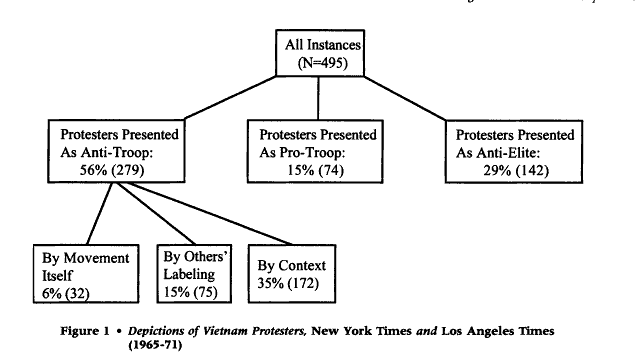
This post raises some serious problems with Lembcke's use of one 1995 study by Beamish et al. to support this claim. In particular, Lembcke somehow falsely reports a 56% incidence of anti-troop behavior as a 6% incidence of anti-troop behavior, a mistake that he has repeated in several publications.
In a very revealing passage, Lembcke argues:
How do you prove that something did not happen? For this book I adopted two strategies. The first was to make the assumption that two mutually exclusive sets of circumstances cannot coexist in the same time and space. In the case of Vietnam veterans and the anti-war movement, I assumed that those two parties could not have been simultaneously hostile to one another and mutually supportive; anti-war activists could not have been spitting on veterans while at the same time befriending them in off-base coffeehouses. (Jerry Lembcke, The Spitting Image, 1998, pp. 3-4)
This reflects a rather unsophisticated view of human nature. The fact that most people don’t hate African-Americans doesn’t mean that stories of people using racial epithets against them are untrue. To explain spitting, there need be only a non-trivial minority who loathed the military during the Vietnam War (I’ll have more on this in future reports).
Lembcke may also be reflecting his own experience as an activist for Vietnam Veterans Against the War, a group that was always genuinely open to veterans who wanted to give up support for the US government’s position in the war and join its efforts. It is not at all a contradiction that most antiwar activists were welcoming to individual servicemen while a minority of those who opposed the war were quite hostile to them. The flaw in Lembcke’s logic can be illustrated by observing that, during the Cold War, the US welcomed Russian spies who wanted to change their orientation to the Cold War and join the CIA or the US side; yet Russian and US spies who had not had a change of heart were working hard against each other.
To support Lembcke’s view of very little anti-troop behavior by the antiwar movement, he cites a 1995 study by Beamish, Molotch, and Flacks, which counted 495 instances of pro-troop or anti-troop behavior in 380 New York Times and L.A. Times news stories accompanying major antiwar demonstrations.
They counted as an anti-troop stance "any portrayal that implied, even indirectly, a troop-blaming orientation" (Beamish, Molotch, and Flacks 1995).
The researchers used an extremely liberal interpretation of what counted as a report of anti-troop behavior. Many of the reports they counted were actually reports of confrontations between activists and uniformed authorities, such as National Guard reservists or military police, who were policing the demonstrations or peace marches. Even by counting such reports as "anti-troop," the researchers reported finding only thirty-two instances, or 6 percent of all the stories over the six-year period, that could be construed as antagonistic behavior by the anti-war movement against GIs or veterans. (Lembcke, 1998, pp. 74-75)
It is true that the Beamish study used broad definitions: if antiwar demonstrators were rooting for the troops to lose on the battlefield, such as by waving Viet Cong flags, chanting for Ho Chi Minh to win the war, or holding up a sign saying “Beat Army,” that would apparently be coded as anti-troops. And if after chanting “End the war in Vietnam, we support the Viet Cong,” the demonstrators chanted “Support our boys in Vietnam, bring them home alive” (NY Times, April 17, 1966), Beamish et al. would code the latter chant as pro-troops, if this demonstration were to fall within their sample.
Here is the chart from Beamish et al. reporting their results (click the chart to enlarge it):
Note that in 380 stories from two major papers, Beamish et al. classified 279 instances of anti-troop behavior, which constituted 56% of the total of 495 coded instances. Counting 279 instances of anti-troop behavior in 380 stories sounds like a lot to me. They found 172 instances in which the demonstrators took some sort of action opposed to the troops (such as presumably waving the Viet Cong flag or cheering for a victory for Ho Chi Minh) and 27 instances in which the demonstrators themselves characterized their actions as anti-troops. They also found 75 instances in which others accused the demonstrators of being anti-troops, 74 instances in which the protesters were coded as pro-troops (such as protesters arguing to bring the troops “home alive”), and 142 instances of the demonstrators being against military elites (anti-brass).
Yet Lembcke falsely claims that only 6% of the 495 instances “could be construed as antagonistic behavior by the anti-war movement against GIs or veterans.” If you look at Beamish et al.’s chart (above), you can see what Lembcke did. He took the 6% of cases in which the demonstrators openly declared their opposition to the rank-and-file troops and falsely described this narrow subset of cases as if it were the numbers for the larger, “extremely liberal interpretation of what counted as a report of anti-troop behavior.”
I’ll be generous and call Lembcke’s sleight of hand extraordinarily sloppy. However it occurred, it is a very serious error to report (as Lembcke has repeatedly done) a 56% incidence of anti-troop behavior as a 6% incidence of anti-troop behavior, especially when Lembcke goes out of his way to quote Beamish et al.’s description (of the 56% figure) as representing "any portrayal that implied, even indirectly, a troop-blaming orientation."
LIMITATIONS OF THE BEAMISH STUDY
The Beamish study is a serious piece of scholarship, but like any empirical study (including my own work) it has some limitations, most of which are no fault of Beamish et al.
First, as Beamish et al. note, the kind of spitting story that most people fixate on (a veteran returning through an airport) is not likely to be captured by looking at big street and campus demonstrations, which after all did not take place at airports. Although Lembcke claims, “No researchers cited reports that veterans were spat on (Beamish, Molotch, and Flacks, 1995),” Beamish et al. do indeed cite Bob Greene’s reports of many such stories (Beamish et al., p. 344, n. 2).
While Beamish et al. seem highly skeptical of these spitting stories, they note that these stories typically involve hostility “not from organized protesters, but from random bystanders.” Since their study covered only organized protests, they make clear that “We have no evidence to test the veracity of Greene’s accounts.” Id. Disturbingly, Lembcke uses Beamish et al. as evidence against stories of spat-upon returning veterans (such as many of Bob Greene’s stories), when the Beamish study explicitly says that they have NO EVIDENCE to test these accounts.
Second, as exhaustive as the 1995 Beamish study may have been for its day, it was done before the New York Times and the LA Times were searchable back to 1965 (the New York Times appeared online for the Vietnam era in 2002). Thus, the authors first determined which demonstrations to examine, and then looked at news reports in the few days before and after the event (a wider window was used for the NYT than for the LAT).
This approach causes them to miss some important behavior they would want to code. For example, Beamish’s article says that only a “smattering” of stories mentioned the presence of Viet Cong flags. I found that odd because Viet Cong flags were present at all of the few antiwar demonstrations I attended in the early 1970s. (I occasionally helped my Trotskyite roommate on some of his tamer activist projects when they were consistent with my McGovern-style liberalism of the day. Even my roommate, who favored a socialist revolution, opposed the presence of such flags.)
Using Proquest, I found references to Viet Cong flags in stories in either or both of the two newspapers Beamish sampled for the great majority of demonstration periods they selected between mid-1965 and mid-1971. When I started to dig deeper into a few demonstrations for which no Vietnam flags were mentioned in the NYT or LAT, I usually found references in other newspapers to such flags—or I found problems with Beamish’s sampling.
For example, a questionable set of demonstrations were those over the People’s Park in Berkeley, which Beamish et al. list for the entire month of May 1969. I skimmed roughly 40-70 articles in the NYT and LAT about those demonstrations during that period, and I didn’t see one that mentioned that they were antiwar or against the war, though again I might have missed one. Yet calling these antiwar demonstrations and (if I read their criteria correctly) including a month’s worth of stories on them might skew the results in one direction or another. I wonder what their results would be without these stories.
The reason that another demonstration (July 10, 1969 in Seattle) might have included no Viet Cong flags is that there were only 50 antiwar demonstrators present, too small to reflect a cross-section of the antiwar community. So beyond the great majority of mid-1965 to mid-1971 demonstration periods where Viet Cong flags were present, perhaps many of the other instances where they aren’t mentioned were either very small demonstrations or were not really concerned much with the war.
The limitations of the Beamish study’s approach are significant in another way: they report no instances of spitting on soldiers, a finding that Lembcke widely trumpets. But at least one of the spitting on troops stories I found started on the front page of the New York Times during their date window: James Reston’s story from the Pentagon on October 23, 1967.
Also, it would also have been better (in the interest of full disclosure) if they had mentioned the story of spitting on police officers (not soldiers) in the January 21, 1969 NYT, though since it involved police, it would not have been coded in their statistical counts. Beamish et al. also strangely limit the Saturday and Sunday, Oct. 21-22, 1967 Pentagon demonstrations, which ended early on the morning of Monday, Oct. 23, 1967, with the arrests of more than 200 people, as having occurred on only one day, Oct. 21, even though the main New York Times account of it is headlined on the carry-over page as a “two-day protest.” Coincidentally, limiting the event to only one of its two days meant that the Tuesday, October 24 LAT story mentioning soldiers being spat upon fell just outside their sampling window.
Further, if the Chicago Tribune had been included, another spitting on troops story would have surfaced, one at the Democratic convention (Sep. 1, 1968).
But there is another problem: not only do Beamish et al. report no instances of spitting (even though there were was at least one instance in the days of their samples), they also claim that there was no evidence of taunting troops. This suggests a possible breakdown by their coders or some problems with their sampling practices. (Did they use students who were influenced by the desired conclusion?) I wonder how they coded taunting, since there are some examples of what I would call taunting of troops in NYT and LAT stories for demonstrations that they examined. And there are more examples of taunting in stories about demonstrations that they did not cover.
This raises a more serious problem. Since nearly all demonstrations were handled by the police, not the military, there would ordinarily be little occasion for antiwar demonstrators to taunt military people directly except for veteran counter-protesters. (Especially in the earlier years of the war, almost all of the taunting appears to have been initiated by the pro-war people against the anti-war people.) Given the level of taunting of police by antiwar protesters, is there any reason to suppose that many of the antiwar protesters wouldn’t consider the national guardsmen or regular army troops as just another kind of “pig.” Again, the evidence is much more complex than that. Some protesters treated the military differently from the police, some treated them the same.
If one reads the newspaper accounts of the Chicago convention, there is very little mention of protesters taunting police, though enough was mentioned that it should have shown up in the Beamish study. When one reads the Walker Report, which on balances excoriates the police, one can see an incredible amount of abuse heaped on both police and guardsmen by activists over long periods of time. One can only speculate about the reasons for leaving it out of most stories: the relative triviality of repeated spitting given all else that went on, press hostility to the police because the police actually targeted the press for beatings (63 of the 300 press working the street were beaten by police), press sympathy for the activists, or the unprintable nature of the taunts.
One should not discount this last reason for not printing taunts in news stories more generally. For example, here are some of the taunts used against police or guardsmen that the Walker Report appeared to find credible:
Some abuse of guardsmen: As Guardsmen arrive for the first time at the Hilton: chant of “Pigs, pigs, fascist pigs!” 212
Then chant of “Oink, oink, oink.” 212
Then jeers of “Pigs ... sons-a-bitches ... f--king pigs ... f--king son-of-a-bitching pigs”
Then “Sieg-HEIL! Sieg-HEIL! Sieg-HEIL!” 212
African-American guardsman lt. taunted “mercilessly” as a “tool” of the “bad guys” 213
Calling several Jewish-named guardsmen “Kike” 213
Walking down the line and spitting in guardsmen’s faces 213
Flicking lighted cigarettes at guardsmen 213
Guard subjected to unbelievable abuse without any significant response. 214
To troops: “F--king draft dodgers, too chicken to serve your time in the regular army.” (Walker Report: “Though such taunts went on for about 20 minutes at a time, no response by the Guard was reported.”) 338
Other abuse, mostly of police: “Pig! ...Pig! ... Pig!”
“Who’s your wife with now?” 247
“Where’s your wife tonight?” 247
“We’re f--king your wives and daughters while you guys are protecting your city.” 209
Young female pulls up her skirt and says to cop: “You haven’t had a piece in a long time.” 248
To citizens in cars on the street: “How would you like me to f--k your wife?” 276
Chants of “F--k, f--k, f--k.”
“F--k you, pig.”
“Co-k s--kers.”
“Mother f--kers.”
“Fascist Pigs!” 210
“Pig f--kers.” 154
“Shitheads.” 155
“Police are pigs.” 164
“Kill the pigs.” 173
“F--k the pigs.” 173
“Sieg heil, schwein!” 174
“Pigs, Oink, Oink!” 179
“Kill the pig, flush him out, bring him in!” [apparently from Lord of the Flies] 144
“F--k you.” 166
“F--k the pigs.” 224
“Dirty pigs.” 224
“You dirty son-of-a-bitch.” 166
Spitting and screaming insults at the police 235
Spitting on a policeman 338
Police bombarded by Pepsi cans “filled with urine”
Plastic bags full of urine and feces dropped from a 15th floor Hilton suite rented out to some of Eugene McCarthy’s staff and supporters
If you think this sounds pretty shocking, you should read some of the stuff I left out. And the Walker Report is justifiably much harder on the police’s behavior. Much of this stuff is not “fit to print” in the New York Times.
My point here is that there was a lot of taunting going on in the Chicago demonstrations that was never mentioned or even hinted at in most of the first-person newspaper accounts of the demonstrations. Most newspapers made no mention of taunting of guardsmen, and many made little or no mention of the taunting of police in their first accounts of the demonstrations.
What this means is that the Beamish study is not a report on what the antiwar demonstrations were like, but rather a report on how they were covered by the press. I also found it odd that the Beamish study included NYT stories from the two days before the demonstration, as well as the five days after a demonstration. This decision would seem to bias the results toward pro-troop behavior, with organizers seldom indicating their aspirations to abuse the troops.
In the days before the Chicago demonstrations, for example, would organizers have said to the press: “If the National Guard is called in, we plan to spit in their faces and taunt them mercilessly to try to get them to commit violent acts against us, which we would then photograph and use against the government”? I doubt that many activists were even thinking along those lines, yet (as the Walker Report makes clear) that is what happened with the taunters standing in front of the Guard at the Hilton. Note that the fact that most demonstrators were probably decent, nonaggressive sorts does not preclude viciously nasty behavior by a significant minority in a crowd.
Breaking down Beamish’s results by the day of the newspaper article (i.e., before or after the demonstration) would make it clear whether their results were biased by the inclusion of pre-demonstration stories. Along similar lines, I would be very curious to see the results broken down by newspaper. I get the impression that the LAT infrequently described negative behavior by antiwar activists at the same demonstrations where the NYT did describe such behavior.
This word seems to have enjoyed a resurgence of popularity recently, usually as a contemptuous statement that someone has "beclowned himself." It is indeed a long-attested word, rather than a newly coined word or a nonce word. From the OED entry on the prefix "be-":
5. Forming trans. verbs on adjectives and substantives, taken as complements of the predicate, meaning To make: as BEFOUL, to make foul, orig. to surround or affect with foulness; ... BESOT, to turn into a sot. In modern use, nearly all tinged with ridicule or contempt ....
b. With n.: bebaron, to make into a baron; bebishop, beclown ...
1609 ROWLANDS Crew Gossips 24 O wretch, O Lob, who would be thus *beclown'd?
SPITTING REPORT III: EVIDENCE RELEVANT TO ONE OF BOB GREENE’S SPITTING ACCOUNTS.--
The 1968 Walker Report—Rights in Conflict, the official federal commission report on the 1968 Democratic Convention that came out a couple months after it ended—was made famous by its initial branding of the Chicago police’s spectacular brutality during several periods in the long week as a “police riot.” The behavior of the Chicago police was indeed appalling; the police even targeted the press for beatings (63 of the 300 press working the street were beaten by police).
Antiwar demonstrators spat and threw urine at both police and National Guardsmen. Spitting on police is recounted several times in the book.
The Walker Report also describes a torrent of abuse heaped directly at National Guardsmen in uniform in an apparent attempt to goad them into violence. According to accounts, many of the demonstrators were holding cameras, ready to take pictures of guardsmen who reacted violently.
Interestingly, given Professor Jerry Lembcke’s prior stereotyping of women, one policeman stationed at the Hilton reported that the obscene abuses shouted by “women hippies” outnumbered those by men “four to one.” (Rights in Conflict, p. 235) (Of course, it might have been that the police officer just wasn’t accustomed to women being as foul-mouthed as men.)
One Guardsman is quoted describing how one male demonstrator went down the line spitting in servicemen’s faces, flicking ashes and lit cigarettes at them, and making religious slurs (Rights in Conflict, p. 213). This represents yet another story debunking Jerry Lembcke’s claim that there were no contemporaneous accounts of servicemen being spat upon (the Walker Report was completed just 53 days after the late August, 1968 convention).
A September 1, 1968 Chicago Tribune account praised the guardsmen who (unlike the police) were credited with showing extreme restraint in the face of extraordinary taunting:
“Newsmen observed that the demonstrators hurled insults at the guardsmen and some spit on them in an attempt to provoke them into action.” (p. 2)
These two accounts tend corroborate in an indirect way one of Bob Greene’s spitting stories in Homecoming. John Kelly, a national guardsman in uniform, was guarding the Conrad Hilton during the 1968 Democratic Convention (p. 130). When a young 2d lieutenant “gave us hell” for joking with the “young female hippies” who were putting flowers in the barrels of their guns, “one of the girls spat right in the lieutenant’s face.” She “melted into the crowd” before they could carry out the order to arrest her. Interestingly, Kelly was pleased with the young woman’s spitting; he wrote: “What she did was just as good as fragging the son of a bitch.”
And it shows that spitting stories do not necessarily feed some psychological need to account for the U.S. losing the war. Further, spitting was claimed to be witnessed by someone who had the anti-brass orientation that Lembcke for some reason thinks is being denied by those who claim that servicemen were spat upon.
Although neither the government report nor the contemporaneous Tribune news story directly confirms John Kelley’s account, they do confirm that Guardsmen were spat upon at the place Kelly reports during one of the times that the National Guard was posted in front of the Hilton. And, of course, the Walker Report and the Tribune account are both contemporaneous accounts of spitting on troops.
My First YouTube: Super Bowl Highlights or Lowlights
I snipped the copyright warning out of the weekend's Super Bowl broadcast as an example for my copyright class of how far copyright claimants exaggerate their rights.
This telecast is copyrighted by the NFL for the private use of our audience. Any other use of this telecast or of any pictures, descriptions, or accounts of the game without the NFL's consent, is prohibited.
Let's see whether the video, clear fair use, gets flagged by a copyright bot.
Prof. Seltzer discusses this further here., as well as notes the possibility of a § 512(a) counter-notification that may get the clip put back up; I didn't see any discussion in the post of whether she had indeed filed the counter-notification, and when results might be expected. Thanks to John Perkins for the pointer.
The clip was about 30 seconds: the copyright warning intoned over a montage of football helmets and portraits and a few seconds of uneventful football after. I believed the fair-use case was good enough to counter-notify that the takedown must have been mistake or misidentification. I sent that on Feb. 14, so the 10-14 business days of 512(g)(2)(C) is up in early March.
Raja M. Kamal and Tom Palmer chronicle the plight of Abdelkareem Nabil Soliman, an Egyptian college student who was arrested and convicted for blogging politically unpopular opinions on his blog. He is to be sentenced tomorrow.
Soliman, 22, was expelled from Al-Azhar University last spring for sharply criticizing the university's rigid curriculum and faulting religious extremism on his blog. He was ordered to appear before a public prosecutor on Nov. 7 on charges of "spreading information disruptive of public order," "incitement to hate Muslims" and "insulting the President." Soliman was detained pending an investigation, and the detention has been renewed four times. He has not had consistent access to lawyers or to his family.
Egyptian authorities have made a mistake in prosecuting Soliman. It is Egypt that will be hurt if he is convicted and sent to prison. That's why sincere friends of Egypt call on the government to drop the charges against him. It is the right thing to do, and it is the best thing for Egypt's standing in the modern world.
As this Washington Post report indicates, we still don't know for sure what Sandy Burglar took from the National Archives.
A report last month by the Republican staff of the House Oversight and Government Reform Committee said for the first time that Berger's visits were so badly mishandled that Archives officials had acknowledged not knowing if he removed anything else and destroyed it. The committee further argued that the 9/11 Commission should have been told more about Berger and about Brachfeld's concerns, a suggestion that resonated with Philip Zelikow, the commission's former executive director.
Zelikow said in an interview last week that "I think all of my colleagues would have wanted to have all the information at the time that we learned from the congressional report, because that would have triggered some additional questions, including questions we could have posed to Berger under oath."
The commission's former general counsel, Dan Marcus, now an American University law professor, separately expressed surprise at how little the Justice Department told the commission about Berger and said it was "a little unnerving" to learn from the congressional report exactly what Berger reviewed at the Archives and what he admitted to the FBI — including that he removed and cut up three copies of a classified memo.
"If he took papers out, these were unique records, and highly, highly classified. Had a document not been produced, who would have known?" Brachfeld said in an interview. "I thought [the 9/11 Commission] should know, in current time — in judging Sandy Berger as a witness . . . that there was a risk they did not get the full production of records."
Sandy Berger did not "burgle" any thing, as he did not commit burglary — the act of breaking and entering to steal — but he did steal documents, and we only have his word that he did not steal anything that was irreplaceable or otherwise left a hole in the historical record. Nonetheless, the man will soon be eligible to have his security clearance restored.
Call for "Institutional Consequences" for a Professor Because of the Professor's Speech:
Paul Campos, a University of Colorado lawprof writing in the Rocky Mountain News, asks:
[D]oes academic freedom insulate a law professor from any institutional consequences when he advocates murder? ... Certainly, it's worth asking [the professor's] administrative superiors at the University of Tennessee what limits, if any, the terms and conditions of [the professor's] employment put on his behavior.
The professor whose job Prof. Campos would apparently like to place in jeopardy is likely well-known to our readers: He's Prof. Glenn Reynolds (InstaPundit) of the University of Tennessee's law school. And the speech that Campos would rule out of bounds as "advocat[ing] murder" is Reynolds' call for a limited "soft war" against Iran in which the U.S. eschews invasion but instead "respond[s] quietly, killing radical mullahs and [I]ranian atomic scientists, supporting the simmering insurgencies within Iran, putting the mullahs' expat business interests out of business, etc." (Reynolds defends himself here, among other things pointing out how many others endorse targeted killings of various sorts as instruments of national preemptive self-defense.)
Assassination (especially assassination of those who merely preach rather than building nuclear weapons, and who are targeted under standards of "radical[ism]" that may end up being pretty broad or vague) is surely dirty business that generally violates all sorts of moral rules that we would normally hold dear. So is an ordinary war, even waged in the most scrupulous possible manner. Many more times so is threatening to incinerate millions of the enemy's civilians — including those who are entirely lacking in culpability or connection to the enemy's military machinery — as retaliation for a nuclear attack. While thankfully Mutually Assured Destruction stayed an unrealized threat, of course we would have had to make good on it if the deterrence had failed and the enemy bombed one city to send a message or test our resolve; and a nuclear-armed Iran would increase the need for yet another round of Mutually Assured Destruction. Recall that just a few weeks ago President Chirac reminded us of this position: "Where will [Iran] drop it, this bomb? On Israel? ... It would not have gone 200 meters into the atmosphere before Tehran would be razed."
What sorts of killings are morally proper in war, or in actions against one's enemies that are short of all-out war, is a difficult question. When are targeted killings today proper to avoid the need for threatened nuclear bombing in the future — a threat that we might have to make good on, or for that matter that the Israelis might have to make good on? Should the rule turn on whether we're in a state of war with Iran, and if so may there be states of war short of hot war? Should the rule turn on whether an "Iranian government official has ... said Iran wants to use nuclear weapons against the U.S." (one item Campos points to in condemning Reynolds)? Should the rule differ for killings of atomic scientists, who are directly involved in what we strongly suspect is a weapons program, than for killings of mullahs, who are just spreading an ideology of war against us?
Unless we're more or less pacifists, we can't just assume that all killings of hostile states' civilians, atomic scientists, and fomenters of jihad are categorically immoral; that's certainly not an assumption on which the world — not just America and France but I suspect virtually all countries — operates. Nor can we just assume that such killings are proper only during war and that there is no war now between the U.S. and Iran. Perhaps that would be a sensible rule, but it's far from obvious that this is so, especially given that not all wars involve active traditional combat. (I suspect that targeted killings of Iranian citizens would themselves constitute an act of war against Iran; but that still leaves the question of whether it's a proper act of war.)
Nor can we simply say that "Murder is the premeditated unlawful killing of a human being" and appeal to some abstract legal principles to decide that targeted killings are "unlawful" and therefore beyond reasonable discussion. First, the legal rules are far from clear — for instance, some have pointed to Executive Order 12333 as a categorical prohibition on "assassination," but an influential, and, in my view, persuasive, 1989 memo concurred in by various Executive Branch legal officials concludes that many targeted killings remain permissible despite this. The memo likewise concludes that many such targeted killings do not violate various international law norms.
Second, legal rules can be changed: Executive Orders made by one President can be unmade by another; statutes can be repealed or amended by Congress; treaties can be renounced. Some argue that some international obligations can't be renounced, either by the obligations' own terms or because of some broad international norms, but there we're getting into "law" that's a very fuzzy and contentious sort of law indeed. Third, it's far from obvious that legal obligation should trump all other considerations, including national security.
In any case, these are serious questions that serious people should discuss seriously. But Campos isn't in the mood for discussion. He is so confident of his position that he wants his academic adversaries fired, the usual rules of academic freedom suspended, and the debate presumably shut off at all levels: After all, if discussion about this is improper for academics, it is presumably at least as improper for journalists, think tank members, Congressmen, executive officials, and everyone else.
I take it that Campos's view that "if the American government were to follow Reynolds' advice, his employer would have an accessory to murder on its payroll" is hyperbole, or at least not legally precise. If I'm mistaken, and Campos means this literally and legally, then he's actually calling for criminal punishment — presumably many years in prison — for people who have the temerity to speak as Reynolds did. But at the very least he seems to be calling for "institutional consequences" related to "terms and conditions of ... [university] employment" "put on [the] behavior" of scholars who want to express views such as Reynolds'.
I'm inclined to think that maintaining a norm against international assassination is generally in the interest of free countries, since our scientists, religious figures, and politicians are more vulnerable targets than those in more closed regimes. Eroding this norm is thus very costly to us, and it may well be that this cost exceeds the likely minor benefits of targeted killing (given that one atomic scientist will likely be replaced with another who's pretty much as good, and who'll be quite well hidden). And as I said up front, there are of course serious moral costs here as well. There are likewise serious moral costs with a nuclear balance of terror, or with an ordinary invasion, even one that scrupulously attempts to minimize (but can never eliminate) civilian casualties.
But only an unwise certitude — and a certitude that I think is unlikely to yield moral action, especially if you have even a modest amount of consequentialism in your moral reasoning — would simply cut off all this debate and fire those who endorse one side of it. That, unfortunately, is the error that Prof. Campos seems to have fallen into.
Spitting Report, Part II: Of Civilian Airports and Attempted Debunkings.--
Spitting Report, Part II:
Landing at Civilian Airports and Other Problems With Attempted Debunkings.
1. BACKGROUND:
In my first, somewhat speculative post on the stories about servicemen and veterans being spat upon during the Vietnam era, I suggested that perhaps Professor Jerry Lembcke had not fully understood the limitations of LEXIS/NEXIS, the most popular service for news searches (a problem NEXIS shares with WESTLAW). Because in NEXIS the full texts of most of the major newspapers start about 1982, NEXIS is effective for searching 1983 to the present, but is usually not useful for pre-1979 events and is of only marginal utility for 1979-82 searches.
My next post (on newspaper evidence of spitting 1967-72) was the first of several more formal reports on the issue of spitting. Perhaps Lembcke’s most central evidentiary claim is that, if spitting on servicemen was fairly common in the Vietnam era, there would be at least some evidence of it in accounts of the period—if not news reports of spitting on soldiers at least some discussions of it. Lembcke claims that there were no contemporaneous accounts of spitting and no discussions of it, except for one retrospective account in a 1973 book by Robert Jay Lifton and an ambiguous mention by Cardinal John J. O’Connor in a 1968 book. Lembcke claimed that stories of spitting started appearing in the press about 1980.
I found and documented many contemporaneous news accounts of spitting on servicemen in the 1967-72 period. I found many other more generalized discussions of spitting on servicemen in news stories, columns, and letters to the editor (most of which I didn’t bother to cite). Thus, one of Lembcke’s main reasons for doubting the many 1987-2007 extant oral histories of being spat upon is simply false.
I show that the San Francisco International Airport, where some of the spitting incidents are alleged to have occurred, was authorized as one of the four main West Coast “ports of debarkation” where servicemen returned on direct flights from overseas (among the others was Travis Air Force Base). Not only did Army Regulations in the late 1960s and early 1970s designate the San Francisco International Airport to receive direct flights of military personnel, they required the Oakland Army Terminal to staff a returnee team located at the San Francisco Airport to meet and process servicemen arriving directly from Vietnam and the Far East. Further, the particular spitting story that Lembcke has most often attempted to debunk involved a soldier on emergency leave, a status that typically allowed soldiers to fly on commercial flights directly to US commercial airports at Army expense (see discussion below). Thus, another reason that Lembcke raises for doubting spitting stories is also flatly false.
2. EVALUATING THE STORIES IN BOB GREENE’S HOMECOMING:
Although ultimately it is unclear how many of the spitting stories in Bob Greene’s collection Homecoming (1989) are true and how many are false, the 60 first-hand accounts he published at least avoid making one obviously false claim after another. Like Lembcke (Spitting Image, 1998, p. 6), I take the first-hand accounts of being spat on or witnessing spitting more seriously than the second-hand or third-hand accounts. Besides the 60 first-hand accounts, there are an additional five spitting stories in the Homecoming in two classes that are less credible or relevant: one account of being spat upon in New Zealand and four second-hand (hearsay) accounts.
Two of these 60 stories are so sketchy that it’s hard to tell the details of what is supposed to have happened, leaving 58 first-hand accounts with enough detail to get at least a rough idea about what is supposed to have happened. Four letter writers to Bob Greene tell of two spitting incidents, and one writer, Barry Streeter (p. 41), tells of three incidents. I found one error in one story, though not a serious one: one story refers to the Oakland AFB (p. 12), by which the writer probably meant Travis AFB near Oakland, though I may have missed other errors obvious on the face of the stories.
Most of the stories in Bob Greene’s Homecoming involve servicemen who are still in the service (many are coming home on leave), not those who have been discharged or separated from the service. Some letter writers reported being spat on before going to Vietnam and some do not claim to have been to Vietnam at all. Some have been home and out of active service for months or years. Some responded violently to the spitting attack, such as by punching the spitter; most did not.
About half purportedly took place in or near commercial airports, the rest did not—but then, Bob Greene invited stories of spitting by describing a returning serviceman being spat upon by a hippy in an airport, so his collection should be skewed toward these sorts of stories. For example, others were described as taking place on several college campuses; at a shopping mall; on a street, highway, or a freeway; and in front of the Waldorf Astoria in NYC. A Catholic priest, who served as a chaplain, reported being spat on at the JFK airport by a woman about 43 years old who said that “I napalm babies” (Homecoming, p. 35).
Although not typical of Greene’s collection of spitting stories, even some of those who opposed the war or were pleased about the incident reported spitting on servicemen or vets. One Berkeley neurosurgeon who opposed the war, never went to Vietnam, spending his military service in San Francisco saving the lives of men whose heads were blown apart in Vietnam. He reported being spat on by a young neighbor and asked about how many he had killed today as he was getting out of his car in Berkeley, California. He said that he later sat down to have a talk with the boy (Homecoming, pp. 18-19). A female anti-war activist and University of Wisconsin student said that in the fall of 1971 she was spat upon in Madison, Wisconsin by an 18 or 19-year old while wearing her Air Force Overcoat and her Vets for Peace hat. (Lembcke might speculate that this Madison teenager spat on her because of her Vets for Peace hat, not her Air Force Overcoat.) A National Guardsman describes his pleasure when during the 1968 Chicago Democratic Convention a young woman spit in the face of a lieutenant who “gave us hell” (p. 130).
3. DEBUNKING MYTHS:
A. How Many First-Hand, Public Accounts of Spitting on Vietnam Vets Has Lembcke Debunked?
When one looks for the source of the idea that no spitting occurred, most roads lead to Professor Jerry Lembcke. While there are many Vietnam veterans who don’t believe the spitting stories (probably because they didn’t experience harassment themselves), the academics, journalists, and public intellectuals who are pushing the no-spitting meme seem to derive many of their arguments from Lembcke. So it makes sense to look more closely at Lembcke’s evidence and argumentation.
Lembcke, a professor of sociology at Holy Cross and a Vietnam vet, investigated hundreds of news accounts of antiwar activists spitting on vets. But every time he pushed for more evidence or corroboration from a witness, the story collapsed—the actual person who was spat on turned out to be a friend of a friend. Or somebody's uncle. He writes that he never met anybody who convinced him that any such clash took place.
Is this true? Did Lembcke claim to have “investigated hundreds of news accounts of antiwar activists spitting on vets.” If this were true of published accounts of spitting on Vietnam veterans, I can’t imagine that Lembcke wouldn’t have detailed some of these debunkings in his book.
Here are some of the claims that Lembcke made about spitting:
The truth is that nobody spat on Vietnam veterans . . . . (Jerry Lembcke, Spitting on the Troops: Old Myth, New Rumors, The Veteran, vol. 33, no. 1 (2003))
There were also actual incidents of Vietnam veterans being treated abusively, but in all the documentable cases it was pro-war people who were the abusers. And there are, finally, the reports by Vietnam veterans themselves of either having been spat upon or having witnessed buddies being spat upon. For obvious reasons, I gave these reports serious consideration, but their validity was hard to establish. Almost all such reports came years after the incidents were alleged to have occurred, while in the actual time frame in which men came home from Vietnam there are no such reports. When one attempts to validate the stories through follow-up research, many such claims dissolve rather quickly, and in others one finds details that betray a lack of authenticity. (Lembcke, The Spitting Image, 1998, p. 6)
[T]he real story of solidarity between the anti-war movement and Vietnam veterans has to be told, and the image of the spat-upon veteran has to be debunked and its mythical dimensions exposed. (Id., p. 26)
[W]e need to dispel the power of myths like that of the spat-upon Vietnam veteran by debunking them. (Id., p. 10)
What about the public first-hand accounts of spitting, such as the 58 reasonably detailed spitting stories in Bob Greene’s book Homecoming? How many, if any, of these public, first-hand spitting stories has Lembcke actually debunked? Is Lembcke referring to Greene’s published stories when he writes, “When one attempts to validate the stories through follow-up research, many such claims dissolve rather quickly . . . .”?
It is one thing to assert, as is probably true, that the second-hand and third-hand stories of spitting have been spread so widely that the general public substantially over-estimates the incidence of spitting.
But this is true of most memes. For example, Lembcke himself has spread a false meme that there were no contemporaneous accounts of spitting on soldiers in the press at the time or even (with a couple of exceptions he is willing to admit) any discussions of the issue in the press at the time. Referring to spitting, he writes:
Not only is there no evidence that these acts of hostility against veterans ever occurred, there is no evidence that anyone at the time thought they were occurring. (Lembcke, 1998, p. 75)
Problem is, the spitting story seems to be fantasy. Perhaps some soldiers somewhere got spat on. Yet no reports of such incidents ever appeared while the Vietnam war was going on. Not until years later did the story surface. (Lembcke, Newsday, May 1, 2000).
Lembcke’s false meme (about no contemporaneous discussions of spitting on soldiers) has spread so widely that it now appears in scholarly books and articles, press accounts, and even movies.
It is entirely possible that many retrospective hearsay accounts of spitting are unreliable, but it does not follow that most of the hundreds of extant first-hand accounts are doubtful as well.
One should also be sensitive to the context in which spitting stories arise. If a first-hand account arises only when the story-teller has been asked to justify his own wrongdoing, failures, or mental problems, that context would render the account less reliable than when a veteran writes in to Bob Greene who wants to know if the spitting stories going around are true, or writes to Shafer to tell them of his experiences of abuse.
B. Attempted Debunking By Lembcke (letter by Barry Streeter):
The one spitting story that Jerry Lembcke has most often attempted to debunk is the letter from Barry Streeter, published in Bob Greene’s Homecoming (p. 41). Instead of picking one of Greene’s more typical accounts for an attempted debunking, Lembcke picks the most extreme example in Greene’s book, the only letter writer claiming three instances of spitting. After mentioning Bob Greene’s stories, Lembcke writes:
These stories have to be taken very seriously, but as historical evidence they are problematic. In the first place, stories of this type didn't surface until about ten years after the end of the war. If the incidents occurred when the storytellers say they did, in the closing years of the war, why is there no evidence for that? Moreover, many of the stories have elements of such exaggeration that one has to question the veracity of the entire account. One that Greene published read,
My flight came in at San Francisco airport and I was spat upon three times: by hippies, by a man in a leisure suit, and by a sweet little old lady who informed me I was an "Army Asshole."
Besides the fact that no returning soldiers landed at San Francisco Airport, I find it hard to believe that the same veteran was spat on three times in one pass through the airport.
There are many stories like this one (the prevalence of San Francisco in these stories might be suggestive of a story-telling cliché) . . . .
Let’s look closer at this supposed debunking of the letter from Barry Streeter.
C. Contemporaneous Stories.
First, as Part I of my report shows, there are contemporaneous references in the 1967-72 press of spitting on servicemen.
D. Did Servicemen Land in San Francisco?
Next, Lembcke argues: “[N]o returning soldiers landed at San Francisco Airport.” Not only is Lembcke making a false claim here, but his differing treatment of this case may reveal something about Lembcke’s reliability in argumentation. Let’s compare his critique of Barry Streeter’s letter in the 1999 article quoted above to Lembcke’s critique of it in his 1998 book on spitting.
On page 1 of the book Spitting Image (1998), Lembcke begins with two quotes—one from Streeter’s letter, which Lembcke attacks, and the other from an anti-war friend, Sharon Moore, who recounts the return of her friend Terry from Vietnam and who considers spitting an urban legend. Lembcke appears to treat Moore’s hearsay account of no harassment of Terry as true.
Yet, unlike his 1999 article, Lembcke’s 1998 book does not critique Barry Streeter’s letter by claiming that “no returning soldiers landed at San Francisco Airport.”
Why?
Because in the book Sharon claims that her friend Terry also flew into the San Francisco airport: “Terry returned to McCord Air Force Base near Seattle, flew to San Francisco on a commercial airline, then took a bus into the city.” (Spitting Image, 1998, p. 2)
So in his book, Lembcke can’t claim that veterans coming back from Vietnam wouldn’t have flown into San Francisco, because they sometimes did, as his friend Sharon’s story indicates. Streeter’s letter never says that he flew into San Francisco directly from Vietnam; Streeter wrote: “My flight came in at San Francisco airport . . . .” Like Moore’s friend Terry, Streeter may have flown in from Seattle (or elsewhere), after transferring by bus from a military airport.
Yet in Lembcke’s 1999 article, without his juxtaposing Sharon Moore’s story, readers would not be able to see that Lembcke’s claim is false. As the New York Times reported (May 7, 1967), servicemen often have to take many different flights to get home. Further, soldiers on leave were sometimes flown directly to civilian airports such as O’Hare, especially around the holidays (Zanesville Times Recorder, December 26, 1970). Streeter flew home in mid to late November, immediately before Thanksgiving. But there are much bigger problems with Lembcke’s stories about servicemen not returning to commercial airports, such as San Francisco.
E. The San Francisco Airport Was One Of Four Official West Coast Airports Used For Direct Flights Back From Overseas.
Perhaps the most bizarre claim made by those who are trying to debunk the spitting stories is that returning servicemen didn’t fly directly into commercial airports on the West Coast. Army regulations tell a different story. There are extensive regulations governing military personnel flying from overseas on commercial airlines into commercial airports, some of which are summarized in Army Regulations (612-5) and on the form “Commercial Air Travel Information Sheet,” which was given to servicemen flying back from Vietnam to commercial airports other than the standard commercial ones of San Francisco, Seattle, or JFK, or such military airports as Travis AFB and McChord AFB.
There were four West Coast locations designated for returning soldiers as “aerial debarkation” ports or “arrival points” within the continental US on direct flights from overseas: Travis AFB in Fairfield, CA ([north]east of Oakland), McChord AFB in Tacoma, WA, San Francisco International Airport, and Seattle-Tacoma International Airport (1969 AR 612-5; 1973 AR 612-5). Chart 2.1 from 1969 AR 612.5 shows the San Francisco International Airport as one of these four main “aerial debarkation” ports for servicemen returning from the Far East.
Further, Army regulations ordered the Oakland Army Terminal to “Establish . . . liaison teams at the port of aerial debarkation serving the returnee-reassignment station.” (1969 AR 612-5, 3.1(15) & 3.16) This designation of the San Francisco International Airport as one of the four West Coast “aerial ports of debarkation” and the requirement that the Oakland Army Terminal staff the San Francisco commercial airport with returnee-reassignment teams was carried forward in the 1973 version of the same regs.
Thus, according to Army regulations in the late 1960s and early 1970s, military personnel from the Far East were authorized to fly directly into the San Francisco International Airport, where they were to be met by Army returnee processing teams, staffed out of Oakland.
Soldiers who flew directly from Vietnam, Tokyo, or Honolulu into civilian airports other than the three US civilian airports where Army processing teams regularly met troops (San Francisco, Seattle, or JFK)—civilian airports such as Los Angeles or O’Hare—were given the “Commercial Air Travel Information Sheet” to explain their travel procedures.
Here is an excerpt from the 1969 AR 612-5 (pp. 31-33), revised through 1971:
Commercial Air Travel Information Sheet
1. You are returning to the United States through a commercial air terminal that does not have a U.S. Army Returnee-reassignment Station. Therefore, there may, or may not, be a military assistance team located at the terminal at which you land. Since these instructions will assist you in complying with your movement orders, you should retain them for future reference. . . .
5. This paragraph pertains to those individuals who are returned to the United States for TDY or leave and will be returning to their overseas organization.
a. You should retain your copy of your commercial airline ticket as verification of the date you returned to the United States. This date will be used by the custodian of your military leave record in computing the amount of leave for which you are to be charged.
b. If you are on TDY or emergency leave, port call instructions should be included in your orders. If this information has been omitted from your orders and you are:
E1-E5—Report to the Oversea Replacement Station listed in your TDY or emergency leave orders upon expiration of your leave and travel time.
E6-E9 and Officer Personnel—Request assistance from the Port Call Section of the applicable Military Traffic Management and Terminal Service (MTMTS) Area Office immediately upon arrival in CONUS.
Eastern Area MTMTS for East bound travel; telephone (212) 439-5400, . . . Brooklyn, NY.
Western Area MTMTS for West bound travel; telephone (415)466-2081, Oakland, CA.
c. If you are returning to the United States in an ordinary leave status, your return trip transportation is at your own expense.
Consider these arguments that Lembcke made about another spitting story not in Greene’s book, one where the serviceman flew into Los Angeles:
GIs landed at military airbases, not civilian airports, and protesters could not have gotten onto the bases and anywhere near deplaning troops. There may have been exceptions, of course, but in those cases how would protesters have known in advance that a plane was being diverted to a civilian site? And even then, returnees would have been immediately bused to nearby military installations and processed for reassignment or discharge.
As I understand the army regulations (and newspaper accounts) of the time, these three sentences of Lembcke contain three false claims and one seriously misleading one. Contrary to Lembcke’s claims:
(1) GIs often landed at civilian airports, such as San Francisco.
(2) Protesters could get near deplaning troops.
(3) While some returnees, especially GIs being separated from service, would ordinarily have been transferred to a base for processing, other returnees, especially GIs on leave, would ordinarily have gone straight home, rather than having to transfer to military installations.
(4) To encounter large numbers of servicemen returning from Vietnam, protesters would not need to know anything about flight schedules because of the sheer volume of military personnel going through the larger West Coast airports, especially San Francisco.
The first of these four issues has just been dealt with, and the second issue follows from the first (since in that era, anyone was routinely allowed to go out to the gates, as well as to baggage claim areas). The third will be dealt with in next section, and the fourth will be handled in a later report.
F. Emergency Leave.
In quoting from Barry Streeter’s letter, Lembcke omits another crucial aspect of Streeter’s story: that he was coming home on “emergency orders,” i.e., an “emergency leave, a common practice for events such as a death in the family. Although I am still waiting for full regs from the late 1960s to arrive in my mailbox to fill out some of the details of my analysis, those granted emergency leave were authorized to fly on commercial aircraft to commercial airports at the military’s expense. If a military flight to an Air Force Base were leaving immediately, the soldier might have taken it, but otherwise he would have taken a commercial flight to a commercial airport. If he flew directly into the civilian airports at San Francisco, Seattle or JFK, he would have been quickly processed and sent on his way (at his own expense for travel within the continental US). If he arrived at another airport, such as LAX, if there were no processing team there (the regs did not mandate that there be one at LAX), he would simply call the Oakland Army Terminal to inform them that he was in the US.
So, for a serviceman like Barry Streeter, who claimed to have “returned from Vietnam in November 1971 on emergency orders,” perhaps the most likely place for him to arrive would have been directly on a civilian flight from the Far East to the civilian San Francisco International Airport.
2.13. Personnel returning to CONUS or other areas for temporary duty or leave. . . .
c.(2) Emergency leave personnel.
(a) Orders issued for personnel returning to CONUS for emergency leave (AR 630-5) will specify that transportation used by the individual from the aerial port of debarkation will be without expense to the Government and will direct his return to the oversea command upon completion of leave. Orders will direct these individuals to contact the appropriate U.S. Army returnee-reassignment station, if not processed by a U.S. Army returnee- reassignment processing team at the port of debarkation. The orders will include only the travel to CONUS. Orders issued for personnel returning to CONUS or non-CONUS area of residence for emergency leave via air which authorize air transportation for return to the oversea command, will include a specific fund citation to defray cost of travel to and from overseas. . . .
3-12. Leave of absence.
a. Travel orders issued by the oversea commander to personnel traveling individually normally will grant such individuals a delay en route from the U.S. Army returnee-reassignment station to the specific unit of assignment. . . .
d. Personnel returning to CONUS on emergency leave will be permitted to depart on such leave without delay.
G. Are Three Spitting Incidents Too Many?
Once all of Lembcke’s fact-based criticisms of Barry Streeter’s letter have collapsed, Lembcke is left with just an intuitive argument. Lembcke argues that three instances of spitting in one time spent in the airport seems awfully high—and they are. If most accounts depicted multiple spittings on the same day, one might raise this as an objection. But of the 58 first-person accounts in Greene’s Homecoming, only Barry Streeter’s depicted three instances of spitting and only his depicted more than one separate incident on the same day in the same location.
Also, one must remember (using crude Bayesian insights) that more unusual stories are more salient and more likely to be volunteered. Greene’s collection is not a random selection of typical veteran experiences (as Lembcke recognizes in his book). Whether this outlier is implausible depends on how frequent spitting actually was.
To continue in the intuitive style of argumentation that Lembcke raises, imagine that a Duke Lacrosse student claimed that he was spit at three times in one day on the Duke campus last fall. That might sound high, but it would not be implausible, even though the great majority of Duke students probably supported the Lacrosse players. Similarly, if 30 years ago a person of a different race had walked through a community with a significant minority of vicious racists, a report of three spittings in one day would seem high but not implausible.
Until a few years ago, I was very overweight, though otherwise I was reasonably fit. I would often go for six months or a year between hearing someone insult me directly on the street. In other settings, however, insults averaged more than one a day. For example, in the early 1990s, I was sometimes riding my bike the approximately 10 miles to work from where I live on Chicago’s South Side and 10 miles back four or five days a week. Most of the trip was on the lakefront bike path where one could go quite fast. I once counted the number of insults over 10 days of riding during good weather, and it was 9 insults. Although the average was about one insult a day, on many days I got no insults, while on other days it wasn’t unusual to get three to five insults a day. The great majority of those doing the insulting were teenagers. I was able to reduce that rate of insults by about 80% simply by wearing an imposing looking helmet and sunglasses.
So Barry Streeter’s three spitting events in one day seems high intuitively, but if the other accounts of spitting in the San Francisco airport are true, then this account is not too implausible. Barry Streeter’s relatively extreme account may or may not be reliable, but at least Streeter makes no claims that Lembcke has yet shown to be false, while Jerry Lembcke has unfortunately made several demonstrably false claims while trying to debunk Streeter.
H. How Typical is Streeter’s Account?
Lembcke claims that “there are many stories like this one.” Yet of the 58 relatively detailed first-hand accounts in Bob Greene’s book, Streeter is the only writer claiming more than one independent act of spitting on the same day in the same location, and there are only four other letter writers who claim two spitting incidents in any combination of locations. The only even slightly suspicious thing about Barry Streeter’s story that Lembcke has managed to raise is that Streeter reports being spat on three times during a single day at the San Francisco Airport. At least on the frequency of spitting, there are NOT “many stories like this one.”
As this recent Gallup survey shows, atheists continue to be America's most unpopular minority group. Gallup asked respondents the following question:
Between now and the 2008 political conventions, there will be discussion about the qualifications of presidential candidates — their education, age, religion, race, and so on. If your party nominated a generally well-qualified person for president who happened to be [insert group name], would you vote for that person?
Some of this opposition to candidates from particular groups may be a result of using information short cuts rather than simple bigotry. For example, a survey respondent might be opposed to an atheist candidate not because he has anything against atheists as such, but because he knows that most atheists are political liberals; he doesn't want to support a candidate that is on the political left, and as a result of "rational ignorance" (discussed in my recent article here) he doesn't want to take the time to study the candidate's issue positions in detail.
Unfortunately, however, it is likely that bigotry is the main factor, even if it is not the only one. After all, the survey asks whether voters are willing to support a candidate from a particular group nominated by their own party, and the party is unlikely to nominate someone whose ideology is greatly at variance with that of the party's base. Moreover, the percentage of respondents unwilling to support a black or Jewish candidate is negligible, despite the fact that these two groups are probably even more overwhelmingly made up of liberal Democrats than are atheists. The Gallup survey also indicates that those unwilling to vote for an atheist candidate include 33% of self-identified liberals, and 52% of "moderates;" these two groups are unlikely to categorically reject an atheist candidate merely because they perceive them as liberal.
Finally, it is worth noting that the 53% figure for those unwilling to support an atheist presidential candidate of their own party is statistically indistinguishable from the 50% who, in another recent survey said they had a "mostly" or "very" unfavorable view of atheists, and the 51% who believe that "[i]t is necessary to believe in God in order to be moral and have good values" (see here). The 50% figure, by the way, is much higher than that for any other other minority group, with Muslims a distant second at a 31% "mostly" or "very" unfavorable rating.
Thus, it is likely that a high percentage of those unwilling to support an atheist candidate for the presidency even if that candidate were nominated by their own party do so because of a generalized prejudice against atheists, not because they are relying on information shortcuts.
As I have argued in the Legal Times Article linked above, and here , the widespead prejudice against atheists is in large part due to the false perception that atheism is equivalent to immorality or moral relativism. Since this post is already getting too long, I'm not going to explain in detail why this widespread view is wrong. However, for those interested, I covered that issue in the Legal Times article and in the post linked in the first part of this paragraph.
Jonah Goldberg and one of his readers consider an interesting constitutional federalism issue on Battlestar Galactica. One of the notable aspects of the show is the way constitutional and political economy issues are dealt with in at least a moderately sophisticated way. Far better than on most other TV shows, science fiction and otherwise - though that isn't a very high standard of comparison.
Who Was Justice Moody?:
My friend and colleague Jon Siegel recently started a blog, Law Prof on the Loose, and he is asking that question in a post you can access here.
Lawrence v. Florida and the Status of Cert Petitions:
Is a cert petition in the U.S. Supreme Court seeking review of a state court judgment part of the "state" review process, or is it a federal proceeding? Today the Supreme Court divided 5-4 on this interesting question of statutory interpretation in Lawrence v. Florida. Justice Thomas wrote the majority opinion, joined by Roberts, Scalia, Kennedy, and Alito. Justice Ginsburg dissented, joined by Stevens, Souter, and Breyer.
The case involved the time for filing federal habeas petitions after state courts deny state habeas relief. Defendants get one year to file their petition, although that period is "tolled" — that is, put on temporarily hold — during the following circumstances:
The time during which a properly filed application for State post-conviction or other collateral review with respect to the pertinent judgment or claim is pending shall not be counted toward any period of limitation under this subsection.
28 U.S.C. 2244(d)(2).
The question in the case was whether the filing of a petition for certiorari in the U.S. Supreme Court counts as "a properly filed application for State post-conviction or other collateral review." The defendant in the case was denied state habeas relief and then filed a petition for certiorari in the U.S. Supreme Court. He then waited a few months before filing his habeas petition in the U.S. District Court. By the time he filed in the U.S. District Court, more than a year had passed since the state court had denied review. The question is, does 28 U.S.C. 2244(d)(2) toll the 1-year statute of limitations while the defendant seeks review in the U.S. Supreme Court?
In a majority opinion by Justice Thomas, the Court concluded that it does not. Review in the U.S. Supreme Court is not part of "State post-conviction or other collateral review," as it is not part of the state processes at all. It is a separate federal proceeding seeking relief in federal court, not a state proceeding seeking relief in state court. Further, certiorari review is optional to prisoners and not part of the statutory exhaustion process for filing claims.
Justice Ginsburg's dissent took a different approach. In her view, review in the U.S. Supreme Court is part of "State post-conviction or other collateral review." U.S. Supreme Court review is sufficiently tied to state habeas proceedings that it is a part of that process; it's sort of a continuation of the state process, albeit technically before a federal court. Thus the State review process is still "pending" when a prisoner seeks U.S. Supreme Court review of state judgments.
After reading the statute and the materials for the first time, I find the majority view much more persuasive. It seems pretty clear to me that a cert petition in the U.S. Supreme Court is a federal process rather than some sort of a 'continuation' of a state procedure. It's true that this will prompt many state habeas petitioners to file two petitions at roughly the same time, one seeking certiorari review (usually a "hail mary" pass) and one filed in the district court. But I don't see why this is much of an objection: the alternative is for counsel to file the first, wait a few months until it is rejected, and then file the second as a matter of course. Justice Ginsburg suggests that this would create "anomalous" and "bizarre" questions of jurisdiction in the district court in the rare case when the Supreme Court grants the petition for certiorari. But as the majority suggests, this rare case would seem like a natural candidate for equitable tolling (a point that Justice Ginsburg acknowledges but doesn't answer).
Today a divided three-judge panel of the U.S. Court of Appeals for the D.C. Circuit held that federal courts lack jurisdiction over the habeas corpus petitions filed by Guantanamo detainees. Judge Randolph wrote the majority decision for himself and Judge Sentelle. Judge Rogers dissented. I have not had time to read the decision yet, but it is available here.
UPDATE: For some initial commentary, see these two SCOTUSBlog posts by Lyle Denniston here and here, and Marty Lederman's initial thoughts on Balkinization.
Competition authorities have several tools at their disposal in crafting a competition policy. Most prominent are litigation and merger review. A less-recognized but often effective tool, however, is “competition advocacy.” Broadly, competition advocacy is using persuasion, rather than coercion, to convince government actors to pursue policies that further competition and consumer choice. Competition advocacy can be especially useful in attacking government-created regulatory barriers to competition and in cultivating a “culture of competition” to educate the public on the economic benefits of competition as the organizing principle of the economy. From a cost-benefit analysis, competition advocacy can often generate substantial pro-consumer outcomes at low marginal cost.
Fostering a vigorous competition advocacy program can be especially valuable in Latin American countries that historically have had heavily-regulated economies and a weak culture of competition. This article draws on the experience of the Competition Advocacy Program of the United States Federal Trade Commission during the past 30 years to provide lessons for Latin American competition authorities seeking to build competition advocacy programs. This article is a chapter in a book on Latin American antitrust law and explains how competition advocacy can be an important and fruitful element of a vigorous competition policy in these developing economies.
Wow, This Is Really Cool:
Via Appellate Law & Practice, I see that the Oyez site has now paired Supreme Court oral argument transcripts with audio files to create a really cool syncronized watch-and-listen experience. I don't know how many cases have been matched up already, but the combined effect is pretty sweet. Check out an example.
Preview of Rita/Claiborne Cases:
In the Tuesday New York Times, Linda Greenhouse has a very good article explaining the stakes in Tuesday's oral arguments in two important sentencing cases, Rita and Claiborne, the Supreme Court's follow-up to Booker. The issues in the cases are very technical but very important, and Greenhouse does a terrific job explaining them and putting them in context. You can read the briefs filed in the cases here via SL&P.
I'll be returning to my home town on Wednesday to deliver two talks. First, I'll be speaking before the Federalist Society student chapter at Temple University Law School at 12:00 noon on the topic: "Federalism after Raich v. Ashcroft: Up in Smoke?"
Later that afternoon I'll be speaking to the Philadelphia area lawyers chapter of the Federalist Society at 5:30pm on "Hot Times at the High Court: Will the Supreme Court Control Climate Change Policy?" The event will be held at the Marvin Comisky Conference Center at the downtown offices of Blank Rome. Registration begins at 5pm, and I believe CLE credit is available.
Federalist Society Student Symposium:
This weekend the Northwestern University Law School will host the Federalist Society's annual Student Symposium; the topic is Law and Morality, and you can see the schedule of events here. Two Conspirators will be participating. Randy is speaking on a Friday panel entitled, "What is Morality? The Philosophical and Theological Foundations of Moral Debate," where he will be joined by Michael Perry, Robert Burns, John Baker, and panel moderator Rick Garnett. I will moderate a Saturday afternoon panel, "The Morality of First Amendment Jurisprudence," which will feature Geoffrey Stone, John McGinnis, Phyllis Schlafly, and Andrew Koppelmann.
Peer-to-Peer Networks and the Fourth Amendment:
Over at the CYB3RCRIM3 blog, lawprof Susan Brenner has an interesting post on law enforcement use of peer-to-peer networks. Peer-to-peer networks are sometimes used to distribute images of child porn0graphy, and law enforcement occasionally go undercover as network users and send search queries for such images. If they locate the images on the suspect's hard drive, they obtain a warrant to enter the suspect's home and seize his computer.
Susan's post considers whether government access to private hard drives using the peer-to-peer software constitutes a Fourth Amendment "search":
The computers in [these] cases were in homes. Was it, then, a search for the law enforcement officers to access the hard drives on the computers to locate and copy a file or files (which, arguably, is a seizure)?
On the one hand, you could argue it was a search because we have an intrusion – a virtual kind of intrusion – by law enforcement into someone’s home. On the other hand, you can argue this is not a search because [the defendants] both "opened the door" for law enforcement officers to "enter" their computers by installing and using the file-sharing software.
. . . [More broadly,] If I link my computer to a network, have I lost any Fourth Amendment expectation of privacy in the contents of my hard drive?
I think analogies to virtual space work pretty well here. If a user installs a peer-to-peer program and voluntary opens up a portion of his hard drive to anyone who happens to do the same, then the government is free to search that portion of the hard drive just like anyone else. See Katz v. United States, 389 U.S. 347, 351 (1967) ("What a person knowingly exposes to the public, even in his own home or office, is not a subject of Fourth Amendment protection.").
On the other hand, merely connecting a machine to the Internet does not relinquish a reasonable expectation of privacy. Steps that make it possible for someone to break into your computer don't eliminate a reasonable expectation of privacy in your computer any more than having windows and doors eliminates a reasonable expectation of privacy in your home. See id. at 352 (noting that a person who made a phone call from a glass phone booth "did not shed his [Fourth Amendment rights] simply because he made his calls from a place where he might be seen.")
Of course, there may a need to draw difficult lines here, as what it means to "invite" people in versus "breaking in" can be fuzzy in some cases. But that's true in physical home cases, too, as decisions involving screen doors, open parties, and the like help show.
"Ringside Seats to Gibbons v. Ogden":Gibbons v. Ogden, 22 U.S. 1 (1824), is one of the most important decisions of the Marshall Court. Legal history geeks should check out Eric Muller's interesting post about the oral argument for the case.
Briefs in Scott v. Harris:
As I've mentioned here before, I'm working pro bono on a pending Supreme Court case, Scott v. Harris, set for argument on Monday, February 26th. The case involves a civil action for damages under the Fourth Amenment after a high-speed automobile chase. I'm helping to represent the defendant Deputy Sheriff Timothy Scott, and we recently filed our reply brief. I wanted to post it along with some of the other briefs that were filed in the case.
I don't have all of the briefs, but here is what I have. First, the merits briefs of the parties:
According to Arthur Resnick, director of public and media affairs for the Alcohol and Tobacco Tax and Trade Bureau in Washington, D.C., Matsuzaka’s Asahi ad may merit punitive action.
“Our jurisdiction runs to false and misleading ads,” said Resnick, who pointed to a 1995 ruling that says the bureau would consider unacceptable any ad “which depicts any individual (famous athlete or otherwise) consuming or about to consume an alcoholic beverage prior to or during an athletic activity or event,” or an ad that states that drinking alcohol “will enhance athletic prowess, performance at athletic activities or events, health or conditioning.”
The regulation in question is foolish even as applied to the United States. Consumers should be able to decide for themselves whether or not seeing athletes chugging beer is a good recommendation for the product. While an ad that incorrectly claims that drinking beer "will enhance athletic prowess" may indeed be misleading advertising, an ad that merely portrays an athlete drinking a beer is just ordinary "image advertising" that consumers are more than capable of evaluating for themselves. I am not going to get into technical First Amendment analysis here. But it seems to me that censoring advertising not for false factual claims about the product, but merely for promoting a favorable image of a product that the government disapproves of, is a clear violation of constitutional free speech rights - even if the courts have wrongly concluded otherwise.
What makes the ATTB action against Matsuzaka particularly reprehensible, however, is that the ad in question isn't being aired in the United States. It is a Japanese-language ad that will only be shown in Japan, where ads showing athletes drinking beer are perfectly legal. Not only is the ATTB engaging in censorship of American advertising, it also claims the right to censor ads in a foreign country.
For a video of the offending commercial, see here - unless you're afraid that the sight of Dice-K taking a swig of Asahi Beer will turn you into an alcoholic, as the ATTB apparently fears. Personally, I don't really care for alcohol, especially compared to many of my fellow Russians. But this kind of inane overregulation may yet drive me to drink:).
UPDATE: The official acronym of the Alcohol Tobacco Tax and Trade Bureau is apparently ATTB rather than ATTT, as I initially stated. I have made the necessary corrections to the text of the original post.
UPDATE #2: Some commenters point out that it is not clear whether the ATTB actually intends to go after Dice-K or is merely considering doing so. I agree with this, which is why I noted in the original post that they "might" go after him. But I should have made the uncertainty here more clear. Be that as it may, the important issue here is not whether this agency ultimately tries to punish Matsuzaka or not, but the fact that they claim the authority to do so. Even if they choose not exercise that power in this instance, the claim leaves the door open to using it in future cases - possibly against parties less able to defend themselves than a multimillionaire major league pitcher.
I want to focus here on another book on libertarian history that might otherwise get lost in the shuffle: Lanny Ebenstein's new biography of Milton Friedman. Ebenstein tells the amazing story of how Friedman achieved the incredible double feat of becoming the most influential academic economist since Keynes, while simultaneously becoming a prominent public intellectual and exercising greater influence over public policy than any other right of center thinker of his time (and all but a handful of liberal ones). Ebenstein's recounting of Friedman's extraordinary success makes an interesting counterpoint to Doherty's account of the large amounts of time and money that too many other libertarian activists have invested in various failed efforts to spread their ideas; the most important of these was, of course, the Libertarian Party, whose negative influence I have previously decried. By himself, Friedman did more to promote libertarian ideas and influence public policy in a libertarian direction than the entire LP put together over the course of the Party's 35 year history.
Ebenstein's book also contains many great quotes by and about Friedman. A couple of examples:
When Friedman married fellow economist Rose Director in 1938, her brother Aaron Director (also a prominent economist and libertarian), wrote to ask her to assure Milton that "I shall not hold his very strong New Deal leanings . . . against him" (pg. 39). As Lebenstein explains, Friedman did not become a libertarian until several years later.
In 1971, President Richard Nixon imposed wage and price controls on the country, a ruinous policy rightly decried by Friedman and most other economists. Nixon told Friedman not to "blame George [Shultz] for this monstrosity," even though Friedman's friend Shultz was the administration official in charge of administering the price controls. Friedman's response: "I don't blame George, I blame you" (pg. 186).