Taiwan Presidential Election TV Interview Program:
Originally broadcast on KBDI-TV channel 12, Denver, April 4, 2008. Filmed at the Public Television Service station, Taipei, Taiwan, March 20, 2008. I interview Dr. Yen Chen-Sen from the National Chengchi University's Institute of International Relations and Dr. Lai I-Chung from Taiwan Thinktank. The one-hour video is here.
With the Final Four beginning this evening, I thought I'd pass along a story from Sports Illustrated a couple of weeks ago on the Memphis Dribble-Drive Motion offense. I felt like after reading it I had a much better sense of what Memphis is trying to do. It is also a neat story about some interesting coaches and particularly John Calipari's willingness to adapt to a new coaching style after being so successful at the college level for so long. The original story in Sports Illustrated had some diagrams of the plays which apparently are not included in the on-line version.
If anyone has any similar analysis like this please suggest them in the Comments.
One of Noam Chomsky's favorite debating points regarding Israel is to allege that Israel has had a longstanding policy of intentionally destroying Palestinian society rather than attempting to make peace. He backs this up with a quote attributed to Moshe Dayan. Here, for example, is Chomsky in a 2005 debate with Alan Dershowitz:
One choice is to support Washington’s continued dedication to the road to catastrophe that's outlined by Israel's four former security chiefs, namely watching in silence as Washington funds the cantonization of the West Bank, the breaking of its organic links to Jerusalem, and the disintegration of the remnants of Palestinian society. That choice adopts the advice of Moshe Dayan to his cabinet colleagues in the early 1970s. Dayan was in charge of the occupation. He advised them that "we must tell the Palestinians, that we have no solution, you shall continue to live like dogs, and whoever wishes, may leave." That's the solution that is now being implemented. Don't take my word for it. Go check the sources I cited, very easy, all English.
A while back, a VC reader asked me whether I could confirm the accuracy of the quote attributed to Chomsky. The answer is, yes, but.
First, I've located the original source cited by Chomsky. It's Yossi Beilin, Mehiro shel Ihud 42-43 (Revivim, 1985), a Hebrew book, never translated to English, written by Israeli dove Beilin. It's a secondary source that provides only the barest context for Dayan's remark--all the book tells us is that Dayan's comment illustrates an extreme attitude toward Palestinian refugees, and was made during a meeting with other leaders of the small RAFI party, which was composed of hawkish defectors from the dominant Labor Party. Apparently, Chomsky couldn't be bothered to look up the original transcripts, which are footnoted by Beilin.
Second, Dayan didn't make this remark in the "early 1970s," he made it in September 1967, just three months after the Six Day War.
Third, he didn't say it to his "cabinet colleagues," or in any official government capacity, but at meeting of the leaders of his small party, and his statement on that particular day may or may not have reflected his more general, or his longer-term, views regarding the Palestinians.
Fourth, according the book, Dayan was addressing the situation of Palestinian refugees in the West Bank, not all Palestinians, or even all Palestinians in the West Bank.
Fifth, and by far most significant, Chomsky leaves out the next few sentences uttered by Dayan: "For now, it works out. Let's say the truth. We want peace. If there is no peace, we will maintain military rule and we will have four to five military compounds on the hills, and they will sit ten years under the Israeli military regime." Thus, rather than this quote reflecting a long-term "plan" by Israel, it reflected Dayan's view of the alternative if a peace deal with Jordan (Beilin notes on the same page that Dayan was willing "to divide authority on the West Bank with Jordan"), could not be reached. Moreover, even in the absence of an immediate peace deal, Dayan was not speaking of a permanent occupation, but of a ten-year Israeli presence.
Nevertheless, the quotes in the book don't make Dayan look good. Shimon Peres objects that the occupation proposed by Dayan would make Israel act immorally like Rhodesia, and Dayan responds that moral considerations should be irrelevant.
So, if you want to claim, as Beilin does, that Dayan was prone to adopting extreme views regarding the Palestinian refugees in September 1967, this certainly provides strong supporting evidence. You could argue, moreover, that this suggests a moral blind spot on Dayan's part, as Shimon Peres (whom Chomsky also despises, and also claims was not interested in peace) did at the time. But if you want to argue, as Chomsky does, that the relevant quotation shows that in the early 1970s the man in charge of the Israeli occupation of the West Bank was lecturing his cabinet colleagues (without apparent dissent) that they should reject peace, and mistreat the Palestinian population so badly that they will all want to leave, you are stretching the truth beyond recognition.
For those who are interested, I've posted a translation of the relevant part of the book in the comments.
UPDATE: Commenter "Stu" makes a very salient point:
Assuming the statement was made to someone, I find it interesting that the statement was most likely made after the Khartoum Arab summit. After the June '67 war, representatives of eight Arab states met in Khartoum, Sudan and announced a resolution on September 1, 1967 calling for a continued struggle against Israel and reportedly adopting the position of infamous "Three NOs" with respect to Israel: 1. NO peace with Israel; 2. NO recognition of Israel; 3. NO negotiations with Israel. If Israel had no Arab state with which to negotiate, presumably including Jordan, which had previously occupied the West Bank until the '67 war, Israel had only a newly occupied population with which to deal. I don't recall ever reading that that population had any kind of any kind of representative government with which to negotiate or to whom to turn over possession of that territory.
I think that it gives some context to Dayan's alleged remark. Jordan won't negotiate peace and now Israel's stuck as an occupying power. If anything, it was probably said out of exasperation over the situation.
Putting aside speculation as to Dayan's motives, the fact that the relevant RAFI meeting occurred very soon after the Khartoum summit does provide some very important context.
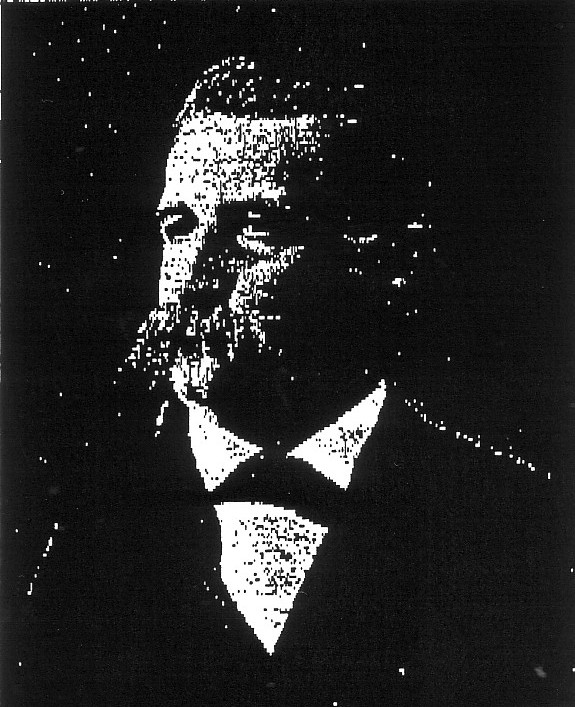
You have probably never heard of the hero of my book, The Day Freedom Died. His name is James Roswell Beckwith, and he prosecuted the Colfax Massacre alone (not by himself with a couple of clerks — alone), defying death threats in majority-white-supremacist New Orleans, back-channel obstructionism from Washington and the sheer physical difficulty of conducting two complex jury trials within four months in a malarial subtropical port city. If I accomplish nothing else with this book, I want to restore J.R. Beckwith to his rightful place in American history.
The oldest son of a farm couple, he was born in Cazenovia, New York, 20 miles south of Syracuse, on December 23, 1832. Cazenovia was antislavery country: Frederick Douglas frequently spoke at Cazenovia’s Free Church, as did Gerrit Smith. In late August 1850, as Congress debated the Fugitive Slave Act, Douglass, Smith and other abolitionist leaders assembled in a Cazenovia orchard. This “Cazenovia Convention” drew more than 2,000 people — roughly half of Cazenovia’s population. I imagine that James Beckwith, then 17 years old, joined the crowd, if only out of curiosity.
A few weeks after the Cazenovia Convention, Beckwith enrolled as a 17-year-old at the Methodist-run Oneida Conference Seminary, whose teachers drilled their students in anti-slavery doctrine. But, after a year there, he asked his parents for permission to go to New York City and read law. He aspired to be a “real, thorough” lawyer — “the noblest work of science,” as he put it. In 1854, he joined the New York bar. After finishing his legal training, Beckwith headed west, first to Michigan, where he served as a district attorney. He married Sarah Catherine Watrous in 1860. Catherine, as she liked to be called, came from Ashtabula County, Ohio, which was also anti-slavery territory. Catherine was a feminist novelist; her nom de plume, “Mrs. J.R. Beckwith,” mocked the prevailing subordination of wives to husbands.
On the eve of the Civil War, the Beckwiths moved to New Orleans, a mecca for lawyers because of its active commerce. As Northern Unionists, their existence was precarious until Union forces reoccupied the city in 1862. But they stayed. By 1868, Beckwith was known professionally, was an accomplished member of the bar with a deep voice and distinctive looks--high forehead, strong cleft chin and bristling walrus moustache.
Though he disdained politics and the “tricksters” who used it “for themselves and their emoluments,” something from Cazenovia still motivated him. His wife Catherine recognized it. In her novel, The Winthrops, she modeled the fictional lawyer Fred Houghton on her husband, depicting him as an “ardent champion for all the varieties of the oppressed, and [an] earnest rectifier of injustice.”
He joined post-Civil War Republican-led efforts to govern his adopted city and state. In 1870, Beckwith served as city attorney under Mayor Benjamin Franklin Flanders, a veteran Republican originally from New Hampshire. In late 1870, the United States Attorney for Louisiana, Alanson B. Long, was found dead in his office, blood seeping from a self-inflicted gash in his throat. New Orleans Republican leaders urged President Grant to replace Long with Beckwith, with one cabling the president that Beckwith was “a good lawyer, perfectly honest, conversant with the business of the office, [a] good Republican and worthy of the appointment.” By January 1871, Beckwith was at work, having first removed the carpet soaked with his predecessor’s blood.
Beckwith's powerful summation to the jury in the Colfax Massacre trial rings down through the ages: "I am not so constructed that I can look with calmness on such horrors as we have listened to. . . . I would rather be that poor wretch burned to a cinder in the ruins of the courthouse than stand as the apologist for the crime that caused it. I would rather go to the bar of God with the chances of the souls of the sixty-four or sixty-five human beings so inhumanly butchered than carry to God a soul so debased as to defend such a crime.”
Beckwith's ability, incorruptibility and moral fire made him dangerous to the white supremacists who hoped to rule Louisiana after Reconstruction. In the final days of February 1877, they demanded his firing as one of their conditions for accepting Rutherford B. Hayes as President. Their emissaries in Washington—including Beckwith’s former courtroom adversary, E. John Ellis--told the Republicans that “no peace could exist” in Louisiana as long as the Colfax Massacre prosecutor remained as U.S. Attorney. Beckwith was fired — almost two years before his term was supposed to end.
Beckwith remained in New Orleans, making a distinguished career as an appellate advocate with frequent appearances before the US Supreme Court. But he and Catherine were never blessed with children. She predeceased him. And when he died in August, 1912, at the age of 79, he was living in genteel poverty, alone except for an African American valet who stayed with him until the end. His estate was valued at a mere $973.72, all of which went to creditors, lawyers and notaries, except for $50 paid to his valet “for attendance during last illness.”
The only substantial historical commentary on Beckwith came in 1987, when Charles Fairman published the second volume of his history of the Supreme Court during Reconstruction. Fairman, who died in 1991, was a distinguished member of the Harvard and Stanford law faculties, a confidant of Justices Felix Frankfurter and Robert H. Jackson, and a teacher of William Rehnquist. As a scholar, Fairman was best known for arguing — as Beckwith's legal adversaries had argued in the 1870s — that the framers of the 14th Amendment did not intend it to “incorporate” the Bill of Rights. Fairman defended the Supreme Court’s reasoning in Slaughterhouse and Cruikshank, though he conceded their baleful impact.
Fairman derided Beckwith as “not a quick learner,” and asserted that “the prosecution in Cruikshank failed because the United States Attorney did not have enough understanding to frame his indictment to charge conspiracy.”
This was terribly unfair, both legally and morally. I hope that, after my book, the record will stand corrected.
J. R. Beckwith believed that the United States could not truly call itself a nation of laws as long as the men who spilled a sea of blood in Colfax, Louisiana on April 13, 1873 went “unwhipped of justice.” And he was right.
A special moment during my recent book tour to Louisiana came when I visited Beckwith's tomb in Metairie Cemetery in New Orleans. It is well-tended, but incomplete. Owing to his poverty at death, and to the fact that he had no survivors, no one ever took the time to inscribe the year of his death on the tomb, as should have been done. Perhaps with the cooperation of some New Orleans lawyers, I can get that done, as an overdue tribute to a great man.
Weinstein Tosses Child Porn Charge for Failure to Tell Jury of Mandatory Minimum Sentence:
When I was in law school, several of my professors expressed their admiration of District Judge (and former Columbia lawprof) Jack Weinstein for his notable "judicial creativity." In light of that, I was interested in this story:
In a decision that turns hundreds of years of legal precedent on its head, a judge ruled yesterday that juries should be made aware of "harsh mandatory minimum" sentencing rules in certain cases. Maverick Brooklyn federal Judge Jack Weinstein issued the ruling in a child-porn case over which he presided - chastising himself for not telling the jury that the defendant faced a minimum five-year sentence before it found him guilty.
The drastic ruling says juries should be told what sentences certain criminals face, especially if the prison terms are particularly long. It attempts to reverse the long-standing rule that jurors not be given sentencing information so they can decide guilt or innocence, without letting the potential punishment color their thinking.
Jeff Rosen writes in the New Republic about sex laws, and among other things says this:
Kennedy's opinion in Lawrence v. Texas, of course, caused Scalia's head to explode and provoked his alarmist warnings about the impending demise of morals legislation.... [Discussion of the continued upholding of prostitution laws omitted.-EV] Other civil libertarians tried to challenge an Alabama ban on the distribution of sex toys. If there is a constitutional right to engage in private sexual conduct, they argued, there should be a right to use (and buy) sex toys. But, in 2001, a federal appeals court rejected their argument, holding that the state has a legitimate interest in promoting "public morality" — even if that only involves being offended by someone else's private conduct. [I think Rosen is talking about the 2007 decision in the Alabama lawsuit, not the pre-Lawrence 2001 decision.-EV]
It's now obvious, in short, that Scalia's predictions were alarmist. Morals legislation is alive and well.
It struck me as odd, though, that the article omitted the 2008 federal appeals court decision that did strike down a Texas sex toy ban precisely on Lawrence v. Texas grounds. This decision suggests that Scalia's factual predictions "about the impending demise of morals legislation" are not quite as "alarmist" as the article suggests (at least to those who, like Scalia, would find such a demise to be normatively alarming).
Perhaps the Texas decision might be eventually reversed by the appeals court sitting en banc, or by the Supreme Court. But it seems to me it would have been worth mentioning alongside the contrary Alabama decision.
How Judges Think:
Over at Bench Memos, Ed Whelan has a very interesting set of posts (seven so far) on Richard Posner's forthcoming book, How Judges Think.
As promised, I'd like to go into the 13th and 15th Amendment issues in Cruikshank, by way of suggesting why Justice Bradley's ruling as circuit justice in the case was so mistaken -- legally, not just morally.
First, consider the indictment by US Attorney J.R. Beckwith. It's hard to summarize a sprawling, 32-count document which scarcely resembles the charging papers of today's criminal justice system. But the gist of his case was as follows.
The first half —Counts 1 through 16—was based on Section 6, the Enforcement Act’s anti-conspiracy provision, and charged the white perpetrators with joining together to “injure, oppress, threaten, or intimidate” freedmen so as “to prevent or hinder” their “free exercise and enjoyment” of rights guaranteed by the Constitution or federal law.
In specifying these rights, Beckwith necessarily improvised, doing his best to fit within both the precedents set by the lower courts, and by the newly decided -- and still poorly understood -- Slaughterhouse Cases. In Count 1, Beckwith charged the defendants with violating the black men’s “right and privilege peaceably to assemble.” In Count 2, he charged a violation of their “right to keep and bear arms for a lawful purpose.”
The case for these two counts, based on the First and Second Amendments, respectively, was, indeed, harder to make after Slaughterhouse. But the ruling gave him plausible reasons to try. In enumerating the “privileges and immunities” of citizenship that the Federal government could still protect, Slaughterhouse had specifically mentioned “the right to peaceably assemble and petition for redress of grievances.” As for the right to bear arms, Slaughterhouse had said nothing one way or the other.
Count 3 spoke of the two men’s right not to be deprived of life and liberty without due process of law. This resembled a claim rejected in Slaughterhouse. However, the right to due process was not only in the post-Civil War 14th Amendment but also in the pre-war 5th Amendment. And though it dissected “privileges and immunities,” Slaughterhouse dismissed the plaintiffs' due process claim briefly. To Beckwith, this must have left open the possibility that the Enforcement Act could be construed to protect a 5th Amendment due-process right for men who were not resisting paying a fee to slaughter their cattle, but who themselves had been imprisoned, beaten and killed like animals.
Count 4 cited the freedmen’s right to the same legal protection “for the security of their persons and property . . . that is enjoyed by white citizens.” Beckwith derived this right -- almost verbatim -- from the statute which established it, the Civil Rights Act of 1866. In Beckwith’s view, the allegation flowed from the simple and obvious fact that the white mob at Colfax would never have treated their victims this way if they had been white men.
Count 5 was more general. It spoke of an enterprise to violate the men’s “rights, privileges, immunities and protection as citizens of the state of Louisiana and the United States . . . on account of their race and color and for the reason that they, being such citizens, were persons of African descent and race and persons of color and not white citizens.”
Count 6 charged the defendants with banding together to punish the Colfax freedmen because they had exercised the right to vote on Election Day, November 4, 1872, at which both state and federal offices had been contested. Count 7 charged them with combining to prevent the Negroes from exercising the right in any future elections.
Count 8 charged the violation of “every, each and all and singular of the several rights and privileges granted or secured to them respectively by the constitution and laws of the United States.” It was vague, but Beckwith thought that its advantage lay precisely in its generality. It was a catch-all charge that said, essentially, “Whatever rights the black men may have under the Constitution or federal law, the conspirators violated them.”
Beckwith based counts 16 through 32 on Section 7 of the Enforcement Act — its penalty provision, which provided that, if conspirators committed any common-law felony in the course of their unlawful enterprise, they would face the prescribed penalty of the state in which they lived. Thus, they repeated the litany of violated rights from the first 16 counts, but added that the conspirators had murdered a freedman in the process of violating his rights. If the jury convicted on any of these 16 counts, the defendants would get Louisiana's penalty for murder: death.
In this respect, Beckwith's case was utterly revolutionary: Southern white men, he said, should pay with their lives for killing black men. The fact that he proposed to make this happen on the basis of largely black prosecution testimony was even more audacious.
Beckwith was giving the jury so many different ways to convict that they would take at least one. Given the ambiguous text of the Enforcement Act and the uncertainties created by Slaughterhouse, the indictment was a credible effort. In crucial respects, it was similar to indictments used to convict Klansmen in other states.
Moreover, as a good real-world practitioner, Beckwith was acting on his knowledge that William Woods, the Republican author of U.S. v. Hall, would preside over this trial as circuit judge. To be sure, in Slaughterhouse -- now binding precedent -- the Supreme Court had not embraced Woods’ broad view of U.S. citizenship. But, given Woods’ record, Beckwith had every reason to hope he would find a way around that problem.
Crucially, federal law of the time provided for no appeals to the Supreme Court in criminal cases. Cases could reach the high court only if two judges sat on the trial, and disagreed on a legal issue. Thus, strategically Beckwith's aggressive indictment also made since, since with only Woods presiding, no such "division of opinion" could occur.
It was only happenstance that the first trial, during February and March 1874, ended in a hung jury, necessitating a second trial that happened to fall during Bradley's circuit-riding in New Orleans during May and June. If there had been a verdict of any kind in the first trial there would have been no US v. Cruikshank, 92 US 542. Such are the accidents of history.
So, how did Justice Bradley dismantle the indictment (on a post-conviction motion in arrest of judgment)?
The first two counts, premised on 14th Amendment incorporation of rights to assemble and bear arms were easy: No state action + Slaughterhouse. Fair enough -- though it was, at the very least, hypocritical of Bradley to invoke Slaughterhouse, since in that case he had been outraged by a state law that merely required white men to pay a fee to slaughter their livestock.
Ditto for Count 3, the due process violation.
But then Bradley came to Count 4, derived from the Civil Rights Act. And Bradley had long believed, as he wrote in his famous dissent in U.S. v. Blyew, that the Civil Rights Act was valid legislation under the 13th Amendment, since it was necessary to destroying the incidents of slavery. The 13th Amendment did permit Congress to criminalize individual behavior, Bradley believed, since it contained no state action language.
This is where Bradley went off on what today we might describe as a flight of judicial activism -- showing, in the process, how his views were evolving to reflect the growing pro-South opinion of Northern conservative Republicans.
He struck down the count because it failed expressly to allege that the conspirators had acted with a racial motive. No federal court had ever required such a clear statement in criminal pleadings. Bradley just made it up, contending that otherwise it might be possible for people who were not former African slaves to gain the protections of the Civil Rights Act -- as if that were a bad thing. Even accepting Bradley's point (that Congress did intend to protect freedmen first and foremost) it was utterly formalistic for him to insist on a precise clear statement in this case, considering that Beckwith had specified that the victims were black, and that they had been denied the rights they would have gotten if white. "It ought not to have been left to inference" -- no matter how clear -- "it ought to have been alleged," this jurist huffed.
Count 5, however, did specifically allege that the men's rights had been violated "on account of race." How would Bradley overcome that? Now he invoked different criteria, noting simply that the allegation of violated rights was too vague. It didn't specifically say which privileges and immunities the men had been denied by being attacked and killed. He used the same argument to get rid of Count 8. To me, this is the best demonstraton of his bad-faith determination to void these indictments.
As for counts 6 and 7, the voting rights violations, Bradley once again invoked his racial-intent clear statement rule. He argued that the Enforcement Act was unconstitutional insofar as it did not limit federal authority to cases in which voting rights were denied "on account of race." This, too, was brand-new. No federal judge had ever even suggested such a rule. It also blew by the obvious facts of the case: an attack on blacks by whites plainly motivated by race -- as abundant testimony in the trial showed.
Another demonstration of Bradley's true, political intent: Bradley could have ordered the defendants held without bail, while Beckwith empaneled a new grand jury and attempted an indictment that would meet Bradley's new specifications. Instead, the justice sua sponte ordered them released on bail. They vanished into the swamps and backwoods of Central Louisiana, far beyond the reach of the poorly-funded, outgunned federal law enforcement team in the state.
The Supreme Court in its final ruling two years later did not go as far as Bradley did in striking down the Enforcement Act's conspiracy provision for lacking a racial-intent clear statement rule. But it did hold that no case could be made under the Act without both alleging and proving such intent. As Beckwith and other US Attorneys recognized, this was a distinction without much of a difference: in the real world of the post-Civil War South, proving specific racist intent to a jury beyond a reasonable doubt would be a tall order indeed.
Thus did Cruikshank help cripple federal law enforcement in the South after Reconstruction.
Jeffrey Rosen has a very positive review of Eric Lichtblau's new book,Bush's Law: The Remaking of American Justice in today's NYT. Among other things, Lichtblau writes of the "titanic battle" between the Times and the Bush Administration over his and James Risen's investigative reporting about the administration's domestic surveillance efforts.
In a series of meetings that lasted 14 months, beginning weeks before the 2004 presidential elections, President Bush and 10 senior advisers made personal appeals to The Times not to run the article. In mid-December 2004 the editors initially decided not to run it because of concerns about national security.
But in the fall of 2005 Mr. Risen told the editors that he was thinking of including the story in his own forthcoming book, and they began to reconsider. It was now clear, Mr. Lichtblau writes, that the administration had lied to The Times in describing the scope of the program and in claiming that administration lawyers unanimously supported it. Mr. Lichtblau’s reporting revealed that there were deep divisions about the program’s legality at the highest levels of the administration. And when Mr. Lichtblau learned that administration officials had discussed seeking an injunction against The Times, just as President Richard M. Nixon had tried to enjoin the publication of the Pentagon Papers, the Nixonian tactic helped seal The Times’s decision to publish the article and to post it first on the Web, so that the presses literally couldn’t be stopped.
Mr. Lichtblau argues that the administration’s national security arguments were overblown. The government had already pledged to eavesdrop on Al Qaeda, he notes. Therefore it wasn’t news to anyone that it was making good on the pledge; the news was that it was refusing to get court orders to do so, despite President Bush’s public claims to the contrary.
Rosen thinks Lichtblau should have engaged the more serious arguments against disclosure, such as those made by Jack Goldsmith, more seriously. Yet he still makes this sound like an exciting and interesting book.
Ninth Circuit En Banc Opinion in Fair Housing Council v. Roommates.com
is here; Chief Judge Kozinski writes the opinion for an 8-3 en banc panel. About to read it now; hope to have comments soon.
UPDATE: The en banc court reaches the same result that the panel below reached. Let me summarize the issue, and the holding, by borrowing from my earlier post.
The Fair Housing Council sued Roommate.com, which runs roommates.com, under the Fair Housing Act. Roommates.com (I'll use the more familiar plural site name, rather than the less familiar singular company name) contains many expressions of people's preference for roommates' sex, familial status, sexual orientation, and sometimes race, religion, and handicap; the Fair Housing Act generally prohibits housing advertising that expresses such preference as to "race, color, religion, sex, handicap, familial status, or national origin. (Interestingly, the FHA allows such discrimination when conducted by an owner who is looking for roommates; this might extend to a renter who is looking for roommates, though I'm not sure; but the exemption expressly excludes the advertising ban, so that the advertising ban does apply even to roommate searches. More on that here.)
Roommates.com's defense is 47 U.S.C. § 230, which many courts, including the Ninth Circuit, have interpreted to provide broad immunity to content providers who merely let others post material on their sites. That's why I'm generally not legally liable for things you folks post in the comments (though let's not make a test case out of it, OK?).
But the en banc court held that there's an important limit to such immunity — because § 230 defines "information content provider" as "any person or entity that is responsible, in whole or in part, for the creation or development of information provided through the Internet or any other interactive computer service," roommates.com may be liable based on its own actions as information content provider. And that, the Ninth Circuit held, means roommates.com might violate housing discrimination law insofar as roommates.com solicited discriminatory preferences that the law prohibits publishing, and then let people search based on those preferences.
So how did this play out?
1. Roommates.com did ask people for their preferences by sex, sexual orientation (irrelevant to the FHA but relevant to California antidiscrimination claims that are also raised in the lawsuit), and presence of children, and let searchers search by such preferences. The questions about roommate preferences were roommates.com's own communications, and thus weren't immune under § 230. (Note that the court was only deciding whether Roommates.com was immune under § 230. The substantive question of whether Roommates.com violated housing discrimination law, or for that matter whether it had a First Amendment defense against the application of housing discrimination law, is left for the district court to consider on remand.)
2. Roommates.com's communication of users' answers to those questions, and provision of search services based on those answers, was also not immune under § 230: Roommates.com expressly asked for this information, and was thus in part the developer of the information:
Here, the part of the profile that is alleged to offend the Fair Housing Act and state housing discrimination laws — the information about sex, family status and sexual orientation — is provided by subscribers in response to Roommate’s questions, which they cannot refuse to answer if they want to use defendant’s services. By requiring subscribers to provide the information as a condition of accessing its service, and by providing a limited set of pre-populated answers, Roommate becomes much more than a passive transmitter of information provided by others; it becomes the developer, at least in part, of that information.
3. Roommates.com's communication of users' "Additional Comments," given in response to roommates.com's "strongly recommend[ing] taking a moment to personalize your profile by writing a paragraph or two describing yourself and what you are looking for in a roommate," is immune under § 230, because "Roommate does not tell subscribers what kind of information they should or must include as 'Additional Comments,' and certainly does not encourage or enhance any discriminatory content created by users. Its simple, generic prompt does not make it a developer of the information posted.
Thus, if a site (for instance, Craigslist, which recently won a § 230 case in a Seventh Circuit) simply asks people to post their ads, and lets others search the ads in full text, but without expressly asking for sex/familial status/etc. preferences and specifically providing searches for such preferences, the en site will be immune. But say a site invites a certain kind of information, for instance asks people to express a preference that one may not express in housing ads, or expressly asks people "to provide private, sensitive and/or defamatory information about others" (an example from Judge Kozinski's separate opinion when he was on the three-judge panel). Then the site will be treated as a content provider of that information, won't get § 230 immunity, and thus may be liable, under antidiscrimination law, privacy law, or libel law, as the case may be (if the request is indeed soliciting information that it would be tortious to publish).
So, the bottom line: This is not a substantial retrenchment of the preexisting law under 47 U.S.C. § 230, which offers a great deal of immunity for those Internet outlets that merely pass along others' speech. But it does suggest that when the outlets try to channel the speech in likely illegal directions, they may be liable for the result of that channeling. My view, incidentally, is that the en banc court likely got this right, for the reasons mentioned in the opinion.
The Supreme Court's decision in Rapanos v. United States reaffirming the existence of limits of federal regulatory jurisdiction over wetlands and other non-navigable waters generated significant uncertainty about the scope of federal authority -- uncertainty the Bush Administration's post-Rapanos regulatory guidance did little to resolve.
This morning I am debating Jim Tripp, general counsel of the Environmental Defense Fund, on what the federal government should do next at a wetlands regulatory workshop sponsored by the American Society of Civil Engineers' Coasts, Oceans, Ports, and Rivers Institute. In two weeks, I'll revisit this issue again when I testify before the House Transportation Committee on proposed revisions to the Clean Water Act that would expand federal jurisdiction.
I'll post more on these events, and recent court decisions in this area, in the days ahead. In the meantime, I my two articles on the Rapanos decision can be found here and here.
Upcoming Speeches:
Today at noon I will be speaking about "Constitutional Cliches: Does Trite Make Right?" at the Vanderbilt School of Law in Nashville.
On Saturday morning, I will be speaking at a conference on unenumerated rights at Drake Law School in Des Moines. In formation about what looks like a very interesting conference is here.
Law symposium to explore forgotten Constitutional Amendments
Drake Law School's Constitutional Law Center will hold its 2008 symposium, Saturday, April 5, in room 213 in Cartwright Hall. The topic will be "The Forgotten Constitutional Amendments."
Scholars will discuss how and why the Ninth and 14th Amendments are considered to be largely forgotten amendments.
They will also explore how the Supreme Court has rarely addressed these amendments when deciding cases.
"The Supreme Court has issued rulings declaring that there is a right to privacy that includes a right for women to have abortions, and that includes a right for homosexuals to engage in sexual activity," said Mark Kende, director of the Constitutional Law Center. "Yet these rulings are based on a part of the Constitution that has to do with due process.
"The Ninth Amendment and 14th Amendment Privileges or Immunities Clause seem, by their language, to be possible provisions that make sense for the court to use in discussing individual rights. Mysteriously, however, the court has rarely discussed those clauses.
"This conference will explore the reasons why the court has hesitated to rely on those provisions, and whether anything is likely to change in the future. The conference will therefore shed light on some of the most important and controversial political issues of our time such as abortion and homosexuality," he added.
Other speakers include: Daniel Farber, Kurt Lash, Michael Kent Curtis, Rebecca Zietlow, and David Bogen.
On Monday afternoon at 4pm, I will again be speaking on "Constitutional Cliches" at the University of Virginia College of Law in Charlottesville.
Firing Employee for Lawfully Carrying a Gun When on Company Business:
I just ran across an interesting case on this subject, Winters v. Concentra Health Servs., Inc., No. CV075012082S, 2008 WL 803134 (Conn. Super. Mar. 5). Note that the decision is on a motion to strike, and thus decides only whether the plaintiff's theory is legally valid assuming the facts are as he claims in his complaint. The decision comes long before the plaintiff actually tries to prove the facts:
Having concluded that the plaintiff properly alleged he was an at will employee of Concentra's, the court must next inquire whether he also alleged that his termination from Concentra violated “any explicit statutory or constitutional provision ... or whether he alleged that his dismissal contravened any judicially conceived notion of public policy.” The plaintiff pleads in count one that his termination from Concentra for carrying a lawfully concealed firearm to work in the absence of a clearly established company policy to the contrary violates the fundamental right to possess firearms for self-defense enshrined in article I, § 15, of the constitution of Connecticut. [“Every citizen has a right to bear arms in defense of himself and the state.”]
Ergo, the plaintiff has alleged that his termination violated an explicit constitutional provision, which safeguards an individual's limited right to bear arms in self-defense. Furthermore, while our Supreme Court has not fully elucidated the contours of the right guaranteed by this constitutional provision, it has recognized “that the constitution protects each citizen's right to possess a weapon of reasonably sufficient firepower to be effective for self defense.” Indeed, the court has explained that this limited right “would be illusory ... if it could be abrogated entirely on the basis of a mere rational reason for restricting legislation,” citing Lakewood v. Pillow, 180 Colo. 20, 23, 501 P.2d 744 (1972) (statute prohibiting possession of firearm in vehicle or place of business for self-defense invalid); In re Brickey, 8 Idaho 597, 599, 70 P. 609 (1902) (statute prohibiting carrying of deadly weapon in any form in cities or towns invalid). Accordingly, the plaintiff has explicitly referenced a right that is articulated in a specific provision of the constitution of Connecticut, and which has been judicially recognized by our courts as embodying a public policy that is not easily abrogated.
The defendants respond by arguing both that (1) the plaintiff needs to reference an explicit public policy standing for the proposition that a right to bear arms is sufficient to modify the general standards of at will employment, and that (2) the policy of allowing guns in the workplace for self-defense purposes is trumped by a purportedly countervailing public policy that encourages a safe work environment. Neither argument withstands meaningful scrutiny. The plaintiff does not assert that the right to bear arms modifies a company's ability to prohibit employees from carrying a lawfully concealed firearm in the workplace. Instead, he argues that because Concentra did not have a company policy prohibiting lawful firearms at work, he could not be terminated for availing himself of his constitutional right to possess a weapon of sufficient firepower to be effective for self-defense.
[Footnote: The plaintiff alleges that he consulted his Concentra employee handbook prior to bringing his weapon to work and was unable to locate a policy prohibiting the private possession of lawful firearms at work. Moreover, he pleads that his supervisor was not aware of any such policy, and that the first time he learned of Concentra's zero tolerance policy regarding firearms at work was at the time he was terminated. Assuming the facts alleged by the plaintiff in a light most favorable to sustaining the complaint, the court concludes that he has pleaded the company did not have a policy against lawful firearm possession at work or failed to provide adequate notice to its employees of such a policy.]
This is an important distinction because the public policy animated by article I, § 15, of the constitution of Connecticut is limited in scope and does not prevent a private landowner from prohibiting the otherwise lawful possession of firearms on his land. See Benjamin v. Bailey, 234 Conn. at 465 (article I, § 15, “permits reasonable regulation of the right to bear arms”); General Statute § 29-28(e) (permit to carry pistol does not authorize possession where otherwise prohibited by law or by person owning premises). Thus, while the existence a company policy prohibiting the possession of firearms at work and the plaintiff's prior knowledge of such a policy may later prove dispositive, these factual questions are of no moment in this context because the court must assume the truth of the plaintiff's allegation that Concentra did not have such a policy.
Similarly, the defendants' argument that the public policy allowing qualified citizens to possess a firearm for self-defense purposes is trumped by a purportedly competing public policy that encourages a safe work environment is equally acarpous. Although the defendants are correct that our courts have recognized a public policy “requiring an employer who conducts business in Connecticut to provide a reasonably safe work environment to its employees,” the defendants misperceive any conflict between this policy and the fundamental right to bear arms for self-defense.
As a preliminary matter, it bears emphasis that the defendants offer no evidence to support their implied asseveration that the mere presence of a concealed firearm by a qualified employee makes the workplace less safe. [Footnote: Actually, the plaintiff alleges that he brought his firearm to work with him during night shifts to ensure his personal safety in an otherwise unsafe work environment. Specifically, the plaintiff avers that: Concentra's office was located in a high-crime neighborhood; gang violence had resulted in the death of one person in the street outside Concentra's office; Concentra did not provide building security; and the plaintiff had to walk across a large parking lot to get to his car each night.]
Nevertheless, while an exposition concerning the impact of personal firearms on workplace safety may prove edifying, it is as unnecessary to resolve this motion as it is ultracrepidarian. An employer may prohibit any person from possessing an otherwise lawful firearm on his property, regardless of whether such a policy makes its work environment more or less safe. The court is not, therefore, persuaded that a policy allowing qualified citizens to carry a firearm for self-defense is in tension with a public policy that obligates employers to provide a safe work environment for their employees.
As a normative matter, I generally believe that employment at will is the right approach, and that in the absence of a binding contract or some statutorily specified prohibition an employer should be free to terminate its relationship with an employee for any reason. Nor do I think that courts should mandate that employers create explicit policies defining what conduct may lead to termination, or derive constraints on private behavior from the state constitution's constraints on government behavior.
Nonetheless, the tort of wrongful discharge in violation of public policy does exist in many states (though its boundaries vary from state to state, and are often quite unclear). This particular application struck me as worth noting.
And, no, I don't encourage the use of "acarpous," "ultracrepidarian," or even "asseveration."
The UN Human Rights Council and the Influence of Nondemocratic States on International Law:
Eugene's excellent post on the UN Human Rights Council's egregious resolution seeking to repress freedom of speech provides an example of a problem that John McGinnis and I have sought to highlight in our work on democracy and international law: the extensive influence repressive nondemocratic regimes on international law's contents. If you look at the list of nations supporting the resolution, it turns out that most of them are either outright dictatorships (such as China, Cuba, and Jordan) or authoritarian pseudo-democracies such as Russia. By my count, about 16-18 of the 21 nations voting for the resolution fall into one of these categories. In a vote limited to democratic states, the resolution would have lost overwhelmingly by at least a 2-1 margin (all 10 of the nations voting against it were democratic).
An international law norm supported primarily by dictatorships is not necessarily a bad one. On average, however, such norms are likely to be worse than those generated by the domestic legislative processes of democratic states and therefore should not be allowed to override them without prior ratification by those same democratic processes (as in the treaty ratification process in the United States).
We should be especially wary of nondemocratic states' influence in the field of human rights law, where these regimes have an obvious incentive to promote norms that legitimize their efforts at repressing their political opponents and staying in power. The resolution discussed in Eugene's post is a clear example. Repressive regimes seeking to suppress opposition groups can easily label their speech "racist," "xenophobic" or an incitement to "hatred," to use the terminology of the resolution; they could then argue that repressing such speech is just a case of enforcing international law. Although these regimes would probably engage in repression even without support from international law, obtaining such support gives their policies unwarranted legitimacy, and undermines international efforts to prevent them.
Unfortunately, many scholars and international law advocates argue that international law should be allowed to override the domestic law of democratic states in even absent formal ratification processes. To the extent that this occurs, our domestic law might be displaced by legal norms that serve the interests of brutal despots.
Most experts would concede that UN Human Rights Council Resolutions are not in and of themselves binding international law. However, as McGinnis and I discuss in our article, such resolutions do contribute to the formation of so-called "customary international law." It would be unfortunate if such "law" were allowed to displace domestic law - not because US law is especially good, but because this particular alternative is often far worse.
Mazin Qumsiyeh has posted a rather nonresponsive response to my extensive documentation of his record of adopting and promoting anti-Semitic ideas. No explanation, for example, of why his website hosts an anti-Semitic article on "Jewish Power" written by a Holocaust denier. He calls my claim of anti-Semitism "defamatory" but fails to point out anything I wrote that was false. Qumsiyeh adds that my "'personal attack' consisted of copying a couple of articles from Zionist extremists who have long been discredited and you have never bothered to contact me for the facts." In fact, the evidence in my original post consisted primarily of links to two articles Qumsiyeh himself wrote, a blog post reprinting an email he wrote, and an article hosted on his own website. Straight from the horse's mouth, as it were.
In response to an astute comment: yes, I made a mistake in the citation for U.S. v. Cruikshank. It is 96 92 U.S. 542. My apologies. Absolutely everything else I have to say is completely correct and perfect, however.
I'll get back to the role of the 13th and 15th amendments in the Supreme Court's erroneous Cruikshank decision. But for now, I just wanted to add another piece of interesting evidence regarding the intent of the framers of the 14th, as well as the other two.
One of the little nuggets you'll find in my book, The Day Freedom Died, is a recreation of the Supreme Court oral argument in the case, based on a near-verbatim transcript published in the Baltimore Sun of April 1 & 2, 1875. Of particular interest is the second-day rebuttal delivered by Attorney General George H. Williams. A former Republican Senator from Oregon, he invoked his experience as one of the drafters of the 13, 14 and 15th Amendments, as well as all the civil rights legislation to enforce them.
Williams' words to the Court are especially significant today as evidence — previously unreported, to my knowledge — regarding the intent of the framers of those post-Civil War provisions.
Remember that the other side in the case was arguing that the Enforcement Acts were unconstitutional because they amounted to federal usurpation of state police powers that remained unchanged by the Civil War Amendments. Anyway, here's what Williams said:
First, he made an implicit allusion to the antebellum Fugitive Slave Law, noting that it had been upheld (in Prigg), and that the 14th Amendment had simply enabled Congress to apply the same principles of federal authority to a law enforcement statute that operated to the benefit of African Americans. He said: “the original constitution recognized the right of the slaveholder to property in his slaves and the Supreme Court decided that Congress had the right to pass a law to protect him in those rights. If the time ever comes when as liberal a construction shall be given to laws designed to protect human freedom as had always been given to laws designed to protect human slavery, then the doctrine of the government in this case would be admitted.”
Recounting the legislative history of the Civil War amendments, the Civil Rights Act of 1866, and the Enforcement Act, he explained to the court that “by the 13th and 14th Amendments, and the civil rights bill, the people of the United States intended to secure to the colored man, under the protection of the United States, the right to make contracts, to sue, to hold property, and the various other rights of citizenship.” Alluding to the dissenters' words in The Slaughterhouse Cases, he said that his opponents in this case “contended that the 14th Amendment was nothing more than an empty formula and amounts to nothing—nothing but empty and vain words” — but this had to be wrong. “Even before the adoption of the late Amendments Congress had the power to protect the right to vote for presidential electors,” Williams argued.
Justice Joseph P. Bradley cut him off. “Suppose Congress should enact a law making it a felony to steal the property of another,” Bradley asked. “Congress has the undoubted right to punish the stealing of the property of the government, or of property in the service of the government, but beyond that the law would be unconstitutional. Now, when a law is so framed that one part is constitutional and another unconstitutional, and the two are so bound together as to be impossible to sever, can you hold one part constitutional and the other part unconstitutional?”
Bradley’s point was implicit but clear: the plain language of the Enforcement Act's conspiracy provision seemed to protect both white and black voters from conspiracies to interfere with their rights, whether racially motivated or not. But if the court felt the post-Civil War amendments only authorized Congress to punish racially-motivated violence—which was Bradley’s position--how could it salvage any part of the statute?
Williams replied that “the law could be enforced as to those offences which it is admitted are within the power of Congress to provide for.” That had to include at least elections for Congress, Williams argued, because “the very existence of the government depends upon these elections. If Congress has no power to protect the voters, then the White League of Louisiana, a minority of the people, can stand around the polls and prevent the majority from voting.” This was similar to an argument that Judge Hugh Lennox Bond of the 4th Circuit had found persuasive in upholding Klan indictments in 1871.
Williams pressed the point: “The learned counsel on the other side said that the fathers never attempted to exercise these powers. Did the counsel forget the great civil revolution through which we had passed? The fathers had never exercised those powers because there was no necessity to exercise them. Just as it was necessary to exercise certain powers during the rebellion never before exercised, so now it was necessary to exercise powers to maintain the results wrought out of that rebellion. The fifteenth amendment confers upon the colored people the right to vote. Unless Congress has the power to enforce that guarantee it is of no value whatever.”
Democratic Justice Nathan Clifford observed that in his home state, Maine, “the colored man always had the right to vote,” so there was no need for a 15th Amendment there. Clifford asked Williams: “If two indictments were found of conspiracy, one to prevent the colored man from voting and the other a white man from voting, would the Circuit Courts of the United States have jurisdiction of both cases?”
“They would in the case of the black man,” Williams answered. “I don’t contend that they would in the case of the white man.”
“Then colored men have more rights in the United States courts than white men,” Clifford shot back.
“That does not follow,” Williams insisted. “The constitution does not confer upon white people the right to vote, but it does upon colored people and thence the power of Congress arises to protect them in that right.” He did not mean to suggest that Negroes have greater rights than whites, Williams added, but surely the purpose of the post-Civil War amendments was to free them from slavery, guarantee them equal rights, and protect them against discrimination. Floundering a bit, Williams said he would modify his answer to Clifford: to keep it consistent with his answer to Bradley, it would be better to say that the federal government could prosecute a conspiracy to violate a white man’s right to vote at a congressional election, but not if the violation was at a state election.
Finally, Justice William Strong, one of the Grant appointees whose vote Williams had to win, piped up with a friendly question — as Justice Scalia occasionally pitches a softball to lawyers on "his" side today. Could the federal government prosecute a conspiracy to prevent a man from voting because he was the son of an Irishman? “It would certainly be a race discrimination,” Strong observed.
Strong was countering Clifford’s extreme suggestion by offering the Attorney General a hypothetical case in which at least some white voters could come under federal protection. When Williams did not at first seem to grasp Strong’s point, the justice sharpened it by asking, “Suppose the State of South Carolina, where the majority of the population are colored, should change the constitution of that state and say that no white man should vote, would a remedy against that lie in the United States court?” Now his point was clear. Even under the argument made by the defense, Congress could nullify explicitly discriminatory state laws. The example was obvious and showed how silly Clifford’s question had been.
Williams, seemingly relieved, answered yes — and got back to arguing from his own experience as a Senator. “My idea, in the main, of these amendments was that any and every right guaranteed by them may be protected in the courts of the United States,” he declared. “Give that construction to these amendments and they are of some value, give them the other construction and the freedom vouchsafed to the Negro becomes practically a curse. Any doubt as to the validity of this act should be resolved in its favor. Bear in mind that these amendments and the legislation under them were practically made by the same hands. Is it to be supposed that those who drew the amendments did not know their scope? According to the arguments on the other side it must be assumed of the Senators and Representatives either that they violated their oath or that they did not know the meaning of the language which they used themselves.”
“Ever since the years of the war,” he said, “no matter what was done to preserve the Union, and to protect the rights of the citizens, it has been met with these lugubrious schemes that you are encroaching upon state authority. . . . Millions of people are today waiting with feverish anxiety the verdict of this court, conscious that their lives and liberties are wrapped up in it. If this court decides in favor of this law it will do more to restore peace and quiet to this land than any decision or any legislation since the close of the war.”
“I look forward to the day,” Williams concluded, “when we can consider ourselves not a nation of inharmonious and warring sovereigns, but a Union whose broad shield shall protect--in all and every right of a freeman and a citizen--her people from one end to the other.”
The Eleventh Circuit Finds Against Atlanta School System in Disabled Education Case:
Check out Draper v. Atlanta Independent School System from Judge Pryor (no liberal judicial activist) pretty harshly condemning the school system for its failure to comply with the Individuals with Disabilities Education Act. The opinion is actually quite low on overt rhetoric, but the discussion of the facts and the application of law to facts speaks volumes.
The case was litigated, by the way, by Marcy Tiffany and Steve Wyner. Marcy, whom I know because she's the wife of my former boss Judge Kozinski (and who's a fellow UCLA Law grad!), has had quite a remarkable career, including having been Acting General Counsel of the FTC, Antitrust Counsel to the Senate Judiciary Committee, U.S. Trustee for the Central District of California (the office that deals with bankruptcy matters), and General Counsel of Hughes Electronics. Having more or less retired from all that, she then came back to doing IDEA law.
If you run across an error in a Westlaw version of a document, help your fellow users by e-mailing the correction to west.referenceattorneys at thomson.com. I just called a glitch in to the 1-800-REF-ATTY phone line -- there was a typo in the West Va. Bd. of Ed. v. Barnette flag salute opinion -- and they told me about the e-mail address.
What the Next President Can do to Protect Property Rights:
Like the Cato Institute's Ilya Shapiro (known in DC libertarian circles as "the other Ilya," though he would probably say that I'm the other one), I have just published an op ed in National Review Online. Mine is about the role of property rights in the presidential election. Unfortunately, none of the candidates have given this issue the attention it deserves:
The Supreme Court’s Kelo decision in 2005 generated a massive political backlash. Kelo v. City of New London endorsed the condemnation of private property for transfer to other private owners in order to promote “economic development.” Polls showed that 80 to 90 percent of the public opposed such takings. Oddly, however, we’ve heard almost nothing of this broadly popular issue from the presidential campaigns. . .
Economic-development takings often transfer property from the poor and politically weak to politically powerful interest groups, such as developers. They also undermine economic growth in the community far more than they promote it. Often, they destroy preexisting enterprises that have greater value to the community than the ones established by the post-condemnation owners. Since World War II, some 3 to 4 million Americans have lost their homes to urban renewal and economic development takings. . .
The lack of campaign focus on the issue is unfortunate. There is a great deal that the next president could do to protect property rights. First and foremost, he or she can appoint federal judges who take constitutional property rights seriously. . .
The president can also help protect property rights through the legislative process. In 2005, the House of Representatives passed the Property Rights Protection Act, which would have denied federal economic-development funds to local governments that engage in Kelo-style takings. Unfortunately, the PRPA died in the Senate, and is now stuck in committee in the House. Strong presidential support could well force its passage . . .
Finally, the next president could strengthen President Bush’s June 2006 executive order on eminent domain . . .
Thanks for the comments on my first post. I'd like to take up Hans Bader's defense of Cruikshank, because it concisely gets to the heart of the matter: the state action requirement found by the Court in that case.
My book goes into this history in some detail, because it is crucial to understand that this requirement, so evident to some in retrospect, was not immediately perceived by all jurists at the time of the 14th Amendment's ratification.
In 1871, the Fifth Circuit held, in a case called US v. Hall, that the 14th Amendment incorporated the Bill of Rights(through the privileges and immunities clause — Prof. Bader and I agree, I think, that this was a proper interpretation that The Slaughterhouse Cases later muddled).
The facts of Hall, briefly, were that a political meeting of black men in Alabama was attacked by Klansmen, with casualties (all black Republicans) including killed and wounded. The US Attorney charged the Klansmen with conspiring to violate the men's First Amendment rights. The Fifth Circuit upheld the indictment by holding not only that the 14th Amendment incorporated the First Amendment against the states, but also — and crucially — that state inaction, i.e., failure to protect rights, was a form of state action. This was not the holding of Judge William B. Woods, the Fifth Circuit judge of the time alone: it was suggested to him privately in a letter from none other than Justice Joseph P. Bradley.
Thus, as of the Colfax Massacre, the law of the land was Hall, which stoo for the proposition that the 14th Amendment could be a shield against anarchy as well as (state) tyranny. This made sense in the context of the time: a contrary ruling would have enabled the Klan to conquer the South simply by creating a state of terror and ungovernability. The Slaughterhouse Cases would modify that considerably, of course; interestingly, Slaughterhouse was decided on April 15, 1873--two days after the Massacre.
The key ruling in Cruikshank was not so much the Supreme Court's 1876 decision as Bradley's 1874 ruling as circuit justice for the 5th Circuit, which overturned both Hall — and, of course, Bradley's own previous (private) view.
In my judgment, this about-face was not dictated by Slaughterhouse, which, even as it reduced the privileges or immunities clause of the 14th Amendment, left open the possibility that assembly, gun possession and due process rights might be part of protected "federal" POI. Furthermore, Slaughterhouse dealt with state action, par excellence: a statute setting up a regulated abbatoir that all butchers must use. It did not necessarily cover the anarchic situation contemplated by Hall — and presented by the Colfax incident.
What happened in between to change Bradley's mind? Remember that he dissented in Slaughterhouse, so you might have expected him to interpret it as narrowly as possible while riding circuit in Cruikshank. Instead, he wielded it aggressively against the federal prosecution.
I would argue that two things — neither of them legal — dictated Bradley's response.
1. Politics. The 1872 election had precipitated a split in Bradley's Republican party, between those who supported Grant's relatively aggressive use of federal power to stifle Klan violence in the South and those who thought it was an unconstitutional fool's errand. Bradley clearly leaned in the latter direction, as did several other Republicans on the Supreme Court at the time.
2. Race. Bradley had never been an abolitionist and in fact had a long history as a pro-South, pro-slavery Northerner. This changed briefly during and shortly after the Civil War, but by 1874, he was thoroughly frustrated with what he saw as the excesses of black-supported "carpetbagger" governments in the South. His dissent in Slaughterhouse was predicated, in part, on his wildly exaggerated belief that the Louisiana slaughterhouse statute was some kind of corrupt carpetbagger imposition, when in fact it was a moderate and sensible public health measure. In Cruikshank, when black lives and not white Southerners' sensibilities were at stake, his judgments changed accordingly.
This may seem unduly harsh as an assessment of Bradley's motivations, but I think it's accurate (at least that's how I argue it in my book). It helps to account for his seeming enthusiasm for a broad view of the 14th Amendment in Slaughterhouse, and his ultra-narrow view in Cruikshank.
The 14th Amendment, by the way, was not the only basis for the federal indictment in Colfax — or for the later decisions by Bradley (and the entire Supreme Court) which struck the indictment down. The 13th and 15th Amendments, and statutes derived from them also played a role. Even if Cruikshank was rightly decided on the 14th, the court might still have upheld the charges on other grounds. But I'll go into that more in a subsequent post.
Feedback on the Slate Convictions Blog:
As many readers know, I've been splitting my blog time in the last few weeks between the Volokh Conspiracy and Slate's new "Convictions" blog. I'm curious to know what Volokh Conspiracy readers think of the new Slate blog — whether you read it, and if you read it what you think of it. Here's a quick reader poll, and feel free to leave comments in the comment thread (especially if you have ideas for improvement):
8. Urges States to take actions to prohibit the dissemination, including through political institutions and organizations, of racist and xenophobic ideas and material aimed at any religion or its followers that constitute incitement to racial and religious hatred, hostility or violence;
9. Also urges States to provide, within their respective legal and constitutional systems, adequate protection against acts of hatred, discrimination, intimidation and coercion resulting from the defamation of any religion, to take all possible measures to promote tolerance and respect for all religions and their value systems and to complement legal systems with intellectual and moral strategies to combat religious hatred and intolerance;
10. Emphasizes that respect of religions and their protection from contempt is an essential element conducive for the exercise by all of the right to freedom of thought, conscience and religion; ...
13. Reaffirms that general comment No. 15 of the Committee on the Elimination of Racial Discrimination, in which the Committee stipulates that the prohibition of the dissemination of all ideas based upon racial superiority or hatred is compatible with the freedom of opinion and expression, is equally applicable to the question of incitement to religious hatred; ...
So prohibiting dissemination of ideas based upon religious superiority "is compatible with the freedom of opinion and expression"; I suppose that would include claims that Islam, Christianity, or whatever else is the one true religion that is correct while others are false. And states are supposed to "prohibit the dissemination ... of ... xenophobic ideas and material aimed at any religion or its followers that constitute incitement to racial and religious ... hostility"; I suppose that would include, for instance, condemnation of Scientology as fraud, or of Catholicism as oppressive, or for that matter of all religion as folly. And here I thought that freedom of thought, conscience and religion included the freedom to think and comment about all ideologies, including religious ones.
Those in favour [21] included: Azerbaijan, Bangladesh, Cameroon, China, Cuba, Djibouti, Egypt, Indonesia, Jordan, Malaysia, Mali, Nicaragua, Nigeria, Pakistan, Philippines, Qatar, Russian Federation, Saudi Arabia, Senegal, South Africa and Sri Lanka. Those against [10] included: Canada, France, Germany, Italy, Netherlands, Romania, Slovenia, Switzerland, Ukraine and United Kingdom. A similar resolution has been passed since 2002. Abstentions (14): Bolivia, Brazil, Gabon, Ghana, Guatemala, India, Japan, Madagascar, Mauritius, Mexico, Peru, Republic of Korea, Uruguay and Zambia.
Today's WSJ editorial page reports that Senator Arlen Specter is sufficiently upset with the slow pace of judicial confirmations that he plans to shut down the Senate if Democrats do not schedule more confirmation votes on President Bush's appellate nominees.
A look at the numbers explains why the ranking Republican on the Senate Judiciary Committee is spitting mad. In the last two years of Bill Clinton's Administration, when Mr. Specter was in the chairman's seat, the Republican-controlled Senate confirmed 15 appellate court nominees.
Now, more than halfway through Mr. Bush's final two years, Chairman Patrick Leahy isn't returning the Constitutional courtesy. The Democratic Senate has confirmed a mere six nominees with no plans in sight to move the remaining 11 forward. Judicial nominees rarely are confirmed in the final months of a President's second term, so the clock is running out. Democrats figure they'll retake the White House in November, and they don't mind leaving the courts short-handed for another year or two as they stall for liberal nominees. . . .
. . . "I sided with Clinton on his judges who were competent," Mr. Specter points out. After the judicial wars of the Bush years, this notion seems almost quaint.
Mr. Leahy has taken a far more partisan approach to his responsibilities as chairman, holding just one confirmation hearing since September. That was a hastily scheduled hearing for Fifth Circuit nominee Catharina Haynes on February 21 when the Senate was in recess. No Republican on Judiciary was in Washington at the time and Mr. Specter arranged for Senator John Warner from nearby Virginia to pinch-hit for him. Nor does Mr. Leahy appear to mind that, of the 11 appeals-court nominees awaiting Senate action, seven would fill seats deemed to be judicial emergencies. One-third of the 15 seats on the Fourth Circuit, covering Maryland, Virginia, West Virginia, South Carolina and North Carolina, are vacant.
This is further evidence of the downward spiral of politicization of the judicial confirmation process, as each side engages in escalating retaliation against the other for its perceived obstruction -- and there is no end in sight.
I've been predicting this for a LONG time, and now it's happening: Radiohead is releasing the separate components or 'stems' (bass, voice, guitar, strings/FX and drums) for download and remixing (and then allowing users to upload their own versions of the song to a site where everyone can vote on the ones they like best). This is going to be HUGE -- I always thought (and still think) that the Beatles (or at least the owners of the Beatles copyrights) could make about a billion dollars re-releasing -- say $0.99 per song) the individual tracks to Sgt. Pepper's Lonely Hearts Club Band and allowing buyers to come up with their own remixes ... How cool would it be to be able to come up with your own version of "A Day in the Life"? Not to mention every other band that has a similarly large and loyal following. People will gladly pay for the privilege -- remixing is great fun, and lets a lot of people who have deep interest in the music but no way to express it creatively to get into the act. The RIAA is probably going to have a fit about some of the other remix sites (Mixwit, Muxtape), but that will fade into insignificance as recording artists realize how much they have to gain by exploiting this passion on their listeners' part ...
[Reposted, with comments now working (I hope).-EV]
I've been pleasantly surprised by the interest blawgers and other reviewers have shown so far in The Day Freedom Died, my new book about a little-known massacre of more than 60 African Americans in 1873 — and the ill-fated federal effort to bring the perpetrators to justice. The Supreme Court let the guilty parties go free in U.S. v. Cruikshank, 96 US 542 (1876).
So I am grateful for Eugene's invitation to spread the word in this forum. The point of this and subsequent posts, I hope, is to deepen the discussion to talk about just why I feel that the court got it wrong not only morally — but legally. The pinched interpretation of the 14th Amendment embodied in Cruikshank and subsequent Reconstruction-era rulings (e.g., The Civil Rights Cases) has not only had deleterious consequences for constitutional law down to the present day. It wasn't even required at the time!
My book shows that, prior to Cruikshank, lower court federal judges had upheld pretty ample federal authority to go after the Klan, ruling that the 14th Amendment did empower Congress to criminalize individual acts that violated the civil rights of others. It was only with the intervention of Justice Joseph P. Bradley, riding circuit as the trial judge in Cruikshank in 1874, that that court began to see things differently. It was Bradley's decision to toss out the Colfax Massacre convictions in mid-1874 that the court upheld in the final Cruikshank ruling in 1876.
In the intervening two years, white paramilitary organizations, green-lighted by Bradley, ran unchecked through LA, Miss., and SC, overthrowing the last three Republican governments in the South's three black-majority states.
I will make two predictions: 1) Few lawyers who have expertise in the areas covered by the recently released Yoo Memorandum (part I here, part II here) will defend it as sound and persuasive legal analysis; 2) No more than a handful of such lawyers will agree with John Yoo's characterization of the memo as "near boilerplate."
One question this raises is the point at which one can fairly say that a given memorandum or opinion is unreasonable. But I want to focus on a different point: if my assumptions above are correct, this creates a great opening for opportunistic conservative legal bloggers/commentators. A majority of conservatives still support President Bush's conduct of the war, and the Yoo Memorandum authorized techniques that were part of that conduct. Some supporters of Bush's conduct will want to distance themselves from the sorts of activities that the Yoo Memorandum authorizes, but many diehard Bush supporters will presumably want to stand by their man, and the conduct of the war. So the very small percentage of lawyers who will defend the Yoo Memorandum, combined with the greater percentage of Americans who will defend the conduct authorized by that memorandum, presents a chance for legal commentators seeking prominence: take the unpopular position and infuriate most people, but gain the everlasting gratitude of a nontrivial segment of the conservative community.
Of course, the wisdom of this bet depends in part on that segment of the conservative community continuing to have power, and perhaps expanding their power. Will the Yoo/Addington/Gonzales wing of the conservative legal establishment have power in the future? If you think so, and your desire for power is greater than your qualms about endorsing what looks to be quite shoddy legal reasoning, then now is your chance to write an op-ed/blog post on why the Yoo Memorandum is right. I'll be curious to see who seizes the opportunity.
With the infamous "torture memos" back in the news, it seems worth noting that my former colleague, Amos Guiora, has a brand new book, Constitutional Limits on coercive Interrogation. I have yet to read it, but have every reason to expect it will be interesting and provocative like much of his other work. There are few working in this area that have anywhere near his real-world experience on the front lines of counter-terrorism work — something which makes his refusal to endorse the "we must win so everything is permitted" doctrine that much more significant.
There's an interesting posting on Dani Rodrik's always-interesting blog about the difference that the President's party affiliation makes to the distribution of income during the four years of the president's term. Citing a new book by political scientist Larry Bartels, the data apparently show that when a Republican president is in power, people at the top of the income distribution experience much larger real income gains than those at the bottom--a difference of 1.5 percent per year going from the bottom to the top quintile in the income distribution. The situation is reversed when a Democrat is in power: those who benefit the most are the lower income groups.
Not surprising, I suppose -- but what is surprising is that "compared to Republicans, Democratic presidents generate higher income gains for all income groups (although the difference is statistically significant only for lower income groups)." Without having read the Bartels analysis, I'm not sure I believe it -- but if it is true, it's pretty interesting, and troublesome (for those of us who from time to time pull the GOP lever in Presidential elections).
Ilya Shapiro (no relation) of the Cato Institute has an interesting column detailing the irrational red tape that faces foreign skilled workers seeking to obtain H1-B visas that would allow them to stay in the United States for up to three years, with a later opportunity for renewal. He rightly labels current policy as an "April Fools for skilled workers" - hundreds of thousands of whom found out yesterday that they will have to wait till next year to have even a chance of getting into the US. Although immigrant skilled professionals make obvious contributions to the US economy and are highly unlikely to become welfare cases, current immigration law still prevents all a but a few thousand of them from entering each year - even on a temporary basis. In addition to the costs to the US economy, it's also worth emphasizing the losses to the would-be immigrants themselves - most of whom would have vastly better lives in the US than in their home countries.
When even the conservatives at National Review Online (who are generally highly skeptical about immigrants and immigration) publish an article arguing that a set of immigration restrictions should be loosened, you know that we have a real problem.
Does Tennessee's Serious and Violent Sex Offender Monitoring Pilot Project Act, which requires convicted sex offenders to wear a GPS device (including those previously convicted), violate the Constitution's ex post facto clause? Six judges on the U.S. Court of Appeals for the Sixth Circuit thought so, and dissented from the denial of en banc review of a panel decision concluding otherwise. Wrote Judge Keith for himself and five other judges:
I believe that the retroactive application of the Surveillance Act constitutes an Ex Post Facto Clause violation because (1) as a catalyst for public ridicule, it is a form of shaming, humiliation, and banishment, which are well-recognized historical forms of punishment; (2) it promotes the traditional aims of punishment; and (3) it is excessive in forcing Doe to broadcast his sex offender status not only to those who choose to inquire, but also to the general public. The majority, in upholding the Surveillance Act, deliberately turned a blind eye to the obvious effects of forcing Doe to wear such a large box on his person. Moreover, the majority erred in its emphasis that such boxes “will only become smaller and less cumbersome as technology progresses.” The question at hand was whether the required technology under the Surveillance Act violates the Ex Post Facto Clause today, not whether technology could conceivably develop such that it will become inconspicuous in the future.
Imagine you were a state legislator and some folks asked you to pass a law making it a crime to give advice about paint colors and throw pillows without a license. And imagine they told you that the only people qualified to place large pieces of furniture in a room are those who have gotten a college degree in interior design, completed a two-year apprenticeship, and passed a national licensing exam. And by the way, it is criminally misleading for people who practice interior design to use that term without government permission.
You might stare at them incredulously for a moment, then look down at your calendar and say, "Oh, I get it -- April Fool!" Right? Wrong.
These folks represent the American Society of Interior Designers (ASID), an industry group whose members have waged a 30-year, multimillion-dollar lobbying campaign to legislate their competitors out of business. And those absurd restrictions on advice about paint selection, throw pillows and furniture placement represent the actual fruits of lobbying in places like Alabama, Nevada and Illinois, where ASID and its local affiliates have peddled their snake-oil mantra that "Every decision an interior designer makes affects life safety and quality of life."
Here is a new paper on the topic, by Anthony Niblett, Richard Posner, and Andrei Shleifer:
The efficiency of common law rules is central to achieving efficient resource allocation in a market economy. While many theories suggest reasons why judge-made law should tend toward efficient rules, the question whether the common law actually does converge in commercial areas has remained empirically untested. We create a dataset of 465 state-court appellate decisions involving the application of the Economic Loss Rule in construction disputes and track the evolution of law in this area from 1970 to 2005. We find that over this period the law did not converge to any stable resting point and evolved differently in different states. We find that legal evolution is influenced by plaintiffs' claims, the relative economic power of the parties, and nonbinding federal precedent.
That version costs $5 unless you are at a university or live in a poor country, I cannot yet find an ungated copy of the paper.
"Mom Wins Fight For Autism Insurance":CNN's lead story is featuring the wonderful Lorri Unumb, formerly my colleague when she was the Director of the legal writing program here at GW Law and presently the Director of the legal writing program at Charleston School of Law. CNN has posted a video of the report here.
I am delighted to announce the new Daniel Webster Program at Dartmouth College. Headed up by Dartmouth Government Professor James Murphy, the program will host lectures, conferences, and provide curriculum counseling for students seeking to study Western Civilization. The precise focus of the program reflects Jim's particular interests--the continuity of thought from the Ancients to the Moderns.
This Friday the Webster Program will have its first "Janus Lecturer," Anthony Kronman, who will lecture on his book "Education's End." I read Dean Kronman's book back in the fall and found it to be a terrific and stimulating work. His chapter on the terrible influence of political correctness on education, and especially the humanities, is an especially valuable and original chapter.
I wish Professor Murphy and all those affiliated with the Webster Program all the best. This is a splendid undertaking and I am extremely pleased that it has come about. I wish that we had this when I was a student!
When I was in college I didn't have strong views on the value of a core curriculum (we didn't have one, of course). After going to law school, however, I have become a believer in the value of some sort of core curriculum or common learning experience. In my opinion first year of law school is one of the most effective learning experiences that students can have in their educational career, and one reason is because the first year of law school is essentially a core curriculum. Students take all of the same classes and wrestle with all of the same new concepts. Equally important, this provides students with a common currency of concepts and educational challenges, such that the out of classroom experience reinforces the in-class experience. Students start finding themselves talking about cases and using concepts outside of their class time. One difficulty with upper-class learning in law school, I think, is that the curriculum quickly becomes fragmented such that students are no longer taking the same classes and being exposed to the same set of concepts.
I think that undergraduate education would similarly benefit from having some similar sort of common learning experience.
The John Yoo Torture Memos Released:
Marty Lederman has the breaking news over at Balkinization. Part 1 is here (39 pages), and Part II is here (42 pages). I'm printing out the memos now, and I hope to post more thoughts after I have read them.
Medellin Debate:
The Federalist Society website is hosting an interesting debate on the Supreme Court's recent decision in Medellin v. Texas, featuring the contributions of Ted Cruz, Nick Rosenkranz, David Sloss, and Edwin Williamson. Part I is here, Part II is here.
Los Angeles City Council members ... plan to vote today on a 40-hour moratorium on homicide, a symbolic gesture that comes as the city has seen an uptick in killings in recent months.
A "nonbinding resolution," the article assures us.
"Supreme Court Grants Cert in 'Fantasy Baseball' Case;
Three Justices Recuse Themselves Due To Participation in High Court League." The New York Personal Injury Law Blog has more. "The high court league has been around for years, and is known as Articles For Deletion, based on an old spoof about amending substantial parts of the Constitution to increase the court's power. When the league was named, there was a vote between AFD and Least Dangerous League ...."
In particular, what had happened to [Bill Clinton's] 1992 promise . . . that genocide in Bosnia would be opposed by a Clinton administration?
. . . President Bill Clinton had not found it convenient to keep this promise. Let me quote from Sally Bedell Smith's admirable book on the happy couple, For Love of Politics:
Taking the advice of Al Gore and National Security Advisor Tony Lake, Bill agreed to a proposal to bomb Serbian military positions while helping the Muslims acquire weapons to defend themselves—the fulfillment of a pledge he had made during the 1992 campaign. But instead of pushing European leaders, he directed Secretary of State Warren Christopher merely to consult with them. When they balked at the plan, Bill quickly retreated, creating a "perception of drift." The key factor in Bill's policy reversal was Hillary, who was said to have "deep misgivings" and viewed the situation as "a Vietnam that would compromise health-care reform." The United States took no further action in Bosnia, and the "ethnic cleansing" by the Serbs was to continue for four more years, resulting in the deaths of more than 250,000 people.
I can personally witness to the truth of this, too. I can remember, first, one of the Clintons' closest personal advisers—Sidney Blumenthal—referring with acid contempt to Warren Christopher as "a blend of Pontius Pilate with Ichabod Crane." I can remember, second, a meeting with Clinton's then-Secretary of Defense Les Aspin at the British Embassy. When I challenged him on the sellout of the Bosnians, he drew me aside and told me that he had asked the White House for permission to land his own plane at Sarajevo airport, if only as a gesture of reassurance that the United States had not forgotten its commitments. The response from the happy couple was unambiguous: He was to do no such thing, lest it distract attention from the first lady's health care "initiative."
It's hardly necessary for me to point out that the United States did not receive national health care in return for its acquiescence in the murder of tens of thousands of European civilians. But perhaps that is the least of it. Were I to be asked if Sen. Clinton has ever lost any sleep over those heaps of casualties, I have the distinct feeling that I could guess the answer. She has no tears for anyone but herself. In the end, and over her strenuous objections, the United States and its allies did rescue our honor and did put an end to Slobodan Milosevic and his state-supported terrorism. Yet instead of preserving a polite reticence about this, or at least an appropriate reserve, Sen. Clinton now has the obscene urge to claim the raped and slaughtered people of Bosnia as if their misery and death were somehow to be credited to her account! Words begin to fail one at this point. Is there no such thing as shame? Is there no decency at last? Let the memory of the truth, and the exposure of the lie, at least make us resolve that no Clinton ever sees the inside of the White House again.
People who follow federal criminal law know that it occupies Title 18 of the U.S. Code. Copyright law buffs know that the Copyright Act occupies Title 17. Why are they next to each other?
Time Magazine's "THE CLEAN ENERGY SCAM": The Other Side of Biofuels.--
Time Magazine is reporting on recent studies suggesting the harm to human survival and the environment from our move to corn-based ethanol and other biofuels:
THE CLEAN ENERGY SCAM
[B]y diverting grain and oilseed crops from dinner plates to fuel tanks, biofuels are jacking up world food prices and endangering the hungry. The grain it takes to fill an SUV tank with ethanol could feed a person for a year. Harvests are being plucked to fuel our cars instead of ourselves. The U.N.'s World Food Program says it needs $500 million in additional funding and supplies, calling the rising costs for food nothing less than a global emergency. Soaring corn prices have sparked tortilla riots in Mexico City, and skyrocketing flour prices have destabilized Pakistan, which wasn't exactly tranquil when flour was affordable.
Biofuels do slightly reduce dependence on imported oil, and the ethanol boom has created rural jobs while enriching some farmers and agribusinesses. But the basic problem with most biofuels is amazingly simple, given that researchers have ignored it until now: using land to grow fuel leads to the destruction of forests, wetlands and grasslands that store enormous amounts of carbon.
I propose rotating which states hold the first primaries and caucuses to reduce the harm that pandering to Iowa does to our financial and environmental health.
By the way, is it really true that "The grain it takes to fill an SUV tank with ethanol could feed a person for a year"?
I'm delighted to say that Charles Lane will be guest-blogging this week about his new book, The Day Freedom Died: The Colfax Massacre, the Supreme Court and the Betrayal of Reconstruction. The book tells the story of the mass murder of more than five dozen black men in 1873 Louisiana; the federal prosecution of the killers led to the Supreme Court's ruling in United States v. Cruikshank (1876), a landmark decision that (among other things) held that neither the First nor the Second Amendment applied to the states via the Fourteenth Amendment.
Charles covered the Court for the Washington Post from 2000 to 2006, and edited The New Republic from 1997 to 1999.
Sleep Less. Think More:
The Institute for Humane Studies at George Mason University has just extended the deadline for its famed Liberty & Society summer seminars. IHS is also offering a $10 credit at Laissez Faire Books if you apply now. I started teaching in these seminars when they were founded in 1980. At the time, I was still a prosecutor in Chicago and took vacation time to write my lectures and go to the University of Dallas to speak. The intellectual intensity of the seminar contributed to my leaving practice and entering teaching shortly thereafter. There is no "party line" at these seminars; disagreement is encouraged. Perhaps the main guiding principle is that classical liberalism provides a set of intellectual problem-solving tools, rather than a catechism of predigested answers. Applications are here. This year's Liberty & Society seminars are:
June 28 - July 4, 2008
Bryn Mawr College (Philadelphia, PA)
July 12 - 18, 2008
Vanderbilt University (Nashville, TN)
June 7 - 13, 2008
Wake Forest University (Winston-Salem, NC)
If you are a student, or know one who is interested in exploring the subject of liberty, check out the IHS website. You can also view a video on the seminars:
And this video tells you more about IHS:
Other summer IHS seminars are listed here. I will be teaching at the Advanced Studies seminar being held at DePaul in Chicago on July 5th-11th.
I'm delighted to report that -- according to our eXTReMe Tracking counter -- in each of the first three months of 2008, we had more "unique visitors" than we'd ever had before then. March was the highest, at 742,812; the previous record was 655,649, last April (equivalent to a bit under 680,000, accounting for the difference in month lengths).
So far in 2008, we're averaging well over 25,000 visitors per weekday, with a little over half that each weekend day. Last year's traffic was fairly flat, but for some reason we're seeing a substantial increase this year. Hope it continues; in the meantime, keep visiting, and urge your friends to do the same!
Oral Argument in DC v. Heller. The view from the Counsel Table:
On March 18, I joined the lawyers for Dick Heller at the counsel table for oral argument in District of Columbia v. Heller. The counsel table has four seats, and there were three lawyers representing Mr. Heller, so Alan Gura, the lead lawyer in the case, invited me to sit with them at the counsel table.
The practical function of the lawyers who are not presenting the oral argument is to write notes for the arguing lawyer, in case a tangential issue comes up. During the presentations by Walter Dellinger (for D.C.) and Paul Clement (for the Solicitor General) Justice Stevens asked questions which pointed out that of the Founding Era state constitutions, only two (Pennsylvania and Vermont) specifically mentioned self-defense as one of the purposes for the right to arms. So I gave Gura a note pointing out that courts in Massachusetts and North Carolina had interpretted their state constitution "for the common defence" language as an encompassing a right to arms for legitimate purposes, including defense against criminals. During Gura's presentation, Justice Stevens raised the point again, and Gura began to detail the case law, but Justice Stevens waved him off, stating that he was interested only in the constitutional texts.
After oral argument in any case, it's always possible to think about how a particular answer could have been given better; but I think that Alan Gura did an excellent job. He was solid, well-informed, and persuasive.
Some observations from a first-timer in the Supreme Court:
The counsel table is quite near the bench. It's an interesting experience to see the Justices up close and personal, after having spent so many months trying to discern their modes of thought.
It is indeed awe-inspiring to hear the Marshal of the Court announce: "Oyez! Oyez! Oyez! All persons having business before the Honorable, the Supreme Court of the United States, are admonished to draw near and give their attention, for the Court is now sitting. God save the United States and this Honorable Court!"
Before the argument, Walter Dellinger, a true Southern gentleman, came over to shake our hands. He graciously told Gura that Gura would do "great," and said that his own very first oral argument had been his best.
Also awe-inspiring are the Court's chambers, with a beautiful high ceiling, and friezes on all four walls depicting great law-givers, as well as mythical characters personifying law-related virtues such as wisdom.
Based on the oral argument, it is possible to identify a few of the amicus briefs that were particularly influential. As Respondent, Gura would have been foolhardy to argue that the Court's leading precedent, United States v. Miller needed to be altered in any respect. That argument was instead in Nelson Lund's excellent brief for the Second Amendment Foundation, and was apparently adopted by Justice Kennedy.
Justice Kennedy's view that the militia clause of the Second Amendment emphasizes the importance of the militia, but does not limit the rights clause was supported not only by Gura's brief, but also by a careful textual analysis in the Lund brief, and by a strong historical presentation in the Academics for the Second Amendment brief, written by David Hardy and Joseph Olson.
Gura was asked at one point if there was any contemporaneous evidence indicating that self-defense was a purpose of the Second Amendment. He began by pointing to the 1787 Dissent from the Pennsylvania ratifying convention, which had urged that the proposed U.S. Constitution be amended to state: "That the people have a right to bear arms for the defence of themselves and their own state, or the United States, or for the purpose of killing game; and no law shall be passed for disarming the people or any of them, unless for crimes committed, or real danger of public injury from individuals; and as standing armies in the time of peace are dangerous to liberty, they ought not to be kept up: and that the military shall be kept under strict subordination to and be governed by the civil powers."
Justice Souter retorted that the Pennsylvania Dissent was only concerned about the militia. Given the text of what the Pennsylvanians said, I find this view implausible; the better argument on D.C.'s side (made by, among others, Dennis Henigan of the Brady Center) seemed to be that if James Madison wanted to protect more than militia-only uses of firearms, he could have copied Pennsylvania's language, but he chose not to.
Nevertheless, Justice Souter seemed to have been persuaded by arguments in a historians' brief by Carl Bogus, which cited the law review scholarship about Pennsylvania by Nathan Kozuskanich. Kozuskanich was also cited in D.C.'s briefs, and in several of D.C.'s amicus briefs.
Michael Bane's Down Range TV has a collection of various lawyers, academics, and other Second Amendment advocates, discussing the oral argument. He also has a link to the oral argument audio. C-Span's Real Video coverage of the press conference after the brief (about 21 minutes, equally divided between the two sides) is here. A 15 minute iVoices.org podcast in which I'm interviewed about the oral argument is here.
For over a quarter-century, pro-Second Amendment lawyers such as Stephen Halbrook, Bob Dowlut, Don Kates, and David Hardy had dedicated their careers to making March 18, 2008, possible. Moreover, without the work of millions of pro-Second Amendment activists over the years, there would have been no chance of victory, however persuasive the evidence of original meaning might be. If the gun prohibition lobby had succeeded in its plans to use the 1976 D.C. ban to pass handgun bans in many cities and several states, it is doubtful that the Supreme Court would have the institutional will to strike down so many laws. And it also seems unlikely that most of the Justices who might have been appointed by a President Kerry, Dukakis, Mondale, or Carter would have been willing to declare even the D.C. ban unconstitutional.
Yet while the work of millions of citizens made March 18 possible, it was Alan Gura who had to finish the job alone. Our young Skywalker performed magnificently, and I hope that by the Fourth of July, the law-abiding citizens of our nation's capital will once again enjoy their rights to own handguns, and to use firearms in defense of their homes and families.
This story has received a lot of play, but isn't this comparing apples to oranges? There are still more Christians than there are Muslims, and Muslims, like Christians, are not just one group. Most obviously, there are Sunni Muslims and there are Shiite Muslims, and if I understand things correctly, there are some divisions within those major groupings as well. I'm not sure why it matters, but until (at least) there are more Sunni Muslims than there are Catholics, I think Catholicism is still the world's biggest religion by adherents.
Bleg on Search Warrants:
Pardon the bleg, but I'm wondering if any readers could help me locate materials on typical procedures police follow when executing search warrants inside the home. There has been a lot written recently on what happens before and during the entry (see, e.g., Radley Balko's report on the use of SWAT teams and no-knock searches), but I'm interested in what happens inside the home after the police enter and begin to actually look for the evidence.
In particular, I'd like to find materials on how invasive the searches are; how much property damage typically results; how much of a mess the police make; etc. This issue doesn't come up much in the cases because whether property was damaged or the police made a mess of the place isn't readily usable as a basis for suppression following the execution of a warrant. Such claims arise occasionally in 1983 and Bivens civil actions, but the cases seem to be pretty sporadic.
Anyway, I've talked to various police officers and FBI agents about this question over the years, but I'd like to find sources that are a bit more grounded (and cite-able) than my casual conversations. Oh, and I'm particularly interested in the invasiveness of executing warrants for drugs, although other types of cases are of interest as well. Thanks.
A Favorite Quote:
"It is easy in the world to live after the world's opinion; it is easy in solitude to live after our own; but the great man is he who in the midst of the crowd keeps with perfect sweetness the independence of solitude." -- Emerson, Self-Reliance.
This year's Stoneridge v. Scientific Atlanta is "probably the most important securities law case in the past decade" (in Jonathan Adler's words); it's far outside my field, but even I can tell that it's a big deal.
In any case, Stanford's Rock Center for Corporate Governance is holding what looks to be a first-rate panel on Stoneridge and its implications next Tuesday evening, April 8: It's moderated by Stanford Law's Joe Grundfest, and the panelists include Andrew Vollmer (SEC Deputy General Counsel), Prof. Jay Brown (Denver), Steven N. Williams (Cotchett, Pitre & McCarthy), and Timothy Bishop (my colleague at Mayer Brown, who was one of the winning lawyers in the case). If you're interested in corporate law (or the Supreme Court and business more broadly), and are around the Bay Area, this is the event for you.
On the 28th of March LiveLeak.com was left with no other choice but to remove the film "fitna" from our servers following serious threats to our staff and their families. Since that time we have worked constantly on upgrading all security measures thus offering better protection for our staff and families. With these measures in place we have decided to once more make this video live on our site. We will not be pressured into censoring material which is legal and within our rules. We apologise for the removal and the delay in getting it back, but when you run a website you don't consider that some people would be insecure enough to threaten our lives simply because they do not like the content of a video we neither produced nor endorsed but merely hosted.
As I've commented before, I sympathize with distributors who feel pressured to remove materials for fear of violent retaliation. I have argued that "leading bookstores, like leading universities, need to take some risks -- and, yes, even risks that involve potential risks to customers and employees -- in order to protect the marketplace of ideas that sustains them." But I recognize that we can't expect everyone to be heroic on this score, and that goes double for smallish outfits that might not have a great deal of money to invest in security.
Still, while those who give in to threats shouldn't get much blame, those who resist the threats (even with a brief delay for ramping up security) deserve praise. So, good work, LiveLeak: You've struck a badly needed blow for freedom, and against the thugs.
An Exciting Hiring Season at George Mason Law School:
We've hired eight candidates this year--two laterals and six entry-levels, with one more offer still outstanding. Meanwhile, no one is leaving, so this is a net gain of at last eight new faculty members on a faculty of about thirty.
Some of the highlights:
We only extended eight offers to yield our six entry-level acceptances, an impressive, and unprecedented for us, "yield". (Okay, one of our hires wasn't otherwise on the market, but that's still five out of seven.)
Several of our new professors turned down offers from "higher-ranked" (according to U.S. News) law schools, and others canceled pending job talks at such schools in favor of accepting our offer. We've lost faculty to some of these schools in the past, which makes our success this year especially sweet.
We were able to fill some longstanding curricular needs. Jay Verrett, for example, will help cover our business law courses, and Helen Alvare, a lateral from Catholic, will teach family law.
Four of our new faculty members work in the area of intellectual property. George Mason has long had an excellent IP program, staffed primarily by an amazing group of part-time and adjunct faculty, but we've struggled to develop a core group of full-time IP faculty. (Most recently, President Bush appointed my former colleague Kimberly Moore to the Federal Circuit.) Suddenly, next year we are going to have what has to be the most talented and interesting group of young IP scholars in the country. Joining our current faculty members with an interest in IP, Bruce Kobayashi and Samson Vermont, will be Laura Bradford (currently a visiting assistant professor at GMU), T.J. Chiang, Adam Mossoff (a lateral from Michigan state), and Chris Newman, formerly of Irell and currently a research fellow at UCLA.
Our seventh and eighth hires are Jonathan Mitchell, currently a Visiting Assistant Professor at the University of Chicago, and Harvard Climenko Fellow David Schleicher, both extremely impressive individuals.
Admittedly, as chair of the appointments committee this year I'm biased, but I think that our junior faculty, which also includes co-blogger Ilya, Sam, Neomi Rao, Joshua Wright, Nathan Sale, and Allison Hayward, now compares favorably with any junior faculty in the country.
UPDATE: More good George Mason news: Our alum (and my former student) Jon Klick, formerly of Florida State, has accepted an offer from the University of Pennsylvania Law School.
The Washington Postreports on continuing efforts to reintroduce the Mexican gray wolf in the southwestern U.S. It's been brought back from the brink of extinction, but now the real difficulty begins.
At first glance, there is no reason that Mexican wolves should not make the same sort of robust recovery that gray wolves have made in the northern Rockies. But the northern wolves have more than three times as much quality habitat as the wolves in the Southwest. And a trickier problem government officials face is that the politically influential ranching community in the Southwest has opposed the wolves' reintroduction, and the officials, in seeking to accommodate those interests, have satisfied no one.
Early in the process, federal officials created what Oakleaf called "artificial boundaries where wolves can be present or not" -- if a wolf goes beyond the official Blue Range Recovery Area, which spans 9,290 square miles, it is relocated. In addition, in 2005, Fish and Wildlife put into place "standard operating procedure 13.0," which calls for the permanent removal of wolves that come into conflict with livestock.
As a result, federal officials have been taking wolves out of the recovery area even as they've been putting them in: Fish and Wildlife has released nearly 100 Mexican wolves over the past decade, but as of last year they had counted at least 117 as removed, roughly half of them because of conflicts with cattle. Others were counted as removed because they had died. At the end of 2006, Fish and Wildlife predicted that 102 wolves, including 18 breeding pairs, would live in the wild, but the most recent survey shows that the current group numbers 52, including just four breeding pairs.
"It's like stocking a trout pond," said Eva Sargent, who directs the Southwest program for Defenders of Wildlife. "It ain't the wolves -- they're good at being wolves. It's overzealous enforcement by the agency."
Because all four favorites made the NCAA Final Four and because more points are awarded for the last few games, the winner of the Volokh Conspiracy’s March Madness contest will likely be determined by whoever correctly chooses the winner and loser of the Championship game. Most people currently leading the contest chose either UCLA or NC to beat the other team in the Finals.
I may be wrong, but from looking through the choices online, it appears that in 7 of the 8 scenarios for the Final Game, the contest winners would be the following:
d. UCLA over Kansas: Which is what? (currently 18th)
e. Kansas over UCLA: Circ230 (currently 6th)
f. Kansas over Memphis: Jim Lindgren (currently 3d)
g. Memphis over NC: Baclaw (currently 18th)
As for the 8th scenario — Memphis over Kansas in the title game — I don’t know who would win, but it might well be Baclaw (who would definitely win if Memphis defeated NC in the title game).
Random comments:
1. Participating in a March Madness pool is fun; it increases my interest in the games. I have been in only 2 such pools before this year, one of which I was lucky enough to win.
2. At least this year, on average, picking favorites works better than picking underdogs. Ilya Somin, who picked only favorites, is tied for 6th place among 252 entries, an extremely impressive showing for just picking the higher seed to win every game. He cannot win the contest, however, because if he wins the rest of the way, he will be edged out by I Can Haz Bobblehead?, who is currently leading all participants. This suggests to me that, in a small contest, picking all favorites is likely to be the optimal strategy, but with 200 contestants, it might or might not be. Perhaps those with more experience with these pools in prior years can enlighten me on the efficacy of this strategy.
3. Besides Ilya tied for 6th place, among other VC bloggers Todd Zywicki is currently tied for 9th place and I am in 3d place. Given Kansas’s struggles today, I’m not feeling very good about my picking Kansas to beat Memphis in the finals. If most of our leading contestants are correct and the Championship game is between NC and UCLA, I won’t be anywhere near the lead in the final standings because these contestants would earn at least an additional 32 points for picking the semi-final games correctly. If I should be lucky enough win it all, I will decline the extremely valuable prize in favor of whoever takes 2d place.
4. In the comments, feel free to comment on strategies for March Madness pools based on this or past years.
Sonny Rollins Trio Plays "Weaver of Dreams":
Sonny Rollins has been one of the most influential jazz saxophonists, and unlike many of the greats of the 1950s, he's still very much around and playing. There's a lot of Sonny Rollins on YouTube, and here's a favorite clip from a 1959 concert leading a trio with bass and drums (Henry Grimes and Pete LaRoca).
Rollins recorded a ton of stuff in this period, so picking a favorite for those interested in hearing more is pretty hard. Saxophone Colossus is widely considered the greatest Rollins album, so that's probably the best place to start. My personal favorite is probably The Bridge from 1962. If you like the trio format of this YouTube clip, check out A Night at the Village Vanguard from 1957.
The task I was given for my paper was to evaluate the nation's primary federal laws governing hazardous waste management and cleanup -- the Resource Conservation and Recovery Act (RCRA) and Comprehensive Emergency Response, Cleanup and Liability Act (CERCLA, aka "Superfund") -- and present recommendations for reform based upon four consensus principle about the future direction of environmental policy: 1) Cross-cutting regulatory approaches that address underlying causes; 2) Openness about trade-offs; 3) Scaling regulatory authority to the problem; and 4) Expanding the use of market incentives and information.
One problem with the existing regulatory structure is that it fundamentally misunderstands the nature of the hazardous waste problem. Hazardous waste is not, in itself, "pollution." Producing potentially dangerous residuals is not, in itself, an environmental problem. Rather, hazardous waste only becomes pollution, and an environmental problem, when it is improperly handled and mismanaged. The current regulatory scheme seeks to prevent such problems by detailing an extensive list of requirements for those who generate, transport, store, treat, or dispose of such wastes. This, in turn, requires the government to classify materials as "wastes" or non-wastes, and "hazardous" and non-hazardous wastes. In practice, however, these labels are often quite arbitrary, and their application can impede legitimate source reduction, waste recycling and reuse efforts. Worse, when contamination occurs, cleanup decisions (when made pursuant to federal law) do not take sufficient account of local conditions and preferences. The ultimate consequence is a set of programs that do not do nearly as much as they could to reduce the risks posed by the improper management and disposal of hazardous wastes.
My paper calls for a fairly radical decentralization of many aspects of hazardous waste policy. In particular, it calls for the federal government to focus its resources on efforts on those areas in which the federal government has a comparative advantage or a particular federal interest. Beyond that, I argued, the primary regulatory decisions should be made by state governments so as to ensure greater tailoring of specific management, disposal, and cleanup decisions to local conditions and preferences. I further outlined some transition rules to allow for the gradual assumption of greater authority and flexibility by state governments.
In terms of the federal role, I believe that the federal government should focus in a few areas.
The federal government should continue -- indeed increase -- its scientific and technical research about hazardous materials, the threats they pose, their proper management, treatment and disposal, and cleanup techniques. There are substantial economies of scale of research in this sort, and greater federal research could help produce more informed and educated state-level decisions about hazardous waste policy.
The federal government should continue to regulate the transportation of hazardous wastes, particularly across state lines. Such regulation includes federal requirements for the containment and transportation of the wastes, in addition to record-keeping and disclosure requirements. A single set of uniform requirements governing the transportation of hazardous wastes would ensure an unobstructed market in waste management services while providing a baseline level of protection for all states.
The federal government should create a mechanism to address interstate spillovers. While improper waste management rarely extends beyond a local region, there are exceptions to this general rule. Sometimes activities conducted in one state pollute the land or water of a neighbor. In other cases, improper waste management or insufficient cleanup can contaminate a common pool resource shared by more than one state. In such circumstances, "polluted" states should have recourse against "polluting" states, and only the federal government is capable of playing this mediating rule. As I see it, the primary aim of the federal government here would be to prevent states from harming their neighbors. Absent such conditions, however, states should have a significant degree of latitude in designing and reforming their own programs.
The one part of the federal Superfund program that appears to have been a clear success is the emergency removal program. It is not entirely clear why this has been the case, but I suspect it may be because the federal government developed some level of specialized expertise in such actions. In any event, as this part of the program appears to be working, I see no reason to try and "fix" it. If the federal government is doing something well, as it is here, I think it should continue unless there is a compelling reason to believe states could do it better.
Without question, I have recommended a fairly dramatic degree of reform. Yet I am convinced that such reforms would improve the management and cleanup of hazardous wastes. As I write in the paper's conclusion:
Federal hazardous waste policy has become particularly wasteful and inefficient. Although hazardous waste problems are among the most localized of environmental concerns, federal hazardous waste laws are among the most centralized of federal environmental laws. In order to foster greater jurisdictional matching, primary responsibility for the regulation and cleanup of hazardous wastes should be returned to state governments. The federal government has an important role to play in hazardous waste policy, but this role requires more targeted and specialized efforts than the adoption and maintenance of a comprehensive cradle-to-grave regulatory system and a large scale waste site cleanup program that impose federal standards on local communities. Through technical guidance federal agencies can inform local waste management and cleanup decisions without imposing uniform federal standards that fit few jurisdictions well.
With federal efforts confined to those areas in which the federal government possesses a comparative advantage, state governments will be freed to reassume leadership in hazardous waste policy and tailor state policies to local needs and concerns. This, in turn, could foster greater recognition of and accountability for the trade-offs inherent in hazardous waste policy, and a more justifiable regulatory regime for hazardous waste. Insofar as questions of hazardous waste policy turn on subjective preferences about risk and ecological value, they are particularly well suited to local control. It is time for a hazardous waste policy devolution.
Will operating the world's largest particle accelerator create a black hole that swallows up the Earth? Walter L. Wagner and Luis Sancho think it might, so they have sued the Department of Energy and the European Center for Nuclear Research (CERN) in federal court seeking to halt completion of the Large Hadron Collider in Switzerland. The New York Times reports:
The world’s physicists have spent 14 years and $8 billion building the Large Hadron Collider, in which the colliding protons will recreate energies and conditions last seen a trillionth of a second after the Big Bang. Researchers will sift the debris from these primordial recreations for clues to the nature of mass and new forces and symmetries of nature.
But Walter L. Wagner and Luis Sancho contend that scientists at the European Center for Nuclear Research, or CERN, have played down the chances that the collider could produce, among other horrors, a tiny black hole, which, they say, could eat the Earth. Or it could spit out something called a “strangelet” that would convert our planet to a shrunken dense dead lump of something called “strange matter.” Their suit also says CERN has failed to provide an environmental impact statement as required under the National Environmental Policy Act. . . .
The Large Hadron Collider is designed to fire up protons to energies of seven trillion electron volts before banging them together. Nothing, indeed, will happen in the CERN collider that does not happen 100,000 times a day from cosmic rays in the atmosphere, said Nima Arkani-Hamed, a particle theorist at the Institute for Advanced Study in Princeton.
What is different, physicists admit, is that the fragments from cosmic rays will go shooting harmlessly through the Earth at nearly the speed of light, but anything created when the beams meet head-on in the collider will be born at rest relative to the laboratory and so will stick around and thus could create havoc.
The new worries are about black holes, which, according to some variants of string theory, could appear at the collider. That possibility, though a long shot, has been widely ballyhooed in many papers and popular articles in the last few years, but would they be dangerous?
According to a paper by the cosmologist Stephen Hawking in 1974, they would rapidly evaporate in a poof of radiation and elementary particles, and thus pose no threat. No one, though, has seen a black hole evaporate.
As a result, Mr. Wagner and Mr. Sancho contend in their complaint, black holes could really be stable, and a micro black hole created by the collider could grow, eventually swallowing the Earth. . . .
Dr. Arkani-Hamed said concerning worries about the death of the Earth or universe, “Neither has any merit.” He pointed out that because of the dice-throwing nature of quantum physics, there was some probability of almost anything happening. There is some minuscule probability, he said, “the Large Hadron Collider might make dragons that might eat us up.”
Two George Mason Law School student organizations, the ACLU and the International Law Society, are sponsoring a lecture tomorrow by one Mazin Qumsiyeh, entitled, "Terrorism, the US, and the Centrality of the Israel/Palestine Question: Can Peace be Based on Human Rights and International Law?"
I saw a flyer for this event, and the name sounded vaguely familiar. So who is Mazin Qumsiyeh?
He is an American scientist of Palestinian origin who is a leading propagandist for the Palestinian cause. There's plenty of information out there about his anti-Israel views (he frequently likens the Israelis to Nazis), but a little digging shows something more disturbing.
Despite his own vigorous denials that he has anti-Semitic intent, Qumsiyeh's advocacy for the Palestinians and criticism of "Zionism" shades, as it all too often does, into rather obvious prejudice against Jews. In particular, he appears so one-sidedly devoted to his (fantastical) interpretation of the Arab-Israeli conflict that he invokes conspiracy theories about nefarious Zionist plots to suppress the Palestinian cause, perhaps because he can't imagine that other informed people might simply disagree with his perspective. And, as is not uncommon among rabid "anti-Zionists," he manages to often lose sight of his own asserted distinction between Zionists and Jews. In short, unlike traditional right-wing anti-Semites who start with hatred of Jews and a belief in Jewish conspiracies, and naturally go from that to hatred of Israel, Qumsiyeh seems to start with a hatred of Israel that he assumes all reasonable people should share, and then progresses (or regresses, really), to a belief in conspiracy theories reflecting longstanding anti-Semitic themes, and implicitly, strong prejudice against Jews. Evidence was not hard to come by, from his own website and an initial 15 minutes of Googling, and I've recounted it below. And yes, the student organizations in question are aware of this.
(1) Qumsiyeh believes that "Zionists in Israel and the US" control U.S. presidential elections, and that the reason that Dennis Kucinich, Ron Paul, and Mike Gravel were "marginalized" was because they were unfriendly to Israel. Charitably, such nonsense would reflect a complete ignorance of the self-marginalizing character of these campaign, but there is further evidence that it is actually part of a larger conspiratorial worldview in which "Jewish Zionists" are pulling the strings. In the same paragraph, he switches from "Zionists" to "Jews," focusing on Jewish influence in American politics, just in case there was a doubt that he conflates the two groups. "Establishment Jews", according Qumsiyeh, have also supported and funded Barack Obama's candidacy to serve the greater interest of the Jews, especially Zionism.
(2)Qumsiyeh suggests that "Zionists" somehow have the power to suppress genetic research that allegedly shows that Jews of European and Middle Eastern origin do not have common genetic origins (arrant nonsense, by the way), and to disseminate bogus research that shows the opposite. Thus, he writes: "Valid scientific research must not be shunned by political pressure groups intent on preventing any rational discussion and stifling apparent conflict with the aims of Zionism. Similarly, scientists should not be allowed to publish statements and conclusions not supported by the data simply because they appear 'politically correct' at the moment or do not generate an outcry. A statement such as that by Amir et al. that 'We have shown that Jews share common features, a fact that points to a common ancestry' should not be allowed to stand." Once again, Qumsiyeh himself sometimes refers only to "Zionists," but other times conflates Jews with Zionists, as when he states that "It seems odd though that authors who are accepting of Zionist claims or are Jewish make conclusions not even supported by their own data while authors from other backgrounds based on similar data (showing clear links of Ashkenazim to Turkic populations) make differing conclusions." In other words, he is accusing Jewish geneticists of manipulating their findings to serve a large Jewish interest in Zionism. (Ironically, it is Qumsiyeh himself who manipulates genetic and ethnographic research to propound the long-discredited notion that Ashkenazic (European) Jews are primarily the descendants of Khazar converts, and thus have no historic ties to the Land of Israel).
(3) Here is Qumsiyeh's website. He links to just a few articles not written by him, including one entitled "Jewish Power" by one Paul Eisen [update: a Holocaust denier, who even extreme anti-Israel, pro-Palestinian activists properly find beyond the pale], which he hosts on his own site. This article is full of statements reflecting obvious invidious prejudice against Jews (click show to continue)
By their own reckoning, Jews are 'a nation that dwells alone' it is 'us and them' and, in many cases, 'us or them'. And these tendencies are translated into the modern state of Israel.
Nonetheless, an awful lot of Jews certainly do control an awful lot of America. ... Nor have Jews been slow in exploiting their position. Jews have not hesitated to use whatever resources they have to advance their interests as they see them.
Shamir took me to task, "Eisen is too optimistic", he said, "Palestine is not the ultimate goal of the Jews…the world is." Well, I don’t know about that, but, if as now seems likely, the conquest of Palestine is complete and the state of Israel stretches from Tel-Aviv to the Jordan River, what can we expect? Will the Jews of Israel, supported by Jews outside of Israel, now obey the law, live peaceably behind their borders and enjoy the fruits of their victory, or will they want more? Who’s next?Qumsiyeh is well-aware that this article is filled with anti-Semitic statements, because he links to an article that says so. He nevertheless promotes it to "start discussions and exchanges," as if a discussion regarding whether Jews really want to dominate the world is somehow rational and productive.
For your information, I include here the list of members of Yale Students "for Democracy", the pro war cabal that subscribes to the same Straussian theology that the neo-cons around Bush have been pushing (Wolfowitz, Perle, Wurmser, Kristol, Feith. [note: all Jews]). I think you will find the list informative. Note that there is significant overlap of this list with the "Yale Friends of Israel" listserve.
The names and e-mail addresses of 64 Jewish students followed his message. Professor Qumsiyeh’s research was not quite as brilliant as he believed it to be; he had mistakenly copied the Yale Friends of Israel member list for comparison purposes rather than the member list of the Yale College Students for Democracy. He was therefore comparing two identical lists of members of the Yale Friends of Israel; not surprisingly, he found "significant overlap" between the two lists. And not surprisingly, Professor Qumsiyeh mistakenly named many students who were staunch opponents of the war in Iraq, and who were horrified at being identified as members of a pro-war cabal by dint of their affiliation with the Yale Friends of Israel.
See also this post, recounting Qumsiyeh's claim that the Iraq War was the responsibility of those, like Richard Perle, "who put Israel and personal wealth ahead of US public interests."
Beyond Qumsiyeh's anti-Jewish mentality, his advocacy of "human rights" is something of a joke, given that it includes a deep admiration for Yasser Arafat, who ordered the murder of hundreds of civilians during his bloody terrorist career.
UPDATE: Here is a page recounting some of Qumsiyeh's "greatest hits." You'll learn, among other thigns, that Qumsiyeh believes that "Zionists" "bilked" Germany, that American foreign policy is controlled by "Zionists" (including major Jewish organizations), and that Zionism reflects Jewish chauvinism against Gentiles.
The great classicist Robert Fagles passed away a couple of days ago. Fagles was one of a handful of people who have translated the Big Three of classical literature (the Iliad, the Odyssey, and the Aeneid); I have read pretty much every translation of the Aeneid that I have been able to lay my hands on, and for my money, Fagles' is the best of the lot. It is, somehow, the most human of them all -- it brings Aeneas to life as a human being in an extraordinarily powerful way, and it somehow makes me think that Fagles himself must have been a decent fellow. It makes for absolutely gripping reading -- if you haven't read it, you'd be doing yourself a favor to pick it up.
Canadian law student Jacob Kaufman has posted this interesting article about property law in the Lord of the Rings. I actually once created a handout for my Property class on how LOTR is really about the different modes of property acquisition. Sadly, literary critics have neglected this crucial aspect of Tolkien's masterpiece for too long. Fortunately, property professors and students in at least two countries have begun to fill the gap in the scholarly literature. Below the fold is my handout. You will never see the Ring the same way again. It turns out that property law is even more important in Tolkien's work than in Jane Austen's.
Property Acquisition in J.R.R. Tolkien’s Lord of the Rings
Literary critics have unaccountably ignored the fact that J.R.R. Tolkien’s fantasy classic The Lord of the Rings was written for the purpose of explicating the different modes of property acquisition under the common law. Nonetheless, a close examination of the work demonstrates that nearly all the different methods of acquisition are described in detail, and their ethical implications examined. During the course of the story, a variety of characters acquire possession of the Ring of Power using every conceivable legal device.
I. Acquisition by Creation.
The Dark Lord Sauron forges the Ring of Power with the help of knowledge gained from the elven smiths of Eregion. His right to the Ring is thereby based on creation. The claim may be tenuous because it is not clear whether he made illegal use of the elves’ patented production processes (the suspicion of illegality is strengthened by the fact that Sauron made every effort to keep the elves from finding out what he was doing).
II. Acquisition by Conquest.
The Last Alliance of Elves and Men defeats Sauron in battle. The human King Isildur cuts the Ring off of Sauron’s finger (along with the finger itself), thereby acquiring it by right of conquest. Even assuming that the conquest was legitimate, it is not clear whether the law would support an exclusive claim of ownership by Isildur, without any rights simultaneously vesting in the elves (who played an equal role in winning the battle).
III. Acquisition by Find.
On his way home from the war, Isildur is ambushed and killed by orcs. The Ring is lost. Centuries later, it is accidentally found by the hobbit Deagol and his brother Smeagol (AKA Gollum). Deagol claims a property right based on his status as finder.
IV. Acquisition by Adverse Possession.
Gollum kills Deagol and takes possession of the Ring, which he retains for many years. Over time, he comes to think of himself as the real finder of the Ring, and he is strengthened in this opinion by the passage of an enormous length of time. Because Gollum’s possession of the Ring is open and notorious, under a claim of right, and for an extremely lengthy duration far beyond the statutory time period, he may have a claim based on adverse possession. However, Gollum’s claim is defective because a claim of adverse possession cannot succeed if it resulted from a criminal act by the claimant. In addition, adverse possession cannot normally establish title to personal as opposed to real property.
V. Acquisition by Agreement.
Gollum loses the Ring to the hobbit Bilbo Baggins in a riddle contest in which the Ring was a mutually agreed stake.
VI. Acquisition by Gift.
Bilbo gives the Ring to his nephew Frodo Baggins. His intention to give Frodo the ring is clear (though he waivers initially), and he hands the ring over in person, thereby effecting proper delivery.
VII. Temporary Acquisition by Necessity.
While Frodo lies unconscious, his servant Sam Gamgee temporarily takes possession of the Ring in order to save both of their lives from imminent danger.
VIII. Attempted Reacquisition by Self-help.
After Frodo regains the Ring from Sam, he plans to destroy it by throwing it into the fires of Mt. Doom. Both Sauron (who believes that he is the rightful owner) and Gollum (ditto) attempt to get the Ring back before Frodo can destroy it. They both resort to illegal self-help remedies rather than bringing the appropriate common law action and a preliminary injunction against destruction of the Ring before the case can be heard. Gollum succeeds in regaining the Ring from Frodo, but falls into the fire, destroying both the Ring and himself.
Moral of the Story
Much trouble could have been avoided if only the parties to this extended property dispute had properly followed the law of acquisition (not to be confused with the Ferengi Rules of Acquisition).
UPDATE: In addition to the primary property dispute over the ownership of the Ring, there are several other conflicts over property in the Lord of the Rings, such as the claim of Rohan's neighbors that the Riders wrongfully disposessed them of their land, the conflicting claims to ownership of Moria as between the Dwarves and the Balrog, and Aragorn's claims to inherit the lands and other property of his ancestor Isildur. The chapter on "The Scouring of the Shire" with its scathing portrayal of Saruman's "Gatherers and Sharers" and Saruman's nationalization of industry is a thinly veiled attack on socialism. None of this is to say that Tolkien was some kind of libertarian. He hated modern industry and capitalism. But he did have a conservative traditionalist's attachment to private property, and it comes through in the book at many points.