|
Saturday, September 22, 2007
Radical Islamism and Frank Herbert's Dune:
WARNING: This post contains spoilers for Frank Herbert's classic science fiction novel Dune.
Frank Herbert's Dune is one of the greatest science fiction novels of all time. And, as famed sci fi writer Orson Scott Card points out, there are many parallels between the plot of Dune and the rise of radical Islamism in the real world:
There was considerable irony in Dune's use of Arabic culture and language as the explicit basis of the "Fremen," the desert dwellers who become the source of Paul Atreides power and, when he unleashes them, the scourge of the universe.
Herbert traces the roots of Fremen culture from world to world, and makes it clear that, while the specifics of Islamic belief are never laid out, the customs and culture of these people have been Muslim all along . . .
The emotional core of the novel, then, comes from a T.E. Lawrence-like character, Paul Atreides, coming to dwell with and learning to live as an Arab Muslim, until he is able to lead them to victorious battle.
Paul, being a non-Muslim, treats the idea of jihad as an abhorrent one; he long tries to resist the blood and horror of such a thing, though by the end of the book he has given up and realizes that the jihad will happen and cannot be prevented or even controlled.....
[A] Muslim would not read this book the same way I did. To an Arab Muslim, the Arabic words and names would leap off the page; the Fremen characters would be the ones an Arab reader would most identify with.....
And when, at the end of the book, the Arab jihad is triumphant, this reader — [if like] Osama or another of his ideology — would not only feel great emotional satisfaction, he would have the blueprint for his own future.
Because the Fremen in Dune triumph, not just because of the force of their arms or their courage in battle, but because they control the only source of the "Spice," a substance only created in the complex desert ecology of Arrakis, the planet they control. Without Spice the starships cannot navigate, and interstellar trade would grind to a halt.
The whole economy of the interstellar empire is dependent on and therefore under the ultimate control of the Fremen. Anything the offworlders do to them will hurt the offworlders far more than it hurts the Fremen. The parallel with oil is obvious.....
Remember that Herbert wrote Dune in the 1960s, before the first oil embargo, before any Islamist government was ever formed.
Whether Dune had any causal influence on the rise of Al Qaeda, Herbert certainly did a superb job of predicting the rise and the power of such an ideology. I would be surprised if there were not, among the followers of Osama bin Laden, at least a few readers of Dune for whom this book feels like their future, their identity, their dream.
In other words, Herbert got it horribly right.
Unlike Card, I highly doubt that Dune played any role in influencing Osama Bin Laden or his followers. However, Card is right to note the striking parallels between the jihad in Dune and the later rise of radical Islamism in our world. The parallels are imperfect (e.g. - Dune is the only source of "the Spice," while in our world there are many non-Arab oil producers). But they are there nonetheless.
This leads me to another interesting aspect of Dune: at first reading, many readers (myself included) fail to pick up on the fact that the victory of Paul and the Fremen is a tragedy, not a happy ending. Although they succeed in overthrowing the evil Harkonnens and the corrupt Empire, it is only at the cost of unleashing a religious war that will kill billions. The point is made more clear in the later (and inferior) sequel Dune Messiah (where Herbert notes that Paul's victory has resulted in the slaughter of many more innocent people than the Holocaust). But it is evident on a close reading of Dune itself as well.
The mistake is understandable. Paul and his Fremen allies are brave and sympathetic, while their enemies have few if any virtues. Nonetheless, the Fremen victory ultimately creates far more evil than it prevents. The danger of religious fanaticism and hero worship was in fact one of the themes that Herbert sought to emphasize in Dune. These days, when I reread Dune, I can't help but sympathize just a little with the Emperor, or even the Baron Harkonnen:).
UPDATE: There is one other interesting parallel between the Fremen religion in Dune and the ideology of radical Islamism. While the Fremen think of their religion as god-given, in actuality much of its content was deliberately manipulated by the Bene Gesserit (a powerful political organization in the Dune Universe) for their own purposes. Similarly, as I discussed here, many elements of the radical Islamist ideology can be traced back to European fascist origins, and their rise was partly facilitated by the propaganda efforts of Nazi Germany and Fascist Italy in the 1930s and 40s.
Spotted on the Web: A Remembrance of a First Date at Peter Luger's.--
Although we receive the New York Times at home (and thus get full access to the Times' site), with the demise of its pay service, Times Select, all of the Times is more accessible.
After reading an old article on the Jews in Spain (which may still be covered by restrictions for some readers), I followed links to two Wine & Food section reviews from this week's Times: one on wines under $10, and the other on Peter Luger's steakhouse, I then clicked on reader reviews of Peter Luger's and found this enchanting one posted yesterday by an anonymous Times reader:
Memories of Peter Luger Steak House, September 21, 2007
The Peter Lugers in Manhasset, LI, NY is still there, still as busy as it was many years ago, where I had my first real date. The young man had asked my father for permission to take me out and my father told him, she is too young. I was 16, the boy was 18 at the time. After a week of pestering my parents, they relented and said, you can go but only for lunch. Then mother called the boy's mother and they discussed, where will the children go to eat. The boy's mother mentioned Peter Lugers Steak House, on the following Saturday.
The day came, I was all excited, Edward was prompt and was dressed in a suit, shirt and tie. My father told him to drive carefully, asked what time we would be home and off we went. Edward ordered a steak for two and it was the best steak I had eaten, at the tender age of 16.
The food was great, but I really didn't hit it off with Edward. He was just too stuffy and as somber as the brown suit he was wearing. On the way home, I thanked him for a lovely afternoon. He said, I'll call you later in the week and when he did, asking me to go out again, I told him, I don't think so. Well, he ranted, after all the money he spent at Peter Lugers for lunch and you don't want to see me anymore?
So, through the years, when I have lunch/dinner at Peter Lugers, the thought of Edward comes to mind, the money he spent to impress me, then being rejected by a 16-year-old girl. I wonder, if Edward still goes to Peter Lugers?
Reviewer: mkw125
Although I vividly remember my first date (with Lynn), I have very little memory of the first nice restaurant to which I took a date — and in Rockford, Illinois, there are (and were) no restaurants that could compete with Peter Luger's. I'm embarrassed that I'm not even 100% certain which of two young women I went on that date with. (If it occurred in 9th grade it would have been Lynn and in 10th grade it probably would have been Ann, who is now deceased. How strange it is to be at an age when more than a couple of one's high school friends are dead of natural causes.) I remember that night having tortellini for the first time, but I can't remember the name of the restaurant or, more crucially, my companion for the evening.
If I had to cite an eye-opening great meal, I would pick Taillevent in Paris in about 1983, with my wife Valerie and Andrew Kull (then a lawyer in Paris, now a professor at BU). Sitting at the next table was Warren Schwartz, a law professor from Georgetown. Mr. Vrinat was a charming host, the Raveneau Chablis was the first great white wine I'd ever had, and the food was well beyond anything I had experienced in the US. I had a heavenly mushroom pastry for the first course. Andy and I had a seafood sausage for the main course, but I got a generous taste of my wife's extraordinary turbot, which (having had it several times since) remains my favorite main course in the world. We concluded the meal with Taillevent's chocolate marquise with pistachio sauce. Kull, who was then familiar with most of the top restaurants in France, once memorably called Taillevent "home cookin'" because its food was a tad less precious than the other great temples of French cuisine. It's not surprising, then, that he had his wedding dinner there.
The Belgian "Breakup" and the Future of Ethnic Federalism:
Both the New York Times and some European observers are predicting that Belgium may soon break up. This circumstance, combined with the persistence of longstanding secession movements in Quebec, Scotland, and elsewhere, have persuaded some, including our own David Bernstein, to doubt the viability of federalist solutions to the problem of ethnic conflict.
Belgium has a long history history of tension between the majority of Flemish speakers (concentrated in the north) and the French-speaking Walloon minority (most of whom live in the south). It is certainly possible that the country will break up soon. However, there are reasons to doubt both the likelihood of breakup and the claim that such an event demonstrates the failure of federalism.
It is far from clear that Belgium really will split up. The country has weathered ethnic tensions and threats of secession for over 170 years. The record suggests that the current crisis, triggered by a coalition power struggle in parliament, may well blow over as many previous ones have.
Even if it does not, a peaceful secession today by either the south or the north would not invalidate the successes of federalism in keeping ethnic conflict in check. After all, a combination of federalist decentralization and powersharing kept Belgium together for 170 years with a relative minimum of intergroup violence. Flemish and French-speaking Belgians may not like each other much (though the New York Times is surely wrong to claim that they "cannot stand each other"), but they have coexisted successfully for many decades. During that time, the country achieved a high level of political and economic development. The same is true in Canada, which has longstanding issues with its own secession movement, and even more so in Switzerland, whose federalist system has successfully managed conflicts between four different ethnic groups for centuries. Ethnic federalism is no panacea and won't work everywhere; David is probably right to suggest that it wouldn't work under current conditions in Israel/Palestine. But, overall, it has been a great success in Switzerland, Belgium, Canada, and a number of other countries. By allowing each group to have control of those regions of the country where it is in the majority, while respecting basic minority rights, it prevents the kind of zero-sum power struggle between groups that is likely to occur in an ethnically divided society where all the power is in the hands of the central government.
However, the Belgian example is a warning signal on one important issue: Much of the secessionist impulse by Flemish Belgians stems from "deep resentment in Flanders that its much healthier economy must subsidize the French-speaking south, where unemployment is double that of the north." Federal transfers between different regional governments create a zero-sum game between regions and stimulate resentment in regions whose inhabitants believe they are being fleeced for the benefit of parts of the country dominated by other ethnic group. They also reduce the incentive of regional governments in poorer regions to adopt pro-growth policies likely to improve their economic fortunes. These problems arise even in federal systems that are not divided on ethnic lines (as John McGinnis and I explain here). But they are heightened when ethnic grievances come into play. Related Posts (on one page): - The Belgian "Breakup" and the Future of Ethnic Federalism:
- The Single-State Solution:
Federalist Society Supreme Court Preview and Lookback:
D.C. readers might want to visit it at the National Press Club Wednesday (Sept. 26) from 12 noon to 2:30 pm. The panelists: Acting Associate Attorney General Gregory Katsas, Texas Solicitor General and former Rehnquist law clerk Ted Cruz (a very smart and articulate fellow whom I know well), Michigan law professor Joan Larsen, Jones Day appellate lawyer Glen Nager, and former E.D. Va. U.S. attorney's office chief of appeals William Otis. Jan Crawford Greenburg will moderate.
Friday, September 21, 2007
An Idea That Never Once Crossed My Mind:
Slate's Human Nature -- which I always enjoy reading -- reports:
Men are hiring photographers to surreptitiously record their marriage proposals. Photographers say the practice has been growing for three years. In some cases, the client and photographer arrange the timing and location for picture quality, e.g., where to stand (unbeknownst to the woman) so the camera can see both faces. One man choreographed his proposal so his girlfriend would "look pretty for the photographs." Rationales: 1) It's romantic. 2) It's a way to "share" a special moment with friends and family. 3) "The smile on her face in that moment is something you can't recreate." Critiques: 1) It's "stalkerish." 2) It's narcissistic. 3) It's a self-discrediting attempt at authenticity. 4) People are putting the photos on the Internet, so the "sharing" is indiscriminate. 5) We've come to think that photos and video are "the only way to document something" and that "if it's not on Facebook, it didn't happen." Feminist spin: It's another creepy thing men do to women. Misogynist spin: But the women are so vain they email the photos to all their co-workers. Human Nature's challenge: Find a guy who has posted photos of his girlfriend saying no. (Contestants please submit entries here.)
David A. Tomlinson, R.I.P.:
On Tuesday, David A. Tomlinson passed away. For three decades, David had been the President of the National Firearms Association of Canada and an outstanding advocate of the rights of law-abiding Canadian firearms owners. I had the privilege of meeting David several times, and found him to be a true gentleman, and a gentle man. Canada has always had more gun controls than the United States, but the Canadian gun debate changed dramatically in the 1990s, when the Liberal government initiated a Kulturkampf against gun owners, aiming to eliminate the "masculine" culture which gun owners supposedly embodied. No one in Canada was more important in leading the resistance than David Tomlinson.
Although the situation of gun ownership in Canada is still precarious, there is a chance that Canada's rural culture of hunting and guns may survive. The corruption and enormous cost over-runs of the failed registry for long guns played a major role in the defeat of the Liberals by the anti-registration Conservatives in the latest Canadian election, in which Tomlinson worked very hard to mobilize citizen activists to defend their rights. He is a great example of how one man can make a difference.
The National Firearms Association website has a tribute to David. Below are some thoughts about David from his friend Cindy Lightheart:
Dave Tomlinson, president of Canada's National Firearm Association, passed away late in the evening of September 18, 2007. He was born on December 14, 1934, and is survived by a wife of 37 years, a daughter, and a grand-daughter.
I first met Dave four years ago. My son was charged with a minor firearms infraction that he was unaware of--until he was jailed over night. He couldn't afford a lawyer, so I called the NFA and met Dave. Dave cared very deeply about victims of violence with firearms, as well as the victims of unfair firearm laws.
We became partners when Dave nurtured within me, my hidden talent for finding the truth through research. He helped me develop as a writer, and as a firearms advocate. What is little known about Dave, is that he personally helped many people in need, both inside and outside the firearms community. For example, he helped one woman to attend college. He also personally assigned me as NFA Counselor.
Dave exerted a powerful influence on Canadian firearms politics and legislation during the 1970s, even before the creation of the NFA, but more so when he became president of the Association in 1984, being the primary force behind it, and doing so with little help. Since then, he was highly influential in the formation of our firearm laws, and in enhancing the size of the NFA. It currently has a membership of 100,000, and its membership has surged especially during the last few years. He provided lawyers (and non-lawyers) with briefing information about the Canadian laws, precedent cases, and research papers.
When Bill C-68, our infamous, poorly designed, and money-gobbling firearms law came into effect in 1995 (the Bill was so complicated that it took three years before it actually became the law of the land), Dave began to work harder than ever. He was able to confuse the bureaucrats who authored it, because he was an expert in finding loopholes in the law that made it difficult to enforce.
Dave wrote a very sensible, practical, easily comprehensible, and fair gun law to replace C-68, The Practical Firearms Control System , a proven means that would make Canada a safer country, as it attacks the criminal use of firearms, requires more effective firearm training, and is far more cost effective than the present system. However, the firearm-prohibitionist community in Canada has ignored it, to date.
He was very much aware of the harm that UN policies were perpetrating against civilians, globally. He took great pains to educate people to these concerns, to responsible firearm ownership, and to the benefits that civilian firearm ownership provides to society.
Dave Tomlinson was an expert at systems designing, and this talent carried over into his work at NFA, and into Canadian firearm politics. He was a man of morality, kindness, rational thinking, and diplomatic skills.
He was a dear and respected friend. I miss him greatly, as so many surely will.
-Cindy Lightheart, NFA Counselor
Jeffrey Toobin's The Nine and Justice Thomas:
I blogged below about some factual errors in The Nine that worried me. But I was also troubled by a couple of other things; they are judgment calls, and perhaps you might agree with the author's judgment more than mine, but I thought I'd mention them.
In particular, let me start with the book's treatment of Justice Thomas, which at times strikes me as not entirely fair. Let me offer a few example:
1. On pp. 109-10, the book discusses Justice Thomas's speech in which he asserts "my right to think for myself, to refuse to have my ideas assigned to me as though I was an intellectual slave because I'm black." Justice Thomas, the book argues, "chose to attack straw men. No one quarreled with Thomas's right to his own views; no one said black people had to speak with one voice; no one asserted that support for causes like affirmative action was obligatory for Thomas or anyone else .... It was the substance of Thomas's views, not his right to hold them, that his critics attacked."
Is that really right? Unless I'm mistaken, Justice Thomas has quite often been faulted for his positions not just substantively, but by being damned as a traitor to his race, Uncle Tom, house Negro, and the like — statements that do suggest that he should have had certain ideas precisely because he's black, and that black leaders did indeed have to speak with one voice on those issues. As leading liberal black professor Randall Kennedy put it (describing the phenomenon, not endorsing it), "[a]mong professional blacks, especially lawyers, he is widely ostracized and routinely vilified as an 'Uncle Tom.'" Former Surgeon General Joycelyn Elders publicly called Thomas an "Uncle Tom" (see Wash. Post, May 2, 1995); the Rev. Joseph Lowery publicly said (see Atlanta Journal & Constitution, June 4, 1996) that Thomas "has become to many in the African-American community what Benedict Arnold was to the United States, a deserter; what Judas was to Jesus, a traitor, and what Brutus was to Caesar, an assassin." Is Justice Thomas really attacking straw men when he responds to this the way he did? Is it really the case that "no one [has] asserted that support for causes like affirmative action was obligatory for Thomas" and other blacks like him?
2. Likewise, on p. 112, the author dismisses Julianne Malveaux — who said in a cable interview that "I hope his wife feeds him lots of eggs and butter and he dies early like a lot of black men do" — as "an obscure columnist." Her columns have appeared roughly once a month in USA Today, one of the highest-circulation newspapers in the country.
3. On p. 111, the book describes how Thomas received a $1.5 million book advance for his memoirs from Rupert Murdoch, and adds in a parenthetical, "More than three years after the contract was announced, and $500,000 paid to him, Thomas had still not delivered a manuscript." If that's just faulting Justice Thomas for being a slow writer, that's fine, though I expect that three years isn't that long a time for writing a manuscript. But if the claim is that he's somehow taking money and delivering only vaporware — which I think is the impression the parenthetical leave — might it have been worth mentioning that the book is coming out just a few weeks after The Nine? The author might not have known this when he was writing the manuscript, but I'd think it could have been checked before The Nine went to press.
4. On p. 111, the book also reports that Thomas received even more direct financial benefits from his job [besides the payment for the book].... Thomas received $42,200 in gifts over a six-year period. This was more than seven times as much as any of his colleagues, whose gifts tended to consist of crystal figurines and plaques. (Most of the justices accepted all-expenses-paid trips to destinations around the world, where they lectured at universities and met with judges ....) So with the parenthetical, what's the point of the material that goes before? An all-expenses-paid trip is also a gift; if a Justice (say, Kennedy, O'Connor, or Breyer) got a couple more such trips a year than Thomas did, it would easily make up for the $7000 per year in gifts that Thomas got.
Now likely on balance Justice Thomas got much more "tangible, as well as psychic, rewards" stemming from his service, given the book proceeds. But why then the focus on the $42,200 in gifts over six years (nearly half of which, incidentally, involved one gift the value of which was likely psychic more than tangible — a $19,000 Bible once owned by Frederick Douglass)? And if one focuses on the gifts, why not estimate the value of the trips received by the other Justices?
5. On p. 108, the book acknowledges that, "To say that Thomas opposed affirmative action is not to say that he fought all efforts to help poor people, especially blacks," and gives examples of his personal attempts to help black youngsters. Now this is even more of a judgment call, but wouldn't this have been a great opportunity to mention Justice Thomas's specifically judicial attempts to help blacks, by fighting doctrines that he thought unfairly limited government action that would be helpful to blacks?
The most obvious example is his concurrence in Zelman v. Simmons-Harris, which argued that liberal readings of the Establishment Clause that restricted school choice programs were both constitutionally unsound and harmful to poor people, especially blacks. Here's how the concurrence began: Frederick Douglass once said that "[e]ducation ... means emancipation. It means light and liberty. It means the uplifting of the soul of man into the glorious light of truth, the light by which men can only be made free." Today many of our inner-city public schools deny emancipation to urban minority students. Despite this Court's observation nearly 50 years ago in Brown v. Board of Education, that "it is doubtful that any child may reasonably be expected to succeed in life if he is denied the opportunity of an education," urban children have been forced into a system that continually fails them. These cases present an example of such failures. Besieged by escalating financial problems and declining academic achievement, the Cleveland City School District was in the midst of an academic emergency when Ohio enacted its scholarship program.
The dissents and respondents wish to invoke the Establishment Clause of the First Amendment, as incorporated through the Fourteenth, to constrain a State's neutral efforts to provide greater educational opportunity for underprivileged minority students. Today's decision properly upholds the program as constitutional, and I join it in full. There were other examples, too: Consider his solo dissents in Dawson v. Delaware and Virginia v. Black that would have upheld sentence enhancements for racist prison gang members and punishment for cross-burners. In both cases, Justice Thomas thought that the other Justices' interpretation of legal doctrine stymied worthwhile governmental attempts to protect blacks against white violence and threatened violence.
Now, Justice Thomas might have been wrong in some or all of these cases. (I agree with him on Zelman, disagree on Black, and am not sure about Dawson.)
But they, together with Zelman, strike me as important elements of the way in which Thomas did indeed defend, rather than fighting, "efforts to help poor people, especially blacks." They illustrate that Thomas seemed to take seriously various problems facing American blacks, even though he had a different sense of how they could best be solved (and how they could constitutionally be solved). And they show that Thomas thought about this within his judicial role, not just in his personal life. It's to the book's credit that it shows his personal actions along these lines. But when you're writing about a Justice, why not also show what the Justice has done as a Justice in this area?
6. On p. 101, the book writes that "Thomas always joined these states' rights rulings but often wrote concurring opinions urging the Court to cut back even more on federal authority"; it gives as an example a federalism opinion, but then goes on to Justice Thomas's concurrence in the Brady Bill case, Printz v. United States: Thomas signed on to Scalia's majority opinion, of course, but in a brief concurrence suggested an even broader point, that all gun control was unconstitutional. He wrote, "Marshaling an impressive array of historical evidence, a growing body of scholarly commentary indicates that the 'right to keep and bear arms' is, as the Amendment's text suggests, a personal right." But where, other than in the author's mind, is any suggestion that all gun control was unconstitutional? Not in Justice Thomas's opinion. Not in the inherent logic of the "personal right" view: As the author points out, Justice Thomas takes a broad view of free speech, and surely he, alongside everyone else, believes that free speech is a personal right — but that doesn't mean that all speech controls are unconstitutional. It may well be that Justice Thomas takes a broad view of the Second Amendment's guarantees (which is hard to tell), especially if he thinks the Brady Bill might be unconstitutional. But I see no suggestion that Justice Thomas's view would lead to the invalidation of "all gun control."
Again, these are judgment calls; maybe I'm mistaken in faulting them, or maybe I'm making too much of them. But they, and other examples like them, helped sour me on the book.
Mary Mapes' Defense of Dan Rather:
Mark Liberman at Language Log has a post on the subject, and in particular on "the second extraordinary feature of Mapes' screed, namely her view that the only people who raised questions about the memos' authenticity were members of 'the conservative blogosphere, particularly the extremists among them'":
[Y]ou didn't have to be an expert on document analysis to follow the (straightforward, convincing and indeed incontrovertible) argument that certain of the crucial documents were crude forgeries. And the people who were convinced, and said so, were not all "far right blogosphere bully boys". Geoff Pullum [a fellow Language Logger who had blogged about the subject -EV] can be a bit rough on careless purveyors of bad grammatical and stylistic advice, but he's no thug; and I believe that he considers himself politically left of center ....
Federal District Judge -- and Leading Conservative Criminal Law Scholar -- Paul Cassell Resigning:
Sentencing Law & Policy has the story. I don't know Judge Cassell well, though we've met a couple of times; but I have long respected his scholarship, of which there's been a great deal. Here are Judge Cassell's reasons:
In the past few weeks, two primary factors have led me to do something that I never thought possible -- leaving this important public service position. First, the S.J. Quinney College of Law at the University of Utah has offered me a chance to return to pursue teaching and scholarship there. Many interesting things are happening at the College of Law these days, including exciting research by the criminal law faculty and the development of the new Utah Criminal Justice Center. Returning to the College of Law will give me time to pursue research in my area of greatest scholarly interest -- crime victims’ rights. I have several important books and articles on this topic that I would like to turn to as quickly as possible.
Related to this opportunity is the coincidental offer from the National Crime Victim Law Institute to litigate crime victims cases across the country on its behalf. As you know, many indigent crime victims have unmet legal needs in the criminal justice system, particularly because the content of victims’ rights remains largely undeveloped in the courts. Because of my academic specialization on this topic, I hope to be particularly effective in advocating on their behalf.
And finally, I would be less than completely candid if I did not mention the uncertainty surrounding judicial pay as a factor in my decision. With three talented children approaching college years, it has been difficult for my wife and me to make financial plans. As you know, this year federal judges have yet to receive even a cost of living pay increase. Your much-appreciated proposal to raise judicial salaries has yet to be acted on by Congress. I would like to ensure that my children will have the same educational opportunities that I had. How to achieve that within the constraints on current judicial pay is more than a difficult task. My wife and I have concluded that we may not be able to do what we have always planned to do unless I make some changes.
The bench's loss is the University of Utah's, and the National Crime Victim Law Institute's, gain.
Life imitates art:
Someone just dropped by my office asking for one Caryn Voland, an admissions officer here at Georgetown Law with an office number similar to my own. See how life imitates art: This is how Bulgakov, in his novel The Master and Margarita, describes the aftermath of the plot involving the character Voland, who is Satan in disguise (this can be spelled Woland in translations):
Besides cats, some minor unpleasantnesses befell certain persons.
Detained for a short time were: in Leningrad, the citizens Wolman and
Wolper; in Saratov, Kiev and Kharkov, three Volodins; in Kazan, one Volokh;
and in Penza – this for totally unknown reasons – doctor of chemical
sciences Vetchinkevich. True, he was enormously tall, very swarthy and
dark-haired.
Brady II: The Objectives of the Gun Control Lobby:
In the early fall of 1994, the gun control movement achieved unprecedented success in Congress. The "Brady Bill" had been enacted in November 1993, and went into effect in February 1994. After a very tough political fight, President Clinton's omnibus crime bill was passed in August 1994. The bill included a 10-year ban on so-called "assault weapons," as well as other gun controls. Handgun Control, Inc. (which later changed its name to "The Brady Campaign" promptly began to push for legislation which it called "Brady II."
Although the bill was introduced, it did not receive a hearing in the final weeks of Congress before the election. The November 1994 elections resulted in a Republican landslide; in a December 1994 interview with the Cleveland Plain-Dealer, President Clinton stated that the NRA was the reason that the Republicans had won control of Congress.
Nevertheless, Brady II is worth remembering as a roadmap for the gun control lobby's hopes for "the next step" in federal gun control. Due to the results of the 1994 and subsequent elections, HCI/BC has not been so bold in its declared legislative agenda. It would be interesting to know which, if any, items from the Brady II bill are rejected today by the Brady Campaign or the political candidates which it has endorsed.
Arsenal licensing
Any person who owns 20 or more firearms or more than 1,000 rounds of ammunition or primers (e.g. two "bricks" of rimfire ammo) would be required to get an "arsenal" license. To obtain a federal arsenal license, a person would need to be fingerprinted, obtain permission of local zoning authorities, and pay a $300 tax every three years. Her home would be subjected to unannounced, warrantless inspection by the government up to three times a year. "Arsenal" owners would also have to obtain a $100,000 dollar insurance policy.
"Brady II" redefines "firearm" to include magazines and "any part of the action" (such as pins, springs, or screws). Thus, if a person has two Colt pistols, three Remington rifles, and four magazines (of any size) for each gun, then he own an "arsenal." Or if he owned two guns, six magazines, and a box of disassembled gun parts that contained five springs, five pins, and five screws, then he would own 23 "firearms" and would have to obtain an "arsenal" license.
Licensing
Every handgun buyer would be required to obtain a state handgun license. The license would be good for no more than two years. No-one could obtain a license without passing a state-controlled "safety" course. The fees for the license and the safety course would have no limits. The fees could be set far in excess of the state cost of providing the license and the course; instead, the fees could a source of general revenue.
Nothing would prevent licensing authorities from taking months or years to issue a license. And nothing would prevent the authorities from making the "safety" test so rigorous that almost no-one except an expert shooter could pass.
That an applicant had been shooting handguns for 50 years, or was an NRA certified safety instructor, or a proficient competitive target shooter would not exempt him from the requirement to pay for the government "safety" class.
Every handgun transfer (including one's adult son an old revolver) would be subject to these restrictions. In addition, every handgun transferred would have to be registered by make and serial number.
The late Pete Shields, the chair of HCI, in a 1976 interview, explained his strategy for using registration as a way-station to handgun confiscation:
"The first problem is to slow down the number of handguns being produced and sold in this country. The second problem is to get handguns registered. The final problem is to make possession of all handguns and all handgun ammunition--expect for the police, licensed security guards, licensed sporting clubs, and licensed gun collectors--totally illegal."
(Richard Harris, "A Reporter at Large: Handguns," New Yorker, July 26, 1976, p. 58).
The Brady Campaign currently denies that it wants to confiscate handguns. But, to the extent that the promise is sincere, is it more likely to be kept than the group's earlier (and broken) promise "our organization, Handgun Control, Inc. does not propose further controls on rifles and shotguns. Rifles and shotguns are not the problem; they are not concealable." (Pete Shields, Guns Don't Die--People Do, Priam Press, 1981, pp. 47-48).
Taxes
Currently, the price of guns and ammunition is increased by an 11% federal excise tax, revenues from which go to improve hunting habitat and to fund the development of target ranges. Brady II would increase the taxes to 30% on handguns, and 50% on ammunition. So a $500 pistol would cost $650, and a $20 box of ammunition would cost $30.
The tax revenues, instead of being spent on the shooting sports, would be spent on health care.
Persons Barred from Gun Ownership
The list of persons banned by federallaw from owning any gun would be expanded. A person who got into a bar fight 20 years ago, and pleaded guilty to misdemeanor third-degree assault, would be barred (ex post facto) for the rest of his life from owning any gun. (And subject to a mandatory five years in federal prison for a violation.) Any other crime, no matter, how petty, that involved the use or threatened use of force would likewise become a lifetime prohibition.
Possession of handguns or handgun ammunition by a person under the age of 21, or possession of any guns or ammunition by a person under the age of 16, would be illegal. Leetting one's 15 year old nephew borrow a single-shot .22 rifle to go target-shooting on one's own farm would be a federal crime. Gun possession under immediate adult supervsion would still be allowed.
Gun and Magazine Bans
All magazines which hold more than 6 rounds would be outlawed. Possession of existing magazines with a larger capacity would be allowed under the same terms as currently applicable to possession of machine guns: a 10-point FBI fingerprint; an expensive federal tax; and possession only allowed if a letter of authorization from the local police chief is obtained.
"Saturday Night Specials" would be outlawed. They would be defined as:
1. A handgun with any parts made of zinc alloy.
2. Any handgun that uses .22 short ammunition. Many guns that use .22 long rifle can also use .22 short, and would thus be banned.
3. Any revolver with a barrel less than 3 inches.
4. Any semi-automatic pistol with combined height and length of less than 10 inches.
5. Any seme-automatic pistol without a "positive manually operated safety device."
Other Provisions
It would become a federal crime to buy more than one handgun a month.
A permanent 7-day waiting period would be imposed on all handgun transfers (including gifts between family members).
All firearms would have to be "properly stored" is prevent access by anyone under the age of 16.
Gun shows would be destroyed, since licensed firearms dealers would not be allowed to sell guns at the show.
If "Brady II" had become law, what would have been the key to "Brady III" or "Brady IV"? Mrs. Brady has already told us.
She wants a "needs-based licensing" system, under which no one could own any gun unless the local police chief decided that the person "needed" to have the gun. (Erik Eckhom, "A Little Gun Control, a Lot of Guns," New York Times, Aug. 15, 1993, p. B1).
Ownership of a gun for protection would not be considered a legitimate "need." Says Mrs. Brady "To me, the only reason for guns in civilian hands is for sporting purposes." (Tom Jackson, "Keeping the Battle Alive," Tampa Tribune, Oct. 21, 1993.)
The Brady Campaign's current rhetoric is much milder, and the group claims not to oppose defensive gun ownership.
Update: Here is a link to the bill itself, H. R. 3932, introduced March 1, 1994, by Rep. Charles Schumer. A parallel bill, S. 1878, was introduced in the Senate on Feb. 28, 1994, by Senator Howard Metzenbaum. It was cosponsored Senators Kennedy, Bradley, Lautenberg, Boxer, Pell, and Chafee.
A Corrupt Legal Culture
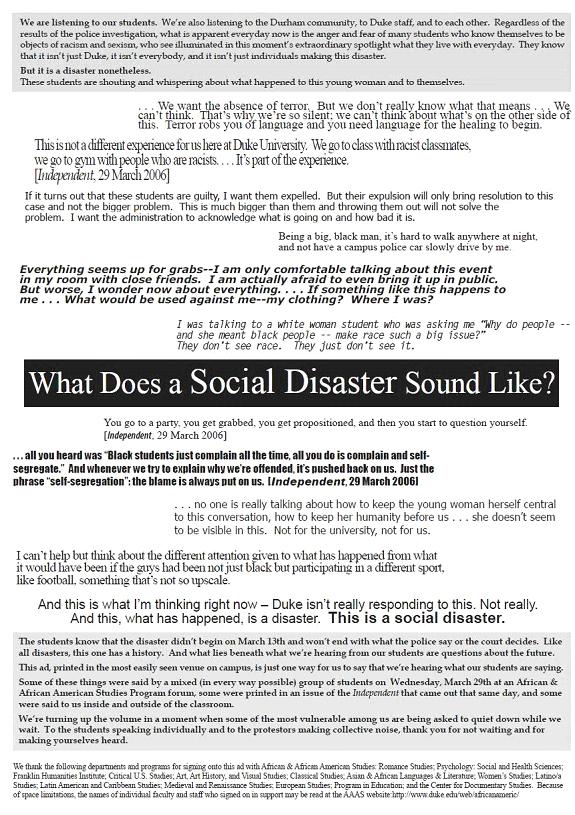
This morning, KC (who co-authored this post) and I looked at two principal enablers of Mike Nifong’s efforts - - SANE nurse Tara Levicy and Durham Police Dept. sergeant Mark Gottlieb. Levicy is no longer working for Duke Hospital; Gottlieb remains on the job at the DPD.
More broadly, this case provided a depressing glimpse inside the Durham criminal justice and legal system; while Nifong has been discredited, most of his allies remain on the job:
--Linwood Wilson, Nifong’s chief investigator, was a man who had given up his PI’s license because of myriad ethical complaints. Wilson displayed a disturbing habit of seeming to intimidate witnesses in the case. One witness, the former manager of the strip club where Mangum danced, swore out an affidavit that Wilson pressured her to change her story that Mangum was behaving erratically in the days before the lacrosse party. Another, the cab driver who corroborated Seligmann’s alibi, was arrested on an old (bogus) warrant uncovered by Wilson.
Both of these witnesses were African-American; local civil rights groups did not criticize Wilson’s actions in any way.
--The DPD command structure (Lt. Mike Ripberger, Deputy Chief Ron Hodge, and ex-Chief Steven Chalmers) was AWOL at best. The key procedural violation in the case came on April 4, 2006. After Mangum had failed to identify any of her “attackers” in studying photo arrays that had at best stretched DPD guidelines (five fillers per suspect, telling the witness the suspect might or might not be included in the lineup), Nifong ordered the DPD to run a third lineup, this time including only the 46 white embers of the Duke lacrosse team, all of whom were suspects. And Gottlieb opened the session by telling Mangum she would be shown only photos of people police believed attended the party.
In recent months, Ripberger, Hodge, and Chalmers have all stated that the DPD handled the lineup properly.
--City Manager Patrick Baker asserted in a May 2006 interview: “I’ve had a lot of conversations with the investigators in this case and with officials at Duke, and at no time did anyone indicate [Crystal Mangum] changed her story. If that were true, I’m sure someone would have mentioned it to me.”
In fact, Mangum never told law enforcement the same story twice; Baker’s portrayal of the evidence was false.
In May 2007, after the dismissal of all charges, Baker co-authored a report stating that the DPD’s handling of the lacrosse case was “typical” of its general performance, and that the officers committed no significant procedural errors. This at a time when there was massive evidence in the public record of gross violations of factually innocent defendants’ rights and good law enforcement practices.
--Dr. Brian Meehan and his lab, DNA Security, conducted the Y-STR testing on Mangum’s rape kit samples. Nifong had obtained the lacrosse players’ DNA through a court order promising that negative DNA results would “immediately rule out any innocent persons.” Meehan’s tests not only found no matches to lacrosse players, but also showed that the rape kit contained DNA matching multiple unidentified males, even though Mangum claimed to have had no sexual contact with anyone for a week prior to the lacrosse party.
Aside from driving another stake through the heart of Mangum’s credibility, these results showed that Mangum’s story could be true only if three lacrosse players had somehow contrived to leave no trace of themselves on or in her body while beating, kicking, and raping her vaginally, anally, and orally for 30 minutes, with no condoms, and with at least one ejaculating. Meehan’s tests also showed that Mangum was such a hospitable host for preservation of left-over male DNA that stuff from previous encounters with several other men was still lying around. In other words, her story could not possibly be true.
The presence of the unidentified males’ DNA -- virtually conclusive proof of innocence -- was suppressed in Meehan’s report. After defense lawyer Brad Bannon had figured this out by doggedly sleuthing through almost 2,000 pages of documents, Meehan tried to bluff his way out of the problem during a climactic hearing on December 15 by initially denying what his own documents proved. Bannon -- briefly terrified that he might have missed something -- proceeded to dismantle the DNA expert, cell by squirming cell, in the most thrilling cross-examination either of us have ever witnessed.
--Judge Ron Stephens, former Durham DA (and Nifong boss), who handled the case from March into June 2006, consistently rubber-stamped whatever Nifong asked and evinced hostility to defense lawyers who challenged the DA.
North Carolina non-testimonial orders require probable cause to believe that a crime was committed and reasonable grounds to believe that each individual subject of the NTO could have committed the crime. Yet Stephens signed off on a March 23, 2006 NTO requiring all 46 white lacrosse players to give DNA -- even though police didn’t show reasonable grounds that many of the lacrosse players even attended the party, much less could have committed the “crime.”
The move previewed the judge’s performance throughout the case. In April, he set $400,000 bonds, suggesting that Collin Finnerty and Reade Seligmann were flight risks. In an early November interview with The New York Times, he issued a de facto endorsement of Nifong’s re-election. And last month, he served as a character witness for Nifong at the ex-DA’s criminal contempt trial. His argument: Nifong’s punishment should be minimized because Nifong was an ethical beacon to a generation of Durham ADA’s.
The last 18 months, in short, have revealed a deeply flawed legal culture in North Carolina’s fourth largest city. And good reason exists to believe that the lacrosse case only exposed a fraction of Durham’s corruption. To conclude with a vignette: during Nifong’s criminal contempt trial, Durham judge Marcia Morey testified for the ex-DA. Morey offered an unusual argument to minimize Nifong’s repeated lies to the court to conceal his discussions with Dr. Meehan of the undisclosed exculpatory DNA test results.
Prosecutors, Morey asserted, had less of an obligation to be candid before a trial date was set. “I do think it makes a difference,” the judge continued. “Are you are at a trial stage, [or] are you at a pretrial conference?” Her apparent implication: Pretrial, at least, why make a fuss about a little lying between friends -- prosecutors and judges -- for the sake of helping prosecutors oppress innocent people?
"Do Not Call" Listings to Expire:
Remember the FTC's "Do Not Call" list? Well, individual listings expire after five years, so numbers will begin to drop off the list in 2008 if not renewed. The AP reports here.
Pielke's The Honest Broker:
I reviewed Roger A. Pielke, Jr.'s The Honest Broker: Making Sense of Science and Policy in Politics in the summer issue of The New Atlantis. The review is now available on-line here. Pielke makes many interesting points in the course of his discussion of science politicization (and policy scientization), and the threat posed to science by "stealth issue advocacy." At one point, he makes an interesting comparison between the politicization of science in environmental policy with the politicization of intelligence in the run-up to the invasion of Iraq.
Pielke draws a provocative and somewhat persuasive parallel between the reliance upon the precautionary principle in environmental policy and the doctrine of preemption in foreign policy, as advocated by the Bush administration with regard to Iraq. In each case, uncertainty itself is not a reason for inaction. To the contrary, uncertainty can be a reason for action—it was the possibility that Saddam Hussein had weapons of mass destruction that justified preemptive action, just as it is the possibility that anthropogenic emissions might cause tremendous environmental harm that justifies precautionary climate policies. Preemption and precaution are policy responses to uncertainty, but when the potential costs of such actions are high—as with the Iraq war or global climate change policy—the argument for preemption or precaution may be difficult to make, so policymakers attempt to shift the debate to safer terrain.
Framing these policy debates as questions of science or intelligence can create incentives for the misuse of information. In the case of Iraq, “the quest for certainty required by a commitment to preemption elevated the role of politics in policy and diminished the actual role of information and intelligence,” Pielke argues. “It transformed intelligence into a form of advocacy.” Much the same phenomenon occurs in the debate over global warming. In each case, the expert information has been oversold and the underlying value judgments upon which the policy decisions rest are obscured. In this context, information becomes “an asset to be used to achieve victory in the debate over values, rather than a source of enlightenment.”
When scientific or technical information is presented in order to advance a predetermined political agenda, it can undermine the credibility of those who provide the information, as well as those who rely upon it. The overselling of pre-war intelligence about Iraq damaged the credibility of both the Bush administration and U.S. intelligence agencies, and handicapped the administration’s “subsequent ability to make similar decisions by discrediting its own intelligence agencies,” Pielke observes. In much the same way, overselling scientific evidence in support of dramatic climate polices risks undermining the credibility of both the policy advocates and the science agencies, such as NASA, that produce or support the underlying research.
I should also note that Cambridge University Press is apparently offering a discount on The
Honest Broker. Details here.
Jeffrey Toobin's The Nine: Inside the Secret World of the Supreme Court:
I'd heard great things about this book, and so I read it with high expectations. It is indeed well-written, interesting, and, though it's opinionated, it is generally fairly balanced (though not entirely so). I didn't find much that was strikingly new there, but I've followed the Court quite closely; I expect that others will find a good deal of new material there, and I found some myself.
Still, I was in many instances disappointed by the book. I'm not sure whether I might have been in too nitpicky a mood, or perhaps had my expectations set too high. Still, there were more than a few instances in which I saw some pretty significant omissions or misdescriptions — sometimes in situations when the facts were seemingly being shoehorned into the theory that the book was at that point propounding. Let me give four examples.
1. On p. 301, the book is setting forth the theory that Justice O'Connor moved to the left in the early 2000s. The theory itself may well be sound, to some degree. But consider the following passages that seem to be framed as support for the theory: For all of O'Connor's fondness for Roberts, his appointment did not restrain [1] the move to the left that characterized her jurisprudence and [2] thus [3] the Court's. Indeed, as Rehnquist and O'Connor prepared to leave, there was a quality of a Prague Spring in the Court's decisions — [4] a last gasp of liberalism before a likely surge to the right. At the end of his tenure, [5] Rehnquist was never more beloved, but also never more irrelevant. [Bracketed numbers added. -EV]
Take, for example, the chief's vaunted federalism revolution. [Some details that go into the federalism debate and mention the Raich medical marijuana possession case, and that don't mention O'Connor, omitted. -EV]
In Gonzales v. Raich, six justices, including Kennedy and Scalia, said that Congress could indeed prohibit private, doctor-authorized pot farming....
The trouble is that Raich is a counterexample for three of the five assertions in the first paragraph, not an example. Raich might be seen as an example of "the Court's [move to the left]" (assertion 3), if one treats the rejection of a judicially enforceable enumerated powers doctrine as a left position, and of Rehnquist's "irrelevan[ce]" (assertion 5). But consider the other three assertions: - O'Connor didn't move to the left (assertion 1) in Raich: She took the "right-wing" restraints-on-government-power position in Raich (something the book never explicitly says).
- The Court's move to the left in Raich did not stem (in a "thus" relationship, as assertion 2 posits) from O'Connor's position — it moved in spite of O'Connor's vote.
- Even setting aside the singularly inapt Prague Spring metaphor (Prague Spring was a brief moment of democracy, preceded by dictatorship and followed by foreign tanks), Raich is not an example of "a last gasp of liberalism before a likely surge to the right" (assertion 4): The six Justices in the Raich majority remain on the Court, so Rehnquist's and O'Connor's retirements would either not affect the Raich lineup or turn it into a 7-2 or 8-1 case (if Roberts and Alito are more like Scalia than like Thomas).
So the example undermines three of the five claims that it's supposed to exemplify, and supports only the other two. Yet a casual reader who doesn't know the Raich lineup (and doesn't infer it from the ambiguous "six justices, including Kennedy and Scalia") might well assume that the example does fully support the opening paragraph.
2. On p. 90, the book talks, with some admiration, about the strategy of Jay Sekulow, one of the leading lawyers of the Religious Right. Sekulow's first Supreme Court case, the book says, was the Jews for Jesus' challenge to a Los Angeles International Airport ban on all "First Amendment activities": The original theory of the case was straightforward. Proselytizing was a form of religious activity among Jews for Jesus followers. A blanket ban on the practice thus interfered with their First Amendment right to the "free exercise" of their religion. That was how these cases had customarily been argued. Religious expression was always defended under the Free Exercise Clause.
But Sekulow's relative ignorance about the Constitution turned out to be his best weapon. Sure, cases involving religion were always argued under the Free Exercise Clause. But Sekulow came up with a different theory. The First Amendment, after the religion clauses, goes on to say that Congress shall make no law "abridging the freedom of speech." (In a series of cases after World War II, the Court said that the First Amendment was binding against states and localities as well as Congress.) Sekulow thought the eviction of the Jews for Jesus minister was a speech case, not a religion case....
[Later on p. 94, following a discussion of Sekulow's other free-speech-based victories for religious speech:] By the midnineties, the issue was settled. According to the standards of Supreme Court litigation, Sekulow had emerged out of nowhere to revolutionize an important rule of law. As a result of his efforts, it was clear that if a school, airport, or other public forum was going to open up its facilities to some individuals or groups, the authorities couldn't exclude religious speakers from the list.
But of course religious speech cases had long been argued under the Free Speech Clause as well as under the Free Exercise Clause. The 1943 West Virginia Board of Education v. Barnette case — which the book discusses just three pages earlier — struck down a compulsory flag salute as a violation of Jehovah's Witnesses' free speech rights; the Witnesses had lost on a religious freedom theory just three years before, in another case the book cites. In fact, many of the leading free speech cases of the late 1930s and 1940s, such as Schneider v. New Jersey (which upheld the right to leaflet) involved "religious expression" "defended under the Free [Speech] Clause," not the Free Exercise Clause. Some other leading cases of that era, such as Cantwell v. Connecticut, involved religious speakers who successfully sought protection both under the Free Speech Clause and the Free Exercise Clause.
What's more, in 1981, just six years before the Jews for Jesus case reached the Supreme Court, the Court's Widmar v. Vincent decision had upheld religious speech rights on public property — there, university classrooms rather than airports — based on the Free Speech Clause, on the theory that religious speech couldn't be discriminated against in a publiuc forum. The same year, the U.S. Court of Appeals for the Fifth Circuit upheld (in Fernandes v. Limmer) the rights of speakers to leaflet in airports; the case was brought by a religious group (the Hare Krishnas), relying on the Free Speech Clause as well as on religious freedom. And the same year, 1981, the U.S. Court of Appeals for the Ninth Circuit (in Rosen v. Port of Portland) reached the same result, relying entirely on the Free Speech Clause, in a case involving the Jews for Jesus themselves. Sekulow became general legal counsel for the Jews for Jesus in 1986; in mid-1980, when the Rosen case was briefed, Sekulow had apparently just graduated from law school, and was on his way to a job as a lawyer for the IRS.
So it may well be true that Sekulow is, as the book suggests, a skilled and important legal strategist for the Religious Right. But his supposed great innovation — which changed the way "[r]eligious expression was always defended" — seems to have been no innovation at all.
3. On p. 194, the book says: Even without outright opponents of the death penalty like Brennan, Marshall, and (eventually) Blackmun, the Court in the Bush years imposed new limits on executions. In 2002, the Court said judges alone, without the concurrence of jurors, could not impose death sentences; also that year, the justices ruled that the execution of the mentally retarded violated the Eighth Amendment's ban on cruel and unusual punishments. These rulings all came over the vigorous dissents of Rehnquist, Scalia, and Thomas — sometimes joined by Kennedy or O'Connor, who was an especially strong supporter of the death penalty — but the shift on the Court as a whole was unmistakable. But the 2002 decision holding that there's a right to jury trial in death sentencing was joined by Justices Scalia and Thomas (Rehnquist and O'Connor were the lone dissenters).
4. On p. 309, the book describes the Solomon Amendment case, Rumsfeld v. FAIR, by saying In short, Roberts said that he who pays the piper calls the tune. "Congress is free to attach reasonable and unambiguous conditions to federal financial assistance that educational institutions are not obligated to accept," he wrote.... Yet the Court actually refused to rest on the proposition that "he who pays the piper calls the tune," and instead held that the government could mandate access to universities by military recruiters even if this was a flat mandate rather than a condition on federal assistance: This case does not require us to determine when a condition placed on university funding goes beyond the "reasonable" choice offered in Grove City and becomes an unconstitutional condition. It is clear that a funding condition cannot be unconstitutional if it could be constitutionally imposed directly. Because the First Amendment would not prevent Congress from directly imposing the Solomon Amendment's access requirement, the statute does not place an unconstitutional condition on the receipt of federal funds. The "Congress is free" quote is from Grove City, and was quoted by Chief Justice Roberts only as part of his description of Grove City.
* * *
So how big a deal is all this? Maybe not that much; maybe these errors and some others I found are about par for the course even for a well-written book. Still, they made me worry how accurate some of the other material was — material that I didn't know as much about, and thus couldn't fact-check myself.
Another Example of Academic Open-Mindedness in California:
NY Times:
The appointment of Donald H. Rumsfeld, the former defense secretary, as a distinguished visiting fellow at the Hoover Institution is drawing fierce protests from faculty members and students at Stanford University and is threatening to rekindle tensions between the institution, a conservative research body, and the more liberal campus.
Some 2,100 professors, staff members, students and alumni have signed an online petition protesting Mr. Rumsfeld's appointment, which will involve advising a task force on ideology and terrorism. Faculty members say he should not have been offered the post because of his role in the Bush administration’s prosecution of the Iraq war.
"We view the appointment as fundamentally incompatible with the ethical values of truthfulness, tolerance, disinterested enquiry, respect for national and international laws and care for the opinions, property and lives of others to which Stanford is inalienably committed," the petition reads.
Philip G. Zimbardo, emeritus professor of psychology, explained his objection to Mr. Rumsfeld's appointment as he rushed across campus to teach a class. "It is unacceptable to have someone who represents the values that Rumsfeld has portrayed, in an academic setting," Dr. Zimbardo said.
Res ipsa loquitur.
UPDATE: Oh, and did you know that Stanford has a "mainstream" which all appointments, even of visiting fellows, must be part of? "Pamela M. Lee, a professor of art history who helped write the petition against Mr. Rumsfeld, said she hoped her protest would send a message and prompt the university to review its relationship with the Hoover Institution.
'It's extremely important for the Hoover to know that their appointments are not in the mainstream of the Stanford community,' Professor Lee said,'as well as to send a very clear signal to the country that this is not what Stanford is about.'" So, according to Professor Lee, enforcing ideological conformity among the faculty is "what Stanford is all about." Having one of the most distinguished public servants [yuck, did I write that?] officials of the last half century--an objectively true statement, regardless of what one things of his politics--on campus three to five times (!) is not "what Stanford is all about."
And, come to think of it, I can't resist the contrast between the reaction to Rumsfeld at Stanford and, judging from the stories in the Columbia Spectator, the almost complete quiescence, apart from some Jewish groups, at Columbia regarding the invitation to Mahmoud Ahmadinejad. In fact, according to the Spectator, some of the harshest criticism received by Columbia president Lee Bollinger is that he didn't criticize Minutemen Project found Jim Gilchrist, invited by students last years, as he has Ahmadinejad.
Some commenters suggest that Zimbardo is just a social scientist concerned about Abu Ghraib. Not exactly. He told the San Jose Mercury News, with regard to Hoover: "They can have any fascist they want there, and they do... We've never protested before but this seems to be egregious." Ah, the voice of reason. I guess, say, George Schultz is just "any fascist," but Rumsfeld is an egregious one.
Nifong's Enablers
For those who believed the lacrosse case was over, the past two weeks brought news on two fronts. First, Brendan Sullivan and Barry Scheck, on behalf of the three falsely accused players and their families, presented representatives of the City of Durham with the outlines of a devastating potential lawsuit against the city, former DA Mike Nifong, several police officers, and other individual defendants. The initial demands: $30 million, plus a wide array of procedural reforms, unless the city caves in and settles.
Second, after acting DA Jim Hardin urged a state criminal investigation of Nifong and others, reports surfaced that Justice Department investigators had arrived in the Triangle to look into the case.
Meanwhile, we have learned, Duke, its administrators, and its extremist professors are not out of the legal woods yet either. The University settled months ago with the three falsely accused players. But now a high-powered legal team representing most of the other 44 members of the 2006 lacrosse team is exploring a possible lawsuit. The grounds would include mistreating the entire team, including misleading smears of the players by Duke President Richard Brodhead and dozens of professors.
The first two moves are a reminder that the law enforcement misconduct in the lacrosse case extended well beyond Mike Nifong. Stuart (who co-authored this post) and I thought we would wind up our week of guest-blogging by reviewing the performance of Nifong’s criminal justice enablers.
Two people were vital in sustaining a case with no evidence and a complaining witness utterly lacking in credibility for Nifong to exploit. After the DA took over the case, the duo did everything possible to help him keep the charges alive.
The first was Tara Levicy, the sexual assault (SANE) nurse who wrote up Mangum’s Duke Hospital report. A women’s studies major in college, Levicy worked for several years for a Maine company that ran nature tours. She then changed careers, got a nursing degree through an accelerated program for liberal arts majors, and moved to Durham. Eight months later, she was a SANE trainee.
Levicy later told a defense attorney that she had never encountered a woman who lied about rape. She came across as an ideologue. And she applied her women-don’t-lie ideology to the lacrosse case regardless of the evidence.
Since Levicy was still a trainee at the time, Dr. Julie Manly, a resident physician, conducted the physical exam of Mangum on the morning of March 14, 2006. Yet Levicy, essentially a note-taker, told a police investigator two days later that the exam showed signs consistent with a sexual assault even though the medical records said nothing of the kind. (Neither the Durham Police nor Nifong ever interviewed Dr. Manly.) By March 21, Levicy was saying that Mangum had experienced “blunt force trauma,” even though nothing in Levicy’s own official report suggested such a diagnosis.
Over the next nine months, Levicy consistently changed her story to fit new prosecution theories of the “crime.” At the beginning, she had written that Mangum said her attackers were named Matt, Adam, and Brett and that they hadn’t used condoms. But when Nifong later claimed that the players used aliases and suggested that condoms might explain the lack of DNA evidence, Levicy adjusted her story to fit Nifong’s theory.
In a January 2007 statement, Levicy contradicted her initial report by saying that the “victim” had been uncertain if her “attackers” had used condoms and had been aware that they had used aliases. When asked by a defense attorney why, if Mangum were uncertain, Levicy had thrice written in her rape report that Mangum said “no” when asked if the assailants used condoms, the SANE nurse had no reply.
She also explained away the lack of DNA evidence with an unscientific feminist slogan: “rape is a crime of power, not passion.” As the interview continued, it became clear that Levicy didn’t understand that DNA could be obtained from items other than sperm. Skin cells, for example.
Most SANE nurses, it should be noted, are professionals. But a minority (how large is unclear) are, like Levicy, ideologues determined to use their medical authority to uphold an ultra-feminist view of rape. Asserted defense attorney Joe Cheshire: “There’s a Tara Levicy in every hospital.”
A second Nifong accomplice – or at least enabler – was Mark Gottlieb, the Durham police sergeant who supervised the case. Gottlieb was already notorious before the stripper party for arresting ten times as many Duke students (all for trivial offenses) as the other three Durham officers of comparable rank and assignment combined. Several students leveled credible allegations that he violated their rights in these arrests and lied in court to cover his tracks.
Gottlieb muscled his way into case after the initial responders had concluded that Mangum was lying. The sergeant, on the other hand, seemed interested not in finding out what happened but in proving Mangum’s allegations and settling scores with Duke students.
When Nifong ordered him to violate Police Department procedures and run a third photo-ID process confined to lacrosse players, Gottlieb did so unhesitatingly. By his own admission, in a March deposition for the State Bar, the sergeant gave at best misleading and at worst outright false testimony to the grand jury that voted indictments against Reade Seligmann and Collin Finnerty.
But Gottlieb’s most remarkable contribution to the case came in July 2006, when he submitted an undated, unsigned typewritten memorandum that purported to memorialize events from months before. (When asked why he had no contemporaneous notes, Gottlieb claimed that he had kept them on a “dry-erase board,” from which they had been accidentally erased.) Among other dubious items, Gottlieb’s memo claimed that in a March 16 conversation, Mangum had given dead-on descriptions of the three players ultimately indicted — even though his partner’s contemporaneous handwritten notes showed that her descriptions had been radically different.
With people like Levicy and Gottlieb helping him out, Nifong was able to keep a non-existent case alive. A post later today will look at other aspects of the troublesome legal culture that figured in Durham’s persecution of innocent lacrosse players.
Thursday, September 20, 2007
The Single-State Solution:
It's not working too well in relatively peaceful, prosperous places like Belgium, which makes me believe that when people like Tony Judt suggest it for Israel/Palestine, they are either being facetious or really mean "let the Arabs take over and the Jews disperse."
UPDATE: A seemingly informed commenter says that the Times story is overblown. But there is also a serious movement in Scotland to secede from Britain, and of course Quebec is constantly threatening to succeed from Canada. If groups like these are unhappy being in a single federation, it's pretty hard to a imagine a happy ending to a binational Israelstine, at least in this stage of the game.
"I Am the Very Model of a Usenet Individual" --
dated, but still funny.
Should We Be Blogging About the "Jena 6"?:
I'm with Glenn Reynolds on this. I'd really like to blog about the case, and I spent about 30 minutes this morning trying to research it, but I couldn't get a good enough sense of what the facts are or what the precise cause of the protest is to really know what to make of it. Wikipedia has the best summary I could find, and it seemed to suggest that the problem was a decision by prosecutors to overcharge a case in an environment of severe racial tensions. Specifically, the state charged one juvenile as an adult and initially charged him with attempted murder even though there was no evidence of that intent (and then dropped it to assault with a deadly weapon, even though the evidence of a deadly weapon was questionable). But I did find it hard to get a sense of what was going on, at least so far. As Glenn puts it, "The signal-to-noise ratio [isn't] that good." UPDATE: I had missed this summary by Radley Balko, which is very helpful. Related Posts (on one page): - Sunday Song Lyric:
- TalkLeft on the "Jena 6":
- Should We Be Blogging About the "Jena 6"?:
The Reaction to the MoveOn.Org "General Betray Us" Ad:
Over at Time.com, Michael Kinsley has a very good column on the "outrage" over MoveOn.org's advertisement about General Petraeus. A taste: These days, mock outrage is used by every side of every dispute. It's fair enough to criticize something your opponent said while secretly thanking your lucky stars that he said it. The fuss over this MoveOn.org ad is something else: it is the result of a desperate scavenging for umbrage material. When so many people are clamoring for a chance to swoon that they each have to take a number and when the landscape is so littered with folks lying prostrate and pretending to be dead that it starts to look like the end of a Civil War battle re-enactment, this isn't spontaneous mass outrage. This is choreography. I think that's basically right; There's a time-honored art to faux political outrage, and this ad created a fine opportunity to practice it.
Explaining Brodhead
As a high-profile case of prosecutorial misconduct affected his own institution’s students, how is it possible to explain Duke president Richard Brodhead’s passive response?
A few explanations can be eliminated. Duke officials did not - - at least privately - - initially believe Crystal Mangum’s fantastic lies. Duke cops told their superiors the case would go away quickly, because Mangum wasn’t credible. The lacrosse captains met with four senior administrators, including Brodhead, and not only denied the allegations but laid out the scope of their cooperation with police. The president, the executive vice president, the AD, and the dean of student affairs all expressed confidence the captains were telling the truth. (Brodhead has subsequently denied saying this.)
Nor were Brodhead’s actions consistent with his own publicly stated justifications. In an interview with Stuart Taylor for our book, the president explained that he remained silent in face of Nifong’s dubious procedural behavior because “I do not believe the day ever comes when private individuals have the right to take public judgment back into their hands.” Yet between 2000 and 2005, Brodhead twice had spoken out on behalf of his own students in legal matters (both times at the urging of leftists on campus). And, indeed, in the lacrosse case, he ultimately did “take public judgment back into [his] hands.” After Nifong dropped rape charges on December 22, the president publicly called for appointment of a special prosecutor. Sexual assault charges were still on the books.
So what did explain Brodhead’s actions? First, the president appears to have reacted with a deep, visceral disgust at the captains’ decision to hire strippers. In June 2006, when he met with the lacrosse team, he told them that all needed to accept responsibility for the party (the captains, who had hired the strippers, had already apologized), even though he knew that some players hadn’t even attended the party. In his October 2006 interview with 60 Minutes, he described the evening as one of “highly unacceptable behavior.” Brodhead, it’s worth noting, did not have a record of strongly denouncing other spring break parties. It was as if he had spent a lifetime on college campuses and only realized in March 2006 that college students drank and had wild parties during spring break.
Second, and more important, Brodhead appears to have been cowed by extremists within his faculty. (It’s worth remembering that this case began just over a year after Larry Summers lost a vote of no-confidence in Harvard’s Faculty Council.) A turning point event came in an emergency meeting of the Academic Council on March 30, 2006. The president urged caution and asked faculty to wait for the facts to come in. But the assembled professors, around 10% of the arts and sciences faculty, responded with vitriolic attacks against the team. One speaker claimed that Duke, as an institution, tolerated drinking and rape, and the lacrosse incident reflected a University problem from the top down. Another suggested punishing the team by suspending lacrosse for three years and then making it a club sport. A third asserted that the team embodied the “assertion of class privilege” by all Duke students. A fourth called on the University to do something to help the “victim.”
Three professors overpowered the meeting: Houston Baker stated as a fact that African-American women had been “harmed” by the lacrosse players and claimed that students in his mostly white, female class were terrified of the lack of an administration response. Wahneema Lubiano alleged favoritism by Duke toward the team and demanded a counter-statement from Duke denouncing the players. And Peter Wood asserted that two years previously, the team was out of control, and demanded a hard line against the athletic director, coach, and team. These remarks, according to several people who attended the meeting, received robust applause.
One week later, when Brodhead cancelled the lacrosse season, he appointed a “Campus Culture Initiative” to explore issues raised by the case. Wood chaired one of the CCI’s four subcommittees. Two other subcommittees (race and gender) were chaired by Group of 88 members Karla Holloway and Anne Allison. And one of the four student members was Chauncey Nartey, an African-American student who had sent an e-mail to the Presslers that the former coach’s wife considered a threat against their daughter. The Presslers filed a police report and told the administration what Nartey had done; the appointment went ahead anyway.
Brodhead’s disinclination to challenge faculty extremists extended to issues that nearly all academics would recognize as improper. For instance, on April 6, 2006, women’s lacrosse coach Kerstin Kimel told the president that multiple instances of in-class harassment of lacrosse players had occurred, with professors using class time to bully their own students. Yet neither Brodhead nor anyone in his administration ever investigated Kimel’s claim; in summer 2006, Duke spokesperson John Burness conceded that he had heard “rumors” of unprofessional behavior but suggested the problem had been handled by a dean sending out an e-mail reminding professors to treat all students fairly. The book documents several of these events.
Similarly, the Group of 88’s ad presented the administration with a ready-made opportunity to stand up to the worst of its faculty: after all, the ad claimed that five departments had officially endorsed its contents, even though none of the departments had actually voted on the question. Yet Brodhead not only remained silent in the face of this obvious breach of academic protocol, but he thrice, in early 2007, defended the Group of 88’s statement as a banal, even welcome, expression of the concerns of race/class/gender faculty on campus.
In the end, it's hard to imagine that his mishandling of the lacrosse case will not overshadow the other events in Brodhead's first term as president.
The Administration's Response
“Pandering” (New York Times). “Clearly terrified of the racial and gender activists on his own faculty” (Wall Street Journal). “Did little, if anything, to defend the lacrosse players or to criticise the faculty for its lynch-mob mentality” (Economist). “Weak-kneed” (Newsweek). “Seemingly terrified of the protestors and a radicalized faculty with the power to turn him into another Lawrence Summers” (Weekly Standard).
The reviews on Duke president Richard Brodhead’s performance in the lacrosse case are less than glowing. Such a poor performance hadn’t been expected in 2004, when Brodhead arrived in Durham after serving as dean of faculty at Yale. In New Haven, he distinguished himself for his urbane, witty charm; clear intelligence; and ability to accommodate the faculty’s demands. Yet Brodhead also lacked experience dealing with a top-flight athletic program or with elite college athletes. Duke’s national reputation came from its ability to combine first-class athletics with first-class academics.
Brodhead set the tone of his lacrosse response in his initial decisions on the case. On March 25, 2006, the same day the egregiously biased News & Observer “interview” with Crystal Mangum appeared, the Duke lacrosse team was scheduled to play Georgetown. In a virtually unprecedented move for a Division I athletics program, Brodhead canceled the game with Georgetown already on the field for its pre-game warm-ups. He described the move as punishment for the team’s party - - even though, as AD Joe Alleva later admitted, the party had violated no Duke rule and Duke never before had canceled a game because of moral distaste about team members’ behavior.
Lacrosse parents believed that Brodhead’s actions conveyed an impression of guilt. But he spurned repeated requests to meet with a group of them, either on March 25 or any time thereafter.
As the crisis intensified, Brodhead’s statements increasingly minimized any reference to a presumption of innocence. On April 5, reacting to the release of a vile e-mail that administrators knew or should have known was not a direct threat, the president cancelled the entire season. In a 2,377-word statement explaining the move, he didn’t mention a presumption of innocence or the players’ denial of all charges at all.
Instead, in a passage that perfectly captured the race/class/gender mindset that dominated Duke’s public response to the case, Brodhead declared, “The episode has brought to glaring visibility underlying issues that have been of concern on this campus and in this town for some time—issues that are not unique to Duke or Durham but that have been brought to the fore in our midst. They include concerns of women about sexual coercion and assault. They include concerns about the culture of certain student groups that regularly abuse alcohol and the attitudes these groups promote. They include concerns about the survival of the legacy of racism, the most hateful feature American history has produced. Compounding and intensifying these issues of race and gender, they include concerns about the deep structures of inequality in our society—inequalities of wealth, privilege, and opportunity (including educational opportunity), and the attitudes of superiority those inequalities breed.”
This was Brodhead’s final public statement before the first two indictments obtained by Mike Nifong.
The president took a similar approach in his first public appearance after the indictments of Reade Seligmann and Collin Finnerty. Speaking to the Durham Chamber of Commerce, he stated, “If our students did what is alleged, it is appalling to the worst degree. If they didn’t do it, whatever they did is bad enough.” What, precisely, did Seligmann and Finnerty do? They attended a party they played no role in organizing, and they drank some beer.
A few months later, asked by an alumni group to speak out not on the players’ guilt or innocence but to demand that Nifong respect the rights of Duke students, Brodhead instead turned the American system of justice on its head. It would be improper, he suggested, to criticize Nifong in any way. Instead, he articulated Duke’s policy in the following way: “We are eager for our students to be proved innocent . . . which is all the more reason why we require the legal system to proceed in a fair-minded, even-handed, and speedy fashion.”
Between March and December 2006, Brodhead displayed a broad deference to the criminal justice process, implying that academic institutions should never criticize legal misconduct. He also compiled a pattern of actions that conveyed an impression that the administration believed that the lacrosse players were the kind of people who could commit the horrific crime that Nifong described. And, even as he was complaining that “the facts kept changing . . . every day we learned new things that no one knew the day before,” he spurned at least three offers from defense attorneys or the parents of indicted players to give the University Council unfettered access to the state’s discovery file, to prove that Nifong’s case was a fraud.
How to explain this pattern of behavior? A post this afternoon will offer some hypotheses.
Stuart Taylor responds:
Sorry to have been absent for awhile, but I am happy to note that while I've been giving a speech this evening to a North Carolina group (the Fair Trial Initiative) devoted to helping poor death row inmates, most of the responses to critical comments that I would have been motivated to write have already been covered quite well by others. I add a few observations:
The following is tiresome: "Not to worry, there are thousands of poor people of all races whose stories of police and prosecutorial misconduct will never make the headlines of any national newspaper, talking head TV show or outraged blogger." I would wager the commenter a hot fudge sundae that I have written more than ten times as many published articles over the years about injustices to poor people than the commenter ever has. I would also wager that the commenter cannot site many (if any) examples of prosecutorial misconduct directed against poor people in recent years that is as egregious as the misconduct of Nifong here. More to the point, since when is it a plausible critique of an article decrying especially grotesque injustices to human beings to say that less affluent human beings, too, suffer injustices? If you are are the victim of an armed robbery, should you keep quiet because less privileged people than you have been victims of armed robbery more often? Is there a more flattering way to describe such logic than to say that it is shallow. . . well, I'll save the noun.
As for Anonymouseducator's "Lets not pretend that most of the Duke lacrosse team would have been accepted at Duke if they didn't play lacrosse": Has this commenter ever complained about admissions preferences for preferred racial minorities, which are considerably weightier than those for lacrosse players? I acknowledge the possibility that some groups (perhaps including a few of the lacrosse players) are given undue preferences because of status as athletes or as racial minorities. So which of these admissions preferences should be assessed as more problematic? The one that leads to a 100% graduation rate and GPA's on a par with the class as a whole, plus a lifelong harvest of friendships and valuable lessons in clean competition, teamwork, and endurance in the face of difficulty? Or the one that leads to dramatically sub-par academic and graduation rates plus racial isolation, self-segregation, and discord? For extra credit, Anonymopuseducator, please take a guess which of the preferences described above is the lacrosse preference and which is the racial preference.
"Privileged jocks": The only substantive content of this phrase is that by accidents of birth, such individuals are born into relatively affluent families and have through hard work developed their innate athletic gifts to the point of becoming college athletes. Just what, pray tell, is reprehensible about that? Would you like them better if they were born into poor families and had joined violent gangs or drug rings?
On our criticism of the NYT's 8/25/06 monstrosity versus the quoted passages thereof: I am mystified as to why anything in the passages quoted by the commenters casts the slightest doubt on our criticisms, and would be grateful for an explanation.
Stuart Taylor
Wednesday, September 19, 2007
Republican mayor says "I Do" to SSM:
San Diego Mayor Jerry Sanders, a Republican, announced today that he's changed his mind and now supports gay marriage:
· I am here this afternoon to announce that I will sign the resolution
that the City Council passed yesterday directing the City Attorney to file
a brief in support of gay marriage.
· My plan, as has been reported publicly, was to veto that resolution, so
I feel like I owe all San Diegans an explanation for this change of heart.
· During the campaign two years ago, I announced that I did not support
gay marriage and instead supported civil unions and domestic partnerships.
· I have personally wrestled with that position ever since. My opinion on
this issue has evolved significantly — as I think have the opinions of
millions of Americans from all walks of life.
· In order to be consistent with the position I took during the mayoral
election, I intended to veto the Council resolution. As late as yesterday
afternoon, that was my position.
· The arrival of the resolution — to sign or veto — in my office late
last night forced me to reflect and search my soul for the right thing to
do. . . .
· As I reflected on the choices that I had before me last night, I just
could not bring myself to tell an entire group of people in our community
that they were less important, less worthy and less deserving of the
rights and responsibilities of marriage — than anyone else — simply
because of their sexual orientation. . . .
· I do believe that times have changed. And with changing time, and new
life experiences, come different opinions. I think that's natural, and
certainly it is true in my case. . . .
· I have close family members and friends who are members of the gay and
lesbian community. These folks include my daughter Lisa and her partner,
as well as members of my personal staff.
· I want for them the same thing that we all want for our loved ones —
for each of them to find a mate whom they love deeply and who loves them
back; someone with whom they can grow old together and share life's
wondrous adventures.
· And I want their relationships to be protected equally under the law. In
the end, I could not look any of them in the face and tell them that their
relationships — their very lives — were any less meaningful than the
marriage that I share with my wife Rana.
[Thanks to journalist Rex Wockner for providing the text of the mayor's message.]
Leave aside for now the merits of the California marriage litigation San Diego will now support. Leave aside also the tactical question whether a pro-gay marriage ruling from the California Supreme Court would be worth the risk of a backlash producing a state constitutional amendment banning both gay marriage and civil unions.
A couple of things in the mayor's statement really stand out. First, he is willing to reconsider his views about even fundamental matters in light of experience, and allow those views to evolve and adapt over time. It's obvious that Sanders' personal experience with gay people among his friends, staff, and family has had a deep effect on his view about marriage. He no longer sees gay marriage as alien to marriage because he has seen gay relationships up close. Second, in light of his experience, Sanders sees no meaningful distinction between his own marriage and the relationships gay people form.
Years ago, Michael Sandel distinguished liberal toleration from moral argument. Mayor Sanders' claims are not liberal arguments for toleration of nasty behavior. They are substantive and highly contested claims about the good of lasting homosexual relationships. They do not argue for some formal equality or abstract liberty by trying to bracket the question whether homosexual acts are immoral; instead, they confront the moral objection to homosexuality itself.
Liberal toleration was sufficient to convince Americans (including their courts) to do away with stigmatizing and pointless sodomy laws. That's why the laws could be eliminated in a country in which the majority of the population still viewed homosexual acts as immoral. Doing so simply signaled tolerance. Liberal tolerance might even be enough to sustain support for civil unions.
But allowing gay marriage goes further because it affixes a stamp of approval. The most committed opponents of gay marriage understand this, and that's precisely why they oppose it. Maggie Gallagher once said that losing on gay marriage means "losing American civilization." Losing gay marriage for Gallagher and others means not just losing on some words in the family code or on some legal debate over how to define fundamental rights. It means losing a world-view. The advantage they have in public debate is that they address the moral questions that matter to people, while gay marriage supporters are trained to recite the oath to liberal tolerance: "The government should not legislate morality." That line worked with sodomy laws but it won't work with marriage. Americans understand marriage itself to "legislate morality," so arguing amorally for gay marriage is like arguing for touchdowns in a baseball game.
It's possible for those with moral objections to homosexual acts to support gay marriage as good policy. But for most Americans, supporting gay marriage will mean seeing it and the love of gay couples it memorializes as good things, as moral things, not as merely neutral things, and certainly not as distasteful things we must abide as the price of preserving individual liberty and pluralism. They will have to cross the gap between tolerance and acceptance, which one Republican mayor has now done.
UPDATE: Video of Mayor Jerry Sanders' emotional announcement is available here.
Mankiw's Case for a Carbon Tax:
On Sunday, economist Gregory Mankiw wrote a piece in the New York Times making the case for a "carbon tax." Among other things, Mankiw discusses how a carbon tax could be adopted without imposing regressive tax burdens. [The] natural aversion to carbon taxes can be overcome if the revenue from the tax is used to reduce other taxes. By itself, a carbon tax would raise the tax burden on anyone who drives a car or uses electricity produced with fossil fuels, which means just about everybody. Some might fear this would be particularly hard on the poor and middle class.
But Gilbert Metcalf, a professor of economics at Tufts, has shown how revenue from a carbon tax could be used to reduce payroll taxes in a way that would leave the distribution of total tax burden approximately unchanged. He proposes a tax of $15 per metric ton of carbon dioxide, together with a rebate of the federal payroll tax on the first $3,660 of earnings for each worker. Mankiw also explains why a carbon tax is preferable to various energy conservation regulations, such as automobile fuel economy standards. Enhancing fuel efficiency by itself is not the best way to reduce energy consumption. Fuel use depends not only on the efficiency of the car fleet but also on the daily decisions that people make — how far from work they choose to live and how often they carpool or use public transportation.
A carbon tax would provide incentives for people to use less fuel in a multitude of ways. By contrast, merely having more efficient cars encourages more driving. Increased driving not only produces more carbon, but also exacerbates other problems, like accidents and road congestion. Mankiw also explains why a carbon tax would be preferable to an equivalent cap-and-trade regime. In addition to the points Mankiw raises, I have argued that a cap-and-trade scheme is likely to result in greater corporate rent-seeking.
Duke Coverage: The Good, the Bad, & the Ugly
As of early April, now at the head of the guilt-presuming pack, The New York Times vied from early April 2006 on in a race to the journalistic bottom with trash-TV talk shows hosted by the likes of Nancy Grace, CNN’s egregiously biased, wacko-feminist former prosecutor. The Washington Post, The Los Angeles Times, USA Today, CNN’s Paula Zahn, and many others joined in.
By late March, CNN, MSNBC, NBC, and Fox TV trucks were filling the parking lots, grabbing random students for interviews, turning the campus into a freak show set. The team’s 46 white members had been branded as depraved racists from coast to coast.
Like the extremist professors, the media were not about to let mere evidence get in the way of a delicious “morality play that simultaneously demonized lacrosse, wealth, the white race, the South, and the male sex,” as Charlotte Allen later wrote in The Weekly Standard. Consider the coverage of the disclosure of near-conclusive proof that the rape charge was a fraud: the April 10, 2006 release by defense lawyers of undisputed evidence that no lacrosse player’s DNA had been found anywhere in or on Crystal Mangum.
The DA’s office itself had previously told the court that the “DNA evidence requested will immediately rule out any innocent persons.” Case closed, one might think. But most in the media treated it as a mere bump in the road.
The Times, for example, put the defense bombshell on the sports page, rounded up people to dispute the defense claims, and misleadingly quoted a respected DNA expert to suggest that the DNA didn’t prove anything. Sports columnist Selena Roberts, apparently oblivious to the evidence, wrote on April 11 that “Duke’s lacrosse members established a Lord of the Flies ethos in Durham.” Even worse were Nancy Grace and Wendy Murphy (an adjunct law professor who made over 30 appearances on the case and at one point affirmed, “I never, ever met a false rape claim, by the way. My own statistics speak to the truth").
“The authorities were leading the lynch mob and the press was behind them clapping and screaming,” defense lawyer Joe Cheshire later recalled. “It was stunning to me how they leapt to a conclusion, and their absolute unwillingness to listen to anything that wasn’t what they had already decided they wanted to be true.”
There were honorable exceptions, including the meticulously fair coverage of MSNBC’s Dan Abrams and ABC News “Good Morning America’s” Chris Cuomo. Some conservatives, including MSNBC’s Joe Scarborough, also stressed the evidence of innocence that came pouring into the public record. (Our book is critical of Scarborough’s coverage based on three early programs, a lapse for which I have apologized after having my attention drawn to his more numerous subsequent comments highlighting evidence of innocence.)
Times columnists David Brooks and Nicholas Kristof put the paper’s news columns and sports pages to shame with forceful pieces in May and June 2006 headlined, respectively, “The Duke Witch Hunt” and “Jocks and Prejudice.” Newsweek atoned for putting mug shots of two Duke defendants on its cover by running on June 19 a strong piece demolishing Nifong’s phony case. Investigative reporter Joe Neff of the News & Observer did stellar work throughout. Producers working with the late Ed Bradley of “60 Minutes” spent months putting together a devastating expose of the case’s fraudulence that finally aired on October 15.
The Chronicle, Duke’s student newspaper, consistently outclassed almost all of the national media. So did an ideologically eclectic group of case-specific blogs, some flavored liberal (such as TalkLeft.com), some conservative (such as La Shawn Barber’s Corner), some mainly just honest (such as Liestoppers and my co-author KC Johnson's Durham-in-Wonderland).
But the Times and Duff Wilson did their best to turn the tide back in Nifong’s favor in a 5,600-word monstrosity that ran on August 25, 2006, with Jonathan Glater sharing the byline. It was shredded from top to bottom just over three hours after it had appeared on the Times web site, in a 3:20 AM post by the Liestoppers blog’s brainy analysts. A few days later I wrote in Slate:
“The Times still seems bent on advancing its race-sex-class ideological agenda, even at the cost of ruining the lives of three young men who it has reason to know are very probably innocent. This at a time when many other true believers in the rape charge . . . have at last seen through the prosecution's fog of lies and distortions.”
Not until a week after the dramatic exposure on December 15, in open court, of Nifong’s conspiracy to hide the most powerfully exculpatory DNA evidence of all did the Times evince the slightest suspicion that this was not a case of privileged white males oppressing poor black woman. This was a rogue prosecutor oppressing innocent young men, aided and abetted by a mob that included the Times itself.
The bias driving media coverage of the Duke case had many roots. “When this case first made national news,” Sharon Swanson of the News & Observer reflected later, with commendable candor, “I was viewing the scenario through the prism of white liberal guilt. I felt somehow responsible that young black women were still being exploited by affluent young white men in the South. I stereotyped the entire Duke lacrosse team.”
Also at work was the attitude underlying a hoary slogan long embraced by reporters as the essence of their trade: “Comfort the afflicted and afflict the comfortable.” How many of those who glory in this idea ever stop to ask themselves whether all of “the comfortable” deserve to be afflicted? Should every child born into an affluent family be afflicted for that alone? A stunning array of journalists and academics -- many quite comfortable in their own right -- exuded exactly that attitude in their gleeful sneering at the “privileged” Duke lacrosse players.
Some Choice Words on Law School Faculty Hiring
from Jeff Harrison, professor at University of Florida law school.
The handling of the [Chemersinky] situation so many have written about sounds like there is no other interpretation than Irvine blundered.
But Pleeeeze, no more claims of being outraged that politics entered into the decision. I have seen decanal hiring, faculty hiring, tenure review letters, teaching evaluations, and tenure decisions affected by the political leanings of the candidate. I have watched while one candidate has his or her resume and scholarship dissected while another candidate gets a light look all based on political philosophy. I've seen the bottom of the class become "outstanding" and top of the class become not so good.I have seen one very liberal decanal candidate go down in flames when, evidently on the basis of one or two rumors, he was determined to be "insufficiently sensitive to race." A minority faculty candidate was nailed because he was not the "right kind of African American." The persistent obsession with hiring people with elite credentials with no verification that they are better scholars or teachers than other top grads is yet another political decision that defines the profession. If this does not go on at your own school, that's nice but, come on, our profession operates under a huge anti-intellectual cloud and claims of outrage and surprise are disingenuous.
A Remarkable Story:
Over at Simple Justice, Scott Greenfield has an astonishing post about a criminal case that deserves much wider attention: People v. Flores, in which a defendant was accidentally convicted of murder and then sentenced for murder even though the murder charge had already been dismissed. If the facts of Scott's post check out, this case is an unbelievable story of ineptness and prosecutorial abuse. And as Scott notes, it's a story that the Appellate Court seems to have wanted to keep quiet; while the court vacated the conviction for the nonexistent murder charge, it did so as quietly as possible. If you're a journalist, this sounds like a story you should check out. Thanks to Mike Cernovich for the link. Related Posts (on one page): - More on People v. Flores:
- A Remarkable Story:
Goldstein on the Current Court and the Supreme Court's Docket:
Over at SCOTUSblog, Tommy Goldstein makes some very thoughtful points about the the previous and upcoming Supreme Court Terms. In particular, he makes some quite perceptive comments about the presently fashionable claim that we now have a consistently conservative Court: [T]he characterization of this Court is part caricature and is deeply dependent on the near-accident of the particular cases that are decided in any given Term. Although the era in which true liberalism was an ideological force on the Court (e.g., Brennan, Marshall, and Douglas) is now over, this is manifestly not a period of conservative hegemony. Like Justice O'Connor, Justice Kennedy's commitment to any ideological world view is too fragile for either wing of the Court to have genuine confidence in the outcome of an entire Term's worth of cases. And moreover, many important cases are not decided on ideological grounds or by five to four majorities.
. . . I think that the existing and anticipated docket strongly suggests that, during OT2007, the outcomes of the highest-profile cases will be perceived as quite liberal. As a consequence, I think it is exceptionally unlikely that next Term will end as this one did, with front-page stories and reports leading the evening news describing the Court as profoundly conservative, with laudatory commentary by the right and howls of protest from the left. Instead, we will see (mistaken) talk of the "surprising" tack by the Court back to the left and (among the legal glitterati) the "good Kennedy, bad Kennedy" phenomenon in which his ideological views seemingly oscillate dramatically from Term to Term. In fact, this commentary will be wrong: the Justices and their views will be exactly the same come June 2008; it is the cases that will be different. I think Tommy is exactly right. The key driving the current Court is its cert practices: How the Court goes depends on which cases the Court takes. In the Warren Court era, the Justices looked for cases that would help them move the law where they wanted. The Warren Court took lots of cases, and they used those cases to change a lot of law. They didn't need splits, or in some cases even a relevant decision below. Today the picture is quite different. Today the Justices are focused heavily on lower court splits; they appear to see their primary role as resolving lower court uncertainty on legal questions that have spent a lot of time percolating below. This means that the Supreme Court's docket is actually set mostly by lower court judges rather than coalitions of the Justices. Lower courts decide whether to create a split, and that split is what prompts Supreme Court attention. (If you're thinking that might create room for some tactical split-creation below, well, yes it does.) As a result, the direction of the Court is defined by where the Justices are on the specific issues where the lower courts divide. This tends to lead to a much smaller docket as well as much less predictable trends in the direction of caselaw from year to year.
Eskimo words for snow:
While in my native Kiev a couple of weeks ago, I picked up a Dictionary of Russian Vulgar Slang (Bol'shoi slovar' mata). But this was only volume 1 of a multi-volume dictionary. This roughly 200-page volume was entirely devoted to the meanings and usage of the word "dick." Volume 2, devoted to yet another word, is even longer. And I'm sure more volumes are in the works.
Remarkable Editorializing in the New York Times:
"Reporters" Steven Erlanger and Helene Cooper:
Under international law, Israel is considered an occupying power in Gaza, even though it has removed its troops and settlers. Denying civilians access to the necessities of life is considered collective punishment and a violation of international law under both the Hague and Geneva conventions although the amounts involved could be subject to dispute.
This is particularly remarkable, because even the "usual suspects" don't agree that Gaza is clearly "occupied" by Israel. B'tselem, for example, a left-wing human rights organization, will only go so far as to say: "The broad scope of Israeli control in the Gaza Strip, which exists despite the lack of a physical presence of IDF soldiers in the territory, creates a reasonable basis for the assumption that this control amounts to 'effective control,' such that the laws of occupation continue to apply." In any event, the status of Gaza under international law is clearly in dispute [and I, being ignorant and largely of and largely indifferent to, international law, don't have any view of the issue]. Even for Mr. Erlanger, it's pretty surprising that he would so blatantly adopt a position on a contentious issue in the middle of a news story.
No Good Environmental Deed Goes Unpunished:
A computer recycler discovers environmental regulations can discourage enviornmentally desirable activity.
My L.A. Times op-ed on Chermersinsky, Summers, and the State of Academic Freedom on Campus:
Some excerpts from my op-ed, which appears in today's L.A. Times:
The saga of controversial liberal law professor Erwin Chemerinsky's on-again, off-again deanship at the new UC Irvine law school was highly unusual in two ways. First, the pressure to enforce political orthodoxy at Chemerinsky's expense came from the right, not the left, and second, academic freedom and 1st Amendment values won a resounding victory when Chemerinsky was ultimately rehired. A more typical example of how academic freedom remains in jeopardy across the country is the UC Board of Regents' treatment of Larry Summers, the former president of Harvard. University....
The hostility to Summers reflects the growing influence of professors who see their primary mission not as advancing human knowledge but as promoting a "progressive" political agenda.
Entire academic departments are often overtly ideological and politicized, even at schools not normally thought of as hotbeds of activism. Loyola Marymount's women's studies department, for example, proclaims as its mission "to call attention to the androcentric nature of society, propose alternatives and strategies that honor women's human rights, and promote a vision of society where gender hierarchy, as well as other forms of social injustice, are eliminated." In universities across the United States, conservative scholars are about as welcome, and as rare, in women's studies programs as Nazis in B'nai B'rith....
The Chemerinsky episode, disturbing though it was, should not distract us from the primary challenge facing academic freedom in American universities: the rise of an academic far-left establishment that seeks to use universities as a base for political activism, and is perfectly willing to violate accepted standards of academic freedom to achieve that goal. Anyone concerned with the future of American higher education has the duty to defend the values of scholarship and open debate against authoritarian political correctness. Unfortunately, by disinviting Summers, the UC regents failed miserably.
Related Posts (on one page): - Another Example of Academic Open-Mindedness in California:
- My L.A. Times op-ed on Chermersinsky, Summers, and the State of Academic Freedom on Campus:
Ecologists vs. Economists:
In a column discussing the debate over Bjorn Lomborg's Cool It (which I reviewed here), John Tierney notes that some of Lomborg's sharpest critics have not been the best prognosticators themselves:
Yes, Dr. Lomborg thinks like an economist instead of a climate scientist, and he doesn’t have a degree in climatology. Critics say his lack of climatological expertise makes him an unreliable guide for foreseeing the consequences of a warmer world, but I think these critics are ignoring history. They claim to be taking in the big picture, to be foreseeing great trends over the next century, but they’re missing one of the most valuable lessons from the past half century: when it comes to getting the big picture right, when it comes to preparing for environmental catastrophes, economists have a better track record than the scientists who specialize in analyzing environmental trends.
Tierney notes that one of the experts who attacked Lomborg's Skeptical Environmentalist in the pages of Scientific American, John Holdren, conveniently ignored his own prior arguments on resource scarcity.
He reviewed Dr. Lomborg’s chapter on energy, which reviewed the history of energy scares and predicted there would be not dire shortages and dramatic price increases in the future. Dr. Holdren began his critique by complaining that Dr. Lomborg was “asking the wrong question” because environmentalists had known for decades that there was no danger of energy being in short supply. This struck me as as odd bit of revisionist history, given both the “energy crisis” rhetoric of the 1970s and Dr. Holdren’s own bet that resources would become more scarce. Then, in the rest of the critique, Dr. Holdren faulted Dr. Lomborg for not paying enough attention to the reasons that there could be future problems with energy supplies.
I and others found Holdren's criticism particularly amusing because Scientific American itself had recently published articles forecasting the imminent depletion of energy supplies. When challenged on this point, SciAm's editor tried to explain that the articles were about the depletion of "affordable" energy, not energy supplies themselves — yet this is the precise argument that Lomborg addressed in his book.
[NOTE: Error in quote fixed.]
One Judge, One Career Clerk:
As expected, the Judicial Conference has adopted rules that will limit the use of career clerks by federal judges, largely due to cost concerns. The Legal Times reports:
Chief Judge Thomas Hogan, chairman of the conference's executive committee, told reporters that tens of millions of dollars would be saved over the next decade by managing the career clerk population. Currently, there are 291 career clerks, each with an annual salary of around $100,000, in chambers where another career clerk is employed. They'll be grandfathered into the new system, of course.
The temporary -- or "term" -- clerks make anywhere from $50,000 to $80,000 a year, depending on their level of experience. Speaking of which, Hogan also touched on another trend: Anecdotally, he said, fewer law school grads are jumping right into clerkships. Instead, they're working for a year or two at private firms, and then applying to the courts once they've paid off a good hunk, if not all, of their law school loans. It's a win-win, he said. The judges get better help, and the help gets better pay.
Media Mob Descends on Duke:
In late March of 2006, the journalistic echo chamber quickly spread the image of drunken, disorderly, publicly urinating lacrosse thugs around the world. It began with an appallingly biased five-column, front-page March 25 article in the Raleigh News & Observer. The headline -- “Dancer Gives Details of Ordeal” -- conspicuously omitted the word “alleged.” So did the subhead, “A Night of Racial Slurs, Growing Fear, and Finally, Sexual Violence.” False. As was much of the coverage in the Durham Herald-Sun.
Nifong whipped the national media into a feeding frenzy with his assertions on March 27 and thereafter that the lacrosse players were clearly guilty of raping the “victim,” of pounding her with racial slurs, and of forming a “wall of silence” to cover it up.
Of course, it was understandable that in the early days reporters and others would wonder: Why would a woman make up such a charge? And why would a prosecutor embrace it so confidently unless he had the evidence to prove it? So the initial coverage was bound to highlight Nifong’s charges.
Far less understandable was the sparse coverage of the four captains’ public statement on March 28 that the rape charge “is totally and transparently false”; that the “team has cooperated with the police” and “provided authorities with DNA samples”; and that “the DNA results will demonstrate that these allegations are absolutely false.”
For a defense lawyer to allow such a prediction unless certain it would prove out would court professional suicide. This put careful journalists on notice not only of the claim of innocence but also of defense lawyers’ confidence -- after grilling the lacrosse players and investigating other evidence -- that the DNA would set them free.
USA Today ignored the statement entirely in a March 30 article that, instead, stressed that “the flier being distributed outside Duke’s student union Wednesday night looked like a wanted poster: 40 faces of young men, smiling smugly for the camera.” Reporter Sal Ruibal reached out for a gratuitously pejorative adverb to describe a bunch of kids smiling for their official photos.
Chimed in columnist Christine Brennan: The lacrosse players were “giving us all a whole new definition of the word teamwork. ...Perhaps if no one is found guilty of any criminal activity in this unseemly affair, the collective silence of the Blue Devils someday will be seen as admirable. For now, though, the sports world’s vaunted concept of team is reaching a frightening extreme.”
In this atmosphere, The New York Times initially stood out for its reasonably balanced coverage. The first Times reporter to conduct detailed interviewing about the evidence in the rape case was sportswriter Joe Drape, who authored or coauthored articles that appeared on March 29, March 30, and March 31. In each article, he quoted Nifong but also presented a defense viewpoint.
Drape quoted Durham defense lawyer Bill Thomas providing an unanswerable reply to Nifong’s taunts: “Everyone asks why these young men have not come forward. It’s because no one was in the bathroom with the complainant. No one was alone with her. This didn’t happen. They have no information to come forward with.”
The more Drape pushed, the more he came to believe that Mangum was not credible and her rape charge was probably false. Encouraged, Bill Thomas provided all the evidence of innocence then in his possession to the Times reporter, expecting a great article. But in early April Drape called Thomas and said there would be no article because he was “having problems with the editors.”
And soon after Drape privately told people at Duke -- and, presumably, at the Times -- that this looked like a hoax, his byline disappeared from the Duke lacrosse story. The word among people at Duke and defense supporters, including one who later ran into Drape at a race track, was that the editors wanted a more pro-prosecution line. They also wanted to stress the race-sex-class angle without dwelling on evidence of innocence. They got what they wanted from Drape’s replacement, Duff Wilson, whose reporting would become a journalistic laughingstock by summer, and other reporters including Rick Lyman.
Times editors also got what they wanted from sports columnist Selena Roberts. Her March 31 commentary, “Bonded in Barbarity,” seethed hatred for “a group of privileged players of fine pedigree entangled in a night that threatens to belie their social standing as human beings.” Virtually presuming guilt, Roberts parroted already-disproved prosecution claims that all team members had observed a “code of silence.” She likened team members to “drug dealers and gang members engaged in an anti-snitch campaign.”
Roberts also took a swipe at Duke itself: “At the intersection of entitlement and enablement, there is Duke University, virtuous on the outside, debauched on the inside.. . . Does President Brodhead dare to confront the culture behind the lacrosse team’s code of silence or would he fear being ridiculed as a snitch?” The message was clear (and soon heeded by Duke President Richard Brodhead): Lynch the privileged white boys. And due process be damned.
Despite the passionate commitment to “diversity” and trashing of “privilege” in her Duke columns, Roberts herself lived a rather privileged life, with a home in Westport, Connecticut, a bastion of rich whiteness. Hypocrisy, perhaps?
How Federal is Star Trek's Federation?
While teaching my Federalism seminar recently, I made an analogy to Star Trek's United Federation of Planets. That got me thinking about the role of federalism in Star Trek. How much power does the Federation's central government have, and how much is left to the individual planets? Does the central government's Star Fleet have a monopoly of military force, or do Vulcan and other planets have their own local forces? Does the Federation subsidize planetary governments heavily, or are there hard budget constraints? Despite five Star Trek TV series and numerous movies, these questions haven't really been answered. Unfortunately, the academic literature on Federation law isn't much help either (see also this supposedly comprehensive volume on Star Trek and the law, which almost completely ignores federalism issues).
The evidence in the TV series' on these points is contradictory. On the one hand, the Federation seems to have a socialistic economy with a massive welfare state and no currency, which would require a high degree of centralization and planning incompatible with meaningful federalism. In the absence of a currency and price system, central planning seems to be the only way to coordinate a complex economy to even a limited degree. On the other, member planets apparently have considerable autonomy. For example, Vulcan seems to have very different laws from Earth. And Vulcan's economy seems to have a large market sector dominated by family-owned enterprises. In Deep Space Nine, the planet of Bajor applies for Federation membership. Although Bajor is at least a partial theocracy with a government heavily influenced by religious leaders, anti-Federation Bajorans never argue that Federation membership would lead to the end of Bajor's quasi-theocratic political system (as it surely would if the highly secular Federation denied political autonomy to member planets).
How to reconcile the evidence? I would suggest that it is only Earth that is socialistic, while the other member worlds have free market systems or mixed economies. The human-dominated Star Fleet military is the only Federation military force, and is tasked with collecting tribute from the nonhuman planets for redistribution to Earth. But as long as they pay their taxes, which subsidize Earth's welfare state and Star Fleet itself, they are largely left alone to govern their domestic affairs as they see fit. The Federation is essentially a big protection racket (in both senses of the word: providing external security, and also "protection" against its own depradations). There is even a good historical precedent. The 5th century BC Athenian-dominated Delian League also collected tribute from the other member states (which had no independent militaries) and used it to finance government spending on welfare benefits and the Athenian Navy, an analogue to Star Fleet. As long as the allies paid their tribute, Athens mostly left them alone and did not try to influence their domestic policies.
This theory explains a lot. For example, it is now clear why Star Fleet is so completely dominated by humans. I don't think we have ever seen a nonhuman Star Fleet admiral, and there are very few nonhumans serving even as lower-ranking officers. Except for a few collaborators like Mr. Spock (who is criticized by his fellow Vulcans for accepting too many "illogical" human ways), the nonhumans can't be trusted to force their own people to pay tribute. It also explains why the human-dominated Star Fleet military force seems to have near-total control over Federation foreign policy (e.g. - Star Fleet officers such as Capt. Picard make major policy decisions without any significant civilian oversight).
Furthermore, in one of Star Trek movies, a Klingon spokesman denounces the Federation as a "homo sapiens-only club." Taken literally, this is too obviously false to be effective propaganda; the Federation surely does have nonhuman members. But this propaganda line makes sense if it actually refers to the fact that Federation and Star Fleet are tools for expropriating wealth from nonhuman planets and transferring it to Earth.
Why don't we ever see Captain Kirk or Capt. Picard on tribute collection runs? Because the Enterprise is one of Star Fleet's most advanced warships, and is therefore reserved for more difficult missions, such as going "where no man has gone before" in search of new wealthy star systems to occupy and tax. Note the term "no man," which further underscores human control of Star Fleet.
How does the Prime Directive fit into this? On the surface, it seems incompatible with an imperialistic Federation. But remember that the Prime Directive only applies to planets which are at a much lower level of technological development than the Federation itself. That is, only to planets that are not wealthy enough to be worth the cost of occupying and taxing. Star Fleet Command wants to prevent glory-seeking captains like Kirk from taking over underdeveloped worlds that are likely to drain more revenue than they bring in. The Prime Directive serves this goal, while also cloaking Federation imperialism in a veneer of righteousness that has been all too successful in fooling generations of TV viewers.
I highly doubt that this is the interpretation of Star Trek that Gene Roddenberry intended. However, it does account for the available evidence, doesn't it?
UPDATE: Commenters note that there actually has been one (though only one) nonhuman Star Fleet Admiral. I stand corrected. But most likely she's just a token exception that proves the rule. Moreover, all she does is preside over the trial of one of the few other nonhuman officers in Star Fleet (Worf). They wouldn't trust her to preside over the trial of a human!
UPDATE #2: Some commenters claim that scarcity (and thus economics) is irrelevant in the Star Trek universe because they can manufacture anything they want instantly using replicators. Not entirely true. Some crucial raw materials, such as the dilithium crystals that power their starships clearly can't be replicated. Same with the replicators themselves (you never see them try to replicate a replicator). Ditto for the Latinum that the Ferengi use as currency; if the Ferengi could replicate latinum at will, the currency would rapidly collapse due to hyperinflation caused by constant replication. Thus, there is scarcity in the Star Trek universe, even if many goods that are scarce today are much easier to produce for them. Related Posts (on one page): - National Review's Star Trek Weekend:
- How Federal is Star Trek's Federation?
Posner on Law Professors and the Legal Profession:
The University of Chicago Law Review has posted a series of short essays commemorating the late Professor Bernard Meltzer; among them is this quite interesting piece by Richard Posner on law professors' relationship to the legal profession. Thanks to Adam White — a mere practicing attorney, harumph — for the link.
Tuesday, September 18, 2007
Movie Welfare Bleg:
Many states and nations have begun offering "incentives" (corporate welfare) for movie-making in their jurisdiction. The subsidies are commonly justified on the grounds that they help the local economy. Do any readers know of any studies assessing to what degree, if any, film industry subsidies actually do benefit the economy of the subsidy-giver? If you have answers (not just speculation), please supply them in the Comments. Thank you.
Maryland high court rejects gay marriage claim:
By 4-3, Maryland's high court today rejected a claim for same-sex marriage under the state constitution. The opinion is more than 100 pages long and is studded with more citations to cases, law reviews and books (including, notably, William Eskridge's Gaylaw), and sociological and scientific studies, than any case yet on the issue.
The Maryland court rejected the argument that the ban on gay marriages is a form of sex discrimination, though it called that argument "beguiling." It rejected the argument that sexual orientation discrimination should be subjected to heightened scrutiny, citing gays' legislative success in the state as evidence the group is not "politically powerless" and thus needs no unusual judicial protection from the majority. It added that there is not yet a sufficient scientific consensus on whether sexual orientation is "immutable." The court also decided that there is no fundamental right to marry another person of the same sex. These conclusions all follow the majority trends in the state courts so far.
Finally, the court concluded that the limitation of marriage to opposite-sex couples is rational because it furthers (however imperfectly) the state's legitimate interest in encouraging procreation. If the correct level of scrutiny is the traditional rational-basis test, this conclusion is hard to dispute.
SSM has lost in every state high court to consider the issue since the stunning success in Goodridge in Massachusetts in 2003. SSM legal advocates lost outright in Washington state and New York in 2006. New Jersey's high court also rejected an SSM claim in 2006, though it did order the recognition of civil unions and left open the possibility of a future pro-SSM ruling. A case is still pending in California's supreme court.
When you consider that SSM legal advocates have carefully chosen the most sympathetic venues since Goodridge, this record of losses is especially significant. It means that strong anti-SSM precedents are being created in the friendliest states, making pro-SSM rulings in other states even more unlikely in the near future. Once California is decided, the initial phase of post-Goodridge litigation will have pretty much run its course. That was the phase that was supposed to start an avalanche of pro-SSM judicial rulings that would quickly lead to gay marriage around the country. It didn't happen. Other cases are pending in states like Iowa, and there's nothing to stop gay couples from filing anywhere else, but the odds are now longer. If SSM is to advance much in the near future, it will probably have to come legislatively.
The Group of 88's Effects
While the Group of 88 led a faculty rush to judgment against the lacrosse team, the most striking aspect of the Duke faculty’s reaction to the lacrosse case came in the professors’ utter closed-mindedness as Mike Nifong’s case collapsed in late 2006. For instance:
--History professor Peter Wood claimed, in an interview with the New Yorker, that a lacrosse player advocated genocide against Native Americans. His evidence: an anonymous student evaluation in a class of 65.
--Literature professor Grant Farred published an October 2006 op-ed accusing Duke students of “secret racism” for seeking to vote Nifong out of office; in April 2007, he publicly deemed unnamed lacrosse players guilty of “perjury.”
--Houston Baker, by this point having been hired away by Vanderbilt, suggested that the lacrosse players might have been guilty of other rapes (he supplied no evidence) and e-mailed one player’s mother that her son and his teammates were “farm animals.”
Such statements seemed to violate the spirit if not the letter of Duke’s Faculty Handbook, which contains the following passage: “Members of the faculty expect Duke students to meet high standards of performance and behavior. It is only appropriate, therefore, that the faculty adheres to comparably high standards in dealing with students . . . Students are fellow members of the university community, deserving of respect and consideration in their dealings with the faculty.”
Yet — as our book makes clear — the Brodhead administration had shown no willingness to enforce the Handbook’s provisions at any point in the lacrosse affair. In spring 2006, at least three History professors used class time (in classes with lacrosse players) to deliver guilt-presuming lectures, including one who offered what he termed the findings of his “research” — that an “ejaculation had occurred.” An anthropology professor dismissed her class so the students could go outside and watch an anti-lacrosse rally. And a political science professor — after sending an e-mail in which she described the two lacrosse players in her class as accomplices to rape — gave both students an F on the final paper. One sued Duke; in an out-of-court settlement, Duke publicly announced that the grade had been changed (to a “pass”) and paid an undisclosed sum.
Group members disinclined toward unsubstantiated attacks or unprofessional behavior engaged in an Orwellian attempt to redefine the past. Perhaps the best example came in a January 2007 op-ed from English professor Cathy Davidson, who rationalized the Group of 88’s statement as nothing more than saying “that we faculty were listening to the anguish of students who felt demeaned by racist and sexist remarks swirling around in the media and on the campus quad in the aftermath of what happened on March 13 in the lacrosse house. The insults, at that time, were rampant. It was as if defending David Evans, Collin Finnerty and Reade Seligmann necessitated reverting to pernicious stereotypes about African-Americans, especially poor black women.”
These claims were absurd: in late March and early April 2006 virtually no one was publicly defending the lacrosse players “on the campus quad” or anyplace else, much less using racial stereotypes to do so.
While the Group members’ positions might have been divorced from reality, they had a chilling effect on campus discourse. For nearly six months, as an extraordinarily high-profile case of prosecutorial misconduct involving their own students unfolded before their very eyes, not one member of the Duke arts and sciences faculty publicly criticized Nifong’s behavior. The first who did so, Chemistry professor Steven Baldwin, also blasted the Group of 88 for betraying their responsibilities as professors. The response? The next day, the director of Duke’s women’s studies program accused Baldwin of using the “language of lynching,” while the co-director of Duke’s Center for Study of Race, Ethnicity, and Gender sent Baldwin an e-mail implying that they should settle their differences through violence.
This sorry record did not pass without notice. In a virtually unprecedented move, defense attorneys cited the statements and actions of the students’ own professors as a major reason why these undergraduates could not receive a fair trial locally. Wade Smith, one of the lead defense attorneys, noted during Nifong’s ethics hearing that the D.A.’s publicity campaign effectively transferred this case from the start to the court of public opinion. In that courtroom, the antics of the race/class/gender-obsessed Duke professors had considerable effect. After Nifong recused himself, the defense attorneys prepared a PowerPoint presentation of the case for their initial meeting with the special prosecutors. They ended the presentation not with anything Nifong said or did but with a close-up of the Group of 88’s statement, as a prime example of the shameful aspects of the case.
Even now, with Nifong’s case having been exposed as a fraud, only one member of the Group of 88 has publicly apologized. Another privately admitted that she was sorry for signing the statement, but wrote that if she apologized publicly, “my voice won’t count for much in my world.” The Economist recently concluded: “The only people who, it seems, have learned nothing from all this are Mr. Nifong’s enablers in the Duke faculty. Even after it was clear that the athletes were innocent, 87 faculty members published a letter categorically rejecting calls to recant their condemnation. And one professor, proving that some academics are as far beyond parody as they are beneath contempt, offered a course called ‘Hooking up at Duke’ that purported to illustrate what the lacrosse scandals tell us about ‘power, difference and raced, classed, gendered and sexed normativity in the US.’”
Dahlia Lithwick on Conservative Opposition to Mukasey:
Slate's Dahlia Lithwick has a blistering column attacking conservatives for opposing Judge Michael Mukasey's nomination as attorney general. There's one big problem with her argument: it ignores the fact that the overwhelming majority of conservatives are supporting the nomination, not opposing it.
Lithwick herself cites the endorsements of Mukasey by Bill Kristol (the most prominent neoconservative pundit), and Andrew McCarthy in the National Review (the most important mainstream conservative opinion journal, which also endorsed Mukasey in this editorial). By contrast, the only conservative she actually quotes as opposing Mukasey is the obscure Brian Burch of the little-known "Catholic-based advocacy group Fidelis," who has doubts about Mukasey's position on abortion. Yet Lithwick's article reads as if Kristol and the National Review are exceptions and Burch is the rule. Perhaps Orin Kerr is right, and Lithwick is the victim of a crafty White House effort to make it seem like there is more conservative opposition to Mukasey than actually exists. Even so, a legal journalist for a major online publication should know enough about the conservative scene to be able to tell the difference between widespread opposition and a small number of holdouts.
Lithwick also makes a silly argument in claiming that those conservatives who are concerned about praise for Mukasey by prominent liberals such as Senator Charles Schumer and Nan Aron are engaging in "hysterical partisanship." Given limited information, one way to judge a political figure's views is to look at the views of those who support him. You don't have to be a "hysterical partisan" to use this admittedly imperfect information shortcut. If a Democratic President nominated an AG who had been warmly praised by, say, Dick Cheney, I doubt that Lithwick would denounce liberals who were concerned about it as irrational or "hysterical." Especially not if the president were politically weak at the time, and had incentives to make nice with a Republican-controlled Congress. In this case, conservative concern about Mukasey is misplaced (which is one reason why the vast majority of conservatives are supporting him). Mukasey's writings (see here and here) and record on the bench show that he is pretty clearly conservative, even if he does reject some of the Bush Administration's more extreme claims of inherent executive power. But that doesn't mean that all such concern is "hysterical partisanship."
UPDATE: I have changed one passage in the original post to make it clear that, in the hypothetical case of a Democratic nominee praised by Dick Cheney, Lithwick would not have denounced as irrational or hysterical liberals who were concerned about the nomination. Whether she would actually oppose such a nomination herself, I don't know (though it wouldn't be completely surprising if she did, and I would not claim that she was a "hysterical partisan" if such a thing were to happen).
UPDATE #2: For more evidence of conservative support for Mukasey, see this supportive post by Ed Whelan, President of the Ethics and Public Policy Center (a prominent social conservative think tank).
Robert Jordan, RIP:
Well-known fantasy writer Robert Jordan passed away on Sunday. Despite my own longstanding interest in this genre, I haven't read much of Jordan's work, and so am not in a position to say much about it here. However, he was widely regarded as one of the most prominent and successful post-Tolkien writers in the field. For more information on his life and writings, see here.
UPDATE: It turns out that the actual day of Jordan's passing was September 16, not today. I have corrected the post to remove this inaccuracy.
The White House and Conservative Concern About the Mukasey Nomination:
You probably don't read the VC for amateurish and uninformed speculation, but in case you do I have just that about the nomination of Michael Mukasey. Specifically, I wonder if the White House has intentionally tried to create the impression of some conservative opposition to the Michael Mukasey nomination to help speed him through and help change the conversation about the Bush Administration. Here's the idea. Say you're in charge of political strategy at the White House, and you realize that Mukasey is a truly outstanding nominee who is also highly confirmable. You know he'll make it through, and the only question is how easily and at what cost. For tactical reasons, you "leak" to the press that you are very worried about conservative opposition to the Mukasey pick. You then make sure the press can find someone on the right — anyone — who would be willing to say something negative about Mukasey. At that point you can sit back and watch the show. Based on this inside "scoop" about potential conservative unrest, the MSM would dutifully go off and write their articles about how there is conservative opposition to Mukasey (citing White House worries and the one guy they could find to actually express concern, in this case some guy named "Brian Burch" from a group I have never heard of named "Fidelis"). The stories don't need any content; they really just need a good headline, like " How Bush's AG Pick Irritates the Right." Predictably, a few conservatives would see the articles and echo the concerns in the blogosphere. After all, if the press is saying that the Right is worried and you very much identify as being on the Right, then presumably you should be concerned as well. Equally predictably, some liberal critics eager to paint conservatives as nuts would write columns imagining (and criticizing) broad conservative opposition. Voila — with just a simple "leak," you have ensured that media discussion of the nominee will frequently mention conservative concerns. Why go through the trouble? Two reasons. First, in Washington the friend of your enemy is your enemy. You can't have a 100% consensus nominee because as soon as partisans on one side embrace a nominee the other side will grow suspicious. In a world with a Democratic Senate and a lame duck Republican President, it's much better to have a fellow Republicans suspicious of a nominee than the Democrats. Second, this story changes the conversation. More press attention on largely imaginary opposition within the GOP means less press attention on the Democrats' agenda. It takes the story away from Democratic demands on the Bush Administration for documents and puts it on the internal dynamics of conservative interests groups in Washington. All things being equal, that's a conversation that the White House would much rather have. Anyway, this is just my amateurish speculation. I really have no idea if this was a deliberate move. But the skeptic in me wouldn't rule it out, and it would be a pretty good pump fake if it's actually what's happening. Related Posts (on one page): - Dahlia Lithwick on Conservative Opposition to Mukasey:
- The White House and Conservative Concern About the Mukasey Nomination:
Opposite and Negation:
One of the legal tests for causation turns on whether an intervening act was "abnormal." In my criminal law class last week, I pointed out that if the act was abnormal, the result would be X, but if the act was not abnormal, then it would be Y. I also flagged for students that "not abnormal," clumsy as the phrase is, isn't quite the same as "normal." But there was a bit of confusion about how "not abnormal" can indeed be different from "normal."
I thought the issue — the difference between opposites and negations (is there a better term than "negation," by the way?) — was worth briefly explaining to my first-semester law students, so that's what I plan to do this afternoon. Here's what I plan to say:
1. Many adjectives have both an antonym and a negation. The antonym of "tall," for instance, is "short" — it's at the other extreme of the height spectrum from "tall." But the negative of "tall" is not "short." Many people, after all, are neither short nor tall; the negative of tall includes both the short and the ones in the middle. Thus, "not tall," clunky as it is, means something different from "short."
2. The English negative prefixes — "non-," "un-," "in-," and the like — sometimes mean opposite and sometimes mean negative (and sometimes something altogether different). "Illegal" pretty much means "not legal." "Abnormal," on the other hand, doesn't quite mean "not normal" — there are things in between normal and abnormal (say, the relatively rare but not very rare) that would qualify as "not abnormal." Likewise, "not unhappy" is not the same as "happy" (even setting aside cases where "not unhappy" is used for some rhetorical effect).
As a general matter, when some quality is either present or not (e.g., legal or illegal), the antonym is the same as the opposite. But if there's a spectrum (e.g., short to tall), the antonyms often differ from the opposites.
3. Exercises:
a. What's the negation (not antonym) of "positive number"?
b. (Borrowed from Lewis Carroll:) What's the negation (not antonym) of "once there was a princess"?
c. What's the negation of "lean and mean"? (This is a good way of also introducing DeMorgan's Law.)
* * *
Any suggestions about this? Is it so obvious that first-semester law students are sure to already know all about this? Are there some better examples I can use, or some easier ways of explaining it?
Of course, I realize that this isn't quite teaching law; but I think this is important for lawyers to know, and in my experience throwing in a few minutes of general knowledge every so often makes class more fun.
The Group of 88
Professors like to think of themselves as aggressive defenders of due process. In theory, the academy exists for the pursuit of truth. And faculty members are, in an ideal world, more inclined to embrace the dispassionate evaluation of evidence than the passions of the mob.
The behavior of activist members of the Duke arts and sciences faculty during the lacrosse case contradicted all of these myths about the academy. And most other professors at Duke elected to remain silent as their extremist colleagues rushed to judgment and refused to reconsider their actions.
In March 2006, less than a week after Crystal Mangum’s rape allegation became public, Houston Baker, a professor of English and African-American Studies, penned an open letter demanding the immediate expulsion from Duke of all 46 white players on the lacrosse team. (Several lacrosse players, in fact, hadn’t even attended the party.) Baker mocked the “tepid and pious legalism” that resulted in “male athletes, veritably given license to rape, maraud, deploy hate speech, and feel proud of themselves in the bargain.”
Two days after Baker’s missive, the former dean of faculty, History professor William Chafe, published an op-ed in the campus newspaper, the Chronicle. Entitled “Sex and Race,” Chafe’s op-ed suggested that the whites who kidnapped, beat, and murdered Emmett Till provided the appropriate historical context through which to interpret the behavior of the lacrosse players. In an unintentional commentary on the article’s intellectual seriousness, Chafe (a historian of civil rights) misidentified the year for Till’s murder, one of the crucial events in the development of the civil rights movement.
Then, on the 6th of April, 88 members of the arts and sciences faculty took to “the most easily seen venue on campus,” the Chronicle, to publish a full-page ad filled with guilt-presuming anonymous quotes, allegedly from Duke students. In their own voice, the professors asserted unequivocally that something “happened to this young woman” (Mangum). Following up on protests that had featured a “castrate” banner and the widespread distribution of a “wanted” poster with lacrosse players’ photos, the signatories said, “To the protesters making collective noise, thank you for not waiting and for making yourselves heard.” And the ad, paid for by the African-American Studies Program, claimed the endorsement of five academic departments—even though none of the departments had actually voted on the issue.
Months later, when asked about the propriety of the ad, statement author Wahneema Lubiano (a Literature professor and 1987 Ph.D. who has never published a scholarly monograph) unintentionally testified to the groupthink evident in many Duke departments: “In the moment when the ad came out, I did not hear from one colleague that there was something wrong with the ad.”
The signatories, who came to be called the Group of 88, were of differing races, genders, departments, seniority, and interaction with the lacrosse players. But they had one thing in common. Disproportionately housed in the humanities and a few social sciences departments, an astonishing 84.1 percent of Group members describe their research interests as related to race, class, or gender (or all three). Some featured research agendas that came across more as parodies than serious scholarship. To take some extreme examples: Kathy Rudy published a scholarly article reminiscing how, when she arrived in Durham, she and fellow radical feminists oriented their activities around “the ideas that women were superior and that a new world could be built on that superiority.” Grant Farred's most recent book looked at the controversy over ex-Rockets' coach Jeff Van Gundy's claim a few years back that officials were making too many calls against the team's star center to wildly assert that Rockets player Yao Ming "represents the spectral presence of Chinese capital within America. He is, precisely because of his complicated ideological heritage, the most profound threat to American empire.”
For those whose intellectual approach presupposes an American society deeply oppressive on grounds of race, class, and gender, the lacrosse episode was too tempting not to exploit. As Group member Mark Anthony Neal explained two days after Nifong obtained his first indictments, the allegations proved that Duke needed to rework its curriculum in “an innovative and brave” fashion, so as to teach students to behave “in a progressive manner.”
The most striking aspect of the faculty’s reaction, however, came not in the rush to judgment but in the professors’ utter closed-mindedness as Mike Nifong’s case collapsed in late 2006. A post later today will discuss the issue.
An Important Clarification About Whether You Owe Me A Beer:
My post yesterday on how the brain remembers facts seems to have created tremendous uncertainty over whether VC readers owe me a beer. Just to be clear, you do not owe me a beer. My apologies for the confusion.
Roth on Guns and Why Historians Struggle Determining "which quantitative studies are wrong and which are right."--
In Reviews in American History the country’s leading historian of homicide, Randolph Roth (OSU) has an article that deals with two recent disputes in American history: how many guns were listed in early American probate records and whether the Old West was violent (I dealt with the latter issue in an earlier post). On these two related issues, revisionist historians had suggested that there were few guns and relatively little violence.
Roth first indirectly addresses a question that puzzled me. How could historians be so easily misled about the quality of Michael Bellesiles’s fall 2000 book, Arming America?
Roth writes (link may not work for many non-university readers):
As historians, we take pride in our openness to new ideas. That is why, I think, so many of us were enthusiastic about Michael Bellesiles’s Arming America. Its thesis—that few Americans used, owned, or cared about guns before the mid-nineteenth century—was certainly congenial to scholars who supported gun control, because it suggested America’s homicide problem was caused by an increase in gun ownership and the creation of a “gun culture.” But Arming America had a more fundamental appeal for historians. It proved that they could make important discoveries, that they could confound received wisdom with bold hypotheses and careful research, and that they could play a crucial role in public life. Unfortunately, Arming America was wrong about early America.
Why do we as a profession have trouble deciding which quantitative studies are sound and which are not? Why do we mistake faulty studies for good ones and vice versa? Like everyone else, including statisticians, we are not very good at judging probabilities. Humans are proficient at many things, like counting, but as psychologists have discovered time and again, we have trouble figuring odds or risks or rates on the fly. Our common sense is a hindrance. That is why we need tools to help us determine which quantitative studies are wrong and which are right. Thanks to statisticians, those tools are at our disposal. It’s simply a matter of getting acquainted with them in a statistics course, keeping a few textbooks at hand, and thumbing through them occasionally for formulas that can help us answer quantitative questions.
Bellesiles claimed, for instance, using evidence from probate records, that only 15 to 21 percent of the wealth-holding population owned guns in the late colonial and early national period [even that estimate was an increase over Bellesiles's original estimate in Arming America of 14.7%]. But James Lindgren and Justin Heather, who reanalyzed a sample of probate records gathered by Alice Hanson Jones, found that half of all wealth-holders had guns in 1774. Who is right? It takes only a few minutes to decide, once the data are in hand and the right formula is found.
The historical consensus today, even among many of Bellesiles's former supporters, appears to be that Bellesiles was wrong on most of his main points about guns in early America (see Fall From Grace). Yet I still occasionally encounter people who believe that, though Bellesiles may have made some major mistakes or even may have acted improperly, his significant errors were limited to the probate data, leaving his primary thesis of very few guns and little or no gun culture in early America basically intact. Yet in two widely read articles (one co-authored with a student, Justin Heather), I detailed hundreds of mistakes in Arming America that significantly undercut nearly all of the major claims in the book.
Most historians just found it hard to believe that one of their own had made such basic errors, especially once the book had been praised by some of the country’s best historians in the New York Times and the New York Review of Books (both reviewers later changed their opinions). And because we had used sophisticated statistical techniques, some historians were slow to realize that the errors we identified were easily identifiable in the records and the raw data itself.
I urged that, before entering the public discussion, historians should spend an hour in a good research library checking the published probate records of Providence that Bellesiles had used for some of his counts. They could quickly see that nearly every claim he made about those records was false (of course, we did not expect historians to go into the many unpublished archives to read the original probate records we also analyzed for other times and places). Although Bellesiles viciously attacked our work on the Providence records in the Wall Street Journal and online, he then quietly capitulated on almost every one of our points regarding Providence, removing most of his mistaken statements from his book in 2001.
In his 2007 article, Roth recounts guns in one of the sources we used, the 1774 inventories published by Alice Hanson Jones:
Nearly half of the 919 estates in her sample included guns, even though at least 28 inventories in her sample were incomplete, and 81 estates were owned by women, 13 of whom owned guns. . . .
The formula shows that there is a 99% chance that the actual proportion of wealth-holders who owned guns (π) was between .600 and .462. There is only a 1 in 200 chance that the proportion of wealth-holders who owned guns was below 46.2 percent. Lindgren and Heather are right: probably half of all wealth-holders owned guns.
Assuming that Jones’s sample was properly executed—and it has been verified by subsequent scholars—how likely is it that the actual proportion of wealth-holders who owned guns was only 15 to 21 percent, as Bellesiles claimed? . . .
Bellesiles’s estimate of 21 percent is 12.0 standard deviations below the sample proportion (53.1 percent) and his lower estimate of 15 percent is 14.2 below. That is an enormous distance, statistically. The chance that Bellesiles’s estimates are correct is nil—less than 1 in a zillion-zillion. . . .
Thanks to these statistics, we can reject Bellesiles’s findings with confidence. We do not have to examine his methods or his selection of counties. His estimates of gun ownership are impossibly low.
To someone with even a modicum of statistical sense, Bellesiles's estimates were mathematically impossible.
It is gratifying to have our work replicated and confirmed, an act for which I heartily thank Randy Roth.
By the way, two participants in the debate over Arming America (Clayton Cramer and Saul Cornell) have published books in the last 15 months.
Nebraska State Senator Sues God:
So reports the AP:
Fed up with the threats, tired of natural disasters, the state's longest-serving state senator is using his legal muscle against who he says is the culprit — God. State Sen. Ernie Chambers of Omaha sued the Almighty in Douglas County District Court last week.
Chambers, who skips morning prayers during the legislative session and often criticizes Christians, said he filed the lawsuit to show that anybody can file a lawsuit against anybody....
Chambers, incidentally, once sued to bar legislative prayers in the Nebraska Legislature. The Supreme Court ultimately rejected the lawsuit, in Marsh v. Chambers (1983).
For a decision about a lawsuit against Satan, see United States ex rel. Mayo v. Satan and His Staff, 54 F.R.D. 282 (W.D. Pa. 1971).
Monday, September 17, 2007
The NY Times Has Given Up on TimesSelect,
reasoning that these days you want to draw in eyeballs and sell ads rather than keep them away and sell content. (Hat tip: Instapundit) The story also notes that changes may be coming over at the Wall Street Journal's website: The Wall Street Journal, published by Dow Jones & Company, is the only major newspaper in the country to charge for access to most of its Web site, which it began doing in 1996. The Journal has nearly one million paying online readers, generating about $65 million in revenue.
Dow Jones and the company that is about to take it over, the News Corporation, are discussing whether to continue that practice, according to people briefed on those talks. Rupert Murdoch, the News Corporation chairman, has talked of the possibility of making access to The Journal free online.
You Owe Me A Beer:
This is two weeks old but still pretty interesting: a Washington Post story on the impact of the human brain's tendency to think that "easily recalled things are true." Hat tip: Frank Pasquale. UPDATE: I should point out that the title of this post, "You Owe Me A Beer," is not accurate. If you're thinking, "hey, I owe Orin Kerr a beer," then that belief is false. I repeat: While you might be thinking that you owe me a beer, in fact you don't. You do not actually owe me a beer.
Who Do You Sue to Enjoin Acts of God?:
Answer here.
"Conservatives" and the Lacrosse Case
Both of the comment threads dealing with the case have featured comments suggesting that conservatives rushed to judgment as well — only on the opposite side because the accuser was a black woman and the accused were white males who were perceived as wealthy.
This seems to misrepresent the pattern of early dissent in the lacrosse case. A few conservatives did criticize Nifong at a relatively early stage (Sean Hannity, Wendy McElroy, La Shawn Barber).
But by far the most passionate — and persuasive — early critic was Jeralyn Merritt at TalkLeft, whose posts saw through Nifong's case even before the first two indictments. The first searing moral critique of Nifong's behavior came from an African-American sportswriter, Jason Whitlock. And the key local public opposition to Nifong came from a liberal Duke Law professor, Jim Coleman.
This case, obviously, came to attract considerable conservative interest — as, indeed, it should have. Prominent liberal organizations, such as the New York Times or the state NAACP, took stances that bolstered prosecutorial misconduct, contradicting their stated general principles. But the idea that the opposition to Nifong originated from some type of conservative cabal is, to me, misguided.
(For the record, I'm a Democrat who's supporting Barack Obama for president and who vehemently favors gay marriage, choice, and fair taxation policies.)
"Confirm Michael Mukasey":
Over at Balkinization, Scott Horton has a post urging the Senate to confirm Michael Mukasey. He makes it seem like Mukasey is James Comey without the baggage. Sounds awfully good to me.
AFF College Blogger Contest:
The America's Future Foundation is sponsoring a search for the nation's best college-age conservative or libertarian blogger. The contest is open to undergraduate and graduate student bloggers, ages 25 and younger. The winner will receive a grand prize of $10,000. The judges are Radley Balko (The Agitator), Robert Bluey (RobertBluey.com), Jonah Goldberg (NRO), Mary Katherine Ham (TownHall.com), Megan McArdle (Asymmetrical Information), and yours truly. The application deadline is December 31, 2007, and the winner will be announced next April. Further details are here. Good luck to all who enter!
Chemerinsky to Become Dean At U.C. Irvine After All:
Brian Leiter's post with the news is here; U.C. Irvine's press release is here.
Nifong: The Banality of Evil
After learning of Crystal Mangum’s far-from-credible rape allegation, Mike Nifong moved on Friday, March 24, 2006 to take direct command of the eight-days-old police investigation, in a gross departure from standard procedures that avoided oversight of the investigation by any police official above the rank of sergeant. Meanwhile, the police and local papers dramatized the case as an unquestioned example of privileged white athletes victimizing a poor black woman.
Then Nifong met on March 27 with the two main police investigators in the case. They told him that a sexual-assault nurse in training at the Duke hospital thought Mangum had been raped. Perhaps Nifong believed the nurse-trainee, even though the hospital records showed no physical evidence of rape; certainly it was politically convenient to believe her.
But Nifong also had access to the reports of Mangum’s wildly inconsistent stories. And he learned from the cops that Mangum had been unable to identify a single attacker in two photo lineups and that the second dancer, Kim Roberts, had called Mangum’s allegations a “crock.” Nifong’s response: “You know, we’re f***ed.”
Less than an hour later, ignoring ethics rules forbidding prosecutors from publicly seeking to “heighten condemnation of the accused,” the D.A. began an unprecedented, week-long media campaign. He declared with certitude in dozens of interviews that white Duke lacrosse players had raped and brutalized a black woman while pelting her with racial epithets.
Nifong compared the alleged crime to a cross-burning, and to a quadruple homicide. He falsely claimed that the players had refused to cooperate with police. Before long he had whipped up African-Americans and others in Durham and at Duke into such a frenzy of rage at the lacrosse players that it would have consumed Nifong himself had he failed to produce rape indictments before the May 2 primary election.
Meanwhile, evidence of innocence came pouring into the DA’s office. But there was no turning back for Nifong. So when he learned privately that DNA tests of all 46 white lacrosse players were negative, he publicly abandoned his own office’s assurance that the DNA would identify the guilty and exonerate the innocent. Instead, Nifong started saying that DNA doesn’t prove anything, and that the attackers might have used condoms. Never mind that Mangum had repeatedly asserted that her “attackers” had not used condoms and that one, two, or three of them had ejaculated.
Nifong also spurned several offers by defense lawyers to show him detailed alibi and other evidence that their clients were innocent, including an electronic timeline established by time-stamped photos and cell phone records. The DA avoided ever personally interviewing the ever-changing Mangum about the facts. And he looked the other way as other evidence of innocence accumulated.
This was a classic case of willful blindness to the facts. It was as though Nifong sensed that the rape charge was probably a fraud -- how could he not? -- but wanted to avoid confronting clear proof because he was determined to prosecute no matter what the evidence.
Accordingly, Nifong focused on manufacturing evidence of guilt. He rigged up a third photo-ID process that violated all the rules designed to insure reliability. The police showed Mangum photos only of lacrosse players who had attended the party. They told her this, stoo. In what amounted to a multiple choice with no wrong answers, Mangum “identified” four lacrosse players as possible attackers. Nifong obtained indictments against three of them.
Nifong also sent the DNA evidence to a private lab for more sensitive, “Y-STR” testing. The results were even more conclusive proof of innocence: In three meetings during April and May of 2006, lab director Brian Meehan told Nifong and his police investigators that while the DNA in the rape kit did not match any lacrosse player, the lab did find the DNA of multiple other, unidentified males. Mangum had told police she had no sexual contact with anyone for a week before the supposed rape.
Rather than drop the charges, Nifong and Meehan agreed that the paid expert would hide this powerful evidence of innocence by omitting it from his report. And in the summer and fall of 2006, Nifong lied to two judges when asked whether Meehan’s tests contained anything beyond what his report had revealed. What finally blew Nifong’s case out of the water was a riveting, December 15 cross-examination in which defense lawyers forced Meehan to admit all the elements of this conspiracy.
Nifong’s unethical media campaign, his willful blindness to the facts, his rigged photo lineup, his lies to the public and the court, and his concealment of proof of innocence are a rare study in how to frame innocent defendants by using procedural violations to construct a phony case out of whole cloth.
The DA also had accomplices who joined or assisted in his crimes, including some police officers and others, plus enablers who helped him get away with his flagrant misconduct for so long. Subsequent posts will examine some of the enablers.
As for Nifong, North Carolina Attorney General Roy Cooper called him a “rogue prosecutor” in April, while declaring the three wrongly indicted defendants “innocent.” The DA lost his law license in a bar disciplinary hearing in June. He was convicted of criminal contempt and jailed for a day this month. And he still faces possible investigation for crimes that could bring serious prison time, including obstruction of justice and violating the lacrosse players’ civil rights.
(KC Johnson co-authored this post.)
Could O.J.'s Sentence for Robbery Take Into Account His Killings?
The AP reports:
O.J. Simpson was arrested Sunday and faces multiple felony charges in an alleged armed robbery of collectors involving the former football great's sports memorabilia, authorities said....
The charges against Simpson will include robbery with a deadly weapon, conspiracy to commit robbery and burglary with a firearm, all felonies, Dillon said....
Simpson, 60, has said he and other people with him were retrieving items that belonged to him. Simpson has said there were no guns involved and that he went to the room at the casino only to get stolen mementos that included his Hall of Fame certificate and a picture of the running back with J. Edgar Hoover....
I'm not an expert on Nevada state sentencing rules. But I can say that, if Simpson is convicted, and the judge is making a discretionary sentencing decision about Simpson's sentence, the federal Constitution would (1) let the judge take into account any past crimes on Simpson's part, (2) using a preponderance of the evidence standard, (3) even if Simpson had been acquitted of those crimes. This means that a judge could increase the penalty all the way up to the statutory maximum for the crimes of which Simpson is convicted, far beyond what the norm would be for a typical armed robbery, burglary with a firearm, or what have you.
The theory behind modern American sentencing, after all, is that while guilt is about what the defendant did in this case, sentencing may (and should) in part turn on the defendant's general character. That's why first offenders are often treated leniently, but people with long criminal history records are punished more harshly.
Moreover, proof beyond a reasonable doubt has never been required at sentencing. Historically, judges could make decisions based on facts that hadn't been proven in any formal way; certainly facts shown by a preponderance of the evidence suffice. For this very reason, judges could consider alleged past criminal conduct of which the defendant had been acquitted: The acquittal simply shows that the conduct couldn't be proven beyond a reasonable doubt, and doesn't preclude proof by a preponderance of the evidence.
The Supreme Court has held that in presumptive sentencing guidelines schemes, all facts relevant to enhancement (except those which can be proven through a record of criminal convictions, and civil judgments likely wouldn't suffice) need to be found by a criminal jury. But the Court specifically held that judges could find such facts whenever they are making discretionary decisions, rather than decisions under presumptive guidelines schemes.
Simpson has been found guilty by a civil jury of killing his ex-wife and Ron Goldman. (If I'm not mistaken, the jury's award of punitive damages involved a finding of guilt by clear and convincing evidence, though I don't think this is necessary to my analysis.) It's possible -- I'm not sure -- that a judge could simply rely on this past finding; but a judge could certainly enter such a finding himself based on his own review of the evidence.
And given this finding about Simpson's past conduct and therefore his moral character, the judge would be legally allowed to impose a higher sentence than he would on a typical robber, burglar, or what have you. I'm not sure whether a judge would indeed act this way; but the federal Constitution would let him act this way if he so chose.
These are my tentative thoughts; please let me know whether I'm mistaken, though I think I'm right on the constitutional question. Please also let me know what Nevada state law rules might bear on the subject, if you're knowledgeable about Nevada law.
UK run on Northern Rock Savings Accounts Continues.--
Although a couple of weeks ago the limited run on Nationwide Banks in the US was quickly stemmed, the run on Northern Rock in the UK continues for at least the third straight business day on Monday (via the Guardian):
Thousands of anxious savers besieged branches of Northern Rock this morning [Monday] as the run on the crisis-hit mortgage bank gathered pace.
Its shares plummeted by 34% to 290p within the opening minutes of trading on the stock market today. This follows Friday's 30% share price collapse at the group, Britain's fifth-largest mortgage lender, which has lost three-quarters of its value over the past 12 months.
There were heavy losses among other banks, with Alliance & Leicester down more than 10% and Bradford & Bingley down around 9%.
As much as £2bn is believed to have been withdrawn from Northern Rock accounts on Friday and Saturday, although many online customers were unable to access their funds. The current share price gives the bank a market capitalisation of £1.3bn.
Queues started forming in the early hours this morning, with some customers arriving as early as 3am.
In Leeds, around 100 people were queuing outside the Northern Rock on Briggate. Some had even brought chairs and flasks to make their wait more comfortable. . . .
Caroline Clarkson, 39, said she was frustrated by the bank's response to the crisis.
She said: "When you phone them, you can't get through and when you go to the website, it just crashes.
"When you read all the reports over the weekend and you think about your money, I decided it just was not worth the risk. Why risk it when I can take it out today and put it in another account?"
At a branch in Liverpool, one woman, who left clutching a handbag packed with around £3,000 with the strap double-wrapped around her shoulders, said: "It is not much but it's all I have in the world.
"But then, when I think of the staff inside, not knowing how this will turn out and their whole livelihoods are at stake, I feel rotten."
Usually the day before a US Federal Reserve rate cut (expected Tuesday) is an up day in the US stock market, as is the day of a rate cut, but today the US stock market is struggling against European pessimism. Further, the first of the major US brokers (Lehman) reports earnings on Tuesday, which could be either disastrous or surprisingly solid. If you know which way the market will move today and tomorrow, you are smarter than the rest of us.
Bush Taps Former District Judge Michael Mukasey For AG Spot:
This move was widely rumored over the weekend, and now is official. I don't know very much about Mukasey; by reputation he was a very good district court judge, but he has a lower profile than the other candidates. Press reports over the weekend seem to be presenting him as a relatively moderate conservative who was picked because he was confirmable in a Democratic Senate.
Nifong Before Lacrosse
The basic tale of Mike Nifong -- the disbarred, disgraced, jailed-for-a-day former Durham DA who may yet face a felony prosecution -- is widely known. But news reports have barely begun to plumb the depths of what may be the worst prosecutorial misconduct ever exposed while it was happening.
Desperate to win an election against a strong white candidate in a county about evenly divided between whites and blacks, Nifong (also white) seized on a patently incredible, constantly changing rape allegation against Duke lacrosse players. It was made in March 2006 by a deeply disturbed African-American stripper named Crystal Mangum. Using the case to inflame racial discord, the DA rode the black vote to victory.
The problem was that that the rape claim was a transparent fraud. And in hindsight, Nifong’s conduct seems bizarrely self-destructive. What kind of man would try to send three innocent young men to prison for 30 years to win an election? How could a career prosecutor not previously known as a nut or a rogue go so bad, so fast? How could he have thought he would get away with it?
Stuart Taylor and I (who jointly wrote this post, and one later today) have found widespread curiosity about these questions, especially among lawyers, while working on our new book, Until Proven Innocent: Political Correctness and the Shameful Injustices of the Duke Lacrosse Rape Case. So this first post in a week of guest-blogging focuses on Nifong’s background, character, and the months of escalating misconduct that have brought him down. Subsequent posts will examine the misconduct (as we see it) of dozens of Duke professors, many journalists, the Duke administration, and the Durham law enforcement establishment.
A North Carolina native, Nifong was an undistinguished student at the state university in Chapel Hill, where he acquired an intense dislike both for Duke students and for lacrosse players, and its law school, from which he graduated in 1978. His first and only job as a lawyer was as an assistant DA in Durham. The competent, if undistinguished, prosecutor tried around 300 felony cases and rose in seniority amid high turnover.
Nifong had a reputation as a tough, sometimes bullying prosecutor. He was known for throwing screaming, obscenity-laden fits at people he thought he could push around. But he was not known as a zealot or as unethical. After a medical leave in the late 1990s, Nifong moved to a sleepy job in traffic court.
Then Governor Mike Easley named Nifong interim DA in April 2005, after elevating his elected predecessor, Jim Hardin, to the bench. Easley later said that Nifong had pledged not to seek election in 2006 for a full four-year term. If so, Nifong violated the pledge. He declared his candidacy a few months later, apparently because his pension was at stake.
His pension? Yes: In his first day as DA, Nifong had fired a longtime rival, Freda Black. She quickly made clear her intent to run in 2006. Well-known from her work in a high-profile murder trial, Black soon became the front-runner. Nifong knew that Black would fire him, as he had fired her, the first chance she got. His concern, he told his initial campaign manager, Jackie Brown, was not that he cared about being DA; he needed another three years in the Durham DA’s office for his pension to fully vest.
Nifong proved an inept candidate. By mid-March, 2006, he was way behind Black and out of money. Even after lending his campaign $30,000 of his own modest savings, he still seemed doomed to defeat.
Enter Crystal Mangum and her fantastic claim of being brutally gang-raped, beaten, kicked, and strangled by three white, out-of-state, supposedly rich Duke lacrosse players. For Nifong, this was a lifeline. And he would define his career by his subsequent actions.
Sunday, September 16, 2007
Significant Developments in DC Case on Handgun and Self-Defense Bans:
This spring, the DC Court of Appeals ruled in the case of Parker v. District of Columbia. The case had three important legal holdings:
1. Five of the six plaintiffs did not have standing to sue, because the mere threat of criminal prosecution for exercising their constitutional rights was not sufficient to confer standing. The ruling was based on an extension of a previous DC case, Navegar, which had involved challenges to the federal ban on "assault weapons."
2. The DC government's complete ban on handguns (other than handguns which were registered in DC before the ban went into effect) violated the Second Amendment.
3. DC's ban on the possession of functional long guns was also a violation of the Second Amendment. DC requires that all rifles and shotguns be locked up or disassembled, and there is no exception in the law for self-defense.
DC's attorneys asked the Court of Appeals to stay its mandate, so that the DC ordinances could remain in effect while DC petitioned the Supreme Court for a writ of certiorari.
But when DC filed its petition, the petition flagrantly violated DC's representations to the Court of Appeals. DC's petition for a writ of certiorari presents one, and only one question: "Whether the Second Amendment forbids the District of Columbia from banning private possession of handguns while allowing possession of rifles and shotguns." This question of course addresses the handgun ban, but does not address the separate holding of the ban on defensive long guns. By Supreme Court rules, the DC petition was required to list all statutes or ordinances which are at issue in the petition, and the DC petition does not list the ordinance containing the self-defense ban.
The strategic implications of DC's decision are enormous. It appears that DC has decided that its long-gun self-defense ban is constitutionally indefensible. The most logical inference is that DC (despite statements by the Mayor at press conferences) has concluded that it cannot convince the Supreme Court that the Second Amendment is not an individual right. DC is retreating to position that the individual Second Amendment right is not violated by a handgun ban, as long as individuals can possess other guns.
Consistent with the DC retreat, the cert. petition itself is quite short on legal reasoning, and amounts to a mini-policy paper on the alleged horrors of allowing licensed citizens to possess registered handguns in their own homes.
The only thing that the DC cert. petition says about the self-defense ban is in a footnote: "The majority read this provision to forbid loading, assembling, and unlocking even a lawfully possessed firearm for use in self-defense. App. 55a. On that reading, it held the provision unconstitutional. The District does not, however, construe this provision to prevent the use of a lawful firearm in self-defense."
Well, if DC thinks that the Court of Appeals "reading" of the straightforward language of the DC Code is incorrect, then the DC cert. petition could have asked the Supreme Court for a second reading. But the petition did not.
Instead, DC falsely told the Court that a person in DC "may lawfully possess a rifle or
shotgun to protect himself."
Accordingly, Alan Gura, the lead lawyer for the appellants in the case, has moved that the DC Court of Appeals lift its stay of its mandate, regarding the striking of the unconstitutional ban on defensive long guns. The motion is available on-line, as are all other filings in the case. Gura's motion is an excellent example of forceful yet temperate legal writing.
Gura has also filed, with the Supreme Court, his own petition for a writ of certiorari, asking for a cross-appeal of the DC Court of Appeals' highly restrictive rule on standing, which he says is contrary to other Circuits, and to Supreme Court precedent.
DC now has 30 days to respond to Gura's cross-petition, so the time when the Supreme Court will decide on whether to grant cert. is probably around November 5-12. Accordingly, should the Court grant cert., the case would probably among the very last for which oral argument was held in the coming Term.
Great Moments in Volokh Conspiracy Commenting:
Commenter Sonja: "as I said earlier, the duration of a Jewish state in Palestine before 1948 was a mere 60 years."
Me: "Sonja clearly never heard of the Hasmoneans, who ruled Judea for quite a while. I'd say not knowing about the Hasmoneans pretty disqualifies anyone as an expert in Jewish history."
Sonja: "A Jewish state, David. That's the question, since you all seem to agree that mere presence on the land is insufficient. How long was the Jewish state in existence prior to 1948? The answer is 60 years, and you don't need to be an expert in Jewish history to answer that."
Me: "Please explain how the Hasmonean dynasty (have you heard of it? if not, see http://en.wikipedia.org/wiki/Hasmonean) was not a 'Jewish state.' Not that I'm conceding that Israelite and Judean rule wasn't 'Jewish' for these purposes, but I'm even more curious about how the Hasmoneans weren't."
Sonja: "David: with all due respect, if I had to choose between wikipedia and Edward Said ... well enough said."
If you have even a passing familiarity with Jewish history, you can't help but get a chuckle out of that one! The existence of the Hasmonean dynasty is no more in historical doubt than the existence of the Roman Empire, and I doubt even Said ever said anything to the contrary (though I wouldn't be shocked if he nevertheless somehow came up with the sixty years figure, which is impossible to reconcile with the Hasmonean dynasty's existence).
As an aside, note that I don't think that the rights and wrongs of the Israeli-Arab conflict at all turn on the history of Jewish sovereignty in the Land of Israel, anymore than I think it really matters at all for current practical purposes that the local Arabs didn't consider themselves "Palestinians" with an identity different from other regional Arabs until extremely late in the game. Since all national identities are mere social constructs, the fact that the Israeli Jews and the Palestinian Arabs believe themselves to belong to particular, separate nations with an entitlement to all or some of the land in dispute is all that really matters at this point. But that doesn't mean that there isn't something disturbing about persistent Arab propaganda denying, e.g., that there was ever a Jewish Temple in Jerusalem, and otherwise trying to erase ancient Jewish (if you consider the pre-6th century Babylonean exile Israelites and Judeans, "Jewish," it's a bit of an anachronism) ties to the land--the basic subject by the way, of the ongoing Nadia Abu El-Haj controversy at Barnard.
Adventures in Government Land Use Regulation:
UCLA law professor Steve Bainbridge recounts the following personal experience with the LA
land use bureaucracy:
My wife and I wanted to put an addition on our house here in the City of Los Angeles. Our general contractor told us that the first thing we had to do was get up-to-date zoning and property information from the Building Pemits Department. He recommended that we hire a "fixer" who was used to dealing with the bureaucracy. That was 2 months ago. Today, we were informed by the City zoning department that they could not give us the necessary zoning information ... because, according to zoning records, our house does not exist! On top of which, the zoning folks also had no record of the street on which we live.
I was speechless until it occurred to me to ask why, if our house doesn't exist, we have to pay property taxes and so on. The answer? "That's another department." Back to being speechless. I then recovered enough to ask what we had to do to have the existence of our house established, which I thought would be a simple process - after all, you can see it on Google Earth. I was told we would first have to have a hearing to determine whether the street that runs in front of our house is a public street or private road. Given the backlog, it would be about a year before that process could be completed. Then we'd have to have another hearing to establish the existence of our house. Then we'd have to apply for a building permit, geological inspection, etcetera etcetera. At which point, I gave up in despair....
Obviously, we should be cautious about generalizing from a single case. But it is worth noting that Bainbridge couldn't find a way to solve this problem despite the fact that he is a prominent legal scholar with (as he notes later in the post) connections in city hall. Things may be even worse for less well-connected LA property owners. The moral of the story: even seemingly reasonable government regulations may seem undesirable once we recgonize that they will be administered by bureaucrats with little or no incentive to cater to citizens' needs.
UPDATE: I initially forgot to link to Steve Bainbridge's original post. That problem has now been fixed.
UPDATE #2: To my mind, the biggest howler here is not that the City's records were so inaccurate (though that is bad enough), but that this relatively simple problem is likely to take years to fix.
When Is it Permissible for Universities to Refuse to Hire Professors Based on their Political Views?
The Chemerinsky saga raises a broader question: Is it ever permissible for a university to refuse to hire an academic because of his political views? For reasons that Eugene Volokh elaborates here, schools should be much more hesitant to reject professors on political grounds than high-ranking administrators such as law school deans. I am tempted to say that taking ideology into account in faculty hiring is never defensible. However, there are three situations where it probably is:
I. Institutional Commitments to a Religion or Ideology.
Some schools are explicitly committed to promoting a particular religion or (less often) political ideology. In such cases, it is permissible for the school to give preference to professors who share that commitment. For example, Brigham Young could legitimately prefer Mormon professors over non-Mormons. However, a school that follows this approach should openly announce its commitments and what they entail in terms of faculty hiring. It would be wrong to mislead prospective students and faculty members by secretly pursuing an ideological or religious agenda behind a veneer of supposed neutrality. To my knowledge, most religious universities that give preference to co-religionists in faculty hiring are in fact open about their agenda. By contrast, some secular schools that engage in ideological discrimination are not.
II. Ideological Commitments that Conflict with Professional Competence in One's Field.
Some ideological commitments are at odds with basic professional competence in an academic's own field. For example, a school would be justified in refusing to hire a World War II historian who is a Holocaust denier. Even if his professional credentials were otherwise adequate, the Holocaust denial in and of itself calls his competence into question because the evidence against that position is so overwhelming.
However, it is essential to recognize that this applies only to views on issues that directly relate to the scholar's academic work. Many people have outlandish or poorly supported views on political issues unrelated to their areas of expertise. Views on these unrelated issues should not be held against them in the academic hiring process. For example, Noam Chomsky, in my opinion, has crackpot views on various political issues, such as denying the existence of Pol Pot's mass murders in Cambodia (whose reality is almost as well established as that of the Holocaust). However, his poor judgment on these issues is irrelevant to his academic work as a linguist, in which field he is a leading authority.
Even within job candidates' own fields, there is a danger that hiring committees will tend to define as professionally incompetent any view that diverges too much from their own. That risk is difficult to eliminate entirely, as most people understandably have greater tolerance for views similar to their own than for those that are very different. There is no way to completely cure this bias. All we can do is to try to be vigilant about it, and also to ensure that a wide range of ideologies are represented on faculties. Ideological diversity reduces the danger of political bias in hiring, because it is hard to claim that a job candidate's views are beyond the pale of serious scholarship if some of your current colleagues share them.
III. Ideologies that Prevent Adherents from Treating Students Fairly.
In very rare cases, a job applicant's political ideology might cast serious doubt on his or her ability to treat students fairly. For example, a university could understandably refuse to hire a virulently racist professor for a position where he would be responsible for teaching large numbers of African-American students. After the fact sanctions for discriminatory behavior by the professor may not be sufficient to prevent discrimination, especially given the reluctance of most administrators to sanction academics for all but the most egregious in-class misconduct. Moreover, professors have a great deal of discretionary authority over students, and thus many opportunities to discriminate in ways that are hard for administrators to detect after the fact.
Like the previous one, this exception to the principle of tolerance can easily be abused. For example, political opponents could interpret any opposition to an ethnic or religious group's political agenda as hostility to the group itself. The classic example is the attempt to define all opposition to affirmative action as racist. But there are parallels to this on the right. Thus, it is important to remember that this justification only applies in cases where the job applicant has a prejudice against a group so strong that he is likely to discriminate against students who are members of the group. It is not enough that he opposes some element of the group's political agenda. In the case of religious groups, it is not enough that he opposes the group's theology (e.g. - if he is an evangelical Christian who believes that those who do not accept Christ will go to Hell).
In assessing both the second and third exceptions, faculties should err on the side of tolerance when in doubt. Otherwise, free academic inquiry could be seriously undermined. At the same time, we have to concede that there are extreme cases when schools can legitimately refuse to hire academics based on ideology.
Sunday Song Lyric:
We're at the hospital, waiting for some test results. Doctors and nurses come in and out, monitors pulse and beep, the cuff inflates every fifteen minutes. It doesn't look like Redheadlaw7 will deliver today, but Kate Bush's "This Woman's Work" still seems appropriate. Here's a taste: I know you have a little life in you yet.
I know you have a lot of strength left.
I know you have a little life in you yet.
I know you have a lot of strength left.
I should be crying, but I just can't let it show.
I should be hoping, but I can't stop thinking.
Of all the things I should've said,
That I never said.
All the things we should've done,
Though we never did.
All the things I should've given,
But I didn't. The song was written for the 1988 film, " She's Having a Baby." Here's the video.
UPDATE: The tests were better than expected, so it's back home for more bedrest.
Matt Welch (L.A. Times) Roundup on Chemerinsky News and Commentary
here.
Don't be confused, though, by this excerpt from a rather puzzling Harper's blog post:
But the academics who express surprise here really are displaying their ignorance of the career trajectory of Michael Drake. He came to prominence and climbed the ladder of the University of California system by being politically controversial. It's the nature of the political controversy that tells the difference. Drake loudly touted views that were pleasing to the California G.O.P. Indeed, if Drake is known for one thing it is his staunch opposition to California's Proposition 209. Approved by California voters in 1996, Proposition 209 prohibited discrimination based on race, ethnicity or sex—it was a vehicle for a new, soft affirmative action which focused on improving the educational standards of inner-city and minority neighborhood schools. Since its passage and implementation, graduation rates for African-Americans in the University of California system have soared, and studies suggest a direct and causal link. (As point conceded even by the beyond conservative anti-affirmative action polemicist Rich Lowry in National Review). Drake, being an African-American, was viewed as the perfect poster boy for an anti-affirmative action campaign.
I am not questioning the sincerity of Drake's Clarence Thomas-like anti-affirmative action views. I am merely pointing out that they were politically controversial, they reflected what turned out to be a minority view in California, and time has proven that his opposition was seriously misplaced. Drake suffered no adverse consequences for this in his political career; indeed, he clearly benefited. There's nothing wrong with that. What's wrong is penalizing a person for political views, particularly based on a perception that he is somehow out of step with the mainstream. Time has a habit of changing these perceptions. Drake should have kept that in mind. Indeed, Drake should have kept in mind that one hundred years ago he could not have aspired to be a professor in the University of California system, much less a chancellor -- and that demonstrates the tyrannical and unhealthy effect of blind adherence to the politically conventional.
The Harper's post no longer includes this mystifying passage, which has since been silently replaced by this much more internally consistent item: "If Drake is known for one thing it is his staunch opposition to California's Proposition 209. Approved by California voters in 1996, Proposition 209 prohibited discrimination based on race, ethnicity or sex—it was pushed to impede traditional affirmative action programs. Drake's views were politically controversial. Drake suffered no adverse consequences for this in his political career; indeed, he clearly benefited. There's nothing wrong with that. What's wrong is penalizing a person for political views, particularly based on a perception that he is somehow out of step with the mainstream."
|
|