|
Saturday, March 3, 2007
I'm speaking Monday
in Adler country, at the Case Western Reserve University School of Law on the subject of traditionalist conservatism and gay marriage. The speech is being sponsored by the student chapters of the Federalist Society, the Conservative Law Students Association, and the Lambda Law Students Association. It will begin at noon and food will be served.
Greed is Good For Partners, Just Not For Associates:
Writing in the DC Bar's Washington Lawyer magazine, Arnold & Partner former managing partner (and current DC Bar President) James J. Sandman argues that it hurts partners, judges, the American people, and associates themselves to pay associates too much money. According to Sandman, high associate salaries are bad because they teach young lawyers that money is everything -- and even worse, they cut into the partnership's profits. (Hat tip: Lat)
Ann Coulter and the Right:
There is little say about Ann Coulter, but to second Orin Kerr's post below. Coulter has said a great many idiotic, bigoted, and offensive things over the years, and calling John Edwards a "faggot" is actually tame by her standards. For a very partial sampling of Coulter's wit and wisdom, see this 2006 article by libertarian columnist Cathy Young. As another example, I would note her book claiming that not just some, but nearly all liberal Democrats were traitors and Soviet collaborators during the Cold War.
However, as Orin suggests, the real problem is not the things Coulter says, but the fact that a large swathe of the mainstream right views her as a heroine - or at least as an acceptable part of the conservative movement - despite her having said them. In some cases, I suspect they actually like her because she said them. When Coulter was fired by National Review back in 2001, I hoped that she would be rejected by most other mainstream conservatives, and swiftly fade into oblivion. Unfortunately, I was overly optimistic. While some conservatives - and perhaps more libertarians - have indeed rejected her, too many have not. The very fact that she was invited to address the Conservative Political Action Conference, a major movement conservative event, is a sign of her continued good standing for much of the right. The fact that the previous speaker - prominent Republican presidential candidate Mitt Romney - praised her, is another. But perhaps it's not too late for those conservatives who continue to accept her to make up for lost time.
It would be easy to point to various prominent leftists who have made equally reprehensible statements (though only a select few have made as many as Coulter), and I could probably write a lengthy post cataloging their assorted rhetorical sins. Ultimately, however, the stench of the other side's dirty laundry is no excuse for failing to wash your own.
UPDATE: This post by the Malcontent contains numerous links to condemnations of Coulter's CPAC speech by conservative and libertarian bloggers, and Republican presidential candidates Rudy Giuliani, John McCain, and Mitt Romney. Romney, ironically, was the speaker who immediately preceded Coulter. In his speech, he had praised her, saying: "I am happy to hear that after you hear from me, you will hear from Ann Coulter. That is a good thing." Perhaps Coulter has finally worn out her welcome on the mainstream right. If so, that would be a real "good thing." However, as I mentioned in the main post, similar hopes have been dashed in the past. So we'll just have to wait and see. Related Posts (on one page): - Ann Coulter and the Right:
- Appalling:
Appalling:
If Ann Coulter were a liberal, conservatives would denounce her as a perfect symbol of how modern liberalism has lost all sense of decency. But Coulter's a conservative, so how does a conservative audience respond when Coulter makes a "faggot" joke about a Democratic Presidential candidate? With laughter and applause. Yes, laughter and applause. Just pathetic. (Oh, and I realize Coulter and her suporters deflect criticism with every 7th grade bully's favorite gambit: "It's all just a joke!" "Where's your sense of humor?" etc. I trust VC readers are far enough past junior high not to buy that one.)
Friday, March 2, 2007
Ask Etymology Ethelwulf:
A gentle reader asks, Where the heck does the word "umbrella" come from?
This story takes us on a fascinating etymological odyssey, which only became clear to me when, while reading the Alliterative Morte Arthure today in my medieval reading group at Georgetown Law, I came across the verbs umbeclap and umbelap. (You can find them by searching in Part 2 of the e-text here.) After Sir Berille is killed, Sir Cador "umbeclappes" the corpse (line 1779), meaning "embraces." And, later, in a battle, the King of Libya "umbelappes" some of King Arthur's army (line 1819), meaning "surrounds."
The etymology isn't that difficult: "Umbeclap" begins with the prefix "umbe-" — this is a combination of the prefix "um-" meaning "around" (think of the modern German preposition "um"), and the general-purpose verbal prefix "be-", which is used for a variety of purposes, like intensifying the verb, making it figurative, making an intransitive verb transitive, etc. (consider "become," "befall," "beclown"). And the second component, "clap," is the same as the verb we use to clap our hands, in its less common meaning of "to pat fondly." As for "umbelap," it's the same "umbe-" prefix with "lap," meaning to fold or envelop — this was a term originally used with clothing, so that parts of the garment can "overlap," but acquired a metaphorical sense of surrounding (hence the concept of running "laps" around a racecourse). (All this is in the OED.)
So clearly "umbrella" comes from the Middle English combination of "umb-" with "rella."
To get at the derivation of "rella," we have to look to Latin. In ancient Rome, when you went out in the rain, you would "repluviare" yourself. This is derived from "pluvia" (meaning "rain") and the prefix "re-" (denoting reversal or opposition, like "revocation" or "rebellion" — or "reversal"!). Examples of repluviatio included wearing a hood, or (for the upper classes) having slaves stretch fabric over your head on sticks. (And hence the debates among Catullus scholars over what Catullus actually meant when he wrote "Repluvio te, Lesbia mea" — is he protecting her from rain, or is he using her as his symbolic umbrella?)
When Roman armies invaded Spain in 218 BC — and as Romans colonized the new province — they brought their repluviae with them. Virgil memorably described precipitation in the Iberian lowlands in his collection of love odes De mea pulchra domina: "Pluvia in Hispania praecipue in plano manet." Moreover, when it wasn't raining, the sun shone down pretty hard, so the repluviae doubled as useful parasols.
The Iberians adopted and adapted the repluviae, and in the process the name became Hispanified. As we know, "pl-" words tend to become "ll-" words in Spanish, so "pluvia" becomes "lluvia," "planctus" (the past participle of "plangere," meaning "to lament") becomes "llanto," "planus" (meaning "a plain") becomes "llano," and so on. (You can see the same thing happening with "cl-" in the movement from "clamare" to "llamar.") So, in the outer provinces, repluviare became relluviar.
Of course, not everyone could afford slaves to stretch the fabric over their heads, so in the later Empire, it became more common to actually carry a stick oneself, which would hold the outstretched fabric in place. The main innovation in repluviation technology happened in the fourth century, when a hermit, possibly in the Tyrolean Alps, figured out that you could protect yourself from the elements better if the repluviae (or, as they were now called, relluvias or relluas) stretched their fabric out around your head, not just in a flat surface over your head. With slight modifications having to do with the stability of the curved spokes, this is the same technology we use today.
This innovation quickly caught on. South of the Alps, the technology was called circumrepluviatio, though this bit of technojargon, to put it mildly, didn't pass the test of time. North of the Alps, where weather conditions were quite a bit harsher, the Germanic tribesmen had already been enthusiastic users of "Relluen," and by addition of the transitive prefix "be-", we get the verb "sich berelluen," roughly meaning "to repluviate oneself." As they adopted the "around-the-head" technology, "sich berelluen," through the addition of the "around" suffix "um-", became "sich umberelluen."
Archaeologists still don't know whether the "umberelluen" came over to England in the fifth century, at the time of the Anglo-Saxon invasions, or with the Normans at the time of the Conquest in 1066. (Bede did report that Cædmon wrote a popular hymn called "Dryghten umbrælleþ me," but some commentators think this was scribal error.) But one thing's for sure — better umbrellas than circumrepluviators!
UPDATE: Thanks to a correspondent who reminds me that the "umbe-" prefix is alive and well in other modern English words. To fill someone all around with rage was, in Middle English, to "umberage" him (cf. Chaucer's "This churl me umberageth" from The Haberdasher's Tale), and hence the expression "to take umbrage" at something. However, attempts to link "umbrage" or "umbrella" with the Italian region of Umbria are just pop etymology. And don't even get me started on the "umbra" old wives' tale!
Interview With Amnon Rubinstein:
Ha'aretz carries a very interesting interview with Amnon Rubinstein, who is the very model of a liberal (in the broad sense) Zionist, and whose worldview, I discovered years ago, is rather close to mine in many ways. The interview might go over the heads of readers with little background in Israeli politics and society, but I recommend trying it anyway. Among other things, Rubinstein criticizes the Israeli Supreme Court for getting involved in security issues, discusses his sleepless nights over the threat from Iran, and accuses the far left of hijacking Israeli universities.
Brewing Academic Controversy:
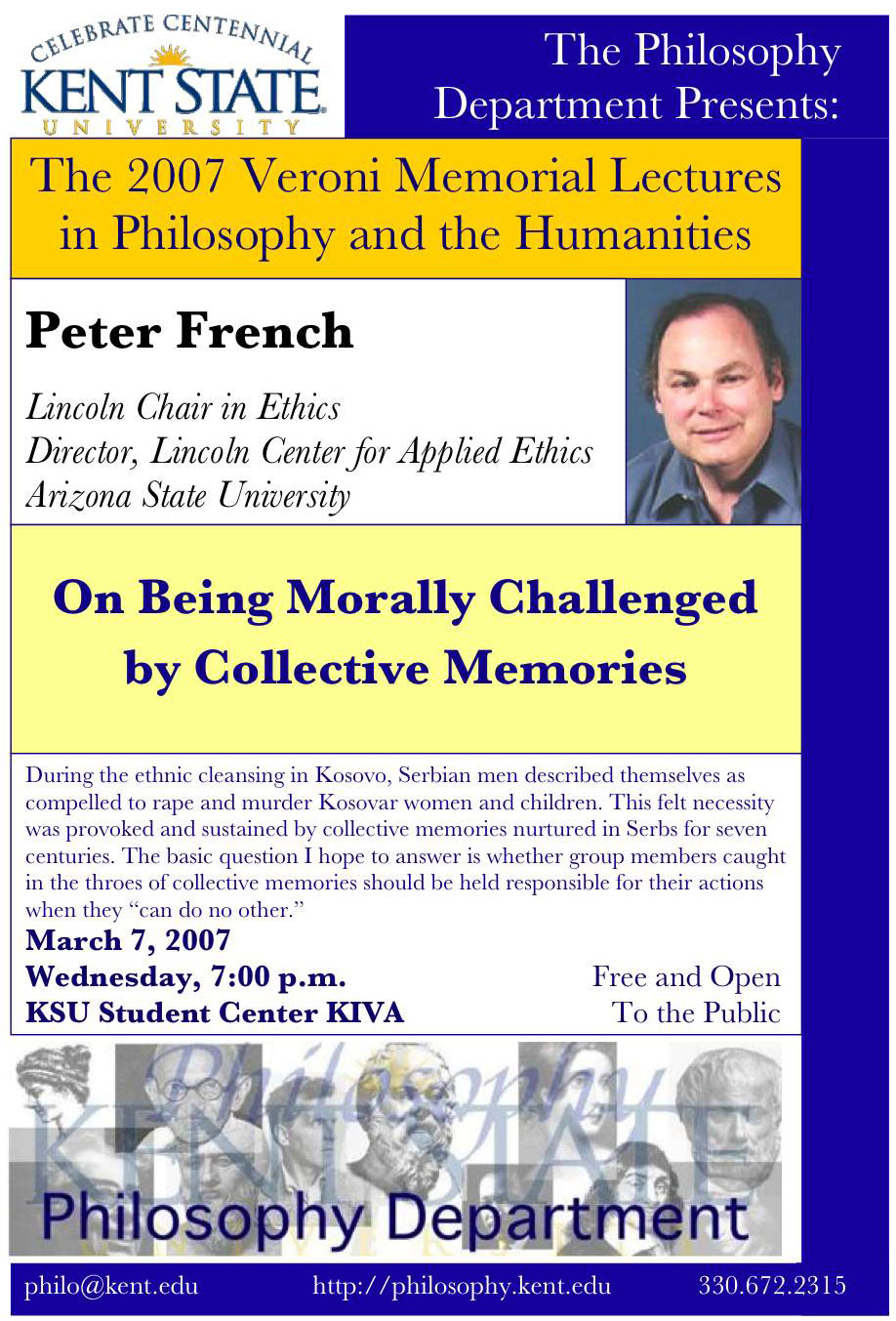
This poster, and the event it describes, appears to be causing a ruckus. The poster advertises the 2007 Veroni Memorial Lecture in Philosophy and the Humanities, to be delivered by Peter French, Lincoln Chair in Ethics, and Director, Lincoln Center for Applied Ethics at Arizona State University. The talk's title is On Being Morally Challenged by Collective Memories, and the paragraph-long description reads: During the ethnic cleansing in Kosovo, Serbian men described themselves as compelled to rape and murder Kosovar women and children. This felt necessity was provoked and sustained by collective memories nurtured in Serbs for seven centuries. The basic question I hope to answer is whether group members caught in the throes of collective memories should be held responsible for their actions when they "can do no other." One person e-mailed me asking how this may create a legally actionable "hostile work environment" for people of Serbian extraction; a serbianna.com "activism" Web page reasons that "Peter French starts from a premise that Serbs are rapists and killers because, according to French, Serbian morality is handicapped by collective memory that was nurtured in Serbs. In other words, French believes that Serbs are morally deviant people because of a false collective memory of their past in Kosovo and as a result of their own delusion have collectively accepted morality of a rapist and a killer."
As I read the poster, French is not arguing that all Serbian men feel compelled to rape and murder, or even that most do. Rather, he is discussing a particular set of Serbian men who did rape and murder, and who supposedly gave "collective memories nurtured in Serbs for seven centuries" as an explanation for that argument. This is reinforced by the fact that the next sentence is hardly an anti-Serb rant, but a question about whether group members should be held responsible for their actions, which is obviously a question about those group members who actually acted.
This is much like, if we wrote, "During the L.A. riots, Korean shopkeepers armed themselves to defend their stores against rioters; this felt necessity was provoked and sustained by their sense of being embattled and victimized by crime," we likely wouldn't be talking about all Korean shopkeepers or even most, but about those Korean shopkeepers who did arm themselves. I think arming oneself to defend oneself and one store during a riot is generally more proper, and rape and murder of course is not, but my point here is that the term "Serbian men" or "Korean shopkeepers" may in some situations refer to those particular Serbian men or Korean shopkeepers that the rest of the paragraph describes.
Perhaps given the bad acts being described, the poster author should have put things more carefully, to avoid the risk of misunderstanding. But while philosophers have a reputation for being very precise writers, a reputation especially easy to nurture when you have a whole paper — nursed over months or years — in which to be precise, quickly boiling things down to three sentences (something that may well have been done not by Prof. French but by someone else) may indeed sometimes produce misunderstandings.
I anticipate that the speech will indeed go as I conjecture, and I hope the controversy will then fizzle. Still, it does seem like a brewing academic controversy, so I thought I'd note it. And of course I naturally think that even if Peter French is a raving anti-Serb bigot, his speech should be constitutionally protected, including against a "hostile work environment" lawsuit. (If the speech were raving anti-Serb bigotry, the university would have the power not to invite him to give a special university-promoted lecture on the subject, and should exercise that power; but that's a separate matter.)
Conservative Legal Luminary Ted Olson Joins Giuliani Campaign:
Apparently this happened yesterday: "The Rudy Giuliani Presidential Exploratory Committee today announced that former Solicitor General Theodore Olson will chair the Mayor’s Justice Advisory Committee." Olson, recall, was Solicitor General from 2001 to 2004, was Assistant Attorney General for the Office of Legal Counsel from 1981 to 1984, and is generally one of the biggest figures in conservative legal circles.
My sense is also that he is seen as a very solid conservative, including by very solid conservatives (though I realize that some very solid conservative friends of mine might ask me how a squish like me could possibly know who's a very solid conservative). This might bear on how other conservatives see Giuliani, whose conservatism is in some dispute.
Why Might It Make Sense To Bar Stepparent-Adult-Stepchild Incest?
The post below, and the discussion in the comments, leads me to ask: Precisely why might it make sense to outlaw sex between stepparents and adult stepchildren? I don't want to ask whether such a ban should be constitutional, or whether criminal penalties are ultimately a good idea. (One might conclude, for instance, that outlawing such sex may make sense, but that on balance it makes more sense not to have the legal system try to investigate and criminally punish such things.)
In the course of describing the rational basis for the law, the court gives what might be an answer to my question:
Ohio has a tradition of acknowledging the “importance of maintaining the family unit.” A sexual relationship between a parent and child or a stepparent and stepchild is especially destructive to the family unit. R.C. 2907.03(A)(5) was designed to protect the family unit by criminalizing incest in Ohio. Stepchildren and adopted children have been included as possible victims of the crime of incest because society is concerned with the integrity of the family, including step and adoptive relationships as well as blood relationships, and sexual activity is equally disruptive, whatever the makeup of the family. As the “traditional family unit has become less and less traditional, * * * the legislature wisely recognized that the parental role can be assumed by persons other than biological parents, and that sexual conduct by someone assuming that role can be just as damaging to a child.” This reasoning applies not only to minor children, but to adult children as well. Moreover, parents do not cease being parents -- whether natural parents, stepparents, or adoptive parents -- when their minor child reaches the age of majority.
Accordingly, as applied in this case, R.C. 2907.03(A)(5) bears a rational relationship to the legitimate state interest in protecting the family, because it reasonably advances its goal of protection of the family unit from the destructive influence of sexual relationships between parents or stepparents and their children or stepchildren. If Lowe divorced his wife and no longer was a stepparent to his wife’s daughter, the stepparent-stepchild relationship would be dissolved. The statute would no longer apply in that case.
But this strikes me as pretty abstract -- how exactly is the "family unit" threatened, and what exactly does "the integrity of the family" mean? Even if you're confident that there's some harm here, it helps to know concretely what the harm is, since that will help us understand what boundaries the incest rule should have.
For instance, is the threat simply the threat of dissolution of the stepfather's and mother's marriage? If so, should the law apply when the mother is dead (in which case I take it the stepfather would still be the stepfather) -- and why should the law apply even when the mother is alive, given that other forms of adultery are no longer criminally punished?
Is it the threat of damage to the stepfather's/stepdaughter's familial relationship, in the event that the stepfather/stepdaughter break up their romantic relationship? If so, why shouldn't the law apply even if the father divorces the mother? (It may be that it literally doesn't apply, given its text, depending on how you read "stepparent," but maybe that just means it should be amended.)
Is it the threat of damage to the mother/daughter relationship? If so, then again why shouldn't the law apply even if the father divorces the mother to sleep with the daughter?
Here's my very tentative thinking on the matter. First, I don't think that the "abuse of authority" argument raised by some commenters is terribly powerful here, if the argument presupposes that the stepfather is using his authority or even his father figure status coercively. Parents, including stepparents who have raised the child for many years, have notoriously little ability to control their adult children; at most, they'll know which psychological buttons to push, but that doesn't seem to help that much. Perhaps in unusual cases stepparents would have some sort of psychological power over their adult children, and maybe cases of stepparent-stepchild incest disproportionately involve those unusual cases. But I'm not sure why we should assume this, and why we should think such psychological power is that much greater than in many other situations where the relationship isn't criminalized. (Even boss-subordinate relationships, for instance, are almost never criminal, and aren't even by themselves cause for civil liability, though they may carry the risk of civil liability if the jury finds some threat of employment retaliation underlying the relationship.)
Second, I don't think that the concern can just be that the stepfather is breaking up his marriage with the mother (that's no different from normal adultery, which, while bad, is generally not treated as a crime) or even jeopardizing the mother's relationship with the daughter (though I might be mistaken on that point, since stepparent-stepchild incest is unusually likely to jeopardize the parent-child relationship).
Third, it seems to me that the problem with a stepparent-stepchild sexual relationship is not that it jeopardizes the relationship between this stepparent and this stepchild. That's a risk that this stepparent and stepchild can be expected to assess for themselves.
Rather, it seems to me that the most sensible argument for banning stepparent-stepchild sexual relationships -- and perhaps other familiar sexual relationships -- is to diminish (as much as possible) the risk that normalization of sexual attraction in stepparent/adult-stepchild relationships will color others' stepparent-stepchild relationships, including ones that involve minor stepchildren.
When a stepfather looks fondly at his stepdaughter, we want her thinking "he loves me [as a daughter] and thinks I'm beautiful," rather than "he lusts after me." When a mother looks at her husband's looking fondly at his stepdaughter, we want her thinking "he loves her [as a daughter], which is what I want," rather than "he lusts after her." When the stepfather is thinking about his stepdaughter, we want him to banish lustful thoughts as much as possible, rather than thinking about how he might arrange things so that he can sleep with her -- even if he waits until she's 18.
And this is an especially compelling problem for stepfather/stepchild relationships because, as best I can tell, there really is nothing biologically unnatural about them; it's naturally for adult males to be sexually attracted to young postpubescent females with whom they're not genetically related. (Perhaps some innate psychological taboos may undermine that when the adult male has raised the girl from early childhood, but many stepparent/stepchild relationships start when the stepchild is no longer a very young child.) There is thus special social need to desexualize these relationships as much as possible. Of course, we don't want incest to be so unthinkable that it becomes unreportable if it happens nonconsensually, but we do want it to be thought of as little as possible unless there's really solid evidence of its being imminent.
If I'm right, then the behavior control here is a means of affecting other people's understanding and expectation of how people behave and think (as well as how they should behave). I should say this is not necessarily a pretty story: Rather than relying on not-very-far-from-libertarian concerns about coercion (even of adults) or violation of promises (such as the marriage vow), this argument for not allowing stepparent/adult-stepchild incest is a form of thought control. Yet it seems to me to respond to a more serious problem than the other arguments, because it suggests that control of this incest is needed not just to protect a few adults from emotionally damaging decisions, but to protect millions of adults and children from the harm that may stem when their stepparent-stepchild relationships become perceived as potentially sexual even when they themselves firmly resolve not to allow the relationships to actually become sexual.
Moreover, if this story is right, then this suggests that the incest ban should apply even if the stepfather and stepmother divorce, and even if the stepfather is a widower. Any stepparent/stepchild sexual relationships risk normalizing such relationships and thus potentially sexualizing people's attitudes towards such relationships more broadly. And it also suggests that adult stepsibling sexual relationships may likewise be harmful in a way similar to what I describe (though again I should note that this doesn't necessarily mean they should be criminalized).
I may well be wrong on all this. This isn't my core area of expertise, I haven't thought about it a great deal, and thankfully I don't even have personal experience with it (lacking either stepparents or stepchildren). But I thought I'd mention this, and see what others have to say.
Careful, the Network is Watching:
The extraordinary story of pianist Joyce Hatto's fake recordings (best recounted in this article from Gramophone, but also given heavy coverage in the NY Times and elsewhere) has an interesting angle that hasn't gotten much play. The whole story (of how Hatto's recordings were actually not hers at all, but had been recorded by other artists and re-mastered and re-released under Hatto's name by her husband) was uncovered, in a sense, by the network. The whole thing unraveled when someone in England put Hatto's recording of Liszt's "Transcendental Etudes" into his computer and tried to rip it to iTunes, and itunes retrieved the information from the CDDB database that it was actually a performance by the Hungarian pianist Laszlo Simon.
I had my own little brush with how smart the network can sometimes be a few years ago. I was preparing to teach one of my classes (Copyright law) in which I was going to be talking a little bit about US copyright history, and I realized I didn't have a copy of the first US Copyright Act. So I googled it, figuring I'd find it somewhere and print it out — "Copyright Act of 1791." Lo and behold, the first two references Google pulled up were citations to papers that I had written. Wow! I got over the flush of excitement, because I also noticed that there were only a dozen or so citations in total. That's odd, I thought — it's not Britney Spears' haircut, maybe, but surely lots of people have written about copyright history, and about the first copyright statute, and all of that. A little poking around and I had the answer — I had been one of the few people to write about the Copyright Act of 1791 because there was no Copyright Act of 1791 — the first statute had been enacted in 1790. Googling "Copyright Act of 1790" pulls up the predicted zillions of hits.
"Boy, was my face red," as we used to say back in Brooklyn. Exposed, by Google, as having screwed up the dates of the first US copyright statute. [I fixed the paper, though copies with my error intact are probably still floating around there somewhere].
And then this afternoon I got an email from a student, who's working on a paper about personal jurisdiction and patent law, and he tells me that a paper of mine shows up as citation #1 when you google "personal jurisdiction over the plaintiff" — which makes me oddly nervous that I've done something wrong again.
"The City's Police Chief and Police Dog Have Degrees from the Same Online School":
So reports a defense lawyer, according to this AP story: The city's police chief and police dog have degrees from the same online school, according to a defense lawyer challenging the chief's authority.
The issue gives "one pause, if not paws, for concern" about what it takes to get a degree from the school, based in the Caribbean, Gene Murray wrote Monday in a motion seeking to have the dog introduced as evidence....
Dean Henry, McGuire's lawyer, said the department had the dog before [Chief] McGuire was hired.
"My client had absolutely nothing to do with any animal getting a degree from an institution of higher learning," Henry said. "The whole thing is bizarre." ...
Murray argues that a drug charge against his client should be dismissed because McGuire was not legally employed and had no authority as an officer.
McGuire, hired as chief in this northwest Ohio city a year ago, is to go on trial this month on charges of falsification and tampering with records. A special prosecutor said McGuire lied on his application and resume about his rank, position, duties, responsibilities and salary in three of his previous jobs.
City leaders have said McGuire's hiring was not influenced by his college degree, and any confusion about his background was resolved during interviews.... Thanks to Michael Barclay for the pointer.
Richard Epstein on Philip-Morris and Weyerhaeuser Cases:
The Federalist Society has just started a podcast, SCOTUSCast, which will feature discussion of recent Supreme Court decisions by law professors. The one and only Richard Epstein hosts the first podcast, which is on the Court's decisions last week in Philip-Morris and Weyerhaeuser. You can hear the podcast here; it's about 10 minutes long, with a 2 minute introduction by Hayley Reynolds.
WSJ Editorial Page Praises Senator Boxer:
Today the Wall Street Journal editorial page praises California Senator Barbara Boxer (link for $ubscribers) for proposing that the federal government set an example in promoting energy efficiency. Stop the presses: Senator Barbara Boxer of California has a good idea. Ms. Boxer, who heads the Senate Environment and Public Works Committee, suggested last week that a first step in reducing greenhouse gases would be to require that federal buildings use more efficient light bulbs, and ask federal bureaucrats to turn off their computers at night.
"Don't you think it's time the federal government were a model of energy efficiency?" she asks. We warmly agree, not least since the United States Government is the largest single consumer of energy in the United States.
It's also one of the most inefficient energy users. According to a 1999 report by the Alliance to Save Energy, the "federal government, consumes about 32% more energy per square foot than the nation's building stock at large." This inefficiency costs taxpayers an estimated $1 billion a year. In Al Gore's phrase, Uncle Sam's leaving one giant "carbon footprint." Of course, the WSJ also can't resist going Senator Boxer one better, proposing that the federal government reduce its energy use even further by shuttering unnecessary agencies.
For myself, I've long advocated a federal environmental policy of "First, do no harm." Many federal programs cause, contribute to, or subsidize various environmental problems, and this is tremendously wasteful. It makes no sense fo the federal government to spend taxpayer dollars to subsidize problems that it will then regulate citizens to ameliorate after the fact. Where possible, it is better not to create or exacerbate the problem in the first place.
The Limits of Lawrence -- Consensual Adult Incest:
After the Supreme Court declared Texas' anti-sodomy law unconstitutional in Lawrence v. Texas, there was substantial speculation about the implications of the decision for other laws targeting consensual sexual activity among adults. If state prohibition on consensual homosexual activity was unconstitutional, some reasoned, then it might be difficult to maintain state prohibitions on incest, at least among consenting adults. Not so, ruled the Ohio Supreme Court earlier this week.
In State v. Lowe, the Ohio Supreme Court considered the constitutionality of the state's prohibition on incest as applied to consensual sexual relations between a step-father and his adult step-daughter. After first concluding that the statute, by its terms, applied to adults as well as children, a six-justice majority rejected the defendant's constitutional challenge, concluding that the statutory prohibition passed muster under the rational basis test because the state has a legitimate interest in prohibiting sexual relations between relatives, even those related by law rather than blood. Lowe cites Lawrence v. Texas to argue that he has a constitutionally protected liberty interest to engage in private, consensual, adult sexual conduct with his stepdaughter when that activity does not involve minors or persons who may be easily injured or coerced. In Lawrence, a Texas statute criminalizing homosexual conduct was held to be unconstitutional as applied to adult males who had engaged in private and consensual acts of sodomy. Lowe contends that Lawrence named a new fundamental right to engage in consensual sex in the privacy of one’s home.
However, the statute in Lawrence was subjected to a rational-basis rather than a strict-scrutiny test, with the court concluding that the Texas statute furthered no legitimate state interest that could justify intrusion into an individual’s personal and private life. In using a rational-basis test to strike down the Texas statute, the court
declined to announce a new fundamental right arising from the case.
In addition to emphasizing that the court in using a rational-basis test did not name a new fundamental right, the state in this case distinguishes Lawrence as being limited to consensual sexual conduct between unrelated adults. Lowe and his stepdaughter were not unrelated. The state argues that since Lowe has no fundamental right in this case, and the state has a legitimate interest in prohibiting incestuous relations and in protecting the family unit and family relationships, the rational-basis test should apply. . . .
We agree with the state that a rational-basis test should be used to analyze the statute. Lawrence did not announce a “fundamental” right to all consensual adult sexual activity, let alone consensual sex with one’s adult children or stepchildren. Because Lowe’s claimed liberty interest in sexual activity with his stepdaughter is not a fundamental right, the statute affecting it need only have a reasonable relationship to some legitimate governmental interest. . . .
. . . as applied in this case, [the statute] bears a rational relationship to the legitimate state interest in protecting the family, because it reasonably advances its goal of protection of the family unit from the destructive influence of sexual relationships between parents or stepparents and their children or stepchildren. If Lowe divorced his wife and no longer was a stepparent to his wife’s daughter, the stepparent-stepchild relationship would be dissolved. The statute would no longer apply in that case. Justice Pfeifer was the lone dissenter. He argued that the true purpose of the statute was to protect children, not prohibit consensual sexual activity between adults who lack any blood relationship. He also speculated that the only interest this application actually serves is providing the state with a "shortcut to conviction," because the statute provides "a strict-liability, slam-dunk sex offense that does not allow the defendant to present any evidence regarding the consent of the victim." "This sort of use of the statute demeans its true purpose," Pfeifer wrote.
Key to the majority's ruling was its conclusion that Lawrence failed to announce a fundamental right or apply heightened scrutiny, making it easier to sustain other state laws governing consensual sexual activity. This interpretation makes Lawrence a less significant decision as it limits the "threat" Lawrence poses to other state efforts to regulate morality and makes Lawrence a much less effective weapon against the criminalization of victimless crimes.
United States v. Kelley and Probable Cause for Search Warrants:
Yesterday the Ninth Circuit published a Fourth Amendment decision that included a rather strongly worded dissent by Judge Sidney Thomas. In his dissent, Judge Thomas accused the majority (Judge Rymer and Ret'd Justice O'Connor) of "eroding" the Fourth Amendment by "lowering" the probable cause standard to fight the "scourge" of child pornography: Child pornography is a scourge on our nation. But every hour, millions of unsolicited and deceptively disguised emails are sent to innocent computer users. Lowering our standards of probable cause to permit government intrusion into private residences based solely on proof of mere transmittal of unsolicited email constitutes an unwarranted erosion of the Fourth Amendment. So you're wondering, was the Fourth Amendment really eroded by the majority's decision? The answer is "no," although for a different reason than the majority offers. The reason Judge Thomas is wrong is that everyone in the case was applying the wrong legal standard, and the standard they applied was far more pro-defendant than it should have been. Had the judges applied the correct Fourth Amendment standard the case would have been a pretty obvious win for the government. The case is United States v. Kelley, and involves charges for knowingly receiving images of child pornography. The government obtained a search warrant for the contents of Kelley's AOL e-mail account after an investigation in Germany revealed that Kelley's account was on the recipient list of a number of e-mails containing child pornography. The question in the case was whether the affidavit in support of the warrant for Kelley's account made the case for probable cause under the Fourth Amendment. The critical part of the case comes at the beginning of the analysis section, in the middle of page 7: Kelley and the government agree that unwitting receipt of e-mail containing contraband will not support probable cause. See 18 U.S.C. § 2252A(a)(2) (criminalizing the knowing receipt of child pornography); United States v. Romm, 455 F.3d 990, 998 (9th Cir. 2006) (holding that a person receives child pornography if he seeks it out). The dispute centers on whether the affidavit is sufficient even though it lacks direct evidence that Kelley actually solicited the offending attachments. In other words, the parties agreed that the warrant was valid only if the affidavit showed probable cause that Kelley knowingly received the images, not just that the images were there in the account. As a result, both the majority and dissenting opinions focus on whether the affidavit offered sufficient evidence that Kelley was a knowing recipient of the images rather than someone who was being "spammed" with the e-mails without knowing about it or against his will. The majority says that there was enough evidence to conclude that Kelley had asked to be a recipient of the e-mails; Judge Thomas concludes that there was a good chance that Kelley was an unwilling recipient and therefore that the warrant was invalid. But something seems off-track here: the court is applying the wrong Fourth Amendment standard. Search warrants don't require probable cause that a particular person committed a particular offense. Rather, they require probable cause that evidence or contraband is located in the place to be searched. The key case is Zurcher v. Stanford Daily, where the Court offered the following analysis: The critical element in a reasonable search is not that the owner of the property is suspected of crime, but that there is reasonable cause to believe that the specific "things" to be searched for and seized are located on the property to which entry is sought. . . . Federal Rule Crim.Proc. 41, which reflects "[t]he Fourth Amendment's policy against unreasonable searches and seizures," United States v. Ventresca, 380 U.S. 102, 105 n. 1 (1965), authorizes warrants to search for contraband, fruits or instrumentalities of crime, or "any . . property that constitutes evidence of the commission of a criminal offense. . . ." Upon proper showing, the warrant is to issue "identifying the property and naming or describing the person or place to be searched." Probable cause for the warrant must be presented, but there is nothing in the Rule indicating that the officers must be entitled to arrest the owner of the "place" to be searched before a search warrant may issue and the "property" may be searched for and seized. . . .
The Court of Appeals for the Sixth Circuit expressed the correct view of Rule 41 and of the Fourth Amendment when, contrary to the decisions of the Court of Appeals and the District Court in the present litigation, it ruled that, "[o]nce it is established that probable cause exists to believe a federal crime has been committed, a warrant may issue for the search of any property which the magistrate has probable cause to believe may be the place of concealment of evidence of the crime." United States v. Manufacturers Nat. Bank of Detroit, 536 F.2d 699, 703 (1976).
Against this background, it is untenable to conclude that property may not be searched unless its occupant is reasonably suspected of crime and is subject to arrest. And if those considered free of criminal involvement may nevertheless be searched or inspected under civil statutes, it is difficult to understand why the Fourth Amendment would prevent entry onto their property to recover evidence of a crime not committed by them, but by others. As we understand the structure and language of the Fourth Amendment and our cases expounding it, valid warrants to search property may be issued when it is satisfactorily demonstrated to the magistrate that fruits, instrumentalities, or evidence of crime is located on the premises. So the proper Fourth Amendment question was whether probable cause existed to believe child pornography was in the account, not whether there was probable cause that Kelley in particular was guilty of an offense. It seems that the government improperly failed to make this argument, so I suppose you can't fault the majority for applying the incorrect standard the government wrongly believed applied. (It's unclear whether the government also conceded Fourth Amendment protection in the e-mail in the first place, which would be front-page news if true.) At the same time, I think it does suggest that Judge Thomas's dissent is pretty far off-base. Judge Thomas decries the erosion of the Fourth Amendment under the wrong test, and under the right test his distinction between spam and invited e-mail is irrelevant. Thanks to How Appealing for the link to the opinion.
Thursday, March 1, 2007
A Different Approach to Teaching Kids About Private Property:
Parents who are looking for an elementary school curriculum that takes a more favorable view of private property than that found at the Hilltop Children's Center may want to try the Ayn Rand School for Tots.
Goodbye to a great American: Arthur M. Schlesinger, Jr.
The great American historian Arthur M. Schlesinger, Jr., passed away yesterday. Best-known for his service in the Kennedy administration, and his biographies of the Kennedys, Schlesinger was criticized by those who thought that intellectuals should stay out of politics. In my Honors thesis at Brown, a quarter-century ago, I examined the question of the intellectual in politics, through a biography of Schlesinger.
I hope to put the whole biography on-line during the next week. In the meantime, here are two chapters, in PDF:
Ch. 1. Schlesinger learns history from his progressive and brilliant parents. At age 11, his mother tells him to stop interrupting at the dinner table, and he retorts, "Mother, how can I be quiet if you insist on making statements that are not factually accurate?" Although his parents are devoted to the public schools, the Cambridge schools are weak; one day, when young Arthur announces "that our teacher had told us that people in Albania were called Albinos because they had white hair and red eyes," his father gives up, and sends him to Exeter. During World War II, he is turned down by the Navy as a security risk (because his father was so anti-Nazi so early!), gets a military intelligence job instead, and later lands a job teaching at Harvard, holding only a B.A.
Ch. 6. The 1960 campaign. Schlesinger and the other liberal intellectuals face intense liberal pressure to stick with Stevenson, and a furious reaction when they defect to Kennedy, who is considered a right-wing machine politician. The maneuvers of Kennedy, Humphrey, Stevenson, and Johnson during the primaries and convention. Schlesinger as a liberal lightening rod for southerners and Republicans. Kennedy's Machiavellian post-election strategy on appointments. Once the appointments are finished, Harvard concludes that it runs the country. (The link on this has been fixed.)
Re-reading the 1960 chapter, I was struck by many parallels to contemporary politics; that's one reason why history deserves study. As a brilliant writer and erudite scholar who loved America and loved American history, Arthur Schlesinger set an admirable example of an intellectual engaged in public life.
UPDATE: Now available: Chapter 9, about the assassination of President Kennedy, the early LBJ administration, and the incredible pressure that Johnson exerted on Kennedy loyalists such as Schlesinger to continue to work at the White House, and Robert Kennedy's carpet-bagging 1964 run for the New York Senate, which was saved in part by what Robert Kennedy called the greatest mission to the Jews since the New Testament: Schlesinger and John Kenneth Galbraith campaigning for Kennedy votes among New York Jews.
Chapter 10, Schlesinger's biographies of John and Robert Kennedy, including the huge controversy when Schlesinger claimed that President Kennedy was planning on firing Secretary of State Dean Rusk.
STILL MORE: Chapter 2. Schlesinger's Pulitizer Prize-winning The Age of Jackson links Jackson's battle against plutocracy with FDR's.
Chapter 4. The 1952 Presidential campaign. Schlesinger serves as a speechwriter for the ever-indecisive Adlai Stevenson, and tries to pull him to the left. Stevenson's campaign is demolished.
AND MORE: Chapter 3, The Vital Center. The founding of liberal anti-communism. Schlesinger denounces the stupidity of the isolationist business conservatives, but directs his most scathing attacks to the delusional utopian left. Some great examples for modern writers for how to be sharply critical, funny, and erudite--and without using any foul words.
Chapter 5. Liberal intellectuals try to cope with the stagnation of the Eisenhower years. In the disastrous 1956 Stevenson campaign, America fails to heed their call for strong leadership and national vigor.
Great Moments in Education - Of Legos, Private Property, and the Tragedy of the Commons:
Teachers at the Hilltop Children's Center in Seattle decided to use Legos to teach children that private property is evil:
[T]he students had been building an elaborate "Legotown," but it was accidentally demolished. The teachers decided its destruction was an opportunity to explore "the inequities of private ownership." According to the teachers, "Our intention was to promote a contrasting set of values: collectivity, collaboration, resource-sharing, and full democratic participation."
The children were allegedly incorporating into Legotown "their assumptions about ownership and the social power it conveys." These assumptions "mirrored those of a class-based, capitalist society — a society that we teachers believe to be unjust and oppressive."
They claimed as their role shaping the children's "social and political understandings of ownership and economic equity ... from a perspective of social justice . .. "
Legos returned to the classroom after the children agreed to several guiding principles framed by the teachers, including that "All structures are public structures" and "All structures will be standard sizes." The teachers quote the children:
"A house is good because it is a community house."
"We should have equal houses. They should be standard sizes."
"It's important to have the same amount of power as other people over your building."
The teachers were also disturbed that "some kids hoarded the "best" pieces, denied their classmates any access at all to the pretend town they were building."
The heavyhanded idiocy of the teachers speaks for itself. Even some of the little tykes weren't taken in:
Not all of the students shared the teachers' anathema to private property ownership.
"If I buy it, I own it," one child is quoted saying.
However, as a property professor I should point out that the teachers' experiment in common property legos may have some educational value, though not the kind that the teachers intended. Giving Legos to a large group of children without allowing any kind of private ownership rights is a great way to demonstrate the dangers of what we law and economics types call the tragedy of the commons.
If kids are not allowed to "hoard" Lego pieces, it is unlikely that an impressive-looking Lego town can be built in the first place. If there is no right to exclude of the kind decried by the teachers, any Lego town that does get built is likely to be quickly destroyed by other children looking for Lego pieces to use for their own projects. Avoiding tragedies of the commons is one of the main reasons why private property is an essential social institution, and the Seattle teachers have, however unintentionally, stumbled on a new way to teach children about it.
UPDATE: There is an obvious irony in the teachers' position on private property. According to its website, the Hilltop Children's Center is a private school that requires parents to pay tuition, as well as a $50 fee just for getting on the waiting list for potential future admission. In order to support itself and pay the teachers' salaries, Hilltop relies on private property and its associated right to exclude - exactly the institutions that the teachers are trying to indoctrinate the children against. Related Posts (on one page): - A Different Approach to Teaching Kids About Private Property:
- Great Moments in Education - Of Legos, Private Property, and the Tragedy of the Commons:
Brett Marston on Warren Burger's Book Annotations:
Brett Marston recently purchased a number of books from Chief Justice Warren Burger's personal library. Brett has been blogging about the margin notes that Burger wrote in to his books, a number of which concerned Burger's views about the proper role of the courts. There are no major surprises, but it's still pretty interesting. You can see an example here, and the whole thread is here.
Wednesday, February 28, 2007
What Are the Facts in Scott v. Harris?:
This is a second response to the oral argument on Monday in Scott v. Harris. In this post, I want to focus on the question, "Just what are the facts?" This is a serious question because the description of the pursuit found in the District Court and the Court of Appeals opinions seems very different from the facts you see when you watch the video. So which governs — the facts as described by the lower courts or the facts as seen in the videotape? Justice Breyer memorably framed the key question at oral argument: What am I supposed to do? I mean, I'll look again at the tape. I certainly will do that. But suppose I look at the tape and I end up with Chico Marx's old question with respect to the Court of Appeals: Who do you believe, me or your own eyes? The right answer is that Justice Breyer should believe his own eyes. It's the right answer for a pretty simple reason: The facts described in the lower court decisions were technically accurate but irrelevant. The lower courts weren't actually making factual "findings" or reviewing the sufficiency of the evidence. Rather, the lower court judges simply misunderstood the legal issues before them, and therefore pointed out facts that were technically true but legally irrelevant. As a result, the Supreme Court doesn't have to choose between two sets of facts. There's really only one set of undisputed facts, and the question is their legal relevance. Here's the key passage about the facts from the Eleventh Circuit's decision, 433 F.3d at 817, which I have numbered in order to break out the distinct factual statements: As noted by the district court judge, taking the facts from the non-movant's viewpoint, [1] Harris remained in control of his vehicle, slowed for turns and intersections, and typically used his indicators for turns. [2] He did not run any motorists off the road. . . . [3] Nor was he a threat to pedestrians in the shopping center parking lot, which was free from pedestrian and vehicular traffic as the center was closed. [4] Significantly, by the time the parties were back on the highway and Scott rammed Harris, the motorway had been cleared of motorists and pedestrians allegedly because of police blockades of the nearby intersections. . . . [5] Nor does the evidence show that Scott or the other officers were in immediate danger or threatened with imminent harm. Accepting Harris' version of events, Harris did not attempt to ram, run over, side-swipe, or swerve into any of the officers (which might have put their lives in danger in the parking lot), nor did he attempt any such conduct once he was back on the highway immediately before the seizure. The legally relevant issue in the case is how much of a danger Harris posed to the public based on his driving. Scott had seen Harris during most of the chase, including during the scene at the shopping center. The question is, how much of a danger would Scott reasonably think Harris posed based on what Scott observed? Let's take the lower court's facts in order to see if they are responsive to the legal issue: [1] "Harris remained in control of his vehicle, slowed for turns and intersections, and typically used his indicators for turns." This is true, at least viewing the record favorably to Harris. But Harris was also driving at 100mph on a two-lane highway zig-zagging in and out of traffic and running lights. The question was the risk of a future accident, not whether it's possible to identify some discrete aspects of Harris's driving that were not themselves dangerous. So this seems pretty non-responsive to the legal question. [2] "He did not run any motorists off the road." This seems true based on the videotape, at least assuming that "running off the road" means really forcing a car off onto an embankment or something like that. But the question is future dangerousness, not one form of a past harm. Again, not responsive. [3] "Nor was he a threat to pedestrians in the shopping center parking lot . . . " Well, that seems right, viewing the evidence favorably to Harris: I don't recall seeing evidence of pedestrians in the parking lot who were directly threatened. But the question was whether Harris was dangerous based on a totality of the circumstances, not whether in an earlier 10-second window Harris had posed a particular threat to a particular type of victim. [4] "[B]y the time the parties were back on the highway and Scott rammed Harris, the motorway had been cleared of motorists and pedestrians . . ." At the exact moment of contact, the motorway was indeed clear. But again, that's not the question. Fast-forward a few seconds and the motorway up ahead would not be clear, and it was that future that Scott had to contemplate when assessing Harris's dangerousness. [5] "Nor does the evidence show that Scott or the other officers were in immediate danger or threatened with imminent harm. Accepting Harris' version of events, Harris did not attempt to ram, run over, side-swipe, or swerve into any of the officers (which might have put their lives in danger in the parking lot), nor did he attempt any such conduct once he was back on the highway immediately before the seizure." True, after the parking lot episode Harris did not direcly threaten Scott. Scott directly threatened Harris only once, in the parking lot, and the contact was made some 90 seconds later. Once again, though, that's not the relevant question. The question is whether and how much of a danger Harris posed generally, not whether at the precise moment of contact Harris posed a danger directly to Scott or other officers. In sum, I think the lower court's description of the facts are hard to square with the video not because they were technically inaccurate, but rather because they were so obviously incomplete. The reasonableness inquiry requires an analysis of the totality of the circumstances, and the lower court opinions did not provide that. Justice Breyer's recollection of what he saw "with his own eyes" was the totality of the circumstances of the pursuit, and that's the corrrect perspective for the Court to follow.
Does a Female Muslim Police Officer Have a Right To Wear a Khimar?
That's the question in Webb v. City of Philadelphia; this decision provides some background, and dismisses some collateral claims on procedural grounds, but does not dispose of the substantive question.
Title VII generally obligates employers to reasonably accommodate employees' religious practices, so long as doing so doesn't cause an undue hardship to the employer (something caselaw has defined as anything more than a minimal hardship). Webb's claim is chiefly that her religious practice of wearing the khimar (which, I'm told, is "a headscarf worn by observant Muslim women that hangs down to just above the waist") must therefore be accommodated.
Sentiments About the Law, as of 1856 --
at least the sentiments of Joel Prentiss Bishop, writing the dedication to his criminal law treatise (some paragraph breaks added, some deleted):
TO THE YOUNG MEN OF THE UNITED STATES
Gentlemen: --
I dedicate this elementary first volume of my Commentaries on the Criminal Law to you.
To those of you who are in or entering the legal ranks, I have endeavored to point the way to that true legal science, which alone is practical, and which alone can give you success. The illusion, that the truly practical and the truly scientific are not in our profession identical, I have endeavored to do my part to dispel. It will devolve on you to do yours.
Those of you who are outside of the profession will gain from these pages, I hope, something of culture; you will obtain that rare knowledge for a non-professional man, a tolerably accurate, though incomplete, idea of what sort of thing the law of the land is; you will qualify yourselves to look more wisely after your own interests, and to discharge the better your duties as members of the community, and parts of this great nation; and you will exert, in consequence of such acquirements, a healthful, reflex influence on the profession itself.
I cannot promise you, in these pages, intoxicating draughts for the fancy; but grateful food for the mind. I shall not lead you through green meadows, ploughed by melodious rills; but shall conduct you where, with mental eye, you will see the abstract right and the practically expedient mingling together, thus constituting the substance of our law; and the law extending itself, and sustaining human society.
If you have ever indulged the prejudice, that the law is a burrow for rogues, and a prison for the good, you will find the delusion dissolved. If you have imagined, that lawyers and judges are corrupted by their calling, you will learn, that the wickedness which exceptional men among them have sometimes exhibited, has come from their own hearts, in spite of better instructions, and not from their books.
I commit this volume to you, the young men of our country; because in your hands is our future jurisprudence. And I pray you never to forget, that our jurisprudence is alike a chief builder in our temple of liberty, a harbinger and nourisher of our prosperity, and an adorner of our national glory.
Neologisms:
On the "isn't a word" thread, Sasha points out:
What irks me is how people just make up neologisms rather than use the good traditional words that are perfectly available. Plus, rather than learn proper English, they mangle the language in ways that "simplify" grammar and spelling, and this is drifting into the written language too. They don't even recognize good grammar and spelling and traditional words if they see them written on the page!
In fact, just the other day, when I tried to use perfectly good English, to wit: "Hwæt! Wé Gárdena in géardagum þéodcyninga þrym gefrúnon, hú ðá æþelingas ellen fremedon" -- no one knew what I was talking about!
Damn kids.
"Threatening" Campaign Speech?
From a decision of the Minnesota Office of Administrative Hearings:
[Finding of Fact] 3. Prior to the November 7, 2006, general election, [incumbent councilman] Mr. Phillips prepared a campaign flyer that listed negative “facts” about [challenger] Mr. Menne. The heading of the flyer stated, “THE MANY FACTS ABOUT GARY MENNE.” Under the heading, Mr. Phillips stated the following:
Fact #1 – Mr. Menne for three years has NOT paid his water/sewer bill with the City of Wyoming and now owes over $2900.00 to US. Question? – Is this the type of person YOU want running OUR city? Someone that feels he is above the rest of US.
Fact #2 – Mr. Menne has his property newly listed with Welsh Properties for sale. Question? – Doesn’t this show he has NO commitment to the CITIZEN’S of Wyoming for which he is supposed to support?
Fact #3 – Attached you will see Mr. Menne’s issues when it comes to doing business as a person in Wyoming. He has many judgments against him, which will tell you that we ALL may have to pay the price for his poor decisions he makes while on council.
NOW you have a choice – Take down the sign in your yard and tell your neighbors that you NO longer support Mr. Menne for the facts listed above. The only way to avoid Mr. Menne getting into office is to vote for the incumbents – ANDERSON – PHILLIPS – ZERWAS. If you don’t remove the sign and still believe in Mr. Menne than you must believe in cheating the rest of US in the city and that will not go unnoticed in the future. THANK YOU.
4. Mr. Phillips attached eight sheets to the flyer that listed judgments and liens filed against Mr. Menne personally or against his business, Gary F. Menne and Son Inc., as well as UCC filings made by Menne and Son Inc. with several local banks. Mr. Phillips believed that Mr. Menne did not deserve election to the Council and that it was important for the voters to have this information....
6. On Saturday, November 4, 2006, Mr. Phillips [anonymously] placed the flyer in the newspaper boxes of persons who had posted lawn signs in their yards in support of Mr. Menne’s candidacy. Mr. Phillips disseminated approximately 90 copies of the flyer....
19. Frank Pechaver is a Wyoming resident who received the campaign flyer in his newspaper box. He and his wife had a lawn sign in support of Mr. Menne’s candidacy on their front lawn. Mr. Pechaver found the flyer to be very intimidating and threatening. Mr. Pechaver understood the flyer to mean that the three Council members (Anderson, Phillips and Zerwas) were going to come after him for having a Gary Menne sign in his yard and that he also would be watched if he did not remove that sign from his yard.... [Other examples omitted. -EV] ...
[Conclusion of Law] 2. Minn. Stat. § 211B.07 provides, in part, as follows:
A person may not directly or indirectly use or threaten force, coercion, violence, restraint, damage, harm, loss, including loss of employment or economic reprisal, undue influence, or temporal or spiritual injury against an individual to compel the individual to vote for or against a candidate or ballot question....
4. The Complainant has demonstrated that the Respondent threatened coercion, harm, loss, reprisal, or undue influence to compel individuals to vote for him or against Mr. Menne.
5. The violation was committed deliberately, but the threat was vague, diffuse, and had no or minimal impact on the voters. The Respondent shall be fined $600 for the violation....
Phillips' behavior was pretty bad, and likely bad politics, too. (Note that Phillips lost, and Manne won.) But should it be treated as a constitutionally unprotected threat? The statement "If you don’t remove the sign and still believe in Mr. Menne than you must believe in cheating the rest of US in the city and that will not go unnoticed in the future" is ambiguous -- it may be a threat of (unconstitutional) official retaliation by the city council, it may be a threat of violent reprisal (probably not very likely, though it might be if there had been a history of such violence in town), it may be a threat of social ostracism, or it may be a threat of economic boycott. Threats of violent reprisal or unconstitutional official retaliation are clearly unprotected. Threats of social ostracism, and of politically motivated economic boycott by consumers (though perhaps not always by businesses) are generally protected, see the Supreme Court's 1982 NAACP v. Claiborne Hardware decision.
It's possible that the administrative panel resolved the ambiguity by hearing the witnesses and determining what Anderson intended to threaten, and how reasonable witnesses would have perceived the threat. (Threats, according to the Supreme Court's Virginia v. Black decision, are unprotected if they are intended to intimidate through the threat of constitutionally impermissible retaliation and they would reasonably be understood this way.) The decision doesn't discuss this, but maybe this finding is implicit. On the other hand, if the panel generally assumed that all threats of retaliation, including social ostracism and individual politically motivated economic boycott, are punishable, then the panel was likely mistaken.
Note also that the statute itself draws no distinction between threats of economic boycott (and possibly social ostracism) and punishable threats: It equally prohibits threats of "force, coercion, violence, restraint, damage, harm, loss, including loss of employment or economic reprisal, undue influence, or temporal or spiritual injury," when made to compel the individual to vote for or against a candidate or ballot question." That might make the statute unconstitutionally overbroad, because even though much of the speech that it punishes -- possibly including the speech in this very case -- is constitutionally unprotected, the statute also punishes a substantial amount of constitutionally protected speech (possibly threat of "harm" in the sense of social ostracism, and likely threat of "economic reprisal" in the sense of politically motivated economic boycott), at least unless state courts interpret the statute narrowly so as to exclude such speech.
Who Would Bush Nominate If He Had Another SCOTUS Pick?:
Over at ConfirmThem, Jan Crawford Greenburg is doing a very interesting Q&A (part 1 here, part 2 here, part 3 coming soon) that includes the following: Given the current political climate, who do you think President Bush will nominate to the Court if a third SCOTUS retirement occurs during his presidency?
Answer: Janice Rogers Brown or Maureen Mahoney. Now I know you’re asking how in the world I could possibly mention those two very different contenders in one breath, right? Ok, here’s why: It all depends on which justice leaves and when. President Bush will tap a solid judicial conservative (i.e., Brown) if he gets a nomination this year. He wants to change the subject, and this is about the only issue he’s got left to rally the base. (If you guys can think of another issue that will keep conservatives together with Bush, let me know.) Judge Brown would be an exciting nominee: She’s getting very high marks from colleagues on the D.C. Circuit, and her experience, compelling life story and demeanor (she’s fast on her feet and would be a terrific witness) would present those moderate southern Democrats (there are still a few of them) with a very difficult choice. . . .
The closer we get to 2008, the better are Maureen Mahoney’s odds, because she’s a conservative who could get confirmed.
Obviously Bush would be able to nominate whoever he wants if an opening occurred, so I take Greenburg's take to be her best guess of what would happen rather than who would necessarily be the smartest pick. Still, my own completely uninformed pet theory for who Bush might nominate if he has an opening is Senator John Cornyn. To be clear, I don't know enough about Cornyn's personal relationship with the President or his Senate colleagues to know if this is even a remote possibility. But from my outsider perspective it seems to me that Cornyn could be a very savvy pick. He's an undisputed conservative; he's a former state Supreme Court Justice with 13 years of experience as a judge and experience in all three branches of government; and he is someone who I gather would be relatively hard for the Senate to reject (as a Senator himself). If the President wants a confirmable solid conservative, Cornyn would seem to be a very good pick if a vacancy occurs. Of course, John Cornyn is a man, baby, and perhaps the President would not consider naming another man to the Court in the event of a vacancy. I don't see how the politics line up for such a judgment, but the President would of course be free to make that call. And if Supreme Conflict is a reliable guide, the President has a genuine commitment to gender diversity and would likely not want to nominate another man.
IRB "Ethics" Overload:
Are Institutional Review Boards (IRBs) out of control? Based on this article from the New York Times, I am inclined to say "Yes they are." (Link via Science & Law Blog.)
Ridicule and Ellipses:
A week ago, a few people e-mailed me about various bloggers (e.g., Grammar.police, Matthew Yglesias, and Obsidian Wings) mocking a "metaphor from Laura Sessions Stepp's Unhooked, excerpted in [a Washington Post] review:
Your body is your property.... Think about the first home you hope to own. You wouldn't want someone to throw a rock through the front window, would you?
Well, that does sound mighty ridiculous; for instance, why is "hooking up," which is presumably consensual and even enthusiastic, like having someone nonconsensually break your property? Why is your body like a house? As a satirical version attributed to Yglesias suggests, why not say, "Your body is your property. Think about the first home you hope to own. You want to have a big party and invite all your friends over"?
Yet the ellipses in the Washington Post review suggest that the quote in the review is incomplete; and while the review must necessarily omit some items, it might have made the argument seem more ridiculous than it really is. I therefore actually got a copy of the book, and here's what it says (p. 262):
[Subheading:] Don't let them have what you've got until you, and they, know who you are.
Your body is your property. No one has a right to enter unless you welcome them in. Think about the first home you hope to own. You wouldn't want someone to throw a rock through the front window, would you? Is your body worth less than a house?
Think of it this way: Your body is not an introductory offer. It's a return receipt. Your partner gives you love or at least respect and affection, and in return you give him part of you — and you decide which part.
Respecting yourself means also respecting the person you've chosen to be with. So when you say "I'm worth waiting for," you should also be saying "And so are you." If your partner is not worth waiting for, he or she is not worth it, period.
Now this is far from brilliant prose, and it does jump around a bunch of related but different concepts. Still, the opening paragraph (after the subheading) is considerably less ridiculous than it seems.
The second sentence (the omission of which the Post noted with the ellipses) explains why we're talking about nonconsensual rock-throwing. In this paragraph, the author seems not to be faulting fully consensual, enthusiastic casual sex, but rather casual sex of the sort that is at least not entirely welcome (a characteristic that I take it the author thinks is not uncommon in casual sex). Many young women, the author is suggesting, let men have sex with them even though they do not fully "welcome them in," perhaps because they feel pressured by the man or by social expectations. Not-fully-welcome sex is not the same as rock-throwing, but at least the analogy is closer than it is between presumably enthusiastic "hooking up" and rock-throwing.
The fourth sentence (which is also omitted in the Post review, though conventions of quotation allow the omission not to be marked with ellipses) then tries to tie the body with the house: They aren't the same (for instance, in the sense that they're both great places to have a party), but rather they're both valuable, and your body is if anything even more valuable. Again, not a terribly convincing metaphor, but not as zany or worthy of derision as some might think. Among other things, try the lampoon quoted above on the whole paragraph:
Your body is your property. No one has a right to enter unless you welcome them in. Think about the first home you hope to own. You want to have a big party and invite all your friends over. Is your body worth less than a house?
Not quite as ridiculous, right? And to the extent that the ridiculousness of the original lampoon is aimed at showing the bad writing or reasoning of the book, the inapplicability of the lampoon to the unabridged quote suggests that the unabridged writing and reasoning isn't quite as bad.
New SSRN Posting, "Gordon Tullock's Critique of the Common Law":
I have just posted a new article on SSRN, "Gordon Tullock's Critique of the Common Law." Here's the Abstract:
Abstract:
This article is part of a symposium on the work of Gordon Tullock to be held in connection with the presentation to Tullock of the “Lifetime Achievement Award” of the Fund for the Study of Spontaneous Orders at the Atlas Research Foundation for his contributions to the study of spontaneous orders and methodological individualism. This contribution to the symposium studies Tullock's critique of the common law.
Tullock critique two specific aspects of the common law system: the adversary system of dispute resolution and the common law process of rulemaking, contrasting them with the inquisitorial system and the civil law systems respectively. Tullock's general critique is straightforward: litigation under the common law system is plagued by the same rent-seeking and rent-dissipation dynamics that Tullock famously ascribed to the process of legislative rent-seeking. This article reviews Tullock's theoretical critique and empirical studies on both issues. The article concludes that Tullock's critique of the adversary system appears to be stronger on both theoretical and empirical grounds than his critique of the common law system of rulemaking.
Whorton v. Bockting:
This morning the Supreme Court handed down Whorton v. Bockting, unanimously reversing the Ninth Circuit (surprise!) and holding that Crawford v. Washington claims are non-retroactive under Teague v. Lane. What does this mean, you're wondering? Well, here's a really simplified version. In 2004, the Supreme Court expanded the meaning of the right to confront witnesses at criminal trials; today, the Supreme Court held that if you were convicted of a crime before 2004 you can't rely on the 2004 decision to try to get out of jail. Justice Alito wrote the opinion of the Court. It's a pretty clean and straightforward decision, just over 13 pages long.
"Europe's Runaway Prosecutions"
An Italian Court is preparing to prosecute CIA agents for their alleged participation in the kidnapping and rendition of a Muslim cleric. The cleric was sent to Egypt where he claims he was tortured. Writing in today's Washington Post, David Rivkin and Lee Casey argue that this prosecution is part of a disturbing trend: "Overseas opponents of American foreign policy are increasingly turning to judicial proceedings against individual American officials as a means of reformulating or frustrating U.S. aims, and action to arrest this development is needed."
Rivkin and Casey argue that "extraordinary rendition" is perfectly legal, but can and should be ended because it is unnecessary and is fervently opposed by European nations. This does not justify the Italian prosecution, however. Indeed, they suggest that the CIA agents should be immune to prosecution if, as reported, Italian officials were aware of their activities. They conclude with a particularly provocative claim: Congress should make it a crime to initiate or maintain a prosecution against American officials if the proceeding itself otherwise violates accepted international legal norms. Thus, in instances where there is a clear case of immunity, U.S. prosecutors could answer proceedings such as the Italian indictments with criminal proceedings in U.S. courts. By responding in kind, even if few overreaching foreign officials are ever actually tried, such a law would create a powerful disincentive for these kinds of legal antics. This would seem to me to be an unprecedented step -- and potentially at odds with Rivkin & Casey's opposition to the criminalization of foreign conduct. Am I missing something? Is there any precedent for what they propose?
Where Are the McLawsuits?
Some legal analysts have been anticipating a surge of lawsuits against fast-food chains and other purveyors of "unhealthy" foods. The underlying assumption is that fat would be the "next tobacco" -- a prospect derided by proponents of tort reform and critics of our litigious society. Thus far, however, the wave of fat suits have yet to materialize.
Weil, Gotshal & Manges attorney Lianne Pinchuk does not think this is an accident, as there are important distinctions between tobacco and fat-based tort claims. "Attempts to use tobacco litigation as a model for fast food litigation have generally failed and will likely continue to fail in the future," she writes in the National Law Journal. Among other things, many state legislatures have acted to insulate fast-food chains from certain types of suits, whereas some state legislatures sought to facilitate claims against tobacco companies. There has also yet to be a "smoking gun" document suggesting fast-food companies have acted in bad faith. As Pinchuk concludes: Despite the lack of success of obesity-related personal injury cases thus far, it is important to remember that when allegations were first made against tobacco companies, the possibility of large verdicts seemed remote. It was only once the litigation reached the discovery phase and negative internal documents were revealed that large plaintiffs' verdicts became possible. The Big Food cases to date have generally not led to discovery, and only Big Food itself knows what damning documents may exist. If they do exist and are discovered by plaintiffs lawyers, they may provide ammunition for more suits and increasing verdicts. Right now, however, fast food companies are enjoying more protections than tobacco companies ever did, and it appears that Big Food is not the next Big Tobacco.
This Doesn't Do Much for the U.S. News Law School Rankings' Credibility:
Professor Theodore Seto:
Indeed, as I began playing with a spreadsheet I had written to replicate the 2006 U.S. News computations, I discovered that even if Harvard had reported a perfect median LSAT of 180, it still would have been ranked third. And even if Yale had reported a median LSAT of just 153 (placing it in the “fourth tier” of law schools ranked by LSAT), it still
would have been ranked first. Indeed, Yale would have been ranked higher than Harvard even if both had been true – if Harvard had reported a perfect median LSAT and Yale a 153.
Of course, I've never thought that U.S. News rankings had much credibility to begin with. As I've suggested before, the best way to judge the "rank" of a law school from the perspective of students is by looking at the quality of its student body, primarily through the most objective factor available, LSAT scores. Looking at a school's LSATs scores tells you how desirable a law school is to students at large, taking into account, via the "wisdom of crowds," all relevant considerations, including job prospects, tuition, locational advantage, teaching quality, job placement, faculty prestige, and so forth. Such data reveal, for example, that relatively new urban law schools with strong faculties in desireable locations, such as Cardozo and George Mason, are preferred by students over many more "prestigious" (and higher-ranked in U.S. News), and venerable, Big Ten Midwestern state law schools (judged by 25th or 75th percentile LSATs, Iowa and Wisconsin aren't even in the top 50!).
For an individual student making a decision, this test would need to be heavily modified by individual circumstance: who cares if students generally prefer to live in New York, D.C., or L.A., if you'd prefer to live in Lexington, Virginia, or St. Louis, Mo.? Who cares about job placement if you know you are taking over your father's practice? And so on.
UPDATE: There are lots more great statistics in the same Seto article. Here's one more: "Harvard gets a 0.4 bonus for its four-point edge in median LSATs (173 as opposed to 169),
while losing 0.7 overall score points for a .06 deficit in median UGPAs (3.81 as opposed to 3.87)."
Tuesday, February 27, 2007
Oil Money and Federalism - Assessing the New Iraqi Oil Deal:
The New York Times has an important article on the new oil revenue deal about to be enacted by the Iraqi parliament. As I have explained in past posts, the distribution of oil revenue is the most vital part of setting up a viable federalism in Iraq, which in turn is the most important part of a stable political solution to the conflict between Iraq's contending ethnic and religious groups (see here, here, and here).
Iraq's population is roughly 60% Shiite Arab, 15% Sunni Arab (the group that dominated under the regime of Saddam Hussein), and 20% Kurdish, with Kurds being in the majority in the north, Sunnis in the center of the country, and Shiites in the south. Decentralized federalism under which each group gets a high degree of autonomy in its own region is the only way to prevent one from dominating the others and perhaps curb the ongoing violence. But at the same time, all three groups need access to Iraq's oil wealth, which accounts for almost all of the nation's income.Because the Sunni center of Iraq has very few oil deposits, the Sunni provinces are dependent on oil revenue from the fields in the north and south and cannot (at least for now) subsist on their own provinces' resources alone. The new oil deal tries to address these problems:
The draft law approved by the cabinet allows the central government to distribute oil revenues to the provinces or regions by population, which could lessen the economic concerns of the rebellious Sunni Arabs, who fear being cut out of Iraq’s vast potential oil wealth by the dominant Shiites and Kurds.
The law also grants regional oil companies the power to sign contracts with foreign companies for exploration and development of fields, opening the door for investment by foreign oil companies in a country whose oil reserves rank among the world’s top three in size......
The draft oil law says that all revenues from current and future oil fields will be collected by the central government and redistributed to regional or provincial governments by population, in theory ensuring an equitable distribution of oil.
Benefits of the New Law.
The draft oil deal has some important advantages, but also some drawbacks. On the plus side is the possibility (noted by the Times) that a guaranteed share of oil revenue might reconcile Sunnis to the new Iraqi government and persuade some of them to lay down their arms. That, in turn, will make it easier for US and Iraqi forces to break the resistance of the remaining bitter-enders.
In addition, there is unnoticed, but important advantage of giving provincial governments a financial incentive to avoid ethnic and religious cleansing. If a Sunni-dominated provincial government expels Shiites or allows private militias to do so, it will lose oil revenue under the proposed law. The same goes for a Shiite-controlled government that expels Sunnis.It may not be noblest motive for clamping down on ethnic cleansing, but the Iraqis should take what they can get in this area.
Third, allowing foreign private investment in Iraq's oil fields will be crucial to increasing the fields' productivity and generating greater prosperity for the country. This is essential for both economic and political reasons.
Drawbacks.
Unfortunately, the draft law also has some important shortcomings. First, all oil revenue will remain under government control, though mostly at the provincial level. This will inhibit the growth of Iraq's private sector, and carry with it all the familiar disadvantages of any large socialist economic enterprise. Moreover, many of Iraq's provincial governments are highly corrupt, and are therefore likely to squander much of the money for that reason alone. Allocating at least some of the revenue to an oil trust plan - which would have given each Iraqi citizen an individual share of oil revenue - would have been a far better choice.
A related problem is the fact that the plan leaves provincial governments with little incentive to adopt policies that promote economic development. A province that gets nearly all of its funding from oil revenue doled out by the central government has little need to grow its own tax base.
Third, the complex arrangement under which provincial governments have the power to sign contracts with foreign oil investors, but the central government will retain the vaguely defined power to "approve" any such agreements might deter investment by rendering contractual rights insecure or uncertain. A key question is whether the right to "approve" includes a power to "disapprove," and if so whether there are any limits on that authority.
Finally, even the best possible oil deal cannot in and of itself solve Iraq's problems. an oil deal is essential to any political solution, but there can be no effective political solution without improvements in the security situation, some of which will have to be brought about through victories on the battlefield. Military success and political success are complements, not substitutes.
Bottom line: the new oil law seems to be an improvement over the status quo, but much remains to be done.
NOTE: The above is based on press accounts of the law's content. I have not as yet seen the draft law itself, and it is possible that the details will change between now and the time when it is enacted.
Environmentalist Trend-Setter Sets New Trends:
Stewart Brand was an early environmental leader, publishing the Whole Earth Catalog, "the bible for the counterculture and the back-to-the-land movement," and pushing environmental responsibility. Now, however, Brand is an environmental heretic who favors nuclear power, and agricultural biotechnology, and dismisses environmental fears about "sprawling megacities" and population growth.
John Tierney profiles Brand in today's NYT. Mr. Brand predicts that his heresies will become accepted in the next decade as the scientific minority in the environmental movement persuades the romantic majority. He still considers himself a member of both factions, just as in the days of the Merry Pranksters, but he’s been shifting toward the minority.
“My trend has been toward more rational and less romantic as the decades go by,” he says. “I keep seeing the harm done by religious romanticism, the terrible conservatism of romanticism, the ingrained pessimism of romanticism. It builds in a certain immunity to the scientific frame of mind.”
UPDATE: A few commenters ask why I believe Brand is an outlier. While there are certainly many who care about environmental problems who share his views, particularly in the scientific community, I think it clear that his positions are not "mainstream" positions in the environmental movement, as represented by the major environmental activist groups and popular environmental publications. To my knowledge, no major environmental organization is publicly and outspokenly in favor of either nuclear power or agricultural biotechnology. For instance, those groups that do the most biotech work are quite critical, and consistently make claims that are at odds with the scientific consensus (as represented by the National Academy of Sciences reports on the subject). In the case of nuclear power, I think there are reasons for ambivalence, including its high cost (which, admittedly, is due in part to the regulatory regime), but I think here, too, many groups stray from responsible critiques to knee-jerk opposition.
America, Meet Mr. Recession?:
The recent implosion in the subprime mortgage market (a very big story barely being covered outside the financial pages) is going to have some drastic consequences:
"Freddie Mac said Tuesday that it would stop buying those mortgages that have 'a high likelihood of excessive payment shock and possible foreclosure.' Freddie Mac also said it would limit the use of loans that don't require income verification or other documentation, and will recommend that lenders collect adequate escrow for taxes and insurance payments."
"The firm said its new requirements cover mortgages known as 2/28 and 3/27 hybrid ARMs, which currently make up about three-quarters of the subprime market. Specifically, Freddie Mac said it will require that borrowers applying for these products be underwritten at the fully indexed and amortizing rate, as opposed to the initial 'teaser' rate."
"The company also will limit use of low-documentation loans, so-called 'no income verification' products in combination with the 2/28 and 3/27 hybrid arms. In addition, the company won't purchase 'no income, no asset' documentation loans and will limit so-called 'stated income, stated assets' products to borrowers whose incomes derive from hard-to-verify sources, the firm said in a press release."
"'There will be a reasonableness standard for stated incomes,' Freddie Mac concluded."
....
"No-money-down loans to borrowers with low credit scores 'are going to be a thing of the past real soon,' says Bob Moulton, president of Americana Mortgage Group."
"'We're probably reverting back to guidelines that were in place' four years ago, NovaStar President Lance Anderson says. The new guidelines wouldn't have allowed as many as 25 percent of last year's loans without more documentation or bigger down payments, he added."
I never understood the economic rationality of giving so-called "liar's loans" (stated income loans) without a hefty downpayment, or basing mortgage qualification on teaser rates rather than the longer-term expected rate. Purportedly brilliant hedge fund managers who bought these loans obviously disagreed, but if I had my money in a hedge fund that even provided a hint that it invested in mortgage-backed securities, I'd be pulling my money out pronto. Remember Long Term Capital Management? These folks aren't as smart as those folks.
Meanwhile, up to 25% of last year's loans would not be viable under stricter underwriting standards this year! Wow! Assumedly, that percentage figure is higher in bubble markets. Given the huge role easy home financing and refinancing has played in the 2000s economic boom (some huge percentage of jobs created over the last several years were in construction and real estate, and consumer spending was boosted significantly by "using the house as an ATM", what's going to keep the economy afloat?
Overruling Roe: Who's Afraid of John Roberts?
My colleague Jessie Hill blogs on the prospects of a Roe reversal at Prawfsblawg here. Related Posts (on one page): - What If Roe Goes?
- Overruling Roe: Who's Afraid of John Roberts?
Holy Roller:
Check out this patent application. Excerpts from the beginning and the end:
Christopher Anthony Roller is a godly entity. "Granters" had been given my powers (acquired my powers) (via God probably). These "granters" have been receiving financial gain from godly powers. These "granters" may be using their powers without morals. Chris Roller wants exclusive right to the ethical use and financial gain in the use of godly powers on planet Earth. The design of godly-products have no constraints, just like any other invention, but the ethnic consideration of it's use will likely be based on a majority vote of a group, similar to law creation. The commission I require could range from 0-100% of product price, depending on the product's value and use....
Christopher Anthony Roller wants exclusive right to the ethical use and financial gain in the use of godly powers on planet Earth.
Questions: If Roller is a godly entity, why does he need protection from the U.S. patent system? Conversely, if he seeks an exclusive right to the ethical use and financial gain in the use of godly powers, then presumably he expects that some other entity would use godly powers were it not for the patent -- how then can the U.S. patent system stand against his rival's godly powers?
Or is it that Roller vs. Competitor = deadlock, while Roller + U.S. patent system vs. Competitor = victory for Roller, even if only by a hair?
Many thanks to Michael Barclay for the pointer.
Law Review Lara Is Asked, and Asks in Turn:
A reader asks:
Dear Law Review Lara:
I am the just-elected editor-in-chief of the Name Omitted Law Review.... [H]ow could a law review (especially, a Tier 2 law school general review) improve its citation ranking? Related to the first question, two alternative questions: should a law review worry about the citation ranking? Are there any other indicators of how successful a law review is that one could take into account instead?
I have a couple of ideas of how to improve the ranking myself, such as cooperating with the faculty when selecting articles and selecting articles on topics that get cited more than others.... Of course, I will be talking about this issue with the faculty here as well. However, any input from you or volokh.com readership would be very valuable to me (and I believe, others).
I referred the NOLR EIC to my coblogger Randy Barnett's Beyond the Moot Law Review: A Short Story with a Happy Ending, 70 Chi.-Kent. L. Rev. 123 (1994); Randy says to switch to a symposium format, with articles to be solicited by the faculty editor who's in charge of that particular issue. But I'd love to hear others' thoughts, and my anonymous correspondent would, too.
Often-Cited Student Articles:
I'm working on the third edition of my Academic Legal Writing: Law Review Articles, Student Notes, Seminar Papers, and Getting on Law Review, and I'd like to update, if possible, the little "Look at these student articles that have been big hits!" pep talk I give at the start. So far, I've found several articles that qualify, including:
Anthony Amsterdam’s student article, The Void-for-Vagueness Doctrine in the Supreme Court (U. Pa. L. Rev. 1960), has been cited by 290 scholarly works (and doubtless many more in the pre-WESTLAW era) and 250 cases. Lewis Sargentich’s student article, The First Amendment Overbreadth Doctrine (Harv. L. Rev. 1970), has been cited by over 210 scholarly works and over 150 cases. Naomi Sheiner’s student article, DES and a Proposed Theory of Enterprise Liability (Fordham L. Rev. 1978), helped pioneer the concept of enterprise liability, has been cited by over 110 scholarly works and over 35 cases, and was heavily used by Sindell v. Abbott Laboratories, the leading case on the subject. Daniel Meltzer’s student article, Standing to Assert Constitutional Jus Tertii (Harv. L. Rev. 1974), has been cited by 60 scholarly works and 60 cases. Robert F. Nagel’s student article, Legislative Purpose, Rationality, and Equal Protection (Yale L.J. 1972), has been cited by 90 scholarly works and nearly 25 cases. Rachel Godsil’s student article, Remedying Environmental Racism (Mich. L. Rev. 1991), has been cited by over 140 academic works. Jim Ryan’s student article, Smith and the Religious Freedom Restoration Act: An Iconoclastic Assessment (Va. L. Rev. 1992), has been cited by over 100 academic works.
Do any of you know of any other student-written articles (whether published as Notes or as full-fledged Articles, so long as they were written while the author was a student) that have been cited by over 100 academic works or by over 20 cases? If so, please post a comment, or e-mail me at volokh at law.ucla.edu. Thanks!
Incomprehensible Intersections:
See here for some cool, and frightening, pictures. Naturally, the Russians win. Thanks to GeekPress for the pointer.
"Isn't a Word":
Every so often I run across commenters, on this blog and on others, complaining that something "isn't a word" -- thus, for instance, a few minutes ago a commenter posted, in response to a post that mentioned "copyeditors,"
Uh... "copyeditor" isn't a word.
Uh, check here (which commenter Steve P. promptly did, and promptly posted about). Likewise, a blogger who was unhappy with InstaPundit's reference to "beclowning" asked, "Why are people making up words?" (He later retracted the question; thanks to Tim Blair for the tip.) See also this apparent attempt to deny the wordosity of "childlike."
I don't want to get in to the prescriptivist/descriptivist debate here; for now, can I simply ask that, if people want to claim that something "isn't a word" -- not just is an ugly word, but isn't a word at all -- or that someone is "making up words," they just do a bit of checking? I can understand how someone can miss "beclown," which doesn't show up in onelook, though it's in the less easily available Oxford English Dictionary. But a onelook.com query or a dictionary.com query will quickly find "copyeditor." It just helps to do a little fact-checking lest you -- well, you know.
When It Absolutely, Positively Has To Be There Overnight,
sometimes it isn't. Last Thursday I sent something by FedEx for delivery first thing the following morning -- and it did absolutely, positively have to be there overnight -- and the package arrived Monday. Apparently the package was missorted in L.A., and wasn't properly read as next-day delivery (and, yes, it was very explicitly labeled as such). Arggh. Now naturally mistakes happen even with the most reliable services; it's quite possible that FedEx is extraordinarily reliable, and I happened to run across the extremely rare error. In fact, perhaps my reaction stems precisely from how much we've come to rely on and trust FedEx. Still, arggh.
Proofreader:
I got an e-mail from Ivan Santana, whom I don't know from Adam but whose attitude struck me as excellent. He's a freelance copyeditor and proofreader who is offering his services to bloggers and other Web page operators, and here's his description of his approach:
I am diligent, incessant and implacable in my attention to detail. I am relentless in my fact-checking methodology, be it using reference materials or be it online using LEXIS/NEXIS, WESTLAW or the Internet, to ensure accuracy. I am undaunted by deadlines or last-minute addenda.
As a copyeditor/proofreader, it is my job to strengthen the fabric of society, held together by a common language, by not having mistakes or inaccuracies distract the readers' attention from the message that is being presented.
What bugs me about most advertising is not that it's self-promotion -- in the business world, you often need to engage in self-promotion. Rather, most advertising is self-promotion that's vapid, in the literal dictionary meaning of the term: "lacking or having lost life, sharpness, or flavor; insipid; flat"; "without liveliness or spirit; dull or tedious."
When proofreaders and copyeditors promote themselves not as "achieving a higher standard of excellence through value-added partnership with the client" or similar mumbo-jumbo, but as "diligent, incessant and implacable in ... attention to detail," "relentless," "undaunted," and aiming to "strengthen the fabric of society" through their work, that makes me smile. I can't speak to the quality of Mr. Santana's services; but at least I read and paid attention to his ad, and if we were hiring a proofreader (rather than just depending on the forbearance of our readers), I would definitely consider him.
Where do They Get Off . . .
. . . claiming that "a billion" people were going to be watching the Oscar telecast? It came up a number of times on Sunday night, and I've seen (offhand) references to it in a number of articles. My guess is, it's not even close to that. The Nielsen numbers -- grotesquely inaccurate, I suspect, but for some reason I don't understand still the best we have -- in the U.S. showed about 38 million viewers, peak -- not too shabby, to be sure, about 1 in 7 or 8 or so Americans. A billion people worldwide is about the same percentage, 1 in 7; but the idea that the Oscar telecast was as heavily watched everywhere else in the world, on average, as it was in the U.S. strikes me as preposterous -- even without the time zone problems . . . I know that there was some extra interest this year in other countries -- in China, for instance, the Oscar awarded to "The Blood of Yingzhou District," a wonderful short documentary about AIDS in rural China, was front page news, and I'm sure that more people than usual in Mexico were tuning in as well. But I'd be amazed if the actual number worldwide were above 250 million -- though if any readers have access to more accurate numbers that would prove me wrong, I'd be interested to see them.
More on Marrama:
Steve Jakobowski of the Bankruptcy Litigation Blog weighs in with an interesting observation about the scope of the bankruptcy court's equitable powers post-Marrama.
Read the whole thing if you are interested in Marrama, but here's Steve's conclusion:
In my view, the majority's willingness to read a 12 word qualifier out of § 105(a) is the hidden nugget of Marrama. Following the majority's reasoning means that clear rights and directives contained in the Bankruptcy Code can be cast aside where "necessary or appropriate 'to prevent an abuse of process' described in § 105(a) of the Code" by a "bad faith" debtor.
How and when this expanded reading of § 105(a) will manifest itself is unclear, but it is a potent weapon indeed to use against the debtor (or possibly any party in interest) that engages in "atypical" and "extraordinary" "bad faith" behavior (even where the "bad faith" is not directly related to the specific "abuse of process" at issue). (See Op. at 9 n.11 and Oral Argument Tr. at 44:19-23, where Chief Justice Roberts stated that Marrama is not about "a right to convert in bad faith." "No one is arguing for that," he said. Rather, he noted, Marrama is about the "right to convert despite the allegation of bad faith.").
In effect, Marrama may well stand for the proposition that any time a debtor engages in "atypical" and "extraordinary" "bad faith," then seemingly absolute rights granted it under the Code may be abridged should the court find that granting such right "merely postpones the allowance of equivalent relief and may provide a debtor with an opportunity to take action prejudicial to creditors." Op. at 10. In the chapter 11 context, one can envision challenges to the right of a "bad faith" debtor (who under § 1121(a) "may file a plan of reorganization ... at any time") to propose or file any plan of reorganization. Other creative examples abound.
Happy hunting!
Bankruptcy professionals generally are quite comfortable with the idea that some residuum of equitable powers lies in the background and interstices of the Bankruptcy Code. To some extent this is what creates some of the clashes between textualism and the Bankruptcy Code, because these equitable powers have long been taken for granted, albeit ill-defined. In one way, that is part of the dispute that underlies Marrama--to the extent that the Code takes these equitable powers for granted as part of the context of the precise language of the Code (which is undoubtedly the case, at least to some extent), they may not be clearly specified in the precise text of the Code.
As Steve notes, key questions about "How much?" "Where?" and "When?" those powers reside have long been unsettled. But if this is the case, then it is important to keep in mind that these questions are distinct from the question of whether there is any such equitable power at all. I'm not sure I read the Court's opinion quite so expansively, but I think he is right that the Court's opinion merits some parsing to consider what exactly the Court's opinion in this narrow case may say about the power of bankruptcy judges more generally to use their equitable powers.
Gov. Sanford's "Conservative Conservationism":
Last week, South Carolina Governor Mark Sanford had an op-ed in the Washington Post outlining a conservative approach to climate change. In this article, Sanford appeared to take seriously the challenge of reconciling conservative principles with a serious approach to climate change policy. I am not sure he succeeded, but the effort itself is significant.
I comment on Sanford's op-ed in this NRO article. Here is a taste: Articulating a truly conservative environmental agenda is much easier said than done, however, particularly for those holding elective office. Most conservatives who engage environmental issues are either knee-jerk reactionaries or half-hearted mimics of the environmental Left. Either is a mistake. The former know what to be against, but have difficulty deciding what to support. Opposing the legislative agenda of the Sierra Club makes sense more often than not, but blindly denying the existence of environmental problems or reflexively accommodating industry demands does not. On the other hand, endorsing the traditional green agenda, but only promising to make it cost less or more efficient hardly inspires support or trust. If massive government intervention is necessary to save the planet, why should voters wish to do it on the cheap? Becoming Al Gore lite is no way to beat Al Gore.
Based upon his Washington Post op-ed, Governor Sanford seems to have learned some of these lessons. He noted conservative politicians have yet to present much of an alternative to conventional environmental policies, in the context of climate change, or any other issue for that matter. Setting aside his misguided effort to blame Carolina coastal erosion on global warming and hyperbolic account of climate change’s current effects, he understands issues like climate change are not going away. Unfortunately, there is little in his article to suggest the sort of actual policies that a conservative could endorse without sacrificing conservative principle. Too many conservatives believe environmental concerns are something to dismiss or deride. Therefore, when someone with Governor Sanford's profile seeks to take these issues seriously, it is a positive development.
Happy St. Gabriel Possenti Day!
February 27 is the Saint Day for Gabriel Possenti, one of my favorite saints. According to The One Year Book of Saints, as a young man in 19th-century Italy, Francesco Possenti was known as the best dresser in town, as a "superb horseman," and as "an excellent marksman." He was proficient with rifles and shotguns. The young man was also a consummate partygoer, who was once engaged to two women at the same time. Twice during school he fell desperately ill, promised to give his life to God if he recovered, and then forgot his promise. On August day at church, Possenti saw a banner of Mary. Her eyes looked directly at him, and he heard the words "Keep your promise."
Possenti immediately joined an order of monks, taking the name Brother Gabriel of the Sorrowful Virgin. Then in 1860:
On a summer day...a slim figure in a black cassock [Possenti] stood facing a gang of mercenaries in a small town in Piedmont, Italy. He had just disarmed one of the soldiers who was attacking a young girl, had faced the rest of the band fearlessly, then drove them all out of the village at the point of a gun....
[W]hen Garibaldi’s mercenaries swept down through Italy ravaging villages, Brother Gabriel showed the kind of man he was by confronting them, astonishing them with his marksmanship, and saving the small village where his monastery was located.
The soldiers were from the nationalist army of Giuseppe Garibaldi, who was defeating the Papal States and bringing Italy under his unified control. As is not uncommon in warfare, some of Garibaldi's soldiers, once the fighting was over, went off on their own, on free-lance missions to pillage and terrorize defenseless nearby communities. About twenty former soldiers and non-commissioned officers showed up in the tiny town of Isola del Gran Sasso.
Possenti was studying for the priesthood in the nearby monastery run by the Passionist Order. (The order is devoted to the "passion" or suffering of Jesus.) When Possenti heard the disturbance in town, he asked the rector for permission to go see if he could help, and permission was granted.
Possenti arrived just in time to see two sergeants on the verge of raping two young women. Possenti snatched one sergeants gun out of his holster, and then quickly grabbed the other sergeant’s handgun. Presumably, the sergeants were drunk and carousing, expecting no resistance, and not particularly focused on weapons retention. Next:
The two of them, dumbfounded, let the woman go.
When the other soldiers in the band of about 20 heard the commotion, they rushed toward Possenti, thinking they easily could make short shrift of this slightly built, cassocked theology student. One of them apparently made some sneering remark about him attired in his cassock.
At that moment, a lizard ran across the road. The marksman Possenti took aim, fired, and killed it with one shot. It was then that he turned his weapons toward the advancing gang, surprised and shocked by this amazing demonstration of handgun marksmanship.
Possenti ordered the terrorists to put down their arms, which they did. He ordered them to put out fires that they had started, which they did.
He ordered them to return the property that they had taken from the villagers, which they did.
He then ordered the whole lot of them out of town at gunpoint. They left, never to return.
The Isolans then accompanied Possenti back to his monastery in triumphant procession, naming him the Savior of Isola."
This was not the only time that Possenti drew a weapon. On one occasion, the young seminarian was taking a walk when a young man came along, and began chatting and walking with Possenti. The conversation was friendly, until they came near a deserted shack, and the stranger tried to lure Possenti inside for a homosexual encounter-—a triple sin in Possenti's eyes, since the sex would be non-marital, homosexual, and a flagrant violation of the seminarian’s vow of celibacy. Apparently afraid that the stranger might attempt to rape him, Possenti drew his hunting knife, which he always carried when walking in the woods, and yelled, "You fiend! If you try to touch me, I'll stick you through." The stranger fled.
Possenti died on February 27, 1862, at the age of 24.
Possenti was declared a saint in 1908. Today, there is an international Catholic lay movement called the Saint Gabriel Possenti Society. The Possenti Society, which has been approved by Catholic authorities, seeks to have Possenti declared the patron saint of handgunners. Although the Society has a Catholic orientation, it includes non-Catholic members.
Should the Vatican eventually grant the petition, St. Gabriel Possenti would join a long line of Catholic saints who are associated with arms, freedom, the military, or crime-fighting.
These are saints for ammunition magazines (Barbara), ammunition workers (Elmo), anti-Communism (Joseph), archers (Sebastian), armies (Maurice), armories (Lawrence), armorers (Barbara, Dunstan, George, Lawrence, and Sebastian), arms dealers (Adrian of Nicomedia), arrowsmiths (Sebastian), artillery gunners (Barbara), battle (Michael the archangel), against battle (Florian), against burglaries (Leonard of Noblac), cavalry (Martin of Tours), Crusaders (Charles the Good, King Louis IX of France), fortifications (Barbara), freedom (Holy Infant Jesus of Prague), hunters (Hubert), hunting (Eustachius, Hubert of Liege), infantry (Martin of Tours), knights (Gengulphus, George, James the Greater, Julian the Hospitaller, Michael the Archangel), military chaplains (John of Capistrano), paratroopers (Michael the Archangel), quartermasters (Martin of Tours), security forces (Michael the Archangel), swordsmiths (Maurice), United States Army Special Forces (Philip Neri), and the Women’s Army Corps a/k/a WACs (Genevieve, Joan of Arc). There are also a large number of saints for the armies or navies of particular nations.
References: Clifford Stevens, The One Year Book of Saints (Huntington, Indiana: Our Sunday Visitor Publishing Div., 1989)(source of the 1st block quote).
John Michael Snyder, Gun Saint (Arlington, Vir.: Tellum Pr., 2003)(source of the 2d block quote). Snyder is the founder of the Possenti Society, and a long-time lobbyist for the Citizens Committee for the Right to Keep and Bear Arms.
The list of saints is from Patron Saints Index (part of Catholic Community Forum), and Snyder, pp. 16-18.
Passionist Order website, including a biography of Possenti which focuses on his intense spiritual development and devotion to Mary. (BTW, another Passionist Saint is Maria Goretti, about whom I've written previously. Hungarian version of Goretti article is here.)
Miscellany: On hearing this story, I have always felt sorry for the lizard, which was, after all, completely innocent. Presumably though, it was better for one innocent lizard to die so that many innocent people not be raped, robbed, and assaulted. Symbolically, the lizard might be seen as a miniature dragon, meaning that Possenti was symbolically slaying evil. (Snyder, p. 96).
Most Rev. Custodio Alvim Pereira, Archbishop Emeritus of Lorenzo Marques, Mozambique, Vice President of the Chapter of St. Peter's Basilica, Vatican City, has accepted two St. Gabriel Possenti Society Medallions, which were blessed at the Society's official luncheon in Rome. Pope John Paul II accepted a St. Gabriel Possenti Society gold medallion with an official Vatican letter of acceptance and thanks, signed March 12, 2001 by Monsignor Pedro Lopez Quintana, Assessor of the Vatican Secretariat of State.
I am a member of the St. Gabriel Possenti Society, from which I have received a silver engraved Medallion of Honor.
Monday, February 26, 2007
Reflections on the Oral Argument in Scott v. Harris:
I just finished reading the transcript from today's oral argument in Scott v. Harris. It was an excellent argument: The Justices were all very engaged in the case, and I thought they asked exactly the right questions. Now that the argument is over, I wanted to offer some thoughts on the deeper issues raised by the case. Instead of offering all of my thoughts in one very long post, I thought it would be better to write a few posts, each of which addresses a major issue mulled over during the argument this morning. In this first post, I want to focus on the question, "what should the test be?" (And just a reminder, in case you haven't read any of my prior threads, that I am co-counsel for Scott and co-authored the brief in the case.) The Justices spent a good amount of time on the question of what test they should use to determine reasonableness in a case like this. There are two key precedents, and they took very different approaches: Tennessee v. Garner , 471 U.S. 1 (1985), announced a specific rule to govern reasonableness when deadly force is used — in that case, shooting a fleeing felon in the head — and Graham v. Connor, 490 U.S. 386 (1989), then explained that the real issue in excessive force cases is a general balancing of interests. The facts of this case are unlike Graham or Garner. So the question is, what's the test? Should it be Graham reasonableness, Garner's specific rule, or something else? My own view is that the overarching question is reasonableness under Graham, but that the Court must giving meaning to Graham reasonableness by articulating specific rules that guide officers and courts in specific contexts. For example, Garner explains Graham reasonableness when an officer uses a gun or another device that is clearly deadly force under the circumstances. The question is, what is Graham reasonableness in a high speed car chase? Or more accurately, what inquiries could be used to help define reasonableness in different types of car chases? The problem with creating a single answer to this is that most pursuits implicate two distinct interests: first, protecting public safety from the dangers of the moment, and second, catching the bad guy to enforce the law in that case and deter flight more generally. Under the particular facts of Scott v Harris, the first interest was primary and the latter was secondary; this case was primarily about minimizing harm to public safety, not catching a bad guy to bring charges. But the facts of each case will fall along a continuum of both the degree of public harm and the government interest in enforcing the law. Scott's brief contends that while reasonableness cannot be defined for every case, at a minimum a seizure is reasonable if reasonably calculated to minimize the threat to human life and safety. This isn't intended to be the exclusive test that governs all police chases, as it deals only with the public safety interest. Clearly many seizures would be reasonable even if not so reasonably calculated based on the interest in enforcing the law. But the idea was to offer a guidepost for the use of force that the police can use; many seizures will be reasonable even if they are not about harm minimization, but at the very least officers comply with the Fourth Amendment when they reasonably believe they need to act to minimize the threat to public safety. My sense is that this is a relatively uncontroversial, minimalist guidepost: it does not explain what reasonableness always means, but rather carves out a range of police conduct that will clearly be reasonable in a way that gives relatively clear guidance to the police in car chases (more so than a general balancing test of Graham or even the specific test of Garner). With all of that said, you reach the same result under any of the tests. Scott's conduct was reasonable under Graham, Garner, or the harm-minimization test offered in Scott's brief. So the issue here is how to get to the result, not which result is correct.
Speaking of Chairs:
Here's a short story by Julius Getman that I still remember fondly -- pretty insightful, I think, about how the academy works.
The Price of a Chair
...
In accordance with [Dean] Engle's instructions, the prospect of increasing Nunzio's contribution to the school did not come up during the awards ceremony, the cocktail party that preceded it, or the dinner that followed. But we heard from one of his partners that Nunzio had said, "Engle is bound to put the arm on me soon. I grew up in a Jewish neighborhood, and one thing I learned was that you guys never leave anyone with money alone. It doesn't matter though, 'cause he's in for a surprise when he tries me." ...
Nunzio's face broke into a smile. "... I want you to know that I've been thinking about making a major gift to the law school. Dean Engle, how much would it cost to endow one of your fancy new professorships?"
The dean smiled broadly and for a brief moment laughed the delighted laugh of someone whose fantasy is about to be realized, but he quickly regained his composure, and when he answered, his expression was serious, almost grave. "The new ones start at about one million. Of course if you add a full-time secretary, travel, and research funds you're probably talking about something closer to two million. I know that sounds like a lot, but you have to realize ..."
Nunzio broke in before Engle could finish. "I would expect to add money to acquire books, papers, and translators, and also probably an addition to the library to house the new materials, so I suppose were now talking about three or four million dollars."
My immediate reaction was that this was too good to be true. I noticed that Engle's face showed more suspicion than delight. "Tell me more precisely what kind of professorship you have in mind, and what kinds of controls over the money do you expect to have?"
Nunzio looked at us as though amazed by the question. His face was as innocent as a first-year law students. "It would be a professorship in comparative government, and I wouldn't expect to control any aspect of the expenditure after the person is selected. The only requirement is that the chair be named for and involve study in the ideas of Benito Mussolini, whom I consider one of the most misunderstood thinkers of our time." ...
For the rest of the story, see here. Just to make it perfectly clear, I do not think that a Mussolini Chair and a Chair in Sexual Orientation Law are substantively analogous -- they're just both chairs, and thinking of the latter made me think about the former (since there are so few good stories about academic chairs out there).
A Very Sketchy Guide to the First Amendment Law of Academic Freedom:
I had to compose it for a (likely not very influential) document on which a committee here is working, and I thought I'd share it with others. Please keep in mind that this is a very sketchy guide, lacking in the sort of nuance that would turn four pages into forty. It tries to be a summary of existing First Amendment law, and the likely implications from existing First Amendment law when the existing law isn't clear; though I necessarily had to make judgment calls based on what strikes me as the most sensible interpretation of the law in light of the facts as I see them, I am not trying to design the Perfect Constitutional Rule.
Please note also that this at times alludes to what should be dictated by broader academic freedom principles — which may well be more protective of student and professor speech than the law is — but does not take much of a stand on what those principles are; that's the job of another part of the memo on which I'm not working. Finally, note that I do not discuss here the very broad First Amendment protections that private universities enjoy with respect to government action (or the nonexistent First Amendment protections that private university students and faculty enjoy with respect to the private university's action).
* * *
Public universities are bound by the First Amendment. Thus, both public university students and public university teachers are entitled to some protection from discipline, firing, and other retaliation for their speech. In some areas, this protection is pretty clear and pretty broad. In others, it’s relatively vague.
Student speech outside the classroom and outside academic assignments. Most clearly, students generally may not be expelled, suspended, or otherwise disciplined for what they say in student newspapers, at demonstrations, in out-of-class conversations, and the like. The Supreme Court made this clear in Papish v. Board of Curators, 410 U.S. 667 (1973), and Healy v. James, 408 U.S. 169 (1972). Lower courts have followed suit, especially in the late 1980s and 1990s cases that have struck down student speech codes. See, e.g., Dambrot v. Central Michigan Univ., 55 F.3d 1177 (6th Cir. 1995); Iota Xi v. George Mason Univ., 993 F.2d 386 (4th Cir. 1993); UWM Post v. Univ. of Wisc., 74 F. Supp. 1163 (E.D. Wis. 1991); Doe v. Univ. of Mich., 721 F. Supp. 852 (E.D. Mich. 1989).
Of course, student speech may be restricted if it falls within the narrow categories of speech that’s generally unprotected (e.g., threats of violence, personal face-to-face insults likely to cause a fight, or intentional incitement of imminent and likely unlawful conduct). Likewise, the university may impose a substantial range of content-neutral time, place, and manner restrictions, such as bans on the use of sound amplification that would be audible from classrooms. And the university may impose reasonable and viewpoint-neutral limits on student speech on “nonpublic forum” property, such as building corridors and the like.
Still, generally speaking, student speech outside the classroom and outside academic assignments is protected from university punishment, even if it’s offensive, wrongheaded, racist, contemptuous, anti-government, or anti-administration. Of course, it’s not protected from university criticism. The university is itself free to publicly speak to condemn student statements that university officials find to be unsound or improper.
Student speech within the classroom. The Supreme Court has never faced this question expressly, but the logic of the Court’s cases strongly suggests that university professors have broad authority to refuse to call on students, to punish students for talking out of turn, and to stop calling on students who insult other students. Purely passive speech, such as speech on T-shirts, may still be protected, see Tinker v. Des Moines Indep. School Dist., 393 U.S. 503 (1969). But oral statements, which can easily disrupt the class discussion, are within the professor’s authority.
Student speech in academic assignments. Evaluating students’ academic performance necessarily involves making content-based, and often even viewpoint-based, judgments. Did the student give the correct answer? Do the student’s arguments make sense? Is a student essay well-written, well-reasoned, calm, and rhetorically effective?
There are no Supreme Court cases squarely on the subject, and very few lower court cases, but First Amendment principles generally suggest that universities must have very broad authority to judge such student speech. This is especially so because judges often lack the competence to evaluate the quality of work in various disciplines; they therefore rightly defer to the judgments of academics who are better able to tell what’s a good student paper and what’s a bad one.
Naturally, academic freedom requires tolerance of a broad range of student viewpoints, so long as they are thoughtfully argued and pay attention to counterarguments. But judges generally stay out of such grading decisions, and leave their limits to professional ethics rather than to First Amendment law.
Faculty speech outside teaching and scholarship. Government employers generally have considerable authority over the speech of their employees, much more than public universities have over the speech of their students. Generally speaking, an employer may fire an employee for the employee’s speech when (1) the speech is on a matter of private concern, such as general small-talk, or the employee’s concern about his own job conditions, or (2) the speech is so likely to disrupt the employer’s functioning that the likely disruption outweighs the value of the speech to the employee and his listeners, or (3) the speech is made as part of the employee’s official duties. See Connick v. Myers, 461 U.S. 138 (1983); Pickering v. Board of Ed., 391 U.S. 563 (1968); Garcetti v. Ceballos, 126 S. Ct. 1951 (2006).
Nonetheless, the Supreme Court has repeatedly stressed, including in university professor speech cases, that “our Nation is deeply committed to safeguarding academic freedom, which is of transcendent value to all of us and not merely to the teachers concerned,” Keyishian v. Bd. of Regents, 385 U.S. 589, 603 (1967); Sweezy v. New Hampshire, 354 U.S. 234, 250 (1957). The Court may well ultimately conclude that the role of university professors is such that the normal government employee speech rules don’t quite apply to them. As the Court pointed out in Garcetti (which held that speech made as part of an employee’s duties is constitutionally unprotected), “There is some argument that expression related to academic scholarship or classroom instruction implicates additional constitutional interests that are not fully accounted for by this Court's customary employee-speech jurisprudence”; the Court therefore expressly declined to decide whether the Garcetti limitation on employee speech “would apply in the same manner to a case involving speech related to scholarship or teaching.” See also Jeffries v. Harleston, 52 F.3d 9, 14 (2nd Cir. 1995) (likewise leaving open the possibility that “a faculty member in a public university[] deserves greater protection from state interference with his speech than [do other government employees]”),
And lower court cases have generally concluded that faculty speech outside teaching and scholarship is indeed quite broadly protected by the First Amendment from employer retaliation, so long as it is on matters of public concern. See, e.g., Levin v. Harleston, 966 F.2d 85 (2nd Cir. 1992). The courts seem to take the view that a considerable degree of debate, controversy, and even disruption caused by offensive ideas is an inherent part of the interchange of ideas in which universities must engage. See, e.g., Mabey v. Reagan, 537 F.2d 1036, 1050 (9th Cir. 1976); Adamian v. Jacobsen, 539 F.2d 929, 934 (9th Cir. 1975). Therefore, while normal employers are generally entitled to fire employees who have (for instance) offended customers or members of the public, universities are probably bound by the First Amendment to tolerate similarly offensive speech by teachers, at least outside the classroom.
Note that this applies to professors facing discipline that might affect their academic posts. Professors who double as administrators — deans, chairs, heads of institutes — may generally be stripped of their administrative positions whenever they say something that higher administrations reasonable see as likely to disruptive. See Jeffries v. Harleston, 52 F.3d 9, 14 (2nd Cir. 1995). Academic freedom may mandate that the professor keep his academic post, but not that he keep related administrative posts.
Faculty scholarship. There is virtually no caselaw having to do with discipline based on faculty scholarship. Just as student academic assignments must be evaluated by the university based on its content and sometimes even its viewpoint, so faculty scholarship must be evaluated, when candidates are hired or not hired, when professors are tenured or not tenured, and when other promotion decisions are made. It seems likely that here too the constraints on university action will stem from professional norms of academic freedom, and not from judicially enforced First Amendment principles.
Firing of a tenured professor for the viewpoints expressed in his scholarship, on the other hand, would violate the tenure contract, would likely violate the Due Process Clause by stripping the professor of the rights secured by the tenure contract. It may violate the First Amendment as well, since the university wouldn’t be able to defend the firing as just a normal employment decision that is routinely made on the basis of the professor’s scholarship.
Faculty teaching. A public university professor’s First Amendment rights are likely at their narrowest when it comes to his teaching. The professor teaches at the behest of and on behalf of his academic department; and both the university and the public have an interest in making sure that certain materials get taught, and taught effectively. For example, scholarship often aims at upsetting conventional wisdom, but in most undergraduate classes, the conventional wisdom is precisely what must be taught. Likewise, professors usually have broad flexibility in choosing their scholarship topics, but may not have the same flexibility in choosing what to cover in their Introduction to Constitutional Law course.
Most universities give professors substantial flexibility in their choice of syllabus and teaching techniques, and this may generally make sense. But no court cases suggest that the First Amendment secures the same flexibility. The Supreme Court has never expressly considered the question, and lower courts have generally not faced it at the college or university level. Nonetheless, it seems likely that courts would hold that the administration is constitutionally allowed to dictate what matters a professor teaches, to require a professor to use a certain teaching method, and even to require the professor to teach certain viewpoints (e.g., the view that the Earth is much older than 6000 years) as true.
On the other hand, before a university disciplines a professor for supposedly improper teaching, the university likely has to make clear to the professor what is allowed and what is not. A professor cannot, for instance, be punished for using allegedly excessive sexual humor and metaphor as a teaching tool under a general “sexual harassment” policy that never made clear that such sexual allusions are forbidden. See Cohen v. San Bernardino Valley College, 92 F.3d 968 (9th Cir. 1996); Silva v. University of N.H., 888 F. Supp. 293 (D.N.H. 1994).
Finally, note that under the First Amendment, what one level of supervisor (the dean) may do, higher-level supervisors — such as college administrators, the Regents, or even the legislature — likely may do as well. Broader academic freedom principles, and (usually) simple good sense, may suggest that the curriculum or teaching styles in public university classes should be dictated chiefly by fellow academics. But the First Amendment draws no such line; if the speech of a professor as university employee is regulable, it would be regulable by the university’s ultimate controllers (the Regents or the legislature, representing the people) as well as by university officials.
Religious Freedom and DNA Gathering:
An interesting decision (U.S. v. Holmes, 2007 WL 529830 (E.D. Cal. Feb. 20)), though, if the court's analysis is correct, not one that will materially affect law enforcement. I quote it at some length, partly because it helps illustrate how religious exemption analysis under the Religious Freedom Restoration Act and similarly exemption regimes works:
The United States alleges that defendant Elden Leroy Holmes violated the terms of supervised release by refusing to provide a blood sample for the purpose of DNA testing. Holmes states that he is prepared to provide a DNA sample by other means, in particular by buccal swab, which requires the light scraping of the inside of the cheek....
The court finds that Holmes' religious exercise would be substantially burdened by forcing him to provide a blood sample and that the government has failed to demonstrate a compelling interest in collecting DNA through a blood sample rather than by an equally reliable buccal swab DNA sample to be obtained by the State of California at no cost or burden to the federal government. The court GRANTS the motion to dismiss, contingent upon the successful entry of Holmes' DNA profile into the Combined Offender DNA Index System (CODIS), via the California DNA databank.
Under the Violent Crime Control and Law Enforcement Act of 1994, 42 U.S.C. §§ 13701, et seq., the FBI established CODIS, an index of DNA samples from convicted offenders, crime scenes, and unidentified human remains. Section 14135a(d)(1) requires probation officers to collect a DNA sample from individuals on federal supervised release. Failure to cooperate with probation officers exposes individuals on release to misdemeanor charges and the revocation of release. Id. § 14135a(a)(5)....
Holmes ... argues that under the Religious Freedom Restoration Act (RFRA), 42 U.S.C. §§ 2000bb, et seq., the government's requirement that he submit his DNA through a blood sample imposes a substantial burden upon his free exercise of religion. Holmes does not consider himself a member of an organized religion. In his individual belief system, however, Holmes describes blood as "the most evocative symbol of life we have" and giving blood as a matter "between me and God, period." He states that his blood "contains my soul" and that giving blood "would result in a sacrifice of my soul."
According to Holmes, his blood contains his "contract" with God; the removal of blood from his body breaches this contract. Thus, if he were to give a blood sample, it would create "a deep spiritual wound." Holmes analogizes the injury to disrespectful acts targeted at central symbols of organized religions. He states that his beliefs are long-held as a matter of conscience. Other than having blood drawn during service in the Navy and giving blood to help a particular person, the government presents no specific instances in which Holmes has violated his professed beliefs....
"Under RFRA, the Federal Government may not, as a statutory matter, substantially burden a person's exercise of religion, 'even if the burden results from a rule of general applicability.' " Gonzales v. O Centro Espirita Beneficente Uniao Do Vegetal, 546 U.S. 418 (2006) (quoting 42 U.S.C. § 2000bb-1(a)). RFRA recognizes an exception, however, if "that application of the burden to the person--(1) is in furtherance of a compelling governmental interest; and (2) is the least restrictive means of furthering that compelling governmental interest." 42 U.S.C. § 2000bb-1(b)....
A. Substantial Burden Upon Free Exercise
Legal protection for free exercise of religion is not limited only to those practicing an organized religion. Rather, it extends to an individual's personal relationship with a creator or higher power. The court does not enquire into the objective truth of such beliefs. [Footnote: For this reason, the court does not delve into the accuracy of Holmes' belief that blood cells are alive while cheek cells captured by buccal swabs are dead.] Under RFRA, "[t]he term 'religious exercise' includes any exercise of religion, whether or not compelled by, or central to, a system of religious belief." 42 U.S.C. § 2000bb-2(4). A substantial burden is placed upon religious exercise when the government places "pressure on an adherent to modify his behavior and to violate his beliefs." A burden may still exist even if, on occasion, the plaintiff has acted against a stated religious belief....
[B]ased upon Holmes' declaration and testimony, the court finds his professed beliefs to be sincere.
B. Compelling Interest
"RFRA requires the Government to demonstrate that the compelling interest test is satisfied through application of the challenged law 'to the person'--the particular claimant whose sincere exercise of religion is being substantially burdened." ... Holmes does not dispute that the government has a compelling interest in entering his DNA profile into CODIS. He frames his argument more narrowly, arguing that the government has failed to demonstrate a compelling interest in obtaining his DNA profile through a blood sample as opposed to a buccal-swab sample collected by an authorized State laboratory.
Although the FBI laboratory is not equipped to handle a buccal swab sample, California laboratories authorized under the FBI's quality assurance standards are capable of processing the sample and uploading the resulting DNA profile into CODIS. As stated by Dr. Brian Harmon at the hearing, the DNA profile uploaded into CODIS does not differ depending upon whether it was drawn from a blood cell or a cheek cell. By making the court's waiver of Holmes' supervised release condition contingent upon the successful uploading of his DNA profile into CODIS, the court addresses the government's concerns regarding the reliability of buccal swabs. The court, therefore, holds that the government has failed to demonstrate a compelling interest in forcing Holmes to submit to FBI-administered blood-based DNA testing rather than the California buccal swab test.
C. Least Restrictive Means
Even if the court found the government's interest compelling, the government has not demonstrated that it is employing the least restrictive means to achieve that interest.... [Holmes represented] that he has made arrangements with a California parole officer to submit to a buccal swab test and have his DNA profile uploaded into CODIS through the California system.... Since the court's order is contingent upon the successful uploading of Holmes' California sample, the court retains the ability to revise its findings if Holmes' California test alternative does not work out. The court, therefore, holds that forcing Holmes to submit to a blood-based DNA test is not the least restrictive means of achieving the government's compelling interest in obtaining his DNA profile....
UCLA Law School Chair in Sexual Orientation Law:
I just learned that the UCLA School of Law will have — thanks to a $1 million gift — a chair in sexual orientation law. I expect that my colleague Bill Rubenstein, one of the nation's leading scholars of sexual orientation law, will fill it, though that's just my guess.
Note that $1 million isn't enough to add a whole new faculty position: The money will just result in the creation of a title for a worthy academic, and the money will either be used for general law school programs, or specially routed to programs and research related to the subject matter. At UCLA, though not at some other schools, a professor's holding a chair does not mean that he personally gets some of the money that the donors gave.
I'll likely be on KSLR-AM (630) in San Antonio today from 4 to 4:30 Central talking about the chair. I'm naturally delighted that the school has gotten the donation, that my colleague will get a well-deserved honor, and that sexual orientation law — an obviously important subject, given the range of legal questions (sodomy laws, substantive due process, marriage, choice of law, employee benefits, child custody law, wills and trusts law, tax law, don't ask/don't tell, and so on) in which sexual-orientation-and-the-law questions arise — is being studied in the legal academy generally and at my institution in particular.
For my own, quite limited, work in sexual orientation law, see Same-Sex Marriage and Slippery Slopes, 33 Hofstra Law Review 1155 (2006), which I'm delighted to say received a Jesse Dukeminier Award (as one of the best sexual orientation law articles of 2006) from the Williams Institute.
UPDATE: I was supposed to be on for about half an hour, but it turned out that they weren't getting any calls on the subject, so it got cut short at about 20 minutes (just fine by me). Maybe I just persuaded all the listeners. Related Posts (on one page): - Speaking of Chairs:
- UCLA Law School Chair in Sexual Orientation Law:
Arizona Capitol Times "Poll" About School Choice:
The Arizona Capitol Times asks,
Are private school voucher programs a valid use of tax money?
The results right now: 94% for, 6% against. Of course, this means precisely one thing -- those people who learned of the poll and who decided to participate broke down 94%-6%. It means nothing about the views of Arizonans generally, of Americans generally, or of readers of the Arizona Capitol Times generally.
Naturally, a post such as this one may skew the results still further, if it draws more people to participate in the "poll," and if (as is highly likely) the views of our readers who choose to participate are unrepresentative of whatever other group one might be trying to measure. But the results were unrepresentative before this post, and would have been skewed even if no blog had ever linked to the poll. I hope that readers of the Arizona Capitol Times realize the poll results are meaningless, in which case the newspaper's decision to run the poll would be merely frivolous; my fear is that some readers won't realize it, in which case the newspaper's decision would be downright misleading. (True, judging by the current poll results, it would mislead people in the direction I favor, but that's hardly an adequate justification.)
Does Richard Cohen Really Believe This?:
A few weeks back, I noted that Richard Cohen was unfairly lumped in with a group of hard-core Israel-hating leftist Jews. I also noted in that post that critics of Israel are too quick to imply or assert that friends of Israel are hysterics who leap to condemn any criticism of Israel as anti-Semitic, and by doing so, they are in effect trying to silence the pro-Israel side of the debate. As it turns out, an example of this disposition comes from none other than Cohen:
Anyone who reads the Israeli press knows that Israel's national sport is self-criticism, often in the most vitriolic and personal terms. On the day I am writing this, for example, I found a reference to a remark made by an Israeli judge. He suggested Israel is becoming as corrupt as Sicily.
I cannot vouch for the accuracy of that observation, but I can say that several of the country's top politicians, including the prime minister, are under investigation. I can also say - not withstanding the facts - that if a non-Israeli had made such a colorful comparison (Sicily! the Mafia! Goyim gone wild!), he would have been instantly accused of anti-Semitism or, if Jewish himself, of aiding and abetting anti-Semitism.
What an absurd assertion! Comparing corruption in Israel to corruption in Sicily is exactly the type of criticism that one would expect if Israel was treated as a normal country. Instead, critics tend to equate Israel with Nazi Germany and South Africa, and question whether all six million Jews in Israel should be either shipped back to where their anscestors came from or forced to live as a dhimmi minority in a Palestinan Muslim state.
I'm not an expert on the subject, but I'm perfectly willing to say that from what I can discern, corruption in Israel is a major problem. Forget investigations of the Prime Minister and whatnot; it's widely known among Israelis that one can avoid certain unpleasant military assignments if one has the right connections (as a relative of mine in Israel did), and that contractors often violate building rules willy-nilly because of "protexia" (connections) and bribery. While I'm sorry to report this is a real problem, I guarantee that I won't get an emails accusing me of aiding and abetting anti-Semitism. [Nor, would I get, as Cohen should, grief for stereotyping Jews with his gratuitous "goyim gone wild" remark.]
I'm sure, indeed, that Israelis and most friends of Israel would actually be overjoyed if stories and commentary about Israel focused on the real warts and strengths of the society, without the persistent demonization of the country and its people that you can find, e.g., in any comment threat at Kos or the Huffington post that deals with Israel. To take one telling example, every Israeli I have ever met hates reserve duty, most hated their army service, and, if they are are parents, have as their biggest fear that their sons will be sent to war someday. Many, indeed, contemplate emigration for just these reasons. Yet, Israel is consistently portrayed in the U.S. (and worse in the rest of the world) as a "militaristic" society. Of course, it would help if U.S. and other media correspondents in Israel ACTUALLY SPOKE HEBREW, so they could talk to people other than extreme-right-wing immigrants from the U.S. who live in the West Bank, and leftist university professors. Both groups, for different reasons, will create the "militaristic" stereotype to naive American reporters.
UPDATE: Of course, if the criticism of Israel as corrupt came from, say, a writer who has overlooked corruption in every other country he has written about, including countries that are far more corrupt than Israel, and, when writing on Israel, only reports such negative stories, than one has a right to question the writer's agenda. Context matters.
FURTHER UPDATE: To support my point, here is a posting at the pro-Israel "Israel Hasbarah" website discussing corruption in Israel. And here's another one by Leonard Fein in the Jewish Forward. And here's an ever worse example than Cohen.
Initial Scott v. Harris Argument Reports:
Greetings from the lovely Cincinnati airport, where I am sitting in a sandwich shop hitting "refresh" over and over waiting for early reports on the oral argument in Scott v. Harris. Lyle Denniston seems to be first out of the gate with this interesting report over at SCOTUSblog.
More on Firing Employees for Possessing Guns Outside Employer Property:
Last week I blogged about a federal district court's holding that Ohioans -- even ones employed by private employers -— are presumptively protected from being fired for off-employer-property (and presumably off-duty and lawful) possession of guns. The court concluded that such firing would violate the tort cause of action created by Ohio state courts and known as "discharge in violation of public policity"; the case is Plona v. UPS, 2007 WL 509747 (N.D. Ohio Feb. 13) (emphasis added):
Plona, an Ohio resident, was employed by UPS at a facility in Cleveland, Ohio.... Plona ... was terminated in April 2006, allegedly because UPS discovered that Plona had a handgun in his vehicle while at work. Plona alleges that he had the handgun, which was disassembled and unloaded, and locked in his car in a public-access parking lot used by both UPS employees like Plona and non-employees/customers of UPS. On the day of his termination, UPS announced that law enforcement would be conducting a routine search of all persons and property on UPS premises for contraband. When Plona informed law enforcement about the handgun locked in his car, and the handgun was then discovered, he was terminated....
[T]he court proceeds on the facts alleged in the complaint and all inferences drawn in Plona's favor, meaning that the court presumes for the purposes of this motion that the parking lot where Plona's car was parked was not UPS company property....
Plona has made one claim in his complaint against UPS, for wrongful termination in violation of Ohio public policy. That claim, under Ohio common law, has four elements: (1) that a clear public policy existed and was manifested in the federal or state constitution, statute or administrative regulation, or in the common law (the “clarity” element); (2) that terminating employees under the alleged circumstances would jeopardize the public policy (the “jeopardy” element); (3) that the termination was motivated by conduct related to the public policy (the “causation” element); and (4) that the employer lacked overriding legitimate business reasons for termination (the “overriding justification” element).... The first two elements — clarity and jeopardy — are questions of law, to be determined by the court..
In this case, the claimed source of the “clear” public policy is the Ohio constitution, Article I, Section 4, which states that “[t]he people have the right to bear arms for their defense and security ...” Plona asserts that Ohio has a clear public policy, as stated by its constitution, permitting its citizens to bear arms and that allowing UPS to terminate him for possessing an unloaded, disassembled firearm off of company property would jeopardize that public policy.... The court finds that the public policy of Ohio permitting citizens to bear arms, as stated in Article I, Section 4 of the Ohio constitution, is clear enough to form the basis of a wrongful termination claim....
Permitting UPS to terminate Plona for possession of a firearm off of company property would be no different than permitting UPS to terminate Plona for possessing a firearm at his residence. And allowing an employer to terminate an employee for exercising a clearly established constitutional right jeopardizes that right, even if no state action is involved.
The comment thread yielded an interesting discussion about whether this was a sound application of this tort -- and one can of course argue about whether the tort is sound more broadly, or whether the employment-at-will principle should be preserved as broadly as possible (perhaps subject to specific statutory exceptions created by the legislature, not by courts).
But a couple of days ago, I ran across another interesting provision -- Ohio's concealed carry status, which provides (Ohio Rev. Code § 2923.126(C)(1)) (emphasis added):
Nothing in this section shall negate or restrict a rule, policy, or practice of a private employer that is not a private college, university, or other institution of higher education concerning or prohibiting the presence of firearms on the private employer's premises or property, including motor vehicles owned by the private employer. Nothing in this section shall require a private employer of that nature to adopt a rule, policy, or practice concerning or prohibiting the presence of firearms on the private employer's premises or property, including motor vehicles owned by the private employer.
Does this statutory provision provide extra support for the district court's view, by implicitly assuming that employer power over employees' gun possession should extend only to the employer's property? Or should it be ignored, on the grounds that it merely restates one aspect of the employment-at-will doctrine, and other aspects -- such as the employer's power to fire the employee for using whatever products the employer might dislike (absent an express state statute restricting that power) -- remain untouched?
Congratulations Orin!
Fellow Conspirator Orin Kerr was recently awarded this year's Paul M. Bator Award. The award is given each year by the Federalist Society to an academic under 40 for excellence in teaching, scholarship, and commitment to students. It is well deserved.
Sunday, February 25, 2007
Expert Witnesses and Adversarial Bias:
I've posted on SSRN (and sent to law reviews) my paper, "Expert Witnesses, Adversarial Bias, and the (Partial) Failure of the Daubert Revolution." It's already received some attention from Blog 702 and Law.com Here's the abstract:
This manuscript raises two questions that have been surprisingly missing from the voluminous law review literature on expert evidence since the landmark Daubert decision. First, what is the underlying rationale for the replacement of the old qualifications-only, let-it-all standard for expert testimony with Daubert/Federal Rule of Evidence 702's requirement that all expert testimony be subject to a stringent reliability test? Second, once we have identified this rationale, has the "Daubert revolution" succeeded on its own terms?
I conclude that the implicit rationale for the reliability test is to preserve the perceived advantages of the adversarial system, while mitigating the harms to the courts' truth-seeking function by the inevitable strong biases that accompany adversarial expert testimony. These biases include the conscious biases of hired guns, the unconscious biases of other paid experts, and the selection biases that result from the fact that attorneys "shop" for their experts from a large pool of qualified individuals.
Rule 702 thus attempts to serve a worthy goal, but it far from fully succeeds in efficiently achieving this goal. First, in the context of forensic expertise in criminal cases, Rule 702 does nothing to address the huge gaps in resources between the prosecution and most defendants that severely inhibit defendants' ability to challenge unreliable prosecution expert testimony.
Second, Rule 702, applied correctly, does succeed in barring "junk science" causation evidence in toxic torts cases. However, it does so at the expense of excluding speculative evidence supporting causation, even when most experts in the field would conclude that the relevant evidence is a sufficient basis from which to find causation by a preponderance of the evidence. While Rule 702 is easily preferable to the prior overly permissive regime, it likely goes too far in insisting on a reliability test that makes the courtroom stricter about causation evidence than is the scientific community itself. The way around this problem is to amend Rule 702 to allow courts to admit educated guesses about causation, but only when nonpartisan experts, not subject to adversarial bias, are willing to make such guesses.
Finally, Rule 702 puts severe restrictions on the testimony of experience-based testimony by connoisseurs. Such experts may only testify if their field of expertise is a legitimate one, and they have proven to the court that they truly have the expertise they claim. Rule 702 also properly prevents attorneys from shopping for outlier and hired gun connoisseurs, given that there is no objective way for a jury to determine whether an experience-based expert's views are correct or representative of other experts in the field. Therefore, in the context of connoisseur testimony, courts should either replace adversarial experts with a panel of nonpartisan experts, or only allow an adversarial expert to testify if his conclusions are consistent with those of a nonpartisan advisory panel.
Great Line
by Judge Pierre N. Leval, from when he was a district judge and was reversed a couple of times on an interesting and important copyright question by the Second Circuit:
It has been exhilarating to find myself present at the cutting edge of the law, even though in the role of the salami.
Pierre N. Leval, Fair Use or Foul? The Nineteenth Donald C. Brace Memorial Lecture, 36 J. Copr. Soc'y 167, 168 (1989).
Oral Argument in Scott v. Harris:
Tomorrow the Supreme Court is holding oral argument in Scott v. Harris, the Fourth Amendment excessive force case that I have blogged about (and for which I am co-counsel for the petitioner). Unfortunately I won't be at the argument: My efforts to return to DC from Chicago today after the Federalist Society student symposium at Northwestern have been stymied by the major storm that hit both Chicago and the DC area, which means that I won't be able to get a flight back to DC until Monday night at the earliest. I hope to blog about the argument when the Court releases the transcript tomorrow afternoon, but I may be en route all day so it's hard to know. (It would be particularly nice to have the audio of the argument to listen to as well, as I could give you a more informed take on what the Justices were thinking, but the Court does not release audio tapes of most arguments until enough time passes that no one cares anymore.) Meanwhile, there has been a lot of press coverage of the case today, both in print and on TV. Warren Richey of the Christian Science Monitor offers his take here.
Sunday Song Lyric:
Noted songwriter Randy Newman held the record for the most consecutive Academy Award nominations without winning an Oscar — fifteen. Newman's drought ended in 2001, when he won the Oscar for best song for "If I Didn't Have You" from Monster's Inc.
Newman is up for another best song Oscar tonight, and it's my unprofessional, uninformed opinion is that he has a good shot. One would think a song from Dream Girls would win, but that movie's votes could be diluted among its three separate best song nominations. Melissa Etheridge was nominated as well for her song in An Inconvenient Truth, but I would think Newman's song has the edge. Newman's nomination is for "Our Town", sung by James Taylor in Cars. It's a fairly traditional lament for the way things used to be in small town America that fits the movie well. Here's a taste of the lyrics: Long ago, but not so very long ago
The world was different, oh yes it was
You settled down and you built a town and made it live
And you watched it grow
It was your town
Time goes by, and time brings changes, and you change, too
Nothing comes that you can't handle, so on you go
You never see it coming, when the world caves in on you
On your town
There's nothing you can do
Main street isn't main street anymore
Lights don't shine as brightly as they shone before
To tell the truth, lights don't shine at all
In our town The full lyrics are available here.
Newman is known for writing songs in character. His lyrics are sometimes pointed (particularly when he's not writing for children's films), but they don't always reflect his own views, political or otherwise. That said, most think Newman's recent song, "A Few Words in Defense of Our Country," represents his views about the United States today. It was published as an op-ed in the New York Times in January, and is highlighted on RandyNewman.com. Just a few words in defense of our country
Whose time at the top
Could be coming to an end
Now we don’t want their love
And respect at this point is pretty much out of the question
But in times like these
We sure could use a friend.
Update on Convicted Egyptian Blogger Abdel Kareem Soliman:
Egyptian blogger Sandmonkey has a detailed post providing updates on the situation of Egyptian blogger Abdel Kareem Soliman, who was recently sentenced to four years in prison for the "crimes" of "contempt of religion" and "insulting the president." It is ironic that the "insult" to President Hosni Mubarak for which Kareem was convicted was that of criticizing him for various authoritarian policies, a critique that is surely validated by the action against Kareem. I have little more to say about the conviction itself other than to add my voice to the many others who have rightly condemned it as a travesty and a violation of human rights.
The more difficult question concerns the broader implications of this prosecution. It is the first such action against an Egyptian blogger, and to my knowledge, one of the relatively few times so far that a blogger has been imprisoned solely for the contents of his blog posts anywhere in the world. It has long been argued that the internet makes it more difficult for authoritarian rulers to suppress opposition to their rule. And there is some truth to this. It is much easier for bloggers and opposition groups to reach a wide audience online than by other means, and more difficult for governments to track them there and impose punishment.
Unfortunately, government censors need not suppress all or even most opposition bloggers and websites in order to have a major chilling effect. Punishing the authors of a few of the better-known opposition sites could have enough of a deterrent effect to greatly reduce the the potential of the internet as a tool against tyranny. Indeed, it is sobering to consider that even the lesser punishment of expulsion from a university - which was inflicted on Kareem months before his conviction - might well be enough to deter a great many would-be oppositionists even without jail time. How many of us would be willing to speak out against the government if doing so meant forfeiting any hope of a successful career and being consigned to a life of poverty? Those bloggers and opposition leaders brave enough to risk punishment could still have some impact, but perhaps not enough to seriously threaten the regime's grip on power or force it to liberalize.
If the Egyptian government is able to avoid paying any real cost for imprisoning Kareem, and succeeds in chilling opposition speech online, other authoritarian rulers could emulate its strategy. Even if the international "Free Kareem" movement doesn't succeed in its immediate object, hopefully it can inflict enough public relations damage on the Egyptian state that it and other governments will think twice about similar actions in the future.
|
|