Saturday, May 27, 2006
As I mentioned below, Pete McCloskey (according to the L.A. Times, "the best thing that could happen for the district, the state, the nation and possibly the Republican Party") had spoken to a Holocaust revisionist group, and had called the Holocaust "the so-called Holocaust." That struck me as troubling, and it seemed to me that the papers should have acknowledged this and tried to explain it.
But a commenter points to yet another item, which strikes me as even more troubling. This is from McCloskey's speech at the Institute for Historical Review conference (emphasis added):
From an Israeli television studio I was interviewed by Tom Brokaw in New York for NBC national television. I'll never forget what happened. He asked what we had found, and about our talks with Assad, Hussein and Arafat. You know, you just get five-minute sound bites. I was asked what I thought of Begin. And I said that he's the same guy who, back in 1947, had hanged British soldiers. He was terrorist. Even most Jews thought of him as a terrorist. Some called him a Jewish Hitler, I believe. And I was asked what I thought of Ariel Sharon [who was then Israel's defense minister]. "Well, he's a butcher," I said. "He's a mean guy." I was asked about Yitzhak Shamir. I said something similar about him. And then Brokaw asked me what I thought about Yasser Arafat. "Well," I said, "I think he's a man of peace." At that point, the Israeli military censor cut off the interview and the link to NBC in the United States....
Now if the Israelis did cut off the interview, they could quite properly be faulted for it. And it's certainly quite legitimate to fault Israeli leaders for their past actions. (I can't speak to the details of Begin's, Sharon's, and Shamir's past conduct, but I do know that reasonable people have made such criticisms of Begin and Sharon; for purposes of this post, I'm happy to assume the truth of those criticisms, and to include Shamir in the group.)
But can someone who harshly condemns Begin, Sharon, and Shamir for their past violent acts yet calls Yasser Arafat "a man of peace" really be "the best thing that could happen for the district, the state, the nation and possibly the Republican Party"?
(For those who want to justify McCloskey's statements on the theory that he would have said more to qualify his position about Arafat had the censors not cut him off, please note that he related this story in his own speech, with no qualification and no explanation. When someone gives a speech to a Holocaust revisionist group and favorably recalls an incident in which he harshly criticized Israeli leaders but called Arafat "a man of peace," that seems to me a good window on the man's mindset.)
Related Posts (on one page):
- S.F. Chronicle on the Allegations About Congressional Candidate Pete McCloskey:
- One Advantage of the Republican Party, 1982:
- More on the Congressional Candidate Endorsed by the L.A. Times and the S.F. Chronicle:
- L.A. Times & S.F. Chronicle Endorse Congressman Who Spoke of "So-Called Holocaust":
and removes from its shelves the current issue of Harper's Magazine — the issue that reprints the cartoons in the context of an article by Art Spiegelman, the author of Maus and other graphic novels.
The cartoons are at the center of one of the most important censorship debates of this decade. Seeing them is necessary to evaluate the debate. Harper's is one of the leading general-interest magazines in North America. Art Spiegelman is one of the top cartoonists now living. And yet the fear of demonstrations — which presumably refers to the fear of violent demonstrations — apparently led Canada's largest retail bookstore to buckle. Sad.
From The Toronto Globe and Mail:
Canada's largest retail bookseller has removed all copies of the June issue of Harper's Magazine from its 260 stores, claiming an article by New York cartoonist Art Spiegelman could foment protests similar to those that occurred this year in reaction to the publication in a Danish newspaper of cartoons depicting the Prophet Mohammed.
Indigo Books and Music took the action this week when its executives noticed that the 10-page Harper's article, titled Drawing Blood, reproduced all 12 cartoons first published last September by Jyllands-Posten (The Morning Newspaper).
The article also contains five cartoons, including one by Mr. Spiegelman and two by Israelis, "inspired" by an Iranian newspaper's call in February for an international Holocaust cartoon contest "to test the limits of Western tolerance of free speech."
It's unclear what part, if any, the five cartoons played in the Indigo ban; phone calls to its Toronto headquarters were not returned yesterday. In 2001, Indigo founder and CEO Heather Reisman ordered all copies of Adolph Hitler's Mein Kampf pulled from stores, describing the book as "hate literature." Two years later, she helped found the powerful lobby group the Canadian Council for Israel and Jewish Advocacy.
In a memo obtained by The Globe and Mail that was e-mailed to Indigo managers yesterday about "what to do if customers question Indigo's censorship" of Harper's, employees are told to say that "the decision was made based on the fact that the content about to be published has been known to ignite demonstrations around the world. Indigo [and its subsidiaries] Chapters and Coles will not carry this particular issue of the magazine but will continue to carry other issues of this publication in the future." ...
If you have more information on this story, please post it in the comments. Thanks to reader John Thacker for the pointer.
Related Posts (on one page):
- We Are All Danes Now, Latest Installment:
- Canada's Largest Retail Bookstore Bows To Fear of Anti-Cartoon Demonstrations,
- "Racist" Cartoons:
- It Appears Borders Is Carrying the Harper's Issue
- Harper's Magazine Apparently Publishing the Mohammed Cartoons,
- Free Speech and Tort Lawsuits Over Attacks on Bookstores:
- Fear of Extremist Muslim Violence Suppresses Speech in the U.S.:
Should Congress, in the execution of its powers, adopt measures which are prohibited by the constitution; or should Congress, under the pretext of executing its powers, pass laws for the accomplishment of objects not entrusted to the government; it would become the painful duty of this tribunal, should a case requiring such a decision come before it, to say that such an act was not the law of the land.(A) James Madison
(B) Thomas Jefferson
(C) James Wilson
(D) John Marshall
(E) Lysander Spooner
Related Posts (on one page):
- "Libertarian" Constitutional Quote of the Day VI:
- Why the Daily Quotes?
- "Libertarian" Constitutional Quote of the Day V:
- "Libertarian" Constitutional Quote of the Day IV:
- "Libertarian" Constitutional Quote of the Day III:
- "Libertarian" Constitutional Quote of the Day II:
- "Libertarian" Constitutional Quote of the Day:
For the answer, click
(Cross posted at OrinKerr.com)
Friday, May 26, 2006
The California Court of Appeal has just held that, under the Stored Communications Act, service providers need not — and may not — turn over the contents of subscriber e-mail when those contents are subpoenaed in a civil case, unless the subscriber consents. (Warrants and other court orders in criminal cases are another matter.) This came in the same case, O'Grady v. Superior Court (Apple Computer, Inc.) that I discuss below.
UPDATE: Added the "unless the subscriber consents" clause; I at first omitted it because I thought it went more or less without saying, and that the controversies arise precisely when the subscriber doesn't want the information turned over. But, prompted by the first comment posted below, I thought I'd add the clause for the sake of precision.
Related Posts (on one page):
- Subpoenas to Service Providers for Contents of Stored E-Mail:
- Web Sites Covered by the California Journalist's Privilege:
So holds the California Court of Appeal in Apple's lawsuit based on a Web site's publication of leaked Apple trade secrets. (The site is O'Grady's PowerPage.) The court was interpreting the California Constitution's journalist's privilege provision, which protects (empasis added) "[a] publisher, editor, reporter, or other person connected with or employed upon a newspaper, magazine, or other periodical publication, or by a press association or wire service[, or a radio or television news reporter or other person connected with or employed by a radio or television station], or any person who has been so connected or employed" from being held in contempt for failing to reveal the name of a source.
The court said, among other things, that:
The California journalist's privilege isn't limited to printed media.
The privilege applies to the publication of raw data — even with little explicit editorial commentary — and not just to the reporter's own words about that data.
Though "periodical publication" might be read as requiring publication at fixed intervals (like the way most newspapers generally publish, but unlike the way blogs publish), in this context it simply refers to "all ongoing, recurring news publications while excluding non-recurring publications such as books, pamphlets, flyers, and monographs." (The court also noted that weblogs might also be considered "magazines," but concluded that it didn't have to resolve this because of its broad reading of "periodical publication."
Bloggers are also covered by the journalist's privilege that California courts (and many other courts, though not all courts) have inferred from the First Amendment. This federal privilege, unlike the state privilege, can be trumped by a showing that the confidential information is necessary and not obtainable through other means (a showing that the court found wasn't adequately made here); in this respect, the federal privilege is narrower than the state privilege, but it's also broader in other respects (for instance, it provides more protection than just immunity from contempt sanctions), so the federal privilege remains relevant in California.
The courts ought not limit the privilege to "legitimate" journalists, as opposed to mere bloggers (who, Apple argued, "are not members of any professional community governed by ethical and professional standards"). The court wrote, "We decline the implicit invitation to embroil ourselves in questions of what constitutes 'legitimate journalis[m].' The shield law is intended to protect the gathering and dissemination of news, and that is what petitioners did here. We can think of no workable test or principle that would distinguish 'legitimate' from 'illegitimate' news. Any attempt by courts to draw such a distinction would imperil a fundamental purpose of the First Amendment, which is to identify the best, most important, and most valuable ideas not by any sociological or economic formula, rule of law, or process of government, but through the rough and tumble competition of the memetic marketplace."
It seems to me that the court got this absolutely right. Under the California journalist's privilege, all those who communicate to the public in a relatively regular way (as opposed to speaking only occasionally, or speaking only to a few friends) are protected, and are covered by the language "newspapers, magazines, or other periodical publications." Some state statutes are narrower, applying, for instance, only to "newspapers." But the California provision is written broadly, and should be read broadly, without any textually unjustified, hard-to-administer, or illogical distinctions.
Congratulations to O'Grady's legal team, including the Electronic Frontier Foundation and (representing amici) the Center for Internet & Society, for their success in this case. I was one of the amici (bloggers and others) on whose behalf the Center filed its brief.
Denise Howell (Bag and Baggage) has more.
Related Posts (on one page):
- Subpoenas to Service Providers for Contents of Stored E-Mail:
- Web Sites Covered by the California Journalist's Privilege:
Congratulations to Brett Kavanaugh, whose appointment to the U.S. Court of Appeals for the D.C. Circuit has just been confirmed by the Senate. Brett is a very smart and thoughtful guy, and will make a first-rate judge. He's also, I'm delighted to say, a Kozinski clerk (he clerked the year before me).
First of all, I was not claiming that any of the writers I am quoting from are themselves libertarians in the modern sense. While it may be that the entire generation of the Founders who were not monarchists were far more libertarian than many are today, this would be a matter of degree and also very difficult to establish one way or the other as an historical matter. In any event, this was not my point.
Secondly, some have questioned whether these quotes are indeed libertarian and noticed I put "libertarian" in quotes. They are very close to the mark here. I do not believe that any of these quotes are distinctively "libertarian" in the modern sense (though some may come pretty close, especially today's by James Wilson). Then why post them and allude to them all as "libertarian" albeit in quotes?
My decision to post these quotes was stimulated by comments on my posts from last week in which some claimed that I was reading my libertarianism into the Constitution. I hear this a lot, but I deny it is true. In my book, Restoring the Lost Constitution, my only claim is that all or most of the Founders held the views represented in these quotes and other views that are also not distinctively libertarian. For example, that (unlike today) the Necessary and Proper Clause should be interpreted in such a manner as would allow courts to review the necessity and propriety of national legislation.
Therefore, the fact that these statements are NOT distinctively libertarian refutes the claim that I am reading libertarianism into the Constitution. I am simply "reading into" the Constitution these and other claims that are not distinctively libertarian—though libertarians can favor them as constitutional precepts, as can others with different views. Indeed, I think one of the virtues of the U.S. Constitution as written is that persons of a variety of political views ought to accept it. Many on the left and on the right, however, prefer a different form of government than the one specified in the writing, which is why they adopt theories of "interpretation" or of "precedent" that allow them to amend important aspect of it. And most Americans are not aware of what the Constitution actually says. (Why exactly should they pay close attention to the text when the Supreme Court does not?) My scholarly objective has been to expose readers to what the Constitution actually says, to discover and convey as accurately as I can what the text originally meant, and to defend the proposition that courts ought to adhere to this original meaning.
Finally, contrary to the claim of Clayton Cramer, I am not now, nor have I ever, attributed a "Presumption of Liberty" to the Founders. Indeed, it is odd that this claim would be made following my post last week in which I asserted the opposite. I wrote:
[T]hough the evidence of this is far more fragmentary than that which establishes the power of judicial nullification, from my reading, judicial deference as exemplified by "Hamilton's test of 'irreconcilable variance'" was probably the dominant view. The fact that Jefferson too articulated this view as Secretary of State in the context of the debate over the national bank, which he opposed and Hamilton supported, is evidence that the view was commonly held.A Presumption of Liberty, like a "presumption of constitutionality," or Footnote Four which privileges enumerated rights, or Footnote Four-Plus which adds protection of judicially-selected "fundamental rights" to those that are enumerated are all constitutional constructions, not interpretations. NONE are in the Constitution itself.
The issue, then, is which of these constructions is the most consistent with what IS in the Constitution? The text of the Ninth Amendment strongly suggests that (1) unenumerated rights should be treated the same as enumerated rights. (2) Protecting NO constitutional rights at all, while logically consistent with the wording of the Ninth Amendment, is inconsistent with other evidence of original meaning. (3) This leaves the proposition that we should protect unenumerated rights in the same manner as we now protect enumerated rights. (4) We now protect enumerated rights, such as speech, press, and assembly, but putting the onus on the government to justify its regulation of these activities as necessary and proper. (5) We should extend the same protective presumption to other liberties. (6) Such a presumption is especially warranted where now, unlike at the Founding, Congress pays little or no attention to the constitutionality of what it does unless it thinks the courts will pay attention.
Justifying a Presumption of Liberty of state legislation requires an inquiry into the meaning of the Fourteenth Amendment and, in particular, the Privileges or Immunities Clause, NOT the Ninth Amendment.
I hasten to stress that even this position is not purely "libertarian," as it would allow more regulation of liberty than many libertarians would prefer as a policy matter. But while the written Constitution may be more libertarian than the constitution given us by the Supreme Court, it is not a purely libertarian arrangement and I have never suggested that it was.
(civil comments only please)
Related Posts (on one page):
- "Libertarian" Constitutional Quote of the Day VI:
- Why the Daily Quotes?
- "Libertarian" Constitutional Quote of the Day V:
- "Libertarian" Constitutional Quote of the Day IV:
- "Libertarian" Constitutional Quote of the Day III:
- "Libertarian" Constitutional Quote of the Day II:
- "Libertarian" Constitutional Quote of the Day:
The Senate is expected to take up the issue of a federal constitutional amendment to ban gay marriage in early June. The sublime Jon Rauch has a new column in the National Journal arguing against the amendment. The upshot, argues Rauch: the threat of judicial activism has been oversold, the states are addressing the issue on their own in a variety of ways, and the predicted chaos arising from discordant state approaches has not arrived. In other words, federalism is working.
The case for a federal marriage amendment is even weaker now than it was in 2004, also a national election year, when the Senate last voted on this issue. Nevertheless, we seem fated to have this discussion every two years in Congress.
Coming soon: my new white paper for Cato against the amendment.
Some conservatives seem eager for the Justice Department to prosecute the press for reporting on leaked classified information. Former Reagan Administration official Bill Bennett said on his radio show such reports were not worthy of prizes but "worthy of jail." This past weekend, Attorney General Alberto Gonzales fueled the fire when he suggests on ABC News' "This Week" that the prosecution of journalists was a possibility. "There are some statutes on the book which, if you read the language carefully, would seem to indicate” that prosecuting journalists for reporting on leaked classified information “is a possibility,” he said. The Attorney General went on to say that DOJ has “an obligation to enforce the law and to prosecute those who engage in criminal activity.”
Today, media attorney Michael Berry and I have an article on National Review Online urging conservatives to get off the press prosecution bandwagon. In our view, such prosecutions — even if constitutional — would be unprecedented and unwise. (And I'm less convinced of some of the legal arguments under the Espionage Act than I was a few weeks back.)
Here is our bottom line:Publishing classified information is not the same thing as stealing state secrets or spying for the enemy. There is a distinction between clamping down on government employees who leak sensitive national security information and targeting the reporters who publish those leaks. It is one thing to question the wisdom or propriety of publishing sensitive national-security information, or to allege media bias. But it is quite another to call for the criminal prosecution of journalists for reporting on matters of public concern, even when those matters implicate national security. Not every embarrassing or unfortunate disclosure is a criminal act.The full article is here.Sensitive information should be treated sensitively, even by journalists. Conservatives, however, should be wary of novel applications of vaguely worded criminal statutes, particularly in the face of clear constitutional text. If the Justice department were to go ahead and prosecute journalists for reporting on such information, it would unduly hamper press freedom and set a dangerous precedent that conservatives would come to regret.
UPDATE: I'll be responding to critiques on and off in the comments throughout the day.
All Related Posts (on one page) | Some Related Posts:
To the Constitution of the United States the term SOVEREIGN, is totally unknown. There is but one place where it could have been used with propriety. But, even in that place it would not, perhaps, have comported with the delicacy of those, who ordained and established that Constitution. They might have announced themselves “SOVEREIGN” people of the United States: But serenely conscious of the fact, they avoided the ostentatious declaration.(A) James Madison
Having thus avowed my disapprobation of the purposes, for which the terms, State and sovereign, are frequently used, and of the object, to which the application of the last of them is almost universally made; it is now proper that I should disclose the meaning, which I assign to both, and the application, which I make of the latter. In doing this, I shall have occasion incidently to evince, how true it is, that States and Governments were made for man; and, at the same time, how true it is, that his creatures and servants have first deceived, next vilified, and, at last, oppressed their master and maker.
(B) Thomas Jefferson
(C) James Wilson
(D) Lysander Spooner
(E) Herbert Spencer
(civil comments only please) For answer click "show"
Related Posts (on one page):
- "Libertarian" Constitutional Quote of the Day VI:
- Why the Daily Quotes?
- "Libertarian" Constitutional Quote of the Day V:
- "Libertarian" Constitutional Quote of the Day IV:
- "Libertarian" Constitutional Quote of the Day III:
- "Libertarian" Constitutional Quote of the Day II:
- "Libertarian" Constitutional Quote of the Day:
Thursday, May 25, 2006
Some commenters on my earlier post faulted Congress for restricting (though not banning) only picketing around national cemeteries, which as I understand it mostly limits the law to military funerals. Why doesn't it apply to "funerals of gays or 'normal people?'"
Because restricting noncommercial conduct around all funerals would be pretty clearly outside Congress's enumerated powers (even setting aside the First Amendment constraints on those powers). Even as to this law, there's some question whether Congress has the enumerated power to restrict noncommercial conduct on state-run streets outside federal cemeteries; but at least there Congress has a plausible case that such restrictions are necessary and proper to protecting activities that take place on federal property. (As to restrictions on picketing around military funerals, there's also a somewhat more far-fetched case that such restrictions are necessary and proper to helping raise armies.) But a restriction on all funeral picketing, with no connection to federal activities, would be pretty clearly unconstitutional.
Related Posts (on one page):
- Federal District Court Strikes Down Parts of Funeral Picketing Ban,
- Funeral Picketing:
- ACLU Backs Funeral Picketers:
- AP Error About Funeral Picketing Restriction Makes Its Way Into New York Times:
- More on Newly Passed Federal Anti-Funeral-Picketing Bill:
- Congress Enacts Anti-Funeral-Picketing Bill:
- Funeral Picketing:
- Funeral Picketing:
in Slate. Very funny.
When the L.A. Times endorsed former Congressman Pete McCloskey for Congress, and said he was "the best thing that could happen for the district, the state, the nation and possibly the Republican Party," wouldn't it have been good to note — to explain why he deserves election despite this — that he has referred to "the so-called Holocaust" in a speech he gave before a conference put on by the Institute for Historical Review?
McCloskey said at the time [2000], "I don't know whether you are right or wrong about the Holocaust," and referred to the "so-called Holocaust."
According to the San Jose Mercury-News,
McCloskey said Friday that he has never questioned the existence of the Holocaust, and the 2000 quote referred to a debate over the number of people killed.
Okay, then. Note that McCloskey's speech to the IHR was covered by the L.A. Times at the time.
I realize this is a bit of an old story (the editorial was on Jan. 25), but I just heard of it, and thought it worth noting, especially given that McCloskey's primary campaign is still going on.
UPDATE: A reader points me to this letter from Pete McCloskey to the editors of the Institute for Historical Review's publication:
I want to make a polite suggestion. So many of my friends and relations personally saw the Nazi death camps during the last days of World War II that I myself am convinced that there was a deliberate policy of extermination of Jews, Poles, gypsies, and homosexuals by the Nazi leadership. Numbers of the specific events can be challenged, but it is my personal view that the IHR would be far more effective if it were to concede that a holocaust did occur and focus on the ADL’s distortions of truth. Andy Killgore’s and Dick Curtiss’ publication would be an ideal example to follow.(Paul N. McCloskey, Jr. seems to be Pete McCloskey's given name.) This is consistent with his statement that "the 2000 quote referred to a debate over the number of people killed," and with one not uncommon line of Holocaust revisionist argument — sure, some Jews were killed, but not on the 6 million scale. It still seems to me worth noting that the supposedly "best thing that could happen for the district, the state, the nation and possibly the Republican Party" is (1) someone who has spoken of the "so-called Holocaust," and (2) at the very least seems to flirt with the Holocaust revisionist position that the mass murder of the Jews was carried out on a considerably smaller scale than historians believe.Paul N. McCloskey, Jr.
Redwood City, Calif.
FURTHER UPDATE (reflected in a change I made to the title of the post): Yesterday, the San Francisco Chronicle also endorsed McCloskey, again without noting his comments on the "so-called Holocaust." Thanks to CalPatriot for the pointer.
Related Posts (on one page):
- S.F. Chronicle on the Allegations About Congressional Candidate Pete McCloskey:
- One Advantage of the Republican Party, 1982:
- More on the Congressional Candidate Endorsed by the L.A. Times and the S.F. Chronicle:
- L.A. Times & S.F. Chronicle Endorse Congressman Who Spoke of "So-Called Holocaust":
An AP story, as posted on the CNN site, reports:
Demonstrators would be barred from disrupting military funerals at national cemeteries under legislation approved by Congress and sent to the White House....Here, however, are the relevant parts of the bill:Under the Senate bill, approved without objection by the House with no recorded vote, the "Respect for America's Fallen Heroes Act" would bar protests within 300 feet of the entrance of a cemetery and within 150 feet of a road into the cemetery from 60 minutes before to 60 minutes after a funeral....
(a) Prohibition- No person may carry out--One can still fault the bill on various grounds. One possible problem is that this seems to punish people who engage in demonstrations if even one participant engages in "noise or diversion that ... tends to disturb the peace." Another is that it's not exactly clear what qualifies as a "road, pathway, or other route of ingress to or egress from"; would it just be the driveway that leads only to the cemetery, or would it also be any city street that would lead to the cemetery as well as to other places? (That vagueness can, I suppose, be cured by judicial construction, though it can nonetheless be faulted.)(1) a demonstration on the property of a cemetery under the control of the National Cemetery Administration or on the property of Arlington National Cemetery unless the demonstration has been approved by the cemetery superintendent or the director of the property on which the cemetery is located; or
(2) with respect to such a cemetery, a demonstration during the period beginning 60 minutes before and ending 60 minutes after a funeral, memorial service, or ceremony is held, any part of which demonstration--
(A)(i) takes place within 150 feet of a road, pathway, or other route of ingress to or egress from such cemetery property; and
(ii) includes, as part of such demonstration, any individual willfully making or assisting in the making of any noise or diversion that disturbs or tends to disturb the peace or good order of the funeral, memorial service, or ceremony; or
(B) is within 300 feet of such cemetery and impedes the access to or egress from such cemetery....
Nonetheless, the law does seem to do less than "bar protests within 300 feet of the entrance of a cemetery and within 150 feet of a road into the cemetery from 60 minutes before to 60 minutes after a funeral." It bars only access-impeding demonstrations within 300 feet of the cemetery entrance, and only demonstrations that involve "noise or diversion that disturbs or tends to disturb the peace or good order of the ... ceremony" within 150 feet of the entrance road. If the latter provision is interpreted the way it has been in other laws that contain this language, it will be simply a content-neutral ban on speech that disturbs because of its noisiness and not its message. This would likely make the law constitutional, because of the limitation to disrupting or access-impeding demonstrations, possibly except for the one-loud-demonstrator-makes-all-liable provision.
Perhaps the "barred from disrupting" in the opening paragraph might be said to capture the extra requirement of blocking access or causing disruption. Still, it seems to me that in context, the AP story may well be reasonably read as simply asserting that the bill "would bar protests within 300 feet of the entrance of a cemetery and within 150 feet of a road into the cemetery from 60 minutes before to 60 minutes after a funeral." And that paints the law as quite a bit broader than it actually is.
Many thanks to reader Jeffrey Williams for the pointer to the AP story.
UPDATE: Commenter Jason Fliegel correctly points out that the ban applies to all demonstrations -- including favorable ones -- not just to protests. I was using protest as an imprecise term for demonstration, but it's better to be precise, especially if all it means is changing one word; I've therefore changed the post (in which I used the term "protest") accordingly.
Related Posts (on one page):
- Federal District Court Strikes Down Parts of Funeral Picketing Ban,
- Funeral Picketing:
- ACLU Backs Funeral Picketers:
- AP Error About Funeral Picketing Restriction Makes Its Way Into New York Times:
- More on Newly Passed Federal Anti-Funeral-Picketing Bill:
- Congress Enacts Anti-Funeral-Picketing Bill:
- Funeral Picketing:
- Funeral Picketing:
Commenters on my earlier post that asked about this have made some very interesting points; I urge people who are interested in the issue to read them. Here's the best argument I could see, after having read that discussion (especially the comments by Medis), for Hastert's position:
1. The Speech and Debate Clause covers not just public documents that are part of the legislative process, but nonpublic ones as well, such as confidential bill drafts, memos about legislation from the staffer to the Congressman (here I use the term to mean both Senator and Representative), memos from one Congressman to another, and the like. I think that's likely right, under the Court's precedents.
2. The Speech and Debate Clause not only bars the other branches from punishing Congressmen based on their statements in the legislative process, but also creates a sort of evidentiary privilege -- like the lawyer-client privilege, the executive privilege, and so on -- that protects confidential documents that are part of the legislative process from being uncovered. That seems plausible, though not certain; but in any event, it seems that the Department of Justice agrees with this.
3. To enforce this privilege, any search must keep the Executive Branch from learning the contents of the documents. Before the documents are turned over to the prosecutors who are working on this case, the privileged documents must be screened out. This is similar, I believe, to what's done with searches of lawyers' offices, where someone who accompanies the searchers screens out the documents that appear to be covered by lawyer-client privilege. Again, the DoJ seems to agree with this; they seem to have provided screeners who are supposed to be independent of the prosecutors..
4. Now, the main argument against this particular search: Any such screener should have been a Legislative Branch official, not an Executive Branch official or someone controlled by the Executive Branch. That is not the rule for ordinary searches of lawyers' offices; as I understand it, the screener there is chosen by the prosecutors, though often not a prosecutor's employee himself. But perhaps it should be the rule for the search of a Congressman's (or a federal judge's) office, since there is a possible set of relatively trustworthy officials who can protect the interests of their Branch, but who will not be controlled by the particular alleged wrongdoer whose premises are being searched.
This does strike me as a plausible argument -- but it is an argument of the "the search would have been just fine, but only with this extra procedure that we wanted them to implement" sort, and not of the "the search is unconstitutional, period" sort.
In any case, that's my tentative thinking; I'd love to hear more on this.
Related Posts (on one page):
- FBI Search of Rep. Jefferson's Congressional Office Upheld:
- The Constitutional Argument Against the Search of the Congressman's Office:
If it be understood that the powers implied in the specified powers, have an immediate and appropriate relation to them, as means, necessary and proper for carrying them into execution, questions on the constitutionality of laws passed for this purpose, will be of a nature sufficiently precise and determinate for judicial cognizance and control! If, on the other hand, Congress are not limited in the choice of means by any such appropriate relation of them to the specified powers; but may employ all such means as they may deem fitted to prevent, as well as to punish, crimes subjected to their authority; such as may have a tendency only to promote an object for which they are authorized to provide; every one must perceive, that questions relating to means of this sort, must be questions of mere policy and expediency, on which legislative discretion alone can decide, and from which the judicial interposition and control are completely excluded.(A) James Madison
(B) James Wilson
(C) John Marshall
(D) Lysander Spooner
(E) Rufus Peckham
(civil comments only please) For answer click "show"
Related Posts (on one page):
- "Libertarian" Constitutional Quote of the Day VI:
- Why the Daily Quotes?
- "Libertarian" Constitutional Quote of the Day V:
- "Libertarian" Constitutional Quote of the Day IV:
- "Libertarian" Constitutional Quote of the Day III:
- "Libertarian" Constitutional Quote of the Day II:
- "Libertarian" Constitutional Quote of the Day:
On the first day of the 104th Congress, the new Republican majority will immediately pass the following major reforms, aimed at restoring the faith and trust of the American people in their government: FIRST, require all laws that apply to the rest of the country also apply equally to the Congress.I wonder if that plank will be prominently discussed at Tuesday's hearing.
Wednesday, May 24, 2006
from an anonymous comment to Orin's post below:
WARRANTS: Not good enough for us, too good for you.
For example here's an idea: "I BEG YOUR PARDON: Celebrating the vital role of Presidential pardons when members of Congress get into a wee bit of trouble with the law." Or how about this one: "JOB INSECURITY IN AMERICA: Do we really need to be reelected every two years, or can we be appointed for life like the Judges?"
More suggestions welcome in the comment thread.
[UPDATE: The comments have been very interesting; I have a post on a plausible, though limited, answer here.]
I confess I'm pretty puzzled by Speaker Hastert's theory here. I understand that the power to arrest, search, and prosecute Congressmen could be abused by the Executive. But I take it that Speaker Hastert isn't arguing that Congressmen can't be prosecuted, or even can't be prosecuted for bribery. (Actually, Justices Douglas, White, and Brennan seemed to take the latter view in United States v. Brewster (1972), at least as to the selling of legislative acts; but they lost, and I hadn't heard of anyone trying to revive this position.)
Is it that Jefferson could be prosecuted, but his office couldn't be searched? If so, what exactly is the constitutional basis for the distinction? For now, my tentative view is the same as Orin's — there's no constitutional problem here — but perhaps I'm missing something.
If you have some thoughts about the constitutional issue, either for or against the argument that the search was impermissible, please post them. Please stay away from general speculation about the politics or ulterior motives of the matter; such speculation may be quite interesting, but I just want to keep this particular discussion thread focused on the constitutional question.
The House Judiciary Committee has just announced a rare recess hearing, set for next Tuesday, entitled, "RECKLESS JUSTICE: Did the Saturday Night Raid of Congress Trample the Constitution?"I'm tellin' ya, folks, you just can't make this stuff up.
1. Hastert tells President Bush FBI raid was unconstitutional.
2. Officials: Hastert "In the Mix" of Congressional Bribery Investigation
A commenter to the government speech post reasoned that, "I'd say the threat of a reprimand would have a chilling effect on speech." Sure; but I think that can't be enough to make a reprimand (assuming the reprimand is based on the target's constitutionally protected speech) unconstitutional.
Lots of things may have a chilling effect on speech. Criticism, in particular, often has a chilling effect on the speech that's being criticized; that's often its purpose. One reason we don't say various things -- stupid things, rude things, or even things that we think are right but that we think many others dislike -- is that we fear being criticized for them.
Likewise, government denunciations of particular positions, even without naming names, can have a chilling effect. If the government denounces racism, that may deter racists from speaking. If the University Administration denounces criticism of homosexuality -- or denounces defense of homosexuality -- that may likewise deter professors and students from speaking, even setting aside their fear of more tangible actions. When leading institutions argue that some viewpoint is reprehensible, that surely helps create a climate in which some people will be deterred from expressing that viewpoint.
The question, I think, is whether government criticism of particular people's speech, and in particular the government's assertions that the speech violates some rules, is sufficiently different from the other examples I just gave. I'm not sure what the answer is; but let me offer this hypothetical: Say that a high school student, or for that matter a college student, writes something that's racist, religiously bigoted, or otherwise insulted. Let's assume that the administration may not punish him (especially likely for the university student).
Should the administration be equally barred from publicly condemning him by name, for instance in some e-mail to the students? What if the speech is done by a student organization -- should the administration be barred from publicly condemning the group by name? Should it make a First Amendment difference if the statement were labeled an "official reprimand" as opposed to being an ad-hoc statement?
Related Posts (on one page):
- "Chilling Effects":
- Government Speech Criticizing People for Their Speech:
See this Reuters report. "It is now clear the story is not true .... We apologize for the mistake and for the consternation it has caused not just National Post readers, but the broader public who read the story."
I also regret having passed along what proved to be an incorrect claim. I flagged my uncertainty in the original post, but I'd much prefer to have not quoted what proves to be a false story, than to have quoted it even with a not-sure-whether-this-is-right disclaimer.
Related Posts (on one page):
- National Post Apologizes for the Iranian-Jews-Required-to-Wear-Identifying-Markers Story:
- Jewish Member of Iranian Parliament:
- More on Iranian Dress Code?
- Iran Requiring Badges for Christians, Jews, and Zoroastrians?
The Texas Commission on Judicial Conduct has officially admonished Texas Supreme Court Justice Nathan Hecht for his statements on behalf of his friend Harriet Miers, when she was nominated for the U.S. Supreme Court. Orin comments on this, and questions whether the admonition is quite fair. I might also add an interpretive question: One of the canons that Justice Hecht supposedly violated says, "A judge or judicial candidate shall not authorize the public use of his or her name endorsing another candidate for any public office, except that either may indicate support for a political party." Does "candidate" include a Presidential nominee for a nonelective office, or does it only include candidates who are running in an election?
But let me also ask a different question: The Houston Chronicle reports that Justice Hecht plans to appeal the ruling, on the grounds that his comments were protected by the First Amendment. Does it violate the First Amendment, though, for the government to publicly reprimand you for your speech? The government, after all, is contributing something to the marketplace of ideas (though of course backed with its special authority as the government).
Maybe governmental speech is itself protected by the First Amendment, and maybe not; that's a complex and unresolved question. But why should government speech, unconnected to any coercive action (loss of a job, loss of an office, and so on) be treated as a First Amendment violation? May Congress issue ad hoc condemnations of groups and organizations that it finds reprehensible (e.g., the Communist Party, the Nazi Party, etc.)? If so, why can't government agencies issue condemnations of speech that they find violates some rule, even when the speech is immune from criminal punishment or other tangible governmental action?
I've seen some lower court cases that have, without much reflection, treated reprimands based on speech as First Amendment violations. There's also been a bit of back-and-forth on the Court about this at times, though rarely. Still, it seems like an important and unresolved issue.
Related Posts (on one page):
- "Chilling Effects":
- Government Speech Criticizing People for Their Speech:
When I criticize Slate's Bushism of the Day, for instance on the grounds that it unfairly quotes material out of context, I often get the reaction that it's just a joke, and jokes don't have to be fair, just funny.
Now I had assumed that political jokes — especially, though not only, those that are indeed trying to make a political point (however slight and familiar) — should still conform to some standards of fairness. If, for instance, some journalist wants to make fun of a candidate for the candidate's supposed inarticulateness, dishonesty, pronenss to exaggeration, pomposity, meanness, pride, or what have you, the quotes he provides in the service of this should be accurate and in context. But I realize I might be mistaken, so I thought I'd ask our readers their views.
To channel the discussion, let me suggest the following. Say that a journalist decides to make fun of Hillary Clinton for some trait she supposedly possesses -- say, cold-bloodedness, personal cruelty, or pomposity. (This is purely a hypothetical; I'm not claiming that Senator Clinton possess such traits.) In the course of this, the journalist provides various quotes that are potentially funny, because they illustrate the trait in a humorous way. Which, if any of these, do you think the journalist ought not do? Or should the journalist feel free to do all of these things, on the theory that he's acting as a humorist, not a journalist, and that the sole question in humor is whether the joke is funny, not whether it's fair?
1. Making up a quote that was supposedly said by Hillary Clinton, in a context in which many readers will assume that Hillary Clinton actually said this (i.e., not in the standard "What did Hillary say to Bill?" joke, where it's clear that the statements are made up).
2. Providing a quote that Hillary Clinton actually said, but omitting a fact that the audience likely doesn't know, but that would be relevant for evaluating the actual significance of the quote. (For instance, quoting Senator Clinton saying something mean, but not revealing that she said this to someone who had supposedly romantically mistreated her daughter, or to someone who had been continuously heckling Clinton herself.)
3. Providing a quote that Hillary Clinton actually said, but not quoting the material right before or right after the quote that, if included, might change the way the audience perceives the quote. (For instance, quoting Clinton saying something that seems cruel, but omitting the following line, which reveals that the statement was just a joke.)
Would our response to all of this be, as some commenters in an earlier thread suggested, "'fairness' in [Volokh]'s sense is indeed not something that we generally expect or demand of such jokes," or "[j]okes don't have to meet standards of fairness, if they're funny"? Would we at least balk at the journalist's inventing a quote and passing it off as real, no matter how funny the quote is? If we would, would we think the same about the journalist's omitting important facts, or important context?
Where rights are infringed, where fundamental principles are overthrown, where the general system of laws is departed from, the legislative intention must be expressed with irresistible clearness, to induce a court of justice to suppose a design to effect such objects.(A) John Marshall
(B) Andrew Jackson
(C) Lysander Spooner
(D) Herbert Spencer
(E) Rufus Peckham
(civil comments only please) For answer click "show"
Related Posts (on one page):
- "Libertarian" Constitutional Quote of the Day VI:
- Why the Daily Quotes?
- "Libertarian" Constitutional Quote of the Day V:
- "Libertarian" Constitutional Quote of the Day IV:
- "Libertarian" Constitutional Quote of the Day III:
- "Libertarian" Constitutional Quote of the Day II:
- "Libertarian" Constitutional Quote of the Day:
Tuesday, May 23, 2006
Tonight at about 10:20 p.m. (Eastern Time, I think, but am not sure) Radio Free Europe/Radio Liberty's Russian language station will broadcast a report on the Milberg, Weiss case, including some analysis by me. You can listen on the RFE/RL Russian website.
Here's today's Bushism of the Day, from Slate:
"Finally, the desk, where we'll have our picture taken in front of — is nine other presidents used it. This was given to us by Queen Victoria in the 1870s, I think it was. President Roosevelt put the door in so people would not know he was in a wheelchair. John Kennedy put his head out the door." — Showing German newspaper reporter Kai Diekmann the Oval Office, Washington, D.C., May 5, 2006
My first reaction when reading it was: Huh? Kennedy putting his head out the door? What is he talking about? I had assumed that this would be the reaction of many other readers, and the response to my post below confirms that it was indeed the reaction of some.
If I'm right, wouldn't it have been just a bit more fair to include a little more context?
Finally, the desk, where we'll have our picture taken in front of — is nine other Presidents used it. This was given to us by Queen Victoria in the 1870s, I think it was. President Roosevelt put the door in so people would not know he was in a wheelchair. John Kennedy put his head out the door.
Q Yes, the very famous picture --
THE PRESIDENT: That's it — the most famous picture. And then Reagan, interestingly enough, put the bottom on there. He was a big guy, he didn't want to bump his knees under the desk.
I'd never heard of the picture, but it turns out that the picture shows John F. Kennedy's son (sometimes known as John-John, but quite properly called John, especially when the context is clear to listeners, which in this case it obviously was) coming out the door in front of the desk. Am I one of the few people who had never heard of the desk? And if I'm not, wouldn't it have been better to explain the matter to readers? Bush rightly guessed that the journalist who was interviewing him would get the reference, and in any case he was right there to clarify if the journalist seemed confused. But it seems to me that the Bushisms author couldn't fairly make such an assumption.
What's more, why exactly was that line included in the quote, if not to make Bush sound absurd — unfairly so, for the reason I just described? Some commenters suggested that the point of the Bushism may relate to Bush's diction: "where we'll have our picture taken in front of" instead of "in front of which we'll have our picture taken" or "where we'll have our picture taken," plus the unnecessary "is" before "nine other presidents used it." These glitches happen routinely in unscripted speech, even in the speech of intelligent and generally articulate people. Read some transcripts some time, and you'll see a lot of it. Carefully listen to yourself or your articulate friends talk, and you'll hear the same.
But in any event, all these glitches are in the first sentence; the other sentences are quite grammatical. (Some commenters claimed otherwise, but I think they're mistaken.) Why are those sentences included? Some commenters objected to the "us" in the "given to us by Queen Victoria" as a supposed "royal we," but I take it that in context "us" simply means "Americans" (as in "the French gave us the Statue of Liberty").
Some other commenters said the sentences are disjointed, but recall that Bush is discussing items in his office. How do you describe an interesting piece of furniture to someone who's looking at it with you? I'll bet you point to one aspect, say a sentence about it, point to another, say another sentence, and so on. The connections between sentences are provided by your gestures and the listener's examination of the piece; you don't need to worry about sounding disjointed. A few people pointed out that the desk was used by more than nine Presidents — one source reports that it has been all since Hayes except Johnson, Nixon, and Ford — but surely that can't be the Bushism author's point. One commenter suggested that "The author's point: Bush is quite willing and able to prattle on about inane details of a desk. Yet, by many accounts, he demonstrates far less willingness and ability to discuss important policy matters." Yet that hardly seems like a fair way to use the quote; Bush is giving a journalist a tour of his office — aren't Presidents allowed to do that, and to talk about the furniture in the process?
In any case, I still can't see any legitimate reason for the third and fourth sentences to be included. If the inclusion is an attempt to make Bush sound like he's saying something absurd, it's unfair, because it would work only because of the audience's own ignorance of the photo to which Bush was referring, and which is noted in the very next sentence from the transcript. And if it's not an attempt to do that, I have no idea why those sentences were quoted.
Finally, let me stress again: Of course the Bushism item is a joke, and jokes shouldn't held to the same standards of logic or fairness as a newspaper article would be. But it's clear that the joke is meant to make a political point — meant to be something of a criticism. Shouldn't such material pass at least some standard of fairness, like for instance that it not be something that looks absurd (at least to some readers) in context but perfectly sensible in context?
All Related Posts (on one page) | Some Related Posts:
- Whom Are You Going To Believe -- The Transcript or Your Lying Ears?
- Bushism of the Day:
- My Three Suggestions for Improving Slate:
- Today's Bushism:
- Asking You for a Small Favor:...
- Bushism of the Day:
- Spinsanity criticizes Slate's Bushisms and Kerryisms.
- Latest Bushism:
I wanted to ask my readers, of all political stripes, for a small favor. Can you please read the following Bushism of the Day (from today's Slate), and ask yourself: "What do I think is funny, ridiculous, inarticulate, telling, or otherwise noteworthy about it? What point do I think the author of the column was trying to make with it?" Please post the answer to one or both of these questions in the comments.
Please don't do research on this, try to find the context of the quote, talk the matter over with others, or read the other comments before posting your own. I'm genuinely trying to find out (albeit through a highly informal and unscientific survey) how people react to this item.
"Finally, the desk, where we'll have our picture taken in front of — is nine other presidents used it. This was given to us by Queen Victoria in the 1870s, I think it was. President Roosevelt put the door in so people would not know he was in a wheelchair. John Kennedy put his head out the door." — Showing German newspaper reporter Kai Diekmann the Oval Office, Washington, D.C., May 5, 2006
Please don't post comments other than the answers to the questions; I'll post more about this item later today, and you'll have plenty of time to discuss the matter further. Right now, I just want to gather people's reactions to the quote. Thanks very much for your help!
UPDATE: Thanks, got a lot of responses, which very helpful; comments on this post are now closed.
All Related Posts (on one page) | Some Related Posts:
- Whom Are You Going To Believe -- The Transcript or Your Lying Ears?
- Bushism of the Day:
- My Three Suggestions for Improving Slate:...
- Today's Bushism:
- Asking You for a Small Favor:
- We Provide the Context, So Slate Doesn't Have To:...
- Bushism of the Day:
- Spinsanity criticizes Slate's Bushisms and Kerryisms.
- Latest Bushism:
My local evening news reported on recent area graduation, showing graduates at one of the colleges. In the short clip nearly half the students were on their cell phones. I wonder how many experiences this generation is missing by spending their every free moment on the phone.Funny, I wonder how many experiences this generation is missing by spending their every free moment on the Internet. Oh, wait....


Here is a close-up of the marker itself:

For more information about Lysander Spooner click here (but I see it needs to be updated!).
(civil comments only please)
Nor is our Government to be maintained or our Union preserved by invasions of the rights and powers of the several States. In thus attempting to make our General Government strong we make it weak. Its true strength consists in leaving individuals and States as much as possible to themselves—in making itself felt, not in its power, but in its beneficence; not in its control, but in its protection; not in binding the States more closely to the center, but leaving each to move unobstructed in its proper orbit.(A) Andrew Jackson
Experience should teach us wisdom. Most of the difficulties our Government now encounters and most of the dangers which impend over our Union have sprung from an abandonment of the legitimate objects of Government by our national legislation. . . . Many of our rich men have not been content with equal protection and equal benefits, but have besought us to make them richer by act of Congress. . . . If we can not at once, in justice to interests vested under improvident legislation, make our Government what it ought to be, we can at least take a stand against all new grants of monopolies and exclusive privileges, against any prostitution of our Government to the advancement of the few at the expense of the many, and in favor of compromise and gradual reform in our code of laws and system of political economy.
(B) Lysander Spooner
(C) Herbert Spencer
(D) Bernard Siegan
(E) Richard Epstein
(civil comments only please) For answer click "show"
Related Posts (on one page):
- "Libertarian" Constitutional Quote of the Day VI:
- Why the Daily Quotes?
- "Libertarian" Constitutional Quote of the Day V:
- "Libertarian" Constitutional Quote of the Day IV:
- "Libertarian" Constitutional Quote of the Day III:
- "Libertarian" Constitutional Quote of the Day II:
- "Libertarian" Constitutional Quote of the Day:
I just ran across this post of mine from a couple of years ago, and thought it might be worth re-posting (my apologies if I thought wrong, but maybe in several generations' worth of improvement, my descendants won't make the same mistake):
I've often heard the argument (buttressed sometimes by citations to the movie Gattaca) that letting parents use genetic technology to boost their babies' intelligence, athletic prowess, or musical ability would make it easier for rich people to improve their kids' genes, which will increase social stratification, as descendants of the poorer people will find it harder to compete. I profoundly disagree with this argument. (I set aside the quite different arguments that certain techniques, especially in their early stages, may have problems that increase the risk of serious genetic defects, and that certain genetic traits help kids at the expense of others -- imagine a gene that makes people resistant to some contagious disease but increases the chance that they'd be asymptomatic carriers.)
1. If you take this argument seriously, it would be largely an argument against private education (and I've heard the argument made this way), since of course private education lets rich parents improve their kids' competitiveness relative to poor kids.
It might even be an argument against smart people deliberately seeking out other smart people to marry, which is basically a lay form of genetic engineering. Would you therefore urge "breeding for equality," in which smart people self-consciously try to marry dumb people, so their kids wouldn't have too much of an unfair advantage? Or how about programs that try to persuade smart men that the feminine ideal should indeed be the dumb airhead woman (and, of course, to persuade smart women that they should marry dumb men)? True, there might be a significant difference in degree between the IQ benefits to be gained by genetic engineering and the IQ benefits to be gained by lay genetics or education. But I stress the "might be," and in any event the principle strikes me as quite similar.
2. Technological progress is on balance very good, and generally speaking it's disproportionately produced by smart people (technologists, businesspeople, and so on). More smart people means more chance of cures for disease, of better transportation and information technology, of space flight, of good environmental inventions, and so on. True, smart people do harm, too; if Hitler had been dumber, the 20th century might have been less bloody. But on balance, I'm pretty sure that it's good for society generally to have more smart people.
3. Most technologies -- computers, CD players, and the like -- start out expensive enough that only rich people or institutions can afford them, but then, with technological development and economies of scale, the price falls, and more and more people can access the technology. Some Americans may be too poor to afford them, but most Americans can afford technology that provides most of the key features. Rich people can still afford better stuff, but the marginal quality difference between what the 90th percentile can afford and what the 50th percentile can afford isn't that vast. (Consider, for instance, personal computers.)
So if you're concerned that only the top 5% will ever afford getting higher IQ for their kids, that seems highly unlikely. And if you're concerned that only the top 70% will afford it, and oppose the technology because of the bottom 30%, then I think you have the wrong set of priorities. Work on ways to eventually make the technology accessible even to the bottom 30%, rather than denying it to the top 70%.
There's an old Soviet joke about the man who visits Hell. (Actually, there are many different Soviet jokes about the man who visits Hell.) In Hell, there are three giant cauldrons in which the sinners are being boiled. On the rim of one stands a regiment of demons, shoulder to shoulder, constantly using their pitchforks to smack down the sinners who are trying to escape. On the rim of the second walk a few demons, who occasionally whack someone down. The rim of the third is empty, but no-one is getting out.
What's going on here?, the visitor asks. "There are three kinds of people," the Devil says. (In the original joke, they are Jews, Russians, and Ukrainians, but in honor of the 2004 Orange Revolution I've sworn off Ukrainian jokes.) "The first kind is in the first cauldron. When one looks like he's trying to escape, all the rest follow him. We need a lot of demons to manage them.
"The second kind is in the second cauldron. Occasionally someone is trying to escape, but the others don't pay any attention. It takes just a few demons to deal with this kind.
"The third kind is in the third cauldron: When one is starting to escape, all the others drag him back down by the ankles."
Don't be that third kind.
A few months ago, I was donating blood here at UCLA; a law student was one cot over from me; and both of us simultaneously noticed that my blood was flowing out faster than hers.
And, no, this wasn't some idle scientific observation. We both really did feel a sense of victory / defeat over it, until we realized how silly that was.
Monday, May 22, 2006
There's a pretty interesting article in the latest U.S. News about David Addington, Cheney's right-hand man. I've heard scary stories about him from a number of friends in the White House and various departments -- basically, that he belittles and denigrates those whom he regards as insufficiently hard-line about presidential power, and is ruthless. I find these stories scary because those friends are more supportive of presidential power than most anyone else in the world, and they didn't go far enough for him.
Anyway, the article treads lightly on those stories, but it highlights the ways that the Administration (often through Addington) was able to get very broad advocacy documents from the Department of Justice's Office of Legal Counsel. This isn't new -- we've known about the extreme OLC opinions for a long time -- but the article makes an important point that is often lost in the fray: in most cases the Adminisration didn't need those broad opinions in order conduct the war on terror as it thought appropriate. A narrower, more reasonable construction would have given them the authority they actually planned to exercise. So not only were the opinions legally shaky (at best), but they were also unnecessary (and, it seems, politically stupid).
(Full disclosure: I was hired at OLC by another figure who was prominently mentioned in the article, Tim Flanigan, and some have put him in the same category as Addington. I am fond of Tim and have no pretensions of objectivity when it comes to him.)
I'm not sure any of this matters to Addington, but as an OLC alum I find it saddening. In my opinion, an OLC that simply goes along with everything the President wants is doing him a disservice; their job is -- or should be -- to give careful advice that lets the President know the sorts of legal obstacles his policies would face. I believe that the President should feel free to ignore OLC's advice in most cases (I, too, am a believer in a strong presidency); but I think OLC should give that unwelcome advice in the first place.
Here, OLC (and other potential dampeners on Cheney and Addington's enthusiasms) served to fuel the fire -- at a cost to the rule of law and (obviously less importantly) the integrity of entities like OLC. My sense is that Jack Goldsmith helped to undo both kinds of damage, but rebuilding credibility takes a lot longer than destroying it.
The powers of the legislature are defined and limited; and that those limits may not be mistaken, or forgotten, the constitution is written. To what purpose are powers limited, and to what purpose is that limitation committed to writing, if these limits may, at any time, be passed by those intended to be restrained? The distinction between a government with limited and unlimited powers is abolished, if those limits do not confine the persons on whom they are imposed, and if acts prohibited and acts allowed, are of equal obligation.(A) John Marshall
(B) Herbert Spencer
(C) Rufus Peckham
(D) Murray Rothbard
(E) Milton Friedman
(civil comments only please.) For answer click here:
Related Posts (on one page):
- "Libertarian" Constitutional Quote of the Day VI:
- Why the Daily Quotes?
- "Libertarian" Constitutional Quote of the Day V:
- "Libertarian" Constitutional Quote of the Day IV:
- "Libertarian" Constitutional Quote of the Day III:
- "Libertarian" Constitutional Quote of the Day II:
- "Libertarian" Constitutional Quote of the Day:
(Civil comments only please.)
then I don't care if you're offended. Here's an item from the Manawatu Standard (New Zealand):
A mob of angry Chinese students protested at Massey University yesterday after Chairman Mao was lampooned on the cover of the student newspaper.
Students likened the cover of Chaff, which this week satirises women's magazine Cosmopolitan, to the anti-Muslim cartoons circulated around the world in February.
Tempers flared outside Massey's library as about 50 Chinese Massey and UCOL students and a Chinese lecturer confronted Chaff staff.
Students said the issue is racist and the last straw, as many have also suffered verbal abuse on the streets of Palmerston North....
"Chairman Mao is like Jesus to us," he said on the verge of tears....
Yang Chenglin said students are proud of their Chinese culture.
"Mao gave us independence. He's no more a killer than George Washington or George W Bush....
Mao Zedong, or Chairman Mao, was the founder of the People's Republic of China and one of the most prominent figures in Chinese history.
He is also revered as a great spiritual leader and cultural symbol....
Interestingly, the newspaper didn't mention that Mao, unlike George Washington, George W. Bush, or Jesus, is responsible for the deaths of tens of millions of Chinese who died while he ran the country. I hope that's because it assumed that its readers — other than the ones who view Mao like Jesus — would already be aware of that.
(Thanks to FoxNews' Tongue Tied for the pointer.)
Proposition 82, which will be voted on soon in California, would raise taxes on rich taxpayers to fund broader preschool education. There are lots of things to say about it, but here's one item that particularly struck me: The Proposition would require that "by July 2014, all teachers in the new state preschool program must have a four-year college degree. (Researchers estimate that around 30 percent of preschool teachers in California currently have a college degree.)"
How can that possibly be sensible or fair? Teaching and taking care of small children is important work, but a college education seems highly unlikely to make one better at that work. What's more, the degree need not be in anything related to early education. Knowing college-level math, college-level science, college-level English, and the like may be valuable for a lot of jobs. But how is it valuable for teaching preschool-level skills and knowledge?
The Proposition does provide that, "By July 2016, teachers would also need to hold a new early learning teaching credential," which "would likely require an additional year of education beyond a college degree." But even if requiring the credential would be sensible, it doesn't explain why the credential needs to be on top of an unrelated college degree. (The current requirements, according to the ballot pamphlet, are 40 units — about 1 1/4 years of college — of which 24 units must be in early childhood education.)
So as a result, it seems to me that this proposal would raise the cost of education (though it apparently also mandates such cost increases independently of the college degree requirement). It would also shut out of this field lots of excellent caregivers and preschool teachers who don't have a 4-year college degree, who don't want to spend the time to get a college degree, and who might not have the temperaments, skill set, or the cognitive capacity to do well in a 4-year college (not everyone does have such a temperament, skill set, and cognitive capacity, and my sense is that one can be a very good teacher of 4-year-olds without having those attributes). Of course, lots of preschool teachers and would-be preschool teachers do have college degrees, and have done well in college; good for them. But that doesn't tell us that such degrees should be required.
Also, let me ask a legal question: Under current civil rights law, some kinds of policies that are neutral as to race (on their face and in their intentions) may still be illegally discriminatory if they have a substantial disparate impact on members of some racial groups, and don't have enough of a business justification. In fact, the leading case on this, Griggs v. Duke Power Co. (1971), struck down an education requirement — a requirement that janitors have a high school education. Now I think that Griggs was wrongly decided, but it's the law, and in any event the Civil Rights Act of 1991 made clear as a statutory matter that this "disparate impact" theory is viable.
I'm not an expert on this part of employment law, so let me ask people who are: Would programs implemented pursuant to Proposition 82 be similarly vulnerable to a disparate impact claim, if — as I suspect is the case — blacks and Hispanics in California are materially less likely than whites and Asians to have 4-year college degrees? (I am not saying that being a preschool teacher is like being a janitor in most ways. My suggestion is simply that, just as being a good janitor requires some important skills but not the ones that high school teaches, so being a preschool teacher requires other important skills but not the ones that college teaches. Being a preschool teacher isn't easy; I think I'd do horribly at it; but my point is simply that my college degree wouldn't make me, or anyone else, any better at doing such a job.)
If you are knowledgeable about the disparate impact theory, please post your answers in the comments below. (If you aren't knowledgeable about the theory, please feel free to comment on the policy questions I'm discussing, but please avoid speculating about the legal question, which is technical enough that it probably requires technical knowledge to answer.)
Incidentally, I do not think the requirement is so irrational as to violate the Equal Protection Clause. Under that Clause, the legal test for such requirements is very forgiving — one simply has to come up with some conceivable "rational basis" for it, and the theory that college graduates are likely to be on average smarter than non-college-graduates (not always, but on average) would definitely qualify. But to say that a program passes the rational basis test is hardly a high compliment, and surely doesn't tell us that the program is sensible or fair.
Here are some new web items related to work I've been doing:
1. My latest media column for the Rocky Mountain News examines local coverage of last week's developments in the Ward Churchill case. The column also reports on media bashing of Colorado Springs and its elected officials and congressional candidates because of their un-p.c. stands on some social issues.
2. The Independence Institute
recently hosted a speech by Jack Chen, Director General of the Taipei Economic and Cultural Office in the midwestern U.S. (That is, head of the midwestern consular office for Taiwan). You can listen to the MP3 file of the speech, and my introduction, here. As I point out in the introduction, the notion that China has a historic claim of sovreignty over Taiwan is incorrect. Taiwan and China were nominally part of the same nation in 1945-49 (although the Nationalist government of the time did not even have effective soveignty over much of the mainland during this period) and for 17 years in the 19th century. Before that, China had claimed sovereignty only over part of Taiwan, and emphatically disclaimed sovereignty over the rest.
3. There's now a Polish translation of the 4-page summary of my monograph "Fifty-nine Deceits in Fahrenheit 9/11." The Polish translation joins previous translations in Czech, French, Italian, Portuguese, and Swedish. Although the English-language blogosphere and media have long made it clear, to anyone who cares to pay attention, how false Fahrenheit 9/11 really was, and although the conventional political wisdom is that Fahrenheit 9/11 provoked a backlash which helped Bush win re-election (and also destroyed the hopes of a Democratic U.S. House candidate Ginny Schraeder, who had used a Fahrenheit screening as a fundraiser in her southeast Pennsylvania district), it is still true that Fahrenheit 9/11, and its maliciously anti-American propaganda, are still influential in the non-English speaking world.
4. In a project organized by some staffers of the Italian magazine Il Foglio, hundreds of legislators and policy analysts in Europe and the United States signed a call for strong Western action against Iran's terrorist regime. You can read an English-language summary here. The English-language report somewhat garbles my identification (which is Research Director at the Independence Institute), presumably because of difficulties in Italian-English translation.
Today's Bushism of the Day:
"That's called, 'A Charge To Keep,' based upon a religious hymn. The hymn talks about serving God. The president's job is never to promote a religion." -- Showing German newspaper reporter Kai Diekmann the Oval Office, Washington, D.C., May 5, 2006
Here's the full context:
These are all Texas paintings.... [Discussion of Texas paintings, and also of the paintings of Washington and Lincoln, omitted. -EV]
That's called "A Charge to Keep," based upon a religious hymn. The hymn talks about serving God. The President's job is never to promote a religion. The great thing about America--and Germany, for that matter--is that you should be able to worship freely. I like to tell people, you're equally American whether you're a Jew, Muslim, Christian, or atheist--you're equally all Americans--and that if we ever lose that, we begin to look like the Taliban.
I understand, in parts of Europe, some scoff at my faith. It doesn't bother me. But I happen to believe, for me at least, faith is one way to make sure that my values stay intact and that I keep life in proper perspective, which is a very important part, in my judgment, of being a good decisionmaker.
Sounds to me like the President was showing a foreign journalist around the Oval Office. While showing the journalist the paintings and explaining what they meant to him, Bush came to this painting (thanks to BAGnewsNotes for the pointer) and noted that its title was based on a religious hymn that Bush apparently finds inspirational. He then realized that this reference to religion might draw criticism from some (especially by foreigners who aren't fully aware of how American political life works); and he thought it would be good to point out that the President generally ought not promote a religion, but is entitled to be influenced by his religion. It's hard for me to see anything particular inarticulate, unwise, choppy, inexplicable, or even funny about this.
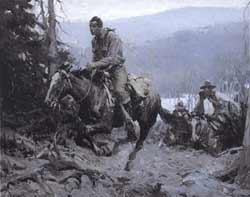
But in any case, doesn't the quote seen in context -- with an explanation for why he was talking about the painting, and with more details of what he was trying to say about religion -- seem different than the quote provided out of context?
All Related Posts (on one page) | Some Related Posts:
- Whom Are You Going To Believe -- The Transcript or Your Lying Ears?
- Bushism of the Day:
- My Three Suggestions for Improving Slate:...
- Asking You for a Small Favor:
- We Provide the Context, So Slate Doesn't Have To:
- We Provide the Context, So Slate Doesn't Have To:...
- Bushism of the Day:
- Spinsanity criticizes Slate's Bushisms and Kerryisms.
- Latest Bushism:
Congratulations to my friend and colleague Kimberly Moore who late last week was nominated for a seat on the Court of Appeals for the Federal Circuit. A few Patent commentators have already complimented her patent law scholarship and reputation here and here. Although progress on Circuit Court nominations are likely to be pretty dicey between now and November, given Kimberly's credentials and temperament, I can't imagine that she will be a controversial or difficult confirmation.
She is a great friend, colleague, and scholar and I am just delighted for her that this well-deserved honor has come about.
A nifty new(ish?) phrase I just heard.
The Manhattan Institute's Walter Olson has a subscription-only op-ed on the Milberg Weiss indictment in today's WSJ. Olson writes:
Milberg Weiss lawyers have been in the forefront of efforts to define kickbacks broadly and punish them with rigor. The firm's Web site boasts that it "has sued major providers of private mortgage insurance for kickback violations, resulting in substantial settlements." Melvyn Weiss and others at the firm have expressed indignation at, and filed lawsuits over, alleged kickbacks in the contexts of Wall Street initial public offerings, mutual fund sales, insurance brokerage commissions and doctors' prescribing of pharmaceuticals.There's more at Overlawyered.com.Although there are many debatable cases, concealed payoffs to named plaintiffs in class actions aren't one of them: They're clearly improper under virtually any analysis. As the indictment states, both plaintiffs and their lawyers are under obligation 1) not to place a named plaintiff's interests above those of absent class members; 2) not to behave deceitfully or unethically toward the court or absent class members; and 3) not to withhold from the court "any fact" that might call into question the representativeness of the plaintiff (a financial dependence on the lawyer would be one such fact). As a class action proceeds, plaintiffs repeatedly swear under oath to these matters. Bonus payments to compensate named plaintiffs for their time and trouble are permitted at settlement, but they must be disclosed to absent class members and approved by the judge.
These rules have a purpose. With other class members absent, named plaintiffs are one of the few watchdogs against self-dealing or misconduct by the lawyers -- specifically, the pursuit of settlements that result in high legal fees, whether or not they serve the interest of the class. It's true that law firms do seek docile, loyal or merely clueless persons to serve as their named plaintiffs, which means it's rare (though not unheard of) for them to contribute an independent point of view in a case. But if the Justice Department's allegations are correct, Milberg was taking no chances on the watchdogs staying pacified: It threw regular chunks of raw liver into their cages. Significantly, Justice alleges that payoffs were computed not as a share of the class's eventual recovery, but as a share of Milberg's own fee haul -- incentivizing the named plaintiff to side with Milberg's interests should the two clash.
The WSJ itself also has a subscription-only editorial on the matter, titled "Very Rough Justice." The editorial is of mixed minds on the indictment, and begins:
Let's all admit it. Across the country last week, millions of Americans were indulging in Schadenfreude -- the enjoyment of another's misfortune -- at the indictment of class-action tort giant Milberg Weiss. Yet even the many victims of Milberg Weiss should think twice about cheering the Justice Department's blunderbuss tactic of indicting the entire law firm.The editorial continues, noting that the evidence against Milberg Weiss attorneys seems to be quite strong, but the Justice Department's tactics were excessively heavy-handed.
Despite the impressive evidence, the problem with this case is that Justice has chosen the nuclear option of indicting the entire Milberg Weiss firm. As in the Arthur Andersen case, this may well mean a death sentence for the law firm whether or not it is convicted. More troubling is that, even if Milberg is convicted, the larger cause of justice and deterrence may not be served. . . .. . . The Justice Department essentially held a gun to Milberg Weiss's head and threatened to indict unless the firm waived attorney-client privilege and agreed to label its own partners criminals. Never mind the irony that this is similar to the methods that Milberg Weiss has used itself against countless law-abiding businesses.
The practice is still a dangerous precedent that can be used -- and surely will be -- against more honest business enterprises. Justice played the same rough game with KPMG, deciding not to indict that accounting firm only after it agreed to renounce the tax shelters it had been selling and throw many of its partners over the side. The threat of a corporate death sentence is an abuse of prosecutorial discretion against any but the most corrupt criminal enterprises -- namely, the mob.
Related Posts (on one page):
- Olson & WSJ on Milberg Weiss:
- More on Milberg Weiss Indictment:
- Milberg Weiss Indicted
- Will Milberg Weiss Be Indicted?
Speaking to the Georgetown University Law Center's graduating class yesterday, Chief Justice John Roberts explained that he seeks greater consensus and more restraint on the High Court. According to the New York Times report:
He said the nation would benefit if the justices could avoid 5-to-4 decisions in cases with sweeping impact, noting that many of the court's most controversial cases, including presidential wartime powers and political boundaries in Texas, would be decided in the final six weeks of the current term.
"If it is not necessary to decide more to a case, then in my view it is necessary not to decide more to a case," Chief Justice Roberts said. "Division should not be artificially suppressed, but the rule of law benefits from a broader agreement. The broader the agreement among the justices, the more likely it is a decision on the narrowest possible grounds."
Sunday, May 21, 2006
For years, school textbooks in Saudi Arabia preached intolerance and hatred against non-Muslims. After September 11, Saudi officials promised this would change. More recently, they proclaimed they had "removed materials that are inciteful or intolerant towards people of other faiths." Nina Shea, writing in the Washington Post, shows otherwise.
A review of a sample of official Saudi textbooks for Islamic studies used during the current academic year reveals that, despite the Saudi government's statements to the contrary, an ideology of hatred toward Christians and Jews and Muslims who do not follow Wahhabi doctrine remains in this area of the public school system. The texts teach a dualistic vision, dividing the world into true believers of Islam (the "monotheists") and unbelievers (the "polytheists" and "infidels").
This indoctrination begins in a first-grade text and is reinforced and expanded each year, culminating in a 12th-grade text instructing students that their religious obligation includes waging jihad against the infidel to "spread the faith."
The bulk of her article provides selections from various texts to prove her point. As Glenn comments, this is further evidence that "the Saudis are not our friends." Unfortunately, the U.S. government has long tolerated outrageous conduct by the Saudi government, something I first blogged about here and here.
What makes a great conservative rock song? The lyrics must convey a conservative idea or sentiment, such as skepticism of government or support for traditional values. And, to be sure, it must be a great rock song. We’re biased in favor of songs that are already popular, but have tossed in a few little-known gems. In several cases, the musicians are outspoken liberals. Others are notorious libertines. For the purposes of this list, however, we don’t hold any of this against them. Finally, it would have been easy to include half a dozen songs by both the Kinks and Rush, but we’ve made an effort to cast a wide net.Topping off the list is "Won't Get Fooled Again" by The Who. Why is this a conservative song? "The conservative movement is full of disillusioned revolutionaries; this could be their theme song, an oath that swears off naive idealism once and for all," Miller explains. "The instantly recognizable synthesizer intro, Pete Townshend’s ringing guitar, Keith Moon’s pounding drums, and Roger Daltrey’s wailing vocals make this one of the most explosive rock anthems ever recorded — the best number by a big band, and a classic for conservatives." Consider some of the song's lyrics:
There's nothing in the streetsThe full lyrics to the song are here.
Looks any different to me
And the slogans are replaced, by-the-bye
And the parting on the left
Are now parting on the right
And the beards have all grown longer overnight
I'll tip my hat to the new constitution
Take a bow for the new revolution
Smile and grin at the change all around
Pick up my guitar and play
Just like yesterday
Then I'll get on my knees and pray
We don't get fooled again
Don't get fooled again
Meet the new boss
Same as the old boss
UPDATE: A reader with a much better memory than mine notes that I blogged about WGFA during the Townsend-Moore dust up over whether the song could be used in Fahrenheit 9/11. Relevant to the debate in the comment thread is this comment from Pete Townsend:
WGFA is not an unconditionally anti-war song, or a song for or against revolution. It actually questions the heart of democracy: we vote heartily for leaders who we subsequently always seem to find wanting. (WGFA is a song sung by a fictional character from my 1971 script called LIFEHOUSE. The character is someone who is frightened by the slick way in which truth can be twisted by clever politicians and revolutionaries alike).
UPDATE: The full list of 50 is now on-line here.
Related Posts (on one page):
- Townshend on the Politics of WGFA:
- Sunday Song Lyric: