Preview of Gonzales Testimony:
Time Magazine has a preview of the Attorney General's Senate testimony on the NSA domestic surveillance program. I'm planning a couple of NSA-related posts for next week, and hope to respond to the Gonzales testimony on Monday, as well. All yours for one great price.
Saturday, February 4, 2006
NYT on Electronic Evidence:
Today's New York Times has an interesting piece on the growing use of digital evidence in court.
More Multiplication:
A comment to the follow-up to my "A Little Multiplication Could Have Gone a Long Way" post says:
What? You mean not everyone memorizes useless conversions like that there are 1440 minutes (or 86400 seconds) per day? What is this country coming to?
I'd have let this slip, but given that the whole thread was about multiplication -- and that I'm a math geek -- I just couldn't resist. First, knowing how many minutes there are in a day, it turns out, is not useless: Among other things, it would help journalists and press release authors avoid errors like the one I was blogging about.
But second, here's a secret -- you don't have to memorize the conversions. Even if you don't remember the conversion, you can still figure out how many minutes there are in a day, whenever you need to (for instance, if you want to check whether the item you're about to publish is accurate). How, you might ask? What occult science will give me this magical power? Why . . . multiplication!
In fact, you don't even know how to do multiplication, since there are, I'm told, electronic devices that can do it for you. All you need to know is that such an operation exists, and that it can be deployed to solve immensely difficult problems like the "how many 5-minute increments in a day" one? (To be fair, it also helps knowing about multiplication's partner in crime, division.)
As it happens, I do remember a rough estimate of the number of seconds in a year, partly because one runs into these "every X seconds/minutes Y happens" -- 30 million, or (for a better approximation) 10 million pi for math geeks. I don't remember the number of minutes or seconds in a day. But I am so learned that the numbers are nonetheless available to me whenever I please. And you too can have this fearsome power . . . .
Related Posts (on one page):
The Boston Globe on Speech Offensive to Different Religious Groups:
Here's today's Boston Globe editorial on the Mohammed cartoons controversy:
Freedom expression is not the only value at issue in the conflict provoked by a Danish newspaper's publication of cartoons satirizing Islam's founding prophet, Mohammed. The billowing controversy is being swept along by intolerance, ignorance, and parochialism. The refusal of each camp to recognize and respect the otherness of the other brings closer a calamitous clash of cultures pitting Islam against the West.
No devotee of democratic pluralism should accept any infringement on freedom of the press. But the original decision of the Danish paper, Jyllands-Posten, to solicit and publish a dozen cartoons of the Muslim prophet was less a blow against censorship than what The Economist called a schoolboy prank. . . .
Other European papers reprinted the cartoons in a reflex of solidarity. Journalists in free societies have a healthy impulse to assert their hard-won right to insult powerful forces in society. Freedom of the press need not be weakened, however, when it is infused with restraint. This should not be restraint rooted in fear of angering a government, a political movement, or an advertiser. As with the current consensus against publishing racist or violence-inciting material, newspapers ought to refrain from publishing offensive caricatures of Mohammed in the name of the ultimate Enlightenment value: tolerance.
Just as the demand from Muslim countries for European governments to punish papers that printed the cartoons shows a misunderstanding of free societies, publishing the cartoons reflects an obtuse refusal to accept the profound meaning for a billion Muslims of Islam's prohibition against any pictorial representation of the prophet. Depicting Mohammed wearing a turban in the form of a bomb with a sputtering fuse is no less hurtful to most Muslims than Nazi caricatures of Jews or Ku Klux Klan caricatures of blacks are to those victims of intolerance. . . .
There's actually much that I agree with here; that one is and should be legally free to say something doesn't mean that it's right to say it. And while religious ideas, like all ideas, should be open to vigorous debate, needless emotional provocation generally doesn't much advance the debate.
This editorial, though, led me to try to search for what the Boston Globe had said about past controversies involving high-profile speech that was offensive to other religious groups. I searched in particular for editorials referring to the controversies surrounding Andres Serrano's "Piss Christ" and the Brooklyn Museum's display of the Virgin Mary covered in feces that was made up in part of feces and of cutouts of bare buttocks from magazines. I may have missed some — if I have, please let me know — but here are the ones I found. Nov. 3, 1999:
This week, US District Judge Nina Gershon sent New York's Mayor Rudolph Giuliani a message he should heed: Stop trampling on the Brooklyn Museum's First Amendment rights.
Giuliani is furious about an exhibit, "Sensation: Young British Artists from the Saatchi Collection." He called the art "sick," withheld operating funds, and started eviction proceedings against the museum. One object of his anger is a painting of a black Virgin Mary spotted with elephant dung. The mayor said: "You don't have a right to a government subsidy to desecrate someone else's religion." It's a passionate argument, but it ignores the facts and the law. None of the $2 million for the "Sensation" exhibit came from New York City. Serious allegations have been raised about the museum's fund-raising for the exhibit, but that is a separate issue. The city's contract with the museum calls for the city to pay for maintenance without, as the court says, "stating any conditions regarding the content of the museum's artworks."
Most damning is the court's finding that the city is violating the museum's First Amendment rights. Gershon quoted many cases, including the Supreme Court's 1989 ruling in Texas v. Johnson protecting flag-burning. "If there is a bedrock principle underlying the First Amendment, it is that the government may not prohibit the expression of an idea simply because society finds the idea itself offensive or disagreeable."
But what about the 1998 Supreme Court ruling letting the National Endowment for the Arts use "general standards of decency" in its considerations? Gershon noted that this ruling was on awarding grants, not withdrawing operating funds. And the Supreme Court upheld these grant considerations as long as they did not permit "viewpoint discrimination."
Gershon issued a preliminary injunction ordering the city to stop withholding funds, end eviction proceedings, and refrain from retaliation or tampering with the museum's board. Too bad a judge has to remind Giuliani of his duty to do no harm to one of his city's great cultural institutions.
July 17, 1990:
The National Endowment for the Arts is a federal agency created 25 years ago to function as a friend and patron of the arts. It was never intended that the NEA should serve as a moral arbiter of the projects it considers funding.
But that role has been thrust upon the NEA by Congress, following the outcry of Sen. Jesse Helms of North Carolina and a band of conservative congressmen and critics over the exhibitions of work by photographers Robert Mapplethorpe and Andres Serrano.
Last week, the NEA issued new guidelines that attempt to define obscenity, in response to a directive from the General Accounting Office. Helms had asked the GAO to investigate whether the arts agency was implementing restrictive language added last fall to its appropriation.
Grant recipients now are required to furnish "a written justification of the project" and an explanation of how it complies with the obscenity language in the NEA's appropriation legislation. Already, some prospective recipients have refused to sign such a pledge.
Critics of the pledge-signing requirement argue that imposing such guidelines has an intimidating effect and is tantamount to censorship.
Liam Rector, executive director of Associated Writing Program in Norfolk, is right when he notes that "the place where obscenity needs to be determined is in the courts — not in Congress and not by the NEA."
The New School for Social Research in New York and Bella Lewitsky, a California choreographer, have filed separate suits in federal courts, challenging the constitutionality of the congressional restriction on the agency's grants.
Congress should grant the National Endowment for the Arts the five-year extension it is seeking and allow it to go about its business without restrictions that hamper the agency and discourage artistic expression.
May 20, 1990:
In its 25-year history, the National Endowment for the Arts has become an invaluable friend and patron of the arts, funding an impressive array of institutions and activities. Now the hysteria generated by a small group of myopic arch-conservatives, led by Sen. Jesse Helms of North Carolina, threatens the NEA's freedom.
Strong pressures are building on Capitol Hill to place limits on the way the NEA awards grants because of the misperception that it supports obscene or sacrilegious art. Supporters of the NEA are divided on whether to seek a one-year or five-year NEA reauthorization.
It would be unreasonable to expect unanimity of support for the many projects the NEA has funded over the years, given the subjectivity of creative expression. The NEA has been criticized often, and some have charged it with elitism.
However, until last year it had never been charged with underwriting smut, as it was when it financed a restrospective of photographs by Robert Mapplethorpe and made an award to photographer Andres Serrano. The art of these two men has been used unfairly by Helms and an organization called the American Family Association as a device to discredit the NEA, overlooking the important work the NEA has accomplished in fostering the arts.
Where does the public stand on federal aid for the arts? A survey conducted for People For The American Way indicates that Americans strongly support the NEA's role as a promoter and distributor of arts funding and do not wish to see the methods for granting arts awards changed.
Congress should approve another five-year reauthorization for the National Endowment for the Arts and allow it to continue making its cultural contribution to the nation — without any legislative restraints.
On their own, also eminently plausible arguments; I agree with parts of them and disagree with other parts, but they are certainly quite defensible.
Yet where in those editorials are the admonitions about the need for "respect" of religious groups? The condemnations of the juxtaposition of bodily excretions with religious figures as "schoolboy prank[s]"? The denunciations of the art as undermining the "ultimate Enlightenment value" of "tolerance"? The condemnations of the artists, and of those NEA and museum decisionmakers who used their discretion to judge the work artistically excellent, as "obtuse"? And, of course, the suggestion that the works are "no less hurtful to most [Christians] than Nazi caricatures of Jews or Ku Klux Klan caricatures of blacks are to those victims of intolerance"?
Why the difference?
UPDET: Reader Matt Lister pointed out that the Virgin Mary painting was not "covered in feces," as I wrongly reported above, but contained elephant dung as part of the display, and also contained what seemed to be cutouts of naked buttocks from magazines. I've revised the post accordingly; I don't think the details affect the overall analysis, but I'm pleased to be able to correct them.
All Related Posts (on one page) | Some Related Posts:
- Daily Illini Fires Editor Who Published the Mohammed Cartoons:
- President of Bar Association in Pakistan, Plus Major Pakistani Party, Supports Murder of Danish Cartoonists:
- The Twelve Mohammed Cartoons, in Detail:...
- The Catholic Church and Free Expression:
- The Boston Globe on Speech Offensive to Different Religious Groups:
- Sorry I can't Join the "Buy Danish" Campaign...
- U.S. State Department on the Cartoons Depicting Mohammed:
- Bush Cabinet Member Condemns Anti-Christian Blasphemy, and Points to Laws Restricting Incitement to Hateful Expressions:
- Suppressing Anti-Religious Speech -- an Emerging International Law Norm?
Sorry I can't Join the "Buy Danish" Campaign
but I still remember that in 2002, in response to Israel (finally) taking decisive military action against a wave of terrorist suicide-murders, the Danish General Workers Union canceled an order from an Israeli company, and announced that "we call for the hundreds of thousands of members of the union to refrain from buying products manufactured in Israel." So forgive me if my heart doesn't bleed for the Danish workers whose jobs are at risk from another branch of Islamic extremism. Two wrongs don't make a right, and I certainly don't wish the Danes any harm; I just don't feel any urgent need to go out of my way to help them.
All Related Posts (on one page) | Some Related Posts:
- Daily Illini Fires Editor Who Published the Mohammed Cartoons:
- President of Bar Association in Pakistan, Plus Major Pakistani Party, Supports Murder of Danish Cartoonists:
- The Twelve Mohammed Cartoons, in Detail:...
- The Boston Globe on Speech Offensive to Different Religious Groups:
- Sorry I can't Join the "Buy Danish" Campaign
- European Reaction to anti-Semitic Cartoons:...
- U.S. State Department on the Cartoons Depicting Mohammed:
- Bush Cabinet Member Condemns Anti-Christian Blasphemy, and Points to Laws Restricting Incitement to Hateful Expressions:
- Suppressing Anti-Religious Speech -- an Emerging International Law Norm?
European Reaction to anti-Semitic Cartoons:
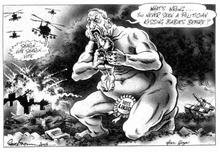
Among the many ignorant things arising out of the Mohammed cartoon controversy is the claim emanating from many quarters in the Muslim world that if the target of the cartoons had been important to "the Jews," European governments would have cracked down on the individuals involved. There are many levels to this ignorance (e.g., those pushing this line can't seem to resist adding a little Holocaust denial into their spiels, and they of course completely ignore the many grossly offensive cartoons that appear in the Arab media), but here is one illustration. In 2003, an English newspaper published the following cartoon of Ariel Sharon eating a Palestinian child:
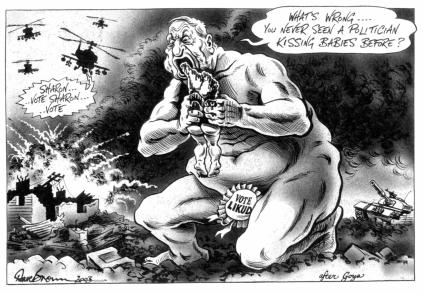
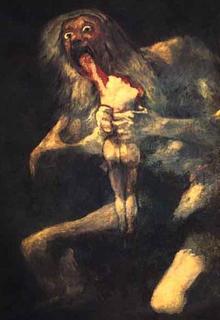
The cartoon invoked two of the most heinous and longstanding themes in European anti-Semitism: Jews lusting after the blood of non-Jewish children, and Jews as demonic beasts (the cartoon being based on the Goya painting below[the Goya painting is of Saturn devouring one of his children, but Saturn is portrayed as looking like a demon, and alluding to that painting in depicting Sharon brought to many minds the "Jew as demon" theme present for centuries in European art])
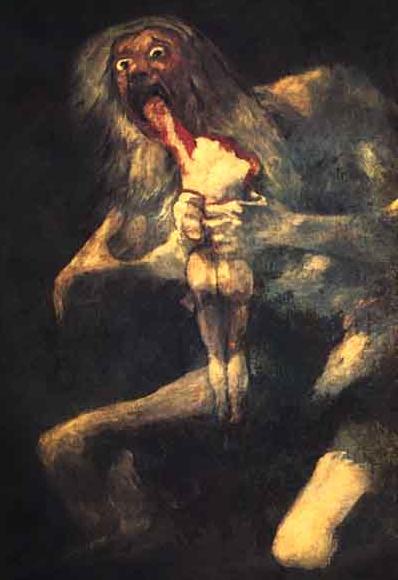
The cartoonist may not have been aware of how his cartoon picked up on anti-Semitic iconography. But he soon found out, and was completely unapologetic about it. And how did the the rest of the British press react? Well, the UK's Political Cartoon Society awarded it first prize in its annual competition for best cartoon, with full knowledge of the anti-Semitic subtext. The UK government failed to arrest the author, the newspaper, or the director of the Cartoon Society, or even denounce them. So much for the mythical power of "the Jews."
UPDATE: Nevertheless, I agree with Andrew Sullivan that the Europeans "would be in a stronger position to defend press freedom if they practised it more often," though I'm not sure I agree with all of his specific examples. And Sullivan links to a Gateway Pundit post that suggests that some of the furor is a result of additional, much more offensive cartoons inventing by the Danish Muslim group that is stirring the controversy.
All Related Posts (on one page) | Some Related Posts:
- Daily Illini Fires Editor Who Published the Mohammed Cartoons:
- President of Bar Association in Pakistan, Plus Major Pakistani Party, Supports Murder of Danish Cartoonists:
- The Twelve Mohammed Cartoons, in Detail:...
- Sorry I can't Join the "Buy Danish" Campaign
- European Reaction to anti-Semitic Cartoons:
- U.S. State Department on the Cartoons Depicting Mohammed:
- Bush Cabinet Member Condemns Anti-Christian Blasphemy, and Points to Laws Restricting Incitement to Hateful Expressions:
- Suppressing Anti-Religious Speech -- an Emerging International Law Norm?
Following Up on "A Little Multiplication":
Last week I blogged, under the title "A Little Multiplication Could Have Gone a Long Way," about this claim in the Oregon State University newspaper (The Daily Barometer):
According to a press release issued by the Women’s Center, 2,000 rapes occur every five minutes.
I pointed out two things:
The assertion should have led the author and the editor to be skeptical, since it would mean 2000 x (60/5) x 24 x 365 = 200 million rapes a year (presumably in the U.S.), a truly vast number. And in fact, the press release on which they were relying didn't say that; rather, it said, "About 2,000 rapes are committed daily at the rate of about one every 5 minutes."
Moreover, the press release itself was patently mistaken, in a way that the reader of the press release probably should have caught with a bit of quick multiplication — a "rate of about one every 5 minutes" would be about 300 daily ((60/5) x 24), not about 2000 daily.
I posted my observation about both errors (in a little more detail than this recap) on the blog. I had also e-mailed this observation, again about both errors, to the Barometer and to the Women's Center.
The Barometer then published this correction:
Approximately, 2,000 rapes occur each day, or one about every five minutes. The Daily Barometer misprinted this fact in an article that appeared in the Jan. 19, 2006 edition of The Daily Barometer.
The Daily Barometer staff regrets any misunderstanding or inconveniences caused by this error.
Unfortunately, this corrects the first error, but not the second error. It is not a "fact," and can never be a fact, that "2,000 each day" would equal "one about every five minutes." Whoops. (The Women's Center doesn't seem to have corrected this assertion on its own Myths & Facts page.)
I don't mean to blow this out of proportion (speaking of multiplication). I suspect this newspaper is no better or worse than most student newspapers, or than many nonstudent newspapers. But I thought this was worth noting because I think it's emblematic of some of the weaknesses that newspapers often suffer from, especially a tendency to quote seemingly authoritative sources without skeptically examining them, and a lack of comfort with numbers that keeps many journalists from quickly spotting these sorts of errors.
I should also stress that I myself often make errors (though I hope not ones quite like this). But when I do, and when I don't correct them (or correct them incorrectly), others are quite right to point this out. The result of such corrections, I would hope, is more accuracy in the present, and more care in the future.
Related Posts (on one page):
- Multiplication:
- More Multiplication:
- Following Up on "A Little Multiplication":
- A Little Multiplication Could Have Gone a Long Way:
Friday, February 3, 2006
U.S. State Department on the Cartoons Depicting Mohammed:
Washington on Friday condemned caricatures in European newspapers of the Prophet Mohammad, siding with Muslims who are outraged that the publications put press freedom over respect for religion. . . .
"These cartoons are indeed offensive to the belief of Muslims," State Department spokesman Kurtis Cooper said in answer to a question. "We all fully recognize and respect freedom of the press and expression but it must be coupled with press responsibility. Inciting religious or ethnic hatreds in this manner is not acceptable."
"We call for tolerance and respect for all communities for their religious beliefs and practices," he added. . . .
A longer version also includes this quote:
"Anti-Muslim images are as unacceptable as anti-Semitic images, as anti-Christian images or any other religious belief," State Department spokesman Sean McCormack told reporters.
A Reason Online piece links to the shorter version, and condemns it as "a craven condemnation of an affair that is none of their business."
I'm glad to say, though, that the State Department response was a good deal more assertively pro-free-speech than the Reuters account suggests. I couldn't find the Kurtis Cooper statement, but here's the relevant excerpt from the Sean McCormack press briefing:
QUESTION: Yes? Can you say anything about a U.S. response or a U.S. reaction to this uproar in Europe over the Prophet Muhammad pictures? Do you have any reaction to it? Are you concerned that the violence is going to spread and make everything just --
MR. MCCORMACK: I haven't seen any — first of all, this is matter of fact. I haven't seen it. I have seen a lot of protests. I've seen a great deal of distress expressed by Muslims across the globe. The Muslims around the world have expressed the fact that they are outraged and that they take great offense at the images that were printed in the Danish newspaper, as well as in other newspapers around the world.
Our response is to say that while we certainly don't agree with, support, or in some cases, we condemn the views that are aired in public that are published in media organizations around the world, we, at the same time, defend the right of those individuals to express their views. For us, freedom of expression is at the core of our democracy and it is something that we have shed blood and treasure around the world to defend and we will continue to do so. That said, there are other aspects to democracy, our democracy — democracies around the world — and that is to promote understanding, to promote respect for minority rights, to try to appreciate the differences that may exist among us.
We believe, for example in our country, that people from different religious backgrounds, ethnic backgrounds, national backgrounds add to our strength as a country. And it is important to recognize and appreciate those differences. And it is also important to protect the rights of individuals and the media to express a point of view concerning various subjects. So while we share the offense that Muslims have taken at these images, we at the same time vigorously defend the right of individuals to express points of view. We may — like I said, we may not agree with those points of view, we may condemn those points of view but we respect and emphasize the importance that those individuals have the right to express those points of view.
Sounds to me like McCormack, at least, is repeatedly stressing that the cartoons ought to be protected from governmental punishment, but is simply exercising the government's right to speak out against them. Naturally, the Reuters story could only quote a small part of the comments, but it's unfortunate that the quoted excerpt seemed to understate the State Department's expressions of support for free speech.
All Related Posts (on one page) | Some Related Posts:
- Daily Illini Fires Editor Who Published the Mohammed Cartoons:
- President of Bar Association in Pakistan, Plus Major Pakistani Party, Supports Murder of Danish Cartoonists:
- The Twelve Mohammed Cartoons, in Detail:...
- European Reaction to anti-Semitic Cartoons:
- U.S. State Department on the Cartoons Depicting Mohammed:
- Bush Cabinet Member Condemns Anti-Christian Blasphemy, and Points to Laws Restricting Incitement to Hateful Expressions:
- Suppressing Anti-Religious Speech -- an Emerging International Law Norm?
Sharansky on the Hamas Win:
I've been wondering what Natan Sharansky, champion of Middle East democratization, has to say about the Hamas election victory. You might have been, too. Ha'aretz has the scoop. Essentially, he argues that to have real democracy, you need a free society, not just free elections. The Palestinians had free elections, but no free society. A very interesting interview.
UPDATE: And here, courtesy of a reader, is a Sharansky op-ed on the same topic.
Racial Epithets:
Drudge reports:
A woman accused of using racial epithets while waiting for food at a Connecticut Taco Bell drive-through window was arrested Wednesday.
Jennifer Farrelly, 19, of East Windsor, has been charged with ridicule on account of race, creed or color and second-degree breach of peace. . . .
Face-to-face personal insults (racist or not) are generally unprotected by the First Amendment. They fit into the "fighting words" exception to free speech, on the theory that they lack constitutional value and tend to cause fights. Speech that isn't directed to a particular hearer is generally protected, even if it's an insult; but speech that is so directed, and is said face-to-face, where an imminet fight (or worse) is possible, is unprotected.
The relevant provision of the Connecticut breach of the peace statute, § 53a-181(a), has been narrowed by the Connecticut courts to cover only fighting words. (See State v. Szymkiewicz, 237 Conn. 613 (1996).) Farrelly thus might well be prosecuted under this statute.
On the other hand, the "ridicule on account of race" statute is unconstitutional, at least if it is this satute (the only one I could find that uses those words):
Any person who, by his advertisement, ridicules or holds up to contempt any person or class of persons, on account of the creed, religion, color, denomination, nationality or race of such person or class of persons, shall be fined not more than fifty dollars or imprisoned not more than thirty days or both.
Even if the statute applies here (despite its seeming limitation to "advertisement[s]," and even if it's interpreted to be limited to unprotected speech, such as fighting words, defamation, or the like, it still singles out particular viewpoints -- racist hostility as opposed to other hostility -- for punisment. R.A.V. v. City of St. Paul (1992) held that such viewpoint discrimination is generally unconstitutional even when the discrimination happens within a category of unprotected speech. R.A.V. struck down a ban on race-based fighting words; the logic of that case would equally apply here.
Quick Response to David:
Since David's comments to his post below are closed, here is a "comment" in post form: I'm not entirely sure I understand. David, are you criticizing the speaker for not believing in democracy? For not sharing a western style sense of civil liberties? For confusing "the state" with individuals in the state?
Enjoying the Fruits of Liberalism, and Rejecting the "Costs":
Given that newspapers, bloggers, t.v. stations, etc. in all Western countries have now published or shown the offending Mohammed illustrations, and given that the public in many Muslim countries doesn't seem to distinguish between what individuals do and their countries (given that the state apparently has an obligation to censor "blasphemy"), it strikes me that the boycott should spread to all Western goods and technology. Here's a comment I can respect from the Washington Post:
"I am not willing to buy any product from a country that has insulted my prophet, my religion and my dignity as a Muslim," said Leila Faleh, 42, a hospital administrator shopping at the store. "I would rather go back to drinking milk from a cow and eating dates."
Yes, go back to drinking milk from a cow, and eating dates. Go back to a 35 year life-span, to a world without antibiotics and anesthesia, to a world where human slaves are bought and sold, and lfe is cheap. Do without your cars, refrigerators, television, and cell phones. But please, don't enjoy the fruits of Western liberalism and then violently reject the freedom that not only accompanies it, but that was a necessary precondition to it. The Middle East is in desperate need not of democracy, but liberalism.
If Ayn Rand were still alive, she would probably suggest that WE boycott THEM, wondering how we let cultures that left to their own devices would be living like the Patriarchs came to threaten us with our own technology. The sanction of the victim, indeed.
UPDATE: I wasn't trying to be subtle, so I must have just been unclear. The problem is not with the boycotters, though to be consistent they should be boycotting a lot more than Danish cheese. The problem is with those who threaten, engage in, or even merely support violence against the West, precisely because of its liberalism (including the fact that one could publish "blasphemous" pictures of Mohammed without being arrested) [for example, see these pictures from a London protest], but meanwhile benefit from all the benefits that liberalism has provided them.
What do these television shows
have in common:
The A-Team, The Wonder Years, Homicide, Family Guy.
Works to Help Non-Libertarians Understand Libertarianism:
A student of mine writes with this question:
I consider myself to be a classical liberal (free trade, freedom of expression, freedom of religion ...)with an exceptionally large bleeding heart (there is no excuse for having hungry kids or the mentally ill out on the streets), but I am trying to understand what it means to be a libertarian.
So this is a law student who has not previously been exposed much to libertarianism and would like a good and serious, but somewhat accessible, introduction to libertarian thinking. I thought of Nozick (perhaps too arcane for the general reader) and Hayek (perhaps too economic and nonresponsive to this person's interests). And there are plenty of works, of course, that cover more specific questions, such as voluntary provision of charity or public goods.
This is a question I get on a fairly frequent basis, and one for which I am usually flummoxed for an answer. So I figured I'd throw it out to readers, as I suspect many of you might have works that you recommend as particularly useful to somebody looking to understand libertarianism better.
I'd be especially interested in hearing from non-libertarians about works that you may have found especially useful in helping to understand libertarianism from an "outsider" perspective (even if you obviously did not find yourself to be persuaded) in the end).
While you are at it, please feel free to add any personal recommendations you may have for "Conservatism for Non-Conservatives" or "Liberalism for Non-Liberals" as well.
When is Copyright Infringement like a Broken Leg?:
According to an article in the Mudville Gazette, the Army has been distributing a photograph (of a US Army major cradling a girl killed by terrorists) taken by photographer Mike Yon, and that Yon has threatened the Army with a copyright infringement lawsuit. The Army's response is interesting: it claims that the standard liability waiver that Yon signed before he was permitted into the war zone (in which he agreed to "release the (military) of any liability from and hold them harmless for any injuries I may suffer or any equipment that may be damaged as a result of my covering combat") covers injuries to his intellectual property as well as to his person or his personal property. I must say, I've never heard that one before, in 20 years of practicing intellectual property law; but I'm not sure how I feel about it ...
Thursday, February 2, 2006
Deliberation Day Experiment in Colorado.--
Over at the University of Chicago faculty blog, Cass Sunstein reports on an experiment on the effects of deliberation on views:
Deliberation Day and Political Extremism
A few months ago, David Schkade, Reid Hastie, and I helped to organize a kind of Deliberation Day in Colorado. (The events were sponsored and funded by ABC News, which should be broadcasting our experiment soon, in connection with a general discussion of political polarization in America.) Two cities were chosen: Boulder (a predominantly liberal area) and Colorado Springs (generally Bush country). About 60 citizens were brought together to explore three of the most controversial issues of the day: affirmative action, an international treaty to control global warming, and civil unions for same-sex couples.
People in Boulder deliberated with others from Boulder, and people from Colorado Springs deliberated with people from Colorado Springs. Thus people were generally sorted into groups of like-minded people. . . .
Our key question was this: What would be the effect of deliberation on people's views?
Here are our three major findings.
(1) Liberals, in Boulder, became distinctly more liberal on all three issues. Conservatives, in Colorado Springs, become distinctly more conservative on all three issues. The result of deliberation was to produce extremism — even though deliberation consisted of a brief (15 minute) exchange of facts and opinions! . . .
(2) The division between liberals and conservatives became much more pronounced. . . .
(3) Deliberation much decreased diversity among liberals; it also much decreased diversity among conservatives. After deliberation, members of nearly all groups showed, in their post-deliberation statements, far more uniformity than they did before deliberation.
Moot Court:
GW Law School's Moot Court Finals are next Thursday, and the panel is just about as intimidating as it gets in this business: Chief Justice John G. Roberts will preside, and will be joined by Judges Guido Calabresi and Sonia Sotomayor of the U.S. Court of Appeals for the Second Circuit. I just hope no one gets flustered and tries to leave in the middle. As far as I know, this is the Chief's second moot court since his confirmation.
Related Posts (on one page):
- Justice Alito at GW Law:
- GW Moot Court:
- Moot Court:
Who's to Blame for the Caricatures of Mohammed?
Why "the Zionists," of course.
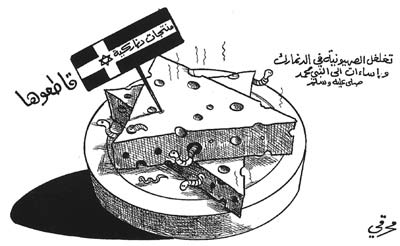
(From a newspaper in Bahrain, courtesy of the ADL: the cartoon claims the controversy was a result of "The Penetration of Zionism to Denmark." The cheese, shaped like a Star of David, is labeled "Danish products." The text on the far left reads, "Boycott it!") )
UPDATE: Michelle Malkin is doing a great job covering the Mohammed caricature controversy.
An Attack on Munich:
Gabriel Schoenfeld launches a powerful attack on "Munich" in Commentary. A small taste: "Spielberg has said that he made Munich out of a simple desire to commemorate the slaughtered Jews of Munich.... Shortly before Munich was released, Steven Spielberg told an interviewer: 'I worked very hard so this film was not in any way, shape, or form going to be an attack on Israel.' This is a truly curious formulation. Why should he have had to work 'very hard' to avoid turning a film intended to commemorate the murder of Israeli civilians into a film attacking Israel?"
Marcus Cole on a New Law Harming African-American Borrowers in Chicago.--
Marcus Cole of Stanford is guest-blogging at BlackProf.com. Coincidentally, earlier today I was quoting Marcus to my colleagues.
Cole takes aim at a new Illinois law mandating government review with the power to order credit-counseling for prospective home-buyers in several poor neighborhoods in Chicago:
On Tuesday, in addition to Mrs. King’s passing and Justice Alito’s elevation, the State of Illinois enacted a law that requires all mortgage applications within nine Chicago zip codes to undergo a process of review by the state’s Department of Financial and Professional Regulation. The department’s review process determines whether mortgage applicants in these neighborhoods must undergo compulsory credit counseling. If they must, then the mortgage lender must pay the cost of the counseling.
Anyone familiar with Chicago geography and demography knows these nine zip codes. They are all neighborhoods on the South and Southwest side of Chicago. They are predominantly African-American neighborhoods. These neighborhoods are some of the most impoverished in the City of Chicago, and indeed, the nation. On Tuesday, they suddenly became much poorer.
Although the legislators responsible for the new law were motivated by good intentions, they failed to consider the inevitable consequences of their bill. They wanted to protect poor homeowners in certain neighborhoods from high interest rates and predatory lending practices. The new law, however, necessarily increases the costs, time and uncertainty associated with mortgage applications in these black neighborhoods. The cost of credit counseling will be born by and charged to mortgage applicants. This, in turn, will necessarily decrease the price that new home-buyers can afford to pay for homes in these neighborhoods. If they can choose to buy in other neighborhoods, where housing money is more affordable, they, on the margin, will. Furthermore, recent studies of credit counseling programs suggest that these programs have little effect on borrower behavior. The end result is that homeowners in these poor black neighborhoods suddenly have less equity in their homes than they had on Monday.
Legislation like this is often motivated by an unspoken belief that poor black people are incapable of making important decisions for themselves. We see this belief reflected in the protection of failed public schools, and now with respect to personal finances. But the very people for whom such a law was enacted were responsible and wise enough to save to make the down payments necessary to buy these homes in the first place. Suddenly, these same people must have their choices reviewed and second-guessed by state bureaucrats who have no stake in the outcome, or accountability for incorrect or unresponsive decisions. It is hard to imagine the fate of a similar but broader law imposing credit counseling upon all Illinois residents, including white professionals residing in the Chicago suburbs of Evanston, Winnetka, or Kennilworth. Would there have been enough votes in Springfield to impose these “benefits” on everyone, rather than just the residents of the Southwest side of Chicago?
A New Tab, with More Caffeine.--
The New Yorker has a brief article on both the new and old versions of Tab, a soft drink made by Coke that is often hard to find in American supermarkets:
TAB SCARE
The Talk of the TownAs if the mainstream media were not beleaguered enough, now comes word that the Coca-Cola Company is about to release a new drink called Tab Energy. The plan is to capitalize on the popularity of the Red Bull genre while trading on the retro cachet of Tab, with those iconic pink cans—-a plan that could threaten the sanctity of one of journalism’s secret, and most self-conscious, power cliques: the cult of Tab lovers, who have persisted in drinking the pioneering diet soda, despite its virtual disappearance from the market.
“This is a lonely but inspired society,” David Bradley, the owner of The Atlantic Monthly and National Journal, said recently, before news of the brand’s reëngineering had spread. “You can’t imagine the purchasing and trucking and warehousing issues we address in getting Tab into Washington.”
The original Tab, which appeared in 1963, is still produced, though in dwindling quantities. . . . Coke stopped promoting the drink in the mid-eighties, after the cancer scare involving saccharin, an artificial sweetener used in Tab. Present-day Tab enthusiasts must seek out wholesalers . . . or rely on a kind of sixth soda sense—-“the ability to spot the pink,” David Edelstein, the film critic for New York, calls it—in obtaining their daily fixes.
Here in the city, drinkers include Steven Brill and Danny Goldberg, the C.E.O. of the radio network Air America, each of whom has an office fridge stocked with Tab. “I have unadulterated enthusiasm for it,” Goldberg said, adding that he has long since delegated the task of finding the stuff to an assistant.
The fact that Tab comes in a pink can and was conceived as a drink for women seems only to have bolstered the appeal—it’s a “boy named Sue thing,” according to a financier, who picked up the habit from Bradley. (Brill, just to be sure, tends to crush his Tab cans as he drains them.) Then, there is the peculiar flavor (“It tastes like metal”) and the reputation for unhealthiness, a combination that Edelstein, who has four cases delivered to his house every other week, believes gives Tab “the courage of its convictions.”
Steve Isaacs, a self-described “Tab nut” and former Washington Post editor who teaches at the Columbia Journalism School, has been told by several doctors not to drink it. “I tell them to go to hell,” he said recently.
In the mid-1960s (as I recall), the chief diet colas were Diet Rite and Tab, both marketed mostly to weight-conscious women. Coke did not want to destroy its main brand by bringing out a diet cola with the word "Coke" in its name, so it resisted coming out with Diet Coke until Diet Pepsi's long-term success finally led Coke to capitulate. Then Tab was largely orphaned, though some of us persisted in drinking it.
I never liked aspartame (Nutrasweet) much, so I prefer a cola that uses both aspartame and saccharin to one that relies on higher quantities of aspartame. And then there is Tab's lovely metallic taste. I like to say that the main advantage of Tab is that it has two carcinogens (saccharin and aspartame), though I confess that I have not reviewed the medical literature on aspartame and cancer in rodents, so I'm probably unfairly defaming a healthy product.
The new Tab, which is called Tab Energy, seems to be designed to cater to a younger crowd:
Tab Energy, for its part, is “really good-tasting,” according to a Coke spokesman, and “reminiscent of a liquid Jolly Rancher,” according to Fashion Week Daily, which recommends vodka as a mixer. The new can is slimmer, but it’s still pink, with the same Pop-art font. Whereas old Tab has thirty-one milligrams of caffeine and zero calories, Tab Energy has ninety-five milligrams and five calories. Nicole Richie is an early proponent, which seems right—more Los Angeles than New York.
Andrew Sullivan, who pointed me to the story, offered his own fragrant memories of Tab:
I have a very vivid memory of a Harvard friend of mine, with whom I've lost touch - David . . . . His room was full of two things, mainly: dozens of old socks, that had been worn a few dozen times (without ever seeing a detergent), could stand up largely by themselves, and were yellow at the edges; and countless old, empty Tab cans, some crushed, others stagnant, a few actually placed in an orderly pile, ready for consumption. David's politics at the time made Noam Chomsky look like a neocon. Mine were to the right of Reagan. But we had some of the best fights in my life, jacked up on the old cola. The unique aroma of dried-up Tab cans and encrusted foot odor has never quite left my consciousness since.
Law Review Article Submissions:
Daniel Solove has posted lots of helpful information for those sending out law review article submissions next month.
Judge Kozinski and Goldyn v. Hayes:
In a fascinating essay in Legal Affairs published last year, Judge Alex Kozinski posed the following hypothetical about judicial temptation to bend the rules:
Which was it? Well, let me tell you all about this very interesting case, and you can then decide for yourself. (Warning: Long, detailed post ahead. Do not read if you are operating heavy machinery or aren't a Legal Geek, First Class.)
Joni Goldyn went to a local bank and opened an account using a fake name. Not knowing who she was — Goldyn had a number of prior felony convictions — the bank treated Goldyn very generously. The bank not only gave her an account, it also gave her a $1,000 loan, a $500 line of credit attached to her checking account, a credit card, and a "check guarantee card." The check guarantee card was a guarantee to recipients of Goldyn's checks that the bank would cover any checks that weren't based on sufficient funds.
Over the next three months, Goldyn spent the loan money, used the line of credit, and then wrote a bunch of bad checks. Because the bank had issued the "check guarantee card," the bank had to cover the bad checks. At some point along the way, the bank send a letter to Goldyn telling her that it was going to cancel the check guarantee card. The exact language of the letter is unknown. In any event, Goldyn claimed that she never received the letter, and the bank did not actually cancel the guarantee card.
After the letter was sent, Goldyn wrote five more checks for money she did not have in her account using the check card gaurantee. Goldyn was charged with violating Nev. Rev. Stat. 205.130(1), which makes it a crime if "a person . . . willfully, with an intent to defraud, draws or passes a check or draft to obtain [money or property] . . . when the person has insufficient money, property or credit with the drawee of the instrument to pay it in full upon its presentation."
The theory of the prosecution was that Goldyn was intentionally and willfully defrauding the bank. She had obtained the account under false pretenses, and was writing the checks knowing that the bank would be stuck with the loss without any intent to repay the amount. A jury convicted Goldyn of five counts of this crime, one for each bad check she wrote. The Nevada Supreme Court later affirmed the conviction:
Goldyn started serving her life sentences in 1991. In 2003, the parole board granted her parole petition, but Goldyn has remained on parole and her conviction has remained on the books. If she violated the terms of her parole, she could go back to prison for life. Goldyn filed a federal habeas petition asking the federal courts to vacate the state convictions. To obtain relief, Goldyn needed to satisfy the following legal standard from 28 U.S.C. 2254(d)(1):
The key issue, according to Kozinski, is understanding the true meaning of the check guarantee card that the bank issued thinking Goldyn was someone else. The check guarantee card was another line of credit, an implicit loan arrangement, and it remained ongoing even after the bank attempted to notify Goldyn that it was canceling the arrangement. As footnote 2 states:
Kozinski then provided the following analysis of whether the lack of evidence satisfied the requirements of 28 U.S.C. 2254(d)(1):
Well, before you answer that question, consider a little bit of Nevada caselaw that Kozinski's opinon omits. In the case of Garnick v. First Judicial Dist. Court, 81 Nev. 531, 407 P.2d 163 (1965), the Nevada Supreme Court casually read the statute andconcluded stated that it had the following elements:
Under Garnick, Goldyn seems to have satisfied the statute. In fact, the Nevada Supreme Court applied the Garnick standard to affirm Goldyn's conviction. Kozinski acknowledges that Goldyn was guilty under this standard (without citing Garnick), but concludes that this interpretation of Nevada state law is just wrong:
You are reviewing a criminal appeal where a young man has been convicted of murder and sentenced to life without the possibility of parole. You examine the record and find that the evidence linking the defendant to the crime is quite flimsy. The only solid proof supporting the conviction is the testimony of an inmate who shared a cell with the defendant while he was awaiting trial, and who swears that the defendant confessed to the murder (a confession the defendant denies making). You read the snitch's testimony closely and find it transparently unconvincing.I was thinking about that passage when I read the opening paragraph in yesterday's very interesting Kozinski opinion in Goldyn v. Hayes. Here is the introduction: "Petitioner spent 12 years in prison for conduct that is not a crime. We vacate her conviction pursuant to Jackson v. Virginia, 443 U.S. 307 (1979)." This introduction grabbed my attention, and I thought it would be worth taking a close look at the case to see whether Kozinski was following the rules or bending them to get to a result that he thought was just.
Applying the rules of appellate review in an objective manner, you would have to affirm the conviction. After all, the jury is the trier of fact, and it was entitled to return a guilty verdict based on the jailhouse confession alone. Yet what if you believe, to a moral certainty, that the confession is a fabrication and the defendant didn't do it? Must you affirm the conviction and let a young man you believe is innocent spend the next 60 years locked up like an animal in a 7-foot by 10-foot cage?
Which was it? Well, let me tell you all about this very interesting case, and you can then decide for yourself. (Warning: Long, detailed post ahead. Do not read if you are operating heavy machinery or aren't a Legal Geek, First Class.)
Joni Goldyn went to a local bank and opened an account using a fake name. Not knowing who she was — Goldyn had a number of prior felony convictions — the bank treated Goldyn very generously. The bank not only gave her an account, it also gave her a $1,000 loan, a $500 line of credit attached to her checking account, a credit card, and a "check guarantee card." The check guarantee card was a guarantee to recipients of Goldyn's checks that the bank would cover any checks that weren't based on sufficient funds.
Over the next three months, Goldyn spent the loan money, used the line of credit, and then wrote a bunch of bad checks. Because the bank had issued the "check guarantee card," the bank had to cover the bad checks. At some point along the way, the bank send a letter to Goldyn telling her that it was going to cancel the check guarantee card. The exact language of the letter is unknown. In any event, Goldyn claimed that she never received the letter, and the bank did not actually cancel the guarantee card.
After the letter was sent, Goldyn wrote five more checks for money she did not have in her account using the check card gaurantee. Goldyn was charged with violating Nev. Rev. Stat. 205.130(1), which makes it a crime if "a person . . . willfully, with an intent to defraud, draws or passes a check or draft to obtain [money or property] . . . when the person has insufficient money, property or credit with the drawee of the instrument to pay it in full upon its presentation."
The theory of the prosecution was that Goldyn was intentionally and willfully defrauding the bank. She had obtained the account under false pretenses, and was writing the checks knowing that the bank would be stuck with the loss without any intent to repay the amount. A jury convicted Goldyn of five counts of this crime, one for each bad check she wrote. The Nevada Supreme Court later affirmed the conviction:
The elements of the crime of issuing a check against insufficient funds are: 1) with the intent to defraud; 2) making or passing a check for the payment of money; 3) without sufficient funds in the drawee institution to cover the check in full upon presentation. Appellant opened her checking account under an assumed name. Appellant received cash or merchandise in return for each of the checks at issue, and did not have sufficient funds in her account to cover the checks. Appellant’s check guarantee card carried a $500 line of credit, but appellant’s overdrafts far exceeded that amount. The credit union paid the checks because appellant’s use of a check guarantee card to draw the checks obligated it to do so. Although the payee of the checks was not injured, the credit union was injured by having to cover appellant’s bad checks. The jury could reasonably infer from the evidence presented that appellant, with an intent to defraud, drew and passed each of the checks at issue without having sufficient funds in the drawee institution to cover the checks.Goldyn's prior convictions made her eligible for a very severe sentence under the Nevada habitual offender statute. That statute is a sort of a three-strike-you're-out law: it meant that the punishment for each check crime was a potential life sentence. The sentencing judge gave her the maxiumum sentence: a whopping five life sentences, one for each check.
Goldyn started serving her life sentences in 1991. In 2003, the parole board granted her parole petition, but Goldyn has remained on parole and her conviction has remained on the books. If she violated the terms of her parole, she could go back to prison for life. Goldyn filed a federal habeas petition asking the federal courts to vacate the state convictions. To obtain relief, Goldyn needed to satisfy the following legal standard from 28 U.S.C. 2254(d)(1):
An application for a writ of habeas corpus on behalf of a person in custody pursuant to the judgment of a State court shall not be granted with respect to any claim that was adjudicated on the merits in State court proceedings unless the adjudication of the claim—Finally, we get to yesterday's opinion. In a decision authored by Judge Kozinski, the Ninth Circuit issued an unconditional writ of habeas corpus vacating Goldyn’s conviction and ordering expungement of all state and federal records relating to the offense. According to Judge Kozinski, Goldyn had simply never committed the crime in the first place, and the absence of evidence warranted federal habeas relief.
(1) resulted in a decision that was contrary to, or involved an unreasonable application of, clearly established Federal law, as determined by the Supreme Court of the United States;
The key issue, according to Kozinski, is understanding the true meaning of the check guarantee card that the bank issued thinking Goldyn was someone else. The check guarantee card was another line of credit, an implicit loan arrangement, and it remained ongoing even after the bank attempted to notify Goldyn that it was canceling the arrangement. As footnote 2 states:
[The bank] allegedly sent Goldyn a letter a few days before Goldyn wrote the five checks at issue, informing her that her check guarantee account was being closed due to excessive overdrafts. But the letter was sent "return receipt requested," and no receipt was ever returned. Goldyn claims she never received the letter. In any event, Goldyn’s account obviously had not yet been closed, as [the bank] continued to cover her checks.As a result, Goldyn couldn't conceivably be trying to draw on an account with insufficient funds or credit: any check she wrote without funds in the account was just taking out another loan for the amount of the check. She might have been guilty of defrauding the bank, but she wasn't guilty of drawing a check on an account with insufficient funds or credit. The statute only applied when "the person has insufficient money, property or credit" in the account, and the check guarantee card was credit in the account. As a result, Goldyn could not possibly have violated the statute.
Kozinski then provided the following analysis of whether the lack of evidence satisfied the requirements of 28 U.S.C. 2254(d)(1):
No rational trier of fact could have found that Goldyn committed the crime of writing bad checks as defined by Nevada law. See Jackson, 443 U.S. at 319. And no rational judicial system would have upheld her conviction. See 28 U.S.C. § 2254(d)(1). We are saddened and disappointed that the state supreme court unanimously affirmed a conviction carrying multiple life sentences based on such cursory and inadequate review of the record in light of the applicable statute.So was Kozinski fudging?
Well, before you answer that question, consider a little bit of Nevada caselaw that Kozinski's opinon omits. In the case of Garnick v. First Judicial Dist. Court, 81 Nev. 531, 407 P.2d 163 (1965), the Nevada Supreme Court casually read the statute and
The elements of the crime of issuing a check against insufficient funds are (1) intent to defraud, (2) the making or passing of a check for the payment of money, and (3) without sufficient funds in the drawee institution to cover said check in full upon its presentation.It's not clear how the Garnick court reached the conclusion that these were the elements of the statute. The Garnick opinion simply states these as the elements without analysis. Further, if you read the statute closely, the Garnick court's interpretation is different from what the statute actually says. That difference is really critical here: the text of the statute says that it applies when a person "has insufficient money, property or credit," and the Garnick court replaced "money, property or credit" with the somewhat narrower word "funds." The Nevada state prosecutors presumably read Garnick and treated the the Nevada Supreme Court's reading of the statute as binding.
Under Garnick, Goldyn seems to have satisfied the statute. In fact, the Nevada Supreme Court applied the Garnick standard to affirm Goldyn's conviction. Kozinski acknowledges that Goldyn was guilty under this standard (without citing Garnick), but concludes that this interpretation of Nevada state law is just wrong:
The state court correctly identified that Goldyn "did not have sufficient funds in her account to cover the checks." But standing alone, this is not a crime; the statute is only violated if she wrote the checks without sufficient funds "or credit." Nev. Rev. Stat. 205.130(1). Thus, Goldyn’s undisputed lack of funds is of no consequence if she had sufficient credit to cover the checks.So was Kozinski fudging? If so, was that a good thing or a bad thing? Comment away.
A Frank Admission by Justice Ginsburg:
Conservatives often criticize the Supreme Court on the ground that the Justices sometimes indulge their personal preferences over standard legal sources in deciding cases. Defenders of the Court, however, argue that those criticisms are unfair.
In that light, I was struck by a fairly frank admission by Justice Ginsburg about the way in which her personal views directly impacted her vote in a First Amendment case:
Justice Ginsburg also said that her Jewish heritage influenced her ruling in at least one case involving another religion.
"We had one case where I was in dissent — it was about a cross in front of the statehouse in Ohio. And to me, the photograph of that statehouse told the whole story of the case: Here is the Capitol in Columbus, and here is this giant cross. And what is the perception of a Jewish child who is passing by the Capitol? It's certainly that this is a Christian country. A person's reaction could be: 'There's something wrong with me.' It's not a symbol that includes you."
Update:
A word of explanation--I characterized this as a "frank admission" in that although judges surely are influenced by their personal experiences and viewpoints, it strikes me as somewhat rare for a judge to state as explicitly as Justice Ginsburg seems to do so here that she was so strongly influenced by her visceral and subjective reaction to a photograph in the case that it "told the whole story of the case," as opposed to standard legal arguments."Scalia's Infidelity" Paper and Webcast:
This afternoon, I am giving the William Howard Taft Lecture at the University of Cincinnati Law School. I take as my subject, Justice Scalia's 1988 Taft Lecture, "Originalism: The Lesser Evil," in which he describes himself as a "faint-hearted originalist." The title of my talk is "Scalia's Infidelity: A Critique of Faint-Hearted Originalism." You can watch a live webcast of the lecture here and download the paper on which it is based here. This is the abstract:
In this essay, based on the 2006 William Howard Traft lecture, I critically evaluate Justice Antonin Scalia's famous and influencial 1988 Taft Lecture, entitled Originalism: The Lesser Evil. In his lecture, Justice Scalia began the now-widely-accepted shift from basing constitutional interpretation on the intent of the framers to relying instead on the original public meaning of the text. At the same time, I explain how Justice Scalia allows himself three ways to escape originalist results that he finds to be objectionable: (1) when the text is insufficiently rule-like, (2) when precedent has deviated from original meaning and (3) (when the first two justifications are unavailing) just ignore originalism to avoid sufficiently objectionable results. While Justice Scalia describes his approach as "faint-hearted originalism," I contend that he is not really an originalist at all as evidenced by this lecture and also by his stances as a justice in several important cases. This leaves Justice Thomas as the only justice who seems at all bound by originalist conclusions with which he may disagree. I then summarize why the courts ought to adhere to original public meaning originalism, why this form of originalism is preferable to the principal alternative - which I call the "underlying principles approach" - and why originalism, properly understood, does not lead to the types of grossly objectionable results that leads Justice Scalia to be faint of heart.
Update: Apparently the live webcast has been cancelled. Perhaps an archived webcast will be uploaded later, as with previous lectures.
New York Times Article on the Reagan/Meese Revolution in the Courts.--
Adam Liptak has an article in today's New York Times on the consolidation of conservative gains on the Supreme Court.
Conservative lawyers in the administration of President Ronald Reagan had an ambitious agenda. They wanted the courts to pay closer attention to the Constitution's text, to fashion a more limited role for the federal government, to allow religion to have a larger presence in public life, to use skepticism in reviewing race-based classifications in the law and to stop the expansion of protections for criminal defendants.
Many of those ideas, considered bold, and even extreme, at the time, have entered the legal mainstream and now routinely serve as the basis for decisions of the Supreme Court. That means that the Supreme Court's two newest members, both alumni of the Justice Department in the Reagan years, will, if they follow the agenda they helped create back then, largely be consolidating a victory rather than breaking new ground.
Conservatives have high hopes for Justice Samuel A. Alito Jr., who was confirmed on Tuesday, and for Chief Justice John G. Roberts Jr., who joined the court in September. But their to-do list has shrunk.
Some large items, notably abortion, remain, though some conservative lawyers have reconciled themselves to trying to limit rather than overturn Roe v. Wade, the 1973 decision that found a constitutional right to abortion.
My colleague, Steve Calabresi, yesterday was discussing with me the changes since 1982 (when the Federalist Society was founded). He noted that the Court's 4 liberals as a group today are less liberal than the 4 liberals in 1982, who included Brennan, Marshall, and Blackmun. And the 4 conservatives today are stronger as a group than the conservatives in 1982 (even though O'Connor in 1982 had yet to move to the center). But the swing vote in 1982 was Justice Powell, and Calabresi's contention is that Powell was more conservative than the swing vote today, Justice Kennedy.
Wednesday, February 1, 2006
Alito Votes Against Lifting Stay:
From the Associated Press:
New Supreme Court Justice Samuel Alito split with the court's conservative Wednesday night, refusing to let Missouri execute a death-row inmate contesting lethal injection.It's hard to say if this means anything. Alito may just be extra cautious on his second day on the job. The rest of the Justices know the history of this issue, and Alito doesn't yet; in a capital case such as thus, obviously the best course in light of possible uncertainty would be to vote to leave the stay in place. On the other hand, it's possible first evidence of my theory that Alito isn't going to be as conservative as most people think.
Alito, handling his first case, sided with inmate Michael Taylor, who had won a stay from an appeals court earlier in the evening. Chief Justice John Roberts and Justices Antonin Scalia and Clarence Thomas supported lifting the stay, but Alito joined the remaining five members in turning down Missouri's last-minute request to allow a midnight execution.
Balkin on NSA Program:
Over at Balkinization, Jack Balkin has a powerful post on Richard Posner and efforts to defend the NSA surveillance program.
You Can't Say That! About Mohammed:
I hope all the American advocates of purportedly modest hate speech laws have a darn good explanation of why the caricatures of Mohammed in European newspapers don't constitute "words that wound," "assaultive speech," and speech with regard to which "the [Muslim] victim's story" should be considered paramount. If you can ban these caricatures under these activist's theories, there would be little left of the First Amendment. If you can't ban them, but can ban other forms of speech that is allegedly hateful from the target's perspective, I'd very much like to know why. I suppose the original caricatures were not meant to cause offense, and intent may make some difference, but they have been reprinted, in the U.S. and abroad, by those who know that Muslims will find them extremely offensive and hurtful, and even by those who reprint them for precisely that reason. And intent to incite may make a difference, but surely reprinting these caricatures is creating incitement on both sides, sometimes purposely so. So, if you believe in laws banning hate speech (and I'm not talking about speech that carries an implicit threat, like burning a cross), I'd like to hear how you would (if at all) distinguish between the kind of speech you would ban, and the caricatures in question.
UPDATE: Of course, you can bring back blasphemy laws, which coexisted with freedom of speech for decades in the U.S. But I don't get the sense that bringing back blasphemy laws is on the agenda of most anti-hate speech advocates.
Check Guarantee Cards:
I'm in the middle of a long post discussing a very interesting new Kozinski opinion, but I'm running into difficulty because I don't know how check guarantee cards work. If you happen to know the answer to these questions, please answer them in the comments: When a bank issues a check guarantee card to a bank customer, is that usually understood as a line of credit to the customer for the amount of the checks? Or are check guarantee cards simply promises to check recipients that the issuing bank will cover the check amount if there are insufficient funds? How are check guarantee cards ordinarily reovoked -- by notifying the cutsomer, or by cancelling the check guarantee "account"? Anyone who happens to know the practices of the Nevada Federal Credit Union in 1987 is particularly welcome to comment. Thanks.
What Cindy Sheehan's T-Shirt Said: "2,245 - How many more?"--
On my local Chicago TV news last night, the anchors reported that Cindy Sheehan was ejected from the State of the Union Address for wearing an anti-war T-shirt. They didn't say what the words on the T-shirt actually were, but I assumed from their failure to mention them that they must be crude or unsuitable for repeating to a general audience.
Then I read today that her T-shirt simply read: "2,245 - How many more?" That certainly seems like a sensible question to raise: the serious human cost in US lives lost in the Iraqi War and whether that cost (along with many others) is worth the expected benefits. (Whether any time, place, and manner restrictions that Congress might have are Constitutional is, of course, another question.)
Interestingly, most news stories omitted quoting the words on the shirt. A search of Google News yielded 579 hits for the search 'Sheehan t-shirt state union' and only 131 for the search with the phrase "how many more" added to the search.
Also most of the 579 Google News stories about Sheehan's T-shirt omitted a mention that Beverly Young, the wife of Congressman Bill Young, was ejected for wearing a pro-war shirt. It read: "Support the Troops - Defending Our Freedom!" Only 167 of the 579 Sheehan t-shirt stories mentioned 'Beverly Young.'
I was also struck by the number on Sheehan's t-shirt: 2,245. Whether the then current number was 2,245 or 2,243 (as shown on the icasualties.org website), it is likely that in the next few weeks, the total US military deaths in Iraq in the nearly three years since March 21, 2003 is likely to finally surpass each of the worst two months of the Vietnam War: Feb. 1968 (2,293 US military lives lost in that month) and May 1968 (2,316 US military lives lost in that month).
Just to be clear, my purpose in pointing out this comparison is not to make a pro-war or an anti-war argument. I would think that both sides should care about the size of the human cost in US lives lost, in US troops maimed, in coalition forces killed or maimed, and in Iraqis killed or maimed.
UPDATE: Not only have police recommended dropping the charges against Cindy Sheehan, but they have apologized. It seems that there was not even a rule against wearing t-shirts (or t-shirts with political messages) in the first place. Go figure!:
Capitol Police did not explain why Sheehan was arrested and Young was not. However, Capitol Police Chief Terrance Gainer was asking the U.S. attorney's office to drop the charge against Sheehan, according to Deputy House Sergeant of Arms Kerri Hanley.
"They were operating under the misguided impression that the T-shirt was not allowed," Hanley said Wednesday. "The fact that she (Sheehan) was wearing a T-shirt is not enough reason to be asked to leave the gallery or be removed from the gallery or be arrested."
And in a private meeting Wednesday, Gainer apologized and said he planned to issue a statement, Rep. Young told reporters.
"They apologized," Young said. "They made a serious mistake. What they did had no basis."
Retro-Gram:
Western Union telegrams may be gone, but fortunately you can still send a Retro-Gram. Postal mail retro-grams are $3.95, but you can e-mail them for free.
Related Posts (on one page):
Google-in-China:
Google has now offically announced that it has launched a new Chinese version of Google (google.cn) and that, in doing so, it has "agreed to remove certain sensitive information from our search results." You can read for yourself, in Andrew McLaughlin's posting, Google's justification for doing so (and for thereby joining Microsoft, and Yahoo!, in a kind of Hall of Complicity with China's restrictive information policies). Personally, I'm disappointed -- though reasonable people can certainly disagree about the step that Google has taken and on whether it increases, or decreases, the long-run likelihood that information will circulate more freely in China, I had hoped that at least one of the American companies clamoring for the Chinese market would have drawn a line in the sand, on principle, and proclaimed loudly and clearly that they would not cross it, and Google always seemed to be the most likely candidate for that. A net loss (pun intended), I think, for free expression.
Whoops:
A Florida TV station reports: "A 28-year-old convicted felon was arrested after workers at an Orlando gun range noticed he was wearing an ankle monitor while dropping off guns to be repaired, according to a police report."
WESTERN UNION HAS ENDED ITS TELEGRAM SERVICE STOP
NEWS HERE STOP IF YOU WANT A TELEGRAM TRY EBAY STOP LINK VIA DRUDGE
Related Posts (on one page):
- Retro-Gram:
- WESTERN UNION HAS ENDED ITS TELEGRAM SERVICE STOP
New Circuit Justice Assignments:
Samuel Alito's arrival at the Court has led to a slight reshuffling of Circuit Justice duties, announced here. Justice O'Connor used to be the Circuit Justice for the Ninth Circuit. Instead of just giving the Ninth Circuit to Alito (obligatory Henny Youngman joke: "Take the Ninth Circuit — Please!"), the Court reshuffled a bit. Justice Kennedy, a former Ninth Circuit judge, has taken the Ninth Circuit and given up the Eleventh. Justice Thomas, a native of Georgia, has taken the Eleventh Circuit from Kennedy and given up the Eighth. Finally, Justice Alito has been given the Eighth. Seems like a sensible shift.
Does it matter, you're wondering? Well, not much. The Circuit Justice over a particular circuit is responsible for deciding emergency motions from that Circuit, as well as routine matters like filing date extensions. But anything important is referred to the full Court for a full Court vote. As a practical matter, probably the biggest duty of a Circuit Justice relates to death penalty cases. While the Circuit Justice will always refer a petition for a stay or to grant cert in a capital case to the full Court, that Justice can set the tone of whether a particular case merits the Court's review.
Thanks to SCOTUSblog for the link.
Does it matter, you're wondering? Well, not much. The Circuit Justice over a particular circuit is responsible for deciding emergency motions from that Circuit, as well as routine matters like filing date extensions. But anything important is referred to the full Court for a full Court vote. As a practical matter, probably the biggest duty of a Circuit Justice relates to death penalty cases. While the Circuit Justice will always refer a petition for a stay or to grant cert in a capital case to the full Court, that Justice can set the tone of whether a particular case merits the Court's review.
Thanks to SCOTUSblog for the link.
Legal Affairs Debate Club on Law School Clinics:
A couple weeks back I posted on Heather McDonald's City Journal article on Law School Clinics. This week she has been debating Ronald S. Sullivan, Jr., in the Legal Affairs Debate Club on the question, "Should Law Schools Abandon Clinics?"
Interesting discussion/debate over housing law and economics Ph.D. programs at Law Schools
featuring Keith Sharfman and my colleague Josh Wright over at Truth on the Market.
The Paradox of Blackmail and BlogActive's Threatening Letter.--
Eugene raises the paradox of blackmail and the legality of a threatening open letter posted on the BlogActive website.
1. The Cosby Extortion Case. As Eugene notes, someone with an underlying legal claim may threaten to expose it to reach a reasonable settlement. Yet if the amount sought is so substantially out of line with the injury and the threat to embarrass is a big part of the threat, then a criminal charge of extortion can be established.
The chief example here is the Cosby case, where Autumn Jackson, who may have been Cosby's daughter, threatened exposure unless he paid her $40 million. Despite having some possible claim for support as a child, she was convicted because of the excessiveness of her claims and the threats of exposure. Eugene notes that the 2d Circuit Court of Appeals (initially) reversed the conviction of Autumn Jackson. But on rehearing, the 2d Circuit reversed itself and reinstated Jackson's conviction because the error in her jury instructions was harmless. Thus, she was found guilty and her conviction was affirmed.
Here are some excerpts on the law from the 2d Circuit's Jackson/Cosby opinions:
[From 180 F.3d at 81:] The evidence at trial was plainly sufficient to support verdicts of guilty had the jury been properly instructed. Even if Jackson were Cosby's child, a rational jury could find that her demand, given her age (22) and the amount ($ 40 million), did not reflect a plausible claim for support. The evidence supported an inference that Jackson had no right to demand money from Cosby pursuant to a contract or promise and no right to insist that she be included in his will. The jury thus could have found that her threat to disclose was the only leverage she had to extract money from him; that if she sold her story to The Globe, she would lose that leverage; and that if Cosby had capitulated and paid her in order to prevent disclosure, there was no logical guarantee that there would not be a similar threat and demand in the future. Thus, had the jury been instructed that the "with intent to extort" element meant that defendants could be found guilty of violating § 875(d) only if Jackson's threat to disclose was issued in connection with a claim for money to which she was not entitled or which had no nexus to a plausible claim of right, the jury could permissibly have returned verdicts of guilty on that count.
[From 196 F.3d at 387:] We reasoned, however, that not all threats to reputation accompanied by demands of money are inherently wrongful, see id. at 67, and we inferred that Congress meant § 875(d) to criminalize only such threats as are wrongful, see id. at 67-70. We concluded that the court's instruction "erroneously allowed the jury to find defendants guilty of violating that section on the premise that any and every threat to reputation in order to obtain money is inherently wrongful," id. at 71-72, and that the court should instead have informed the jury of the wrongfulness element by instructing that § 875(d) prohibits obtaining money or a thing of value from another by use of threats to reputation only if the defendant has no plausible claim of right to the money demanded or if there is no nexus between the threat and the defendant's claim, see 180 F.3d at 71.
Further, in State v. Harrington, 260 A.2d 692 (Vt. 1969), a lawyer for the wife in a fault-based divorce action was convicted of attempting to extort a settlement by threatening to expose a relevant part of the case, the husband's extramarital affair. The lawyer was also disbarred. The threat to go to the newspapers was explicit and the amount seems to have been excessive.
2. Is the threatening letter posted on the BlogActive website a crime? First, one must look to federal or state statutes to determine their scope. Some blackmail or extortion statutes, such as the federal Hobbs Act, punish only threats seeking property. And the US Supreme Court took a narrow view of property in Scheidler v. NOW II (2003). [DISCLOSURE: I consulted and worked on the brief for NOW in Scheidler v. NOW I, which NOW won in the Supreme Court, and I mooted the NOW attorneys in NOW II, which NOW lost. The case is currently before the Supreme Court yet a third time in Scheidler v. NOW III.] Some state statutes punish both obtaining property and compelling action under the same extortion statute. Other state statutes divide the traditional crime of extortion into one covering property and another covering compelling action (often called criminal coercion).
So this threatening letter would probably not be extortion under the Hobbs Act because it seeks to compel action (voting), not to obtain property. There may be other federal statutes it might violate; I don't know.
But the posted letter may well be extortion or criminal coercion if committed in many, perhaps most, states. Whether it is a crime turns primarily on the closeness of the nexus between the threat (exposure) and the action sought (voting against Alito).
Typically, in order to avoid a violation of an extortion statute, the threat must be very closely linked to the underlying claim. Clearly asking for much more than you are owed (such as in the Jackson/Cosby case) under a threat of exposing embarrassing behavior was enough to lead to Autumn Jackson's conviction.
Similarly, some statutes recognize a defense of seeking only restitution or seeking only to right a wrong in circumstances related to the underlying claim. It would seem to be this defense that the threatener at BlogActive would want to try to claim. It appears that in Mike Rogers's mind, a male Senator having sex with another man in the bathroom of Union Station is directly related to that Senator's vote confirming Justice Alito. Although there isn't enough case law here to give a definitive answer, I suspect that a court would not find the nexus between voting for Alito and gay sex in a public bathroom to be close enough to allow Rogers to use that defense. The nexus in the Jackson/Cosby case and in the Harrington case would seem to have been closer, and both those defendants nonetheless had their convictions affirmed.
The kinds of threats that would seem to be covered by the defense (and thus not extortion) are such threats as:
Pay me back the money you stole or I'll go to the police.
Pay your employer back the money you stole from the company or I'll tell your employer of your theft.
Stop stealing bicycles or I'll report you to the police.
Stop having sex with men in public bathrooms or I'll expose that you are having sex with men in public bathrooms.
Note that the last two examples involve compelling action, but the nexus between the threat of exposure and the action sought is very close.
UPDATE: As to the jurisdictional location of the threat, I consciously avoided that issue. Two commenters below quote the DC blackmail statute, which is not unusual except that it still uses the term "blackmail," which is less common today than using "extortion," "theft," or "coercion." It definitely covers compelling action.
Washington D.C. Criminal Code section 22-3252 provides:
Note that the DC statute does not have an explicit claim of right defense. That doesn't mean there is isn't such a defense (there must be to make sense of the scope of the law), though I seem to recall that one state struck down its extortion statute because of an inadequately broad claim of right defense (on a facial overbreadth challenge).(a) A person commits the offense of blackmail, if, with intent to obtain property of another or to cause another to do or refrain from doing any act, that person threatens:
(1) To accuse any person of a crime;
(2) To expose a secret or publicize an asserted fact, whether true or false, tending to subject any person to hatred, contempt, or ridicule; or
(3) To impair the reputation of any person, including a deceased person.
(b) Any person convicted of blackmail shall be fined not more than $1,000 or imprisoned for not more than 5 years, or both.
(1981 Ed., § 22-3852; Dec. 1, 1982, D.C. Law 4-164, § 152, 29 DCR 3976.) Washington D.C. Criminal Code section 22-3252
Some have raised keeping the victim's identity secret. In the US, usually no effort is made to protect the identity of blackmail victims (unlike some rape victims). Such efforts would probably be futile for someone as prominent as a US Senator.
Related Posts (on one page):
- The Paradox of Blackmail and BlogActive's Threatening Letter.--
- Again With the Paradox?
Hamdan and Supreme Court Jurisdiction:
Both Lyle Denniston and Steve Vladeck are blogging about the latest round of briefing in the Hamdan case involving military tribunals at Guantanamo. The briefs address whether the Detainee Treatment Act of 2005 denies the Supreme Court jurisdiction over the case. The government's motion to dismiss for lack of jurisdiction is here; Hamdan's response is here. My prediction: The Court will conclude that it has jurisdiction to reach the merits. My degree of confidence: High.
Tuesday, January 31, 2006
Again With the Paradox?
Reader Charles Chapman points to the following blog entry, posted Monday, and asks why it isn't criminally punishable blackmail:
Mr. Senator:Tomorrow you will be faced with a vote that may have the longest aftereffects of any other you have cast in your Senate career.
Tomorrow you will decide if your political position is worth more than doing what is right for others like you. For others like you, Mr. Senator, who engage in oral sex with other men. (Although, Mr. Senator, most of us don't do in the bathrooms of Union Station!) Your fake marriage, by the way, will NOT protect you from the truth being told on this blog.
How does this blog decide who to report on? It's simple. We report on hypocrites. In this case, hypocrites who vote against the gay and lesbian community while engaging in gay sex themselves [footnote: While votes on many matters are considered, votes "FOR" either the Alito nomination and the Federal Marriage Amendment are enough to qualify legislators for reporting on this site.].
When you cast that vote, Mr. Senator, represent your own...it's the least you could do.
Michael Rogers
blogACTIVE.com
Oy, what a question. You thought it was an easy issue of criminal law, or for that matter free speech law — but it's only one of the thorniest conceptual questions in all of jurisprudence. And it's a recurring one; I had occasion to blog about it in June 2002, in connection with the abortion-cams issue. Let me rerun my explanation, though with the extra note that our very own Jim Lindgren has written extensively about the subject.
Here's the puzzle, or, as it's sometimes called, the Blackmail Paradox:
1. I am generally perfectly free to publish embarrassing information about you — in fact, I generally have the constitutional right to do so. Likewise, I am free to keep quiet about it.
2. I am generally perfectly free to ask you for money in exchange for my doing something (here, keeping quiet) that I have no preexisting legal obligation to do. (This distinguishes classic extortion, where I ask you for $10,000 not to burn down your store: Because I have a legal obligation not to burn down your store, it's easy to explain why extortionate threats to burn down the store would be punishable. I will use "blackmail" to mean just threats to reveal information, not threats to commit illegal violence or property destruction.) I am also free to ask you to perform some service in exchange for my doing something that I have no preexisting legal obligation to do. I am even free to ask you to cast a vote in exchange for my doing at least some things (though not all things) that I have no preexisting legal obligation to do: For instance, a pro-choice newspaper editor may generally say that he will endorse a politican for reelection if the politician votes against an abortion restriction.
3. But if I ask you for money or a service in exchange for my not revealing embarrassing information about you (and recall that I have no preexisting legal obligation to keep quiet), then that's a crime.
What's the explanation? Legal scholars have debated this for decades, and to my knowledge have not come up with a perfectly satisfactory answer.
Now as I mentioned, the legal system often happily ignores conundrums such as this. Blackmail is a crime, and that's that (and incidentally I agree on pragmatic grounds that it should be a crime, though I myself don't have a good answer to the puzzle).
But sometimes this does raise some significant practical difficulties. Here are a few examples:
A. Say that during the Clinton-Lewinsky scandal, a publisher tells a Congressman "If you vote to impeach Clinton, I will publish information about your own sexual indiscretion." That may well be blackmail (many blackmail laws cover attempts to get people to do things as well as just attempts to get money).
But if the publisher starts a series of articles exposing the sexual indiscretions of Congressmen who have stated their intention to vote for impeachment, that's perfectly legal journalism — even though the implication is clearly "If you vote against impeachment, we won't run this article about you." Likewise if the publisher asks the public for information that might prove to be fodder for such articles. (During the scandal, Larry Flynt's behavior was fairly similar to that in this hypothetical.)
B. My saying "If you don't pay me $X, I'll tell people about your sexual indiscretions" is generally clearly blackmail.
But what if I tell you "I'm about to sue you for a certain behavior, unless you pay me $X to settle the claim," and it's clear that if I do sue you, your sexual indiscretions will come out, either because they're the basis of the suit or because they are somehow relevant to it and will emerge in discovery? This is common and generally legal litigation behavior, subject only to very loose constraints.
C. Some things that clearly fit the "If you don't pay me $X, I'll tell people about what you did" mold should pretty clearly be legal. In the words of one court: "For example, the purchaser of an allegedly defective product may threaten to complain to a consumer protection agency or to bring suit in a public forum if the manufacturer does not make good on its warranty. Or she may threaten to enlist the aid of a television 'on-the-side-of-the-consumer' program. Or a private club may threaten to post a list of the club members who have not yet paid their dues."
The uniting thread seems to be that it's OK to use the threat of publicity to get what is rightfully owed you — but the boundaries of this principle end up being themselves quite uncertain. Factoid: Autumn Jackson, who allegedly tried to blackmail Bill Cosby several years ago by threatening to reveal her being his out-of-wedlock child, had her conviction reversed because the judge didn't instruct the jury about this principle, but the court of appeals later reversed the reversal, because it concluded that the error was harmless, since there was no evidence that Autumn Jackson was just asking for what was rightfully owed her; the above quote is from that case, United States v. Jackson (2nd Cir. 1999).
Finally — as a result of this theoretical uncertainty, and the practical uncertainty that it sometimes breeds — the principle that blackmail may be outlawed has not much expanded into areas that may at first seem to be analogous. "This is quite similar to blackmail, and should therefore be treated just like blackmail is" is an argument that courts are pretty cautious about endorsing, precisely because they realize that quite a few things that are quite similar to blackmail must remain legal, and may even be constitutionally protected.
Yet what does this mean to Mr. Rogers of BlogActive? Does he have a constitutional right to engage in the speech that he has engaged in — which in turn threatens to engage in more speech — notwithstanding the criminal prohibition on blackmail? My brain hurts.
UPDATE: Thanks to commenter Jim T for pointing out an error in how I characterized Autumn Jackson (though fortunately it was an error that didn't affect the substantive question); I've corrected the error above.
FURTHER UPDATE: Thanks also to Jim Lindgren, who pointed out that the initial reversal of the Autumn Jackson conviction was itself reversed. I had read the first Jackson opinion and it stuck in my head; but I didn't notice the second one, and when I cited the opinion, I foolishly didn't check whether it had been reversed. D'oh!
Related Posts (on one page):
- The Paradox of Blackmail and BlogActive's Threatening Letter.--
- Again With the Paradox?
In Re State of the Union:
Chief Justice Roberts and Associate Justices Thomas, Breyer, and Alito attended President Bush's State of the Union address Tuesday night. Dana Milbank has an amusing report of the four Justices' "rulings" about when they should applaud:
At times, Alito followed the lead of the other three justices who sat with him in the front row. When Bush said "We love our freedom, and we will fight to keep it," Thomas looked at Roberts, who looked at Breyer, who gave an approving shrug; all four gentlemen stood and gave unanimous applause.Of course, the applause that really matters is Kennedy's, and he wasn't there. Link via How Appealing.
At other times, Alito showed independence from his senior colleagues. When Bush delivered the stock line "The state of our union is strong," Alito dissented while the other three robed justices in the front row applauded. When Bush declared that "liberty is the right and hope of all humanity," Alito was the only member of the judicial quartet to provide his concurring applause.
It seemed from their frequent conferences that the justices had agreed on some ground rules: Any mention of Iraq or hot domestic disputes were off limits; broad appeals to patriotism were deemed applause-worthy. But there were disputes. When Bush said "We will never surrender to evil," the justices conferred briefly. Breyer shook his head, but Roberts overruled him, and Breyer reluctantly stood with his three colleagues.
Enforcing Godwin's Law:
Back in 1994, a friend at a radio station in Colorado asked me to be a guest on a small talk radio show in Alaska. The Alaskan interviewer, who had been told that I was strong supporter of gun rights, began by asking me if I agreed that gun control is a Nazi conspiracy. To his surprise, I disagreed, and said that there were a lot of people who were for a lot of bad gun control laws, but that didn’t mean that they were Nazis. Nor, I added, was everybody who supported gun control part of a conspiracy.
The host got angry, and insisted that gun control was a conspiracy, because there the Bible shows that conspiracies are real. If I had been quick-witted, I would have pointed out that the Bible also shows that frogs are real, but that doesn’t prove that every animal you see is a frog. However, he threw me off the show before I could make the point.
The host was plainly incorrect, I thought, in his invocation of Nazism, but are there ever circumstances in which commentators can legitimately make analogies to the Nazis? Some people say “never,” and for proof, they cite “Godwin’s Law.” Many of the people who cite Godwin’s Law, however, appear not to know what the Law actually says.
According to Wikipedia, Godwin’s Law was created by Mike Godwin, of the Electronic Frontier Foundation, in a 1990 Usenet discussion. The Law states: “As an online discussion grows longer, the probability of a comparison involving Nazis or Hitler approaches 1.”
Note that Godwin’s Law does not state whether the comparison is valid or not. However, Mike Godwin says that he invented the law to address "a trivialization I found both illogical and offensive."
Wikipedia explains:
…Godwin's Law does not dispute whether, in a particular instance, a reference or comparison to Hitler or the Nazis might be apt. It is precisely because such a reference or comparison may sometimes be appropriate, Godwin has argued, that hyperbolic overuse of the Hitler/Nazi comparison should be avoided. Avoiding such hyperbole, he argues, is a way of ensuring that when valid comparisons to Hitler or Nazis are made, such comparisons have the appropriate impact.
So there is no “Godwin’s Law” against bringing up Hitler or the Nazis. It is precisely because some Nazi/Hitler comparisons are valid that Godwin attempted to prevent the depreciation of the comparison through excessive, improper use. Using Nazi comparisons only when appropriate might be called “Godwin’s Policy.”
According to the Godwin’s Law FAQ, “Abortion and gun control debates always lead to Nazi comparisons.” Many of the comparisons in these debates are violations of Godwin’s Policy. For example:
“The Nazis were pro-natalist and thought that women’s highest purpose was having babies. People who want to ban abortion think the same thing, and therefore they are like Nazis.”
“The Nazis killed millions of people, and abortion kills millions of people, and therefore people who are for legal abortion are like Nazis.”
“The Nazis were right-wingers who liked to own guns and who extolled the military and people who are against gun control are right-wingers who like to own guns and who extol the military and therefore people who are against gun control are Nazis.”
“The Nazis liked strict gun control laws enforced by big government, and so do Americans who like strict gun control laws, and therefore Americans who support strict gun control laws are like Nazis.
There are also many situations in which Godwin’s Policy is not violated by bringing up the Nazis. For example, it would be nearly impossible to write about actual Nazi practices involving birth control, abortion, women’s rights, gun control, military weaponry, or mass murder without using the words “Nazi” or “Hitler.”
In what situations are modern-day comparisons to the Nazis likely to follow Godwin’s Policy of being useful, rather than trivial or hyperbolic? There are several obvious cases for which the Nazi comparison is neither hyperbolic nor trivial, even though the case in question may have some significant differences from the Nazis. This list is meant to be suggestive, not comprehensive:
1. When discussing followers and leaders of a political movement that is explicitly founded on Nazi principles or my admirers/allies of Nazism. These would include some, but not all, of the racist hate groups. These also include the Ba’ath parties of Iraq and Syria, since Ba’ath was founded as an Arab nationalist syncretic blend of Nazism and Stalinism.
2. When discussing somebody who adopts the nickname “Hitler,” as well as followers and cohorts of such a person. This would include Zimbabwe, where the late right-hand man of the tyrant Robert Mugabe was Chenjerai "Hitler" Hunzvi. It also includes the Fatah Party in the Palestinian Authority, one of whose members of the national assembly, Jamal Abu Roub, sports the nickname "Hitler."
3. People who publish and read Mein Kampf not as an exploration of an evil mind, but because they like its agenda. This group apparently includes a huge number of Arab and Turks.
4. People who attempt to delegitimize the Jewish need for a national homeland by denying that the Holocaust took place. This does not mean that everyone who disagrees with the creation of Israel is fit subject for a Nazi analogy. I am referring only to people who implicitly defend the Nazis by denying the historical reality the Holocaust.
5. People who advocate for (or rule) dictatorships and who simultaneously espouse extreme forms of anti-semitism--as in “God hates Jews” or regret that Hitler didn't finish killing all the Jews.
Even though a comparison may be useful, there will always be differences between the modern subject of comparison and the historical Nazis. "Hitler" Hunzvi was an anti-colonialist who loathed the British Commonwealth, whereas Adolf Hitler was not. The original Hitler wanted African colonies of his own, and was willing to agree to a peace treaty which would have left the British Empire intact, in exchange for British acquiescence to German domination of Continental Europe.
Likewise, knowing that a person or group has a pro-Nazi past is often a helpful predictor of later behavior--but not always, since Anwar Sadat was a pro-Nazi activist during World War II, but later made peace with Israel.
So even if a Nazi comparison can be invoked consistently with Godwin’s Policy, there is still room for legitimate debate what lesson can be gleaned from the comparison. For example, it is widely (although not universally) agreed that Neville Chamberlin’s policy of appeasement towards Hitler was a mistake. Ever since the early Cold War, there have been people who argued that various forms of accommodation or non-resistance to totalitarians was bound to lead to disaster, as Chamberlin’s policies did. Sometimes the anti-appeasement analogy seems to have worked well, as in the U.S. policy of deterring or stopping Communist aggression in Western Europe and South Korea.
In other circumstances, the analogy may be much more complicated. The appeasement analogy was frequently invoked by supporters of American military action in Indochina. On the one hand, the non-Communist government Cambodia was far inferior—in terms of fighting ability and popular support—to the democratic government of Czechoslovakia in 1938, so the Nazi appeasement analogy was inapt.
On the other hand, supporters of American intervention in Indochina, in their frequent warning of a “bloodbath” that would follow Communist victory, actually understated the Nazi analogy, since the victorious Communist regimes in Cambodia, Laos, and Vietnam all initiated genocides, rather than only killing their known political opponents.
Reasonable people can always debate the persuasiveness of any particular analogy to the Nazis. It is not reasonable, though, for people to refuse to consider what can be learned from history, including the history of Nazism. And it is simply ignorant for people to invoke their own misunderstanding of Godwin’s Law as if were a rule that forbade attempts to use the last century’s encounter with genocidal tyranny as one of the experiences which can inform our own attempts to meet modern challenges of totalitarianism, anti-semitism, genocide, and other evils.
UPDATE: A commenter raises a very interesting point:1. What about a person who explicitly wanted to form an aliance with Hitler in order to fight British and get them out of pre-State Israel/mandate Palestine in order to form a state of natives of that area?2. What about people who explicitly admire the person referred to in number 1 and use him as a model of a resistance fighter?
Are either 1 or 2 deserving of "Nazi" or "Hitler" comparisons?
I would venture to guess you or Bernstein would think reference 1 was to the Grand Mufti, and reference 2 is to the PLO. Wrong. I am referring to Avraham Stern in 1 — leader of the Jewish resistance/terrorist group, Lehi (or the Stern Gang). In 2, I refer to, among others, Yitzhak Shamir, long-time Prime Minister of Israel, and hero of neo-cons.
Actually, I already knew that some Jews in British Palestine in WWII had the idea of working with Hitler. I also think it's legitimate, and helpful, to look at that stain on Jewish history. If Jews are going to learn from the past, they need to study the mistakes made by some earlier Jews. How did some people who started out as a legitimate resistance group (in my view) end up trying to fight on the same side of the worst Jew-killer of all time?
Almost every people, including the Jewish people, could usefully examine their own past instances of collaboration (even by a small percentage of the people) with Nazis or other evil regimes.
Like some Jews in British Palestine, Anwar Sadat was also on the Hitler side during World War II. In both cases, their conduct regarding Nazism was cause for serious concern about their future judgment. Sadat and some members of Lehi overcame their Nazi-related errors, and became honorable statesmen.
Some Interesting WSJ Stuff:
In case you missed it, some interesting stuff at the Wall Street Journal today.
John McGinnis has a review of Ralph Rossum's new book Antonin Scalia's Jurisprudence on Opinionjournal (free link).
And David Boaz of the Cato Institute weighs in on the Journal's editorial page (this is not available on Opinionjournal, so I believe is subscriber only) inquiring about the absence of libertarian voices in the popular media, juxtaposing that underrepresentativeness with Gallup poll data finding that among the population at large libertarians (and populists) are about as common as the "big two":
The Gallup Poll's annual survey on government found that 27% of Americans are conservative; 24% are liberal, up sharply because the poll was taken after Katrina, which boosted support for the proposition that "government should do more to solve our country's problems." Gallup also found — this year as in others — that 20% are neither liberal nor conservative but libertarian, opposing the use of government either to "promote traditional values" or to "do too many things that should be left to individuals and businesses." Another 20% are "populist" (supporting government action in both areas), with 10% undefined. Libertarian support, spread across demographic groups, is strongest among well-educated voters.
I haven't been able to locate the underlying Gallup poll on-line (and the site is subscriber only) to look at the data myself. So if anyone knows where the actual poll data is available, please post it in the comments or email it to me and I'll post the link as an update.
Update:
A Commenter notes that the Boaz column is also posted in full on the Cato Institute's website here.
OT2006 Clerks:
Over at Prettier Than Napoleon, Amber is collecting the names of the OT2006 Supreme Court clerks.
Alito is Number One . . . Ten:
Congratulations to Samuel Alito, who was confirmed by the Senate to the position of Associate Justice by a vote of 58-42. Alito becomes the 110th Justice in the history of the United States.
Less obviously, congratulations are in order to Justice Stephen Breyer, who is no longer the junior-most Associate Justice and will no longer have to get the door at the Justices' confererences. Eleven years is a very long time to serve as the most junior Justice, and now he can pass on those duties to Alito.
When the Court is next in session, the Justices will sit on the bench in this order, from left to right:
SGB CT AMK JPS JGR AS DHS RBG SAA
Less obviously, congratulations are in order to Justice Stephen Breyer, who is no longer the junior-most Associate Justice and will no longer have to get the door at the Justices' confererences. Eleven years is a very long time to serve as the most junior Justice, and now he can pass on those duties to Alito.
When the Court is next in session, the Justices will sit on the bench in this order, from left to right:
Honoring Sandra Day O'Connor:
Later today, Samuel A. Alito will be confirmed by the U.S. Senate to a position as Associate Justice of the Supreme Court of the United States. While there will be lots of focus on the new Justice Alito, I hope we'll also take a moment to pause and thank Justice Sandra Day O'Connor for her 24+ years of dedicated public service. Justice O'Connor's July 1, 2005 letter to the President announced that she would retire from the Court upon the confirmation of her successor, which means that she will be retiring from active service on the Court as of today. I hope the news accounts of Alito's confirmation make a special point to note that.
UPDATE: I have deleted the entire comment thread, which brought out a pathetic series of attacks on Justice O'Connor. I had thought VC commenters were more mature than that, but obviously I was wrong.
UPDATE: I have deleted the entire comment thread, which brought out a pathetic series of attacks on Justice O'Connor. I had thought VC commenters were more mature than that, but obviously I was wrong.
Monday, January 30, 2006
The Great Zucchini. A Hit at Children's Birthday Parties.--
At James Lileks' suggestion, I just read an amazing journalistic article on The Great Zucchini, a quirky performer at children's birthday parties in the Washington, DC, area. Lileks says:
This piece should be taught in J-schools. This is Pulitizerian. Stick with it, and you’ll see what I mean.
I agree. Indeed, it's better than most of the Pulitzer-prize winning pieces I've read.
The article by Gene Weingarten was published in the Sunday "Washington Post." I was blown away by Weingarten's writing. In some strange way, it reminded me of the feelings that I had on reading some of the great journalism in the 1970s "Rolling Stone": Joe Eszterhas on Evel Knievel, Tom Wolfe writing the articles that later became "The Right Stuff," and Hunter Thompson on the 1972 campaign. The topic may not be grand, and Weingarten's style is very different from Eszterhas's, Wolfe's, or Thompson's, but Weingarten has a sympathetic, light touch that Eszterhas and Thompson never possessed.
Mark Steyn on the Canadian Election.--
At OpinionJournal.com, Mark Steyn offers his opinion on the Conservative victory in Canada. Although Steyn isn't explicit in his opening, I think he is referring to the prevailing view in the press immediately after the defeat of the Spanish government in March 2004.
QUEBEC--Remember the conventional wisdom of 2004? Back then, you'll recall, it was the many members of George Bush's "unilateral" coalition who were supposed to be in trouble, not least the three doughty warriors of the Anglosphere--the president, Tony Blair and John Howard--who would all be paying a terrible electoral price for lying their way into war in Iraq. The Democrats' position was that Mr. Bush's rinky-dink nickel-and-dime allies didn't count: The president has "alienated almost everyone," said Jimmy Carter, "and now we have just a handful of little tiny countries supposedly helping us in Iraq." (That would be Britain, Australia, Poland, Japan . . .) Instead of those nobodies, John Kerry pledged that, under his leadership, "America will rejoin the community of nations"--by which he meant Jacques Chirac, Gerhard Schroeder, the Belgian guy . . .
Two years on, Messrs. Bush, Blair, Howard and Koizumi are all re-elected, while Mr. Chirac is the lamest of lame ducks, and his ingrate citizenry has tossed out his big legacy, the European Constitution; Mr. Schroeder's government was defeated and he's now shilling for Russia's state-owned Gazprom ("It's all about Gaz!"); and the latest member of the coalition of the unwilling to hit the skids is Canada's Liberal Party, which fell from office on Monday. . . .
It would be a stretch to argue that Mr. Chirac, Mr. Schroeder and now Paul Martin in Ottawa ran into trouble because of their anti-Americanism. Au contraire, cheap demonization of the Great Satan is almost as popular in the streets of Toronto as in the streets of Islamabad. But these days anti-Americanism is the first refuge of the scoundrel, and it's usually a reliable indicator that you're not up to the challenges of the modern world or of your own country. In the final two weeks of the Canadian election, Mr. Martin's Liberals unleashed a barrage of anti-Conservative attack ads whose ferocity was matched only by their stupidity: They warned that Stephen Harper, the Conservatives' leader, would be "George Bush's new best friend"! They dug up damaging quotes from a shocking 1997 speech in which he'd praised America as "a light and inspiration"! Another week and they'd have had pictures from that summer in the late '80s he spent as Dick Cheney's pool boy.
Mr. Harper, the incoming prime minister, will not be "George Bush's new best friend"--that's a more competitive field than John Kerry and Jimmy Carter think. But at the very least a Harper government won't rely on reflexive anti-Americanism as the defining element of Canadian identity. No cheery right-wingers south of the border should exaggerate what happened on Monday. It was an act of political hygiene: The Liberal Party was mired in a swamp of scandals, the most surreal of which was a racket to shore up the antiseparatist cause in Quebec by handing out millions of free Canadian flags, a project which so overburdened the domestic flag industry the project had to be outsourced to overseas companies, who at a cost of $45 each sent back a gazillion flags that can't fly. That's to say, they had no eyelets, no sleeve, no halyard line for your rope and toggle and whatnot. You have to lean a ladder up against the pole and nail it into position, which on a January morning at Lac St-Jean hardly seems likely to endear nationalist Quebecers to the virtues of the Canadian state. Millions of dollars were transferred to "advertising agencies" and "consultancies" run by the party's pals and in return they came up with a quintessentially Liberal wheeze: Even if you wanted to salute it, you can't run it up the flagpole. As a forlorn emblem of Trudeaupian nationalism, that's hard to beat.
And yet and yet . . . in throwing the bums out, Canadian voters declined to subject them to full-scale humiliation. Even with viable alternatives for all tastes--conservative, socialist and Quebec separatist--it seems one can never underestimate the appeal of a party of floundering discredited kleptocrat incompetents led by a vindictive empty suit who fought one of the most inept campaigns in modern political history. They clung on to over 100 seats and the votes of Canada's three biggest cities. Truly, the Liberals are one of the most amazingly resilient parties this side of Kim Jong-Il's. . . .
[E]ven if [Stephen Harper] does nothing else, he'll bring to an end a decade of self-defeating sneering. The ayatollahs at least flatter America as a seducer--the Great Satan--which is a more accurate and sophisticated construct than deriding her as the Great Moron.
Posner in The New Republic:
Over at The New Republic, Richard Posner has a piece on the NSA surveillance program that includes this provocative paragaph:
Posner, being a pragmatist appellate judge, is naturally interested in the third and fourth questions. Indeed, his argument is that the answer to the fourth question should inform the answer to the third question. But I think Posner is wrong to dismiss the importance of the first two questions, and especially the first one. A lot of people are interested in knowing whether the Bush Administration bent the rules to allow this program, and if so, how much. Some will condemn any rule-bending as lawless rule-breaking, while others will applaud it as appropriate aggressiveness needed to wage the GWOT effectively. But in both cases, assessing the legality of the NSA program as a "Platonic abstraction" serves an important political function: It gives people information about whether any rule-bending occurred, which individual citizens can use as they wish to inform their view of the program as a whole. It's not the only question, of course, and it may not be of particular interest to a federal appellate judge. But I do think it's an important question.
Lawyers who are busily debating legality without first trying to assess the consequences of the program have put the cart before the horse. Law in the United States is not a Platonic abstraction but a flexible tool of social policy. In analyzing all but the simplest legal questions, one is well advised to begin by asking what social policies are at stake. Suppose the NSA program is vital to the nation's defense, and its impingements on civil liberties are slight. That would not prove the program's legality, because not every good thing is legal; law and policy are not perfectly aligned. But a conviction that the program had great merit would shape and hone the legal inquiry. We would search harder for grounds to affirm its legality, and, if our search were to fail, at least we would know how to change the law--or how to change the program to make it comply with the law--without destroying its effectiveness. Similarly, if the program's contribution to national security were negligible--as we learn, also from the Times, that some FBI personnel are indiscreetly whispering--and it is undermining our civil liberties, this would push the legal analysis in the opposite direction.I find this paragraph rather peculiar. It seems to me that several different questions might be asked about the legality of the NSA surveillance program. First, there is a descriptive question: Is the program consistent or inconsistent with existing law? Second, there is a predictive question: How would the Supreme Court likely rule if presented with this question? Third, there is a normative judicial question: How should a judge rule on the legality of the NSA program if it came before him? Fourth, there is a normative policy question: Is the program effective enough that the law should allow it?
Posner, being a pragmatist appellate judge, is naturally interested in the third and fourth questions. Indeed, his argument is that the answer to the fourth question should inform the answer to the third question. But I think Posner is wrong to dismiss the importance of the first two questions, and especially the first one. A lot of people are interested in knowing whether the Bush Administration bent the rules to allow this program, and if so, how much. Some will condemn any rule-bending as lawless rule-breaking, while others will applaud it as appropriate aggressiveness needed to wage the GWOT effectively. But in both cases, assessing the legality of the NSA program as a "Platonic abstraction" serves an important political function: It gives people information about whether any rule-bending occurred, which individual citizens can use as they wish to inform their view of the program as a whole. It's not the only question, of course, and it may not be of particular interest to a federal appellate judge. But I do think it's an important question.
Large Senate Majority Votes in Favor of Cloture on Alito Nomination:
Update: Total was just announced: 72-25.
The official results haven't been announced, but it appears that all Republicans (except Ensign, who was absent) voted in favor of cloture, as did the following Democrats: Akaka, Baucus, Bingaman, Byrd, Cantwell, Carper, Dorgan, Inouye, Johnson, Landrieu, Lieberman, Lincoln, Kohl, Nelson (Florida), Nelson (Nebraska), Rockefeller, and Salazar. Most surprising of the Dem votes were the Senators from Hawaii (a state which was once Republican, because much of the opposition to statehood came from Southern Democrat racists, then became very blue, and now is becoming increasing purple) and from Washington's Cantwell (who faces a tough re-election fight in state which is purple for state-wide races).
Update: Total was just announced: 72-25.
What the Heck is Going on at DePaul University?:
Courtesy of FIRE: In the latest of several examples of intolerance by DePaul University's administration to non-left-wing ideas, the powers-that-be shut down an "affirmative action bake sale" and are now "investigating" the organizer for "discriminatory harassment."
DePaul, of course, is a private Catholic university, and has the general right to suppress speech, even for extremely stupid reasons. However, DePaul also has contractual obligations, and those obligations include following its own "discriminatory harassment" policy, which claimes that "DePaul University values the free and open exchange of ideas within a university community." And that "DePaul University is committed to the principles of academic freedom and inquiry." The caveat is that DePaul states that "discrimination and harassment" are not protected. So I ask, rhetorically, whom did the students involved in the bake sale "harass"; against whom did they "discriminate"? (yes, technically the white male students who had to pay more for cookies, but I'd like to see the DePaul Adminsitration make that the basis of their case with a straight face). Apparently, at DePaul expressing ideas contrary to the administration's views on affirmative action constitutes at least a prima facie case of "harassment," which I think a reasonable person would say is absolutely ridiculous.
FIRE is, of course, on the case, but I'm wondering if its strategy needs to be less reactive and more proactive when it comes to consistent offenders like DePaul. What if some DePaul students got together and sued the university for misreprentation, fraud, or whatever relevant causes of action state and city laws permit? I'm not generally inclined to use litigation for "political" purposes, but if I were a student at DePaul, and felt constrained to express my own views for fear of being the administration's next victim, I'd certainly be inclined to consider my legal options for making DePaul either fullfil its commitment to academic freedom, or acknowledge forthrightly in its policies that "at DePaul every student's and professor's right express his views is subject to the ideological whims of the university administration."
And click this link for some previous thoughts of mine on "affirmative action bakesales" and freedom of speech.
Stuart Buck on Secret Service Jurisdiction:
My co-blogger David Kopel is concerned with the jurisdiction of the Secret Service, and argues that no one has been making the case for the new law about it. I haven't followed the issue closely myself, despite a quick snarky post last month, but Stuart Buck has been looking into it.
Related Posts (on one page):
- Stuart Buck on Secret Service Jurisdiction:
- More power for Secret Service? ACLU and Kopel say "no":
Southernmost Fairly Major City in Russia:
What is it? Let's define "fairly major" as having population over 500,000, or as being a place that many relatively geographically savvy non-Russians would have heard of (so that Makhachkala, for instance, doesn't qualify). The answer, at least as best I can tell, is hidden below in this post.
More power for Secret Service? ACLU and Kopel say "no":
A new article from Fox News explains how Senator Specter inserted a provision into the conference report on the Patriot Act. The provision, which has never been the subject of a congressional hearing or vote, would significantly expand the power of the Secret Service to create restricted zones in which demonstrations and other forms of free speech could be restricted.
For more on the controversy, see this story from the December Washington Post. The text of Specter's proposal (which was originally introduced as a stand-alone bill), is contained in section 2 of S. 1967.
Personally, I am open to serious, fact-based arguments that there is be a legitimate need to expand Secret Service powers--but those arguments have not been presented, since there have never been any Congressional hearings or debate on giving the Secret Service more power. Congress owes the American people the duty of holding hearings and open debate on any new law, and the duty is especially important when the new law would increase the power of the executive branch to limit the exercise of constitutional rights, including the right to freely assemble.
Related Posts (on one page):
- Stuart Buck on Secret Service Jurisdiction:
- More power for Secret Service? ACLU and Kopel say "no":
Household Tip That I Had Thought Everyone Knew,
Until I Realized That Only All Russians Knew It: Keep vodka in the freezer. That way you don't have to shake your vodka martinis with ice (especially if the mixer is already cold), or otherwise dilute good vodka with mere voda (water).
The same principle likely applies to other hard liquor which people like to drink or mix ice cold, though I can't speak about this with the same familiarity that I can about vodka.
A Comment on Comments:
Do you occassionally think that a VC blogger has missed the boat? Do you sometimes feel that a post is based on a factual error or a misreading of the law, and has therefore reached a wrong conclusion? Do you want to leave a comment explaining the error?
If so, here's a bit of advice: When you write your comment, assume that the blogger has made an inadvertent error and would very much appreciate your correction. Don't assume that the blogger is intentionally trying to mislead people. Don't assume that you are bravely speaking truth to power, exposing the lies of corrupt wrongdoers. Instead, think of us VC bloggers as busy people with a wide range of interests who do their best but are only human and occasionally make mistakes. Then write your comment as a friendly suggestion that will help everyone benefit from your your expertise or knowledge (or just good googling skills). Your comment will be more appreciated, more carefully considered, and more effective.
If so, here's a bit of advice: When you write your comment, assume that the blogger has made an inadvertent error and would very much appreciate your correction. Don't assume that the blogger is intentionally trying to mislead people. Don't assume that you are bravely speaking truth to power, exposing the lies of corrupt wrongdoers. Instead, think of us VC bloggers as busy people with a wide range of interests who do their best but are only human and occasionally make mistakes. Then write your comment as a friendly suggestion that will help everyone benefit from your your expertise or knowledge (or just good googling skills). Your comment will be more appreciated, more carefully considered, and more effective.
Gray v. Gardner Limerick:
Corey Bean, a student in my Contracts II case this semester, submits a limerick in honor of the old Massachusetts case Gray v. Gardner, which turns on the issue of whether the "arrival" of a ship of whale oil by a certain date was a condition precednet or condition subsequent under the contract:
There once was a man from Nantucket
Who bought sperm oil by the bucket,
And tried to evade
A contract he made
But the court did not let him duck it.
Lady Adams’s arrival just might
Not have provoked such a fight
But the parties did wrestle
Over whether the vessel
Must be anchored or only in sight.
Update:
Whoops--sorry, I didn't realize that the line formatting was originally off. I've tried to fix it.
More on James Comey:
The Newsweek story I linked to yesterday began with an interesting note about James Comey's farewell address when he left the #2 slot at the Justice Department:
Was this just the generic reaction of a career prosecutor to a new private sector job? Or was it in part a subtle dig at some inside the Administration? I don't know. Still, it's an interesting possibility.
Comey's farewell speech, delivered in the Great Hall of the Justice Department, contained all the predictable, if heartfelt, appreciations. But mixed in among the platitudes was an unusual passage. Comey thanked "people who came to my office, or my home, or called my cell phone late at night, to quietly tell me when I was about to make a mistake; they were the people committed to getting it right—and to doing the right thing—whatever the price. These people," said Comey, "know who they are. Some of them did pay a price for their commitment to right, but they wouldn't have it any other way."The Newsweek report suggests that this unusual passage was a shout-out to others who opposed hardliners within the Bush Administration. I googled around to see if Comey made any more public statements around the same time that might contain additional hints. I came across one story, an August 8th 2005 Washington Post piece on Comey's decision to accept a position as Lockheed Martin's General Counsel. It's hard to tell whether Comey's statements to the Post were intended as another subtle dig or were unrelated to his DOJ experience, but I thought I would at least point them out:
Comey said in an interview that he chose Lockheed from among a number of opportunities partly because of the company's clean reputation. . . . .(emphasis added).
"[Joining Lockheed Martin] strikes me as a logical extension of what I do now, which is help provide legal advice and manage a huge entity," Comey said. "I like what they do, I like their values and I like their leadership. They are a company focused on compliance."
Was this just the generic reaction of a career prosecutor to a new private sector job? Or was it in part a subtle dig at some inside the Administration? I don't know. Still, it's an interesting possibility.
A Little Multiplication Could Have Gone a Long Way:
The Oregon State University newspaper (The Daily Barometer) had this to say last week:
According to a press release issued by the Women’s Center, 2,000 rapes occur every five minutes.
Huh -- 2,000 rapes every five minutes. That would mean 2000 x (60/5) x 24 x 365 = 200 million rapes a year (presumably in the U.S.). Many people underestimate the frequency of rape. Still, one would hope that it doesn't happen 200 million times a year; at least a little bit of multiplication should have alerted the writer and the editor that something was wrong.
Something was indeed wrong; when I e-mailed the Barometer to ask what the source was, they pointed me to the press release they were citing. It reads:
About 2,000 rapes are committed daily at the rate of about one every 5 minutes.
Not 2,000 rapes every five minutes, it turns out, but 2,000 rapes daily, or one every 5 minutes. Off by a factor of 300 (5 x 60) from how the newspaper rendered it.
But wait! A "rate of about one every 5 minutes" would be about 300 daily ((60/5) x 24), not about 2000 daily. The Women's Center press release was also mistaken (on at least one of the statistics, and maybe both); and again a little multiplication would have helped catch this.
For those who are interested about what the real number actually is, the answer of course is that we don't know for sure. The National Crime Victimization Survey, a survey of noninstitutionalized Americans age 12 or over, estimates that there were 72,000 completed rapes in the U.S. in 2003, plus 45,000 attempted rapes, and 82,000 sexual assaults (completed or attempted attacks short of vaginal, anal, or oral penetration); the 72,000 number would of course translate into roughly 200 rapes daily, not 2000. On the other hand, other studies have reported considerably higher levels, including the 700,000 number that corresponds to 2000 daily (though this was from the early 1990s, and the rape rate has apparently fallen considerably since then). To my knowledge, there continues to be a hot debate about the number (though not about whether 60/5 x 24 = 2000).
I e-mailed the Daily Barometer and the Women's Center to ask what's up, and to suggest that a correction be published (or, as to the web site, simply made); no response from them yet, I'm afraid.
(Note that the NCVS site was down when I checked the link; I fortunately have a printout from which I read the data, but I wanted to alert people that they might have trouble accessing the data themselves.)
Related Posts (on one page):
- Multiplication:
- More Multiplication:
- Following Up on "A Little Multiplication":
- A Little Multiplication Could Have Gone a Long Way:
"Coasean" or "Coasian"?
A long-standing, crucial debate in law & economics is the accepted spelling when Ronald Coase's name is converted into an adjective (e.g., "Coasean bargain" or "Coasian bribe"). In case you were wondering, the latest tally in Westlaw's JLR reports:
"Coasean": 812 article references
"Coasian": 566 article references
This ratio of approximately 60%-40% appears to a basically stable equilibrium over time. In the past three years (since 2002), the tally is "Coasean" 187 and "Coasian" 111.
Both terms appear in 53 article references, usually (but not always, surprisingly enough) because the author uses one spelling but cites to an article using the alternative spelling.
Sunday, January 29, 2006
Which people elected Hitler to their legislature?
UPDATE: Some people were having trouble opening the link. The person in question is Jamal Abu Roub, who goes by the nickname "Hitler." He was recently elected to the Palestinian parliament on the Fatah slate. He is part of the explicitly terrorist Al Aksa Martyrs brigade, which, unlike some other Fatah components, does not attempt to disguise its terrorist nature. Fatah (a renamed version of the terrorist Palestine Liberation Organization) has been governing, more or less, the so-called Palestinian territories as a result of the failed Oslo peace agreement, and has proven that being given the authority to govern does not necessarily reduce an organization's terrorist inclinations. I had mistakenly thought that Hitler was part of Hamas. In any case, Fatah's record provides one more reason to be skeptical that terrorist Palestinians will stop being terrorists once they achieve political power.
Hint: A few years before the election, the same people turned Mein Kampf into a national best-seller.
Additional hint: After the election of Hitler, many people in the West hoped that Hitler's party, faced with the responsibility of governing, would moderate itself, and turn away from its promise to make everyone, particularly Jews, submit to its totalitarian ideology. These same people hope that although Hitler's party is explicitly founded on the promise of total war until total victory, the party in power will recognize the rights of its enemies to peaceful co-existence and to control of areas which Hitler's party claims as its national birthright.
Extra hint: many of the apologists for Hitler's party blame the rise of the party on the provocations of Jews.
Answer: Greg Myre's International Herald Tribune article on Hitler is here.
UPDATE: Some people were having trouble opening the link. The person in question is Jamal Abu Roub, who goes by the nickname "Hitler." He was recently elected to the Palestinian parliament on the Fatah slate. He is part of the explicitly terrorist Al Aksa Martyrs brigade, which, unlike some other Fatah components, does not attempt to disguise its terrorist nature. Fatah (a renamed version of the terrorist Palestine Liberation Organization) has been governing, more or less, the so-called Palestinian territories as a result of the failed Oslo peace agreement, and has proven that being given the authority to govern does not necessarily reduce an organization's terrorist inclinations. I had mistakenly thought that Hitler was part of Hamas. In any case, Fatah's record provides one more reason to be skeptical that terrorist Palestinians will stop being terrorists once they achieve political power.
Newsweek Report on OLC Under Goldsmith:
Newsweek has a must-read article on internal wranglings within the Bush Administration about legal issues surrounding the war on terror, and in particular on the "insurrection" allegedly mounted against a number of controversial policies by short-lived OLC head (and current Harvard Law prof) Jack Goldsmith. From the story:
. . . Goldsmith became a rallying point for Justice Department lawyers who had legal qualms about the administration's stance.
Goldsmith soon served notice of his independence. Shortly after taking over the OLC in October 2003, he took the position that the so-called Fourth Geneva Convention—which bars the use of physical or moral coercion on prisoners held in a militarily occupied country—applied to all Iraqis, even if they were suspected of belonging to Al Qaeda.
. . . [I]n December, Goldsmith informed the Defense Department that Yoo's March 2003 torture memo was "under review" and could no longer be relied upon. It is almost unheard-of for an administration to overturn its own OLC opinions. Addington was beside himself. Later, in frequent face-to-face confrontations, he attacked Goldsmith for changing the rules in the middle of the game and putting brave men at risk, according to three former government officials, who declined to speak on the record given the sensitivity of the subject.
Addington's problems with Goldsmith were just beginning. In the jittery aftermath of 9/11, the Bush administration had pushed the top-secret National Security Agency to do a better and more expansive job of electronically eavesdropping on Al Qaeda's global communications. Under existing law—the Foreign Intelligence Surveillance Act, or FISA, adopted in 1978 as a post-Watergate reform—the NSA needed (in the opinion of most legal experts) to get a warrant to eavesdrop on communications coming into or going out of the United States. Reasoning that there was no time to obtain warrants from a secret court set up under FISA (a sometimes cumbersome process), the Bush administration justified going around the law by invoking a post-9/11 congressional resolution authorizing use of force against global terror. The eavesdropping program was very closely held, with cryptic briefings for only a few congressional leaders. Once again, Addington and his allies made sure that possible dissenters were cut out of the loop.
There was one catch: the secret program had to be reapproved by the attorney general every 45 days. It was Goldsmith's job to advise the A.G. on the legality of the program. In March 2004, John Ashcroft was in the hospital with a serious pancreatic condition. At Justice, Comey, Ashcroft's No. 2, was acting as attorney general. . . . Goldsmith raised with Comey serious questions about the secret eavesdropping program, according to two sources familiar with the episode. He was joined by a former OLC lawyer, Patrick Philbin, who had become national-security aide to the deputy attorney general. Comey backed them up. The White House was told: no reauthorization.
Spielberg and Munich:
I haven't seen the movie yet, but several reviews I've seen have accused Spielberg of using the movie to score political points against the Bush Administration make an ideological point about his distaste for the current American government strategy in the War on Terror. This interview should remove any doubt that these reviewers are right.
Spielberg: The film has already sparked off discussion in the USA about the Middle East and about the methods used today in the "war on terrorism" declared by George W. Bush ...
SPIEGEL: ... in which he repeatedly emphasizes that the enemy is evil incarnate and the enemies are not human beings. The effect of this dehumanization of terrorists ...
Spielberg: ... is that you also no longer have to treat them as humans.
Spielberg claims to be sensitive to the families of the victims of the Munich massacre, but I hardly think using their story as an allegory to promote a political agenda score political points against the Bush Administration shows them proper respect--especially if it's true, as I've read, that the movie spends a helluva lot more time "humanizing" the terrorists than "humanizing" their victims. And by the way, can anyone come up with a single example of when Bush has said that the "enemies are not human beings?" [UPDATE: note that this is precisely what the interviewer said ["empahasizes..."]; Spielberg himself didn't say this, though he didn't disagree, either.]
Another interesting part of the interview is that contrary to some press reports, Spielberg admits in the interview that the movie is based on the (discredited) book Vengeance by George Jonas. Why does Spielberg think the book is accurate?
I met the former agent described by Jonas and known as Avner, and more than once. We spent many hours together. I trust my intuition and my common sense: the man is not lying, he is not exaggerating. Everything he says is true.
Given Spielberg's fortune, do you think he might have actually spent some resources actually investigating the book's claims, rather than relying on "intuition and common sense?" [UPDATE: Spielberg has no obligation to make an "accurate" movie, but in the interview, he is clearly claiming that the book he relied on is accurate. If he just liked the book, he should say, "I liked the book, and I don't care if it's accurate."] I teach and write about expert evidence, and I've learned that when it comes to evaluating controversial claims, nothing is more dangerous than a judge who decides to rely on intuition and common sense instead of objectively considering the empirical basis for the claims in front of him.
UPDATE: Should I have seen the movies before writing about it? Yes, if I were writing a movie review. But given that my two points were (1) an interview with Spielberg shows that the content of the movie was motivated in part by opposition to Bush Administration policies; and (2) that Spielberg claims that the movie is based on an accurate book, but his evidence of accuracy is only his own uninformed judgment, I don't really see how viewing the movie would affect either of those two points.