That's the rule in Alabama, and it's apparently being enforced against a wine that bears this label:
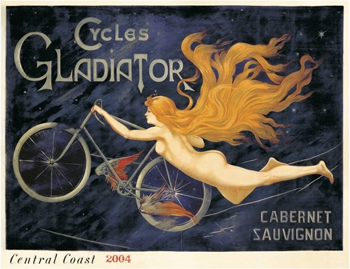
Seems pretty clearly unconstitutional; though commercial advertising (which would include product labels) is less protected by the First Amendment than most other speech, it generally can't be restricted on the grounds that it's offensive. Nor do I see any reason why nudity would be any different. Such depictions of nudity are generally constitutionally protected (see Erznoznik v. City of Jacksonville), and would presumably be no less protected on commercial advertising.
It's possible that some material that is constitutionally protected against obscenity prosecutions might still be so sexually explicit that it can't be displayed where unwilling viewers — and especially children — might see it. But I doubt that the picture above would qualify as "so sexually explicit," especially given Erznoznik's holding that mere nudity can't be restricted on such grounds. And in any case I see no constitutionally sufficient justification for banning such material on offensive grounds on alcohol advertising but not on other forms of advertising.
Thanks to Graham Simms and Dr. Vino for the pointer.
"Congress shall make no law..." specifically refers to the federal legislature.
Welcome to 1868. (Or 1925, anyway.)
Anyway, I guess if it's not on alcohol advertising it's ok, but just in case, don't let them see the Virginia state flag. The Virtue personification isn't being very modest.
Because it increases power -- what dolt could ignore that?
Why should someone interpret "Congress" to mean "Congrees and States and municipalities"? Because they're obviously stuck in the 19th Century. I mean, ratifying and repealing amendments is tiresome, and sometimes they don't even desire to progress (explain that!). It's much more beneficial to simply ignore the subject of a sentence in a fundamental law of the land and pretend it isn't there.
After all, legislation is what courts are designed for.
(d) No advertisement may include any illustration(s) of any person(s) consuming alcoholic beverages or any person(s) posed in an immodest or sensuous manner, nor shall any advertising contain profanity or offensive language.
If Alabama prosecuted the bottler, arrested him, imprisoned him for 14 days, fined him $2000 and assigned him 200 hours of community service, then took his liquor license away (and only returned it 7 years later), would you accept it as a reasonable outcome?
Or do judgements of 'reasonableness' depend upon whether you personally like the defendant?
Sk
1924 just called... It wants its legal theory back :-).
I don't know if that brand of wine is privately owned, but corporations have no inalienable rights, free speech or otherwise. The Constitution addresses human individuals.
That image also doesn't appear to be anatomically correct.
Amendment 21 (I am checking here, yep, that would be later than 1 or 14) seems to bear on this, Sec 2:
"2. The transportation or importation into any State . . . of intoxicating liquors, in violation of the laws thereof, is hereby prohibited."
The much-loved nude dancing cases authorize states to ignore (okay, that is too strong, should I say "dance around") the 1st amendment in barrooms.
I am thinking, just off the top of my head, of California v LaRue, Paps 2AM, and New York State Liquor Authority v ____.
Somebody tell me what I am missing.
Well, the ban applies to advertizing, not lables, and I imagine happens to apply here because labels are advertizing. But you do make an argument that Alabama could ban importing wine with imodest labels, if it chose.
Nor do they have the ability to speak, nor do they care if their punished. The individuals whose interests they represent, however, do.
And corporations consist of what, chopped liver?
If it doesn't alter the EPC, one would think it didn't alter the DPC under which the 1A is made applicable to the States (&their subdivisions).
Same story with Granholm, except with the commerce clause in the background.
Indeed! As luck would have it, I plan on using precisely the same argument when I and my godless atheist majority takes over the Virginia state government, amends our state constitution, and declares Christianity illegal and punishable by death. After all, it's not Congress filling the gas chambers.
Maybe the ones that import pâté.
Won't someone think of the children?
Let's not forget banning guns GMUSOL05! No second amendment for you 14A denialists!
It might, at least, undermine the dormant commerce clause arguments in this case, leaving a pure First Amendment case to be decided instead.
Corporations do not represent anyone's interests in their entirety. They represent people's financial interest. If you told a shareholder to pick a label for a bottle of wine and everyone would know who it was that picked the label, would they pick a label with a naked lady knowing that their friends, family, and peers would know they picked the naked lady? Possibly not. The corporation provides a bit of cover. The shareholder is not making that specific decision.
Even the people in the corporation who chose the label have a bit of cover. "I'm just doing my job. Looking out for the interests of the company. If it was my bottle of wine, I wouldn't necessarily put a naked lady on it."
Corporations provide a lot of cover for behavior that avoids personal responsibility. Actions of corporations are not subject to the same level of personal responsibility that actions of human beings are. Corporations have no inalienable rights.
Well, it's not as though children are allowed to drink the stuff in the first place. And obscure wines like this aren't exactly the drink of choice for 99.99% of underage imbibers anyway. So if the intent of the law is to prohibit sensuous advertising of alcohol to minors, enforcing it in this case is just plain silly.
You should be able to do that, according to the US Constitution. It has the advantage of sequestering your insanity to Virginia. You have announced your plan. If the people of Virginia know your intentions, and know that no help will be forthcoming from the Federal Government, they might get a little nervous, and get it into their heads that it is up to them and them only to determine if they are really going to sit back and let you do that, or perhaps possibly not vote for you.
Having the Federal Government be the rights police sets up a bit of moral hazard. Especially since the Federal Government cannot possibly protect everyone's rights to their satisfaction. It is an empty promise.
The artwork is from 1895 by Parisian artist G. Massias. This painting is far from the most risque example of portrayal of the female figure at the time, in that art movement. For a hundred years, we've accepted this as legitimate art. Now it's obscenity?
Thanks, Alabama.
Of course he is -- he determines both the structure and specifics of the governance of the corporation.
Despite your childish assertions, corporations do, in fact, have inalienable rights that derive from the simple fact that they are (like Soylent Green) made of people.
That has nothing to do with whether or not the folks involved are affiliated with a corporation. Two people colluding in picking a label, where one person says, you find a label that will sell wine, and I'll pay you, that's an expressive act whether or not the individuals are affilitated with a corporation. And if you fine a corporation for speech it engages in, you are punishing individuals for the speech of them or their affiliates.
Corporations don't have rights, but the people behind them do.
What, the court can do no wrong because it would be "moot" to question a badly flawed interpretation?
http://www.lewrockwell.com/blog/lewrw/archives/027108.html
Fortunately, the ensuing media storm embarrassed them into backing off. Hopefully, that'll happen in this case as well.
LKB
Sorry, I'm not a lawyer. It takes effort to maliciously lie about a plain sentence for most people. I'll try harder next time. Do I still get a ritualistic paddling?
Your venom is disgusting, which is why the republic of Virginia, which is the only form it's obliged by the Constitution to take, wouldn't go for it. Do you have anything but hate and power in mind? I guess not; you entertain using the Constitution to do the opposite of what it says.
My internal image of where the the meaning of "land of laws" was destroyed has already been pushed to before that date, but thanks for trying.
That is the truth as far as what the meaning behind the words mean but not the whole story. The 1A exists to prove the federal govt has no power over speech or the press and not a declaration of some principal.
Sickening.
I dunno. I see no reason the individual might be dissuaded from choosing such a label. Maybe I live in a different part of the country though.
Because it's an unnatural part of a lifestyle. If nudity wasn't harmful to children, God would have had children born nude.
Mix that complicated legal context with 'bama-backwater prudism and you might get a time-machine trip directly back to the 1930s.
At the practical level, Alabama embarrasses the nation, and the person who complained about that label embarrasses Alabama.
Reminds me of how folks were saying that viewing bare breasts was harmful to children back during the Janet Jackson thing. We wouldn't have gotten too far as a species if that were true.
It really has to be spelled out for you doesn't it. I usually don't take it upon myself to purely inform, but I did get kind of snarky, so maybe I owe it.
Amendment 14:
"No State shall make or enforce any law which shall abridge the privileges or immunities of citizens of the United States; nor shall any State deprive any person of life, liberty, or property, without due process of law"
Now maybe you honestly think that neither the "privileges and immunities" or "due process" clauses prohibit state governments from imposing any restrictions at all on speech. Maybe you even believe that such a reading is so unreasonable that it would be a "malicious lie about a plain sentence," but you didn't even make that argument, you just stated that "congress" in 1A means the federal legislature, ergo there are no (US) constitutional issues regarding state laws that restrict free speech.
You don't have to be a lawyer, but we do ask that you read the whole Constitution. That also includes Art III sec 2: "The judicial power [of the US Supreme Court] shall extend to all cases... arising under this Constitution." If only the founders had the foresight to name you the ultimate arbiter of disputed consititional language, but alas.
On a more serious note (I assume for the purposes of sanity that /:'s suggestion wasn't serious or wasn't, how shall I say, witting), it isn't just 'Bama that embarasses its denizens. (Please note the correct non-use of an apostrophe) Has anyone else noticed that the Mount Shasta Brewery has recently been engaged in a flap with the ABC officials of the State Formerly Known As Golden. Wanted to put the word "Weed" on their bottle caps. Weed, California is a tiny city named for Abner Weed, and is where the microbrewery is located.
I think you omitted something important like the power is limited to "Controversies between two or more States; between a State and Citizens of another State; between Citizens of different States; between Citizens of the same State claiming Lands under Grants of different States, and between a State, or the Citizens thereof, and foreign States, Citizens or Subjects."
The woman in that photo is clearly not nude--she is wearing a flesh-colored dress; look at the folds of fabric around her legs.
? I don't see any folds of fabric. Are you sure you're not looking at her right leg?
Sunburn
Wrong. Corporations operate within markets, so if anything, their actions are far more scrutinized than any individual. Why would someone say they wouldn't put a naked lady on their wine bottle? I presume it's because whatever social circles he belongs to in would object to that. Such stigmatization applies to corporations to a greater degree, as the "social circles" they operate in are generally more widespread. If a naked woman on a label has large mental negative externalities, then corporations will be punished accordingly in the market. Individuals are far more insulated as they tend to only care about the opinions of those nearest to them.
Yes, that's exactly what I meant when I said that the first amendment refers specifically to the federal legislative body, necessarily excluding States'.
Good God, man, don't do that. It's the judicial power of the United States. The whole next paragraph talks about the jurisdiction of the supreme court.
Sometimes an error the lives long enough becomes part of the truth, at least in the sense that we are much more likely to keep the doctrine of incorporation until the dissolution of the Union than to repeal it.
Is it okay to think it flawed because it's policy that rewrites the Constitution without editing the document, which sets a precedent for the same, given that precedent is given weighty consideration when convenient, because high courts prefer the comfort and legitimacy of precedent to reasoning from principles?
Yes, or at least we did. The great thing about living in a state that enforces arcane or silly laws is being a part of a movement to change them. "Free the Hops" was a grass roots movement to get the limited alcohol content law changed. It gave rise to fantastic little festivals to "FREE THE HOPS." Anyway, it is the kind of cause that brings together pretty normal folks who just want to have a good time. It succeeded. The hops was freed. I am currently sipping on a Duvel that is well past the old alcohol limit. Very tasty and more rewarding because of the history.
This new "controversy" has great possibilities for fun. Now, where is that old email list. It is time to get started.
Now I know you're a troll.
I did not capitalize the 'r', so whatever paranoid fantasies you have about beating down rebels will have to stay in your diary. Currently, a State in the Union is required to be a republic by law; referring to a real or hypothetical State government as "the republic of" is common (and sometimes official). GMUSOL05's hypothetical mentioned "[taking] over the Virginia state government", in response to which I emphasized the republican form of government to counter the tyrrany he ejaculated.
I hope you appreciated this response, but I know it wasn't everything you hoped because I didn't respond to your malicious edit of my comment with some emotional rise. If it's any consolation, I appreciate the quality of your spelling.
http://online.wsj.com/article/SB124779531662955515.html
The Fourteenth Amendment states: "No State shall make or enforce any law which shall abridge the privileges or immunities of citizens of the United States; nor shall any State deprive any person of life, liberty, or property, without due process of law; nor deny to any person within its jurisdiction the equal protection of the laws."
This amendment was clearly not intended to specify that each state must guarantee certain rights to its citizens; rather, it was intended to ensure that each state granted its (newly emancipated) former slaves all of the rights it granted its white citizens.
In other words, the Fourteenth Amendment specifies that each state must treat all citizens equally. It contains nothing more, and nothing less. Any other notion is mere hogwash.
The company is unlikely to sue. But it seems to me any alabama consumer (21+) would have standing. Anybody here licensed in Alabama?
SECTION 4
Freedom of speech and press.
That no law shall ever be passed to curtail or restrain the liberty of speech or of the press; and any person may speak, write, and publish his sentiments on all subjects, being responsible for the abuse of that liberty.
I think JK asked that you read the *whole* Constitution. The enumeration of types of controversies are not limits on the power to hear cases arising under the Constitution and federal law. Here's a tip: go look up "Federal Question Jurisdiction."
Section 2. The judicial Power shall extend to all Cases, in Law and Equity, arising under this Constitution, the Laws of the United States, and Treaties made, or which shall be made, under their Authority; to all Cases affecting Ambassadors, other public Ministers and Consuls; to all Cases of admiralty and maritime Jurisdiction; to Controversies to which the United States shall be a Party; to Controversies between two or more States; between a State and Citizens of another State; between Citizens of different States; between Citizens of the same State claiming Lands under Grants of different States, and between a State, or the Citizens thereof, and foreign States, Citizens or Subjects.
You were the one that applied that label, in your 7.31.2009 5:05pm post.
So, aside from attacking me for using a term quoted directly from your own post, you fail to respond to my assertion that incorporation has a much better chance of surviving till the end of the Republic than getting repeal.
I don't know about wine, but surely it includes the right to well-creased trousers!
Even if the State doesn't respect that, I think we can find a right to look snappy in the liberty protected by the 14A. Maybe it's a privilege and immunity (from poor taste?)
hahahaha since the court says EVERYONE has Fourteenth Amendment rights, jurisdiction questions is extended to just about any controversy (sky is the limit).
Oren says: "So, aside from attacking me for using a term quoted directly from your own post, you fail to respond to my assertion that incorporation has a much better chance of surviving till the end of the Republic than getting repeal."
Incorporation will die before the Republic does because there is no non-fictional foundation to support it. Most scholars I think are against incorporating through "due process," which began with a very bad assumption. Incorporating through the P&I's is even more awkward because of the clear distinction between citizens of a state and of the united states.
Really? Are you not familiar with John Bingham, primary author of the 14th Amendment, who specifically stated that the amendment was intended to incorporate the first 8 Amendments against the states? Hugo Black gives a detailed account of Bingham's views in his dissent in Adamson v. California.
I'm familiar with Bingham's speeches. You are drawing on words by Bingham that came five years after the debates. You also ignore that he was talking about United States citizens as distingushed from resident state citizens.
Yeah, Black cleverly talked about Bingham, but omitted his most important declarations. Black also ignores the fact Congress did vote to define ALL of the P&I's of United States citizens and codified it. Nothing having to do with any of the first 8 amendments.
Unfortunately, it seems that that's kinda true, given current incorporation doctrine (i.e.) "due process" incorporation. For example, I've never understood how state endorsement of religion deprives anyone of "life, liberty, or property"
Unlike Alabama, the BATF initially approved the Balthus label, though Mouton later requested that the approval be rescinded after allegations were made that the label constituted child pornography. Mouton then registered a label with a blank space in place of the Balthus sketch. Given the relative mediocrity of the 1993 Bordeaux vintage, the controversy and the label switch turned into a marketing bonanza for Mouton, as bottles with the Balthus label commanded a premium at U.S. auctions for at least several years after the vintage was released, though I haven't checked recent auction prices to confirm whether the Balthus label still trades at a premium.
If you have a comment about spelling, typos, or format errors, please e-mail the poster directly rather than posting a comment.
Comment Policy: We reserve the right to edit or delete comments, and in extreme cases to ban commenters, at our discretion. Comments must be relevant and civil (and, especially, free of name-calling). We think of comment threads like dinner parties at our homes. If you make the party unpleasant for us or for others, we'd rather you went elsewhere. We're happy to see a wide range of viewpoints, but we want all of them to be expressed as politely as possible.
We realize that such a comment policy can never be evenly enforced, because we can't possibly monitor every comment equally well. Hundreds of comments are posted every day here, and we don't read them all. Those we read, we read with different degrees of attention, and in different moods. We try to be fair, but we make no promises.
And remember, it's a big Internet. If you think we were mistaken in removing your post (or, in extreme cases, in removing you) -- or if you prefer a more free-for-all approach -- there are surely plenty of ways you can still get your views out.