I read with some amusement the struggles that some non-lawyers [and some lawyers as well] have been having understanding the language of Art II, Sec. 1 of the U.S. Constitution: "No Person except a natural born Citizen, or a Citizen of the United States, at the time of the Adoption of this Constitution, shall be eligible to the Office of President . . . ." If the drafters of the Constitution had wanted to require that presidents be born in the United States, they could have done so. Instead, they invoked the then-standard idea of natural citizenship as reflecting natural allegiance to the king or the state.
Standard 18th century dictionaries and commentaries couldn’t have been clearer on this point. For example, Giles Jacob in The New Law-Dictionary (1743) and The Common Law Common-plac’d (1733) made clear who was an alien and who was a "natural born subject”:
The Children of Ambassadors in a foreign Country, are natural born Subjects, and not Aliens. Id. at 22 (Eighteenth Century Collections Online)
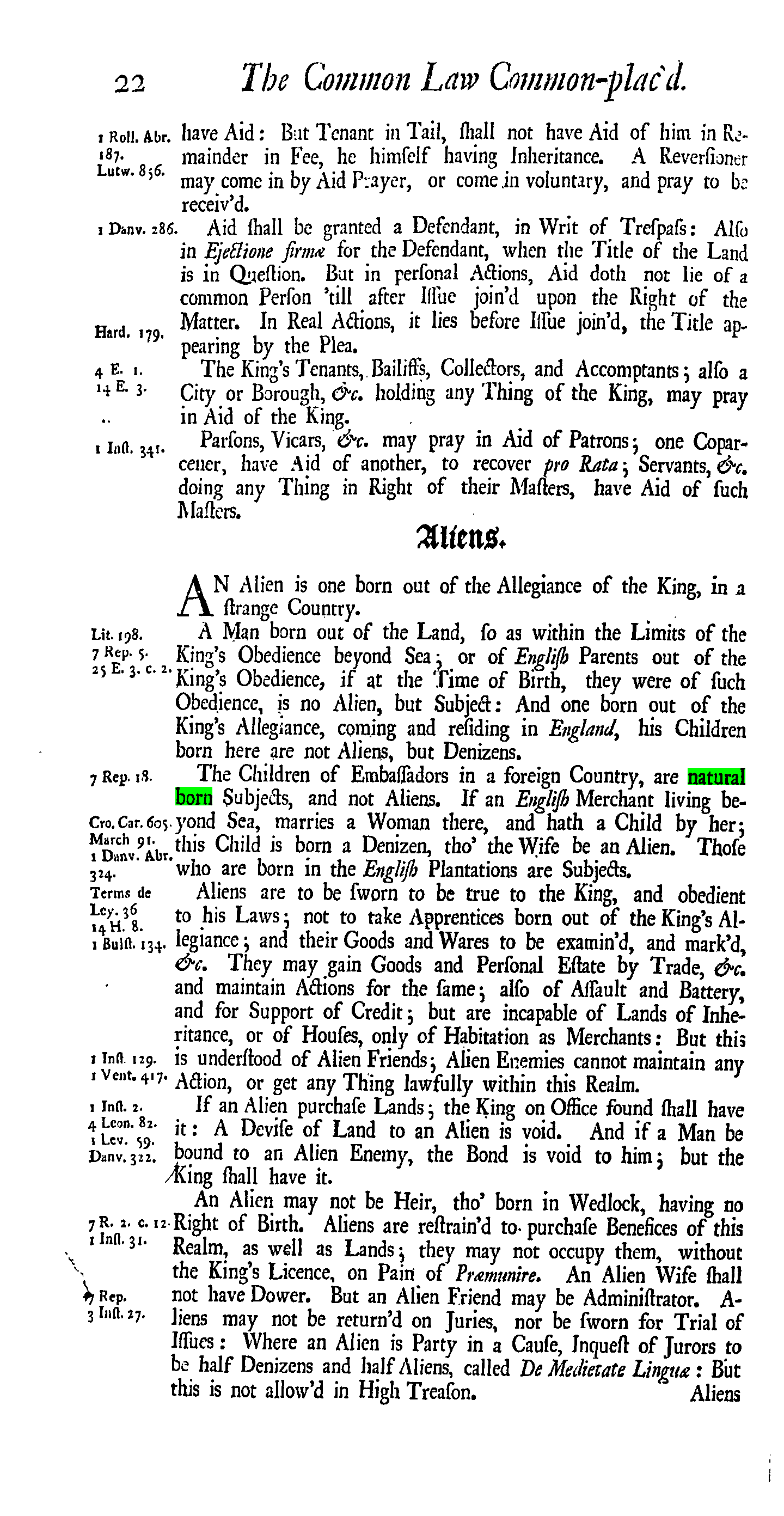
(click to enlarge)
Blackstone has a lengthy treatment:
William Blackstone, Commentaries 1:354, 357--58, 361--62 (1765)
The first and most obvious division of the people is into aliens and natural-born subjects. Natural-born subjects are such as are born within the dominions of the crown of England, that is, within the ligeance, or as it is generally called, the allegiance of the king; and aliens, such as are born out of it. Allegiance is the tie, or ligamen, which binds the subject to the king, in return for that protection which the king affords the subject. The thing itself, or substantial part of it, is founded in reason and the nature of government; the name and the form are derived to us from our Gothic ancestors.
. . . . .
Allegiance, both express and implied, is however distinguished by the law into two sorts or species, the one natural, the other local; the former being also perpetual, the latter temporary. Natural allegiance is such as is due from all men born within the king's dominions immediately upon their birth. For, immediately upon their birth, they are under the king's protection; at a time too, when (during their infancy) they are incapable of protecting themselves.
Natural allegiance is therefore a debt of gratitude; which cannot be forfeited, cancelled, or altered, by any change of time, place, or circumstance, nor by any thing but the united concurrence of the legislature. An Englishman who removes to France, or to China, owes the same allegiance to the king of England there as at home, and twenty years hence as well as now. For it is a principle of universal law, that the natural-born subject of one prince cannot by any act of his own, no, not by swearing allegiance to another, put off or discharge his natural allegiance to the former: for this natural allegiance was intrinsic, and primitive, and antecedent to the other; and cannot be devested without the concurrent act of that prince to whom it was first due. Indeed the natural-born subject of one prince, to whom he owes allegiance, may be entangled by subjecting himself absolutely to another; but it is his own act that brings him into these straits and difficulties, of owing service to two masters; and it is unreasonable that, by such voluntary act of his own, he should be able at pleasure to unloose those bands, by which he is connected to his natural prince.
Local allegiance is such as is due from an alien, or stranger born, for so long time as he continues within the king's dominion and protection: and it ceases, the instant such stranger transfers himself from this kingdom to another. Natural allegiance is therefore perpetual, and local temporary only: and that for this reason, evidently founded upon the nature of government; that allegiance is a debt due from the subject, upon an implied contract with the prince, that so long as the one affords protection, so long the other will demean himself faithfully. As therefore the prince is always under a constant tie to protect his natural-born subjects, at all times and in all countries, for this reason their allegiance due to him is equally universal and permanent. But, on the other hand, as the prince affords his protection to an alien, only during his residence in this realm, the allegiance of an alien is confined (in point of time) to the duration of such his residence, and (in point of locality) to the dominions of the British empire.
. . . . .
When I say, that an alien is one who is born out of the king's dominions, or allegiance, this also must be understood with some restrictions. The common law indeed stood absolutely so; with only a very few exceptions: so that a particular act of parliament became necessary after the restoration, for the naturalization of children of his majesty's English subjects, born in foreign countries during the late troubles. And this maxim of the law proceeded upon a general principle, that every man owes natural allegiance where he is born, and cannot owe two such allegiances, or serve two masters, at once. Yet the children of the king's embassadors born abroad were always held to be natural subjects: for as the father, though in a foreign country, owes not even a local allegiance to the prince to whom he is sent; so, with regard to the son also, he was held (by a kind of postliminium) to be born under the king of England's allegiance, represented by his father, the embassador.
To encourage also foreign commerce, it was enacted by statute 25 Edw. III. st. 2. that all children born abroad, provided both their parents were at the time of the birth in allegiance to the king, and the mother had passed the seas by her husband's consent, might inherit as if born in England: and accordingly it hath been so adjudged in behalf of merchants. But by several more modern statutes these restrictions are still farther taken off: so that all children, born out of the king's ligeance, whose fathers were natural-born subjects, are now natural-born subjects themselves, to all intents and purposes, without any exception; unless their said fathers were attainted, or banished beyond sea, for high treason; or were then in the service of a prince at enmity with Great Britain.
According to even the most technical meaning of "natural born" citizen in the 1780s, John McCain is a natural born citizen of the United States, but George Washington and Thomas Jefferson may not have been (since they were born before 1776), though they would have been generally treated as such at the time.
Related Posts (on one page):
I guess that's a real rib-tickler to the humor-challenged, but I also imagine some readers view with some amusement the struggles that some lawyers have been having understanding the language of the U.S. Constitution. In fact I don't see what being a lawyer or a nonlawyer has to do with it.
The reason I quoted such a long passage is so that one could see the LOGIC of the argument. A soldier is not like a merchant, doing his own business abroad; a soldier is like an ambassador, for as Blackstone notes:
A soldier in service to his government obviously owes his allegiance to his own government. And being on a military base, he owes his protection to his government, which again invokes his allegiance.
Speaking as a member of the Bar, it's all about the fact that lawyers are just better than the rabble. After all, that's why the robed masters get to find all sorts of things in the Constitution that the Framers seem to have plain forgotten to say.
The meaning of alien or foreigner v. natural born subject was black-letter law in the 18th century. (There is some grey area for "denizens" and for those born of foreign parents or of two different nationalities.)
You can find dozens of references using an advanced search for "natural born subject" and "natural born subjects" in the ECCC (Eighteenth Century Collections Online) through your library.
I have even heard of an early US case wherein it is stated that people born before 1776 are not strictly natural born citizens of the US, though they shall be deemed as such.
Jim Lindgren
I am suddenly reminded of my Hispanic friend whose ancestors became American by annexation, never having lived south of Nogales.
*How can you be a person if you're not American?**
**At least in spirit
Is a person born in a territory (to parents who are citizens of that territory) that only later becomes part of the US a "native born" citizen?
A concrete example would be if Scotland became independent of the UK (which is presently an issue) and, rather than joining the EU, instead joined the US as a state. Would Sean Connery, born to Scots parents in Scotland, thereby become a "native born" citizen of the US and eligible to run for US President?
There are two Constitutional ideas at conflict here. One is that states are admitted to the union on the basis of equality with the previously-admitted states.
This seems like a very bad idea to me: such legislation is (a) unnecessary, as the definition is already quite clear as shown by Jim and others, and (b) would suddenly throw into question those whose natural-born citizenship comes through other means, such as those born to American parents overseas who are *not* members of the military.
This was challenged under equal protection grounds once, actually... I forget the case.
Pick issues that barely sound bad for the enemy and really are nothing, and keep hammering them one at a time ('drip drip') so that people get an overall impression that some person or ideal is bad without good reason.
So Sen. MCain is eligible under either of the conditions in the Constitution?
Regardless of the situation in whatever part of Panama McCain was born in, he's natural-born by blood.
Good question for people who were natural-born citizens of places which, after their birth and after 1789, became part of the US such that those born there after the annexation are natural-born citizens. But that's not the situation here.
Happyshooter, this story has been circulating on Ron Paul websites for quite some time. I don't think Paul himself has ever said anything about this. But at least get your facts straight before you blame "the left."
One could argue that "natural born citizen" after the 14th Amendment means citizens "born . . . in the United States." Note that the section specifically makes children of Ambassadors of other countries citizens of the United States, regardless of any "kind of postliminium" Blackstone describes. (I am assuming for now that children of Ambassadors are subject to the jurisdiction of the United States, though I do not know that to be true). The Fourteenth Amendment makes children of illegal aliens citizens, along with children of foreign invaders and anyone else born here.
To the extent that "natural born citizen" in Article II encompassed Blackstone's ideas, the 14th Amendment clearly expanded the definition to include anyone born "in the United States." But it did not limit the definition to only those born in the United States. So the argument that natural born means born in the U.S. is incorrect, assuming that the meaning of "natural born" encompassed in Blackstone applies to the Constitution.
I suspect that people vaguely remember that "born in the United States" is in the Constitution and confuse that with the "natural born citizen" requirement.
(As you can tell, I'm a non-lawyer.)
If a challenge were to be made on the constitutional grounds of ineligibility, who would have standing? Mike Huckabee? Mitt Romney (whose father was born in Mexico to a polygamous family and ran for president)? The DNC? The RNC? Anybody?
To go further, what if it were just in-vitro fertilization, and the sperm and egg donors were not citizens, but the surrogate mother was?
Start making preparations for case-law now! Cloned and test-tube people should be able to run for President in 30 odd years or so.
This should at least be the prospect for a Sci-Fi novella, or an hour and a half on the Sci-Fi channel.
Your post is helpful; however, I think your analysis is incomplete without defining what the term "dominion" meant in the 18th century. This word had a very specific meaning as well, one that is coming up in habeas issues quite often now. According to your passages, whether or not you were born in the king's dominion was crucial. It is not clear to me that the US exercised sufficient control over the Canal Zone to bring it under the dominion of the US. The exception for ambassadors would not include McCain and if that was the exception that proved the rule then just being born to military parents would not prove your point.
All that said, I think the debate surrounding this is academically interesting but very likely irrelevant considering a court would never reach the merits if a suit was brought. Regardless, your post is useful in moving the debate forward.
http://www.herald-dispatch.com/homepage/x1657942987
find a skin tag, clone George, profit.
2. Blackstone prob. references ambassadors, because in the 18th century they would be the subjects most likely to go abroad and take their families with them. Soldiers had no funds to take wives with them (one Revolutionary British commander was worshipped by his men because he actually paid to have their wives brought to America with them, which was unheard of), merchants would rarely put their families to the trouble of travel. An ambassador probably had money and knew he would be out of country for an extended period.
Ambassadors were not an exception. As Blackstone stated:
It would be nonsense to suggest--which BTW you don't suggest--that the natural allegiance of a US military family stationed abroad would be to the country of birth rather than to the US.
The crux of the cited material above is this (my emphasis):
British statutes are foreign law, not common law.
So... as long as McCain was born after 1776, he's ok.
Hoosier, "illegitimate issue of a Trojan" just sounds bad.
The constitution simply states "natural born citizen" with no definition. The Congress has defined that in 8USC1401.
8USC Sec. 1401 (c)
. Nationals and citizens of United States at birth
Sec. 1401. Nationals and citizens of United States at birth
The following shall be nationals and citizens of the United States at birth:
Applicable sec:
(c) a person born outside of the United States and its outlying possessions of parents both of whom are citizens of the United States and one of whom has had a residence in the United States or one of its outlying possessions, prior to the birth of such person;
Also note that the above states persons born “outside of the United States and its outlying possessions”
The Canal Zone was a US possession when McCain was born.
All the above applies to McCain. Sec 1401 also contains numerous other ways a person can be natural born.
The above took me about 10 minutes to find by searching the US Code. How can any lawyer comment on this and go looking for all sorts of rediculous ancient references when the LAW is right there in front of one's face?
"...[A]ll children, born out of the king's ligeance, whose fathers were natural-born subjects, are now natural-born subjects themselves, to all intents and purposes, without any exception..."
Seems like being born in the king's "dominions" was not even necessarily a requirement.
Common Sense: Congress cannot define or amend the Constitution unilaterally. So, while McCain is certainly a natural citizen for statutory purposes, that is not necessarily the same thing as being a "natural born citizen" for Constitutional purposes-- although the former issue may shed some light on the latter. In any event, I think that this thread and the previous one have made pretty clear that this is not an especially close question and that the odds of any court anywhere declaring McCain constitutionally ineligible to serve as POTUS are close to nil.
In any event, that just last week I perceived a penumbra that had obviously emanated from ART III, Sec 1. It was having a latte at Starbucks (I can't afford their coffee, and was just there to use the john). Anyhoo--It covered McCain's butt on this one.
Your high school civics class oversimplified the issue. It is not true that children born outside the US of American parents are always US citizens themselves. Someone even quoted in the earlier thread the statute that indicates this.
See 14th Amendment - being born here is all you need.
Originalists and strict constructionists in particular, feel free to explain which is your view and why.
Was George a "natural born citizen?" You tell me. But I can assure you that there's nothing "easy" or "self-evident" or even evident upon "reading Blackstone's lenghty treatment" of the subject.
See 14th Amendment - being born here is all you need.
I tend to agree. However, there's some scholarship that takes issue with this point, mainly focusing on the "subject to the jurisdiction thereof" clause of the 14th Amendment. See here, e.g.
I was trying to think of ways this might make it to Court and the Court not automatically dismissing it.
The most likely way I could come up with is, some Sec. of State gets wind of this controversy, decides that for the purposes of their State that John McCain is not eligible to run for President because he isn't a Natural-born Citizen and refuses to list him on the Ballot.
The RNC and John McCain would be forced to sue.
This is the only, of many highly unlikely scenarios, way I can think of that might have a chance of getting a hearing.
I can't think of a State that would be willing to put themselves out like this, so I consider it a less than 0.005% chance of happening
The constitution did not define natural born citizen. It was left up to the legislature to define it, just as many things were left to the legislature.
For a while there was a movement among Philipinos born while it was a US possession (from 1898 to PI Independence in 1945, IIRC) to seek US citizenship on the idea that they were born in a US territory.
Don't know if a court ever ruled on this, my guess is probably one did and the claims died there. However there was a fairly strident USENET/BB presence in the 80's on this issue.
This seems to be a related to and contrary to the claim that McCain is natural born. Millions still alive were born in a US territory but don't get US citizenship. I guess the special cases are always there. (I'd also assume some Cubans still alive have such a claim).
But seems to me the question no one wants to ask is:
Is John McCain a US citizen? If so, did he have to apply for that citizenship? If he didn't have to apply for it, and has been treated as a US citizen since birth (presumably with birth certificate, passport, driver's license, etc.) it would seem rather unfair to suddenly rule him a non-citizen.
But, say, if that were to happen, and therefore prevent his becoming president, does this mean he then has to apply for citizenship? Does this make him an illegal resident alien? At age 71, would he have to "go to the back of the line" and wait his turn?
Do you get my drift here? If someone is not a "natural born" citizen of the US, don't they have to acquire their citizenship through a formal process?
Just asking.
Needless to say, this was an extreme minority position ...
At any rate, it is a fine piece of scholarship.
To all those who argue that the Congressional definition should control: why should it?
Art I, sec. 8 gives Congress the power to enact a uniform rule for "naturalization." Presumably, those who were not "natural born citizens" needed to "naturalize." But sec. 8 does not give Congress the authority to define the term, "natural born." So we're left with some form of interpretation, be it original intent, original meaning, or some kind of modern contextualism. Blackstone said that kids of ambassadors owe allegiance to the king; hence, they are citizens, presumably of the "natural born" variety. But take the part of Blackstone boldfaced by Lindgren (apparently as "dispositive" of the issue):
That is not the definition Congress used. In fact, a whole lot of people whose fathers were born in the USA ("natural born subjects" according to Lindgren) are not U.S. citizens because those fathers (and mothers) had not lived in the United States (or otherwise under US jurisdiction) for 10 years prior to their birth, 5 of which were after the parent turned 14.
I would have to say that the Congressional definition of citizenship "by acquisition at birth" is completely irrelevant to the discussion of the meaning of "natural born citizen" in Article II. Blackstone's commentaries (drawing in large part on English statute, not English common law, as noted by other commenters) are relevant, but hardly dispositive.
Which leaves me with something I know the "other" (Randall) Kennedy did say. He was a contributor to a 1995 project in which leading law profs were asked, "what do you believe is the stupidest part of the Constitution?" He pointed to the "natural born citizen" clause. I tend to agree, since almost 219 years later we are still having sensible (I disagree with Lindgren here) debates about it.
I assume that in spite of the second comma, "at the time of the Adoption of this Constitution" applies only to "a Citizen of the United States," not to "a natural born Citizen."
My libertarian dream: some day, a presidential candidate will run on a platform of actually repealing 20% of the laws (or more) from the books, and a constitutional reform commission to propose the repeal or reworking (by amendment) of provisions of the constitution that no longer serve any purpose.
I favor the secularist interpretation: the founders intended to make ineligible for the presidency anyone born to a virgin.
There are several issues here:
First, while Clark was physically an infant when the Kents found him, his spaceship had been traveling at or near the speed of light, resulting in severe time dilation on the journey. If Krypton is more than 5 lightyears away, than from our reference frame Clark would be more than 5 at the time he was found, but from his internal frame, the journey would've been quite short. So which one is accurate?
Secondly, while Clark's parentage was unknown when he was discovered, the spaceship is pretty good evidence he's Not From Around Here. However, the Kents covered this information up, which raises the question of who exactly has to be shown.
And finally, in some versions of Superman's origin, the spaceship is an artificial womb, so was he technically born in the US?
"When I say, that an alien is one who is born out of the king's dominions, or allegiance, this also must be understood with some restrictions. The common law indeed stood absolutely so; with only a very few exceptions [. . .] And this maxim of the law proceeded upon a general principle, that every man owes natural allegiance where he is born, and cannot owe two such allegiances, or serve two masters, at once."
This pretty clearly indicates that being born outside England left one in the status of alien, not natural-born, as the English common law understood things. I recall reading that many English mothers when expecting a baby would travel back to England to give birth, which reinforces this point.
I don't know, for purposes of interpreting the US Constitution, what the effect is of the English statutes changing the common law. I could see an argument that they should be considered, because the statutes merely amend the common law and the amended common law is what the Founders thought about when using the phrase. I could also see an argument that the phrase was intended in its pure sense, without requiring analysis into precisely which statutes were in force in 1789 (non-English father, but English mother abroad?), so that the matter of US Constitutional meaning would not depend on determining precisely who met the requirements of those statutes. In either event, it is not quite as clear to me that this issue is well settled.
I don't see that the common law exception for Ambassadors gets one very far, because of the unique status of an Ambassador as essentially standing in for the King himself. Nothing has suggested that English common law considered the baby child of a soldier stationed abroad to be equivalent to the baby child of an Ambassador. Nor, today, would we necessarily conclude that the baby child of a US soldier would be in the same situation as the child of an Ambassador, given that the soldier need not be a US citizen himself (it's an honorable path to citizenship), and his wife need have no allegience to the United States whatsoever.
I think that James Lindgren's post at 10:08 suggesting that Ambassadors were not an "exception" is quite incorrect. Blackstone clearly states that they were an exception. And the section quoted refers to the loyalty of the father, who having been born on English soil cannot void the contract with the King at birth by traveling abroad. But the father's son, upon birth abroad, and thereby coming under the protection of the foreign king and that contract, owes his [the son's] loyalty to the foreign king. A non-ambassador father does owe a "local allegience" to the foreign king while on foreign soil, which distinguished his situation from an Ambassador.
More generally, I am not sure I would like the US Constitution to be interpreted by considering what a baby child's parents were doing at the time of birth - Ambassador, military, commerce, vacationing, emergency, etc. To give an example of the possible permutations FWIW, I was born in Aruba (at the time a Dutch colony), both parents US citizens born in the USA, but my understanding is that I could not ever have been a citizen of the Netherlands because neither parent was. If the test of "natural-born citizen" depends on "loyalty," where would that leave me?!
Eric Stahlfeld
I tend to agree. However, there's some scholarship that takes issue with this point, mainly focusing on the "subject to the jurisdiction thereof" clause of the 14th Amendment.
I've never really looked at that point, but I've always understood that clause to mean that children born to foreign ambassadors in the U.S. with diplomatic immunity wouldn't automatically be citizens under the 14th Amendment, though Congress could grant them citizenship by statute. It's hard to imagine anyone else who could fall outside the clause.
I made a similar point some time ago regarding the increasingly popular "Cthulhu 2008" campaign (slogan: "Why Settle For The Lesser Evil?"). Could Cthulhu run for President in 2008 despite not having been born in the U.S. (since he presumably has never been born at all, having always existed) and despite not having American parents (since he has no parents)? My theory is that he can run, under the "grandfather" clause that sweeps in those who were living in the United States at the time the Constitution was adopted.
Why would that matter on the issue of whether he's a "natural born citizen" for purposes of Article II?
Reminds me that none other than Farrakhan tried to make an issue of Lieberman's eligibility to be a dual US/Israeli citizen.
I'd go for that, as long as it's done randomly.
Thanks for the reply. I think we read that section the same way ("An Englishman who removes to France, or to China, owes the same allegiance to the king of England there as at home..."). He owes that allegiance because once born in England he can not part with his allegiance. It is natural to his person, so to speak. But that is not to say that the child of an "Englishman who removes to France" is a natural born citizen of England. Under a medieval understanding, the child would be a natural born citizen of where ever his parents had removed to. The exception to this rule was made for Ambassadors' children. And originally for them only (according to Blackstone).
Now, here is where we may differ (and to be clear I'm not expressly advocating this point because I just don't know without more research). You are right to say that "It would be nonsense to suggest--which BTW you don't suggest--that the natural allegiance of a US military family stationed abroad would be to the country of birth rather than to the US." Correct, McCain's parents would not owe a natural allegiance to anyone but the US. But, at least as far as the medieval understanding went, I do not think that this means that McCain is a "naturally born" US citizen if Panama was not under the United States' dominion (which was the point of my original post--that the definition of dominion has to be fleshed out before your analysis is complete). Acts of Congress can make him a "naturalized citizen" but that does not mean he is "naturally born" if my interpretation is correct that it depends on what is meant by a country's dominion.
Blackstone might agree: "But by several more modern statutes these restrictions are still farther taken off: so that all children, born out of the king's ligeance, whose fathers were natural-born subjects, are now natural-born subjects themselves, to all intents and purposes, without any exception."
Now, I'll agree this passage favors your interpretation more so than mine. But Blackstone says the children are "natural-born subjects themselves, to all intents and purposes." The fact that a statute had to make them citizens (since under the pure understanding of "natural born" they were not because they were born outside the king's dominion) and that he qualified "natural-born" with "to all intents and purposes," suggests that these individuals are "naturalized citizens" not "natural born citizens."
Your mistake is in assuming that there's an unchanging "pure understanding" of a common law term of art like NBC. Blackstone was writing, in 1765, about developments that took place before the adoption of the phrase in the US Constitution. Like other common law phrases, the meaning of NBC may well have evolved over time; because the changes were by Parliamentary act rather than judges doesn't make them less legitimate. Blackstone's history thus supports the view that McCain would have been included by the US Constitution's use of the language, since that usage came after the meaning of the phrase was broadened. Also, I think you may be reading "too all intents and purposes" in its modern sense, to mean "sort of" or "more or less" instead of just taking it literally--to ALL intents and purposes.
The relevance of Blackstone is what was considered "natural born" AT THE TIME OF THE ADOPTION OF THE CONSTITUTION. What was more ancient is irrelevant. The question is what the framers meant by the use of that phrase, and it's clear that at the time, "natural born" citizens included all those mentioned by Blackstone.
They came to this country and they forswore their allegiance to their home country and swore allegiance to the United States instead.
The citizenships were separate. States could have citizens who were not US citizens. Maybe that is still possible.
A vital question was whether the Dred Scott decision could be extended so that no state could prohibit slavery. It certainly looked like a possibility then.
...So does that make the laws he signed as President null and void ?
Having heard the arguments of the parties, the Court holds that a natural born citizen of the United States is any person who, at the time of his or her birth, is a citizen under the Constitution and Laws of the United States.
The Court further holds that anyone who thinks that this or any Court would rule otherwise is a damn fool.
That is not dead which can eternal lie.
And with strange æons even death may die.